

Vedic Culture and the Foundations of the Spiritual Path
We are here because we want to follow the path of the Divine, because we have chosen Sanatana Dharma as our Path. And to follow the path of Sanatana Dharma means to go from the human state to the divine. Sanatana Dharma does not say that the human state is a state in which we must remain forever. Nor does it say that this is the highest and greatest state. Not at all. On the contrary, Sanatana Dharma says that the human state is a very limited state and that one should not cling to it, that the human being is by no means the crown of evolution. And it says that one must get out of the human state and move toward a higher one as quickly as possible.
Sanatana Dharma says that our destiny is different, and that our destiny is to go from human being to god-man, and from god-man to deity. If we cling to and hold on to the human state, to the human world, to human habits, human mentality, human culture, human values (and by this, above all, materialistic values are meant), then we will never attain either wisdom, happiness, or development. And the destiny of all who follow the Path of Sanatana Dharma is to move toward the divine dimension, toward the divine state.
The reason for many problems in society lies precisely in the fact that humanity has stopped at the human level and has acknowledged the human as the crown of evolution. Darwin said that the human being is the peak, the top of the food chain, the peak of the evolutionary chain, and everyone believed him. But in fact this is not so. If Darwin had been a sadhu, if he had been a yogi, with his spiritual vision he would have seen many exalted souls, saints, siddhas, gods. And he would have seen that the entire Universe is governed by these divine beings. The human being is by no means the peak of evolution.
Unfortunately, such an erroneous point of view brings many problems to humanity, because, having adopted it, humanity refused to follow the path of evolution, refused to follow the path of development; it wanted to stop, to remain as it was. Simply to live comfortably, to live well, harmoniously, prosperously, without problems. But it is precisely when a person begins to think this way that various external forces arise, pointing out to him the error of his development: crises, natural disasters — these are precisely such external forces, initiated by the gods responsible for the development of our civilization, which impel a person to think, to strain his consciousness, to seek ways out, so that he does not stand still in his evolutionary development.
But for Sanatana Dharma, such paths of development, such ways out, are entirely obvious, and they always exist. Sanatana Dharma connects the future of humanity with divinity. It connects the future of humanity with liberation, enlightenment, and the transition into the class of siddhas, enlightened sages, divine beings. Because divinity lies at the foundation of creation; divinity is the sacred, hidden essence of all phenomena and things in the Universe. And if we truly want happiness, then we need to seek the path to this divinity.
When we seek this path, we are called sadhus. But when we do not seek it, and remain in our humanness, insist on our humanness, and say, “I am a human being, and I want to remain one; I am fine as I am; the main thing is that the needs of my body be affirmed, that my material needs of my body be affirmed, and that is enough for me,” then we are called karma-bandha — those bound by their karma (those who are limited).
Divinity as Liberation from Karma
By divinity we mean, above all, freedom from karma, freedom from the limitations of the human state, because the human state is itself a consequence of karma, a consequence of the action of karmic laws. And in a certain sense, to follow the path of Sanatana Dharma means to go against the current, against the dominant culture, against the dominant meanings and values in society, against what we were taught at school. This is how it seems at first. But in reality, human culture has its own small part. And we do not need to go against anything whatsoever; we simply need to understand the place of human culture and human values within the vast overall mandala of the great universe of Sanatana Dharma.
And when we see the mandala of the universe of Sanatana Dharma and the human world, we will see that there are no contradictions with anything; Sanatana Dharma, Advaita, have no contradictions with anything — everything is simply in its proper place. And we need to set the emphases, the priorities. And we need to put human meanings, goals, and values in their proper place, and the meanings, goals, and values of the sadhu in their proper place. And then we will be able to see the entire cosmos, the whole vast Vedic universe, in its wholeness. And this will be like finding a place for kindergarten, for school, for higher education, for postgraduate and doctoral studies. We have put everything in its place.
When we can put all of this in its proper place, the majestic tree of Sanatana Dharma and the spiritual path of Sanatana Dharma is revealed before us.
Brahman — the fundamental basis of Being
So, what is the principle of Sanatana Dharma based on? It is based on the fundamental basis of Being — on the primordial meta-mind of the entire universe and all creation, which the Vedic tradition calls Brahman. Brahman is the beginning and the end, the alpha and omega of everything; it is the source of life, the primary cause of our Being, the primary cause of the birth of the universe, of time, of the emergence of space, of the emergence of the five elements. It is the primordial cause of all causes.
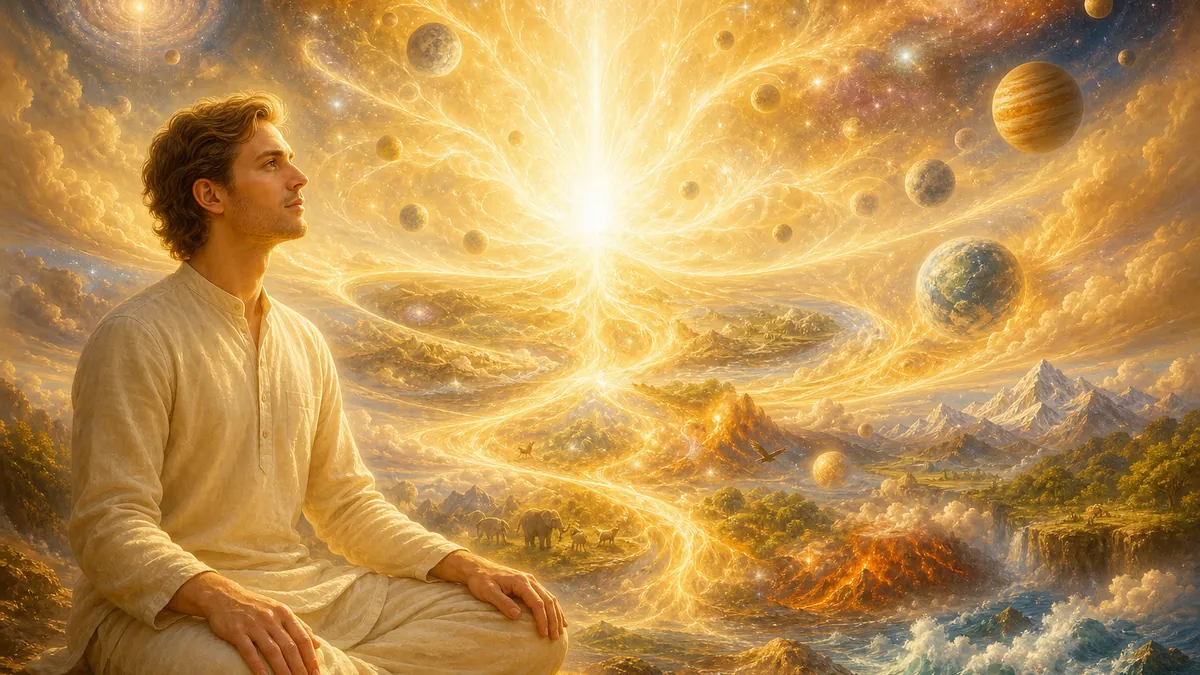
To walk the path of divinity, the path of enlightenment, means to investigate this cause deeply, to discover this primordial Source within oneself, to understand it. And when we understand it, this is called jnana, or gyan — knowledge. And in life there is a moment when we do not know about it and when we do know about it. When we do not know about it, this is called ajnana, avidya, ignorance. And when we know about it, this is called jnana, knowledge.
Two types of knowledge: paroksha and aparoksha
At the same time, jnana is of two types: paroksha and aparoksha. Paroksha jnana is borrowed knowledge, knowledge that has been heard or read. Aparoksha is direct knowledge, directly realized in one’s own consciousness.
For example, you lived before and never knew about Brahman, about the Absolute — the primordial cause of all causes. Such thoughts did not even occur to you. You lived your life. This is ajnana, ignorance. Sometimes there were moments when you reflected on something; sometimes there were moments of suffering; you simply lived. All of this is ajnana, ignorance. That is, you did not see what stands behind all phenomena in the Universe, behind your life: some single foundation, a single meta-mind. In theistic religions this is called God.
But then you began to reflect, began to read the masters, and something began to awaken. You learned that there exists a certain First Cause of all causes, a certain Consciousness underlying all phenomena. It is precisely this Consciousness that is the cause of your parents, your lineage, your life, all human civilization, and indeed all beings. And you began to listen about it, to read about it. You did not realize it, but at least your mind turned toward it. And you received a certain knowledge, even though it was of the mind.
This is paroksha-jnana — knowledge assimilated through scriptures at the level of books or philosophy. And there are very many people who follow the path of paroksha-jnana. There are many priests, missionaries who speak about God, scholars, pandits. And this is normal; it is not bad. But it does not give genuine realization, complete Liberation. It is only borrowed, mental, heard knowledge.
And Advaita Vedanta, Sanatana Dharma, especially the Pratyaksha Advaita of the siddhas, say that this is good, that paroksha-jnana is better than ajnana, but one must go further; one must obtain aparoksha jnana — direct immediate vision. Only aparoksha-jnana removes ignorance and allows the soul to break free from samsara.
The path to direct realization
The teaching of Pratyaksha Advaita, the direct Advaita of the siddhas, the Tantric Teachings, the Teaching of Guru Brahmananda — this is the path to attaining aparoksha-jnana, direct immediate vision. Shankara has a very famous text called “Aparoksha-anubhuti” — non-indirect realization, that is, direct realization. And the precious teaching of Laya Yoga of the siddha tradition, Pratyaksha Advaita, is all a path to the direct, non-indirect realization of the Supreme Source.
There exists a universal meta-mind, the Supreme Source, God, Absolute Consciousness, the Fundamental Basis of Being. And we must somehow establish a connection with it. We must define our relationship with Him. We must know Him within ourselves and our identity with Him. We must somehow understand Him, experience Him, and rethink our life on the basis of this experience.
Sat-Chit-Ananda — the three aspects of Brahman
So, such a Supreme Source in the Vedic tradition is called Brahman, and His main qualities are Being, Consciousness, Bliss — Sat-Chit-Ananda. However, the words “Being, Consciousness, Bliss” seem like rather abstract philosophical categories; they say nothing. We must understand this deeply, again through aparoksha-jnana, not through the mind. This is not philosophy.
Sat — Non-dual Emptiness, Being
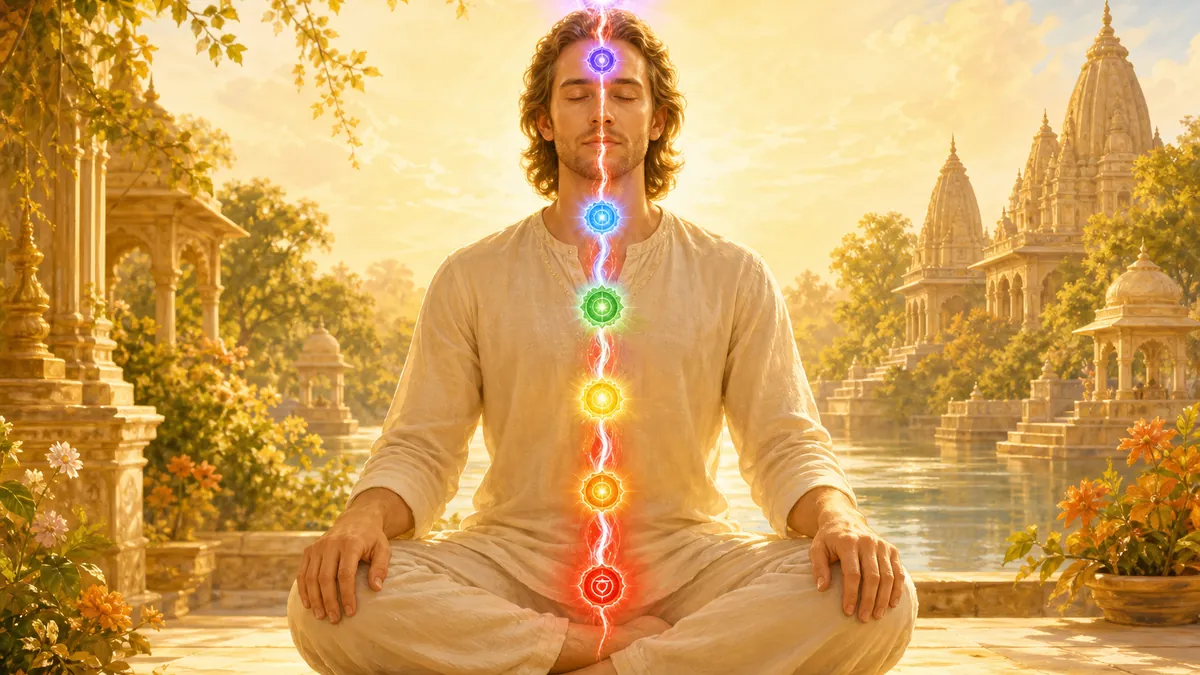
So, what does Being mean? Being means non-dual awareness beyond name, form, subject, and object, which permeates the entire Universe and is also at the very center of our Self, our consciousness. Within us there is unobstructed, empty, objectless, subjectless, non-dual Being. We can experience it when our mind is stilled, free from vrittis, from thoughts. It is supportless, resting on nothing, incomprehensible Consciousness. And it is at the very center of our Self. But unfortunately, our mind always obscures it. Our mental activity, our attachments, do not allow us to concentrate on it.
In the absolute sense, boundless Being (Sat) is the foundation and source of all phenomena in the Universe. From this foundation Ishvara—the Creator God—is born. Ishvara (the Creator God, Brahma) is the Supreme Consciousness that has acquired certain intentions.
Brahma creates the Universe in accordance with the karma of souls. Souls are also parts of this Primordial Consciousness. And, let us say, this part of the Primordial Consciousness does not possess wisdom. And then Brahma initiates the process of creating the Universe so that souls, in accordance with their karmas, can receive bodies and gain certain experiences in this world. It is similar to how someone builds a playground for children.
Ishvara and the Qualities of Bhagavan
Brahma (or Ishvara) is such a Consciousness that knows the source and the end of creation, that knows the birth and death of living beings, that knows both vidya and avidya (enlightenment and bondage). In the Vedic texts, Ishvara (or Bhagavan) is described as one who is endowed with bhaga. Bhaga refers to certain qualities of spiritual power, wisdom, and strength. And it is believed that one who is endowed with six qualities (bhaga) is Ishvara.
What are these qualities?
- Supreme authority
- Supreme Divine Power, vidya bala
- Yashas — Supreme radiance (the worldly term for this is fame)
- Shri — Supreme energy (it can mean success, well-being, energy, strength, health, and material prosperity)
- Vairagya — detachment from one’s energies, from one’s manifestations
- Jnana-shakti — the perfection of wisdom, and svatantriya-shakti — the energy of freedom
And so Ishvara, unlike the jiva (soul), is the one who is perfectly endowed with various infinite qualities. And all of them arise from the aspect of Sat.
Unlike Ishvara, we, souls, are also parts of the one Consciousness, but we are not endowed with these aspects in perfection. We lack Supreme Divine Power, Supreme Divine Authority, dispassion, and wisdom; we are easily subjected to the influence of material nature.
If Absolute Consciousness does not experience the influence of time, and for Absolute Consciousness time is an indivisible substance, and this is the play of its energies (akhanda-kala), then we, souls, are subject to khanda-kala—the influence of divisible time. And time exerts pressure on all of us.
The Action of Kala Shakti — the Pressure of Time
For example, why does a person mature, grow old, then fall ill, die, and then be born again? Because time presses upon him. The pressure of time (Kala Shakti) is what all living beings experience. For example, in the world of people there is such a saying: if you are over sixty, you wake up and nothing hurts, it means you are dead. Because time presses upon all living beings—Kala Shakti.
And this time comes in the form of energy that descends from the subtle world, from the dimension of taijas, through the brahmadvara—the sahasrara chakra—and enters the channels. And the distribution of this Kala Shakti is regulated by the grahas—the planetary deities. Sometimes, when strong grahas are active in our horoscope, we feel various problems or ailments, or something leaves us in the external world; this means that the pressure of time has increased.
It is believed that the deities remember all the actions, words, and thoughts that we performed in the past, and they are simply impartial mirrors. And they return to us karma-phala—the fruits of our past thoughts and actions. Simply impartial reflectors—everything we did in the past, everything we wished for or desired in this life, they simply return to us. And this is their duty, their seva—service. Through karma-phala, we receive the fruits and results of our actions.
So, all of us, as souls (jivas), are under the pressure of time. Kala Shakti presses, presses upon a person, and then wipes him from the board, as a chess piece is removed from a chessboard. There were great kings, great politicians, great figures, but where are they now? A thousand years will pass; it is hard to say what Odessa will be like, whether Odessa will exist at all. A thousand years will pass, and perhaps there will be archaeologists here. They will study the culture of ancient peoples; they will see that these peoples studied Advaita. The word Advaita will be unusual for them; perhaps everyone will have even forgotten it—who knows. All of this is Kala Shakti, the pressure of time.
And we are subject to Kala Shakti. Kala Shakti operates sixty seconds a minute, sixty minutes an hour, seven days a week, and 365 days a year. It is a continuous flow. And this flow, like a turbulent river, carries away, carries away, carries away all living souls. Only strong sadhus, enlightened sages, can withstand the pressure of time. Why? Because they are able to penetrate the dimension of Sat. Sat is the dimension of God. And there is no action of time there. There time is indivisible and is not such a substance as it is with us, flowing from the past into the future in the form of a straight line. And when sadhus penetrate the aspect of Sat, they become free from the action of time; they become like Ishvara, God Himself, the Absolute, who is beyond the power of time.
Chit — Consciousness That Comprehends Itself
Another aspect of the Absolute is Chit. Chit is Consciousness that comprehends itself. It is Consciousness that, separating from Sat, meditates upon itself, comprehends itself, realizes itself, reflects and reflects upon itself. For example, when we meditate and abide in emptiness, an awareness of this emptiness arises in us. And when this awareness arises, suddenly we feel a light that comes forth and a very subtle clarity; this is Chit acting within us, that is, the unobstructed capacity for comprehension, the all-pervading Consciousness that is capable of comprehending everything in this world, everything in all other worlds. This is Chit.
Ananda — the Energy of Bliss
Finally, the third aspect of Brahman is Ananda. Ananda is energy, the energy of bliss, which spreads unobstructedly throughout everything. In this world, everything is built upon energy and the receiving of the energy of bliss. When we eat, obtain any objects, each of us strives to receive ananda. That is, we know unerringly how to extract ananda from food, from water, from relationships, from money. That is, everything we strive for is God. We do not actually need money, we do not need certain objects; we need ananda.
When all this is completed through our body within us, and ananda arises, we feel: “I am happy, I am satisfied.” Because we have come into contact with this unobstructed energy of ananda for a certain time. But in order for us to receive ananda, we must make great efforts. For example, a person works a lot, yet there is no joy, very little joy. Great efforts must be made to receive ananda. But ananda is inherent in the Absolute without any limitations. It is always inherent in Him. That is, it is an uninterrupted wave of bliss that permeates the entire Creation and the entire Universe.
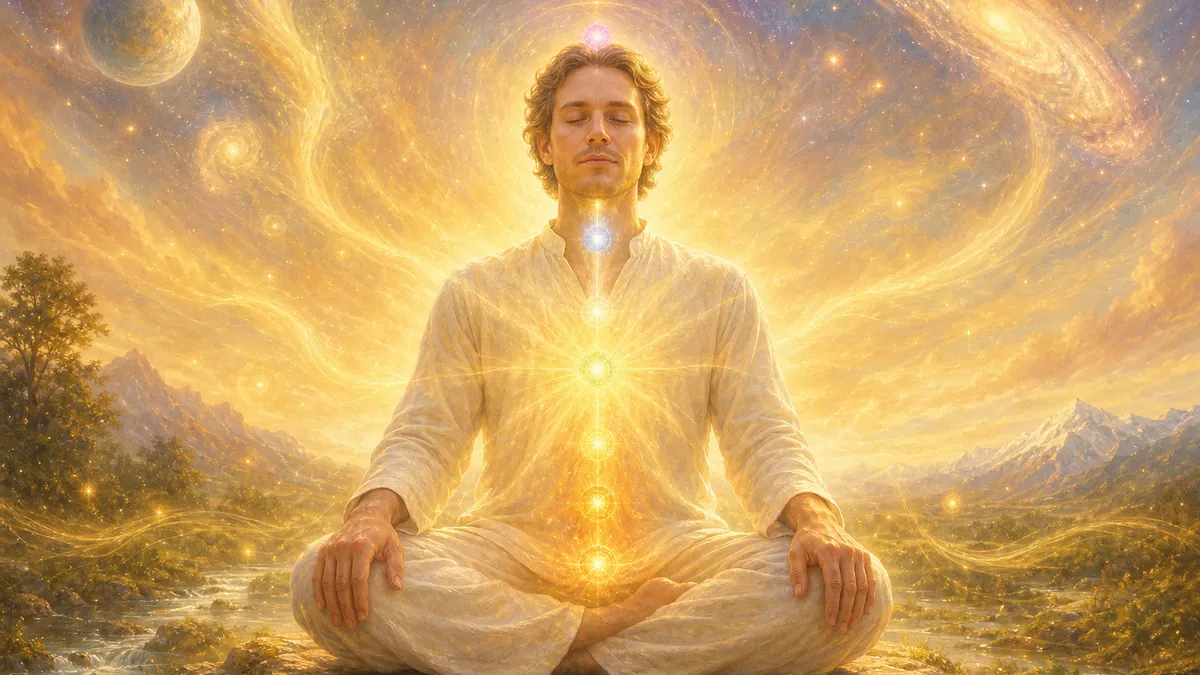
Thus, the Supreme Source is Sat, Chit, Ananda. Non-dual Emptiness is Sat. Consciousness that comprehends itself is Chit. And the unobstructed energy of bliss is Ananda. These three dimensions also exist in our body. For example, when we concentrate on the chakras, practice pranayama, or simply meditate well, Ananda arises in the body as a result of the movement and circulation of the winds through the channels and the melting of tigle — subtle drops located in the chakras. And we come into slight contact with this Ananda.
Direct Knowledge of the Absolute
Direct knowledge of God, knowledge of the Absolute, means entering the dimension of Sat-Chit-Ananda. When we live in the state of samsara, we live in a state of asat — non-truth, because we do not recognize Sat — non-dual empty spatial awareness is not recognized by us because there is a strong craving for material objects in the mind. The external world, material objects, possess enormous charm, enormous attraction. We also do not recognize Chit — self-comprehending awareness, the subtle clarity that is present everywhere, and Ananda is likewise not experienced.
The state of samsara is when we do not recognize the fundamental basis of Creation, do not recognize Sat-Chit-Ananda. The path to divinity indicated by the Vedic tradition lies through the recognition of this fundamental principle. The recognition of such a fundamental principle, when it is explained by the Master and when we eliminate all doubts about it, is called mastery of the perfect view or vision — drishti. And first we need at least a view, at least a worldview, something we could rely on, for example, the worldview “Everything is Brahman” or “Aham Brahmasmi.” We need a very broad, very open worldview, when we have understood what the essence of the universe is. However, this worldview must become completely our own, and we must become fully established in it. Therefore, a view alone, a perspective alone, is not enough. We need awareness of this. And this view, this worldview, is precisely Sat. But we need awareness, a full understanding of it; otherwise it will simply be faith not supported by personal experience.
And then we say that, in addition to the view, there is also awareness, and awareness is meditation, abiding in meditative consciousness (dhyana). And we need to understand how to meditate, how to abide in meditative consciousness, how to discover it, how to approach it, and how never to leave it. Experienced masters always abide in meditative consciousness. Gods, saints, siddhas are sources of the greatest meditative consciousness. They all abide in sahaja samadhi. But beginners do not abide in meditative consciousness—immature souls, beginning yogis. They abide in meditative consciousness only for some seconds, minutes, only as glimpses in their lives. Sometimes they abide in meditative consciousness in retreat, but meditative consciousness has not become part of their life.
Finally, besides meditation, there is also action (kriya), behavior. Action, behavior means how to act in the universe, how to manifest oneself when one is always in meditative consciousness, the ability to skillfully manifest inner energies. And all these three constitute the path in Sanatana Dharma. Jnana (view), dhyana (awareness), and kriya (action). For example, we have absorbed the view, we have acquired a certain worldview: “Everything is Brahman,” “I am Brahman.” We have even learned to meditate a little and to abide in a state of awareness through satipatthana, atma-vichara, shambhavi mudra, mantra, sankalpa, and other methods. But then the question arises: how should we act, how should we properly manifest ourselves based on this? What is action, what is the energy that we manifest?
So, all these three constitute the subject of consideration of the spiritual path—jnana, dhyana, and kriya. And when we speak of action, we say that we need to act from the non-dual view, we need to act while abiding in meditative consciousness. This is the main principle: never to lose the non-dual view, never to lose awareness. And when we take karma-sannyasa, receive diksha, the Guru-mantra, we as if make such an inner promise: to always strive to act from awareness, to act from non-duality. If I am not aware, if I have lost the non-dual view, then karmas act upon me, I receive karma-phalas (the results of my actions), various planets influence me, society influences me, the surrounding culture, a bad mood, the weather, and there is never any stability in me; I cannot meditate on God. One might say: “God does not live in my heart, and rarely appears in my life at all, because I do not know how to stand before God every moment, how to live without leaving God, how to be in God, how to offer myself to God.” But when we abide in meditative consciousness, we need to learn to act from meditative consciousness. The art of action in meditative consciousness is called nididhyasana. Nididhyasana means that we constantly abide in meditative consciousness. And this meditative consciousness is directed toward the Supreme Source—only toward God. It is directed neither toward the breath, nor toward the chakras, nor toward spirits, nor toward anything that has form; it is directed only toward the Supreme Source. That is, our main meditative consciousness must be directed only toward God. And it must know how it should be directed toward God.
The Law of Karma and the Self-Liberation of Thoughts
When we forget the view and do not have meditative consciousness, then we commit wrong actions. Our deeds, our thoughts, our speech—all of them arise from the ego, and the ego is a product of karma. And then we receive, as it were, the unfolding of our karma-phalas (karmic fruits). And when we act from karma, we accumulate new karma. It is said of such people that their thoughts are like carvings in stone. That is, if something is carved in stone, it remains for a long time. But when we act from the non-dual view, from meditative consciousness, our thoughts become a play; they mean nothing. And they instantly dissolve, liberating themselves by themselves. They are compared to circles on water. The art of action from meditative consciousness is the art of abiding in the view and meditation at the time when our deeds, our speech, and our thoughts manifest. And if we choose the correct art of action, we begin to dissolve our karma. If we forget about this, then our karma continues.

Our thoughts become our speech, our speech becomes our deeds, our deeds become our character and our personality, and our personality in the future becomes our new body and our new environment, the world (loka) in which we are reborn. This is precisely how the Law of Karma works. Everything begins with thinking. It is our thoughts that initiate our deeds and actions. It is our thoughts that shape our destiny.
So, I will repeat once again: our thoughts create our words, our words create our actions, our actions create our personality and character, our personality and character create our destiny (daiva), our destiny creates our future body and the world in which we will be born in the future. Karma unfolds precisely through such a chain. And as you have noticed, at the beginning of this chain lie our thoughts. And our destiny will depend on how we understand the mechanism of the development of our thoughts, their arising and self-liberation. Whether in the next life we will have a body in the form of a human being, an asura, a rakshasa, a deity, or whether it will not exist in samsara at all, but will be created only from non-dual consciousness and consist of light. Whether we will be born in the divine dimension of deva-loka (in paradise), reincarnate again in the human world, or whether our rating will drop and we will descend a little lower, or whether we will no longer be reborn in any lokas, but will constantly abide in transcendental consciousness and, like deities, become one with the Absolute, with infinity, with Brahman, who can emanate any bodies, any energies into any lokas—our entire destiny depends on how well we understand this mechanism, on how well we can dissolve the flow of our thoughts into their foundation, into their seed.
The Art of Sahaja Samadhi
So, kriya, the art of acting in meditative consciousness, is the art of always and everywhere being in sahaja samadhi. All the divine beings whom we see all abide in sahaja samadhi. For example, if you are not aware and someone says something hurtful to you, you become offended. And your mind may begin to work in this direction very intensely. For example, you may think that everyone wants to humiliate you, that you are underestimated, that you are such a great person, yet you are being treated so unfairly, and your mind can invent many things. But perhaps, in reality, someone simply failed to notice something; they did not even think of offending you, they did not even intend to humiliate you. You have already imagined everything yourself. This is an example of how the mind works if it does not abide in meditative consciousness, if it does not abide in the correct view. And then the one who was inattentive to you created only a small effort, launched a certain process, while your mind invented everything else, your karma invented it. And you have already changed your destiny, gone down such a tunnel of reality where all this begins to come true, and you become convinced of it. You confirm precisely this: “yes, it is true, that is exactly what I thought.” But it is your mind that creates all of this.
But on the contrary, if you are a good sadhu, if you abide in meditative consciousness, in the non-dual view, then whatever happens, you do not evaluate it, you do not pass judgment on it. There is such an expression: “leave everything as it is.” You simply do not interpret; you do not allow the mind to project anything. You abide in naked awareness and in an open view, like the sky. And then the situation arose, and it dissolved. And nothing—no karmas, no fabrications, no tunnels of reality; the ripples dispersed, and you abide in God. You abided in God before the situation, you continue to abide in God after the situation, and you abided in God at the moment of the situation. And nothing—and it is good. Then you receive a blessing, darshan. You have been abiding in God all the time, and everything that comes to you, both good and bad, is all from God. And then you abide in gratitude that God gives you His blessings, darshans, shaktipats. This is possible when you have deep faith and know the art of the self-liberation of thoughts. When you are able to recognize your thoughts, evaluations, and judgments at the very beginning and catch them. Then they are like ripples on water.
And there are three stages of such self-liberation. The first stage is like a snowflake falling into the ocean. The snowflake fell and dissolved; the ocean does not mind. You could even dump an entire trainload of snowflakes into it, and it would easily dissolve them. And so saints, sages, jnanis are like a vast ocean. Their consciousness is not narrow; it resembles a boundless ocean. They can absorb a great deal of karma, take on suffering, encounter very impure energies, powerful demonic beings, harmful spirits, but they do not even do anything; they do not even struggle with them, do not defeat them, do not wage war. The ocean does not wage war against snowflakes. The ocean does not think: how many snowflakes do I need to dissolve now? The ocean abides in its own nature. It is so omnipotent, so infinite, that it does not need to do anything. It simply needs to remain itself; it simply needs to be the ocean. And when the ocean abides in its own nature, even if meteorites fall into it, it absorbs even meteorites; everything dissolves in it.
Jnani of the highest category live by the principle of “leaving everything as it is.” “Leaving everything as it is” means that whatever they encounter in life, they make no judgments, no assessments; they simply continue to abide in their nature. When they encounter harmful spirits, obstacles, the influence of malevolent planets, they leave everything as it is, knowing that their nature is so infinite, so pure and flawless, that it will dissolve everything. And leaving everything as it is does not mean remaining within one’s human limitations. Leaving everything as it is means leaving everything as it is in God, in the Absolute, because they themselves do not separate themselves from the Absolute. Therefore, when we are in meditative consciousness and our mind is wide open, vast, and we possess great faith and self-surrender, it is enough for us to relax, leave everything as it is, and abide in a state of awareness. Then purity and perfection reveal themselves, and no distracting energies are capable of shaking us. Whatever happens, everything dissolves. This is reminiscent of a thief who sneaks into an empty house. The thief comes hoping to steal jewels, but he enters and sees that an old man is sitting in the house, a poor old man; he is simply drinking tea, and there is nothing to steal from him. And then all the thief’s hopes vanish; he understands that there is nothing to take here. The old man invites him to have tea. They drink tea together. The thief does not strain himself, the old man does not worry about anything; there is nothing to steal, so they can be friends. And then the universe becomes friendly toward us. The five sense organs, the five objects, everything becomes friendly toward us. We know: they cannot steal anything from us.
When we are in a state of distraction, and our mind does not possess the view, meditative consciousness, then the five sense organs are thieves: they constantly steal our energy, our consciousness. Through the eyes, ears, sensations of taste, smell, and touch, through thinking, through information. Everything lays claim to our soul; everything tries to take possession of us, of our energy, of our attention. Then the Universe is not friendly, the elements are not friendly, and we are forced to set many boundaries, many barriers, to fence ourselves off, to protect our borders. We are forced to clearly display the marks of our ego. Like an animal in the forest: every animal marks the boundaries of its territory in the forest. And says: “Do not come here, this is my hunting territory; whoever occupies it, I will tear apart.” In the same way, we place the marks of our human ego, because we know: everyone wants to take something from us, everyone wants to steal something from us. But something can be taken from us, stolen from us, only when we are not in a state of awareness. When, however, we abide in the state of the ocean, the universe becomes friendly, we become open, empty, and wide open. And this type of relationship with the universe is called that of a sister or brother. That is, these are warm, quiet, peaceful relations. Thus, the art of being in sahaja samadhi means, above all, the art of abiding in an open view, meditative consciousness, and acting from it.
Vedic Cosmology
There are three dimensions of the Universe. Vishva is the totality of all the bodies of living beings. This is the material world — all the bodies of people, all the bodies of animals, all the bodies of trees and plants; all of this is the dimension of Vishva. It is God in manifested form. The entire material universe is a manifestation of God, Ishvara. The dimension of taijasa is the astral dimension. From the word tejas — radiance, because the astral dimension is endowed with the power of light, of radiance. And the totality of all subtle bodies, all souls, the souls of gods, asuras, ghosts, bhutas, humans, and other beings — all of this constitutes the dimension of taijasa. In this dimension, Ishvara manifests as Hiranyagarbha. Hiranyagarbha is the Supreme Ruler, Supreme Consciousness, the Golden Embryo. That is, in reality all these souls are one. And Hiranyagarbha perceives them as his one vast astral body. The entire astral world, with all souls, ghosts, and deities, is one great astral body of Hiranyagarbha. In the physical world, this one immense body is called Vaishvanara. Vaishva means universe, and nara means being. That is, it is one vast, boundless being. For example, we all consider ourselves independent souls, individuals, personalities, but for God, for Ishvara, we are all like his cells; we are all one being. It is very important to understand this unity.
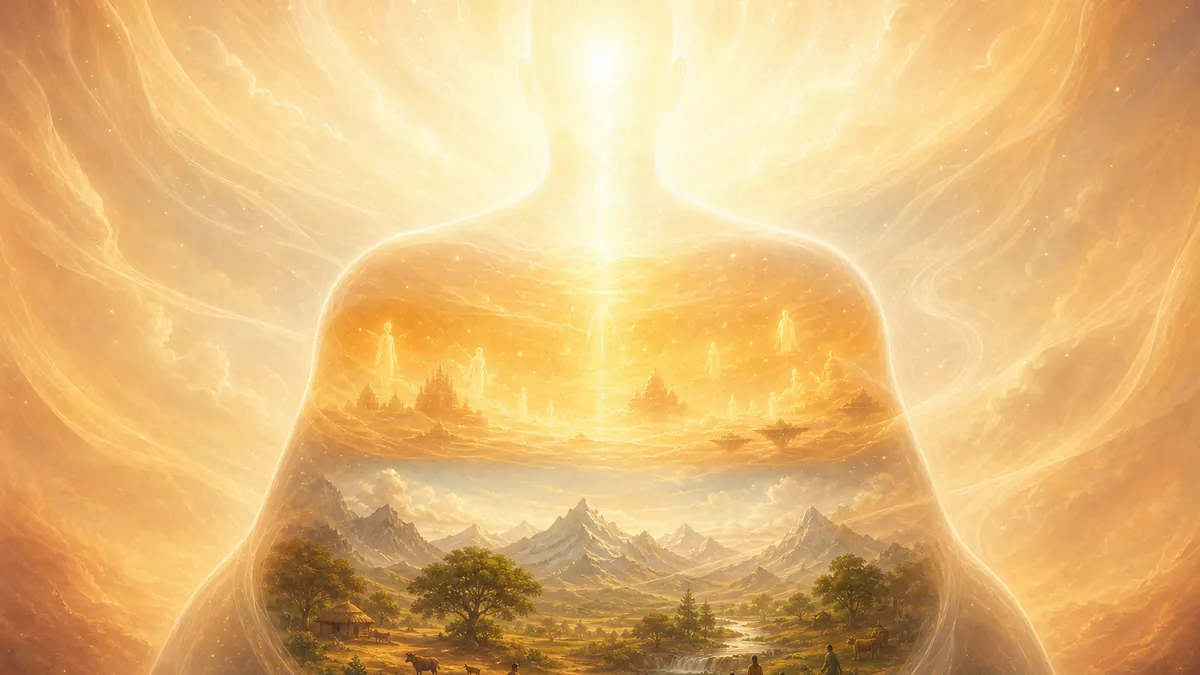
Finally, in the causal world, the totality of all souls in the causal body is called Prajna. All souls have causal bodies. And when we speak of the totality of these causal bodies, the state of Prajna is the part of God called Ishvara. Ishvara perceives all souls in the causal world as his “I.”
Thus, all three dimensions of the Macrocosm—the physical world (the physical universe), the astral world (the subtle-material universe), and the causal world (the causal universe)—all these are the three bodies of God, the three bodies of the Absolute. And here God is the Macrocosm. We, souls, are the Microcosm, and we are particles of this one great universal body of God. Ishvara, the Absolute (Ishvara is also a name of Brahma, the Creator of the Universe), differs from us, from souls (jivas), in that he is aware of the entire Microcosm as part of himself. He is aware of the entire Microcosm as part of himself. But we are not aware of this Microcosm as part of ourselves; we have duality. And all we are capable of is becoming aware only of our own individual, personal microcosm. The power of our consciousness is not sufficient to include the Macrocosm within ourselves and realize it. And this continues while we are in duality. But when we enter the state of the view, the view of nonduality, meditative consciousness, then gradually a consciousness like that of Ishvara also begins to awaken within us, and we begin to understand the identity of the Macrocosm and the Microcosm, for example, the unity of all living beings. On the physical plane, we begin to understand that, in fact, we are all one; we are a single Meta-Mind.
Karmic Flows and Spiritual Practice
There are about 8,400,000 forms of life in the Universe. All souls (jivas) receive embodiment in various forms in order to experience karma-phala—the return of their karmic actions. Karma-phala is the fruit of our karma. For example, in past lives we thought in a certain direction and made efforts in a certain direction. We created certain streams of thinking; these streams flow invisibly in our subtle bodies. We may not see this, but each of us is streams, karmic streams of our thoughts. These streams draw us inevitably toward certain results—karma-phala.
Who created these streams? You yourselves created these streams earlier, by the power of your thoughts. Now we receive everything that these streams bring us. Our present life is the result of our efforts, our past thoughts, the result of past streams that we created. Our next life will also depend on our present efforts, on the streams that we are creating now.
When we make plans, create any projects—this is kriya-mana-karma. The karma that we create with our thoughts. Karma that will manifest in the future and that we create every second is also called agami-karma. Karma that cannot manifest but already exists in our channels (as if frozen in a refrigerator) is sanchita-karma. And the karma of the present life, corresponding to the streams of our thinking, is prarabdha.
We are constantly within certain karmic streams. We ourselves created these karmic streams earlier; no one else created them. Thus, spiritual practice means that we come out of the karmic streams and become established in the nondual view, so that these karmic streams begin to dissolve.
Spiritual practice is not built on thoughts, not built on the mind, although the mind as an instrument may sometimes be used. For example, we practice visualization of the Refuge Tree, of Dattatreya—this is the subtle mind. But it is a very useful mind, because we use the subtle mechanisms of the mind for liberation from karma. But even when we visualize deities, invoke them, recite mantras, we must recognize their nondual, empty nature. That is, the view, the meditative consciousness of nonduality, is always the deep foundation of everything we do.
For example, during a ritual of worship we must try to be in nonduality. Then, when we venerate Dattatreya, we abide in meditative consciousness, we abide in the nondual view; then I and Dattatreya are one. You and Dattatreya are one. This is one consciousness. And one part of your mind venerates another part of your mind, a greater one.
The Art of Action from Sahaja Samadhi
To follow the path of divinity in Sanatana Dharma means to become established in the nondual view, in meditative awareness beyond subject and object, and to learn to act from it in correct conduct—kriya. Sometimes we understand something through the view; sometimes we master meditation and the maintenance of mindfulness quite well, but we encounter difficulties with how to act in conduct, how to live with the manifestation of meditative consciousness. We also need to learn the art of action from sahaja samadhi.
Action from sahaja samadhi is inherent in masters, enlightened beings, siddhas, and it is action without a doer, action without motivation, action without attachment to the fruits of one’s labor, action without any concept of action at all. Such action is simply the activity of energy, which appears to others as action, but to the being itself it does not appear to be action. We call such a state lila or sahaja-lila, the play of the divine, the natural play of the divine. To designate this art of the play of energy, there is the term “chit-shakti-vilasa.” Chit is consciousness, shakti is energy, vilasa is play, dance—something exalted, beautiful, and majestic, full of power, bliss, and energy.
We need to learn to act so that our entire life ceases to be karmic actions, which in any case bind us to samsara, to causes and effects, to karma, and so that our entire life becomes chit-shakti-vilasa.
Service to the Divine Will
How can this be done? First of all, we must act not for the ego, not for ourselves, but all our actions must become seva, service, karma yoga. Service to whom and to what? Service to the implementation of the divine will, service to the Supreme Source, and service to those divine forces that personify it. For example, the saints, divine beings, the Tree of Refuge.
It is very important to learn to distinguish the will of one’s ego from the divine will. The will of one’s ego must be subdued and cut off, while the divine will must be carried out. We will come to full enlightenment when we completely succeed in discarding the ego. When we say: “Lord Dattatreya and all the saints! Here are my hands, here are my feet, here is my body; please use them as intended, I will be a pure and empty conduit of the divine will.”
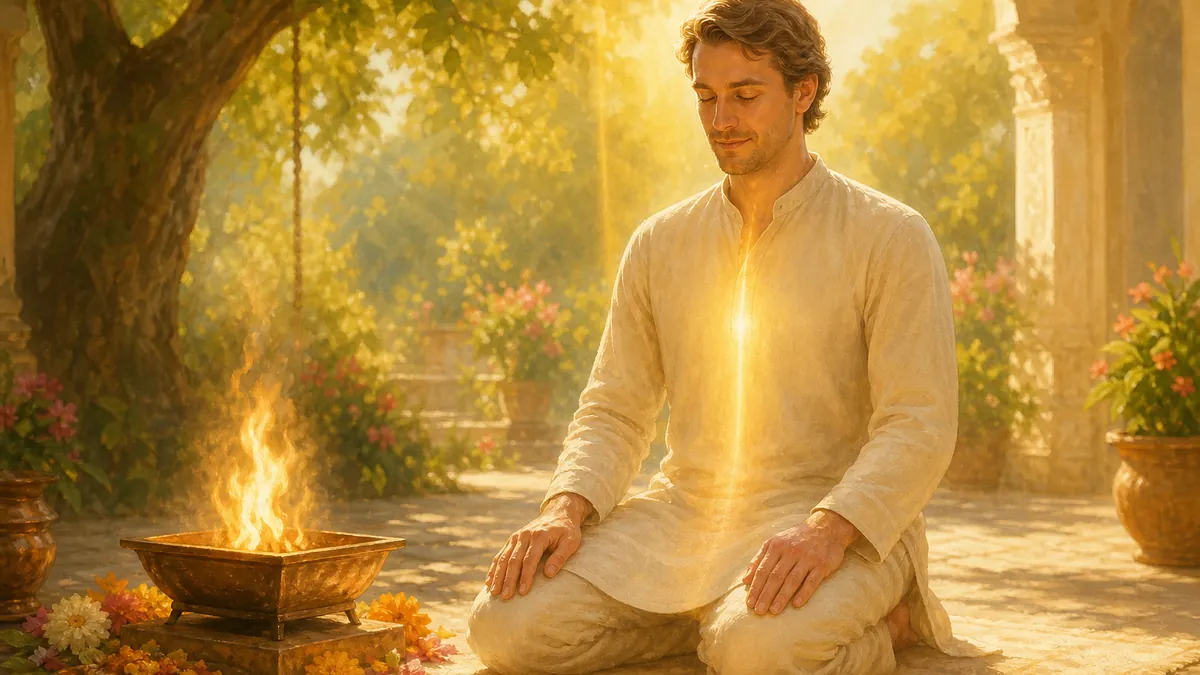
Until we say this, the attainment of Enlightenment is impossible for us, because the ego will always remain in us, and it will say: “But I also have a right to something, I also want something. And what will be left for me?” And it will always conduct such a subtle policy with God, it will always try to bargain.
Sometimes the ego fears Enlightenment because it knows that all its ambitions and clingings will come to an end. And it consciously slows things down. We want to practice, we want to meditate, while the ego summons some harmful spirits; it itself creates such scenarios, it itself creates obstacles. Because the ego is a strong mind. And the strong mind understands that when its end comes, all its ambitions will no longer be able to be realized.
Sometimes it is described how Indra prevents ascetics and rishis from performing tapas, and he sends apsaras to them—these are well-known stories. For example, when the rishi Vishvamitra was meditating, all three worlds began to tremble, and Indra decided to send Menaka so that she would seduce him. All apsaras possess moha-siddhi and prabhava-siddhi, sammohan-siddhi—the power of hypnosis, enchantment, and control of thought. The apsara so enchanted Vishvamitra that he spent the night with her and abandoned his tapas. It seemed to him that he had spent one night, but in reality many years passed there. When he learned this, he was very disappointed and shocked.
Another time, when the rishi Kashyapa was performing tapas, Indra sent Alambusha to enchant him so that his tapas would not change the course of the Universe, so that everything would remain in its place. Indra is always afraid for his position; he thinks: “Some rishi will appear, and his power and wisdom will be such that he will overthrow me from my throne, from my post, and then he will be the lord of the universe.” And Indra still has some pride, attachment; he is sorry to leave his throne. Therefore, he always creates obstacles for hermits and ascetics.
But what is Indra? He should be regarded as the mind; he should be regarded precisely from the standpoint of the microcosm. In fact, even if you perform great tapas, you will not hinder Indra in any way, the universal Indra, because Indra’s power will never even compare with yours. But in this case we are speaking about the microcosm, and very many Vedic myths should be interpreted in terms of the microcosm.
Within us there are representations of Indra, like embassies, in every person. Within us there is a little Indra, and within us there are little deities. That is, the deities of sight, hearing, smell, touch, fire, and so on. And this little Indra is indeed afraid, because it is our mind and our ego, which controls the universe of our body, and it begins to create obstacles on the spiritual path. But when we take the position of serving the divine will, our ego loses its power over us.
The Transition from the Realm of Karma to the Realm of Lila
The art of enlightened action is the art of acting from the state of non-action, from the state of awareness. It is the art of being a conduit of the Divine Will, the art of abiding everywhere in the nondual view, acting from a sense of play rather than from the sense of “I am the doer.” Service, karma yoga, seva, service to all living beings, the motivation of practice for the benefit of all living beings, the motivation “I meditate in order to become a perfect conduit of the Divine Will” — this is the right motivation for mastering such action from sahaja samadhi.
Divine beings do not act; the Divine Will plays through them. Divine beings are not subject to the law of karma; causes and effects do not act upon them, they do not reap the fruits of karma-phala — the fruits of their actions. Divine beings play spontaneously; they do not even concern themselves with actions, the thought does not arise in them that “I have done something,” nor responsibility for what has been done. They do not even have thoughts such as “the fruits of my actions belong to me”; the thought does not even arise in them: “I am the one who partakes, I am the one who enjoys.” Therefore karma has no power over them, and they do not receive the fruits of their actions.
But what are divine beings engaged in? They abide in the perfect nondual view, in deep meditative consciousness, and they are the purest conduits (upaddhi), conduits of the Divine Will. The Divine Will, the Divine energy simply plays; it plays through their bodies. And it manifests spontaneously for the benefit of all living beings. This is what we call lila, chit-shakti-vilasa.
To walk the path of Liberation in Sanatana Dharma means to move from the realm of karma, from the realm of necessity, into the realm of freedom, into the dimension of lila — the Divine Play. In karma, in the dimension of people’s samsara, there is no Liberation, no Enlightenment, and no happiness either. Liberation, happiness, Enlightenment are found in the state of play (lila).
Enlightenment (everyone knows) does not officially exist. The Gods have no legal personality, they have no legal address; all of this is completely unofficial, because the world that people have created is a profane dimension, a dimension of gross elements tightly bound by karma. But Enlightenment, siddhis, divine wisdom — all of this is in another dimension: the sacred, holy, mystical, magical dimension. And spiritual evolution, the spiritual path, means moving into this sacred, mystical, magical dimension.
In this dimension everything works differently: there the ego is non-ego, karma is non-karma, action is non-action. Instead of karma — lila; instead of action — non-doing; instead of ego — simply a creative function and the experience of “Aham Brahmasmi.”
Vision of the World as a Mandala
If we aspire to true happiness, to Enlightenment and Liberation, we need to strive for and make such a transition into this other dimension. We need to stop acting and begin to play; we need to stop identifying ourselves with the ego and learn to abide in the nondual view. We need to stop clinging to the fruits of our actions and appropriating them, and offer them to God. Instead of serving our selfish will, we need to learn to be the purest channel (deva-vahini), a conduit of the Divine Will.
All of this is the path of Sanatana Dharma; all of this is the path of Liberation. And then the entire Universe, all reality, begins to appear before us in a very wondrous, beautiful, sacred, miraculous vision. Such a beautiful, sacred, miraculous dimension is called a mandala.
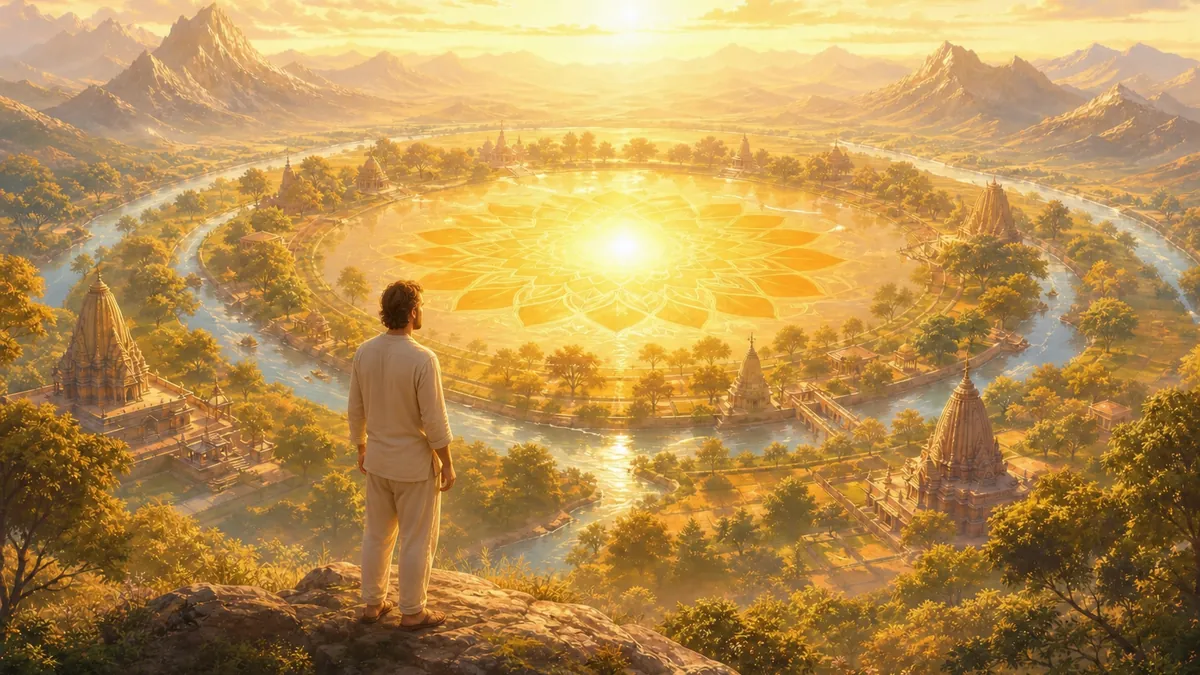
Then everything becomes pure, everything is purified, and it is said that the whole world appears as a pure dimension, a Pure Land; all people manifest as the illusory bodies of deities; the world as a mandala, all houses and buildings manifest as the palaces of deities, all sounds as mantras and bhajans, all situations as lilas, everything that happens to us as darshans of the Divine.
When we understand that there is a fundamental difference between these two visions of the world, we clearly understand: this is the path of Liberation, the path of becoming a deity, and that is the path of samsara, the path of karma, the path of ignorance. That is the realm of necessity, the realm of karma, and this is the realm of Freedom.
My blessings that we all walk this path of Divine Play, of becoming divine beings; that karma not have power over us; that we become established in the nondual view; that we serve the Divine Will and not serve our ego; that thoughts not have power over us; that we surrender ourselves to the power of the Absolute; that this power of the Absolute be within us as our own being, as the inner experience of “Aham Brahmasmi.”
