The path to the natural state through the practice of contemplation
07.06.2026
0 мин. чтения
0
Share
copy
search
add
share
Commentary on the text “Chaturashiti-siddha-pravritti.” Tantipa
“In the city of Sandhonagara there lived a weaver who had many children. Through his skill he had amassed great wealth and married his sons to girls from good families. He continued to live together with them, and the whole family prospered. The weaver’s wife died when he was eighty-nine years old; he had already grown old, become weak and decrepit. His daughters-in-law received their father, but everyone who saw him laughed and mimicked his elderly manners and quirks. Feeling that the old man’s presence at the table had begun to drive people away from the house, the daughters harbored resentment. ‘Let us build a straw hut in the garden and feed him there,’ they decided. And so they did.
It so happened that Guru Jalandharapa, finding himself in the city, came to the house of the weaver’s eldest son, asking for alms. The son invited him to lunch, then offered him to stay in the house for a few days.
‘I do not sleep near people,’ the teacher replied.
‘But you can sleep in the garden,’ the hosts suggested.
They led the yogin into the garden and left him a lamp. The old weaver heard the sound of footsteps and, surprised, asked:
‘Who is making noise there?’
‘I am a guest of this house, a man of Dharma.’
‘And I am the master of this house,’ the weaver shook his head. ‘I was younger, and all this was mine—the house and everything inside it. And now my sons and daughters-in-law mock me; they have shoved me into this hole. All things in the world are impermanent! Here, see for yourself.’
‘All gathered things are a single deception,’ said Jalandharapa, ‘and everything in the world is painful. There is nothing self-existing within what exists. Happiness is in nirvana. Do you want a teaching that will protect you from death?’
‘I do.’
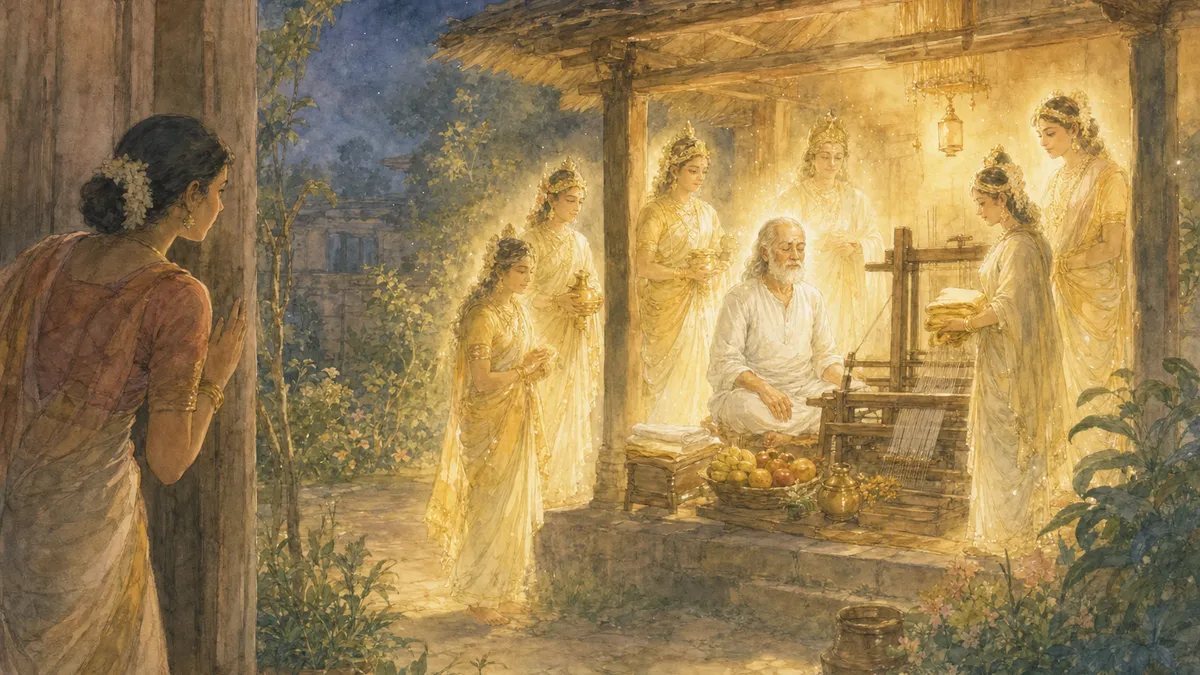
Jalandharapa gave the weaver initiation into the Hevajra mandala and other secret initiations, and suggested that he begin meditating immediately. Then the Guru went off somewhere. The weaver remembered the instructions but said nothing to his household. Thus he practiced for twelve years and acquired many abilities that people do not really understand. One day the eldest son, having completed a successful order, held a celebration. In the bustle, of course, they forgot to bring the old man something to eat. The daughter-in-law remembered this only at night and quietly went out into the garden. The hut was shining brightly in the darkness. The old weaver was sitting inside it, surrounded by fifteen seductive girls, and everything around was piled with exquisite things and dishes. The woman sensed in this something that did not belong to the human world and hurriedly returned to the house.
‘Go and look at what has happened to Father,’ she said to her husband.
He thought that the old man had died and, in tears, went out into the garden. Then everyone who approached the hut saw the same thing as the woman and went away astonished.
Returning to the house, they said:
‘This is not from a human being; it is probably the work of demons.’
But the next morning, when the news had spread throughout Sandhonagara, many people came to bow to the old man. He came out to them, transforming his body into the body of a sixteen-year-old youth. Countless rays of light emanated from his form, and no one could look at him for long. This body was like a polished mirror, in which everything appears in its true, luminous nature. The weaver became known as Tantipa and performed countless deeds for the benefit of living beings. Having departed into the Clear Light in his own body, he simultaneously helped many inhabitants of Sandhonagara pass there as well. Thus, thanks to faith, patience, and attention to the instructions, an old man proved capable of attaining the siddhi of the natural state in his advanced years.”
Signs of Progress in Practice
What are the signs of your progress in practice? Your aversion to ignorance increases. Not that this aversion is a part of duality (attachment and aversion), as some kind of extreme. Not that you fall into some kind of despair, but something appears within you that does not accept ignorance under any circumstances. Then, in the true sense, you become a person of Dharma.
Although we hear that all things in the world are impermanent, we lack faith in these instructions. We still continue to be enchanted by these reflections that arise from our consciousness. We are often so superficial in our practice that we lack the depth of consciousness to understand what the saints were talking about. When we hear stories about siddhas, there is nothing even to comment on here. It is simply an example to follow. If we truly want to practice, then it is simply enough to repeat their path.
The Difference Between the Worlds of Gods and Humans
We were born in conditions in which existence challenges us in the form of old age, suffering, illness, impermanence, and death. In the world of the gods, suffering is not manifested in the same way. The gods are in a meditative state. In fact, if one rises slightly above the world of humans and asuras, all the gods experience meditative states. If you imagine the consciousness and mind of creative people, that the world consists only of creative people (musicians, actors, and artists), then this would resemble the world of the gods. However, their meditative states are not deep because of clinging to their own bhavana. They have certain states of self-satisfaction with their own bhava and pride, and therefore they cannot advance further.
For example, if you have tried to offer the Dharma, it is very difficult to explain anything to such creative people, because in principle they do not want to listen to you. They think they already have everything. But what they have, from the point of view of realization, is nothing. A certain meditative self-satisfaction, from the point of view of the awakened state, is a mere crumb. Nevertheless, attachment to these states closes them off from the genuine Dharma. Therefore, it is difficult to talk with them and to convince them of anything. They will not listen to you, because they have already become accustomed to listening to themselves. When you listen to yourself for a long time, you become closed, unreceptive to listening to anything else beyond that. However, such faith in the intrinsic existence of one’s “I” is an obstacle to the perception of the profound Dharma.
The Importance of the Four Awarenesses
The point is that meditative absorption of a low level does not allow us to truly hear ourselves. We hear only some small, insignificant part of ourselves, and do not hear the great part of ourselves. Therefore, we must become very firmly established in the foundations—in the Four Awarenesses—so that when our meditative abilities increase, relying on the Four Awarenesses, we would be able to manage the mind in such a way that it does not cling to superficial experiences of clarity, dhyana, and so on. It is very important to create within oneself an understanding of the Four Awarenesses during the first years of monastic life. This is much more important than even receiving some profound initiations. Why? Because if you have become established in the Four Awarenesses, you will receive initiations again and still reach the end. But if you do not have the Four Awarenesses, even if you have many initiations, it is said: “Even if the head has become flat from the touch of the ritual vessel, but there is no rootedness in the Four Awarenesses, then there is no deep guarantee that these initiations will work and be applied.”
The gods, dwelling in their meditative state of absorption, do not know that this meditative absorption is temporary. Nevertheless, when it ends, they lose the ground beneath their feet. Here what is meant is the state of the deities of the world of passions.
The Great Choice and the Path of Contemplation
When we practice contemplation, we make a decision—to make the great choice. What is this great choice? It is not only monasticism. To make the great choice in the absolute sense is to make the decision to abide in true contemplation. We make it once, receiving the direct introduction. Then we purify our intention to abide in contemplation. After that, for the rest of our lives we abide in correct contemplation. This is also called making the decision to enter the great non-doing. Such a state is called the state of the great choice. In other words, we make the choice to be aware in any situation, and then we make efforts to hold to this choice. To be aware in any situation and to practice self-liberation and presence are one and the same until our choice leads to a certain point where a radical turning point occurs, where we discover our luminous nature of Mind and are able to unite with it completely.
When you practice shat-chakra yoga, it seems as though it is useless. You visualize the image of a chakra, concentrate on the chest or in the area of the coccyx, but there are no sensations. You do this for a month, then for six months. You read the Hatha Yoga Pradipika, compare your sensations with what is written there, and see that you have no results at all. You concentrate for a year, a second year, and only then do you begin to feel the energy a little, but you do not experience anything of what is described there. Suddenly an understanding comes of how deep one must be in practice in order to attain any results. But on the other hand, there comes an understanding that there is no way back anyway, that one must continue the practice and keep concentrating further. In the third year, you begin to feel the energy when you concentrate. The body ceases to be felt, the breath becomes barely noticeable, and you begin to see light in each chakra — thus comes samadhi associated with the elements. You understand how much persistent effort must be applied in order to develop sensitivity to energy and engage each chakra in the body.
Something similar happens with contemplation as well. We practice contemplation, but we feel that it is like an autumn breeze: the slightest thought or conversation — and it instantly vanishes. It seems that there is no hope of truly contemplating. It is such an elusive thing that even a movement of the body or a fluctuation of thoughts completely sweeps contemplation away. Nevertheless, when we train ourselves for many years to become accustomed to it, we suddenly discover stability in contemplation. It is not yet very deep, but it is steady. It can be maintained even while eating, using the toilet, or talking. Then we feel that, in some incomprehensible way, we have become accustomed to being aware. Then our breathing becomes short and infrequent. We also begin to discover that our energy, too, is gradually beginning to change; the channels in the body and the winds also begin to purify.
Transformation through Contemplation
When such a turning point has occurred, we cease to be ordinary people. We feel that neither the past nor the future, neither attachments nor the world have any significance for us, as if space and time begin to fold up, revealing their wondrous depth, that everything arises from us, everything is within us. We understand that everything depends only on the depth of our contemplation. When it deepens, the mind becomes accustomed to it and is saturated with divine majesty or divine pride. Why does this happen? Because the gods are originally in contemplation — this is their usual state. And when the mind is saturated with the habit of contemplation, we begin to resemble deities.
For example, all deities are not far from the Source. Why do they have superpowers? Why do they possess creative powers, siddhis, clairvoyance, might, and authority? This is not their own shakti; it is the result of their having developed a very deep capacity for contemplation. They are in unity with the Source, whose light gives them enormous energy. They draw upon this creative energy, and through it they acquire immense wealth, power, influence, joy, and enjoyment. Depending on their karma, they abide either in the heavens of passion or in the heavens of Rupa-loka.
The gods of the heavens of passion have an admixture of worldly desires. It is believed that their bodies consist not of earth and water (the elements of which human bodies are composed), but mainly of the element of fire. Therefore their bodies emit a dazzling light. The subtle bodies of the gods of higher worlds consist of even subtler substances; they have no gross elements. All of them are continuously in contemplation, in unity with the absolute Source. If we look at beings in the lower worlds, we will see that they have all lost their Source. They are in oblivion, as if asleep, as if insane. They all wander, taking themselves to be the body and being conditioned by circumstances.
One of the signs of progress in practice is when your contemplation changes your dreams. For example, you may see yourself in a dream in the form of a deity or a saint. When you see this, it means that, thanks to your contemplation, you can attain the body of a deity, that is, attain one of the kinds of liberation. You may see yourself in the form of the deity or saint that is more familiar to you. However, these are also the initial stages of contemplation.
The Bardo of Dharmata and Visions of Light
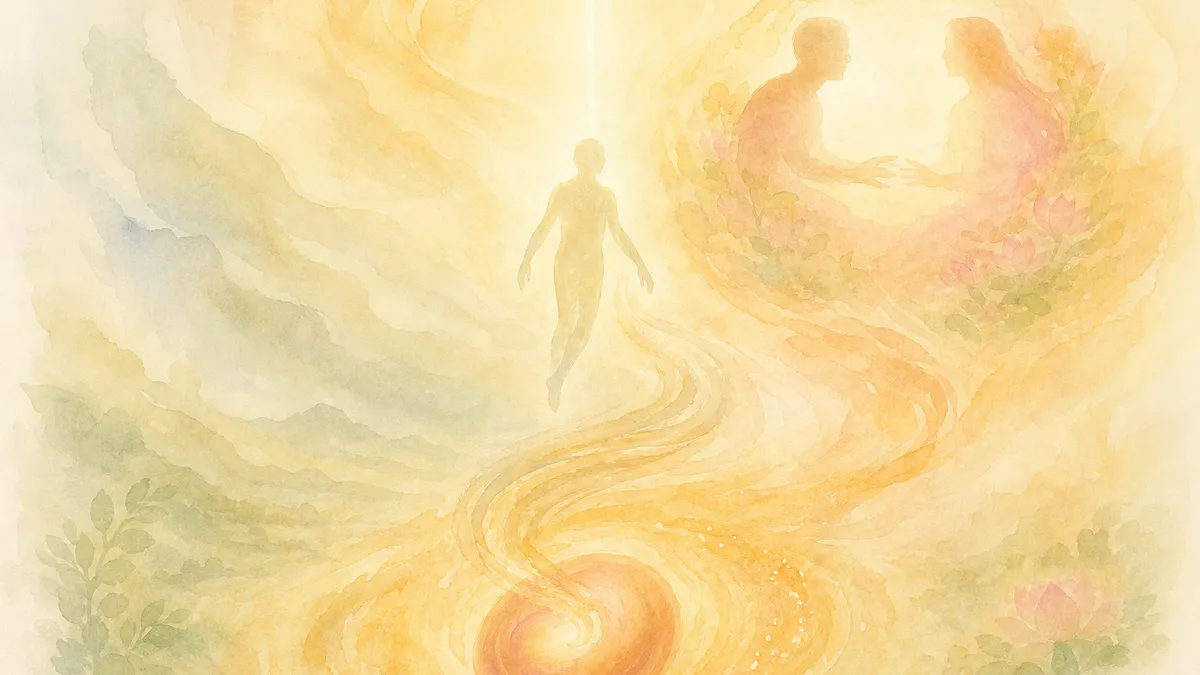
The true power of contemplation is an astonishing immersion into the depth of reality, when the subject is fully reunited with the object. There is a specific term that explains the principle of the intermediate state, or the bardo of dharmata. After the three main kinds of light that are experienced during rebirth, if reunion with this kind of light has not occurred, then the experience of the bardo of dharmata begins, when sound, light, the sound of the devata manifest from the light. At this time, very intense visions of peaceful and wrathful deities appear. A person hears powerful peals of thunder, sees blinding flashes like thousands of suns, as well as five-colored, dazzlingly radiant spheres emitting light like laser flashes. All these visions shake him, terrify him, and bring him into such a state of shock, numbness, and stupor that he loses consciousness. It is as if the four cardinal directions have disappeared, and space and time have begun to fold in on themselves. This is an astonishing, very powerful experience at the moment of death.
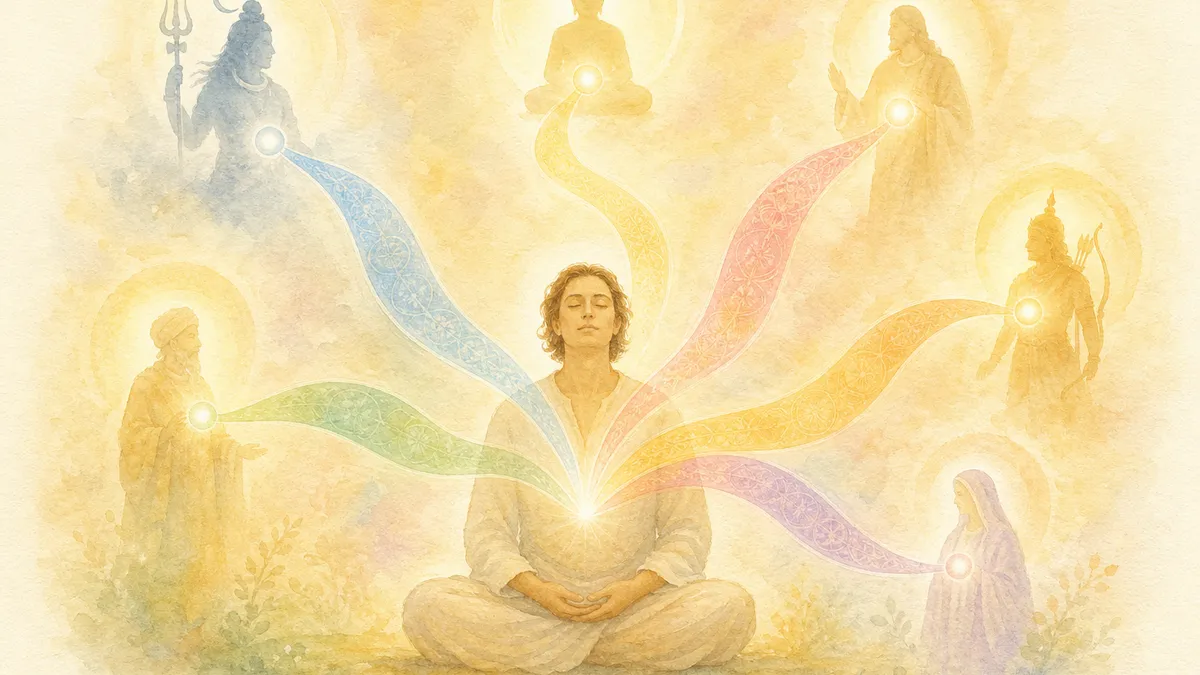
An experienced practitioner can remain in contemplation at this time, integrating with all the visions, and attain one of the highest kinds of liberation; however, this is extremely difficult to achieve. At this time, a person also sees various beams of light emanating from his chest. This light is wonderfully grouped, shimmers, and emerges like banners or carpets. It is a five-colored radiance, at the end of which a shining bindu appears, surrounded by a five-colored halo. These beams of light culminate by entering the hearts of the deities that manifest. The deities at this time manifest in their fullness: with attributes, ornaments, and in characteristic poses. The deities whom the person worshiped during life or whose practice he performed appear. That is, a Christian will see Jesus and the Virgin Mary, a Buddhist will see the Buddha, a devotee of Dattatreya will see Dattatreya, one who reveres Shiva will see Shiva. Someone who did not practice worship of deities will most likely not see the deities of any religion, but will see those visions that once in life evoked admiration in him. Nevertheless, everyone will encounter the manifestation of light and sound.
These visions will be dazzlingly beautiful, astonishing, majestic, and will fill the entire Universe. If the practitioner does not leave his contemplation and is able to understand that these visions are his own mind, his own energy, he will be able to unite with them. Having integrated with them, he will draw these visions in, just as a spider can draw its web into itself. Being in deep contemplation, he will allow these visions to enter consciousness and dissolve. Then he attains one of the kinds of liberation. This is one of the methods inherent in the highest practices, such as jyoti yoga and nada yoga. At this time, everything around is also seen: mountains, rocks, trees, and so on. But it is seen differently, as if veiled in a haze, a mirage, a five-colored radiance. A person also has a body resembling the former one, but it consists of light, although it may seem to him as if it were an ordinary physical body.
At this time, it is important how well the yogin is trained in the contemplation of presence, and how much he understands the entire world as manifestations of his Mind. Imagine that right now you were to see in the sky an enormous wrathful or peaceful deity. This would cause some fluctuations in you: interest or fear, delight or admiration. It is very difficult to think that this deity is your own energy, only more subtle. Nevertheless, this is so.
Once, a long time ago, I was practicing in retreat, and I had a lucid dream. In it I saw myself in the form of one saint—Paramahansa Yogananda. It was me, but my body was his. I was standing on the shore of the ocean. Suddenly two gigantic deities appeared and walked upon the waters of this ocean. Each of these deities was about the size of a nine-story building. They glowed with pink-red light and emitted a dazzling radiance. At that time, the voice of my Guru also appeared, saying: “You will not attain enlightenment until you understand that all this comes from within yourself.”
Then I saw two pink beams of light stretching from my chest. When I concentrated on them and entered presence, these deities dissolved, as if drawn back into the heart. This is how the process of insight takes place: that all visions are generated by your own energy. Thus, the entire Universe, galaxies, and all visible worlds are simply the radiance of light emanating from us, projected by ourselves.
The Nature of Visions and the Process of Rebirth
When we contemplate deeply, such insights arise in us, and we penetrate the nature of Reality. What will happen if a person does not understand this? In the bardo, in jyoti yoga and in nada yoga, there is an opportunity to understand this through the generation of visions and sounds. Nada yoga, jyoti yoga, and contemplation practices generate such experiences even during life. But an ordinary person cannot encounter this except at the moment of rebirth.
If a person does not understand this, he takes these visions for something real, becomes frightened by them, and falls into a state of shock. Then pure visions are replaced by impure ones, and the light of the six worlds of samsaric existence arises. Finally, one of the worlds begins to shine more brightly, something in the person responds, and he wants to go into that world — this is how rebirth occurs. The response depends on what remains unpurified in the person. And the cause of rebirth depends on what attachments were present at that moment.
For example, if someone was attached to someone, he will see scenes of attachment and think: “Oh, this is the person to whom I am attached; I must do something about this.” He will not understand at all what is happening. As soon as he thinks about it, his subtle body will be drawn into the womb. And the law of karma will give him the opportunity to experience the processes of attachment again.
It happens that the cause of this birth for many people is envy, anger, attachment, and the like. That is, this birth might not have happened at all, but in the bardo they made such a fatal mistake due to their unconsciousness, and therefore were drawn into the womb.
When we practice, we should be not merely vigilant, but very vigilant. We pay for our inattention with a new birth. This is like walking on the edge of a blade. Only saints understand how important this is.