

Commentary on the text “Tripura Rahasya,” Chapter 17, “On the Futility of Fleeting Samadhis and the Path to Wisdom.”
“Seekers of the lower class attain wisdom over the course of many births. As for those of the middle class, they attain wisdom within a single lifetime, but slowly and gradually, according to the above-mentioned scheme:
(1) studying the truth;
(2) becoming convinced of it;
(3) meditation—samadhi with qualities and samadhi beyond qualities.”
Seekers of the lowest category, belonging to the pashu category, attain awakening over the course of many births. If they begin practicing in one lifetime and do not complete the practice, they continue it in the next life. Seekers of the vira category, spiritual heroes—that is, those of the middle category—attain complete awakening in this lifetime, but only toward its end, after passing through numerous stages. Seekers of the highest category complete their awakening in this lifetime within a short period of time. Nevertheless, they all follow the same process:
shravana—studying the highest truth;
manana—reflecting on it, developing a new direction for one’s value strategy, revising one’s picture of the world, and changing one’s inner worldview;
nididhyasana—continuous meditation on the highest truth.
Shravana—True Listening to the Teaching
In traditional teachings, shravana is usually understood as listening to the teaching. For example, when you hear that all the values of this world are illusory, that the world is impermanent, that your consciousness is separate from the body, that there is a primordial Source, a great Mind; when you hear the teaching of the siddhas and take all of this into account as a certain conceptual truth, reflecting on it, this may be called shravana. But in the Laya Yoga tradition, shravana means something more—a non-conceptual direct introduction. In other words, elucidating the frameworks of the teaching, explaining impermanence, the law of karma, and rebirth is lower-level shravana, while true shravana is when a teacher transmits nondual vision to a disciple from heart to heart, when a kind of spark seems to arise between two minds, and the disciple briefly resonates with the teacher’s nondual vision, experiencing the same thing. This is authentic shravana.
The term “shravana” literally means “listening.” But from the perspective of Laya Yoga, the disciple listens to the teaching not with the ears, but with the spirit, with the heart. This teaching is transmitted not through language, but through awareness. Naturally, listening in this way requires receptivity, empathy, attunement, openness, the ability to be empty, and the intuitive capacity to understand what cannot be seen. When we understand in this way, a spark of awareness flashes within us.
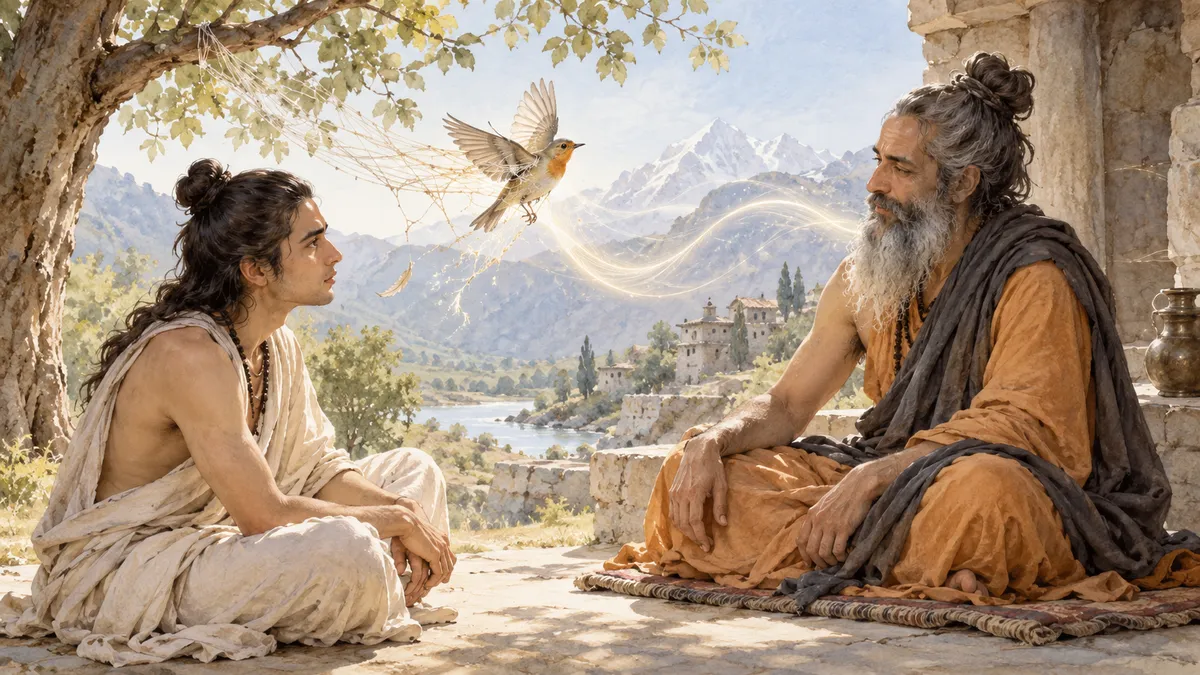
Once I was speaking with a rather prominent person, and he asked me questions about the teaching with great interest. When I gave him explanations, he sincerely tried to understand, but he was unable to grasp the essence. He said to me, “You keep saying ‘to know, to understand, to be aware of one’s state.’ But what is that?” I felt like Gorakshanath, who, by snapping his fingers, telling parables, and using other means, brings the sleeping Minonath to his senses. The text “Gorokho Bijoy” says: “Minonath’s soul struggled like a bird caught in a snare, trying to understand what Gorakshanath was saying.” In the same way, for about three hours I tried to convey the truth to his consciousness, but it was not easy; because he lacked the necessary preparation, shravana had not yet taken place. But true shravana is when the teacher merely hints at the ineffable and the disciple immediately understands everything; something within him responds, and somehow he catches this wave.
Manana—Reconsideration and Clarification
Next comes the stage of manana, that is, reconsideration. In the ordinary practice of manana, the disciple reflects on the teachings received and tries to compare them with his own life. But in the Laya Yoga teaching, the disciple tries to clarify his own state rather than concepts. He tries to clarify the experience of nondual awareness he has just had and to understand how to live with this experience from now on: what to abandon and what to cultivate.
From the conventional point of view, manana means contemplating the law of karma, reincarnation, the meaninglessness of all paths except the spiritual practice of liberation, suffering, impermanence, old age, illness, death, the greatness of the path of liberation, the importance of accumulating merit, the importance of belonging to a lineage and a school, the teacher-disciple relationship, the distinction between Atman and non-Atman, body and consciousness, the path of the great saints and rishis, renunciation, and devotion to truth. All this is encompassed by ordinary manana. But in Laya Yoga, manana does not mean this, although this path is also necessary at the beginning. In Laya Yoga, we clarify nondual awareness as such; we try to understand what the self actually is, what this subtlest “I am” awareness is. Who am I? We try to clarify this point completely for ourselves.
When we clarify “I am” awareness, we restructure our system of values. This means that all illusory goals and plans recede into the background, while clarifying “I am” awareness becomes paramount. Until “I am” awareness has been clarified, everything else is meaningless. If we do not know who we ourselves are, what is the point of doing anything else, setting other personal goals, or engaging in anything else? All of this is meaningless. If the doer is unknown, what is the point of any actions? All such actions will be obscured and will not lead to genuine results. Such is manana from the perspective of the Laya Yoga teachings. We make the “great decision,” eliminating all uncertainty and doubt about how we should live and which direction of values to choose.

Nididhyasana—Continuous Meditation on One’s Own Essence
After the stage of manana comes nididhyasana—continuous meditation on what we have chosen. In our teaching, nididhyasana means constantly abiding in the primordial freedom of consciousness and sky-like clarity, becoming accustomed to such a view, and meditating continuously until it encompasses every aspect of our life, until it gains the power to eliminate all obscurations, cut off all arising karmas, and reveal our true being. Nididhyasana consists in meditating on our own essence; that is, we meditate on ourselves not as the body, but as the Absolute itself—Aham Brahmasmi (“I am Brahman”). We meditate without repetition, without creating mental constructs, without visualizing, and without reciting prayers, but by effortlessly attuning ourselves to this presence. We meditate with the subtlest layer of awareness, establishing our mind at a point of consciousness where there are no concepts, convictions, bondage to images, attachment, hope, or fear. We maintain a view in which there is nothing to defend, and a meditation in which there are no fixations whatsoever. Such is nididhyasana.
If you follow these three principles, then you are following the teachings of the siddhas and observing the golden rule: shravana, manana, nididhyasana. Of course, these are only the most general explanations. In the course of practice, there are many secondary factors—the so-called skillful methods—that must be applied.
Loka-Sangraha and Arruppadai—Principles of Service
There are two important terms: loka-sangraha and arruppadai.
“Loka-sangraha” means “universal enlightenment” or “universal well-being.”
“Arruppadai” means “showing the path to each and every person.”
The term “arruppadai” was introduced by the Tamil siddha Boganathar when, at an assembly of rishis, his proposed tactics and strategy for the siddhas to help suffering humanity were adopted. “Loka-sangraha” is also an ancient term that points to the path of helping all living beings.
When we practice contemplation, it is very important for us to clarify these principles as a strategy for life. This means that our motivation in practice must be completely selfless. If we try to attain liberation based on dualistic, selfish motivation while being strongly attached to the idea of ourselves as the body, it will most likely be impossible to traverse the path of awakening in a single lifetime.
Transformation of Mentality—from Limited Consciousness to Divine Consciousness
The path of awakening in a single lifetime entails discovering within ourselves the consciousness of a deity, which differs greatly from the consciousness of an ordinary, limited person. The mind of an ordinary, limited person dwells in gloom, restriction, and constriction; it thinks locally and is confined to minor, immediate problems. This is what is called karma. But a deity thinks in terms of eternity, infinity, rapture, bliss, ecstasy, pure vision, paradox, play, the single “taste,” parasattarka logic, boundless majesty, prosperity, an abundance of vitality, energy, and play. In other words, the mentality of a deity is something very different from the mentality we have at the outset.
One spiritual teacher said: “The mind of a materialist resembles a dreadful dark cave that smells of fish.” In other words, it is a state of constricted, limited consciousness. We must transform such a dreadful cave into a boundless ocean filled with purity, love, harmony, beauty, majesty, universality, vastness, paradox, play, joy, and bliss. In other words, we must displace the old mentality, completely replacing it with a new one. The principles of arruppadai and loka-sangraha mean that, in order to change our mentality, we try to behave differently in everyday life. We try to set global goals, think on a grand scale, and act selflessly. This means that we make it our goal to help all suffering living beings attain enlightenment, and we live for this purpose. In other words, we change the meaning and direction of our own lives.

Who among you can say that you are consciously trying to do something to help living beings? An ordinary person may say: “I do everything to help living beings: myself and another two or three people close to me,” but this cannot be called arruppadai or loka-sangraha. Following these principles implies that we think more globally: we think in terms of helping all humanity, all living beings in samsara. We do not merely keep thinking, “Oh, how wonderful it would be if everyone attained liberation!” Rather, we actually do something to make this happen; we live as though it were our own goal. Throughout our lives, year after year, we adopt this vision as our own guiding principle. This is also called service to the universal forces of enlightenment, Anugraha Shakti. We become, as it were, a medium, a conduit for higher energies that begin to act through our body. The Buddhist equivalent of this stance is bodhichitta, that is, altruistic compassion, through which we try to act by helping all living beings attain enlightenment.
When analyzing our lives, it is important to ask ourselves: “What is my life for? What is my practice for?” And when we adopt this stance, we see that it makes us far more open and receptive to the vision of the deity.
This does not mean that we adopt a dualistic stance, thinking, “I will save all living beings,” while separating ourselves from others. We adopt the stance of helping living beings without dualistically separating living beings from ourselves. We try to see the entire world and the whole universe as a manifestation of our own energy. Thus, this is a much subtler principle.
When you embrace this vision at the level of your values, you see your own life begin to change in an auspicious direction, as your goals start to coincide with the goals of the saints. It is very important to understand this principle in order to learn to live by it. If we lack this principle, spiritual practice may be intermittent, occurring from one retreat to the next, when we gain some experience and then samsaric energies seize us once again. But when we live by the principle of genuinely helping all living beings attain spiritual enlightenment, this means that, on the relative level, we have a higher meaning and purpose in life. We gradually displace the mentality of our own limited “self,” replacing it with the mentality of a deity.
Accepting Responsibility: The Transition from a Limited Being to a Deity
The ordinary limited mentality is this: “What can the world give me? What can I take from it? How can the world help me? What benefits can it bestow upon me?” The mentality of a deity attuned to the principles of compassion, aruppadai, and loka-sangraha is this: “What can I give to the world? What can I do for the world?” A limited being thinks: “The world must take responsibility for me. It must provide me with a job, a salary, a pension, and proper conditions, and if it does not, then it is bad.” This is a very immature position. A deity reasons approximately as follows: “I am responsible for the world in which I live; everything depends solely on me. By making an effort, I can change the world for the better. I can manifest what I truly consider very important, relying only on my own strength, because the world around me is a manifestation of my own consciousness. Neither politicians, nor religious figures, nor society, nor the state are obliged to do anything for me. I myself am responsible for my life and for the world in which I live. Until I accept this responsibility, this world will continue to develop as it does.”
It is precisely at this stage, when we consciously accept such responsibility, that we enter the state of a devata, a deity.
Maturity or lack of maturity manifests precisely in one’s ability or inability to accept responsibility. If a person lacks sufficient clarity, they think: “Oh! I won’t be able to do this. I won’t succeed. I’m incapable; I don’t have the necessary qualities.” They immediately limit themselves, thinking: “Such personalities tried to do this, but they failed. How could I possibly succeed?” But the deity’s vision is different: “I possess limitless potential. If I, as a practitioner, do not assume such responsibility, then who should assume it at all? If someone else who does not practice accepts responsibility, then they shape both the entire world around me and my destiny, my life. What, then, am I doing as a practitioner? Am I really going to passively watch everything in this world happen independently of my own consciousness?” It is precisely this acceptance of responsibility that signifies a mature approach and a transition from the state of a limited being to the state of a devata, a deity.
The position of an ordinary person is this: I do not accept responsibility but rely on external things; I believe that the world and the people around me owe me this or must provide me with that, while I simply remain passive, accepting it as good fortune. But the deity’s principle is fundamentally different: I am self-sufficient, meditative, and constantly developing my potential; I am sufficiently aware to accept responsibility and manifest myself by accepting such responsibility; I am not afraid of such responsibility.
The Story of King Vasu: An Example of Accepting Responsibility
In ancient times, there was a king named Vasu who accepted responsibility by taking the side of the gods. Once, a dispute arose between the rishis and the gods. The gods said that rituals and sacrifices should be performed in one way, while the rishis said they should be performed in another. Upon seeing King Vasu, they decided to ask him for advice, since he was an outstanding yogi who had attained awakening and was endowed with every virtue. Vasu decided to support the gods because he saw that their reasoning was more profound, although the rishis had accumulated great power through spiritual feats and asceticism. When Vasu took the side of the gods, some of the rishis became indignant and cursed him. As a result of this curse, he was forced to leave the realm of the celestials; once able to walk through the sky, he became an inhabitant of the lower worlds, the underworld. Seeing that Vasu had suffered for the truth, for the higher path, the gods vowed to support him. Throughout his time in the underworld, they made offerings and performed rituals for him five times a day. Thanks to this, even while dwelling in hell, he experienced bliss by receiving nectar. The gods then decided to appeal to Vishnu and ask him to rescue Vasu. They said to Vasu: “The power of the rishis’ curse cannot be revoked, for the law is such that their sankalpa must be fulfilled; their merit and tapas cannot be allowed to go to waste and remain unrealized. But neither can we reconcile ourselves to your suffering. We will do everything possible to bring you out of the lower worlds.” They appealed to Vishnu, and Vishnu summoned Garuda, his devoted disciple and servant, and commanded him to manifest an illusory body and siddhis, descend into the lower worlds, and rescue Vasu. As a result, Vasu soon emerged from the underworld, burned away the consequences of the karmic curse, and in his own body returned to the world of the gods, after which he attained the supreme state of Brahma.
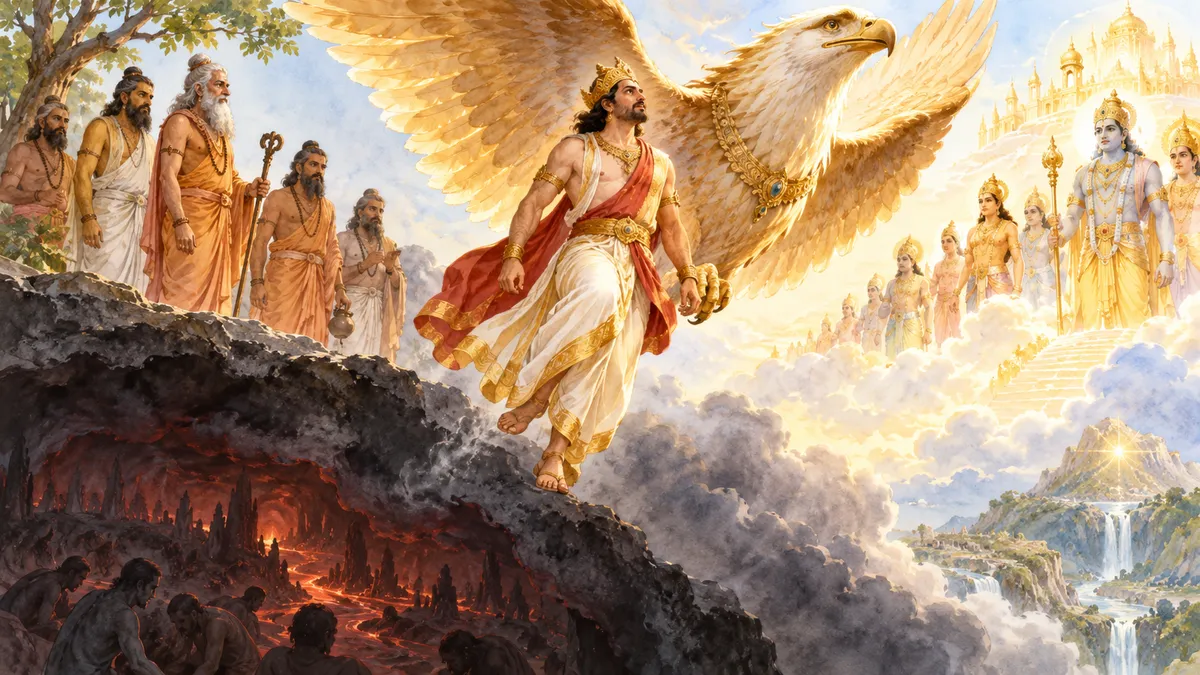
Thus, when we take responsibility, it involves a more mature functioning of consciousness. For example, wishing to help all living beings, I strive to attain liberation as quickly as possible, and so I practice consciously. Wishing to help all living beings, I engage in some form of service, become a monk, and act in a certain capacity, taking responsibility for my own decision.
