


Let us begin examining in greater detail the teaching of the 16 stages of the waxing moon of inner awareness. Since this teaching determines our path and our entire life, it is very important to understand its stages deeply, to recognize the signs of passing through one stage or another, and to know the main practice methods that need to be performed.
I asked some disciples: “Which stage do you consider yourself to be at?” One said: “I am at the stage of tempering.” The second said: “At the stage of creating the mandala.”
It is very important to understand the meaning of the teaching and which step you are currently on.
Why is it important to understand this? So that you know what your next stage is and what you need to do at your particular stage of life, since we all have different circumstances and different levels of understanding. The teaching works individually, so we must determine personally where we are. Perhaps someone really is at a high stage of realization, but if, out of pride, we say, “I am at a high stage of realization,” this will not benefit us, because we will have incorrectly determined our level and incorrectly chosen the strategy and tactics of the path, and therefore will not be able to truly realize what we want.
The Need for the Right Life Strategy
A human being is an evolving, changing creature. We go through the stages of birth, growth, preservation, destruction, and death. Like all living beings in this world, we pass through various cycles. We are all changing; we are in a continuous flow of change. And if we take this into account, we should consider how to choose the right life tactics within this changing flow. If we choose the wrong life tactics, this is dangerous, harmful, short-sighted, immature, and brings suffering.
If we look at the world, few of the people preoccupied with material problems choose the right life tactics. As a rule, if a person does not strive for awakening, their entire life strategy is wrong, deluded, and superficial.
Sometimes it is astonishing to look at modern civilization. It seems that humanity is at the level of a child’s perception of life. And this is astonishing. It is selfish, restless, petty, short-sighted; it sets the wrong goals and does not even achieve those, and it has no global strategy for the development of civilization as a whole—all of these are signs of a childlike civilization. And we live in such a civilization.
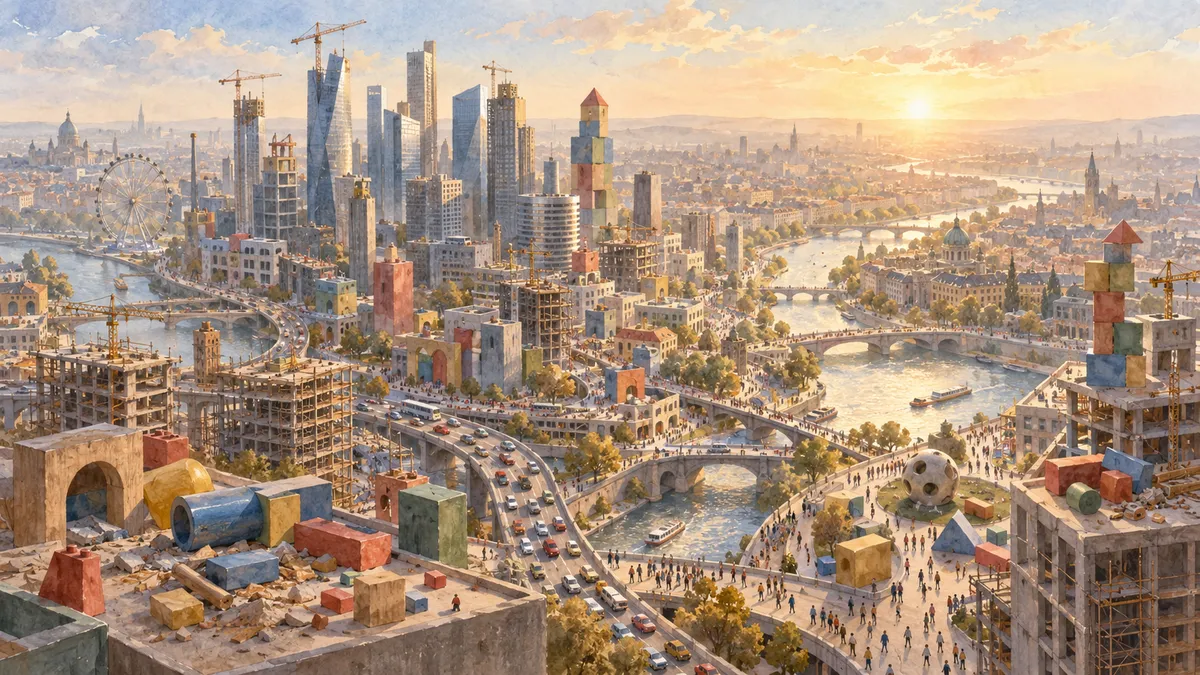
Why should we live in such a civilization? Do you like it? I do not.
I do not want to have the same goals, the same plans, or the same worldview as today’s civilization. This does not satisfy me at all, since it is an entirely childlike level of life. One cannot live this way; it is harmful, foolish, short-sighted, and even dangerous. The way humanity lives today—with its selfishness, hatred, constant hostility, intolerance, lack of tolerance, wars, absence of any global goals for development, and rivalry—is not the life of mature people. Living in this way, with such goals and plans in life, it is fundamentally impossible to build anything normal.
After all, we are changing beings, and reality constantly challenges us. And the greatest challenge is time, impermanence. One must have a very deep consciousness in order to “dance” with reality adequately, to respond and react appropriately to the challenges of time, not to perish when confronted with these challenges, but, on the contrary, to stay afloat and move forward. Since we are changing beings, we should understand how, amid these changes, not to sink downward, into the depths, but somehow to rise upward, constantly progressing and developing.
Vikara is a Sanskrit term meaning evolution, change, and adaptation. And the main task of a human being is spiritual evolution. Only spiritual evolution is capable of teaching us to respond adequately to the challenges of time. As soon as we stop evolving, we can no longer respond adequately to the challenges of time; we are simply erased, whether we want it or not. But it seems that human beings as such do not understand this: they make short-term plans, set petty goals, do not try to foresee the future, do not try to position themselves in the future or lay the causes and effects that will bear fruit for them in the future. If they do not do this, they find themselves at a broken trough when the future arrives. Why? Because the right causes that could have led to the right effects were not created.
Our goal (vedartha) on the spiritual path is to attain the consciousness of the universal human (Vishvanara). In other words, a being who is awakened and enlightened is, at a minimum, a universal human (Vishvanara). This is not a person narrowly fixated on their own selfish, familial, clan-based, racial, national, or individual preferences, but a person possessing global universal consciousness and the state of Vishvarupa, that is, the state of a being who possesses all forms.
Thus, the teaching of the 16 stages is the teaching that gradually leads us to a deeper view of the world and, accordingly, to the development of a deeper life strategy. There is prama—the true—and there is bhrama—the erroneous. The Russian word «прямо» (“directly”) corresponds to the term “prama” as an analogy; that is, it means “to see directly.” True perception of the world is also called jnana. Erroneous perception of the world is called ajnana, avidya. The essence of spiritual practice is to free ourselves from erroneous perception of the world and attain true perception.
Advaita Vedanta
True perception, when speaking at the level of the deepest meanings, is contained in the four mahavakyas of Advaita Vedanta. These are fundamental formulas that define your affiliation specifically with the school of Advaita Vedanta. They are the condensed creed of Vedantic philosophy.
They are as follows:
“Prajnanam Brahman”
“Aham Brahmasmi”
“Tat Tvam Asi”
“Ayam Atma Brahman”
These four sayings contain the very essence of the teaching of Advaita Vedanta. Every school of Advaita Vedanta defines itself according to these four mahavakyas.
The first of them—“Prajnanam Brahman”—means “pure awareness is God, the Absolute.” The essence of this mahavakya is that we seek absolute truth not somewhere outside, nor in concepts, but in the flow of our own consciousness. When the mind is cleansed of conceptual thinking and all mental impressions and impulses (samskaras), it begins to shine like a pure space of awareness filled with light, in which there is no duality.

“Aham Brahmasmi” means “I am the Absolute; I am the Supreme Himself.” When the purified mind begins to comprehend its own nature, the ego—the complex of dualistic notions burdened by past experience, karma, and mental impressions—begins to dissolve into itself. Then, in the deepest layers of consciousness, a person discovers their connection to the Supreme Source, which completely overturns their notions about themselves and changes their own self-identification.

The principle of “Aham Brahmasmi” means that we do not belong to ourselves; we are not our own. We think that we belong to ourselves and can do whatever we please. But nothing could be further from the truth. Moreover, the most shocking truth is that we are not even ourselves at all. And Advaita Vedanta immediately states plainly that this teaching is transcendent. While the teaching of Dvaita always compromises by separating absolute truth from our consciousness, the teaching of Advaita is radical; it says: “You do not belong to yourself. Moreover, you are not you at all. What you think of as yourself is a delusion.”
And here a major conflict of motives, values, ideals, and meanings begins. On the one hand, our old upbringing, our old values, goals, and ideas tell us that we are the body or a complex of ideas, while at the same time various self-identification programs are also at work: son, mother, father, boss, Russian, American, and so on. People are very fond of identifying themselves with something. It seems that the human mind is characterized by an incessant drive toward self-identification. People like to say: “I am Russian” or “We, the older generation, know...” In other words, the mind always has an uninterrupted drive toward self-identification; it loves to identify itself with something.
But the teaching of Advaita, the mahavakya “Aham Brahmasmi,” is a shocking challenge to our ego. When a conflict of values, meanings, and motivations arises, an inner struggle begins, in the course of which the ego—that is, old motivations, meanings, and values—must surrender, submit, and be pacified.
When can they surrender? When the space of the Source, higher values, and higher meanings are recognized, when the space of awareness can truly reveal its light and begin to send its grace (shaktipata). And everyone goes through such a conflict of meanings and values when they practice. And not only in Advaita, but in any religion. In a sense, sadhana is always the crucifixion of the false ego on the cross of nondual awareness. And until such a crucifixion takes place, realization is impossible.
The third mahavakya – “Tat Tvam Asi” (“That Thou Art”) – points to our belonging to God, to our divine nature by definition.

In Christianity, there is the doctrine of original sin. But just as Christianity has the doctrine of original sin, the teaching of Advaita has its own postulate – the postulate of primordial divinity. It says: “Whatever you may think about yourself, first and foremost you are That – the absolute and transcendent. You are not a human being, not a man, not a woman, nor anyone at all; first and foremost, you are That – the supreme Absolute Being. The question is to what extent you allow yourself to acknowledge this, to what extent you possess the openness, awareness, faith, and aspiration to acknowledge this fact at every moment of your life.”
Once I was invited to conduct classes in a city in Ukraine. And when the question of choosing a time for holding the seminar came up, I was told something like: “Better not in summer, because at that time everyone is at their country houses.” I was even embarrassed by such an approach to planning seminars on the teaching and thought: “Maybe they should just stay at their country houses. Maybe there is no point in my going there at all if that is their level of motivation.” I am not prepared to treat the teaching in such a way as to adapt it to the summer country-house season. It seemed to me that the teaching was a much greater treasure than working on a garden plot.
Unfortunately, when you preach the teaching, you inevitably encounter this, because any teaching, even the highest, if it is popularized and becomes widespread, inevitably begins to “lower the bar” when confronted with human limitations. I myself have always been against the profanation and immature popularization of the teaching. I do not believe that the bar of the teaching should be lowered for the sake of popularization. My position is that it is better for others to rise to the level of the teaching than for the teaching to be lowered.
Unfortunately, many contemporary neo-Advaita teachings disseminated in the West follow this popular style. In a certain sense, the popular style is beneficial, since it enables many people to feel a connection with spiritual teachings. Nevertheless, it indulges our egoism and our limitations far too much, and therefore brings little benefit. It contains no radicalism, no true, profound transition. But the meaning of the teaching is to bring about transformation and change, to lead us out of a limited state.
Therefore, the teaching of the siddhas is always presented more restrainedly, more carefully, and only through samaya. It does not strive for popularization, since popularization inevitably vulgarizes. Nevertheless, if the teaching is transmitted through a samaya connection, through the authentic spirit, it does not lose its power even as it spreads, because we preserve samaya and safeguard the spirit of purity.
The spirit of purity of the teaching is transcendent and very radical. Practicing the teaching requires the soul (jiva) to make great efforts, engage in much tapas (asceticism), struggle with itself, undergo purification, and overcome obscured states. The challenges it presents to us are immense, and therefore serious spiritual work, a radical reassessment of meanings, values, and goals is required; then it will work.
The fourth mahavakya is “Ayam Atma Brahman” (“This consciousness is the Absolute; this Atman is Brahman”). Our consciousness has always been absolute; it is just that at some stage of our lives, the channel of connection with our divine consciousness (dhyana-vahini or atma-vahini) was severed. It is like having a connection that suddenly breaks: you have left the coverage area, you have gone too far into matter, into material life. When this channel of connection was severed, absolute divinity and absolute consciousness ceased to be felt.
Consciousness is characterized by sat-chit-ananda. Translated into understandable language, this means the Supreme, the Truthful, the All-Wise, and the All-Benevolent (truth, knowledge, and bliss).
The Supreme Source within us is incomprehensible and indefinable (achintya, nirguna). It is the universal support (adhara) and the Lord (Niyantri). It is all-pervading Consciousness (Vibhu) and the All-Pervading One (sarvagata). This Consciousness is the primordial source of all consciousness that exists (chaitanya), all wisdom (vidya), and all love that exists (kripa). It is also the primordial source of eternal creation and eternal manifestation. It is the Supreme Lord of all that exists—Parameshvara. It is the root cause of everything that happens in the universe, time, and space (mulakarana). It is perfect freedom (kaivalya, svatantrya). And all of this is inherently built into us by definition.
But at some point, the higher circuit of our consciousness was switched off. For example, if we switch off this microphone now, audibility will be significantly reduced; something may still be heard, but it will be difficult to make out, since the sound will be unclear. In the same way, when the higher circuit of our consciousness is switched off, we fail to recognize this Source. We do not believe in it, understand it, or trust it. These two main factors—the disconnection of the higher level of consciousness (buddhi) and the severing of the communication channel (atma-vahini)—are the reason why living beings in the world of samsara remain in ignorance, why they choose false paths, and why they become deluded. This happens because discerning wisdom (viveka), which makes it possible to distinguish prama (the true) from bhrama (the erroneous), is absent.
The First Stage: Dissatisfaction
Thus, the first stage in the teaching on the 16 stages of the waxing of the moon of inner awareness is called “dissatisfaction.” The goal of spiritual practice is liberation. The goal (vedartha) of the siddha tradition is to attain liberation from limited existence, which is full of illusions, ignorance, and suffering.
But what does it mean to attain liberation? Liberation from what?
It means attaining liberation from our limited karmic vision, that is, leaving this karmic vision behind. When we embark on the path of the teaching, it does not mean that we hope to remain in this state forever. After all, we have set out on the path of evolution; we have chosen the path of evolution. This means that we must continually increase our efforts, that reality both within and without must change, and that we must truly free ourselves from the limitations in which we remain. We do not hope to exist forever in this material world, or that it will give us all happiness, joy, and freedom.
Why do we not hope?
Because this world is unreliable and impermanent. How can one place hope in it if it is like an airport to which you fly and then depart? No one lives there for long. How can one hope in such a world? And those who place their hopes in this world are deeply deluded; I would even say that they have serious problems, because they hope for something that, in principle, it is impossible to hope for. If this world were permanent, if we were also gathered in it in the twenty-seventh century and this were guaranteed, then one could place hope in this world and become absorbed in its activities. But as one medical student said in the 1970s, summarizing his term paper on the analysis of life expectancy: “We live in a world of one-hundred-percent mortality.” This is a world of mortals, and therefore it cannot be relied upon.
Attaining liberation means leaving this world for another, higher world. And we must understand what kind of world this is. Attaining liberation means that we are trying to transform ourselves spiritually. And walking the path of such spiritual transformation is far more important than all other things. But if we do not transform ourselves, what is the point of practicing the teaching?

Sometimes it happens that I meet someone who took Refuge as far back as 1998, and I see them only many years later. But spiritual transformation, beginning from the moment of taking Refuge, means that we truly enter a certain stream of transformation, so we no longer have time to get distracted; we do not have time to engage in other things any longer than necessary, because transformation is a stream that requires your complete involvement and total dedication. If you scatter your energy, you yourself will ultimately lose, and your transformation simply will not take place.
Therefore, when we embark on the spiritual path by taking Refuge, we should always reflect on the fact that this is a choice in favor of a completely different life, an entry into a new stream. Ultimately, spiritual transformation means becoming an enlightened universal human being (Vishvanara), and then an immortal, omniscient, omnipresent, all-pervading, omnipotent divine being. Such divine beings were traditionally called devas or siddhas.
In the human world, in the status of a human being, there is no freedom in principle, no liberation. This is similar to how a person of commoner status tries to influence the economy or politics. Whatever they do, they will be told: “You know what? You’d better leave.” It is impossible; they do not have the right status, and no one will even listen to them. To attain freedom, happiness, and liberation, one must change one’s status.
The Human Status and the Need for Transformation
The human status is a low status that does not allow one to control one’s life, time, space, or the five elements. It is a status in which, on the contrary, everyone controls you. In other words, it is not an operating being, but an operated one. We are speaking primarily about the inner ontological status of consciousness. Until we change this status, nothing will happen.
Every living being possesses a certain karma. And its status as a being is determined in accordance with past mental imprints and past karmas. Status determines its karmic vision, and all of us, while inhabiting a human body, likewise possess the human status. That is, we share the common karmic vision of the human world. If we analyze it, humanity is not a particularly successful civilization, and a human being is not a particularly exalted being in the universe. On the contrary, this world and this karmic vision constitute a dimension where there are many limitations. But at the same time, is human birth precious? Why? Because it offers the opportunity to work with these limitations and free ourselves from them.
And our goal is not to remain in the human state, not to remain in this status, because nothing can truly be resolved, attained, or accomplished within it, and we need to go higher, to move forward. Even if a person is a king, a multibillionaire, or anything else, they are still a king or a wealthy person in the human state. It is just like a purebred dog with a beautiful collar is still a dog, and it will never rise to the level of a human being unless it changes its ontological status.
Liberation as an Exit from Collective History
To attain liberation means to change one’s inner status of awareness, to become a divine being (deva, divya), to cease being reborn in the impure worlds, in the impure universes of samsara. It means to leave the collective history in which we are all inscribed, to break out of the unbroken chain of cause and effect, and to make the transition into a transformed, spiritualized reality, into a reality of pure vision, into a pure dimension created by the mind. That is, into a mind-governed personal universe in which a personal history (lila) exists, having become its central deity (mandaleshvara). It is important to understand this.
At present, we are under the yoke. Whether we want it or not, whether we deny this fact or not, we are under the yoke of cause and effect, under the yoke of the law of karma. And this law of karma affects us. In fact, we are completely dependent on it. The laws of nature, physical laws, constants, and the laws of biology and bodily chemistry also affect us—all of these are limitations. We may not notice these limitations, but they exist and dictate the “prose of life” to us. All these limitations are conditionally called the law of karma, that is, the law of cause and effect. And according to the law of karma, we are integrated into collective karma. If karma is understood as event sequences unfolding over time, that is, causes that produce effects and pass into one another, then we are integrated into the karma of humanity, the karma of the solar system, collective karmas, and collective history. Unfortunately, in this collective history, we are not important subjects; rather, we are objects of this collective history, those who are not asked, those who, like splinters in a great river, are simply carried wherever they need to go: from life to death, from one body to another. When a river carries its waters, the splinters in it float along as well, and the river does not ask each splinter, “So, where would you like to go?” During a flood, the river simply carries splinters, logs, and small animals in a certain direction. But this is precisely the state of collective history, when you are a powerless statistic in all events. And few people like such a state—to be a splinter in the collective history of karma.

Liberation is when we leave collective history, when our personal history begins—that is, not karma, but lila, the divine play of the natural state, when event sequences, causes and effects, originate not somewhere in external objects but from your own consciousness, when you yourself are the creator, when you are not a powerless statistic but the principal subject of psychohistory, that is, when history is replaced by psychohistory. Psychohistory means that a psi-factor, that is, consciousness, is introduced into causal relationships, into collective karma, and into event sequences. In other words, our consciousness, our will (icchā-śakti), begins to act as an authoritative volitional operator. Now it is no longer a splinter but a subject that determines where to go, at which stop to get off, or whether to continue onward.
Personal history means that the events of reality are not separate from consciousness, that they are entirely governed by the will of the mandaleshvara, that is, the divine being into which we are destined to be reborn, by the will of the central deity. And such collective history is replaced by psychohistory. Causal sequences of events, that is, the evil infinity of uncontrolled causes and effects, are displaced by the play of divine consciousness (lila). But for such displacement to occur, divine consciousness must be born within us.
The Five Main Energies of the Spiritual Path
To attain liberation means to become free. What does this mean? It means acquiring the energy of knowledge; that is, all of this is connected with acquiring a certain energy.
We usually speak of five main energies that are acquired on the spiritual path. The principal energy is called the energy of knowledge (jñāna-śakti). It appears at the moment when we attain an awakened state and recognize the nature of our mind as pure space of awareness endowed with immense potential, when we realize our potential. The energy of knowledge, in turn, gives us freedom of choice and freedom of will.
The next energy is called svātantrya-śakti. It means that we become free by mastering the energy of knowledge. To be free means choosing reality, choosing the world, choosing the story of events that you want; that is, it means always having a choice, having the ability to exercise free will. This energy of freedom (svātantrya-śakti) develops into the energy of divine will (icchā-śakti). And ultimately, liberation is the blossoming of free will and freedom of choice, when you are completely free.
When we live in this material world, we have almost no free will, meaning that our choices are very limited. Of course, we can make some choices, such as choosing the path of dharma or the path of illusion (and such choices are very important), but generally speaking, free will here is severely suppressed. For example, at present we cannot choose whether to live on Earth, on the Moon, on Venus, on Mars, or somewhere at the other end of the galaxy; whether to live for one hundred years, five hundred years, ten thousand years, a billion years, trillions of years, or hundreds of kalpas, like Brahma. All of this points to the absence of free will and freedom of choice. In the limited state of samsara, free will is very strictly constrained. Liberation means attaining a state of consciousness in which free will can manifest unhindered, when consciousness is so powerful that it is no longer subject to the event sequences of karma, cause and effect, or collective history. It can itself move collective history and draw together the probabilities of cause and effect.
Everything depends on the level of consciousness. If consciousness is developed and possesses great freedom and power, such a person emerges from collective history. For them, lila, psychohistory, begins. If their consciousness is weak, they are integrated into the processes of collective history and karma and can do nothing about it.

Examples of this can even be found in ordinary, worldly reality. There are people known as passionaries. These are charismatic personalities, movers of history, who can influence historical processes. All outstanding people belong among the passionaries (whether they were good or bad is another question): Alexander Nevsky, Napoleon, Alexander the Great, Genghis Khan, and so on. All these people had a colossal influence on the course of historical events in this world. This means that their activated will (iccha-shakti) could shift the sequences of events to some extent.
The state of liberation is an immeasurably higher level. This means that you do not merely move the sequences of events, but emerge from collective history altogether and create your own history entirely. Your consciousness itself is the center of the universe, the central deity (mandaleshvar).
Attaining Absolute Freedom
Attaining absolute freedom means leaving the limited human world and creating a personal tunnel of reality, a personal space for living (a mandala). As a rule, none of us has such a personal space; we are all forced to share it with others, both on an individual and on a collective level. But attaining the energy of will (iccha-shakti) means creating such a personal space. As soon as we raise our consciousness to a high level of self-organization, to a high level of complexity, the laws of the material world lose their power over us. Finer laws begin to operate. This is similar to how the old economic laws do not operate in the world of information technology. Different, entirely new laws operate in the world of information technology. People who try to live in the information world according to the laws of the material world are unsuccessful. In the same way, the laws of the material world do not operate in the spiritual world.
If we live in this material world, we always have such fundamental categories as time, space, and energy. As a rule, all limitations are connected precisely with these fundamental categories. In other words, we either have no time, or we are limited in the space available for living. And if we have both, then we lack the energy to accomplish anything. What does limitation in space mean? For example, I would like a large hall for a seminar or something else very spacious, but they say: “Sorry, there is little land here, and there are many others claiming it.” What does limitation in time mean? It means that cause-and-effect sequences of events proceed very densely. Perhaps you would like to meditate longer, but you are forced to obey these sequences of events. In other words, you do not do what you would like to do because you have no opportunity to do so. Limitation in energy means that you lack the clarity or vital force to accomplish what you want or to change reality. These are the three fundamental limitations: in space, in time, and in energy.
What happens when the limitation of space disappears? It means that you have not merely a room for meditation, but an entire universe for your consciousness. For consciousness, there is no difference. It contains boundless, immense potential. And every person is a potential creator of an entire universe. This is the potential creator-god Brahma, a mandaleshvara who, through the power of consciousness, can create an entire reality. This is the absence of limitations in space.
The absence of limitations in time means that you are no longer conditioned by the hundred or ninety years of your life, but can exist indefinitely. There is no longer any need to worry that time is limiting you. At an extraordinarily complex, high level of consciousness, time can be compressed, stretched, accelerated, slowed down, made to move at any angle, turned into a loop or a time pocket, with certain events placed there for safekeeping until they are needed. Time becomes a category that can be operated with beautifully. And this is not fiction. Mahasiddhas demonstrated such things; they are described in the Puranas and the Upanishads.
For example, an angel or deity communicating with you may immerse you in a state in which you spend sixty years conversing with it, and then, when the conversation ends, you emerge from that state and see that only one second has passed in the human world—that you have not even had time to raise your hand to your head—although subjectively you have lived a complete life during that time. Divine beings possess the ability and power over time because their consciousness is rooted in that state which lies beyond time.
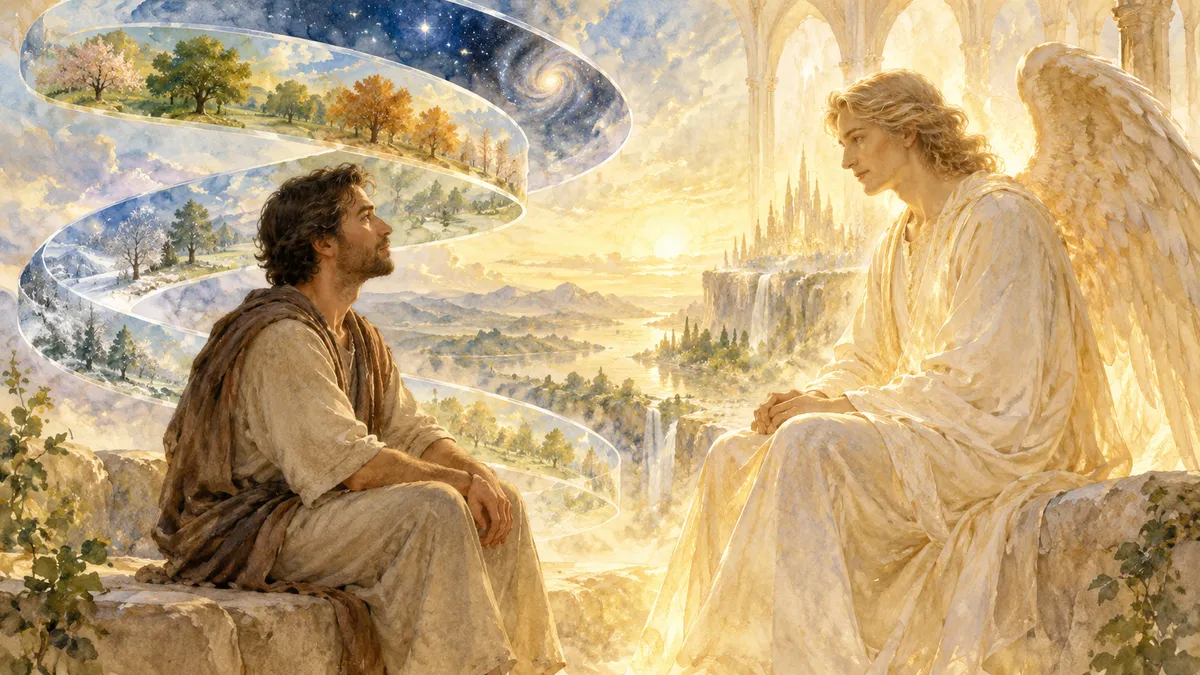
When we gain freedom in time, space, and energy, we can truly enter another reality, a divinely realized reality. Such a state means possessing the fullness of all divine powers. For example, the fulfillment of desires; controlling reality through the power of consciousness; the freedom to control time and space; realizing any intention, whatever it may be; possessing many bodies (multibodiness, mayarupa-siddhi); or becoming the possessor of all forms in the universe (vishvarupa-siddhi); the freedom to live at any point in space, in any dimension of reality (loka-siddhi), that is, multireality; the freedom to create, sustain, or destroy universes like the creator-god (iccha-siddhi). All of this comes at the moment of liberation, when the fullness of divine knowledge (jnana-shakti), divine freedom (svatantrya-shakti), divine will (iccha-shakti), divine sovereignty (aishvarya-shakti), and divine power of action (kriya-shakti) have been realized.
The Beginning of the Development of Awareness
Where does the development of awareness begin once we have defined the ultimate goal? If we have defined becoming a divine being as the ultimate goal, then there is a beginning—the moment when consciousness embarks on the path toward such becoming. The development of consciousness begins with acute dissatisfaction with the material world. The stage of dissatisfaction means that there is a major conflict of meanings and motivations. In science, this is also called cognitive dissonance between desires and possibilities, that is, between the power of consciousness and the restrictive laws of karma, the physical laws of material nature, and so on. This dissonance arises because our small “I” is alienated from the external world, meaning that duality exists. When we regard our small “I” as ourselves and identify with it, we are alienated from everything. By becoming alienated from time, we lose the ability to control it; by becoming alienated from space, we lose the ability to live in an expanded state of space; by becoming alienated from the universal energy, we are forced to draw energy ourselves from the small cocoon of the individual “I,” and this energy is very limited. The state of duality and egotistical alienation is like feeling that you do not truly belong in this world, in this universe; you are alienated from everything, and the universe is cold and merciless toward you. You are allowed to live here for some time within certain limitations, and afterward no one is particularly interested in your opinion. This is roughly what dependence on the law of karma looks like. Dissatisfaction means that we begin to become aware of this; we develop an awareness of impermanence, death, and the limitations of this world. Such awareness is experienced as suffering. Until this awareness has been experienced and suffering has been recognized, the motivation for spiritual practice will not be deep.
Once, one person was advised to reflect on impermanence, the law of karma, suffering, mortality, and so on. He said: “For me, such things are not motivation on the spiritual path; they do not interest me.” But the point is that regardless of whether they interest you or not, they still operate. Whether they interest you or not, you live under these laws and are subject to their influence. If you are not interested in them, then you do not know your enemy by sight and do not respect it. And how can you achieve victory if your enemy is unknown to you while you overestimate yourself? This enemy opposes you regardless of whether you know it or not.
Rishi Vasistha wrote:
Implacably, the “cat” of old age stalks and catches the “mouse” of youth.
Whether we like these laws or not, whether they motivate you or not, they operate independently of our consciousness. And it would be reckless not to take them into account, because when they come, you will say: “But I am not ready.” And then what? They will not say: “All right, we will wait. Get ready!” That is not how it works. When one becomes aware of such things, one comes to understand the meaninglessness of living in delusion.
What does “in meaninglessness” mean? It means that old meanings are discredited, and you understand that you need to develop new meanings. And until you discredit the old samsaric meanings in your consciousness, it will be difficult to develop new, alternative meanings, because the old meanings will always take up part of your consciousness and will always impose their vision. Within us, the subtle level of consciousness (buddhi) deals with meanings and values. All strategic decisions and values are adopted at this highest level of consciousness. When it is active, a person is always searching; they are not fixated on the old meanings absorbed at birth, but are constantly renewing their meanings. Their meanings are always alive and flexible, but in people the higher levels of consciousness usually switch off after adolescence, approximately by the age of twenty. In other words, the value matrix instilled by society, parents, and childhood upbringing crystallizes, and then a switch occurs—buddhi switches off, and mental programs begin to operate. When buddhi switches off, an ordinary person no longer searches. Thus, if a person absorbs the value meanings of the materially conditioned world (for example, to build a house, raise a son, become rich and successful, create a family and have children, and so on), they stop searching.
Attaining liberation means that we must reactivate the highest level of consciousness (buddhi) and switch off these old samsaric meanings. These meanings are deluded; they do not work, they are incorrect, and they have been created arbitrarily, based on a deluded state of consciousness and karma, so they cannot be trusted. These meanings are not divinely inspired; they do not proceed from the higher Source, but from a lower state. When this happens, the stage of realizing the meaninglessness of living in delusion begins. Life in the delusion of dualistic perception is always meaningless.
Realizing the Cycle of Rebirths
After this comes the stage of realizing the cycle of rebirths. We understand that we are not the body, but consciousness, the soul that animates this body (the subtle body). This subtle body can leave one physical body and enter another. When the body dies, we become spirits in the subtle body. Such a spirit enters the realm of spirits, where its own laws operate. For example, there are elder spirits who control various realms, watch over mortals, and determine when they will live and when they will die; there are spirits who decide which of the worlds souls should go to after death: hellish dimensions, pure abodes, or back to the human world. There are servants of these spirits who transport souls to various dimensions. One should not think that once the soul leaves the body, it can act arbitrarily. In fact, after leaving the body, the soul is also highly dependent. Various texts describe how messengers—the yamadutas, servants of the god Yama—come for a living soul that has left the body.
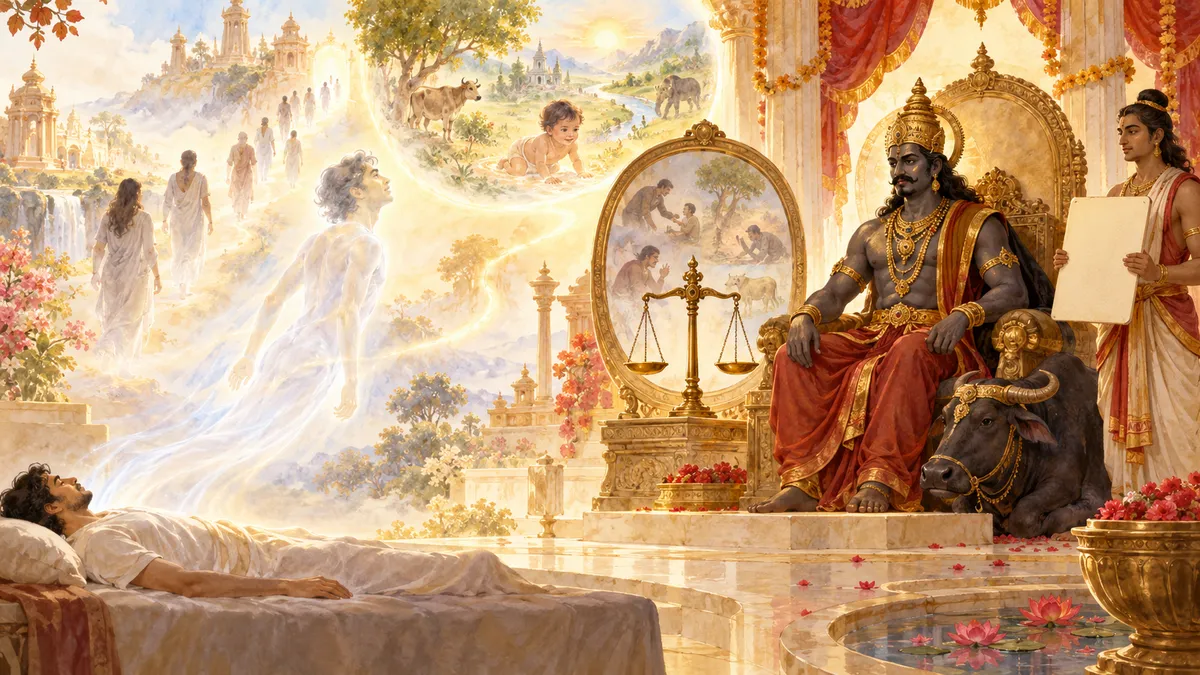
God Yama is the judge between life and death. When his servants come, the soul cannot resist them; they seem to pull it out of the body. This soul, in an intermediate state, arrives at a place where its past actions and consciousness are analyzed. There are many people in this place, and each of them undergoes something akin to Yama’s judgment. Yama is the deity who governs reincarnation, and every person appears before him. He determines the quality of the life that has been lived and, when necessary, looks into the mirror of karma or requests records from his secretary, Chitragupta. This deity is served by many spirits, both wrathful and peaceful. Every sentient being whose mind is not purified and who perceives the world dualistically appears before Yama. Depending on the spiritual tradition or religion, this deity may take the form of an angel, a deity, or a saint whom the person worshipped. This exists in the same way that, in our ordinary lives, there are, for example, representatives of the law. We cannot say that certain energies are absent from our lives, even if we follow the path of Advaita. In any situation, we cannot simply say, “Everything is Brahman, an illusion.” For example, when you enter the metro, you need to buy a ticket, and when a traffic police officer stops you, you need to show him your driver’s license; you cannot say, “Everything is an illusion.” This is energy, and energy must be respected.
If you do not respect the energy of local deities, it may end badly: you may be taken somewhere and put in jail. Even if you say, “It is all an illusion, Aham Brahmasmi. Brahman is real, and the universe is unreal,” these local deities will say, “Of course, you may continue to hold on to your opinion, but then stay here.”
We see that, whatever we may think, reality has energy, and this energy must be respected. Likewise, in the subtle worlds there are various energies associated with spirits and deities. When the soul enters this world, it must also respect these energies unless it possesses immense spiritual power. For example, if a person possesses great spiritual power, these energies cannot even approach them. However, as a rule, all living souls enter a world where Yama (the deity of death, the embodiment of justice) judges them.
Yama’s Judgment and the Law of Karma
To judge means to review their karma and ask questions: “Did you practice dharma during your lifetime? Did you accumulate merit, develop awareness, violate the principles accepted in your universe, violate samaya if you had spiritual connections, steal, do this or that?” Then everything is analyzed. If a person, wishing to defend themselves, says, “I am such a good person; I did this, this, and this,” Yama says, “Now we will check it in the mirror of karma.” The mirror of karma is a conventional term; it is something like an astral database. Then the assisting spirits and Yama’s secretary, Chitragupta, look into the mirror of karma, where everything is reflected in great detail. And sentient beings are amazed: “I didn’t even know that everything was taken into account down to the smallest detail.”
There are sutras describing this process, for example, a sutra recounting the story of Choyjit Dakini, a woman who entered an intermediate state. She was surprised that good and evil deeds, even the most insignificant ones, were recorded so meticulously.
If a situation of balance arises, Yama says, “All right, now we will weigh your black and white deeds.” At this moment, a white man descends from heaven, representing merit—the guardian angel during one’s lifetime—and says, “This person was so virtuous and holy that even heaven will not be enough for them. Look at how much merit they have.” And a black man rises from below (papa-purusha, the man of sin, the embodiment of the inner demon and inner impurity) and says, “This person was so sinful and has committed so many bad deeds through words, thoughts, and speech that even hell will not be enough for them.” And these two men argue with each other. In reality, they are illusory; they are products of our mind.
The astral world is highly paradoxical—in it, your mind can become personified; that is, your thought can manifest as a specific image or living being. Moreover, this living being will possess its own intelligence and may even communicate with you.
And when these two beings begin arguing about a person’s karma, Yama weighs white and black pebbles on scales. If, for example, the white ones outweigh the black, Yama says: “You were a virtuous person, accumulated merit during your lifetime, practiced giving, and observed the principles of your loka. You may go to the higher dimensions and enjoy pleasures there, and when your merit runs out, you will be born again into a good family.” Conversely, when there are more black pebbles, he says: “It seems you lived your life in vain; you accumulated harmful actions, practiced evil speech, and your thoughts were impure. Look, you did this, this, and this. And although you had a few good deeds, white seeds, you will go to the lower worlds, to the hellish dimensions.” When he says this, the spirits standing nearby, holding axes, hatchets, swords, and hooks, begin to grin maliciously, as they have been waiting only for this indictment. Then they quickly seize such a soul and begin leading it away. And such a soul says: “If there is anyone here who is going to the human world, tell people not to waste their lives, to accumulate merit, and to remember that hell is closer than the palm of one’s hand, and that everything we do in this life will have a very powerful effect on our subsequent life. Pass all this on to those who live on Earth.” In other words, such souls understand this principle of accumulating merit, purification, spiritual practice, repentance, and everything else far too late. They see that they are completely seized by their karmas. When such spirits take a soul to one of the worlds, a specific trial or punishment is assigned to it there, and the texts describe very many such trials.

Who does not undergo Yama’s judgment? Only one who possesses great spiritual power and nondual awareness, who does not see Yama and is himself invisible to Yama. That is, one who has expanded their state to such an extent that they cease to be dependent, because their consciousness has become completely self-liberated. All ordinary people, however, experience such things to one degree or another.
Someone may say: “But all of this is merely the mind’s manifestations, according to the teaching.” This is indeed so. But the fact that everything is a manifestation of the mind does not change anything at all. The point is that this world, too, is a manifestation of the mind, but the energies in this world are uncontrollable. If you tried to board a plane at an airport by telling the security officers, “This plane is a manifestation of my mind. So why shouldn’t I fly on it?”, you would hardly succeed. In the same way, in the intermediate state all energies have enormous power over the soul if they are not recognized and integrated into the mandala of contemplation, despite being manifestations of the mind. And it is precisely they that determine rebirth.
Awareness of the Uniqueness of Human Birth
When a person realizes impermanence and that they will have to pass through this, they also become aware of the law of karma. They begin to understand the importance of the causes and effects they create, and the importance of accumulating merit. When they understand the law of karma, they naturally develop a desire to free themselves from all this. And then an understanding of the uniqueness of human birth arises. They begin to realize: “So this is what I need this life for!” The uniqueness of human birth lies in freeing oneself from ignorance and delusion.
What is ignorance (avidya)? It is the absence of insight, of discriminating wisdom that enables one to see clearly the state of affairs in the universe.
What is delusion? It is when, lacking insight, we set false goals and develop false values.
In the “Tripura Rahasya,” Dattatreya says:
A person without insight is like a frog that has fallen into a well. Just as a frog in a well does not know what is good or bad for it and therefore dies in that well because of its ignorance, so people, born in vain in Brahmanda (that is, in our universe), do not know what is good or bad for them and are born only to die thereafter in ignorance.
In our relative world, there are its own values, goals, meanings, plans, projects, and the general development of scientific, creative, and intellectual thought. But in reality, when we embark on the spiritual path, we somehow step out of all this. It is very important to free ourselves from samsaric meanings, values, and goals. Until such psychological liberation occurs, it is impossible to truly move forward.
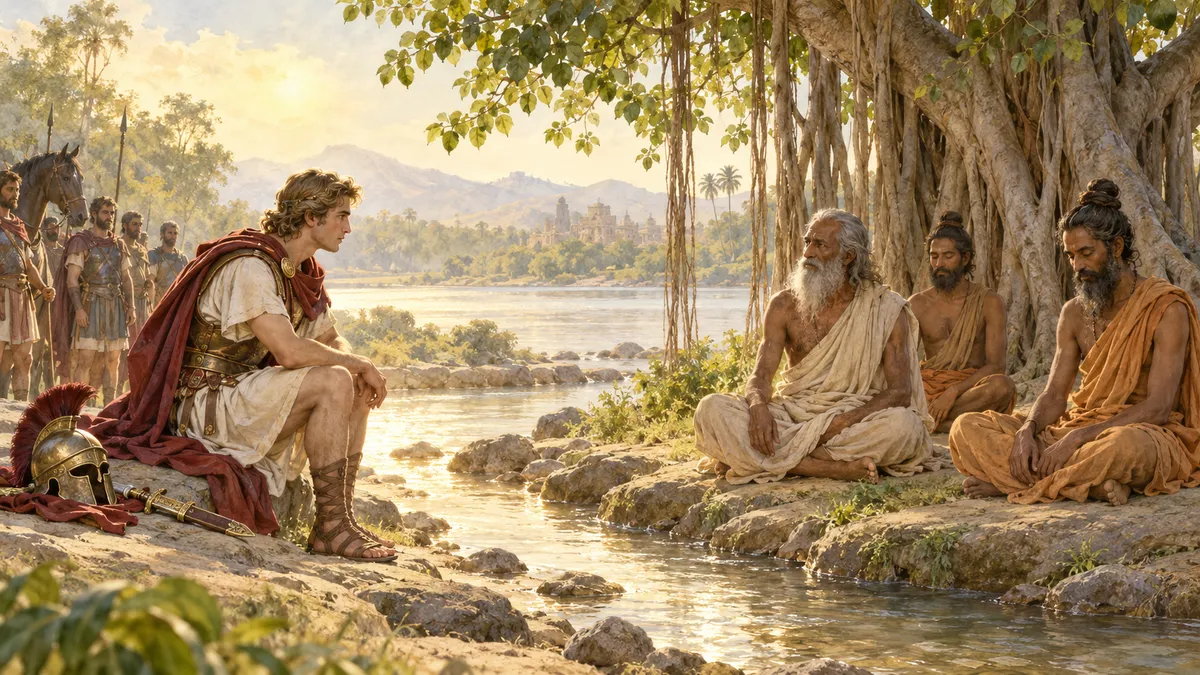
When Emperor Alexander of Macedon learned about the naked ascetic sannyasins, he sent his military commander to ask one of them to come and speak with him. But none of them came to Alexander. So he decided to go to them himself and saw several naked ascetics sitting, meditating, and reciting a mantra. Through an interpreter, he began communicating with them and asked:
– How can I attain your wisdom, naked ascetics?
One of them said:
– To attain our wisdom, you must become just like us; otherwise, there is nothing to talk about.
Alexander continued trying to communicate with them through the interpreter, but nothing came of it, so he left empty-handed.
As long as old meanings and values hold power over us, we cannot move toward the state of divine being.
Primordial Divinity and the Fallen State
The human “I” in its present state is a fallen, that is, limited being that has forgotten its exalted status. It is important to understand this. Its fallen position is обусловлена not by original sin but, on the contrary, by its innate primordial divinity. If one’s position is “fallen,” this means that one has “fallen” from somewhere—in other words, one previously had a higher state, and understanding this gives rise to the motivation to return to it. This primordial divinity, which the human being has lost through identification with the body, the coarsening of consciousness, and the loss of the channel of subtle spiritual connection with the higher aspects of the “I,” is the state in which we now find ourselves. But fallen does not mean sinful or incapable of development. On the contrary, primordial divinity exists within us. But this primordial divinity has been lost.
According to historical research, our ancestors were the ancient Aryans—the founders of Vedic culture and civilization. These ancestors were not a people with a unique way of life or culture, as they are now sometimes portrayed. In fact, they were not human beings but divine beings. And our limited position means that, although we are rightfully divine beings, we have “descended” into the human world. Therefore, our task is to get out of the human world as quickly as possible and enter the status of a divine being, rather than remain in it or become more firmly established there.
What does it mean to get out of the human world?
This does not mean moving to some other geographical location; it means changing the status of our consciousness, leaving conditioned karmic perception and moving to a higher way of seeing. At the same time, it does not matter what kind of body we have, human or otherwise, because this is precisely a status of consciousness.
Liberation is when we move from one karmic perception to another, higher perception. And in the process of making this transition, many different frictions arise. This transition is the spiritual path itself.
The Importance of Changing Meanings and Values
It is believed that anyone who has passed through the first two stages of the teaching on the sixteen stages of the moon’s development will necessarily pass through the subsequent ones, since these stages form the foundation. It often happens that we are interested in working with consciousness and channels, but overlook changing our values and meanings. Then years pass: there seems to be some progress in working with channels and winds, but nothing radical happens. Our “I” continues to play the old games of identification, desires continue to trouble us, and we remain in profane reality.
Why does this happen if we actively practice working with channels, winds, and contemplation? Because there are certain fetters and limitations at the foundational level. In other words, somewhere deep inside, we practice sadhana on the level of old samsaric meanings. No change in meanings or attunement to new meanings has taken place. Ignorance is the basis of human existence in the material world. Ignorance is a particular type of karmic perception, and it is precisely what our world of samsara is made of.
Some people ask: “If everyone becomes a monk or everyone moves to the Pure Land, what will happen to this world?” The question is very logical. And then I say: “Don’t worry. In the lower realms there are many beings who are eager to enter this world. For them, it is a highly desirable world in which they would gladly live. And as soon as people leave this world, it will be populated by these beings; it will never become empty.” But this world in itself, like other worlds, does not possess any great inherent existence. There are countless such worlds; we simply cannot see them. There is no particular value in it. The world is not reality; it is merely a certain vision, a certain meaning, and we create this meaning with our own consciousness. It exists only because we exist with our meanings. By merging our individual meanings into a collective vision, we create this world. It does not exist by itself. This means that by changing our own meanings, we can change the world.
The World as a Creation of Karmic Vision
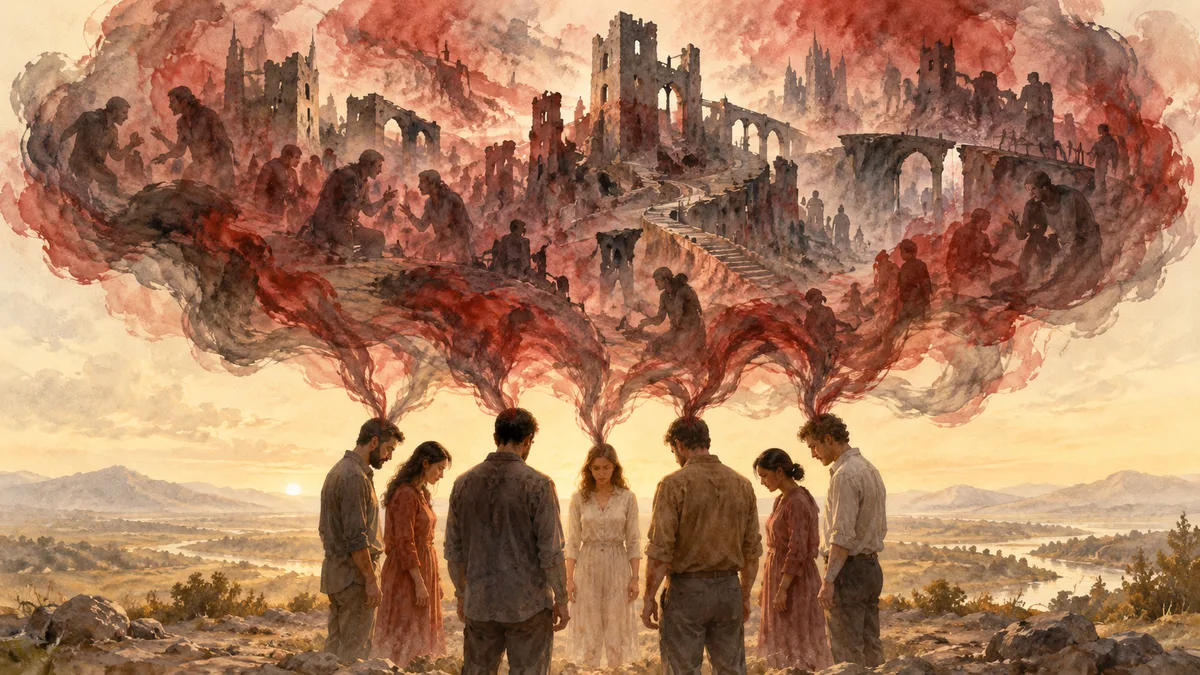
The world as such consists neither of matter, nor even of energy, nor even of information. At the most essential level, the world consists of meanings. Meanings, translated into Sanskrit, are drishti—a certain vision of reality, a karmic vision. And worlds are created precisely by karmic vision. All living beings group together according to kindred karmic visions.
For example, beings possessing the karmic vision of hell gather together, and then hell begins for them. They create hell themselves by gathering together. No one forces them to live in hell. But they come together according to the hellish vision characteristic of them and arrange hell for themselves.
In the same way, beings with the vision of the gods of samsara are also drawn to one another, gather together, and create a world of gods for themselves. For example, members of the bohemian class, affluent individuals, and famous people like everything to be harmonious, delicious, soft, and beautiful, and they create such a comfortable world for themselves. They also allow precisely such people into their circle. This is an example of how the gods arrange their lives so that they may feel comfortable.
People with an asuric karmic vision also unite with those like themselves and, merging their consciousness, create an asuric universe through their meanings. No one creates a universe of struggle, intrigue, hostility, rivalry, and treachery for them specifically. They create this universe themselves: as soon as they resonate with one another, all of this unfolds. There is no world as such, existing independently outside our consciousness. This world is a creation of our consciousness. It is empty; by its nature, it has no inherent existence. It consists primarily of meanings. And the basic meanings of this world are determined by our vision, by our particular human perception of the world.
The World as an Interaction of Meanings
What happens when we eat food? In reality, nothing like that exists at all. The process of eating food is when the meaning of food resonates with the meaning of our stomach. Food is a meaning, the stomach is a meaning, and within the meaning of our body, the meaning of satiety arises. Then we say: “I have eaten, I am not hungry, I am full.” But all of this is completely unreal. It is an interaction, a play of meanings, producing certain meaningful results.
This can be likened to what happens in virtual reality. For example, in virtual reality, an avatar controlled by a user walks around and can fight with a sword, eat, drink, and so on. But in reality, it does none of these things. The avatar itself does not even exist; it is not a real character, but merely bytes and bits of information traveling through wires—certain programs that create visual images. When a person in virtual reality, for example in a computer game, kills someone with a sword, they are not actually killing anyone; in reality, there are various programs interfacing with one another and producing visual effects that create the appearance that the virtual world is real, although none of it actually exists. And when a virtual character eats or drinks something, it does not actually eat or drink anything. The food program and the program of its virtual body simply interact with one another. Bits of information are transmitted, as a result of which its rating or level of vital energy increases.
The same thing happens in the physical world: there is an interaction of meanings, that is, one meaning, interacting with another, produces some subsequent meaning, but in reality nothing of the sort happens, because the world is not material to begin with, but consists of vision, of meanings.
The Key to Managing Reality
This gives us greater freedom, greater hope, greater possibilities, because we can change this world by changing our consciousness, changing our inner meanings and vision. This gives us the key to managing reality, to leaving collective history behind and creating psychohistory, the key to beginning the divine play (lila). This means that since the world is not material and contains neither rigidity nor predetermined conditions, but rather stochasticity, probability, and quantum uncertainty, our consciousness can act as a psi-factor. We do not necessarily have to be subject to causes and effects; to some extent, we can control them, and if we want to control them even more, we simply need to develop our consciousness further. In other words, the world, the universe, can be a manageable reality. And this is a very hopeful fact.
Rishi Vasistha says that the world is a space of meanings, not a space of gross material objects. If it is only a space of gross material objects, then we cannot influence it with our consciousness—we do not even stand a chance; we can influence it only indirectly, for example, by taking a pickaxe and breaking a stone, but we cannot do this by the power of the mind. However, if this is a world of meanings and intentions, then our consciousness consists precisely of this, and therefore we can change this world by changing the meanings and intentions of our consciousness.
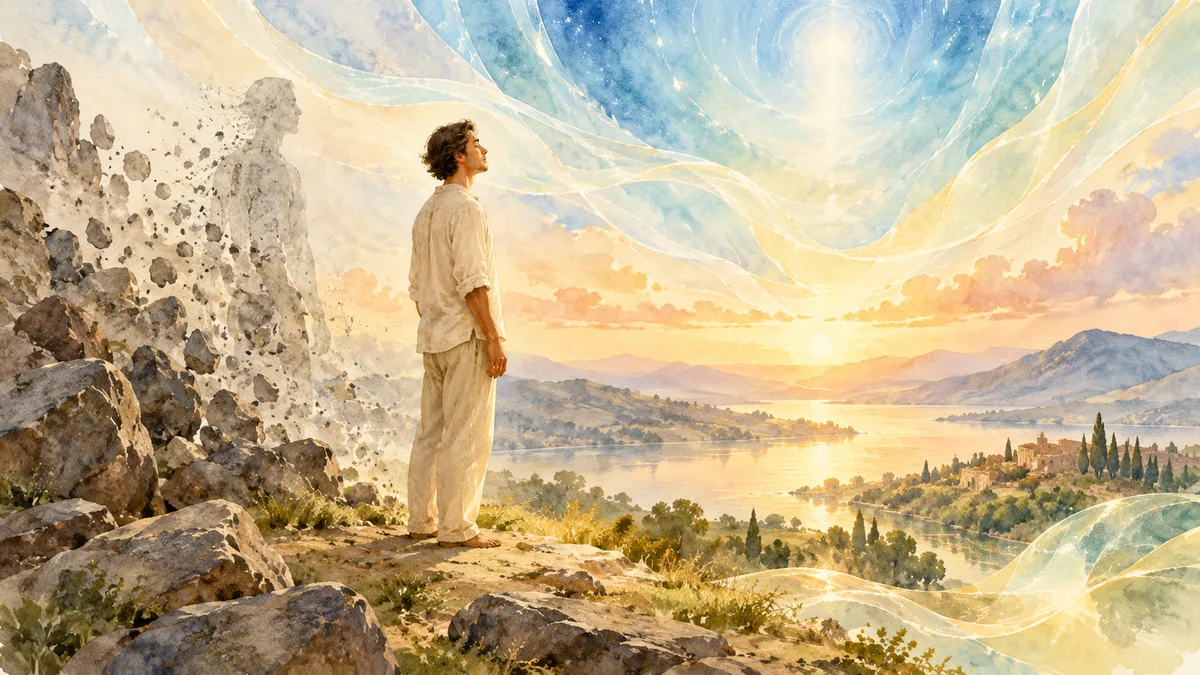
The karmic vision of the human world is connected with the illusory feeling “I am the body” (“aham dehasmi”) and a failure to understand the fact that the “I” in its essence is infinite, like space, and is itself the Supreme Being, the Absolute. Samsara will continue as long as such a deluded karmic vision exists.
Dattatreya says in the “Tripura Rahasya”:
As long as there is ignorance regarding one’s own essence, suffering will continue. Just as a sleeping person is frightened by his dreams, or as a fool is deluded by snakes appearing in a fakir’s performance, so too a person ignorant of his higher Essence experiences fear.
Having mastered new meanings and developed a new status of consciousness, we can change not only ourselves but also the reality in which we live. After all, reality could be completely different. But many people, even while practicing dharma, do not even think about this. We do not necessarily have to be mortal, we do not necessarily have to possess only one body, we do not necessarily have to live in a constricted space—all of this is not necessary; it is not rigidly prescribed. It is prescribed for us only because we ourselves agree to it.
There is a story. A dragon met a bear and said to him:
— Bear, I will eat you today at six o’clock. You must come. Understood?
— Understood, I’ll come.
A wolf was coming toward them, and the dragon said to him:
— Wolf, today at six thirty I will have you as a snack. You must appear. Understood?
— Understood.
The same thing happened with the fox. Finally, a hare was coming toward him. The dragon said:
— Hare, you must come today at seven o’clock, because I will have you for dinner.
The hare asked:
— Is it possible not to come?
— Yes. I’m crossing you off the list.
In other words, all it takes is to start thinking in this direction and set oneself the goal, and one can cancel this entire reality, this vicious infinity. These are solvable issues; all of this can be changed. But if we do not think about it and do not ask, “Is it possible not to come?”, then reality completely dominates us.

You can become immortal, infinite, multibodied, leave the collective history behind, create your own psychohistory, live in a personal universe—a mandala; you can be not a human being but a deity. You only need to ask the right questions.
