

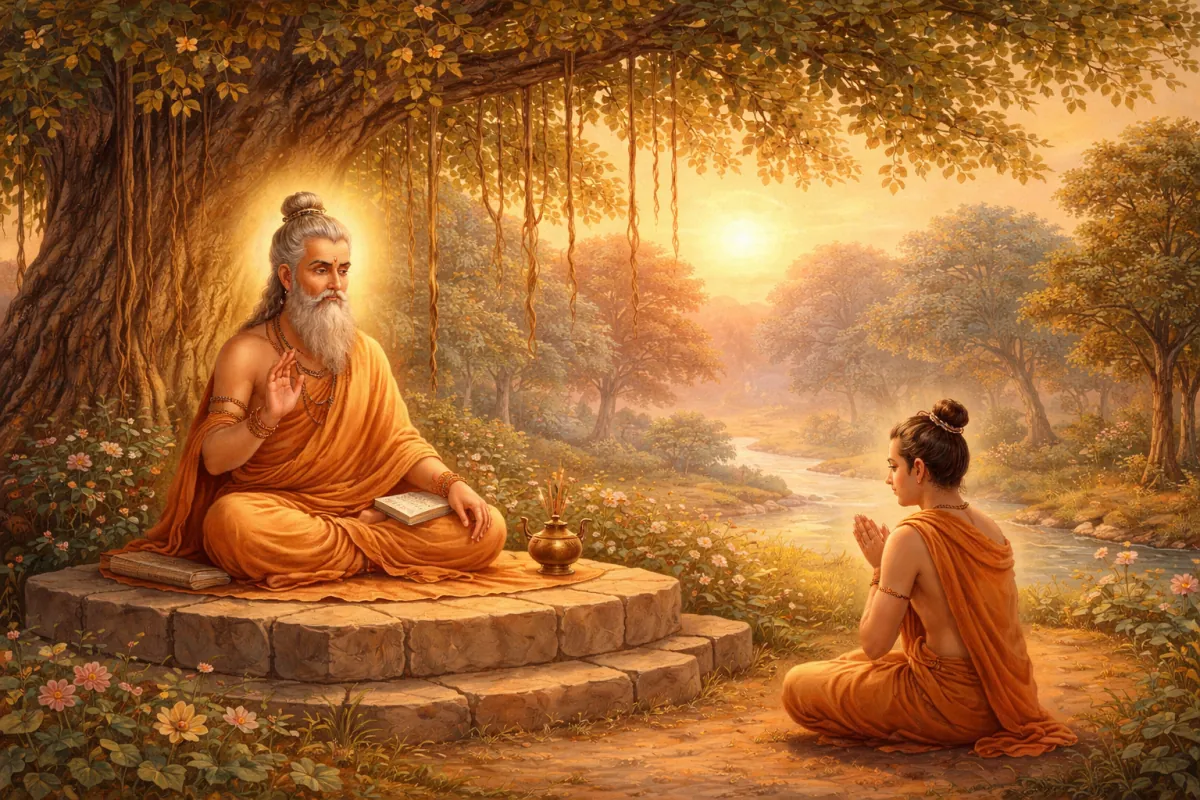
Shri Rama said: “O Parameshvara, you have explained the path to liberation in detail, and now please explain what kinds of people can attain liberation. I have great doubts about this.”
Shri Bhagavan said: “A brahmana, kshatriya, vaishya, or shudra—anyone can attain liberation. Whether a person is a monk or a householder, whether they must become a forest-dweller, or whether, without withdrawing into the forest, they follow the Pashupata Vrata diksha, or whether they regularly worship Shiva and are my devotee—people belonging to all these categories can attain liberation. However, a jada (atheist), a deaf person, a blind person, a mute person, one impure in heart, one who performs no virtuous deeds, an ignorant person, or a false devotee who, while wearing rudraksha, ashes, and lingams, insults or hates people—people belonging to such categories will not attain liberation.”
The conditions for attaining liberation, the realization of moksha-dharma—all vasanas must be exhausted. If they are exhausted within one lifetime, liberation occurs. Nididhyasana, which we aspire to, is nothing other than stabilizing consciousness immersed in Brahman in order to exhaust all vasanas, to exhaust all actions (kriya).
Exhaustion of Actions and States
For example, we have impulses arising from the desire to act. We cannot sit all the time; we want something, we need to act, but this is what we need to work with, and we exhaust it through seva. We direct the currents of our actions toward serving God, through ritual sadhana, through prostrations and circumambulations of temples—this is kriya-nishpatti (the exhaustion of actions), so that not a single impulse to act remains. Note: the ability to act should remain, but the impulses, the vasanas, should not.
Kriya-nishpatti is so that we can remain in non-action, so that such a worldview arises within us: “I have already done everything; I abide in perfection and in non-action; I make the great decision to enter into great non-action.” Let the body act as the illusory body of God, serving dharma; let it perform playful actions, but this will no longer be the action of my mind, it will not be the action of karma. It will be the action of my pure will, subordinated to the will of God. It will be the action of sankalpa, subordinated to sat-sankalpa, divine wisdom, while I myself will abide as the soul in non-action, because there is not a single vasana impelling me to act.
Likewise, there is bhava-nishpatti (the exhaustion of all inner states) of the soul and of all emotions. If the soul does not exhaust all these things, as well as jnana-nishpatti (the exhaustion of all mental and cognitive activity) and establishment in pure jnana—if it does not exhaust these vasanas, a vasana will force it to be born, regardless of what one may want or think. A vasana is energy, and energy, like a hook, catches the soul and draws it toward the place of a new birth.
Vasanas and Their Influence on Subsequent Births
There was one case when, in Vedic times, the clan of a princess named Amba and the clan of Bhishma had mutually agreed that the princesses would marry men from their clan, their ancestral clan, their lineage. Princess Amba was also of royal lineage, and Bhishma’s family—his brothers and relatives—all of them married daughters and princesses only from this royal lineage.
One day, the king, Princess Amba’s father, decided to break this tradition. For some reason, he did not like the princes from this lineage, and he invited princes from other lineages, while they were not invited at all, which was an insult and a slight.
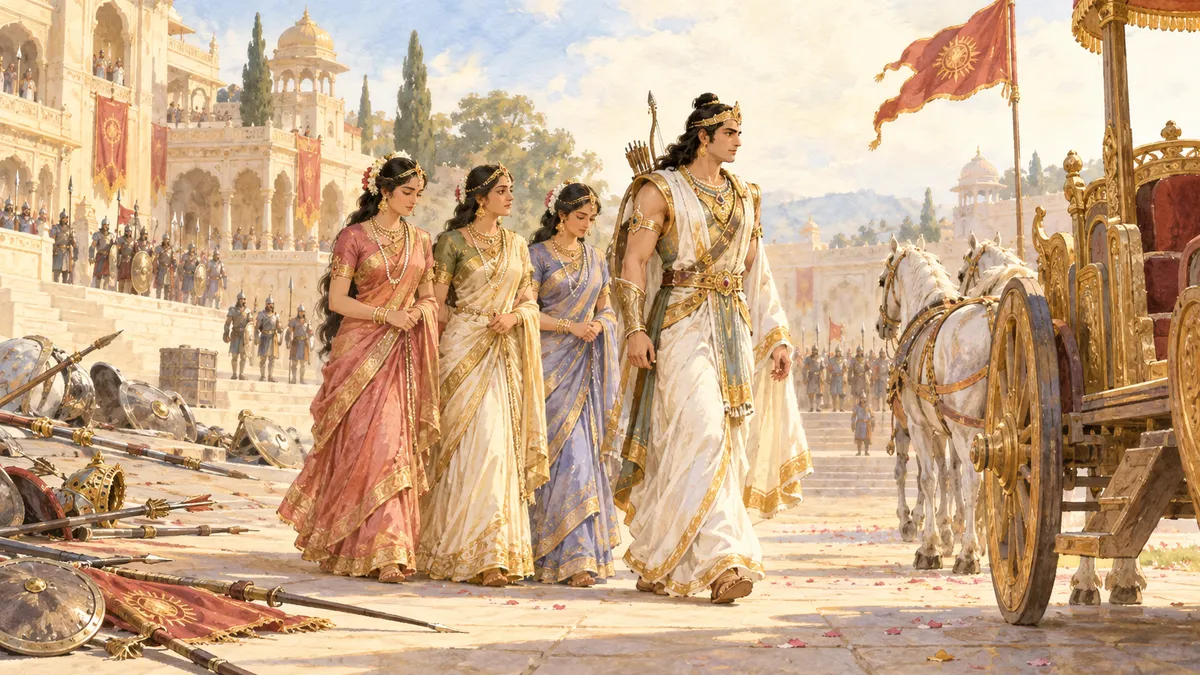
Bhishma was young at the time and very hot-tempered and impetuous, but he was a great warrior, and he came there uninvited. There was something resembling a svayamvara (ceremony); he defeated all the princes who had gone there, defeated all the guards and sentries who protected the palace. Then he very politely went up to the chambers of the princesses and invited them to go with him so that, as was proper, they could marry his brothers, and he said that he was representing the three brothers, while he himself had taken a vow of brahmacharya.
The princesses did not object to becoming related to princes from his lineage, as this was their family tradition, and when they had traveled some distance, Amba, who had already fallen in love with another prince, had not said anything about it. Then, halfway there, she finally told him that she could not become related to someone from his family or marry one of his brothers. Bhishma then took her back with every sign of respect and delivered her back.
The prince who had been designated for her, who loved her, no longer accepted her back. He said that she had been defiled and that he cared about his honor, and that it could no longer work because she had been abducted and so on. And no matter how much Amba pleaded with him, he rejected her.
Then Amba returned to Bhishma and said that he now had to marry; he was the cause of her suffering. Her two sisters had settled well and married princes, but she was not needed by that man, so she came to Bhishma. Bhishma said, “I did not act for myself at all; I acted on behalf of my brothers.” None of his brothers wanted to marry her, and Bhishma did not want to marry either: “I am a brahmachari,” he said.
She was deeply offended and called upon all her connections and other kings, but nothing came of it. She even called upon Bhishma’s guru, Parashurama, and still no one could influence him. Then she made a very powerful vow: she would take revenge, train herself, learn the art of warfare, kill Bhishma, and defeat him as a warrior. And she left her family and became an ascetic, beginning to practice concentration and meditation in order to become a great warrior.
But nothing happened in that life; she did not have time to become a great warrior, grew old, and died. Bhishma lived for one hundred and eighty years—a long time—and she was reborn as a man, remembering herself as that princess Amba, and continued her tapasya.
She had a vision in samadhi—she was also practicing austerities and meditation, thinking of nothing else, leading a renounced life: how to kill Bhishma, how to train herself, and how to take revenge on him. And she had a vision that she would be able to do this only in her next life. This person also grew old and died, but she still identified herself as Princess Amba, hating Bhishma.
In the third life, this was Prince Shikhandi, and he practiced tapasya, remembering himself as Amba. And when the Battle of Kurukshetra began and Bhishma had to choose one of the sides, he chose his own side, while Amba was on the opposing side—but this was no longer Amba; it was Prince Shikhandi.
Bhishma was the strongest warrior despite his advanced age, but when he saw Prince Shikhandi charging at him—and before the battle he had established a rule that no one was allowed to kill women or fight them—Shikhandi was still Amba to him. Having established such rules, he could not abandon his lofty ethical standards. He saw Shikhandi and thought, “It is Amba attacking me again out of resentment”—for three lifetimes. He lived for a very long time, was born and died, and yet the connection remained—a vasana of such great strength.
He cast aside his weapons, and at that moment Amba and the warriors accompanying him simply pierced his body with arrows. But because Bhishma had attained liberation, he lay on a bed of arrows and gave instructions, controlling his prana. He did not die by his own will for six months; for another half a year he received kings while lying pierced by arrows, giving them instruction on governance, politics, yoga, and so on.
Then, when he decided—with Krishna’s blessing—to leave this world, he performed kumbhaka through his yogic power, causing all the arrows to leave his body, fly out of it, and his wounds to close. He stood up, and only after that did he leave his body at will; that is, he had the highest level of control—he truly mastered his prana.
If the soul had any unfulfilled vasanas, these vasanas pass into the next life, and it will continue to embody them. The condition for attaining moksha is exhausting the vasanas within a single lifetime.
Divine Birth
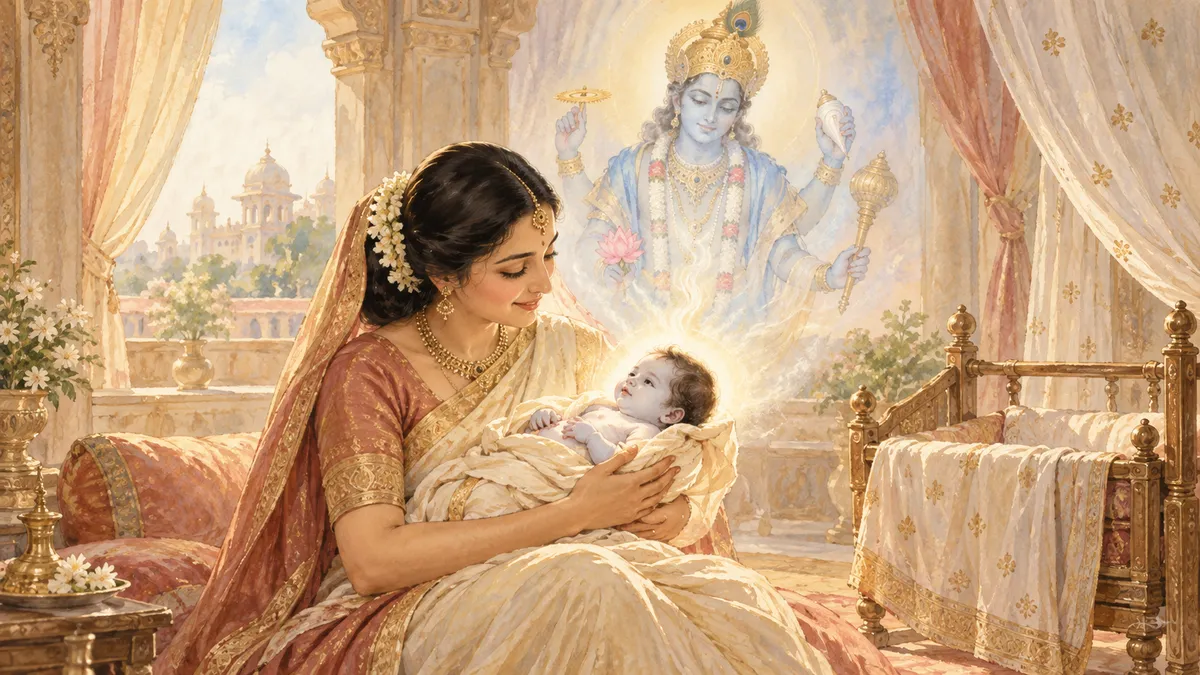
For example, when Rama was born, his mother saw the four-armed deity Vishnu, became frightened, and began praying to this deity, saying, “Become an ordinary child so that I can at least hold you in my arms.” Then he entered her body and was born as a child—this is an example of a miraculous divine birth.
A miraculous birth, a divine birth, differs from a samsaric birth—reincarnation. It differs in that there are no vasanas; there is only an intention, sat-sankalpa, which emanates an illusory body without leaving the natural state and assumes human form.
Sages whose vasanas have been exhausted may be reborn, may leave their bodies at will, change them, or enter another person’s body—this is called, for example, hima-samadhi (samadhi in the Himalayan snow), jala-samadhi (samadhi under water), or sthala-samadhi (samadhi in the earth or underground). One body is abandoned and another assumed if this is necessary to fulfill certain aims, or a body in the form of a deity is assumed, but there are no longer any vasanas that propel the soul and force it to move from one body to another.
Note: in the shloka above, the blind, mute, and deaf refer to spiritual blindness, spiritual deafness, and spiritual muteness, which are qualities of atheists.
Obstacles and Conditions for Liberation
“I am the Guru of the Pashupati Vratam. Whoever hates me, whoever hates Vishnu, will remain in the ocean of samsara even after billions of kalpas, plunged into the cycle of births and deaths, and will not attain knowledge of Shiva (Shiva-jnana), and consequently will not attain liberation. Whoever performs rituals or chants my name with the hope of enjoying material benefits will receive only those benefits, but will not be able to attain liberation. Those who die in Kashi, Dvaraka, Shri Shailam, or Pandarikam will, by my grace, attain Taraka Brahman and gain liberation. Only the person whose limbs remain under their control and help them acquire knowledge, perform austerities, and attain fame will receive the benefits of pilgrimage. Others, who are not pure in heart, earn only sins, even while remaining in places of pilgrimage.
Brahmins for whom the upanayanam ritual has not been performed (who do not wear the sacred thread on their bodies) should not be allowed to chant the Vedas in rituals, except in rituals such as Svadha, Daana, and Pitrukaryam. Deprived of Vedic karma, such a Brahmin is equal to a Shudra. People of all classes, all castes, and all faiths have the right to chant and meditate. By uniting with Shiva through meditation, a person is liberated from samsara; therefore, such meditation is a thousand times better than charity, austerities, and the study of the Vedas. Whoever meditates on Shiva while walking, standing, sleeping, or performing any kind of work—even while engaged in sinful activity—is liberated from the bondage of samsara.
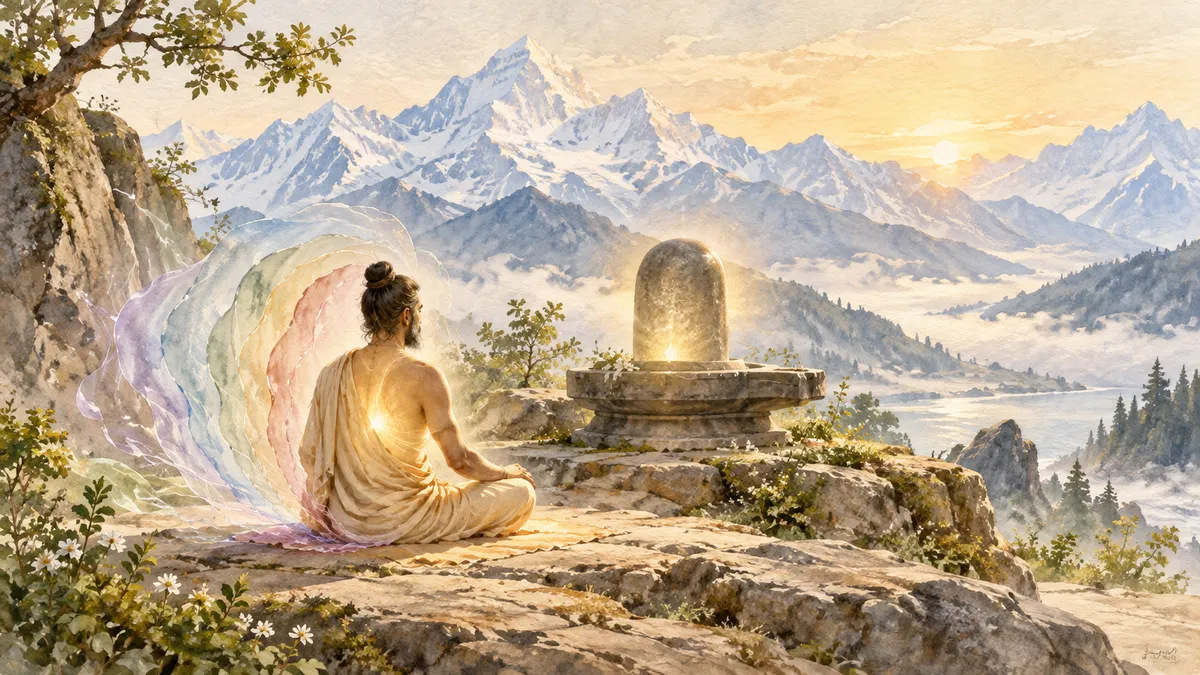
Whoever meditates on Shiva—here we meditate on the lingam. When we meditate on Brahman in Advaitic nididhyasana through contemplation, this is meditation on the maha-lingam or maha-linga. When we meditate on space, on the causal body, this is meditation on the bhava-lingam. When we meditate on the energy body and prana, this is meditation on the prana-lingam.
Meditation on Shiva, whatever he may be doing, is the path of maintaining natural presence. Such meditation separates the yogin from the five sheaths and makes him immortal.
The Story of Narada, Parvati, and Shuka
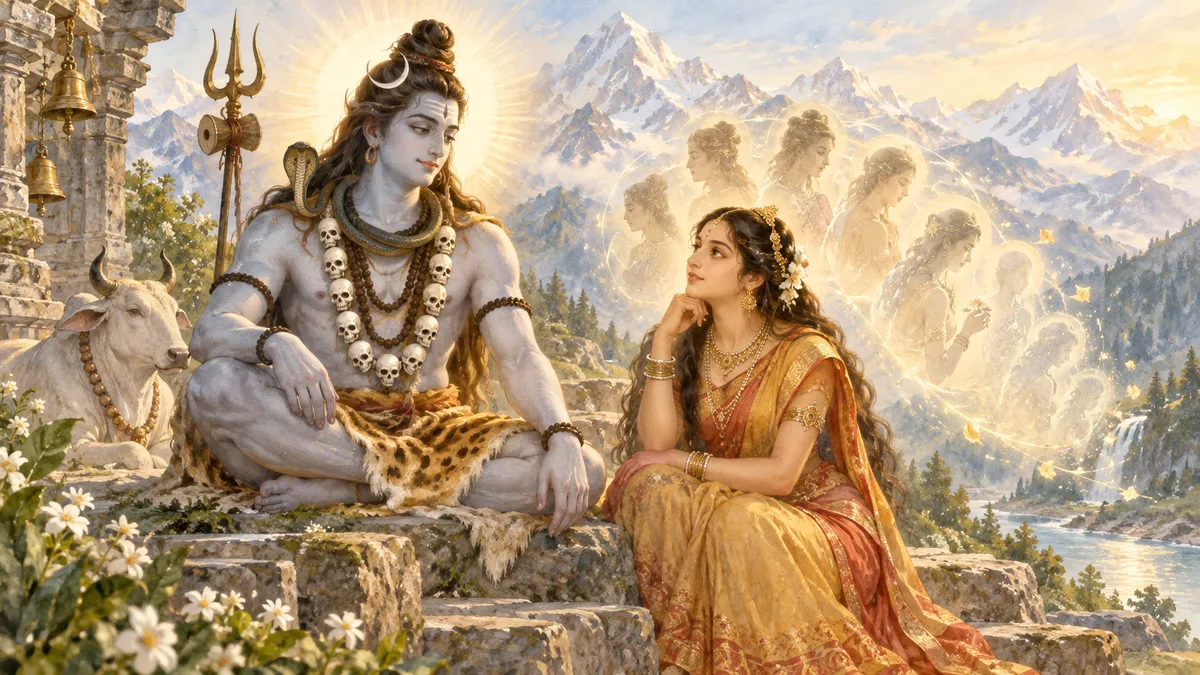
One day, Narada came to Shiva’s abode, and when he arrived, he learned that Shiva had gone away to visit Narayana, and he met only Parvati. He pretended to be upset and said that he had so wanted to see Shiva, but apparently it would not be possible. Then he stayed for some time on Mount Kailash and walked around with such a sad expression that Parvati asked: “Why do you look so sad? You must be troubled by something.”
He said: “I do not even want to tell you, Parvati; let this sorrow remain with me”—he was such a great provocateur. Parvati’s curiosity was aroused, and she said: “Of course, you must tell me at once what is troubling you.” He said: “I do not even want to speak; it may affect you and Shiva.” The more he spoke, the more her feminine curiosity grew. Eventually, she persuaded him to tell her. He said:
— You know, Parvati, Shiva is deceiving you.
— In what sense?
— Not in the sense that he is cheating on you with another woman, but in the sense that he does not love you as he claims.
She said:
— Why do you think so?
— Because he wears skulls, a garland of skulls—and what do the skulls signify?
She says:
— These are my skulls. Every time I am born and die, leave a body, skulls remain from those bodies—he is the one carrying them. In other words, they represent my births and deaths.
He said:
— But Shiva—he is immortal. Have you ever wondered why he is immortal while you are mortal? You know, he could have made you immortal. For example, he once told me that anyone who reads the “Srimad Bhagavatam,” anyone to whom he transmits it, will become immortal. So why doesn’t he make you immortal? He doesn’t want you to become immortal like him and rise to his level. There you have it.
This struck Parvati deeply, and Narada, as it were, planted this thought in her mind and went on his way. Shiva, suspecting nothing, simply came home, and Parvati was out of sorts, not in the mood. Then Ganesha and Skanda came and asked: “Is there dinner, Mother?”—and she said: “Let Shiva feed you.” Shiva did not understand at all what was going on, and he tried to use his charm and power, to talk to her somehow. She was still in no mood, but eventually he managed to get her talking.
She said: “You transmit the ‘Srimad Bhagavatam’ to someone, and that person becomes immortal. So why am I still mortal? Why haven’t you transmitted it to me?” He said: “You never asked. I simply never thought about it”—but in the end he agreed to begin transmitting the text. He started reading it, and she sat opposite him.
At that moment, Narada went to Shuka. At that time, Shuka was simply a sage, a holy man, and he knew that Shiva had once told him and Parvati: “If anyone eavesdrops, I tell you, Parvati, if anyone eavesdrops, I will destroy him, because this is forbidden knowledge—the knowledge that would make them immortal is forbidden knowledge for mortals. No one must receive this transmission.”
Narada went to Shuka and said: “You must urgently go and listen in from behind that stone, behind that rock. Shiva is transmitting this text to Parvati, so that you can become immortal.” He said: “What is it, exactly?” Narada replied: “Actually, Shiva can destroy anyone who eavesdrops.” Shuka said: “Then what are you suggesting I do?”
Narada said: “I am suggesting a sound course of action. You can use the power of your consciousness—there are some birds there, and a parrot has laid an egg. You can enter the consciousness of that egg and be born from it as a chick, a little parrot. In the body of that parrot, you can listen in; Shiva will not realize it is you, and in this way you will receive the transmission and become immortal.”
He did exactly that, which is why he came to be called Shuka (Parrot): he entered the parrot’s egg, then hatched, becoming a tiny parrot chick, and began listening. While Shiva was transmitting the teaching to Parvati, Parvati fell asleep after ten chapters, and he began asking: “Are you listening? Do you understand?”—and so as not to interrupt the transmission, the parrot could not hold back and said, “Uh-huh, uh-huh,” in Parvati’s place.
When he finally finished the transmission, he asked: “Did you understand all the last chapters?” She said: “I fell asleep. I didn’t understand anything.” Shiva then asked: “Then who was saying ‘yes,’ ‘uh-huh’?” He flew into a rage and began searching and looking around. At that moment, Shuka became frightened and, in the body of the parrot, began to fly away, while Shiva took his trident and began throwing it at him, trying to hit him.
He kept dodging it, and Narada realized that something irreparable might happen. He ran to Narayana and said: “We must save Shuka, otherwise Shiva will destroy him. Some holy sage must place himself between the trident and Shuka.”
Narayana said: “Yes, if that person is wise, he can step in, but no one can step in without a reason.” Narayana then thought for a moment and offered this advice: “If this parrot quickly flies to Vyasa, and there is some woman in front of Vyasa, and he manages to transfer his consciousness into her womb and appeals to him, Vyasa will be obliged to become his father and will have to protect him as his son. We must somehow direct him there.”
They involved Vyasa in this plan. Vyasa was an ascetic; he did not need a wife. So how did Shuka appear at all? They summoned a beautiful apsara named Ghritachi. When Vyasa looked at the apsara, a certain vibration (spanda) arose in his mind. The parrot flew there, while Shiva was already chasing him—he simply needed some womb. He quickly shed the body of the parrot and entered Ghritachi’s belly, her womb. Once there, hiding inside the apsara’s body, he began praying to Vyasa as his father. He said: “You are my father, because of the vibration that arose in you when you looked at a beautiful woman.” He did not even touch her; he merely looked at her and thought: “A beautiful woman.” But that was enough for Shuka, in the form of a parrot, to incarnate. In other words, he incarnated in this unusual way, without conception.
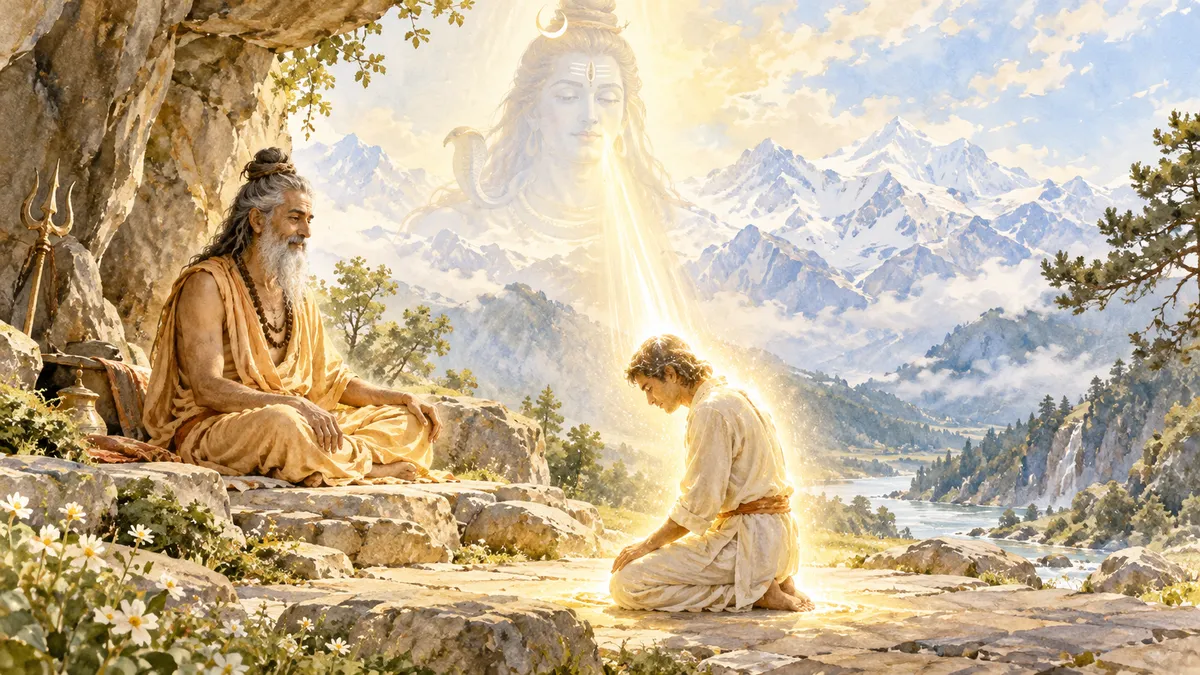
Already from the womb, he sent out a wave of consciousness, addressed Vyasa telepathically, and said: “You are my father, so protect me. Shiva is chasing me with a trident; he is about to kill everyone.”
Vyasa had to take this seriously, as part of his dharma as a father. He stood between Shiva and Shuka and said: “Do not touch Shuka. He is not at fault; moreover, you yourself guaranteed that everyone who heard would become immortal, and he heard it—which means that, by your blessing, he must become immortal.” Shiva was furious at first, but then said: “I like your pranks, Narada, so I forgive you both.”
The Transmission of Shiva’s Grace
When a sadhu acquires the ability to receive a transmission from Shiva, he receives Shiva’s descending grace—anugraha-shakti. It is this grace that makes every jiva who receives it immortal. Therefore, what text or form of transmission is used is not really so important; what matters is that there is a jiva capable of receiving this transmission of grace. By receiving anugraha-shakti, it attains immortality.
Teachings on Meditation and Devotion
Meditation has neither a beginning nor an end. Whoever meditates becomes free from all fear. Whoever utters my name, even out of wonder, fear, or sorrow, attains great virtues. Even a person who is a great sinner, if in any way he simply remembers me once or utters the panchakshara mantra (“Om Namah Shivaya”) once, will undoubtedly attain liberation. For one who regards the entire universe as Shiva-maya (the form of Shiva), there is no need to visit holy places of pilgrimage.
Sacred Attributes of Shiva’s Devotees
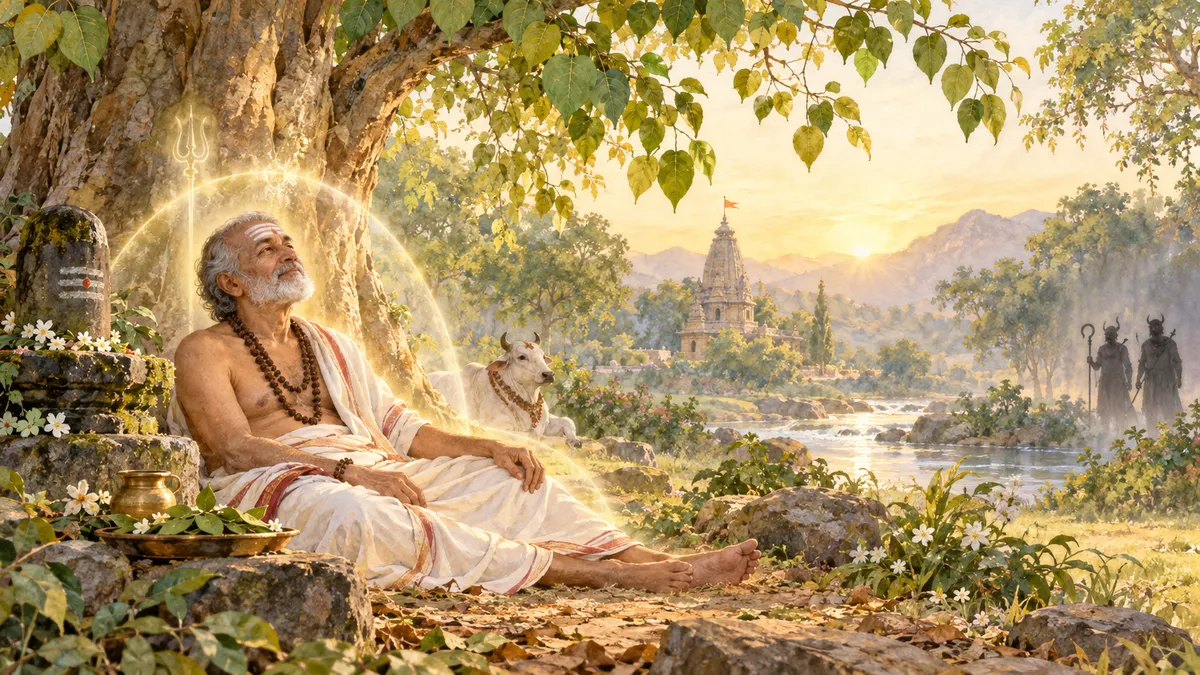
Devotees of Shiva should wear sacred ash and rudraksha on their bodies—this is an important point for those aspiring to devotion to Shiva. A person who applies sacred ash to the body and wears rudraksha, even if he is a great sinner, will attain liberation. Whoever performs no other rituals but constantly chants the name of Shiva will undoubtedly attain liberation.
A great sinner who always lived among sinners and accumulated nothing but sins—even such a despicable person, at the time of death, if he wears rudraksha and applies sacred ash to himself, cannot be touched or approached by Yama’s servants. Yama’s servants will keep their distance from a person who applies earth from beneath a Bilva tree to his body.
Thus ends Chapter 16 of the “Shiva Gita” from the Uttarakhand section of the “Padma Purana.”
