


Commentary on the text “Tripura Rahasya,” Chapter 17, “On the Uselessness of Fleeting Samadhi and the Path to Wisdom”
Now I shall explain to you the process of liberation.
A person learns true devotion to God after a praiseworthy way of life lasting through several births, and then worships Him for a long time with diligent devotion.
Three Categories of Beings
All people are divided into liberated souls and unliberated ones. The liberated are called mahatmas; the unliberated are called band hika (bound), duratma (the deluded Atman). The liberated include rishis, mahasiddhas, devatas, gods, and yogis who, thanks to persistent sadhana, have attained liberation. The unliberated include people, gods of passion, gandharvas, asuras, demons, rakshasas, pisachas (malevolent spirits), pretas, beings of hell, various classes of negative beings, serpent-like beings of the naga class, animals, souls that have gone to the world of the ancestors and to the pure lands, and others.
There is also a special category of beings who have entered the spiritual path, that is, have entered the process of liberation. They are in a marginal, intermediate state. That is, they are not yet of the class of the liberated, but they can no longer be called the class of deluded souls. They are in such a dependent position; they are called sadhus. You also belong to those who have entered the process of liberation, and are called sadhus.
A sadhu is one who has become disillusioned with the unliberated state, who avoids the unliberated state as one would poison, and with all his soul strives toward liberation, as the flame of a lit candle strives toward the sky. A sadhu is one who has entered the path of evolution, applying effort and understanding. Whoever does not possess such qualities is not a sadhu.
When we enter the process of liberation and become sadhus, it means that in this life a great deal is being decided: whether we will again enter the path of samsara or follow the path of nirvana. Perhaps we are not very aware of this, but it is precisely such a colossal decision that we are carrying out. Vast possibilities open before us, but this is still only potential.
For example, looking at your past worldly life, you can assess how you studied at school, at university, or somewhere else. Perhaps you did not fully understand that your life path for 30–60 years was being determined by some small things. In other words, if you had lost heart and decided not to study at university, perhaps your destiny would have gone in a completely different direction, but you made the effort and received a higher education. Click — suddenly you moved to a certain new level in the social stratum. New opportunities opened before you, and a new circle of communication appeared. In the same way, on the spiritual path, when we make some decision, it affects our entire subsequent life.

The Nature of Worldly Pleasures
Dispassion toward worldly pleasures arises in the devotee who gradually begins to experience a strong desire to know the truth and becomes absorbed in the search for it.
Dispassion toward worldly pleasures arises in a yogin who strives for liberation. What are worldly pleasures? They are not only diving in Cyprus and living in a six-star hotel; in fact, they are everything that binds our consciousness. Everything in which an egoistic element of enjoyment manifests, forcing one to forget one’s true nature, to be distracted from contemplation of the Supreme Source, to compromise in awareness, attentiveness, and pranas — these are worldly pleasures. This is difficult for a person who does not engage in transformation to understand, but in essence, everything that arises from egoism, from the identification “I am the body,” is worldly pleasure. One could say that the entire world consists of what is called worldly pleasure. In other words, the view of saints and siddhas differs greatly from the views of ordinary people.
The desire to communicate with a friend is a worldly pleasure. The desire to share something or to listen to another is a worldly pleasure. The desire to possess something is a worldly pleasure. The desire to be loved, to be spoken well of, is also a worldly pleasure. The desire to look worthy in the eyes of others, the desire for praise and honors, the desire to engage in one’s favorite work or in some form of creativity, and so on — this too is a worldly pleasure. The desire to communicate with relatives and maintain family ties, the desire to defend one’s views, concepts, and ideals — this is a worldly pleasure. I even find it difficult to name anything that is not a worldly pleasure.
In fact, all desires colored by an egoistic vision, by egoistic attachment, and the pleasures obtained as a result of their satisfaction, stem from the fundamental ignorance that you are this body. If you trace it carefully, you can see that any desire has an egoistic coloring and, accordingly, rightly belongs to the category of worldly pleasure. Only if you are an honest practitioner capable of looking within yourself will you be horrified to discover that there is nothing there except worldly pleasures and tendencies, gross or subtle. The worldly pleasures of non-practitioners are gross, while those of practitioners are subtle. That is, outwardly practitioners try to discipline themselves, but within there is an abyss of the same pleasures: a subtle desire for superiority, subtle pride, subtle self-satisfaction, a thirst for spiritual experiences, the aspiration to see something with the third eye. All these are countless worldly pleasures with which the consciousness is overflowing.
A genuine practitioner, seeing such boundless samsara within himself, suddenly comes to this insight: “Well, my dear fellow! You are not at all what you thought. You consist entirely of samsara, and with such an approach you still have 16 kalpas to practice.” This is the first discovery a true practitioner makes about himself; that is, he discovers boundless samsara within himself. Only when he makes such a discovery does a great determination arise in him to transcend this samsara. Until such a discovery is made, he will remain in a relaxed, compromising, tamasic state. Only by understanding what an incredible task stands before him is a practitioner capable of heroic sadhana, of heroic spiritual feats, of radical self-transformation and self-surrender. A mature practitioner is distinguished precisely by the fact that he does not harbor any hopes or illusions; he has no false pride or self-conceit. He sees how boundless the Dharma is and how boundlessly much he needs to practice, and therefore he treats sadhana with the utmost care and seriousness.
In ancient times, saints tried to show this to a disciple by testing him for a long time. For example, a disciple comes to a teacher and asks him:
“Show me the path to liberation.”
And the teacher says:
“First learn to listen. Go and learn to listen to the stream, and in three years come back and tell me what you heard.”
For three years the teacher does not even listen to the disciple at all, does not speak with him. It does not matter what the disciple is doing there: perhaps he is crying, repenting, or on the brink of survival. After three years the teacher asks him:
“What did you hear? Perhaps you are now ready to listen to the teaching?”
In other words, this is already the beginning of preliminary practices. After all, you want to hear the teaching? Then be ready to spend three years doing this. This is a very strict approach of the ancient teachers; however, it is fully justified in the sense that it immediately attunes the disciple to a different vision of the spiritual path.
Then the disciple asks again:
“Show me the path to liberation.”
The teacher says:
“Well, let us check whether you can follow my instructions. Here is a cave for you; stay there for three years, and I will come in three years. If you manage, you will receive instructions on liberation.”
And again the disciple has to change a great deal within himself. Living in a cave for three years will seem incredible to many. However, from the point of view of liberation, this is not something incredible; it is something insignificant. What are three years? After all, liberation encompasses billions of kalpas. Thus, a person begins to acquire a “taste” of the boundless and intuitively recognize the qualities required of him.

The Path to Knowing the Truth
So, it says here: “He gradually begins to experience a strong desire to know the truth and becomes absorbed in the search for it.”
When a yogin has thus purified himself through preliminary practices, a strong desire to know the truth arises in him, and he truly becomes absorbed in the search for it. A strong desire to know the truth, from the point of view of the teaching, does not mean that one should suffer and think: “How I long to know the truth! And it is not granted to me in any way.”
I asked one disciple who had spent several months in the mountains:
“How is the practice?”
And he answered:
“I have not attained samadhi.”
But this is not quite the approach that is needed. For us, a strong desire to know the truth means methodical and painstaking work in the practice of self-liberation without clinging, hopes, or fear. If we have understood the practice of self-liberation, this gives us tremendous trump cards in spiritual life, because the ability to be in a self-liberated state begins to untie one knot after another. All the countless worldly states within us can be gradually untied if, from second to second, we abide in the correct self-liberated state. This self-liberated state must be genuine. It is not the case that in classes on self-liberation we say: “This or that—in the Atman there are no such concepts.” And so on. And then this impresses us, and we walk around in an altered state of consciousness. Self-liberation means that every second we impeccably recognize subtle clarity and nurture it just as a mother nurtures a child.
Stages of Learning: Shravana and Manana
Then he finds his gracious teacher and learns from him everything related to the transcendental state. Now he has received theoretical knowledge. After that, he is compelled to consider this matter from all sides in his mind until he gains satisfaction on the basis of his own practical knowledge, which is in harmony with the prescriptions of the sacred scriptures and the instructions of his teacher.
Here the generally accepted stages of “shravana” and “manana” are described. First the disciple receives an explanation, a verbal transmission, and then he carefully reflects on all of it, trying to eliminate all ambiguities. Working with the teaching does not mean being a passive listener. The disciple must show his activity; if activity is not shown, then there will be no results from the teaching either, since the teaching is not theory, although it is presented theoretically at a certain level. But the Teaching itself says: “And now, come on, do something! We expect something from you.”
Senior monks sometimes look so mysteriously at novices or laypeople, as if they expect something from them. With their appearance they say: “We are expecting something from you. Do you even think about the fact that you should do something, somehow change? Or do you intend to keep walking around like this?”
What, then, is meant by this “changing” and “doing something”? It does not mean that we are talking about some physical actions, since the teaching of laya yoga is very subtle. To do something means to begin working with contemplation, to begin truly entering presence and applying it in one’s life. That is, to begin acquiring the level of self-control that, in fact, makes you a laya yogi, to begin little by little to live by this. And the spiritual teacher also looks at the disciple as if hinting to him: “You must do something.”
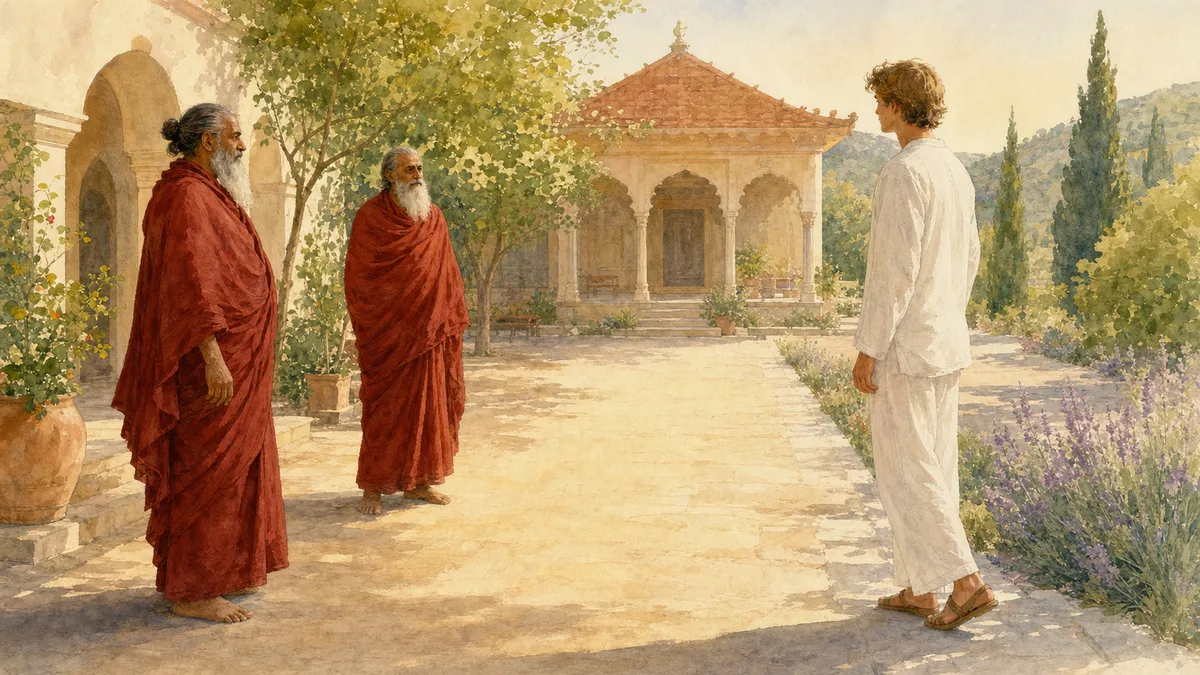
What, then, is the disciple trying to do? We are not now speaking specifically about technical practices, basic practices, since this is something self-evident. Nor are we speaking about the external side of the teaching: daily bhajan mandalas, bows, prostrations—all of this is the external path of the teaching. We are speaking about the most subtle thing that the disciple must do. Laya yoga as the main teaching consists in the fact that we work with awareness, we exercise ourselves in contemplative presence, developing such mastery. This requires great responsibility from us.
When we work with awareness, we can no longer rely on a God in heaven who is somewhere taking care of us; this is no longer enough. Nor can we rely only on the guru, thinking: “Since the spiritual teacher has accepted me as a disciple, the matter is settled.” Nothing of the kind! Because becoming a disciple entails beginning some kind of work. Even the Buddha cannot save living beings if living beings themselves do not practice. Otherwise, the buddhas and saints would long ago have ferried all living beings from samsara to the pure lands. However, this does not happen. Why? Because the living soul possesses free will, given to it by the Creator. In other words, it must itself come to an understanding of the necessity of inner work. Subtle awareness cannot be generated by a volitional impulse from outside or in some other way. One can give a yogi shaktipat, one can give direct transmission, but he himself has to work on maintaining subtle awareness.
Therefore, the disciple enters precisely into the process of working with contemplation. And this process begins with our choosing one of the eight sankalpas and trying to train with it until the path of working with the sankalpa becomes clear to us. These may be the sankalpas “Atma-vichara,” “Sleep,” “Divine Pride,” “Space,” “Brahma-vichara,” or others, but usually the simplest ones are taken as the main ones. The point is that the sankalpa is the key to your contemplation. And then you see that in this entire vast world of samsara, which is contained in the subtle body and would bewilder anyone, it is possible to work, that in one lifetime it is possible to untie very strong knots.
Practical Application of Knowledge
The disciple is able to ascertain the highest truth clearly and confidently. After this, the established knowledge of the unity of the supreme Essence must be applied in practice (even by force, if necessary) until the experience of truth arises in him.
It is said: “To be applied in practice even with effort, if necessary,” until the experience of truth arises.
There comes a point when, if your capacities allow, you practice by applying great willpower, performing tapas, following an ascetic spiritual discipline. However, I do not recommend that beginning disciples take up tapas from the very start. Tapas must be mature. In other words, in Ancient India, siddhas and rishis began ascetic practice after spending their whole lives in the brahmin caste, engaging in Vedic rituals all their lives, absorbing yogic exercises into their blood, and absorbing the Vedas with their mother’s milk. Naturally, after forty or fifty years of life in such an environment, it is not difficult to begin tapas in the jungle, because through the entire structure of society, varnas, ashramas, dharma, and upbringing, you were moving toward it. But recommending that disciples begin with tapas is incorrect. Therefore, at first we perform tapas through service. For example, when you engage in service, when you train in practice, this is your orientation toward dharma. Gradually, according to your capacities, you move on to subtle inner tapas, when long and intensive retreats begin.

Realization of the Inner Essence
After experiencing the inner Essence, he will now be able to identify his supreme Essence with the Supreme Essence and thus destroy the root of ignorance. There is no doubt about this.
The inner Essence is realized in advanced contemplation, and this state of realization is called nirvikalpa samadhi. The memory of this realization allows one to identify the inner supreme Essence with the universal supreme Essence as “I am That.”
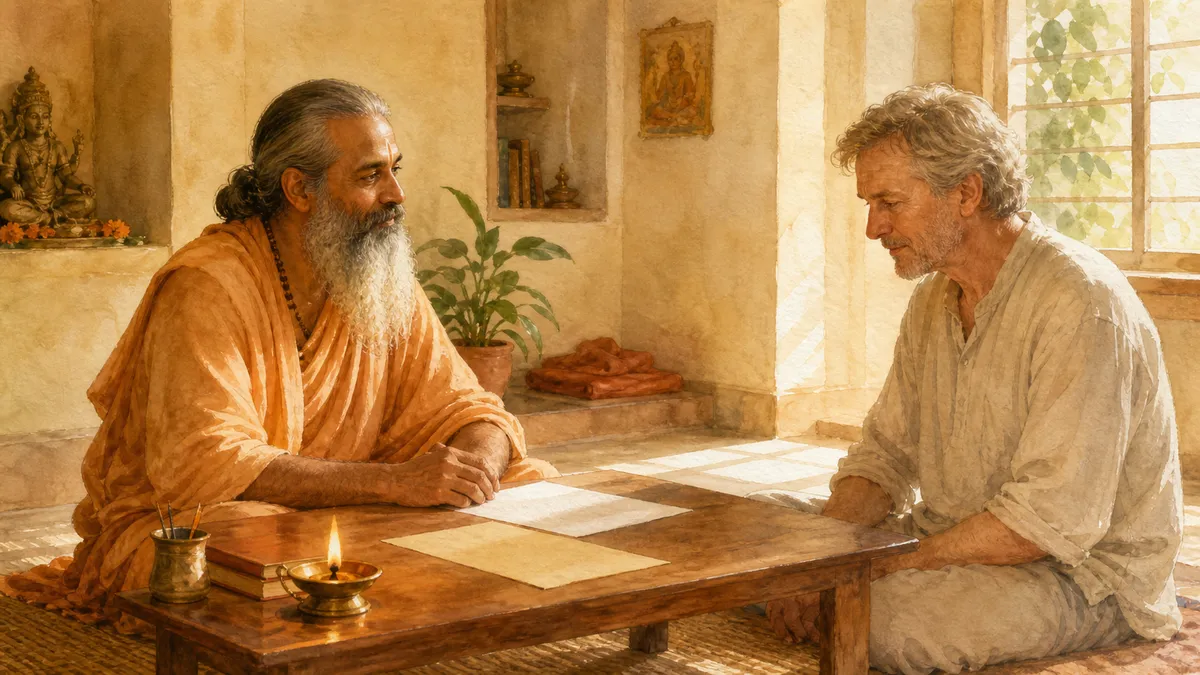
As you know, we have seven stages of training, seven levels of spiritual realization. I always recommend that disciples orient themselves toward them. If monks orient themselves toward them, then among lay disciples so far there are only two people who have passed the first stage. These stages are not formal. Formal examinations, theory, technical methods are only a small part; the essence of the examination for a stage reflects your spiritual realization, samadhi. For example, the examination for the sixth stage presupposes samadhi lasting several hours with the cessation of breathing, nirvikalpa samadhi; the examination for the fifth stage presupposes the development of visions in a dark retreat. In other words, to pass a certain stage and pass the examination for a stage is to enter a new level of awareness, to open up a completely new world. Thus, by practicing according to the stages, you move toward the peaks of mastery. Without passing through these stages as special key points in the teaching, it is impossible to rise. The examination for the fourth and fifth stages means passing a non-conceptual dialogue with the guru. It is difficult to pass, nevertheless it is possible.
One lay disciple, who had practiced yoga for about thirty years, once came up to me with these words:
“Well, why should I take an exam? After all, I have been practicing for so long. I fully understand everything you write about; I like it all very much. I am very confident in myself. And retreats? My whole life is a retreat!”
I felt a certain utterly lightweight state and said to him:
“Come on, so that you can be sure of the high level of your own realization, let us test you a little,” and I began asking him special questions, but I did not hear anything at all that would indicate a high level. “You see, you are already 50 years old, yet you have such a lightweight attitude toward the Dharma. If Seongcheol Sunim were in my place, you would have received a teapot over the head, whereas I treat students gently. You need to engage in practice seriously and next time meditate in such a way that you can answer the questions asked.”
Spiritual Growth Through Passing Through Stages
It is precisely testing, passing through stages, that allows us to see some of our own mistakes and barriers that stand before us. It is like a challenge to us, so that we can move on, changing ourselves. With all my soul I wish to assign students the highest stages, however, if I do this just like that, the benefit from it will be the same as from the mass distribution of medals. The true purpose of the stages is the spiritual growth of the student, so that he actually dissolves all dualistic ideas about himself.
“This is the unity of the Supreme Essence, and it is the same as the identification of the individual transcendent with the transcendent of all the diversity of the world, which appears to be divided into separate individuals. This destroys the root of ignorance immediately and completely.
It is considered that dhyana passes into nirvikalpa samadhi. While modifications mean the multifacetedness of consciousness, nirvikalpa means its single unitary nature.
When the mind does not produce an image conditioned by thoughts, then this is the unchanging position, which is its original and pure state.
When the pictures that had been painted on the wall are erased, only the original wall remains. No other work is required to restore its original state.”
Three Types of Spiritual Seekers
Spiritual seekers are divided into three groups: the best, the middle class, and the worst. The best are called divya (divine), the middle class — vira (hero-yogins), the lower — pashu (bound by their nature). It is very important to determine the type of one’s nature in order to work precisely with the circumstances in which we find ourselves. If we incorrectly determine the type of our nature, we may choose the wrong tactics and spend a great deal of effort on a wrongly chosen path. Naturally, many people want to belong to the best nature, that is, to the divya. And they think: “Well, I am certainly divya!” And when they hear that divyas attain realization spontaneously at the moment of explanation, without effort, this especially attracts them.
Divya Yogins
The best class of spiritual seekers — divya yogins — do not require great effort on their part for spiritual realization. They receive transmission at the moment of explanation, and then the transmission grows within them as a natural state, mixing with life. The best type of spiritual seekers becomes disillusioned with samsaric life on their own and obtains knowledge by actively seeking it.
Vira Yogins
The middle type of spiritual seekers — the vira yogin — has strong will and strong concentration. He does not receive awakening at the moment of explanation, but possesses colossal determination and self-control. He is capable of heroic feats, tapasya. He also easily parts with samsaric attachments, never has doubts, and possesses colossal faith. He is free from bound human concepts, fixed ideas, and values the Dharma as his life.
Pashu Yogins
Finally, the yogin of the pashu category, or one bound by the lower nature, has many doubts and hesitations. He parts with attachments with great difficulty. He assimilates the Teaching only after listening to it many times, and having assimilated it, he does not retain it. Such a yogin self-liberates the mind only after a very large number of years spent in spiritual practice and the accumulation of merit.

Paths to Attaining Liberation
It is said that yogins of the lower type attain enlightenment over many births; their spiritual life is projected into the next life. In this life they prepare so that in the next life they can take up the practice again. By practicing well in this life, in the future they are born in the human world, in a wealthy family, to intelligent parents, in a country where there is Dharma, and at a young age they find a teacher. Yogins of the middle type, having spent their entire lives preparing their consciousness for the culmination—the decisive act of reunion with the highest state—attain liberation at the moment of death. Finally, yogins of the highest type attain liberation while still alive.
What is comforting is that these three types are not something static. One can change the type of one’s own “I.” That is, starting from the lowest type, in the process of spiritual practice we can build ourselves as a vira yogin. In other words, the mind becomes clearer, and suddenly we see that our potential is not satisfied with identifying ourselves as pashu, but already lays claim to the status of vira. Then we can move into another type of spiritual seeker, and a new course of events opens up for us. Further, when we practice very deeply in the status of vira, we can also see that realization can spontaneously awaken within us, that we can lay claim to the divya type. Thus, these three classes are not something fixed, but something we ourselves can regulate and choose—this is exactly how the ancient mahasiddhas practiced.
In the opinion of ordinary people, some mahasiddhas could even have been classified as pashu. For example, one was an inveterate dice player, another was strongly attached to food, a third was a thief—all these are characteristics that point to pashu. Nevertheless, having received instructions from a master, they managed in a short time to transform their nature from pashu to vira and divya, and to become the greatest saints.
How Different Types of Yogins Perceive Tasks
How do yogins of different categories perceive a particular task? Even if it is a difficult task, a divya perceives it with love and self-giving. A vira sees it as a challenge, as something to struggle with and overcome, proving oneself. A pashu sees it as something best avoided if possible, since it disrupts his integrity.
A divya is guided by the divine state, and therefore perceives everything as grace. A vira is guided by his own will, by notions of a practitioner’s honor, by faith in himself. A pashu is guided by his own limitations.
For example, if a yogin of the divya category receives a task in practice or service, he perceives it as a blessing. If a yogin of the vira category receives a task or service, he perceives it as an opportunity to manifest his qualities and higher abilities, to justify the trust placed in him and not lose face, as a means of growth in his own eyes or in the eyes of those around him. A pashu has very limited ideas about himself; he does not believe in his own strength, and therefore he perceives any new task roughly like this: “I won’t manage. I wish this had nothing to do with me. I wish I could live my usual life.” A vira perceives it this way: “Who won’t manage? I won’t manage?! That’s impossible!” A divya thinks this way: “God does everything, and I am simply His instrument. It is inconceivable that I would not manage, because God does everything, and God is perfect.”

It is in precisely this way that we, as practitioners, develop in our own spiritual life.
