

The State of the Free Sage
“Manu continued: The free sage may do whatever he wishes—formally renounce the world or continue to live a family life. But knowing that ‘I do nothing,’ he never becomes despondent.”
A free sage—one who is called a jivanmukta, nityasiddha, siddha—may do whatever he wishes. But since we are not free sages, we cannot do what we wish. We want to do what we want, but it does not work out, because there are many forces that do not allow us to do so. These are not some external forces; they are forces that limit our mind, consisting of our karma. And we do not even suspect that what we want is also a limitation.
And what do we want? If we take a worldly person, he wants very little—happiness, prosperity, wealth, health, success, prosperity for himself and his family, tranquility and peace. That is all he wants. What does a practitioner want? Liberation, enlightenment, harmonious relationships, creative service, pure channels and chakras, good meditative experience; someone also wants a retreat (there are such unique desires), someone wants a special service so that there is an opportunity to express himself in service, someone wants mystical experience, blessings, good relationships with other sadhus, success in preaching and missionary work.
That is, what we want is also our certain limitations. What are these limitations? First of all, in the very concept of “I”: we have an idea of the “I,” and this in itself is already a limitation, which is called anava-mala. And what we want is based on this false idea of “I.” For example, you do not have the desire, upon waking up in the morning, to create a new Universe out of lotuses. It does not even occur to you; you are not used to creating Universes, and in general you have other problems—your life is about something else entirely. This is what limitations are. But there are divine beings in the world at the level of Ishvaras, Mandaleshvaras, Mahamandaleshvaras, who desire this and bring it into being. And all of these are different limitations.
The Path of Inner Freedom
But a free sage is one who has freed himself from these limitations and can act in accordance with his inner nature (sahaja). Such a mode of action, when one’s own will and the will of God are one, is called either sahaja or svechchhachara. When the spirit abides in the first, second, third, or fourth tattva, then the will transmitted from this spirit is the divine will, yet at the same time it is also one’s own will. This is called svatantrya—the path of inner natural freedom, inner spontaneity.
However, souls in samsara are not those who abide in svatantrya, in sahaja, and not those who manifest such a will. They are those who are entangled in various bonds of karma. And such entanglement in karma is the consequence of past actions, while past actions are the consequence of immaturity, of the lack of depth of consciousness, of the separateness of consciousness, that is, of ignorance. And incarnation in the material world is a chance for the soul to untangle all these ropes, to properly attune all its actions, awareness, and behavior. It is another chance. It is obvious that we did not sufficiently make use of the previous chances. This new chance is incarnation.
Precious Human Birth

But this chance is not given to every soul, only to one that has a precious human birth, a unique human birth. It is precisely when we have a unique human birth that this is a sign that in this life we have accumulated a sufficient reserve of dharma-sukriti, of piety, as it is also called. But piety is a parish-church word, strange, old-fashioned, not understandable to people; it can be called a “reserve of spiritual energy.” If one says “a reserve of positivity,” everyone understands that. In general, dharma-sukriti is a reserve of sattvic power, a reserve of a certain power of inner light. And a unique human birth means that we have a sufficient reserve of inner strength that allows us to accomplish this journey toward Liberation. But if the reserve of inner strength is not great, then this is not considered a precious human birth. Such a person cannot practice in order to free himself from those limitations imposed upon him by karma. And the whole question is how to make proper use of this precious human birth, how to use the reserve of this inner spiritual power in order to untie all karmic knots and discover one’s original nature, like these sages of the past.
The State of Enlightened Consciousness
“Knowing that ‘nothing affects me, my mind is colorless and free from conditioning, I am pure, and I am infinite Awareness,’ he does not grieve. Free from the notions of ‘I’ and ‘other,’ he is not subject to suffering. Whoever he may be, in whatever society, he knows that everything that is, is as it is, and he does not become despondent.”
It is useful to study the state of the sages. When we study it, this is a kind of form of Guru Yoga. Despite their unique qualities of character, the state of the sages is the same, and it is characterized by unity with Brahman, with the Absolute. Therefore, it is useful to study the “Yoga Vasistha” and Vasistha himself, when he describes his state. It is also useful to study the philosophy of Dattatreya, and when he describes his own state. This is Guru Yoga. If, for example, all the institutes of the Earth began to study the state of Dattatreya, there would be far more benefit than if they studied strength of materials, polymers, various chemical, physical, biological laws, and other things.
Science often makes many discoveries; it uncovers forces hidden in nature. These forces already exist, because the entire Universe is a manifestation of the unique power of the Absolute—nija-shakti. This power is divided into many small shaktis, various forces that are contained in the biological body, in physical and biochemical processes. Science studies them. But if all the scientific institutions of the world studied the consciousness of Dattatreya, there would be far more benefit, because all material processes would be studied much more quickly, since the basis of all forces, from which this unique universal power (nija-shakti) proceeds, is the pure consciousness of the Absolute, the consciousness of Dattatreya, and it is comprehended through what is called parasamvit.
Parasamvit is the absolute experience of a yogi, identified with Absolute Reality. In other words, it is the samadhi experience of every sage. Therefore, when you read that some sage looks upon everything equally, reflect: “Why can I not look upon everything equally?” When you read that some sage never grieves, ask yourself: “Why should I not act in the same way?” You must immediately investigate what the reason for this is, what the difference between you is. When you learn that he constantly abides in bliss, ask yourself the question: “Why do I not constantly abide in bliss?”
Awareness of One’s Own Limitations
When we ask ourselves questions in this way, we discover that certain qualities are developed in the sages, and the most important quality is abiding in Brahman, devotion and love for God, the capacity for bhakti and the capacity for jnana. This means that all our present current problems, including the problem of being unenlightened, weak faith, and the absence of meditative experience, are connected with the absence of these main qualities. And at a certain stage, a sadhu becomes very acutely aware of the absence within himself of the necessary qualities. When he looks deeply into himself, he sees how many different limitations he has, how much he falls short in qualities compared to the saints, or, to put it in simple terms, how fallen and sinful a person he is.
When you say to a worldly person, “You are fallen, you are sinful!”, he will be indignant, offended, and say: “Why am I fallen and sinful? I am a good person: I pay taxes, go to work, do not break the law, and try to love everyone.” And he will be right. By the standards of a society of robbers, you may even be a saint. But by the standards of saints who have realized an absolutely pure nature, you have a great deal of karma, tamas, rajas, illusions, identifications, egoism, pride, and mind. There is a great deal of everything, and we must accept this as a given and humble ourselves in order to work with it. If we do not accept this as a fact, we will have nothing to work with. If we say, “I am an elevated personality, I am in fact a realized being in the relative.” Then we will have nothing to work with; we will deny the very problematics of the spiritual path. But when we understand that I have limitations, then along with accepting this fact, we cultivate humility in ourselves and at the same time develop in ourselves the ability to follow the spiritual path, to work on ourselves, to cultivate qualities. We understand: “All of this must be worked with.” Then we develop a philosophy of movement along the path and a philosophy of the path itself.
Unity of View and Conduct
Someone may say: “But what about Advaita? What about the sublime worldview of Advaita? What about the magical formula ‘Aham Brahmasmi’?” It is all right, it remains, and it is inherent in you, but in the view, and this means—as potential, as a seed. It is present, but as a seed for your consciousness; it has not disappeared anywhere, but it must be discovered in order to use it, it must be developed so that a mighty tree grows from this seed. That is, the one does not contradict the other.
Sometimes people cannot wrap their minds around how one can acknowledge one’s sins, repent at the vinaya-samhita once a month, and at the same time abide in the view of “Aham Brahmasmi” (“I am pure and perfect”). There seems to be some inconsistency. “How can I, pure and perfect, make some mistakes, be limited?” Yes, you certainly can. This is exactly what the Absolute Spirit is engaged in. He does this, and you merely copy Him. Being infinite, He packages Himself into name and form. Being the one who is inactive (nishkriya), He pretends to be active (sakriya). Such interaction of Shiva and Shakti takes place all the time. Therefore we say that one must combine view and behavior and understand this well.
The Dual Nature of Existence
A human being, like any deity, is a dual being, possessing both the nishkala and sakala aspects at the same time (that is, both with attributes and without attributes), abiding beyond the body and yet at the same time with a body. That is, we are dual by our nature; we are not homogeneous. The Absolute is homogeneous in its transcendent state, while everything else possesses such a dual nature. This dual nature is Shiva and Shakti. This duality makes us constantly feel a simultaneous paradoxicality.
There was a Russian poet, Derzhavin, I believe, who wrote these lines: “With my body I decay in dust, with my mind I command the thunder. I am a king, I am a slave, I am a worm, I am God!” Simultaneously, and this is normal. This is dual nature. In the same way, a sadhu must realize this dual nature within himself. As Shiva, he is transcendent and has the right to declare right now: “Aham Brahmasmi,” “Shivo Ham.” And this must be done, but in the view. And as Shakti? There everything is different. Shakti says: “Know your place! Every cricket must know its own perch,” and so on. Shakti immediately takes the soul in hand, ranks it, and determines its clearly defined place in accordance with karma.
As Shivas, you may declare “Aham Brahmasmi” and “Shivo Ham” as much as you like and meditate on perfection, purity, and spatial consciousness. And this must be done; one must establish oneself in this as deeply as possible. But another question is: how much does this impress the Shakti within you? Shakti may not believe it. For example, there is Prokofiev’s musical work “Peter and the Wolf.” Peter may consider himself Brahman, the Creator of the Universe, as much as he likes, but when the wolf appears (and the wolf is the principle of Shakti), the wolf may not believe such arguments; he does not care, because he is coarse shakti. In the same way, the Shakti within us must be convinced; she must believe it. We must be so convincing in our spiritual life that she, having been convinced, releases us into freedom. And this is not a question of external Shakti; it is a question of our inner Shakti, which binds us.
Interaction with the Forces of Shakti
External Shakti also acts in a binding way. What is this external Shakti? It is the five external elements, time, space, and the laws of causality. For example, each shakti is not directly visible. Until we have investigated it and seen it in manifestation, we do not understand what shakti is. Shakti manifests only when it has already appeared, manifested in the moment. For example, each shakti manifests as kriya (as action) and as karana (result). As long as shakti is not manifested, it is as if it does not exist for us, but it is always there; it subtly and invisibly governs our life.
The Three Foundations of the Spiritual Path
And in this dualistic state, while abiding in samsara, we begin by acquiring the right view. And this is the view of Advaita. Then the Spiritual Teacher says to the disciple: “View is not enough; contemplation must also be established.” To establish contemplation in the tradition of Anuttara Tantra and Laya Yoga is the same as thoroughly studying notes and scales, or perfecting a strike in martial arts. It must be properly established, truly so. Whoever has had a well-trained strike in martial arts since youth will then possess this knowledge throughout life. When a disciple comes to a martial arts coach, the coach tells him: “You must hold your fist like this. The finger is not inside, but outside. The hip must be turned through,” and then adds several more different subtleties. Only then will the strike be established.
In the same way, with the help of the Guru, the disciple must establish contemplative presence; he must be absolutely certain that he has mastered this method in order to use it throughout his life. To study the view of Advaita Vedanta and gain faith is good; a great deal of work has been done, but without contemplation this seed, this potential, cannot be unfolded. And contemplative presence constantly waters this seed so that, over time, this potential expands. Therefore, if in twelve years you manage to become established in the view of Advaita and correctly establish contemplation, then you have done great work; you have become a completely different person, a true sadhu. Let many different limitations and much karma remain, but you are on the absolutely correct path of all the saints of the tradition.
The Art of Conduct
In addition to this, the Guru also says: “And you must also learn to bring it into conduct!” You have only just established contemplation in retreat, only just learned self-liberation, and here there is also conduct! When we say “conduct,” we mean not only observing the rules of vinaya, various vows and obligations of a karma-sannyasi or sannyasi; we are speaking of something much greater. In fact, this is the most difficult and complex part of the Teaching, because conduct instructs us to interact with Shakti, with the universal energy (nija-shakti); it teaches us to explore the Universe in its diversity as a great dynamic complex system (Brahmanda), to find our place in this Brahmanda, and to interact from the natural state.
Therefore, conduct is a way of being in Brahman (brahma-charya); it is a way of abiding in nididhyasana while interacting with various shaktis and not becoming conditioned. It is a special way of interacting with reality so that your contemplation grows into integration. When contemplation grows into self-liberation, self-surrender, and self-recognition, everything culminates in integration. Integration is how divine beings and holy sages behave, but it is something that is not accessible to ordinary people and ordinary sadhus. And conduct is the next part studied after contemplation, in the following twelve years, because in the first twelve years it is impossible to study the art of integration, but it is possible to study the art of view and contemplation.
What, then, is conduct? Conduct means naturally living in nonduality, living naturally from the state of sahaja-samadhi and, while responding to millions of things, being sensitive to the divine will, living from a state of self-surrender, becoming a conduit, an empty vessel of the Divine will. To surrender oneself completely to God, and nevertheless act in this world. The art of spontaneous sahaja conduct is not something that can be taught in trainings; it is something that comes as the natural result of deepening contemplative presence, becoming established in the view, devotion, and self-surrender. But certain methods that help develop the art of conduct do exist.
The Essence of the Teaching
Thus, the holy sage is, above all, a holy being, an uttama-purusha, a mahasiddha, a being who follows the path relying on perfect view, perfect contemplation, and perfect conduct. In perfect view there are no notions, no theories, no philosophies; there is boundless devotion to the nonduality of Brahman. In perfect contemplation there are no thoughts, no concentration, no concepts; there is naked awareness, slightly rippled by vichara-spanda, like the sky—clear, transparent, eternally alive and young. In perfect conduct there are no limitations, rules, or prescriptions; there is spontaneous following of one’s own nature (sahaja, svechchhachara), integration in the natural state with the diversity of phenomena, and the carrying out of the divine will for the benefit of all living beings. This is the essence of the Teaching in which all the sages of the past abide, in which all the sages will abide in the future, and in which all the sages abide in the present. This is what Vasishtha writes and speaks about.
The Study of Holy Sages
We need to study very closely the state of holy sages: their view, their contemplation, and their conduct, because this is the key, the clue to comprehending God. Such holy sages are living lingams. They must be venerated, respected, and studied. They must be studied attentively, by imitating them. But they must not be studied in the way scientists do it. What can scientists do? Attach electrodes to the head, record brain waves, observe what one eats, what the diet is, what time one gets up, what time one goes to bed, the rhythms of brain waves, take a cardiogram. Saints must be studied in the way proper for a sadhu, in order to apply this knowledge to ourselves, because such saints are gates to God, living lingams.
“He knows that wherever he may look, all directions are filled with the light of Awareness, eternal and infinite.”
Wherever we look, we see material nature. Everywhere there is the material world; we see personalities, we see karmas, we see opinions, situations that need to be resolved, various problems and desires. This is our worldly vision (loka-drishti).
There is spiritual vision, called jnana-drishti, when we look and, against the background of material energy (prakriti), see, for example, divine consciousness or divine blessing. But for this, one must learn to look through the eyes of such holy sages—from the view, from contemplation, and from right conduct. When we look through the eyes of view, contemplation, and right conduct, then we carry out the path.
Divine Will and Icchamatra
The whole world is a manifestation of divine will. Someone may ask: “If Brahman is transcendent and has no desires whatsoever, then where does He get any will?” Yes, the Absolute has no desires, no attachments; He is purnatva (perfect, full, and whole). However, He possesses what is called icchamatra. Icchamatra is will in its pure primordial state; it is the tendency toward self-manifestation. Icchamatra means that bliss seeks to self-manifest in a multitude of different blisses through people, animals, asuras, demons, vidyadharas, gandharvas, gods, Great Gods—through any states. Consciousness wishes to self-manifest. Primordial being wishes to manifest through many things. Therefore, divine will (icchamatra) means will in its pure state. And a sadhu is one who learns to perceive this pure divine will at the level at which he is, through devotion.
Action as Non-Action
“Only because of the ignorance of erroneous self-limitation does a person experience joy and sorrow alternately. When self-limitation is weakened or destroyed, there is neither delight nor sorrow. Action arising from weakened inclinations and tendencies is non-action; its fruits never ripen! Such a person performs the necessary actions with his hands and parts of the body, but his mind and heart remain in eternal peace.”
Such action is non-action if it is performed from unity with the divine will. Its fruits never ripen. How can one act without acting, like the holy sages? One must place this body at God’s disposal. One must place this will at God’s disposal, and one must also place this mind at His disposal. This is action from the state of self-surrender. That is why it is said that Avadhuta Dattatreya drinks the nectar of self-surrender.
Once Hanuman was asked, “What lunar day is it today?” Hanuman replied that he understood neither lunar days, nor stars, nor astrology; all he knew was Rama, the name of Rama, and devotion to Rama. He wished to know nothing else. Hanuman is the greatest devotee of Rama. This is the very principle of devotion. If you act from the principle of devotion, you have no desire to scatter yourself too much among other intellectual things, because that is something lower. But devotion is the most important thing; it is the state in which the soul continuously abides in God, without falling out of God.
The Awakening of Self-Awareness
“All other qualities acquired in this world disappear if they are not constantly used, but Self-Realization, once acquired, only grows from day to day. Individuality exists only as long as there is a desire for pleasures. Any desire is a consequence of ignorance! When Self-Realization appears, desire falls away, and together with it the notion of individuality disappears, and the true essence is revealed — the essence of infinite nature.”
To awaken self-awareness is the very goal of studying the view, the practice of contemplation. When self-awareness awakens, we begin to look at the world somewhat differently — through the prism of self-awareness. The awakening of self-awareness begins with the fact that, through fullness of attention or meditation, we are able to observe any phenomena with a certain detachment, without identifying with them. To observe as an observer, not to observe as a participant.
Participant or Observer of a Situation
Every situation has two possible variants. The first is that you are a participant in the situation. The second is that you are an observer of the situation, a spectator. There is, in fact, a third as well — you are the organizer of the situation — but that is already a higher status. To be a participant in a situation means to become involved in karma. For example, there is lust, there is a desire to have sex; you follow its lead, and you are a participant in this situation. That is it: lust has seized you and is leading you in a certain direction with all the consequences. There is anger; anger leads to angry manifestations, and you quarrel with someone. This means that you are a participant in this situation with all the ensuing consequences, with karmas in the future, with karmic knots and relationships being tied. There is a desire to obtain some result; you strive for the result, you act — you are a participant in the situation, you accumulate new karma, because your mind remembers, the subtle structures of your consciousness in the form of astrological deities record and remember everything well in order to return to you everything that you have accumulated, like mirrors. All the subtle structures of your consciousness, having remembered and recorded your emotions and your actions, will try to return everything to you exactly, down to the last coin, down to the last gram. This is the law of karma.
Another way is when you are a witness of the situation. To be a witness, one needs such a small luxury as witnessing consciousness. Witnessing consciousness means that you have singled out within yourself a separate observer, and you steadily abide in this observer as “I am.” Moreover, this is only the very beginning. Next, your “I am” must turn toward the Source of itself. And besides being a witness of the situation, you must simultaneously become a witness of God, Ishvara. And then, experiencing anger, lust, action, a klesha, joy, bliss, happiness or rapture, something good or bad, you will not be a participant in the external situation, but will be its spectator, its observer. In addition, your awakened observer will turn you toward the Source of self-observation, and you will simultaneously be the spectator and observer of your own Source (God).
This second observation (the observation of one’s own Source) is the channel of divine grace (anugraha), the channel of divine connection. You are not a participant, but a spectator of the situation, and, while observing the situation, you simultaneously and steadily observe God and His divine grace; you abide in contact with the Supreme Source, and such contact is always a blessing power (anugraha-shakti). And what happens then? Some situation arises, and you observe it, and you even observe it from the state of grace; you see how the situation is a play of divine energy, you see it in the state of anugraha, in the state of divine grace. And then the situation blesses you, because you see God in it.
Once, when the authorities charged Sri Aurobindo for his participation in the revolutionary movement in India, he saw Krishna. He saw an ordinary man during the trial, but this man somehow crossed his leg, and Aurobindo saw Krishna in him, standing with a flute, slightly bent, with one leg slightly bent in front of the other. Then he looked at the judge and saw Narayana (Vishnu), and this Narayana within said to him, “Fear nothing!” He relaxed and did not worry.
Saints are capable of observing any situation (work, battle, and so on) without becoming involved in it. They are capable of being its spectators, of observing it. In the same way, when Arjuna received darshan from Krishna, he understood the essence of the “Bhagavad Gita,” the essence of dharma, because this observing consciousness awakened in him. Likewise, you too can observe situations. And the second part of the observing consciousness perceives the Source, perceives God. Then the situation can bless you, you can receive divine grace. And then you see: “So this is not a situation at all! This is God’s play! It carries no attachment; there is no problem in it whatsoever. It carries only blessing. This is divine grace!” And you begin to rejoice in any situation that happens to you. At that moment, like those sages from the “Yoga Vasistha,” you can congratulate yourself. Perhaps not fully, but at least a little. But if you are capable of extracting grace from a situation, seeing it as observing consciousness, and your mind simultaneously abides in observation and in the experience of divine grace, without identifying, and the mind is like the sky in contemplation, then you are like the sages from the “Yoga Vasistha.” There is, of course, a difference, because your karma has not yet been dissolved, whereas the karma of the sages has been dissolved. But you are on the same platform as they are. They are on the platform of jnana, and you too are on the platform of jnana. Let their self-surrender be deeper, but you are on the right path.
But when you do not have this self-surrender, this observing consciousness, then what is there? Then there is only the situation. And you do not even have a chance, you have no choice except to be its participant, because the situation draws you in without asking, because the indriyas themselves respond, you cannot oppose anything to it, the karmas themselves respond. Suppose someone were to come up to you right now and pour a bucket of water on your head. “What? How?” That is it, you are a participant in the situation; you cannot oppose anything to it, you have no chance to observe it. But if you are a vigilant sadhu, your awareness within will observe this situation, without giving any assessments or judgments. “Namaste!” Observing the situation, you will observe God’s grace at that very moment, you will be one with the Supreme Source and perceive the situation as darshan. You will think: “Oh, how much nectar!”—even if slops are poured over you. You will think: “Oh, how much nectar, a training in pure vision in its fullness.” And then you will not be a participant in the situation, because all the shaktis that come into imbalance will be pacified by your observing consciousness and by your ability to be in divine grace.
And such sages do not accumulate karma. Everything that happens to them no longer produces karmic results. They will not be reborn again, at least on Earth for certain. Perhaps there will be some subtle situations in which they will be forced to become participants. Perhaps gross situations can be observed in pure vision, in grace, but not certain subtle ones. For example, Indra may arrive on a vimana and say: “You are truly a great holy sage! Palaces have been prepared for you, apsaras are dancing, the tables have already been set in the worlds of the gods, garlands have been prepared to welcome you, divine musicians have lined up in a row. Come! Receive all your merits and enjoy!” And if there is a greedy consciousness that is not ready to give all this to God, then thoughts will arise: “Give all this to God? No, it is better that I take it myself. I am still not an experienced soul; I have not yet experienced so many pleasures; I have never been to Indra’s paradise. Why not?” So if before this you were a sage, but at that moment you make a mistake, you will again become a mudha (a fool). Why? Because you will not give it to God.
The difference between a mudha and a jnani (a fool and a sage) lies in whether you are capable of giving this to God or not. And immediately the mind and ego will start to panic: “Indra’s paradise is a bird in the hand, while God is a bird in the bush. So I give it up—and then what? Observing consciousness. Some small bliss. But these are still, after all, ephemeral things. Whereas Indra’s paradise, the apsaras, the palaces and the prepared garlands—this is already a real attainment, so why not make use of the merits?” And if you begin to doubt, you can quickly move from the category of a sage into the category of a fool (mudha).
What does the wise one do? He likewise remains in the observing state; he is not drawn into the situation, does not become a hostage, a slave of the situation. He observes the situation, and at the same time he observes God and His grace, Ishvara and His anugraha; he abides in the View; he performs self-surrender. That is, he gives all this to God; he does not wish to enjoy the situation with Indra’s paradise; he wishes to enjoy only God, and he gives it up. He says: “If God sends me to Indra’s paradise, I will accept it, but I myself will not go anywhere! I will go only according to the divine will, only according to divine pure consciousness.” This is the fundamental difference between jivanmukti—the one who follows the path of liberation—and baddha (karmi)—the one who follows the path of his karma.
If, according to your karma, you are destined to be reborn in Indra’s heaven, this will manifest; but if you oppose this karma with your consciousness as a jnani, with your self-surrender and wisdom, then this karma will not affect you and will be exhausted. And in the same way, other situations may arise. There may be many of them, and all of them must be surrendered from the state of the witness and the state of blessing; all of them must be regarded as divine play.
Renunciation of the concepts of “I” and “mine”
“Those who amuse themselves with the notions ‘I am this’ and ‘this belongs to me’ fall into the pit of ignorance; those who renounce such notions with a pure heart and mind rise higher and higher.”
For example, a situation arises in which you have been offended, where some of your ambitions have not been satisfied, and you have a desire to express this. At the moment you express it, your ahamkara, ego, and identification with the ego are strengthened. But if you say: “Since I have no notions of ‘I’ and ‘you,’ then there is no one to offend,” you do not take offense. That is, in order to be offended, one must be as the ego. In order to have grievances and ambitions, one must be as the ego. But if you remember: “I am beyond the ego, how can I be offended?! After all, all this belongs to the dualistic mind.” You relax and say: “This is not about me. It is impossible to offend me, and this situation simply flashed by in accordance with past prarabdha, but it has nothing to do with my true self, which means I am invulnerable. This form, name, and body may be offended as much as one likes, but this is not about me. I am not them; I am transcendent; all this has absolutely nothing to do with me.”
For example, if some Black man named John from Los Angeles is being offended, you do not suffer because of it, although as a sadhu you should feel compassion. In the same way, you seem to be in this body, but you are not identified with it. You use the ego and the mind, but you are not identified with them. At most, you can acknowledge: “Yes, my instruments are being offended.” But this is no great misfortune. For example, if someone took your shovel during service, or your pliers, how much does it hurt you? Not at all, because you are not identified with them. To be identified with nothing—that is the state of a sage.
The Five Inner Spaces
“Realize Self-awareness, shining with inner light, filling everything. At the very moment when this omnipresence of Self-awareness is understood, you find yourself on the other side of the cycle of birth and death.”
“Self-awareness, shining with inner light and filling everything with itself” is not a beautiful phrase from a text; it is a concrete experience, and it is described in the form of lakshanas (signs, marks) in the Upanishads, such as the “Mandala Brahmana Upanishad” and the “Advaya Taraka Upanishad.” This is the experience of realizing the five inner spaces (vyoma-panchaka). The five inner spaces of yoga are also what Baba Gorakshanath wrote about. He had these words: “What can a yogin hope for who has not discovered within himself the five kinds of spaces?” What are these five spaces? Guna-rahita-akasha, chit-akasha, maha-akasha, tattva-akasha, and surya-akasha. These five spaces unfold as we practice contemplation, Mahashanti meditation, Shambhavi mudra, and various other methods. They sometimes reveal themselves very quickly, and sometimes slowly and gradually.
Over time, the yogin becomes convinced that his “I,” at its foundation, resembles space. For example, the space in the center of the chest in the form of pure light; the space in the center of the forehead in the form of pure, space-like awareness that does not distinguish between subject and object; the space within the sahasrara chakra in the form of a golden space, like a thousand suns. The yogin begins to discover different kinds of space within his body and mind.
“Know that everything done by Brahma, Vishnu, and the other gods is done by you. Whatever and whenever you see— all this is the Self, or boundless Self-awareness.”
Traps on the Spiritual Path
Here it is very important to avoid the traps of nihilism and eternalism, the traps of pralaya-kala and nastika-drishti. If you do not know that these traps exist, then you are in serious danger on the spiritual path. Every year, these traps carry the minds of thousands of spiritual seekers in the wrong direction on the path of Advaita, on the path of Siddhanta, and in general on the path of esotericism.
The trap of pralaya-kala means overvaluing view at the expense of conduct, or overvaluing contemplation at the expense of conduct. The trap of nastika-drishti (the denier, the nihilist) also means overvaluing the absolute at the expense of the relative, the principle of Shiva (consciousness), parasamvit, at the expense of Shakti. A good sadhu, knowing these errors, does not allow deviations.
“You are this infinite Self-Awareness. With what can it be compared? You are neither emptiness nor fullness, neither consciousness nor non-consciousness, neither yourself nor anyone else! Knowing this, attain peace.”
And here a practical question arises: “If you are this infinite Consciousness, then what, besides faith, is needed in order to experience it?” Devotion and self-surrender are needed; one must learn service, the submission of this body and mind to the service of the divine will. It is precisely through service to the divine will and self-surrender that we come to know the extent to which we are capable of renouncing the fruits and results of our actions, of our ego. It is service that facilitates the unfolding of this divine nature. That which we serve determines our tattva, our highest essence. Sadhus always serve God, only God, and only in connection with God.
The State of the Liberated Sage
“There is no place called liberation, nor any other! When the sense of ego, the sense of self-importance, dies, ignorance and misunderstanding disappear. This is known as liberation or enlightenment. One who attains Self-Realization is beyond the caste system and the rules concerning the order of life, the prohibitions and injunctions contained in the scriptures — like a lion that has broken out of its cage. His actions have no motives and are not arbitrary, therefore their results do not apply to him. He is beyond praise and reproach; he does not fall at anyone’s feet, and no one falls at his feet. He is not disturbed by the actions of those around him, nor does he disturb them himself. But in truth, he alone is worthy of reverence, praise, and every kind of salutation. Not by rituals and not by following rules, but only by honoring such sages can wisdom be attained.”
So, when we studied the state of holy sages, we found that it consists of the path. They are those who walk the path, and this path consists of view, contemplation, and conduct. Their view, contemplation, and conduct are the spirit of faith and devotion, jnana and self-surrender. How can one unite, how can one blend one’s mind with the consciousness of such sages? Vasistha says: “Honoring such sages is the path to one’s own liberation and enlightenment.”
Such sages are the Refuge. Beginning with Shiva and ending with the root Guru, all of this is called the Refuge (sharanam). And in relation to the Refuge, we establish specific attitudes: respect, pure vision, reverence, offerings, glorification, service, praise. When we act in this way, the Refuge becomes a powerful blessing force. When you have an altar at home and make offerings to the Refuge and perform ritual practices every day, these blessings immediately come to you.
The Altar as a Sadhu’s Spiritual Instrument
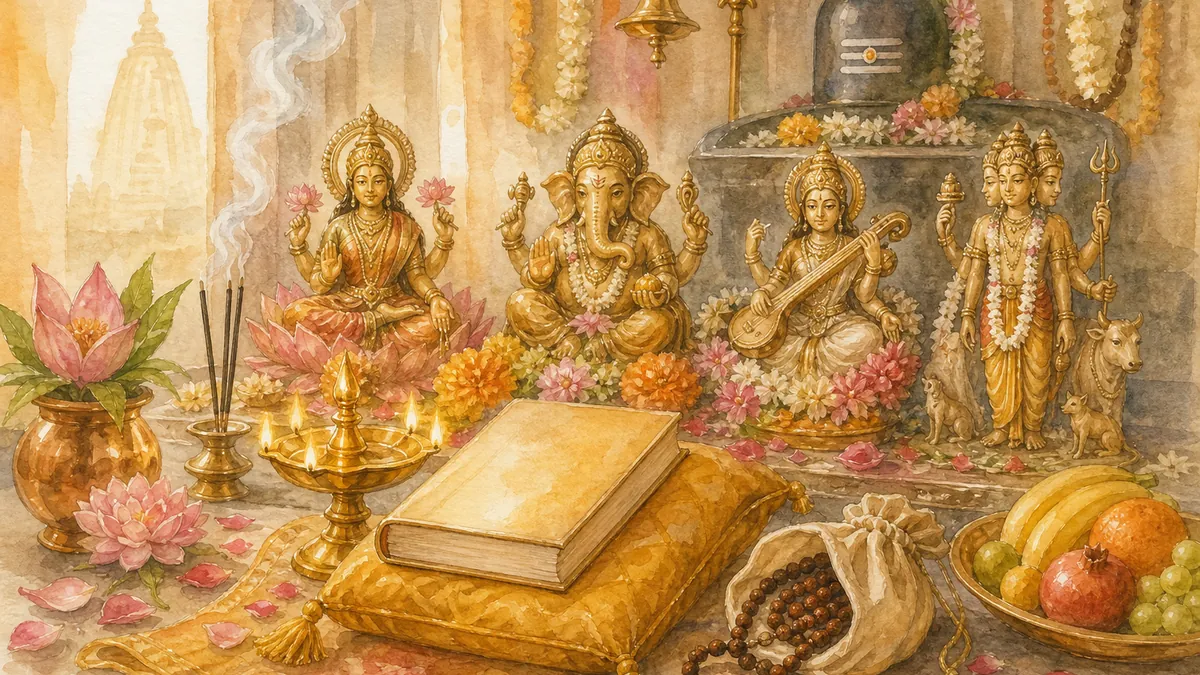
How can one determine whether a person practices or not? One should look at his altar. If the altar is slightly dusty and very clean, it is a sign that nothing has been done there for a long time. But if you see candle drips on the altar, something smeared, scorched cloth, a crumpled prayer book, then you can immediately say: “The person is working. The person is practicing; he is using the altar.”
For a true sadhu, his altar is his working instrument. Just like a keyboard — if it is new, it is a sign that no one works on it. But if the keys have already been worn down so much that the letters are no longer visible, and some are falling out, and the keyboard is smeared with something, then it is clear that the person lives at the computer. For a sadhu, his computer is his altar.
A sadhu must spend sufficient time at his altar. He must become so accustomed to his altar that the altar becomes his second “I.” He must feel it as his inner strength and energy. And even when he travels, his altar on the mental plane must always be with him; he must never part with his altar. The altar may transform, pass into a manasik form, be transfigured into the yoga of the illusory body. This happens as your spiritual maturity grows. But a sadhu must never part with his altar, because for a sadhu the altar is the source of the blessing power of the Refuge and of blessing wisdom.
The Power of the Altar in Worldly Life
Often, when sadhus, karma-sannyasis live in the world and work, they lose spiritual wisdom and spiritual power because they have to constantly come into contact with worldly energies, think about material things, communicate with atheists, see advertisements, non-divine images, worldly values and meanings. Then spiritual power and spiritual wisdom diminish, the mind becomes coarser, and it becomes difficult to follow the spiritual path. And the key to resolving this situation is to increase the time spent before the altar.
In addition, one must invest strength in the altar itself. That is, do not spare the money invested in the altar; this money will return to you tenfold. Give the best and most beautiful things to the altar: the best room, the best wall. If a wardrobe is in the way, throw it out and set up the altar beautifully. If a bed is in the way, sleep in another room on the floor, but make the altar worthy.
This altar will saturate you with spiritual power, change your destiny toward good fortune, attract the goddess Lakshmi, who will give you material shakti. Everything in your life can change if you attract blessings by worshiping the deities with prayer, faith, and devotion. This is the power of spiritual practice, because in this world everything is determined by merit (dharma-sukriti). And who in this world has any merit at all? Spiritual merit, not worldly merit. Divine beings and sages do. Therefore, through upasana at the altar, we reunite with such living beings who are full of merit, full of blessings.
If there is no opportunity to create a full-fledged beautiful altar, then one can create a small altar. For example, monks have a common altar; they do not have individual altars. If someone makes an individual large altar, people will look at him and say: “Prabhu, you seem a bit too proud.” But at least they have a large altar.
Thus, Guru Yoga and Refuge are upasana. Therefore, a true sadhu performs upasana every day, and from this his spiritual power and jnana only increase.
