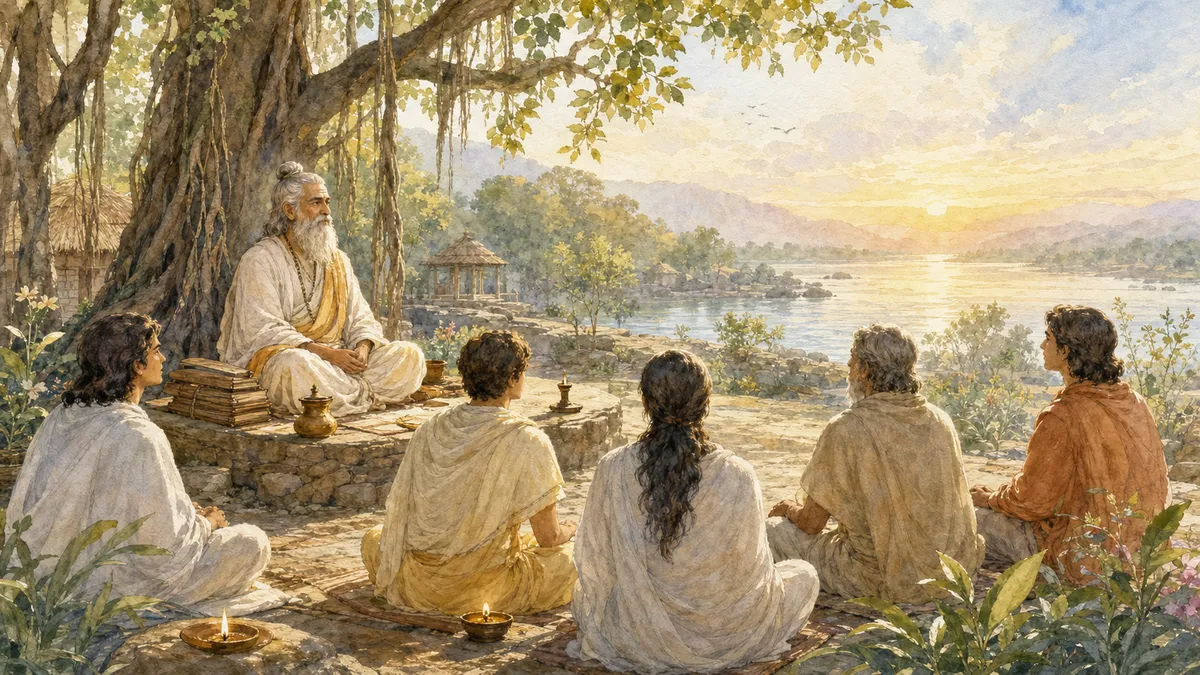
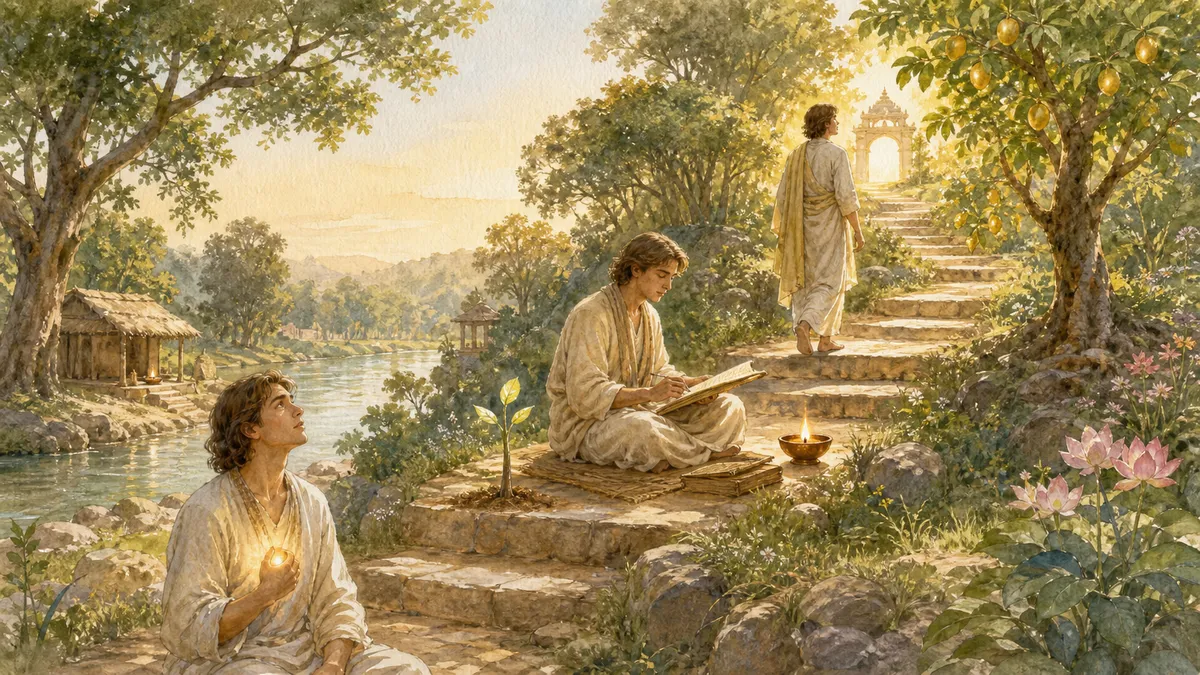
“How does one follow the seven stages of yoga? What are the characteristics of these stages?”
Vasistha continued:
“A person either accepts the world or rejects it. The former asks: ‘What kind of liberation is this? For me, samsara and life within it are far better,’ and he becomes involved in carrying out his worldly affairs. Through many births he attains the truth. He understands that actions in the world are a futile repetition and does not wish to waste his life immersed in them. He thinks: ‘What is the point of all this? I want to rest from it all.’ And he begins to reject the world. ‘How can I cultivate dispassion and thus cross the ocean of samsara?’ He constantly thinks about this. Day by day, this very thought itself promotes the arising of dispassion; calm and joy arise in his heart.”
The Gradation of Living Beings According to Spiritual Merit
Living beings in the material world are absorbed in their own interests and do not think about liberation. The interest of living beings lies in achieving their own meanings and goals, in material prosperity, in procreation, in strengthening their country and nation, and in enrichment. Only a handful of people truly reflect on liberation. These are those who possess the highest merit in the world of humans.
Many people profess so-called religion, calling themselves Christians, Hindus, Buddhists, Jews, and so on. Nevertheless, very few people truly apply the tenets of one religion or another and live by them. Most people are content with simply identifying themselves with a particular religious group, because tradition dictates it, because they were born into that religious group, because their grandfathers or fathers professed that religion, or because that religion dominates in their society. But this still cannot be called a genuine path of spiritual liberation. And such people should also be considered people of little merit.
Only those who, by virtue of great merit and spiritual work accomplished, embrace their path as a conscious choice of striving for liberation are people who truly possess merit and a chance to attain liberation. However, even among these people there are also many gradations.
Three Categories of Practitioners
The best of these people are those who constantly engage in spiritual work, continuously purify the kleshas, closely examine their mind, and try not to deviate even a single step from the holy instructions. And this is very difficult; it requires constant vigilance and spiritual work. This category of practitioners is also divided into several gradations: those who are less fortunate and those who are more fortunate. Those who are more fortunate carefully study and understand well the meaning of the sacred texts, constantly raise the level of their knowledge, develop their clarity and understanding, and attain the awakening of the mind. And those in this group who are less fortunate do not understand the sacred texts and instructions immediately, but only after many years of persistent spiritual practice and study; nevertheless, they practice well and purify the stream of their mind. The most fortunate are called divya yogis; the less fortunate are called vira yogis.
And finally, there is the category that, even after many years, understands the essence of the sacred texts and the essence of the practice of contemplation only with great difficulty. They accumulate merit and purify the stream of their mind in order to be reborn in a pure state in the next life. For example, to be reborn in a pure land or in a good family and to continue spiritual practice with a higher potential of merit.
Thus, there is a certain gradation. Living beings are not equal in their potential and spiritual path. Each of them is at a certain stage and moves in accordance with that stage. And it is possible that those who began later will be able to rise even to a higher stage than those who began earlier. Everything depends on spiritual aspiration.
Spiritual Democracy and Starting Potential
In this life, we do not start with equal opportunities. That is, democracy exists in the spiritual world, but on the level of view; on the relative level, it is as if it does not exist. There are equal opportunities, but not all people are equal. In this life, we already start with a certain baggage, since our subconscious is not a blank slate, and each person has their own potential of merit (virtues) and kleshas (negative states). And those who, in past incarnations, accumulated enough merit possess vividly developed virtuous qualities in this life; that is, their sattva is visible.
How is it visible? At an early age they come to the teaching, they meet a spiritual teacher. They intuitively grasp the essence of the philosophy. They have a highly developed intellect and developed creative abilities. They have a great charge of energy and good destiny. They possess great enthusiasm, great faith, and are always charged for success, for spiritual practice. That is, they are winners in life. Whatever they undertake, they achieve their goal. If they make a decision, they take responsibility for that decision. If they make a choice, they remain faithful to it. Such are people who have accumulated great merit in past lives. Obviously, in past lives such people were rulers, tsars, kings and queens, princesses, sons of rulers. Their worldly merit has been exhausted, and in this life they have set out on the path of Dharma.
People with less merit have difficulties in understanding Dharma, obstacles, doubts, and uncertainty. They have a consciousness of compromise. They are less able to achieve the goals they set; nevertheless, they have great faith, determination, and willpower. Such are the vira.
Finally, those who belong to the pashu category have a weak understanding of the teaching. They have little merit in worldly life. They are not confident in themselves; they have low self-esteem. Their intellect does not distinguish very clearly between Dharma and adharma. If they set goals for themselves, they still do not achieve them, or achieve them by making great efforts and experiencing serious difficulties, since from the very beginning their mind creates such a karmic vision in which they fail. Only by purifying themselves and passing through harsh trials, by reassessing their views and cultivating the necessary qualities within themselves, do they achieve their goal and truly enter the path of Dharma. Such is the pashu category.
That is, from the very beginning each of us begins the practice of Dharma while possessing a certain potential. And this potential is what we earned in past lives.
The possibility of changing one’s potential in this life
Nevertheless, even having a certain initial potential, in this life we have the opportunity to increase it. Even if a person has little potential, but has faith, diligence, and a powerful aspiration, they can accumulate enormous merit in one lifetime and create this potential for themselves. And, conversely, one who has great potential from a previous life, but in this life neglects practice and tapas, can squander the merit given to them in this life.
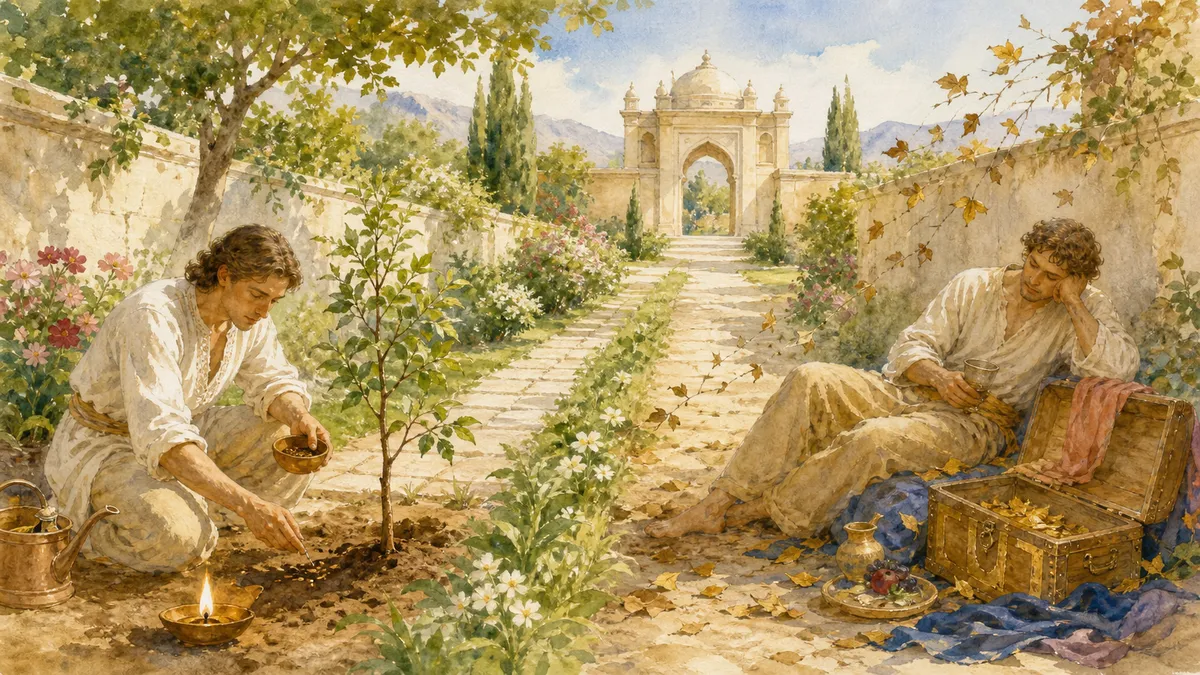
This life is a chance for the living soul to deal with this potential correctly. It is like a person who has capital, for example ten thousand dollars, and if he is very purposeful and enterprising, then by using this money he can earn and create an entire fortune for himself in the future, if he makes the necessary efforts and approaches the matter creatively. Another person, for example the son of wealthy parents, inherits not ten thousand dollars but half a million, yet he is not enterprising, is lazy, weak-willed, lacks a creative streak, is not charged for achieving success, but is inclined toward sybaritism, toward squandering merit, hedonism, pleasures, laziness, and tamas. Three years pass, and he discovers that all his capital is exhausted, everything he had has been squandered. Merits are like such capital. A true practitioner is one who continuously increases their potential, who constantly accumulates merit by making efforts.
And each of us roughly assesses ourselves by asking: “At what stage am I: divya, vira, or pashu?” In accordance with this, we develop a certain spiritual strategy.
The first three stages of yoga
“He is no longer interested in the world, and he is absorbed in praiseworthy actions. He fears sinning. His speech suits the situation; it is gentle, honest, and kind. He has taken the first step toward the state of yoga. He serves saints and sages, seeks and studies the scriptures. His constant aim is to cross the ocean of samsara. He alone is the seeker. The others act selfishly.
Then he ascends to the second stage of yoga, known as questioning, inquiry, direct observation — vichara. He seeks the company of the wise who have studied the scriptures and practices. He knows what should be done and what should not be done. He abandons the sins of pride, envy, delusion, and jealousy. From teachers he learns all the secrets of yoga.
From here he easily moves on to the third stage of yoga, characterized by non-attachment or freedom. He walks through forests in solitude and strives to calm the mind. Following the scriptures and virtuous conduct gives him the ability to see the truth.
Non-attachment or freedom is of two kinds — ordinary and supreme. The practitioner of the first type feels: “I am not the one who acts or enjoys; I do not influence others, and others do not influence me. All this happens because of past karma, by the will of the gods. I do nothing while in pain, pleasure, good fortune, or misfortune. All these — meetings and partings, states, physical illnesses — are brought and carried away by time alone.” Thinking thus, he investigates the truth and practices the ordinary type of non-attachment or freedom.
Vasishtha continued:
Through constant practice of the yogic method, seeking the company of the wise and avoiding bad company, the truth is revealed. When in this way a person understands the Supreme — the One Essence or Truth beyond the ocean of samsara — he realizes: “I do not act; only God acts. Even in the past I did nothing.” He abandons empty, unnecessary words, remaining inwardly and mentally silent. This is the best form of non-attachment or freedom. He has abandoned dependence here or above, within and without, tangible and intangible, rational and irrational. He shines like the boundless self-sustaining sky. This is supreme freedom. In it he enjoys peace and contentment, purity and virtue, wisdom and self-awareness.
The first stage of yoga appears before a person as a chance coincidence after he has lived a virtuous, pure life. One who has reached this point should value this opportunity and strive to preserve it with zeal, effort, and patience. Thus he will ascend to the next stage, and then to the next.”
“Is it possible for an ignorant person, born in a bad family, who does not enjoy the company of sages, to cross the ocean of samsara? And if a person dies on the first, second, or third stage of the yoga described, what happens to him?”
Vasishtha says:
“Through many lives, an ignorant person awakens thanks to some chance occurrence, and until then he continues to experience samsara. When dispassion arises in his heart, samsara recedes. Even an imperfectly correct practice of yoga destroys the results of past sins.
If a person leaves the body during the period of practice, he ascends to heaven, to the Worlds of the celestials. Then he is born in circumstances that support his spiritual practice, and soon he again begins to climb the ladder of yoga.
These three states are called the state of awakening, because in them there is division in consciousness.
Such a person, devoted to noble and pious actions, avoiding sins, attracts others to himself. His initial holiness is on the first stage in its embryonic state; on the second stage it sprouts, and on the third it bears fruit.
One who dies after attaining this third stage, and who has cultivated pure thoughts within himself, enjoys heaven for a long time and then is born again as a yogi. Through constant and diligent practice of the first three stages of yoga, ignorance is destroyed, and the light of wisdom arises in the heart.”
Vasistha describes the seven stages of yoga. These are not the seven stages of Patanjali’s yoga, but roughly the same stages described in the teaching on the sixteen kalas, only here they are reduced to seven main stages.
The first three stages are entering the path of practice, investigation, and attaining a certain stage of awakening. I would call this the stage of conception.
Read 15 times
Articles
Vidya AI
Search
Lectures
November 3, 2026
Mantra of the day
ОМ САДРЩАЙА НАМАХ ОМ Видящему равно – поклонение!
Auspicious Times(Rome)
Brahma Muhurta:
04:54 - 05:49
Abhijit Muhurta:
11:33 - 12:14
Sayam Sandhya:
16:43 - 17:24
Mokshada Ekadashi (6 November)
Ekadashi of liberation. Helps to achieve spiritual enlightenment.