The Path to Enlightenment: Lessons from the Story of Sikhidhvaja and Chudala
27.06.2026
0 мин. чтения
0
Share
copy
search
add
share
Commentary on the text “Yoga Vasistha,” Chapter Six. The Story of Sikhidhvaja and Chudala
The Importance of Studying Sacred Texts
Why is it important to study texts, to study mythology? Because if you study the texts of the transmission lineage correctly, it is like guru yoga; it is like uniting the mind with the saints.
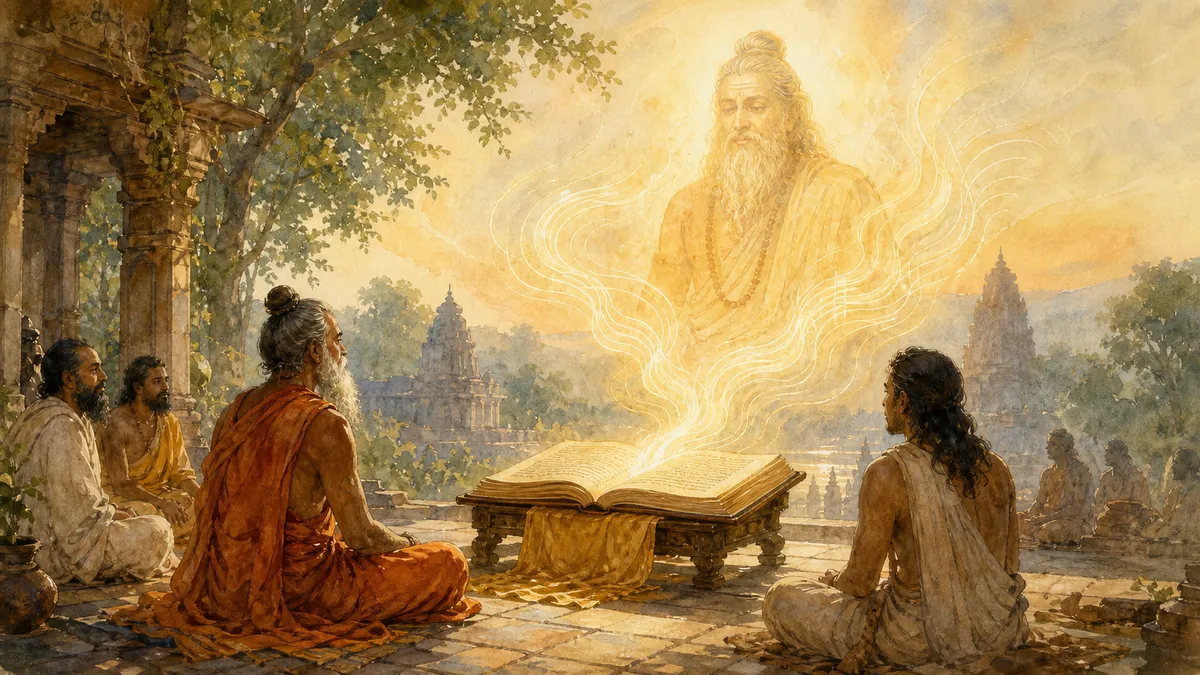
Uniting the mind with the saints means that, through the text, we synchronize and attune our consciousness, and in this way receive one of the forms of spiritual transmission, namely shastra-kripa, that is, the blessing of the sacred text. If you know how to work with a sacred text correctly, you will certainly begin to receive such shastra-kripa. For this, it is necessary to read the text not only at the level of conceptual understanding, but also at the level of intuitive consciousness, uniting consciousness with the source of this text. In this case, with the holy rishi Vasistha. I assure you that, if you do it correctly, you can receive the most powerful experience of non-duality, similar to that which can be experienced after long practice in retreat.
Rishis are extraordinary beings, transcendental, before whom siddhas and gods stand in reverent respect; these beings themselves are like creators of entire universes, and their capacities for manifestation are unlimited. They are depicted as resembling human beings; however, human manifestation is only one of the facets of the spiritual essence of a rishi. A rishi may have the body of a deity, a siddha, or a human being.
In this case, when you read the text, the rishi manifests as the sound body of the shastra—the sacred scripture. To contact the shastra is the same as contacting the sound body of the rishi, the source of the transmission.
When you read the mantra “Om Tryambakam...,” which was transmitted by Rishi Vasistha, you also contact his sound body in the form of sound vibration. Thus, if you have the appropriate understanding, by uniting with such a sound body you can receive a genuine spiritual blessing.
For example, when you study the “Mahabharata,” you contact the intellectual body of Rishi Vyasa, his mandala, and therefore enter into his vision. Or when you study the “Rigveda,” for example, or the “Samaveda,” you contact the vibrational body of Brahma, which is the source of the Vedas.
The ability to contact sacred texts, receiving such spiritual transmission, is indeed a form of guru yoga. Therefore, do not deprive yourself of such an opportunity; do not neglect the study of texts. The spirit of one who studies texts is always cheerful and vigorous; he possesses boundless faith, devotion, and enthusiasm in practice and in service, and, most importantly, he has an intuitive understanding of wisdom, since it is impossible, while reading texts, not to reach the intuitive level of understanding.
The Story of King Sikhidhvaja and Princess Chudala
So, Vasistha gives instructions to Rama. He says:
“Rama, remain in peace and renounce everything worldly. I will tell you the story of Sikhidhvaja.
In the kingdom of Malwa there lived a king named Sikhidhvaja. He possessed all the marks of royal greatness. He was noble, virtuous, brave, and courteous. He lost his father at an early age. From a young age he was able to establish independence and ruled the kingdom with the help of his devoted ministers.
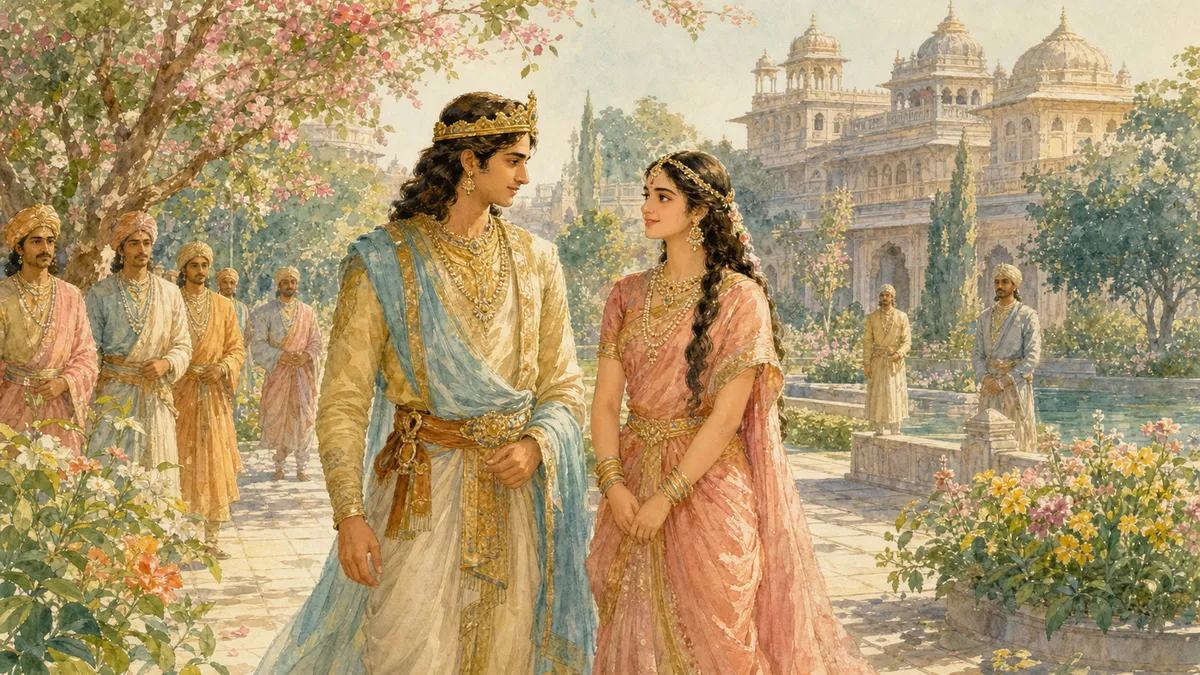
Spring began; romantic fragrances filled the air. The young king began to dream of a wife. Day and night his heart suffered. The wise ministers understood the state of the king’s heart. They went to the kingdom of Saurashtra to ask for the princess’s hand on behalf of the king. Soon King Sikhidhvaja married Chudala.
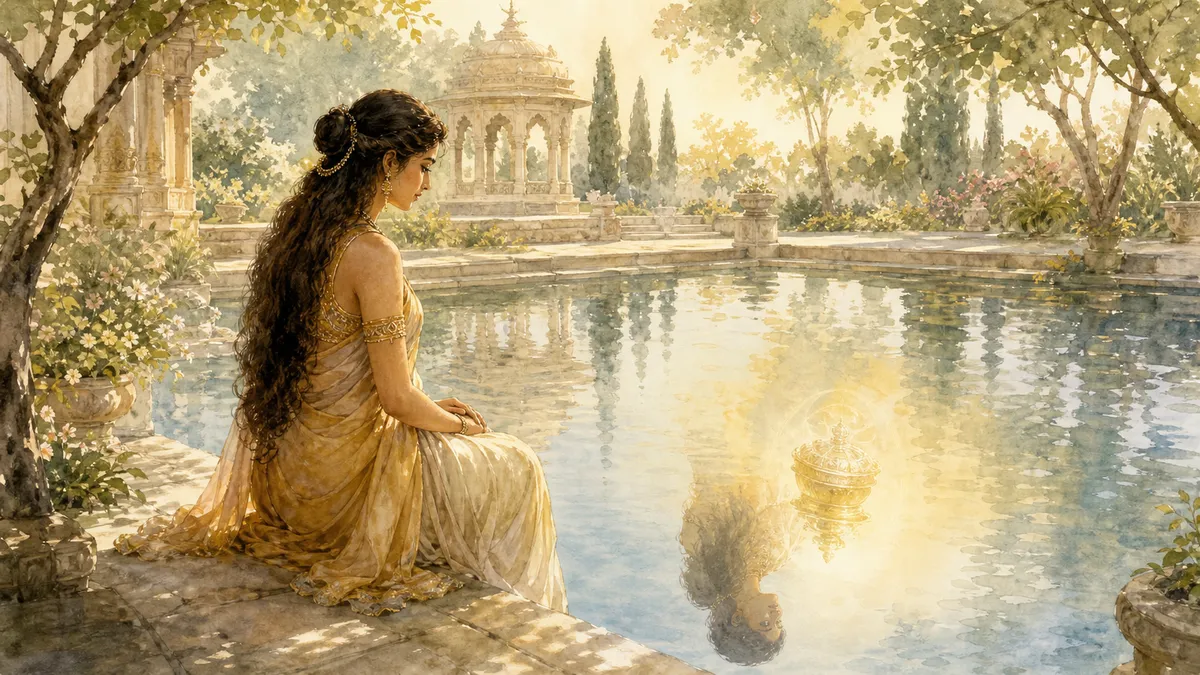
Sikhidhvaja and Chudala loved each other so much that they seemed to be a single being in two bodies. They had many common interests, and together they amused themselves in beautiful gardens. Just as the sun sends its rays to the earth so that the lotus flower may unfold, so the king shone with love for his wife and tried in every way to give her pleasure.
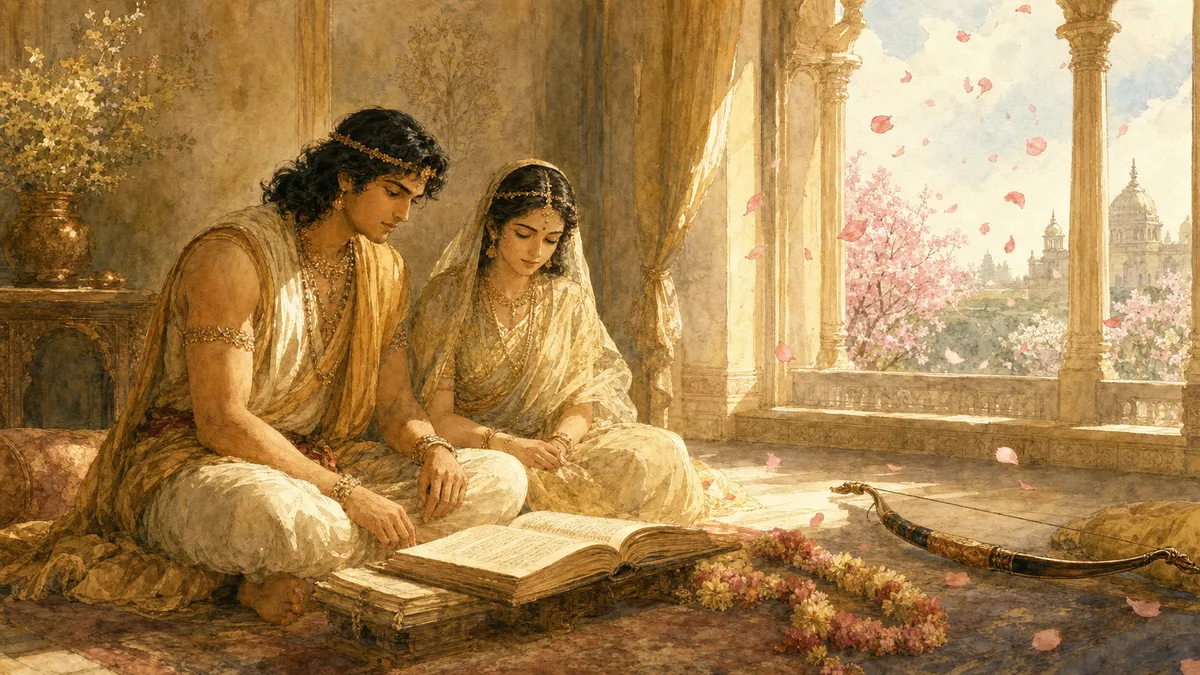
They shared knowledge and wisdom, and in this way they both became very advanced in all branches of knowledge. Each blossomed in the light of the other’s heart. Truly, it seemed that Vishnu himself with his consort had descended to earth to fulfill a special purpose!
Thus Sikhidhvaja and Chudala enjoyed each other for many years, without a single unpleasant moment. But no one can prevent the passage of time. Life appears and disappears like a juggler’s trick. The pleasure one strives for flies past like an arrow released from a bowstring. Suffering pursues the mind as hyenas pursue a dying animal. “Having attained what in this world will the mind no longer suffer?” Reflecting in this way, the royal couple began to study spiritual texts.
They came to the conclusion that only self-realization makes it possible to overcome suffering. They devoted their entire heart and soul to self-realization. They turned to self-realized sages and worshiped them. They constantly discussed self-realization and strove to awaken it in one another.
Queen Chudala’s Enlightenment
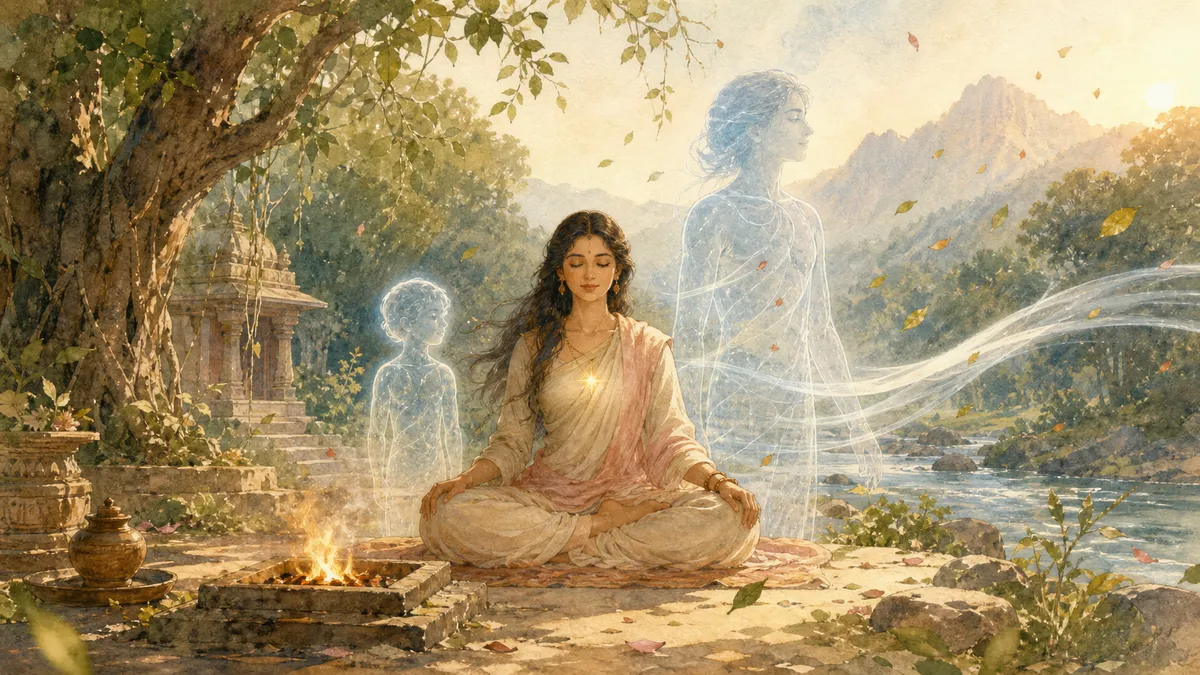
Constantly reflecting on the methods of self-knowledge, the queen thought in this way:
“I now see myself and ask, ‘Who am I?’ How can ignorance and delusion arise? Undoubtedly, the physical body is inert, and, of course, it is not me. It is perceived only because of the movement of thought in the mind. The organs of action are only parts of the body and therefore they too are inert. The sense organs are also inert, because they depend on the mind for their functioning. I consider even the mind to be inert. The mind thinks and adheres to various notions, but it is made to act in this way by the intellect, which is the determining agent. But even this intellect is inert, because it is directed by the sense of ego. And even the sense of ego is inert, because it is only imagined by the individual consciousness, as a ghost is imagined by a small child. Individual consciousness is pure consciousness, as though enveloped by the life force, and it dwells in the heart.
Look! I have realized that this is the pure supreme consciousness, existing as individual consciousness, because consciousness is aware of itself as its own object. This object is non-conscious and unreal, and because one’s own essence identifies itself with this object, it forgets its essence as consciousness. For such is the nature of consciousness: whatever it considers itself to be, whether real or imagined, that it becomes, as though leaving behind its own essence. Therefore, although my “I” is pure consciousness, it imagines itself to be non-conscious and unreal because of its perception of objects.”
Reflecting in this way for quite a long time, Chudala attained enlightenment.
Delighted by this realization, the queen exclaimed:
“At last I have attained what is worth attaining! Now this cannot be lost. Even the mind and the senses are only reflections of consciousness, although they are unreal apart from consciousness. Only this supreme consciousness exists. This is the highest truth, untainted by any impurity, always in a state of perfect equilibrium and devoid of the sense of ego. Once realized, this truth shines constantly, never setting.
This consciousness is called by various names—Brahman, the supreme Self, and so on. In it there is no division into subject and object and their relationship (knowledge). Consciousness is conscious of its own consciousness; it cannot be understood in any other way (as an object of awareness). Only this consciousness manifests as the mind, intellect, and senses. This apparent world too is only this consciousness, outside of which nothing exists. Consciousness undergoes no changes; the only apparent change is the illusory form, which is illusory and therefore unreal! In an imaginary ocean, imaginary waves arise. The mind itself is the ocean, and its waves are also mind. Thus this apparent world arises in consciousness, and they are not different from one another.”
Having realized this, Chudala became even more firmly established in the state of enlightenment. She began to feel:
“I am pure consciousness, omnipresent and devoid of the sense of ego. For this consciousness there is neither birth nor death. It cannot be destroyed, because it is like space. It cannot be cut or burned.
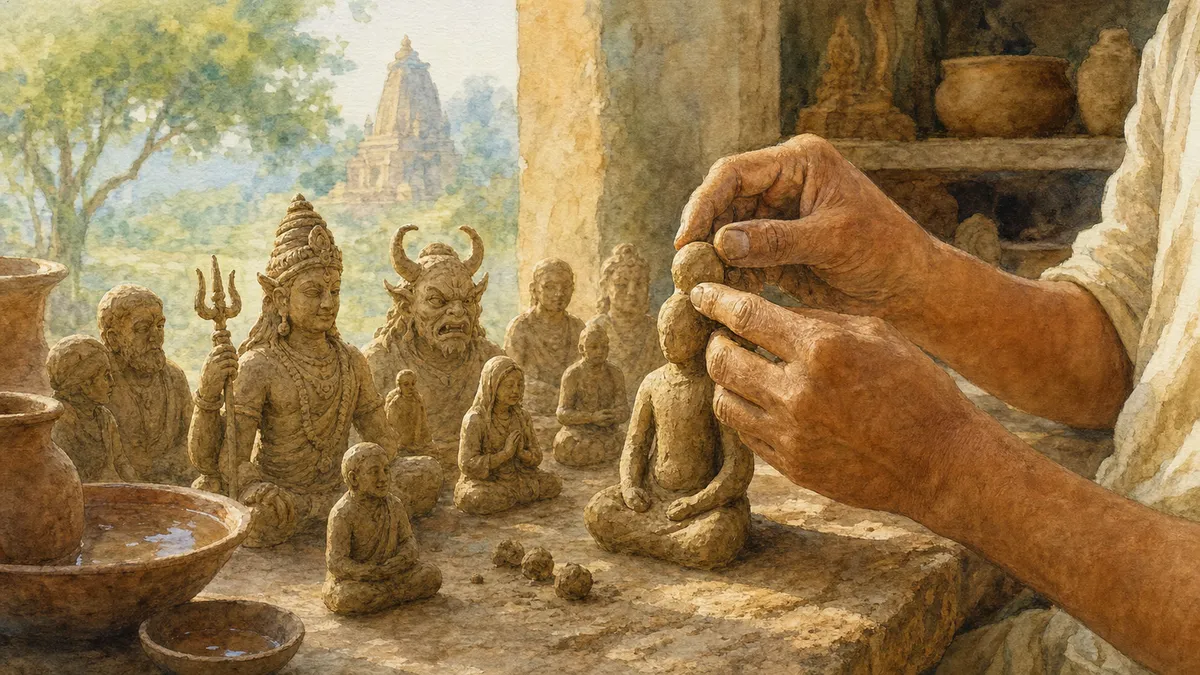
I am free from all delusions. I am peaceful. All gods, demons, and various beings are, in essence, not created, because they are not different from consciousness. External forms are illusory, just as clay soldiers are clay, not soldiers.”
Then she analyzed:
“How did this misunderstanding arise, from which the concepts ‘this is unity’ and ‘this is duality’ appeared? In whom does this delusion exist? Whose is it? I remain in nirvana (liberation or enlightenment), without the slightest disturbance of thought, having realized that everything that exists (whether intelligent or non-intelligent) is pure consciousness. There is neither ‘this’ nor ‘me’ nor ‘another’; there is no existence or non-existence. All this is peace and tranquility.”
Reflecting in this way, she saw that even ignorance itself had never existed.
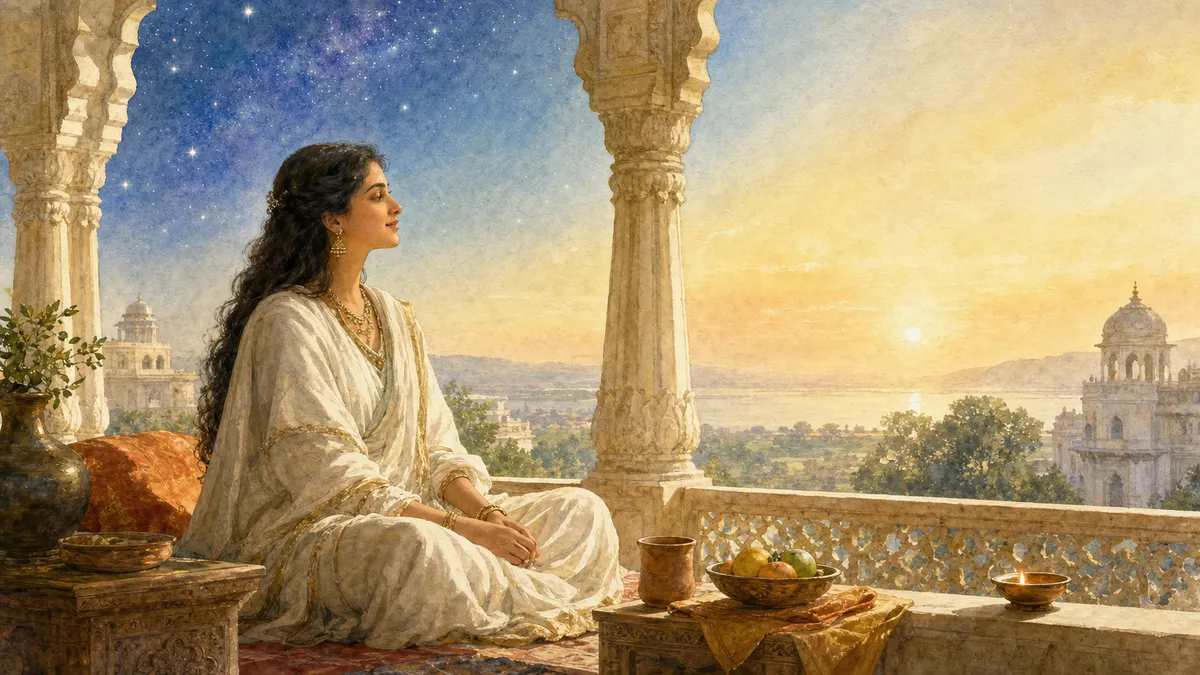
Day by day the queen became more and more immersed in herself, enjoying the bliss of realization more and more. She was completely free from desires and attachments. Without renouncing anything and without striving for anything, she was natural in her behavior and spontaneous in her actions. All her doubts ceased. She crossed the ocean of existence. She became established in the incomparable state of peace.
Thus, in a very short time, she attained the realization that this apparent world would disappear in exactly the same way as it had appeared! She shone with the light of self-realization.
King Sikhidhvaja’s Misunderstanding
Seeing her radiant and peaceful, Sikhidhvaja asked her:
“You have regained your youth and shine in an unusual way, my beloved. You are not distracted by anything at all, and you have no desires, yet you are full of bliss. Tell me—have you drunk the divine nectar? Surely you have attained something that is very difficult to attain?”
Chudala replied:
“I have left behind this emptiness that has assumed some form. I remain in the truth, not in the deceptions of external forms. Therefore I shine. I have left all this and turned to something else. Therefore I shine. I enjoy the non-enjoyment of pleasures as if I were enjoying them. I yield neither to joy nor to indignation. Therefore I shine. I experience great bliss, remaining in the reality that shines in my heart. I am not distracted by royal pleasures. Therefore I shine. Even when I am in beautiful gardens, I remain firmly in my own awareness, not in the enjoyment of pleasures, nor in modesty, and so on. Therefore I shine.
I possess the universe. I am not a limited being. I enjoy consciousness. Therefore I shine. I am That. I am not. Truly, neither am I nor am I not; I am everything, I am nothing. Therefore I shine. I do not seek pleasures, wealth, poverty, or any other way of being. I am content with what comes without effort. Therefore I shine. Everything I see with these eyes, feel with these senses, and understand with my mind—I see only the one truth within myself.”
Unable to understand the queen’s words, Sikhidhvaja laughed at them and said:
“You are just like a child, my dear, babbling something incomprehensible. Having left something for nothing, having left real objects and attained a state of emptiness, can one really shine like that? Leaving pleasures and at the same time thinking, ‘I enjoy unenjoyable pleasures,’ it is impossible to enjoy anything! It makes absolutely no sense to leave everything for nothing and at the same time say that you enjoy nothing. And in general, it makes no sense to consider yourself happy after renouncing clothes, food, a bed, and so on. ‘I am not the body,’ ‘and at the same time I am not anything else,’ ‘nothing is everything’—all this is childish babble. ‘I do not see what I see’ and ‘I see something else’—why, that is nonsense, my dear!
Do not trouble yourself—continue to enjoy what has been given to you. I will continue to amuse myself with you; go and relax.”
Such was Sikhidhvaja’s perception.
It often happens that we do not understand the spiritual level of the person with whom we are communicating, since understanding spiritual level and recognizing subtle consciousness is not a simple matter. What is accessible to us is the physical body, or at worst, the intellect. We can judge another person by intellect, by behavior: “Yes, this is an elevated person! And that one is a fool, a mediocrity.”
And often we are strongly caught up in our own assessments, but sometimes our assessments may not reflect reality at all, because true reality can be much subtler. In the guise of a “simple-minded monk,” Dattatreya may be hidden. In the guise of a layperson, there may be a secret siddha or buddha. It is not all so simple. In the guise of our familiar friend, a deity may be hidden, who may simply not wish to reveal themselves to us because of some prior connections or the absence of secondary causes. This is incomprehensible, but this is exactly how the world exists.
The world does not correspond to our labels. And that is why, from the very beginning, we say: “Practice pure vision, and you will not be mistaken.”
In a banal situation that irritates us, the darshan of a deity may manifest, testing our awareness. In the guise of trouble, the true darshan of cutting off hope and fear may manifest. Everything depends on whether we are able to recognize it or not. In the guise of a deluded being who obstructs us, a deity may manifest (for example, Indra), testing us and wishing to bless us with something. How we interpret reality depends on the level of awareness and on nothing else.
Queen Chudala’s Attainment of Siddhis
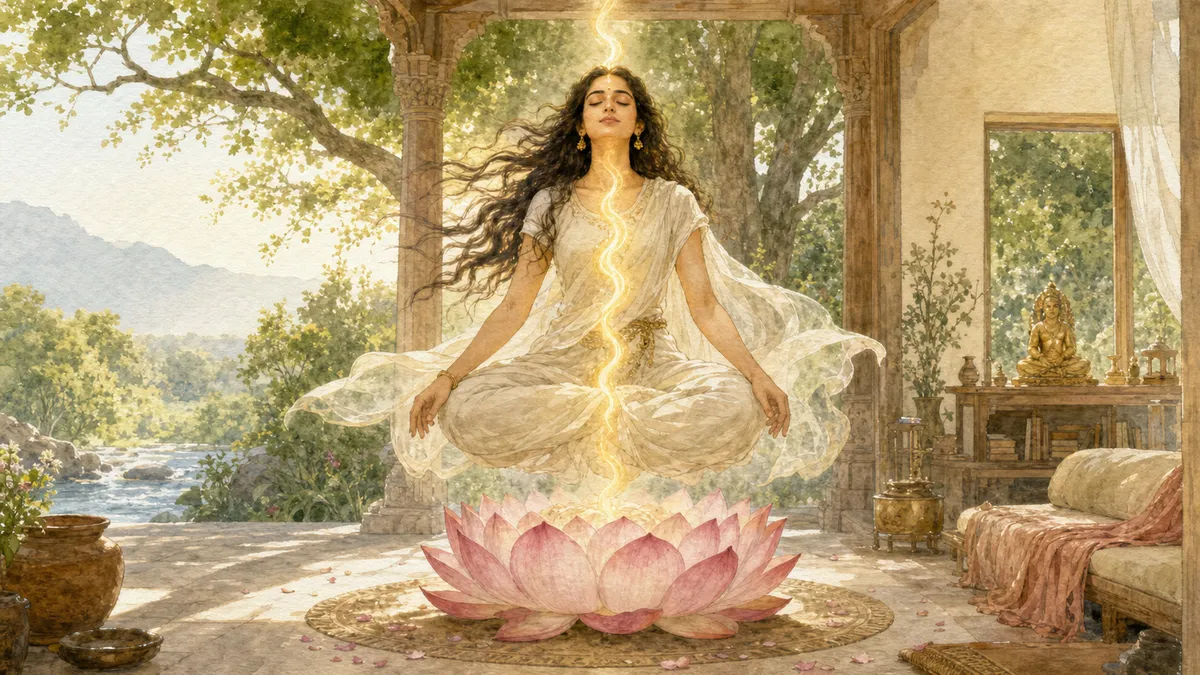
Having said this, the king went about his affairs. Chudala thought, “It is a pity that the king cannot understand,” and continued living, doing her work. Thus they lived for quite a long time. Although Chudala had no desires, at some point she developed a desire to move through space. To gain this ability, she withdrew and, in seclusion, practiced working with the vital forces (air), which have the ability to rise upward.
She attained this ability to rise upward (to levitate) through mastery of the nadi center called “antravestika.” It is the source of other centers in the body and is connected with everything from the waist to the crown of the head. She awakened the kundalini energy and mastered the power of the wind. She also mastered other siddhis and was able to make her body tiny and, conversely, enormous. By revealing the spark that exists directly above the lotus of the heart (the anahata chakra), and by controlling fire and wind, she could manipulate her body.
Queen Chudala possessed all psychic powers: she could become enormous or turn into the tiniest atom and enter any object or body. She traveled through the sky and the deepest oceans, wandered over the Earth, while at the same time not leaving her castle and her husband. She could easily enter any object—a tree, a stone, a mountain, grass, the sky, and water. She visited celestial beings and enlightened sages and had interesting conversations with them.
Although she did everything so that her husband, too, would attain enlightenment, he not only did not listen to her words, but also laughed at her foolishness. He still remained deluded. Chudala considered it unwise to show her abilities before him.
Question: If even such a great yogini as Chudala could not help and awaken her husband, King Sikhidhvaja, then how is it even possible at all to attain enlightenment and understanding?
But Vasishtha said that the cause of enlightenment is the purity of the disciple’s consciousness. External actions and a superficial connection with a spiritual teacher do not lead to self-knowledge.
He said these words:
“Only the self knows itself; only the snake knows its own legs!”
He meant that even though Sikidhvaja had contact with such an outstanding yogini, there was no spiritual connection. And even the spiritual siddha-yogini Chudala could not transmit her enlightenment to him. She could only help him find the path so that he might discover his potential. But if his subtle consciousness was blocked, unopened, and unwilling, then this was not possible.
In other words, the proper samaya connection was absent between them.
King Sikidhvaja’s Depression and His Decision to Go into the Forest
And so, Sikidhvaja was absorbed in illusions. He tried to practice, but in the end he became confused, since he could not understand many things. He fell into depression. This depression was very strong, and nothing could dispel it. He began seeking solitude and performed only the bare minimum of his necessary duties. He also gave away many donations, engaging in charity. He tried to perform ascetic practices, but this did not dispel his confusion and illusions; instead, he sank even deeper into depression.
After much reflection, Sikidhvaja once said to Chudala:
“My dear, for a long time I have enjoyed my reign, all the charms and pleasures of royal life. Neither pleasure nor pain, neither wealth nor poverty can disturb the tranquility of an ascetic. Therefore I want to go into the forest and become an ascetic. The beloved forest, resembling you in every way, will delight my heart just as you do now. Give your consent to my departure, for a good wife will never oppose her husband’s wishes.”
Chudala tried to dissuade him, thinking that there was no point in his becoming an ascetic, because he could receive her instruction and attain awakening. But Sikidhvaja did not wish to accept her as a spiritual mentor and did not listen to her. He said:
“My dear, do not put obstacles in my way. You see, I have already left! You are still a child and should not go with me into the forest, for ascetic life is very difficult. Stay here and take the reins of rule into your own hands.”
Vasishtha continued:
The King’s Departure into the Forest
That night, while the queen was sound asleep, the king left his castle under the pretext of inspecting the city. He rode for a full day and reached a dense forest on Mount Mandara. It was very far from people, and there were signs that holy sages had once lived there.
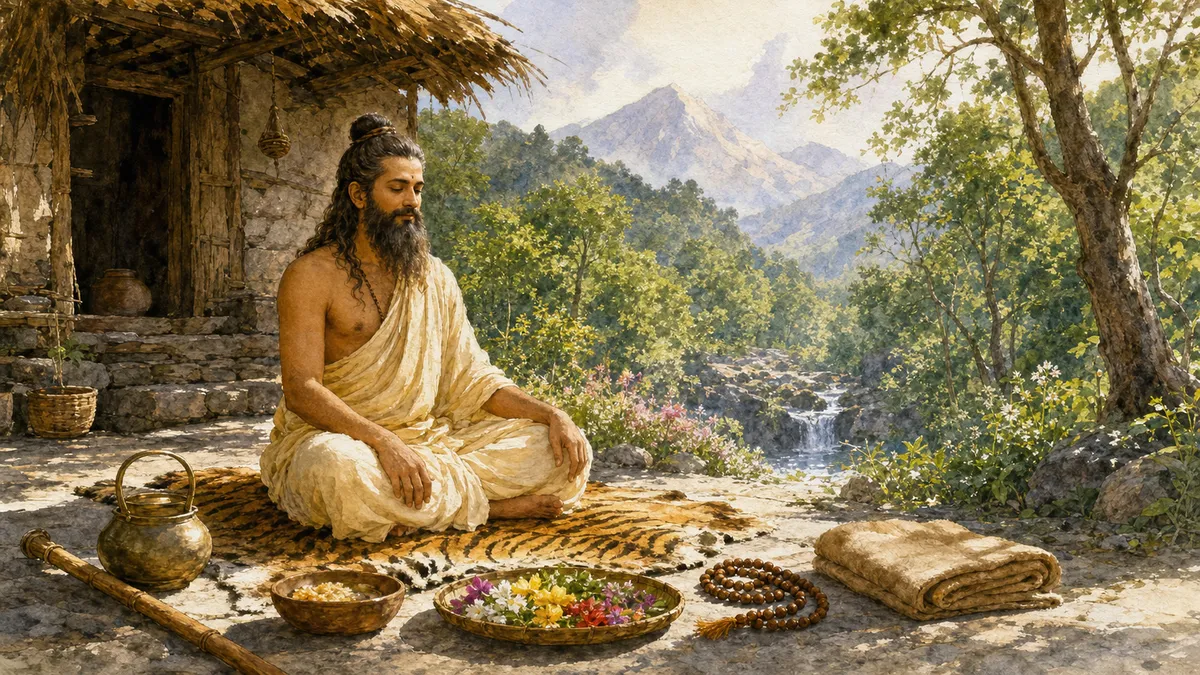
There he built himself a hut and gathered everything he considered necessary for ascetic life: a bamboo staff, a food plate, a water vessel, a tray for flowers, prayer beads, clothing to protect against cold weather, and a tiger skin for meditation. And he began living the life of an ascetic.
He spent the time before noon in meditation and the repetition of mantras. The time after noon was for gathering flowers for worship; then came ablutions and prayers. After that he ate a meager dinner of fruits and roots. The remaining time he again spent repeating mantras. He lived in his hut for a long time, not even remembering his kingdom.
Vasishtha continued:
Chudala awoke and discovered that her husband had left the palace. She felt unhappy and decided that her place was beside her husband. She too left the palace through a small window and flew up into the sky in search of her husband. Soon she saw him in the forest. But before descending from the heavens to him on the earth, she reflected on future events and saw them with the help of her psychic powers. She saw everything that was to happen, down to the smallest detail. Bowing to the inevitable, she returned to her castle by the same path by which she had arrived.
Chudala announced that the king had left the palace on important business. From then on, she ruled the entire kingdom. For eighteen years she lived in the palace, and he in the forest, without seeing one another. The king began to grow old.
Chudala’s Decision to Help Her Husband
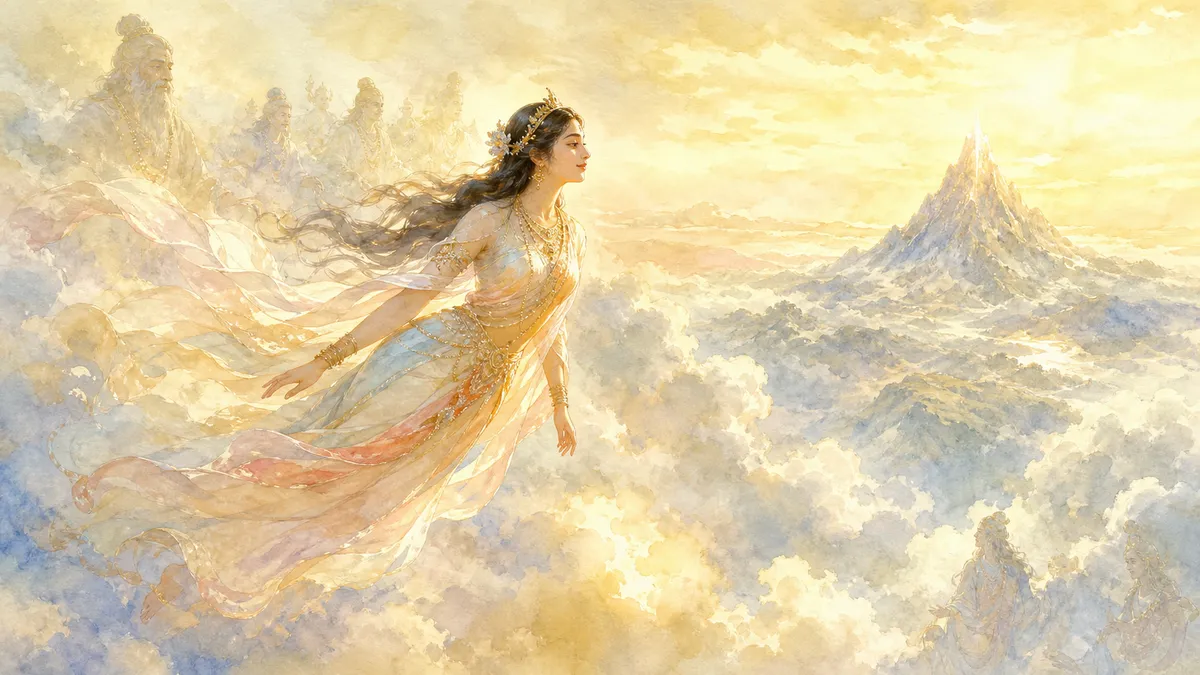
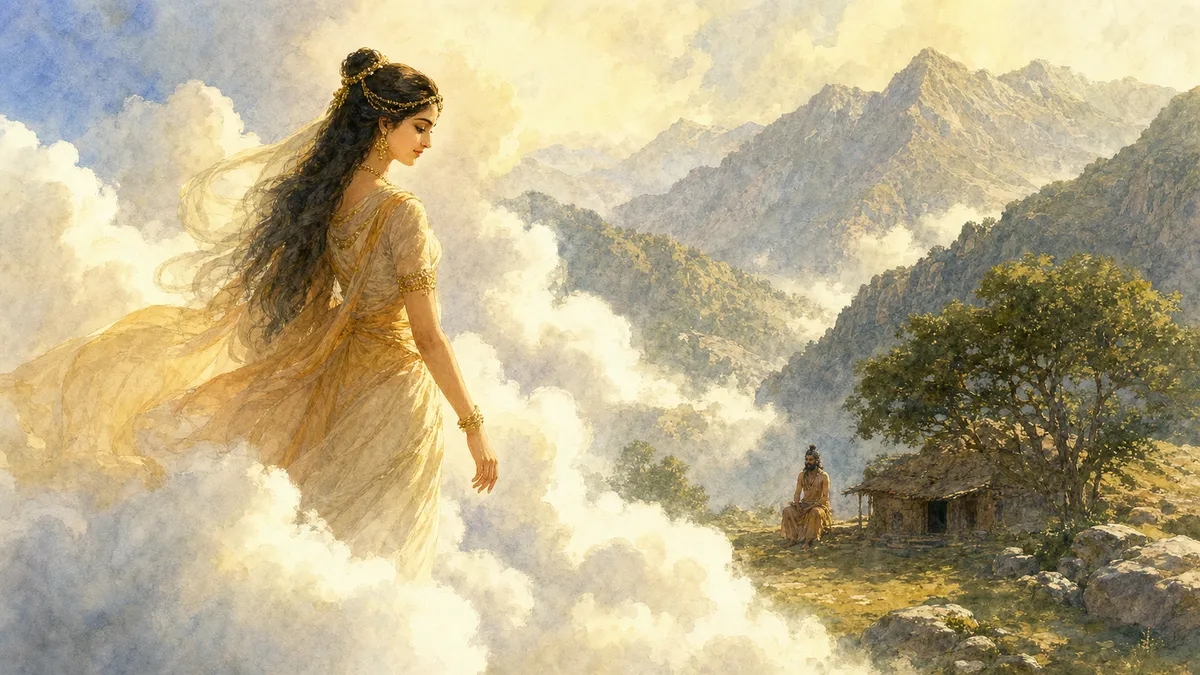
At this time, Chudala saw that her husband’s consciousness had matured sufficiently, and that the time had now come to help him attain enlightenment. Having decided this, she left the palace at night and flew to the place where her husband lived. Along the way she met celestial beings and enlightened sages in paradise. She flew through the clouds, breathing in heavenly fragrances, and looked forward to meeting her husband. She was burning with impatience; her mind was in agitation.
Noticing her state, she said to herself:
“Oh, undoubtedly, as long as there is life in the body, human nature does not cease to act. Even my mind is so agitated! Or perhaps, O my mind, you are seeking your own peace. On the other hand, my husband has most likely forgotten his kingdom and me after all these years of asceticism. In that case, O mind, you are agitated in vain at the prospect of seeing him again... I will restore balance in my husband’s heart so that he returns to his castle, so that we may live there long and happily. The enjoyment of the state of complete equilibrium surpasses any other happiness.”
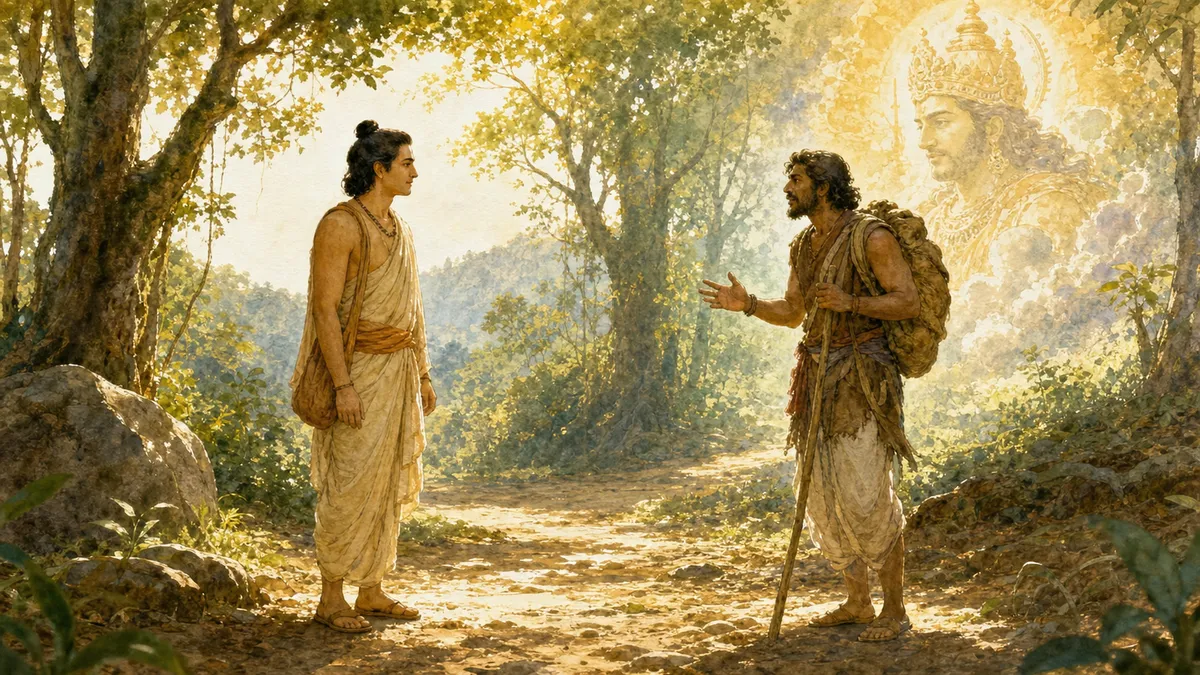
With such thoughts, Chudala flew to Mount Mandara. Still remaining in the heavens, she saw that her husband had greatly changed, for the king had always previously been dressed in royal garments, whereas now he looked like a thin, exhausted ascetic. Chudala was saddened by the condition of her husband, dressed in coarse clothing, with matted hair, quiet and solitary, with skin darkened as though he had bathed in a river of ink. For a second she thought: “Alas, such are the fruits of foolishness! For only fools reach the state in which the king now is.”
Chudala was disappointed not because Sikidvaya looked that way, but because his intellect was in a dull, inert state. She said to herself:
“By his own delusions alone he has locked himself in this lonely place. Here and now I will give him the opportunity to attain enlightenment. I will approach him incognito.”
Sikidvaya himself, meanwhile, had already grown tired of his practice, having gained nothing as a result. No matter how he tried to torment his body, perform rituals, work with mantras, practice other techniques, and so on, his ego was with him, and his mind was also with him. He received only disappointments. The more intensely he strove, the deeper he fell into illusion. In the end, he became very weary of it. But he did not know the way out.
Read 23 times
Articles
Vidya AI
Search
Lectures
November 3, 2026
Mantra of the day
ОМ САДРЩАЙА НАМАХ ОМ Видящему равно – поклонение!
Auspicious Times(Rome)
Brahma Muhurta:
04:54 - 05:49
Abhijit Muhurta:
11:33 - 12:14
Sayam Sandhya:
16:43 - 17:24
Mokshada Ekadashi (6 November)
Ekadashi of liberation. Helps to achieve spiritual enlightenment.