

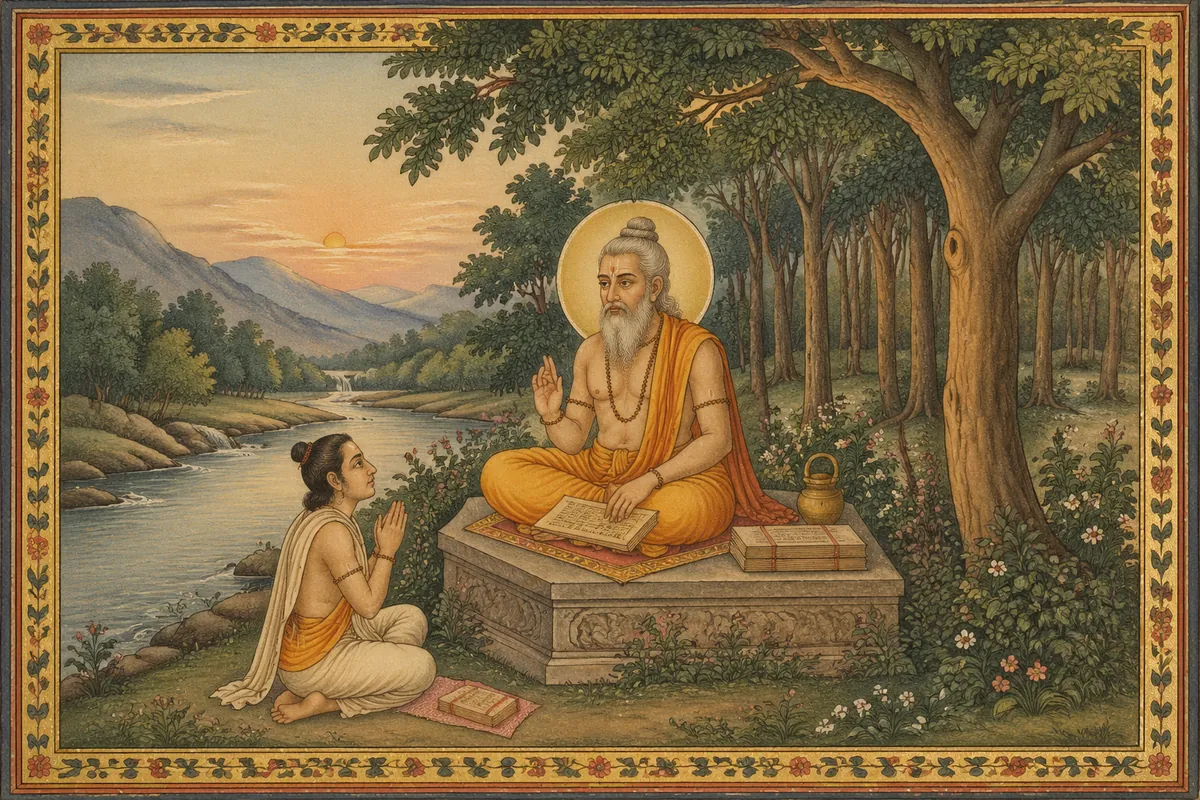
Commentary on the text “Yoga Vasistha”
“At the dawn of a new cycle of creation, they continued to stand in the same place, still with the same intentions. They became creators—these were the ten creators whom you saw; you also saw their universe.”
Rethinking the Picture of the World and One’s Place in the Divine Hierarchy
The path of liberation, spiritual practice, presupposes a new awareness of oneself within the universal tree of Refuge, within the divine hierarchy of divine beings. This is not only concentration, yoga, training the mind, purifying the mind—that is, dealing with one’s inner affairs and problems. This is, of course, important—this is our sadhana—but the path of liberation also presupposes a rethinking of the habitual picture of the world, an expansion of the habitual picture of the world, the inclusion in it of much that we did not have before. For example, gods, saints, the hierarchy of divine beings, and an understanding of one’s place in this new picture of the world.
We are not alone in the universe, and we are not separate in the universe; divine energies constantly pass through our subtle bodies, and we depend on divine energies, and we cannot exist by ourselves. At the same time, within us there is the Atman, which connects us with the essence of the entire universe, with the Absolute. We must make a little sense of all this and find our place in the universe through understanding the Atman, through awakening.
Divine beings are not visible only because our karmic vision does not allow us to see them; our indriyas are not sufficiently purified. When the indriyas are purified, divine beings will also become visible, and divine energies will become understandable. Our human picture of the world, our ego, our perception of the world—this is only a particular case of life in the material world of human beings. As we become sadhus, all this begins to expand, and we expand our picture of the world.
Establishing a Connection with the Refuge
We establish a connection with the great universal tree of Refuge through the tree of Refuge that we venerate in the sangha; therefore, it is very important to venerate the Refuge, to establish a connection with the Refuge, to observe the spirit of samaya, to be in the right relationship with one’s Refuge. The Refuge is an idea of the picture of the world, of the universal picture of the world with which we establish a connection. There is the tree of Refuge, there are painted luminous figures seated on lotuses, but this is only a drawing; we must penetrate the mystery of this drawing, we must understand what the tree of Refuge is for me, what it is in the universe. It is not enough to study the history of these beings, the mythology.
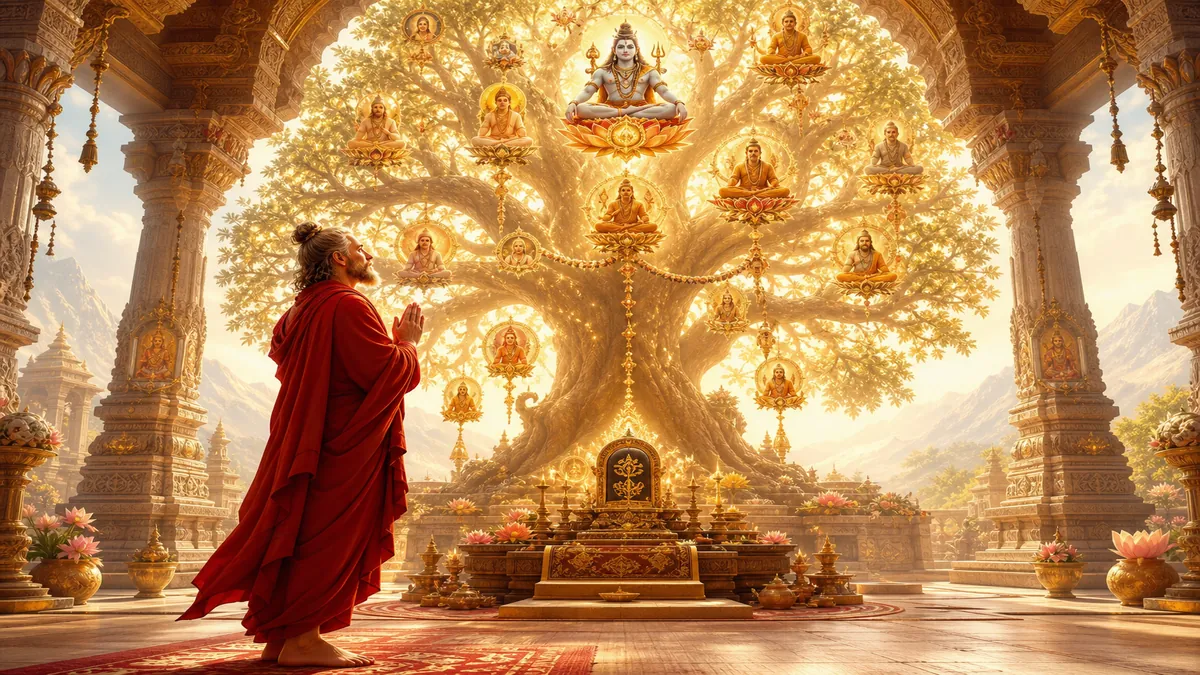
One must understand this energy, the power of blessings that stands behind them, and how to understand it simply by reading the Puranas—this is not easy. It can be understood only when you purify your mind in order to rise to the beings of Refuge. Refuge is something that requires constant attunement, constant meditation. A true sadhu lives in the spirit of Refuge, constantly. We have loka-drishti, our own karmic vision, the way we evaluate the world, the way we see the world; but do we think as the saints of the Refuge think, how do they evaluate the world, through what eyes? Only when we understand how they see the world, how they evaluate the world, will we be able to understand what Refuge is.
Seven Appropriate Relationships with the Refuge
A relationship with the Refuge begins with a relationship with the Guru, with elder brothers and sisters—this is precisely the principle of Guru Yoga, of samaya. The relationships with the Refuge that are appropriate are:
- veneration
- offerings
- praise
- glorification
- service
- worship
- remembrance (smarana)
These are the seven appropriate relationships with the Refuge. No other relationships with the Refuge are intended; if you follow this relationship with the Refuge, gradually the mind begins to be purified, pure vision begins to awaken, kripa (blessings) begin to descend, our spiritual eyes gradually open, and we begin to understand what the essence of Refuge is, what the spirit of Refuge is, what divine beings are in their manifestation.
The same happens through Guru Yoga, and pure vision awakens as a result of such worship, praise, service, offering, veneration, and glorification. For example, mahants, those who lead ashrams, as a rule make offerings of thirty percent of the donations received to the central ashram. It is not about money; it is about offering, or about the one who preaches. We always make an offering—this is our mission in this world, to constantly make offerings. For what? These are not commodity-money relations—they are relations of veneration, worship, and glorification; or we constantly make offerings of flowers, offerings of the five elements, in order to always remain connected with the tree of Refuge.
It is like when you have the Internet: you constantly have to top it up once a month; or if you have a mobile phone, once a month you have to top up the account. If you do not top it up, your Internet will be disconnected, your mobile phone will be disconnected, and communication will become difficult. In the same way, connection with the deities is very expensive; every day it must be topped up, offerings must be made. Every day we must replenish merit; every day we perform invocations, perform arati. If we do not conduct it once, on the second day it is already disconnected. The principle of worship means that we constantly remain in connection.
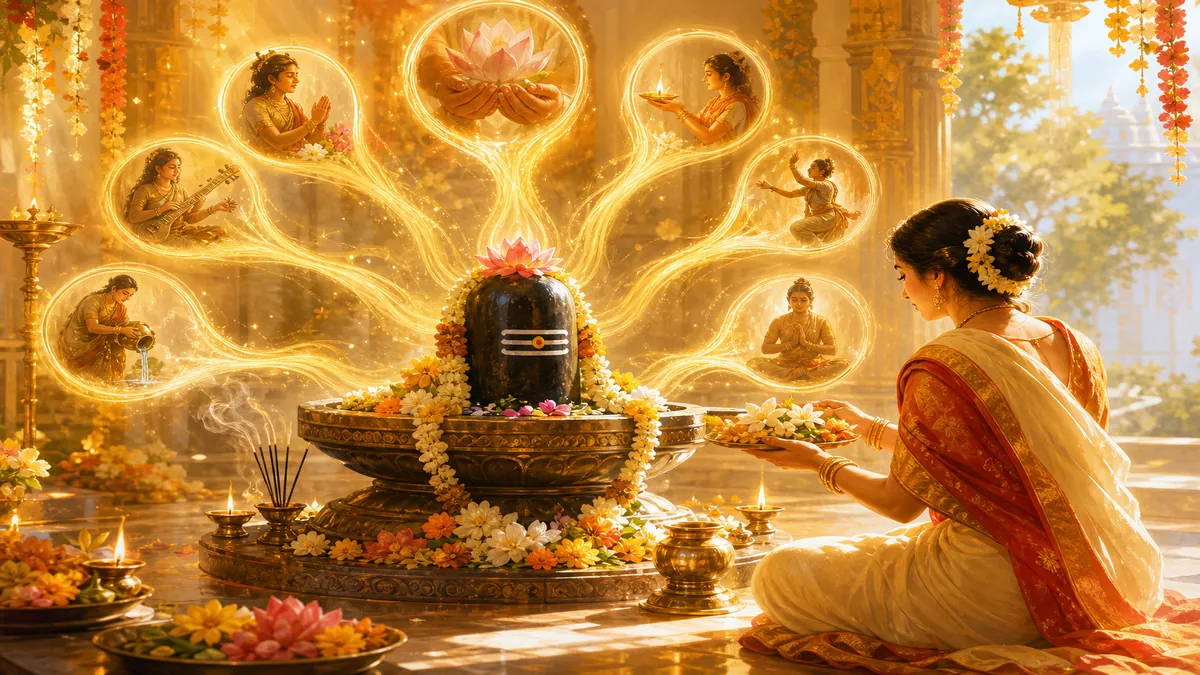
When our contemplation, our samadhi is fairly deep, and we perceive the inner light always and everywhere, then we can be satisfied with inner worship; we no longer need external worship or rituals, and we can nourish ourselves with the inner light by performing self-worship. But this is after spiritual realization, after attaining samadhi.
The Motivation of Sadhana Through Understanding the Divine Hierarchy
Thus, a true sadhu always reflects on such things: that there are saints, that there is my higher “Self,” what my place is in the divine hierarchy of the universe, what I must do so that this place may be worthy, to what extent I am worthy of being a conductor of the sacred energies, of drawing near to them, what I need to do in order to be a worthy conductor, how I need to purify my mind. From this is born the motivation of sadhana, the motivation to cast off the ego, purify the mind, and cultivate humility, because it is very difficult to generate motivation based on something else; even the path of liberation, based on personal efforts, is not a motivation for everyone that would subdue his ego.
The mind, the ego, is such a thing that it requires very sharp motivation to be subdued; it is not so easy to subdue a mind that has gained strength over thousands of lives. It has accumulated great inertia: the mind wants to act in its own way, the body wants to experience desires, the mind wants to be entertained, every part of us wants to act in accordance with its own nature. Our muladhara wants to be angry, or wants something rajasic; svadhisthana wants sex, or simply such pleasures; manipura wants to eat; anahata simply wants sensual attachment; vishuddha wants to speak, to envy, to be jealous, to be proud; ajna likes to spin thoughts, or to suppress others, or to put its ego on display. Our energies from Prakriti have their own hidden motives, their own logic. I am not even speaking of what the chakras below muladhara want, from the thighs to the feet—read about patala, rasatala, mahatala, the work of the consciousness of living beings; that is, these living beings are also present in our channels, but they are strongly suppressed. As humans, we do not encourage these living beings, and in the bodies of sadhus they are even more strongly suppressed, because if they are given freedom, they will manifest as maha-krodha-bhairava in completely inappropriate energies; they can destroy the life of a sadhu.
Breaking the Karmic Chain Through Pure Vision
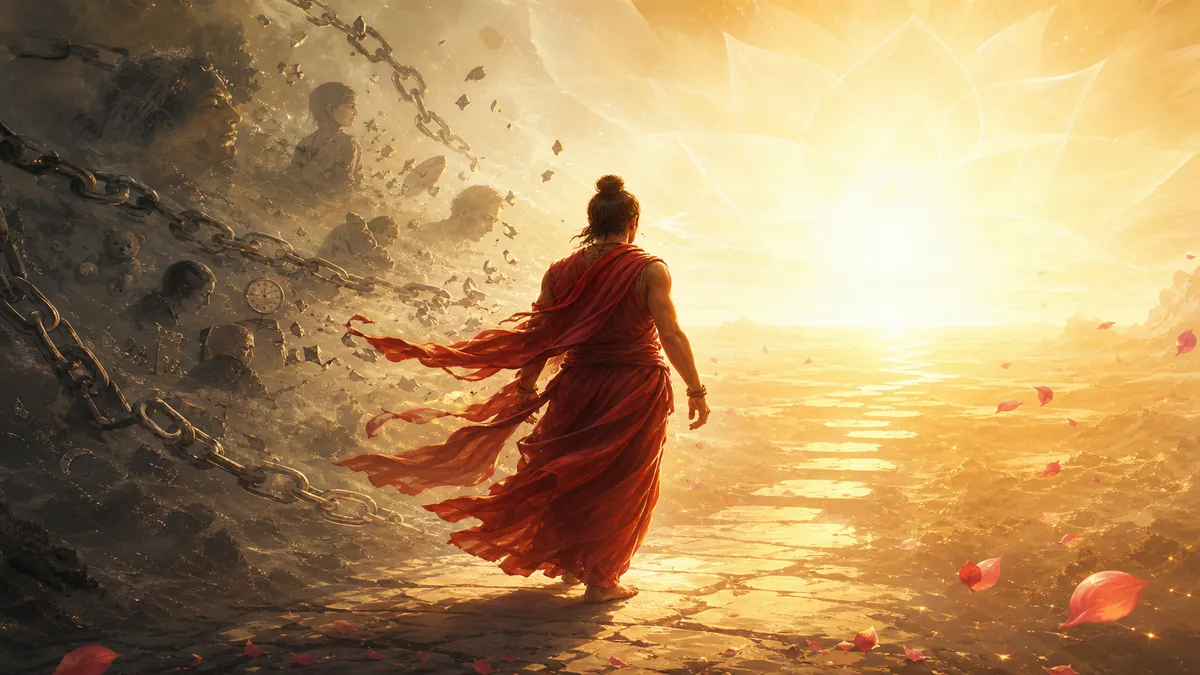
We must subdue the mind through understanding the power of Refuge. Refuge is a very weighty motive for subduing the mind, for making it humble, for casting off its attachment to karma. Everyone has loka-drishti; loka-drishti, in Russian terms, is the habitual picture of the world; everyone looks at the world through the prism of this picture of the world. The habitual picture of the world constantly recreates, even on an unconscious level, the desired image of the future. If this desired image of the future is unconscious, it is vikalpa; if it is conscious, it is sankalpa, sat-sankalpa. The habitual picture of the world (loka-drishti) depends on previously accumulated impressions, on memory, that is, on karma, and one must understand how this linkage works. Accumulated impressions create the habitual picture of the world; the habitual picture of the world continues itself by creating the desired image of the future and by pulling the energy of the future toward itself—this is the chain along which karma develops.
To pacify the mind means to break this chain; it means to disconnect one’s spirit from karma, to change the habitual picture of the world into pure vision, and to shift the desired image of the future toward divine beings, toward the realization of the divine body, the three divine bodies, toward the Dharma, the teaching of the saints. To do this requires an incredible, subtle, divine power; our efforts are not enough here, and this is the meaning of Refuge. Therefore it is very important to constantly invoke Refuge, so that, with the help of kripa (the blessing of Refuge), we can move the levers of fate; then our efforts bear fruit, and our practice of contemplation, study, tapasya, and seva, combined with kripa, move the levers of our destiny, and the path of liberation proceeds easily, everything happens playfully, joyfully, through ananda. Not through tears, nor through sweat, nor through repentance, suffering, or purification, but through play, love, devotion, self-liberation, joy, laughter, and absorption in divine dhyanas.
Creation Without Intention
“I am the sun that shines in one of the universes created by them. Another Creator asked the Sun: ‘O Sun, if the universes have already been created by these ten creators, what should I do now? What should I do?’
The Sun answered:
“You have no desires, nor any motives of your own. There is no need for you to do anything. What joy is there for you in creating a universe? Of course, the creation of a universe for you is an amusement without motives. Creation proceeds from you, free from the slightest desire or motive, just as the sun, without intending to shine, is reflected in a puddle of water, which likewise does not intend to reflect it. Without intention, the sun makes day follow night; act in the same way—create creations without intention. What joy is there for you if you renounce your natural functions as creator? Sages have no desire to do anything; however, they also have no desire not to do anything. You see with your inner vision this universe created by these saints. With physical eyes, a person can see only those objects that were created by himself in his own mind, and nothing else. These objects created by the mind are indestructible—only objects created from material parts are destroyed. A person is made of what has become firmly established as the truth about himself in his own mind—that alone is what he is.”
The Power of Faith and the Formation of Reality
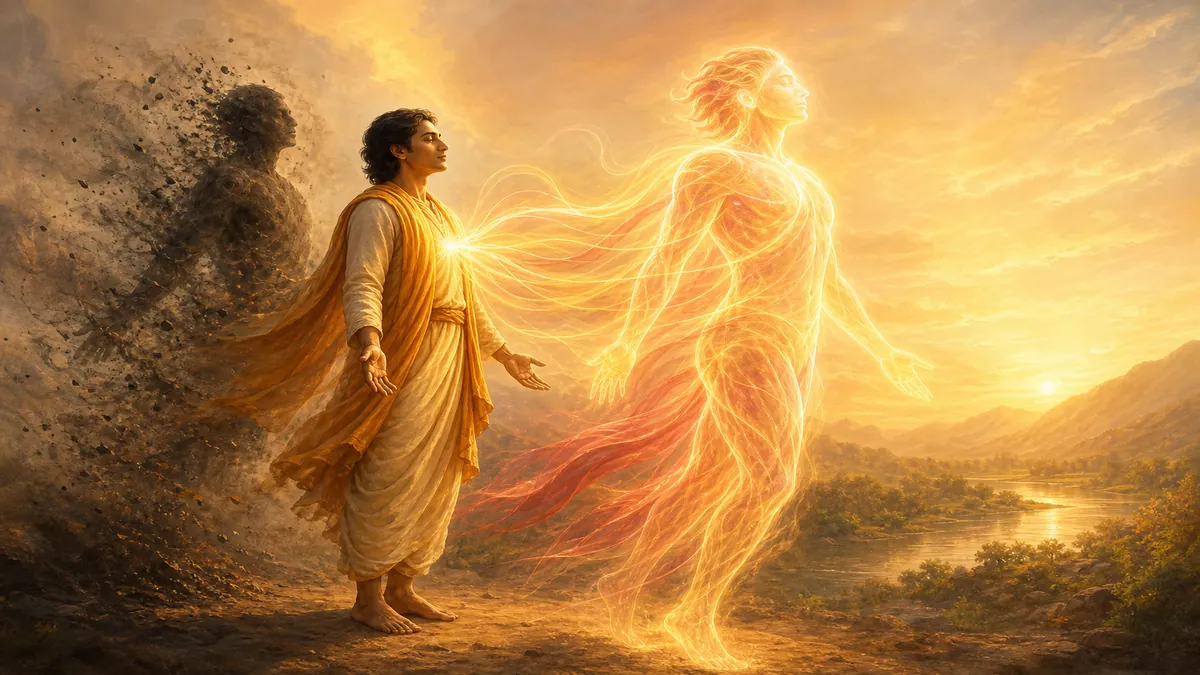
In our own mind, a truth has become firmly established, for example, that we must live in samsara, that we are human beings, that we were born, that we have bodies—this is a very firmly established truth in which we strongly believe. Even when we say, “I am a believer, I believe in God, I believe in Sanatana Dharma, in Refuge,” or Christians say, “I am a believer in Christ,” Buddhists say, “I believe in the Buddha,” they do say this, of course, but on a much subtler level they believe far more strongly that they are a human being, that they are a body. Here the question is: which faith is stronger, which faith will displace the previous one—that is what will be embodied.
For example, when a person has the karma of a hungry ghost, he believes in his greed, he believes in the worldview of a hungry ghost, and his subtle body radiates the vision of a hungry ghost. Over time, this radiating worldview strengthens his faith that he is a hungry ghost. Then, on the human level, he has a human body; on the level of the subtle body, he has the belief that he is a hungry ghost, and so he is reborn as a hungry ghost.
On the contrary, when a person accumulates merit, purifies consciousness, practices the four immeasurables, worship, the practice of Refuge, ishta-devata yoga, and sadhana, he begins to believe in the ishta-devata, to believe in the saints of Refuge. He begins to believe that he himself is the ishta-devata within, in the bhava of the ishta-devata, and during his lifetime he has a human body, while his subtle body takes on the form of the ishta-devata. Then he is reborn, attaining rupa-siddhi; the form of the ishta-devata attains svarupa-mukti (liberation in the form of the ishta-devata).
Another person believes that infinite consciousness, the infinite body of wisdom, jnana-deha, practices contemplation, shambhavi mudra, maha-shanti, meditation, contemplative sankalpa, and becomes established in infinite awareness. If his faith is strong and his absorption in nididhyasana is deep, then over time his consciousness takes on such a form; even while alive he becomes a jivanmukta. He has a human body, but the infinite body of wisdom is realized in him; that is, our faith creates our realized, awakened body, and when the weight of our energy and consciousness shifts, liberation occurs. Enlightenment is when the weight of our consciousness shifts, and liberation is when our energies separate from the old karmic vision, are freed, and also move into this new body, into this new object of faith.
The Mind as the Sole Creator of the World
“The Sun continued:
– Creator, the mind is the sole creator of the world; only the mind is the supreme being. What is done by the mind is action; what is done by the body is not action. O, the powers of the mind—directed by thought, the sons of the saint became creators of the universe. On the contrary, if one thinks: ‘I am a small body,’ the mind becomes a mortal being. One whose consciousness is directed outward experiences pain and pleasure; but the yogi whose consciousness is directed inward is not carried away by ideas of pain and pleasure.”
The Three Stages of a Yogi’s Purification
In the process of sadhana, a yogi must purify himself of three things: egoism, kleshas, and desires. First comes purification from kleshas; a klesha is the crudest, densest desire, like clots that are located in the astral body. It is as if there is a large, beautiful house—this is our subtle body, our personality in our subtle body—but in this house there is a basement level, and there are some cellars there. In these cellars there are some skeletons in the closet, or monsters, and everywhere else it is clean and beautiful, but in this basement there is some monster. Sometimes this monster, taking advantage of the owner’s absence, comes out and begins prowling through the whole house until it is shoved back in—that is a klesha.
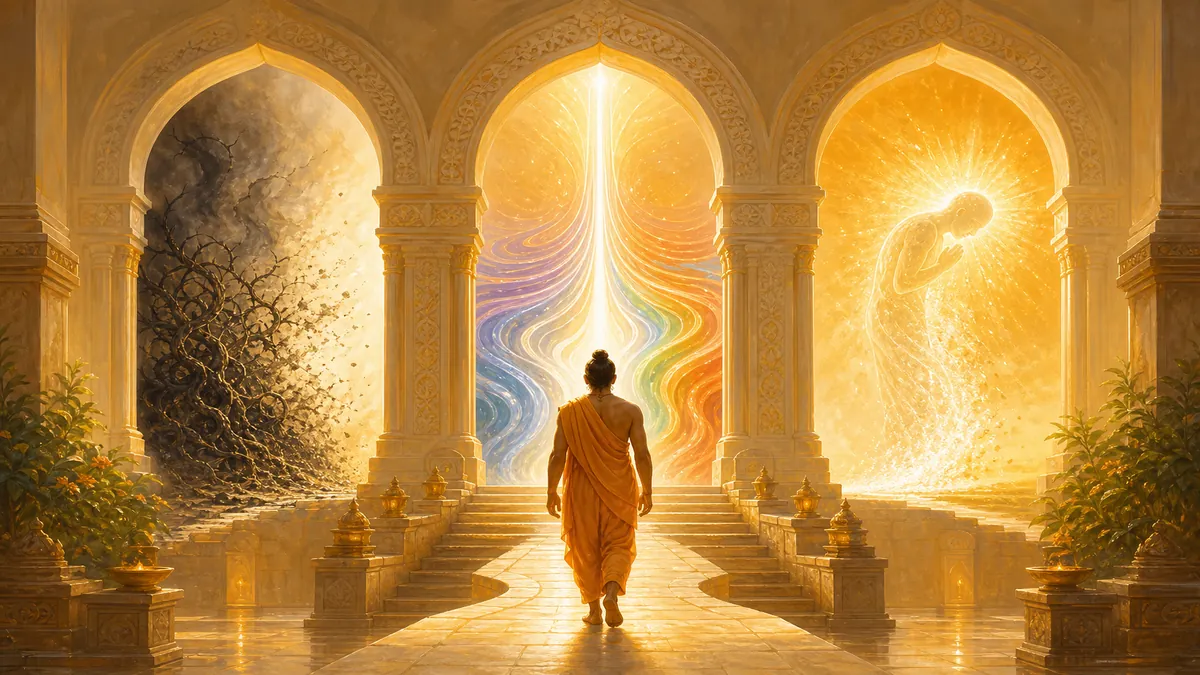
A klesha is an unconscious dark force that may reside in the subtle body. Tamasic beings have very many kleshas; they consist of such kleshas—monsters of the subtle body. Rajasic beings have some of them, enough to be rajasic. Sadhus have few of them; that is, they have almost none, or very few, and a sadhu purifies them in the first years or decades of practice. When the gross kleshas are overcome, it means that nothing very coarse, very gloomy remains in him, and in general he is quite a luminous person.
But he still has desires; desires are energies that are controllable, but nevertheless poorly controlled. They are not dark monsters in cellars such as deeply obscured people have; there is nothing like that. But there are desires, and everything depends on the sadhu—whether he can control the desires in such a way that the desires are completely purified, that they are fully under control, that they never have a chance to become kleshas, and that they then unite with empty nondual contemplation and turn into devatas (deities) and into the five spaces of wisdom. The evolution of desires is such that by contemplating desires and working with them through the methods of kundalini yoga, the sadhu learns to draw the energy of desires into the sushumna so that they dissolve and turn simply into bliss on the energetic level and into wisdoms on the level of the subtle body.
Finally, when desires are overcome, the ego remains—the individualized consciousness to which there is clinging, attachment. The ego requires reverence for God, worship, self-surrender, Guru yoga, and devotion. Without Guru yoga, without Refuge, without self-surrender, it is very difficult to part with the ego. Or else a mission of service to all living beings, the carrying out of divine will, is needed. One way or another, there are no other paths to transcending the ego except to serve that which surpasses you, to revere that which surpasses you. When you can do this, you part with the last stronghold of ignorance—with your ego. The first is kleshas, the second is simply desire, the third is ego. Ego includes many different aspects: the mind, conceptual thinking, memory, and will used egoistically. But there is always one medicine for it: faith, devotion, self-surrender.
Thus, when a yogin, a sadhu, has overcome these three problems of his, he is very close to enlightenment. In fact, nothing prevents him from being awakened; here he only needs patience, diligence in sadhana and contemplation, and he is already in the awakened state. He needs to master the art of nididhyasana so that nididhyasana truly gains strength.
