From Pashu to Pati: The Role of Videshvar in Liberation
24.09.2026
0 мин. чтения
0
Share
copy
search
add
share
2021.08.14
OM OM OM
Continuing the Study of the “Īśvara-Pratyabhijñā-Kārikā”
We continue studying the “Īśvara-Pratyabhijñā-Kārikā,” Part 2. Divine beings who have become what are called pati as a result of attaining liberation and purification—this is part of Īśvara-dhyāna.
When we meditate on the form of a deity, this is called iṣṭa-devatā-yoga.
When we meditate on Īśvara, this is Īśvara-dhyāna.
When we meditate on Brahman, this is Brahma-vicāra.
These are various aspects of the divine Source. Our task is, starting out as ordinary people, first of all, at a minimum, to become sadhus: to remold ourselves, to change, to become such thoroughly seasoned sadhus in the best sense—permeated and imbued with the light of divine wisdom and knowledge.
When we realize the second bhūmi, we become sadhus, and the third bhūmi especially so. Then our task is to go further and become jñānīs from sadhus. A jñānī is born at the transition between the third and fourth bhūmis. This is a more difficult task, but it is achievable from the state of a sadhu. It is impossible for an ordinary person to jump straight into the winning position—unless, perhaps, they have very good vāsanās, past saṃskāras, and possess divya-bhāva. But thereafter, too, our task is to proceed from the state of a jñānī toward divine states.
There are various options and possibilities here: siddhas and devas. Different classes of divine beings can be classified as siddhas and devas; in Shaivism they are called:
And this is our future. Wherever there are higher bhūmis and beyond the bhūmis, wherever there is turīya and beyond turīya, wherever everything moves closer to the 9th, 10th, 11th, 12th kalā and beyond—all of this is our great divine future. And simply by meditating on such beings as a quality, attribute, and part of Īśvara, the yogin’s mind is purified and acquires the right direction.
The Atomicity of the Vidyeśvaras and the Nature of Māyā-mala
“In his auto-commentaries on this aphorism, Utpaladeva, describing the conditions of the existence of the vidyeśvaras, notes their being infected by the impurities of māyā-śakti, that is, their susceptibility to māyā-mala.”
“Ophicization” here is similar to “infection,” only in a more positive sense.
“By virtue of which, while remaining in relations with differentiated cognition, these beings do not possess the full capacity for action and are distinct from the deity and from one another. For this reason, their state is characterized as limited and atomic.”
The vidyeśvaras are distinct from Īśvara and from one another. They possess subtle distinctions and a certain aspect of individuality. In other words, it is not the case that you were a human being and then suddenly entered the zero tattva, the parama-tattva, Paramaśiva, or Brahman, which has neither name nor form and where there are no impurities. In the case of beings such as Śaṅkara—yes, this is so: like oil in oil and milk in milk, this is an example of Advaita. In the case of absolute, total devotion to the view and realization of the seventh or sixth bhūmi—such maha-qualities of a jñānī, svarūpa-samādhi—the body completely dissolves into rainbows. This means complete dissolution into Brahman down to the level of the tattvas: the tattvas pass into a pure state and simply disappear here.
But in all other cases, there are always some intermediate stages, certain aspects of individuality, certain energies, and some extremely subtle dualistic states. And these are traversed gradually. If the soul has managed to break away from the state of a sakala—a saṃsāric being—and avoid the trap of the pralayākalas, it proceeds toward higher states. The vijñāna-kevalas and vidyeśvaras are the first of these, already established on the borderline of the pure tattvas. They are not yet absolutely pure tattvas, but they are the boundary of the pure tattvas—on the verge of the sixth tattva, māyā-śakti.
“But with regard to the atomicity of the vidyeśvaras, one must clearly understand its essential difference from the atomicity possessed by ordinary limited beings. The latter, as we remember, is a consequence of āṇava-mala—the loss of their completeness by beings. At the basis of āṇava-mala lies Śiva’s will to become a limited being, and through māyā-śakti he realizes this will of his.”
Shiva, being the absolute sovereign of his will—a svatantrika—manifests the will to limit a part of his consciousness, acting in accordance with Svacchacara. For what purpose? For the sake of play, an incomprehensible play. But in the process, the souls that are generated perceive this will as a limitation, although Shiva himself does not perceive it as such. Some perceive this will so strongly as a limitation that they lose their essential light. Others lose half of it, while retaining something. Still others retain their essential light completely, but cannot manifest the same power as Shiva. These are not merely vasanas, samskaras, or sins from past lives—it is Shiva’s will, his specific power; it is divine power.
Therefore, things are not so simple when it comes to the ego, worldly desires, kleshas, rajas, and tamas. Nor are they so simple when it comes to maya. If these were small, simple forces, they could be overcome: a little pranayama, a little life under ascetic discipline—and they would disappear, no longer affecting you. But the point is that these are divine forces, because behind them stands Shiva’s own will to impose limitation. And one spiritual teacher asked a young disciple: “So, are you afraid of maya?” The disciple replied: “No, the Lord will save me; I am completely devoted.” The guru said: “I am a little afraid”—because he was wiser. Because maya is not merely our delusions.
If these were only our personal delusions, they would disappear through sufficient self-control, discipline, and purity—there would be nothing to fear. But maya-shakti is Shiva’s power, Shiva’s will, the universal energy that emanates from Shiva himself and is not different from him. It demands respect. A sadhu does not fear it; he respects it and knows that if he fails to recognize its non-difference from Shiva, it will become a serious opponent on the path to liberation. But if he recognizes it, this same power will serve him. The question is how profound your samadhi is, how profound your sahaja-tattva is, and how profound your view and contemplation are.
A refined view and contemplation—and shakti turns toward you in its divine nature, helping you on the path of purification. If they are deficient, shakti refuses to obey the sadhu. It says: “You are not Shiva; I know nothing. Act according to the law of karma. You will not be free, because by Shiva’s will I impose all these limitations: the kanchukas, malas, koshas, and the powers of khechari, dikchari, and bhuchari—they are all yours, so live with them.” The sadhu says: “I am Brahman!”—“I know nothing; I do not see it.” The sadhu says: “Save me, liberate me.”—“Until I provide Shiva to you, show him to you, and manifest him, you will live according to the law of karma. Because this is Shiva’s command, and I cannot disobey it.” And this shakti, this energy, holds the sadhu captive.
But as the view and contemplation grow stronger, skillfulness in conduct also increases. One who has developed their view and contemplation knows how to pacify shakti through their conduct—the energy of their physical body, subtle body, mind, and five koshas. Gradually, it begins to release them into freedom, granting them more and more freedom: freedom from the antahkarana, the five sheaths, and the subtlest inner malas. This release into freedom is precisely the sadhu’s transition into the category of jnani, siddha, and devata: from pashu to pati.
The Mission of the Vidyeshvaras and the Nature of Maya-Mala
“As Yoga-Raja writes, the maya-mala to which the vidyeshvaras are subject, and by virtue of which they are characterized by atomicity in the object-oriented component of consciousness, is also created through maya-shakti.”
The object-oriented component of consciousness—in simpler terms, this is an outward orientation. And when there is duality in this external vision, when there is a dualistic perception, when there is no equanimity and unity in the vision of God due to constant evaluations and judgments based on old samskaras...
Dostoevsky has a story called The Dream of a Ridiculous Man. In it, there was a man whom no one took seriously; they considered him a holy fool. He came to an experience in which everything became equal to him. And suddenly he began to see that everything was in fact equal to everyone else as well—that this equanimous consciousness seemed to be everywhere. He began saying in conversations: “But everything is all the same to you too. In fact, I see this equanimity deep within your consciousness.” And people laughed at him, considering him a lunatic.
Surely, this person accidentally began to experience a state of unified flavor, but did not understand it. He had not read the “Īśvara-pratyabhijñā-kārikā,” nor Shankara, nor Vasishtha. But then it turned out that not everything was equanimous: a little suffering girl brought him out of that state. He lost it, and mental anguish and various psychological problems began. Where did Dostoevsky get this from? If you do not have similar personal experience, you cannot even imagine such a thing. It comes from personal experience. A subtle constitution, a deeply sensitive person with profound self-reflection. But he was not entirely fortunate—there were no shastras, no teaching with which to understand and work through it. Yet there was some kind of Christian faith.
“But the meaning of the existence of vidyeshvaras lies in the spiritual elevation of limited individuals. Such is Shiva’s will in forming this class of beings. And it is precisely this divine will that maya-shakti fulfills by creating the maya-mala of vidyeshvaras.”
Thus, the task of vidyeshvaras is to elevate other individuals. They are missionaries, preachers, mentors, teachers—those who help lower living beings. One might say that this is every missionary’s dream—their future: to grow to this level. Because deities such as Maha-Mantreshvaras, Shiva, and Shakti do not descend directly to human beings. They simply do not possess, nor do they wish to possess, the atomic vision necessary for communicating, for example, with people. They simply do not see the Earth or the galaxy. In principle, they see the entire universe, but no one examines what is there specifically. Put bluntly, there is nothing to preach about there; it is all an illusion.
In order to see this and act on this plane, one must limit oneself. And Shiva’s will is such that he limits these beings—the vidyeshvaras—so that they create such a vision and enter this state. For example, if you are a sadhu, you are not interested in some youth rock party; it is an entirely different world from yours. You would never go there to preach or explain Dharma and higher truths. You know that there are no prepared people there, that it would be pointless, and that their values are completely different. They are fifteen- or sixteen-year-olds for whom “sex, drugs, and rock ’n’ roll” is life. You would not go there to speak about liberation; they would not hear you. But a rocker of roughly the same age, familiar with the youth environment, is needed—someone who will go there and explain something to them in their utterly wild language, and they will begin to listen. This is an earthly example.
The same applies to vidyeshvaras. Their task is to elevate other beings: to descend to lower samsaric deities, pitris, saints in the earthly world, yogis, jnanis, and sadhus; to send their emanations; and to care for the preservation of religions, cultures, teachings, and lineages. This is transcendent intergalactic missionary work. This is the sphere of influence of the vidyeshvaras. Many teachers and spiritual mentors rise to this position.
“In order to be able to help limited beings effectively, it is necessary to enter into relations with the differentiated knowable and, in that aspect of oneself in which Presence is realized in the world of maya, become an individuality. At the same time, one must be beyond the power of karma-mala, since only then is the manifestation of pure action that realizes the pure divine will possible.”
Tirodhana-shakti and Interaction with Sakala Beings
A certain tirodhana-shakti—self-concealment—is necessary in order to interact with sakala beings, with those who cannot break free from the bonds of duality. For example, even after attaining samadhi and reaching a high bhumi, a saint or spiritual teacher must activate his tirodhana-shakti: allow duality and differentiation—at least in order to say his name, to say, “This is me, the teacher, and this is the disciple,” and generally to allow all worldly meanings, even though his consciousness does not possess them at all. But if he does not possess them, he will have neither the ability to use language, syntax, and discourse in this direction, nor the motive or will. It is roughly like this: you come to some saint, bow before him, and he does not notice you at all, continuing to meditate. There is no connection, no possibility of helping, no possibility of learning, and no possibility of following the path.
Sometimes there are saints like this—they are like holy fools. A certain master lived on one mountain in Tibet for a long time, 20 years. Then people noticed that no one had brought him food for quite some time, and it was cold there. They decided to go and check on him. They arrived—there was no fire, everything was scattered around. Meanwhile, he was sitting there meditating. He had had nothing for six months already. He was sitting among the snow and frost, alone in the darkness. They wanted to speak with him, but he began speaking in some strange, unintelligible language, and then said: “You need to go.” That was all. It was impossible to say anything. But later, at the end of his life, he attained the rainbow body—his body evaporated into the light of the five elements.
If people, having gained experience of nonduality and the power of view and contemplation, can become so detached, what can be said about the gods? But vidyeshvaras are those who consciously preserve a certain vision, and Shiva envelops them with tirodhana-shakti. Therefore, they have a mission to help living beings, and they have hosts of gods and angels subordinate to them.
The Hierarchy of the Subtle World and Service to Souls
We do not know this entire system; we do not see that there are many souls in the subtle world—angels, gods, and spirits. The astral world is literally overflowing with them; there are different services, different departments, different mandalas:
There are those who sort the souls that have just arrived in the subtle world from the physical body.
There are those who deal with examining their personal records—analyzing their sins and merits, their balance. This is Yamaraja’s mandala.
There are servants of Anugraha—those who search for souls suited to the spiritual path and say: “You should not go there; you may be dragged into hell there, and then you will incarnate again—come here.”
There are those who save souls already in the subtle dimensions, show them the way, and distribute them among the mandalas.
Everything there is also very well organized. There are many divine and angelic services that help souls find their bearings in this world.
And the soul inevitably encounters them. It is not as though it exists in some airless space and has to figure everything out there on its own. It inevitably encounters spirits, maras, demons, and angels—as angels, I mean deities. And all of this manifests according to its karmic vision. Deep view and contemplation are inseparable from its vision, as a part of itself, as energy. A weak view is like subject-object relationships and connections. These services of divine beings serve the vidyeshvaras; they are subordinate to them in the divine hierarchy.
There are those who meet souls, communicate with them at first, help them, and explain what kind of world this is. Then, gradually entering into telepathic mental contact with them, they explain where they should direct their consciousness and point out different paths. Then they lead them to one of the preparatory schools, where they continue to be trained. And for those who practiced sadhana, they show the way to find kindred souls and a particular religious mandala:
If you worshipped Shiva—there are Shaivite souls there.
If you practiced anuttara-tantra, Dattatreya’s Sahajayana—there are devotees of Dattatreya.
If you worshipped Shakti—there are worshippers of Shakti.
If you worshipped Ganesha—there are worshippers of Ganesha.
Buddhists go to their mandala, Christians to their own mandalas.
For those who meditated on Advaita and the impersonal Brahman—there are followers of Shankara’s lineage, there are pure realms of these followers, and one can gradually establish a connection with them if one is unable to reach them oneself.
Those who are capable do not need any of this. They simply perform the sadhana of transference into the body of wisdom and attain Realization themselves. This is for those who are not capable.
Three Types of Consciousness Transference: The Sadhana of the Illusory Body
Those who are capable perform the sadhana of transference into the illusory body: first they enter the Clear Light, bypassing the three gunas and filling themselves with its power, then, through the seed syllable—like a fish leaping out of the water—they manifest in the illusory body of the deity. Repeatedly purifying their illusory body and perception of the Clear Light, over a period comparable to half a year of earthly life, they attain complete Realization. Then, filling the space around themselves with their emanations, they manifest a mandala of the pure dimension.
Thus, the first type of transference is called transference into a jñāna-kāya—the attainment of a body of wisdom, jñāna-deha. The second is transference into a māyā-kāya, the attainment of the illusory body of a deity that unites form and emptiness.
Finally, those whose merits are lesser accomplish transference into a siddha-deha: through the power of intention, they find the pure land of their chosen deity and, through the power of dhyāna, are transferred there in order to be reborn there.
For all other souls who are unable to accomplish any of these three types of transference—to realize at least one of the three bodies (advanced souls realize all three)—there are celestial services, maṇḍalas, and teachings. Since their practices and understanding are insufficient for them to move forward independently, they remain in a state of stupor, confusion, shock, and incomprehension.
Everything depends on the strength of faith. Those who have strong faith simply continue their practices, even if liberation has not occurred. They diligently perform their practices and seek a way to move forward in their new life in a subtle body. But if they have forgotten everything and have failed either to remain in the Clear Light, to attain liberation in the intermediate state of dharmatā, or to enter the illusory body, such beings are assisted by vidyeśvaras. All these celestial beings act under the guidance of the vidyeśvaras, carrying out their tasks. These are the great divine forces behind missionaries, religious traditions, transmission lineages, and schools. Such is the will of Śiva.
The Nature of the Vidyeśvaras and Their Relationship to Māyā-śakti
“The nature of māyā-śakti is such that it introduces differences into everything. As we have already seen, māyā-śakti conditions both the vidyeśvaras and ordinary limited beings—the paśu—through difference. At the same time, however, the vidyeśvaras’ relationship with māyā-śakti is qualitatively different from that of the paśu. First, in the case of the vidyeśvaras, the manifestation of difference concerns only their object-oriented component. Second, the vidyeśvaras know the nature of difference through vidyā-śakti and remain in conscious relations with māyā.”
The vidyeśvaras see differences in the external world; they possess subtle dualistic energies—but this is not the same as the dualistic state of the paśu. First, this subtle dualistic vision extends only to the external world, while inwardly they have no such limitation: nonduality is realized within them.
Question: Gurujī, you spoke about the services. Does this mean that when a practitioner has taken Refuge and reaches the subtle plane, a natural attunement to Refuge should take place there—is that correct?
Yes.
In other words, you immediately find yourself among your own?
One whose faith and Refuge are strong does not wander—they immediately move along the lineage of their Refuge, thanks to their faith and Refuge.
Question: But then how do they pass through the bardo?
Everything depends on the level of realization attained and on the experience they have developed. This is strictly individual—it cannot be stated unequivocally. These are such individualized worlds.
“To truly know the nature of difference, one must know the nature of identity, of Unity. It is precisely knowledge of Unity that is the foundation on which knowledge of difference rests. Only by directly knowing and contemplating the common, nondual substratum of all that exists can one truly see the genuine nature of those differences between beings that māyā-śakti manifests.
With regard to the sphere in which the vidyeśvaras abide, there are significant discrepancies among different texts. Thus, given that the nature of māyā’s manifestation in relation to the vidyeśvaras differs from its manifestation in relation to ordinary limited beings, a special sphere of mahāmāyā is introduced, where the vidyeśvaras and mantras operate. This sphere is sometimes identified with śuddha-vidyā-tattva, while at other times it is regarded as a separate tattva between māyā-tattva and śuddha-vidyā-tattva.”
If you understand the structure of the 36 tattvas: there is sadvidyā, or śuddha-vidyā-tattva—this is the fifth tattva—and there is the sixth tattva, māyā-tattva. The sphere at the boundary of these two tattvas, between them, is the realm in which the vidyeśvaras abide.
“But since mahāmāyā-tattva is often regarded as the abode of vijñāna-kevalas, the concept of two varieties of mahāmāyā is introduced: the higher—the sphere in which the vidyeśvaras abide—and the lower—the sphere of the vijñāna-kevalas.”
Thus, this sphere has two levels: vijñāna-kevalas abide on the lower level, and vidyeśvaras on the higher one.
The Three Impurities and Karma-mala as the Cause of Saṃsāra
“Shloka. All beings abiding in samsara, beginning with the gods and so forth, are subject to three types of impurity, but it is precisely the impurity of karma that is the sole primary cause of samsara.
Commentary. Abiding in samsara is characterized by an incessant process of transmigration, that is, reincarnation. As Abhinavagupta writes in his commentaries, transmigration is nothing other than an uninterrupted connection with a chain of present and future bodies, senses, and objects.”
Reincarnation is based on karmic connection. We have karmic connections with our past lives, bodies, lokas, and beings. This is called rnanu-bandhana: “rna” means connection, and “bandhana” means fetters. We also have connections with future bodies, lokas, and beings. Until this connection is actualized, it remains dormant—it sleeps in our chakras, in the channels, in the subtle body, while its cause lies in the causal body. Past connections have already been traversed, lived through, and worked out, but they continue to influence us. Future connections have not yet arrived, but they sleep within us in the form of seeds.
But we can change this. We can purify these karmas, burn these seeds, or transform them into a pure state—into the level of play, the mandala of pure vision—and make them dharmic, so that they will no longer become samsara for us. We can purify all of this and work with these connections.
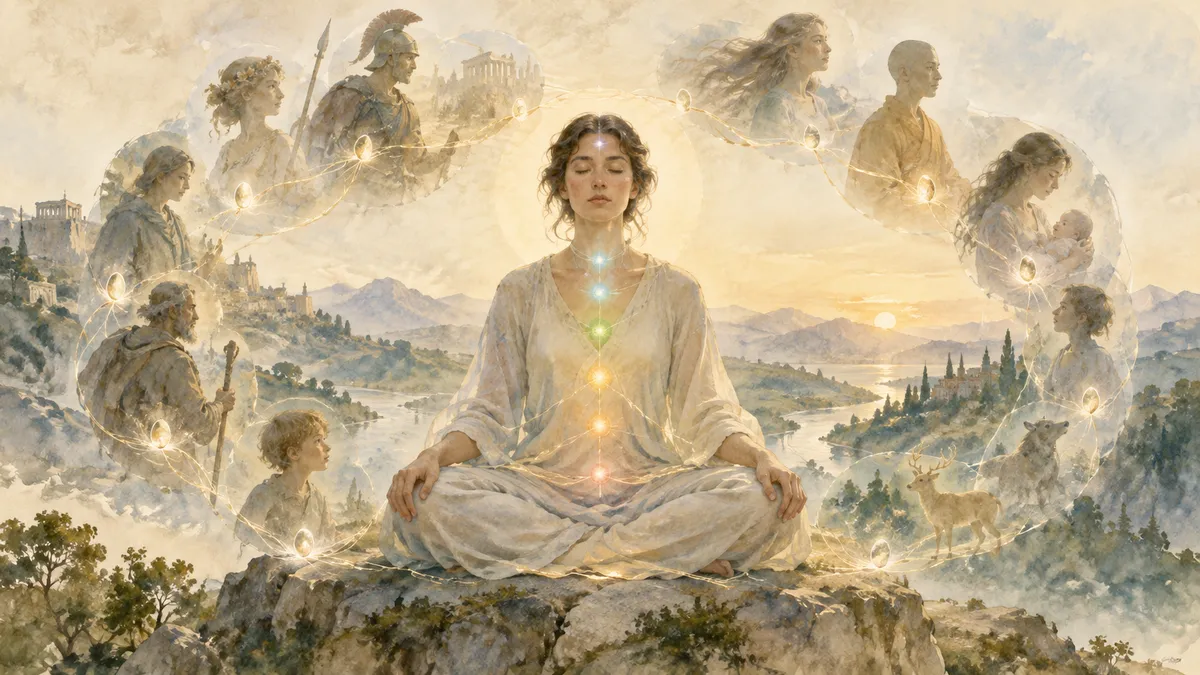
Reincarnation is movement within these connections. When we are born, we simply become denser within this chain of connection. We need to meditate very deeply on the fact that our life is not something point-like, atomic, and separate, confined only to this lifetime. It is not even a thread with beads strung on it, as is sometimes said—it is an enormous mycelium, in which this life is simply a place of condensation and focus. We are something much greater; we are not as small as we appear. Behind every person, even the most frail one in a physical body, stands an enormous chain of lives, and ahead lies another just as vast. Each person is an entire cosmos, a universe, a mandala.
Reincarnation is simply the sequential movement of attention, sliding along the rnanu-bandhanas and acquiring bodies. This is what transmigration is. It is inevitable; it is what our life consists of. But we are too absorbed in our conception of this life, in its fixed ideas, often failing to understand who we truly are and what the phenomenon of life is in general. If people understood what the phenomenon of life is, they would want to do nothing other than attain liberation.
“All beings immersed in the stream of cyclic existence are conditioned by all three impurities: anava-mala, maya-mala, and karma-mala.”
Whomever you take—a billionaire, a politician, a scientist, an artist: is anava-mala present? Yes. Is maya-mala present? Yes. Is karma-mala present? Yes. Because no one is born here without the malas. In order to be born in samsara, one must possess them—birth in samsara is itself a sign of the manifestation of these malas. The Vidyeshvaras are different. They are not born in these worlds. They possess only certain notions of maya-mala, distinctions necessary to inspire limited beings—sakala—in the world of samsara among humans and other living beings.
“But among these three impurities, only karma-mala is the immediate cause of abiding in samsara. This is because only through karma-mala do beings, identifying themselves with one body or another, perceive themselves as agents performing limited actions that serve as the causes of the fruits of suffering and enjoyment they experience.”
Chit-tattva: The Unity of Prakasha and Vimarsha
“Shloka. And this consciousness-principle, formed through the complete predominance of the state of being the agent-subject and animated by kala, remains in a dependent position with respect to such inanimate entities as emptiness and so forth.
Commentary. This aphorism continues the discussion of the state of beings immersed in samsara. The consciousness-principle, chit-tattva, represents the unity of prakasha and vimarsha, the light of knowledge—bodha—and the active principle of agency—kartritva—existing in balance and harmony.”
So, what is the phenomenon of consciousness—chit-tattva? According to Shaivite philosophy, it is the unity of Shiva and Shakti, manifesting as two principles: prakasha and vimarsha. Prakasha is the power of pure luminous consciousness; vimarsha is the power of its self-reflection, self-awareness, and dynamism. Prakasha is bodha, the light of knowledge; vimarsha is the source of all action, all movement, and manifestation.
“As noted earlier, thanks to anava-mala, a kind of separation occurs between these two aspects of absolute consciousness, as a result of which two classes of states of consciousness of limited beings emerge: the first characterized by possessing knowledge without freedom, and the second by limited freedom without knowledge. This aphorism concerns beings who possess limited freedom without knowledge. When beings become tainted by anava-mala, they lose the fullness of consciousness and are deprived of the possibility of a direct connection with kriya-shakti in its unrestricted state.”
Here it is explained how anava-mala affects us. Two obscurations arise:
Freedom without knowledge — I can act, but I do not know who I am.
Knowledge without freedom — I know who I am, but I cannot act; there is no shakti.
This is the action of anava-mala: paurusha-ajnyana and bauddha-ajnyana.
“And it is only through kala that the state of the limited agent is formed and maintained, making possible the class of beings discussed in this aphorism. As we remember, the state of the pure tattvas, beginning with Sadashiva, is characterized as both supreme and non-supreme. Their supreme aspect is perfection and awareness, independence from the object. Whereas the non-supreme aspect represents dependence on the object — ‘this-consciousness.’”
Every living being, every tattva, has a higher and a lower aspect. For example, we have our higher aspect — consciousness as Brahman, our view, to the extent that we have realized it. But our lower aspect is our energy, our behavior, and our manifestation. Sometimes a person may soar high in the higher aspect but have difficulties in the lower one — in energy. And conversely, someone who controls the lower aspect may not be aware of their higher aspect — which raises the question: by virtue of what do they control it? Perhaps through merit.
In the same way, the tattvas have higher and lower aspects. The higher aspect of each of the five tattvas is Parabrahman itself, Paramashiva itself. The lower aspect of the tattvas is their relationship with the manifested universe, everything related to “This.” The higher aspect is “I”; the lower aspect is everything related to “thisness.”
“Through anava-mala, a gap arises between these two aspects. And, in essence, limited beings immersed in samsara are characterized by the almost complete dominance of object-dependent ‘this-consciousness,’ which manifests in their dependent position with respect to such inert entities as emptiness and so on.”
Thus, anava-mala creates a gap between the higher and lower aspects, between “I” and “This,” between consciousness and energy. As a result of this gap, the power of the external aspect, the power of “thisness,” grows, while the power of consciousness weakens — to such an extent that eventually the external world enslaves the soul.
Jnana as the Superiority of the Subject over the Object
“Shloka. The superiority of the consciousness of the Self in its two aspects — activity and awareness — over the successive subordination to inert entities such as emptiness and so on is knowledge, whose distinguishing characteristic is absorption in That.”
Thus, jnana is when consciousness surpasses external objects. Moreover, emptiness is also called an external object here — like space, as an element of space. Jnana is when our I-consciousness surpasses external objects designated by the word “this.” And it surpasses them through absorption in That. And That, as we know, is Brahman. Through the mahavakya tat tvam asi.
“Commentary. The preceding aphorisms examined the state of limited beings immersed in samsara, characterized by the subordinate position of the subject in relation to the object, namely, to such inert entities as the body, mind, vital breath, and emptiness. The process of liberation, of spiritual Realization, is connected with reversing this relationship, namely, with establishing the superiority and lordship of perfect Consciousness, characterized by the fullness of activity and awareness, in relation to the four aspects of the knowable mentioned above. Establishing the superiority of the subject over the object presupposes the dissolution of duality and the absorption of the object by the subject. This is realized as jnana, whose distinguishing characteristic is absorption in That, tat-samavesha-lakshana.”
So, jnana is when your inner subject, through atma-vichara, insight, and contemplation, begins to surpass external objects. For example, you practice the four foundations of mindfulness, chankramanam, atma-vichara, traya-sankalpa, or any contemplative sadhanas that separate your inner observer-subject, strengthen it, and make it at least somewhat independent. This awakens your jnana. But it is not enough simply to make it somewhat independent — it must then become detached, sufficiently independent. Then it can be said that your consciousness continuously abides in itself, established in and directed toward Ishvara, and is capable of coping with the small incoming energies that try to confuse it. This is called attaining the second bhumi.
Question: Gurudji, with atma-vichara there is the bliss of Atman, while here, so to speak, there are kleshas, impurities, and karma. Atma-vichara makes it possible to strengthen the subject, and then it outweighs them, becoming capable of absorbing external sources of bliss and nullifying them. But still, all bliss comes from the Source, while external ones are merely surrogates. And when contemplation becomes stronger, the subject becomes capable of dissolving, or rather absorbing, these things. Does this mechanism work precisely in this way?
That is correct. But before the subject acquires the capacity to absorb, it must develop vairagya within itself — detachment from all these objects — as well as continuity and depth. When vairagya, continuity, and depth have been developed, and when this subject is no longer based on aham-vritti but becomes like space, its absorbing power will gradually increase. It must deepen further; the Clear Light must reveal itself within it.
All of these are processes that occur on the second, third, and fourth bhumis:
On the second bhumi, it gains strength, defined by vairagya and continuity.
On the third bhumi, it unfolds in such a way that the yogin gradually experiences himself as ekyoginirakar — becoming a formless yogin. Gradually, disidentification from the old mechanisms of self-identification — personality, memory, and ego — takes place. Then the samskaras and vasanas dissolve — this too is absorption.
On the fourth bhumi, its luminous nature — bodha — is revealed.
The process by which the absorbing capacity increases takes place precisely at these stages — not immediately. One cannot give birth to an observer and then immediately absorb everything. First, it must be nurtured and protected. But overall, this is indeed the direction.
Question: Gurudji, does this mean that it is only through detachment from objects that one can gradually arrive at the realization of atma-vichara? That is, not only through striving toward the I-thought, toward I-consciousness, but also through distancing oneself from everything else? Is there a difference here?
On the one hand, there must be distancing — because the awareness “I am” must be distinguished as something independent of external objects, thoughts, and everything else. On the other hand, there must be integration — penetration into and discovery of the sense of “I am” in all external objects. These two processes proceed together.
So, does that mean the center is everywhere?
The Center Without Boundaries: From the Second to the Third Bhumi
At first, it seems that the center is located within, and then it is discovered that it has no specific point — it is boundless. Exactly. And this occurs between the second and third bhumis. On the second bhumi, there is a center, and it is experienced as something internal. But on the third bhumi, everything is no longer so simple with the center — it is something indefinable. That is why it is said to be like space. Space has no specific center.
Question: Is there some point at which the unfolding begins, or is it different for everyone? From the practical point of view, it is clear, but from the theoretical point of view — what would Gurudji say? It seems that one could practice detachment from life to life, find some inner space, and sit in emptiness. What will ultimately make it unfold?
A monk in a monastery — not of our tradition — was sweeping the floor with a broom. He had meditated for twenty years. There were large pitchers standing nearby. He struck a stone with the broom; the stone hit a pitcher, the pitcher broke, and the water spilled out. And suddenly, something inside him cracked as well. His inner space merged with the outer. He sat down and entered samadhi. The dissolution of dualistic notions took place.
Question: Is this divine Grace?
Yes, this is divine Grace — it created this situation. There are various instances of such a flash of spirit, when divine Grace removes this attachment.
Question: In the transition from the second to the third bhumi, does something like focusing occur in contemplation — on the second everything is still blurred, on the third it comes into focus, and then there is an immersion into the depth of this state?
Yes, and there is contrast there too. You could put it precisely that way—sharpening. If by sharpening we mean deepening viveka—the discriminating wisdom that allows one to see subtle things without confusing them—then yes. And this continues further, all the way to the fourth bhumi.
Question: So jagrat-sushupti is precisely the state you enter on the third bhumi, into the space of awareness?
Yes.
Question: So this is the next jagrat-sushupti?
You begin to discover jagrat-sushupti on the third bhumi—yes.
Question: And on the second, are there only some initial beginnings of it?
On the second, you are merely drilling a little hole into it—like this.
OM. OM. OM.
Atma-vichara
Pashu
Jnana
Anava-mala
Karma-mala
Maya-mala
Pati
Bhumi
Ishvara-pratyabhijna-karika
Vidyeshwaras
Author Гуру
Read 17 times
Articles
Vidya AI
Search
Lectures
October 31, 2026
Mantra of the day
ОМ НИТАЙЕ НАМАХ ОМ Добродетели – поклонение!
Auspicious Times(Rome)
Brahma Muhurta:
04:51 - 05:46
Abhijit Muhurta:
11:32 - 12:14
Sayam Sandhya:
16:46 - 17:28
Mokshada Ekadashi (6 November)
Ekadashi of liberation. Helps to achieve spiritual enlightenment.