

Commentary on the text “Shri Guru Charitra”
We continue the text “Shri Guru Charitra.” Stories about the incarnation of Dattatreya in the form of Narasimha Saraswati. This text is such that one can perform retreats based on it, reading a certain number of chapters each day. This is considered very auspicious for the purification of karma.
The Birth of Narasimha Saraswati
Ambika performed worship of Shiva on Saturday evenings until her death. In her next life, she was born as the daughter of a Brahmin in Karanya Nagar in the north. Her parents named her Amba Bhavani. When she grew up, she married Madhava, a devotee of Shiva from the same region. After some time, Amba Bhavani became pregnant. She had good thoughts and spoke only about the knowledge of Brahman. After seven months, they performed the Simantha rite. After nine months, Amba Bhavani gave birth to a boy on the auspicious day of Pausya Shuddha Tritiya.
As soon as he was born, he began to chant “Omkar.” Everyone who came to see the child was amazed. The astrologers predicted that the child would be a world Teacher. He would possess the eight siddhis and the nine kinds of knowledge. He would not be bound by worldly life. This is truly an incarnation of God. Having said this, they bowed to the infant and said that he would fulfill the wishes of his devotees. All the residents of the city came to visit the infant and bestow gifts upon him.
To protect the child from the evil eye, his parents performed Drishti with mustard and salt and tied a black thread. But is it necessary to perform Drishti for God? The parents looked upon the child as an ordinary mortal. On the twelfth day, they named him Shaligram, but affectionately they called him Narahari. They often felt that the child was gifted and was an incarnation of God.
One day Amba Bhavani told her husband that her breast milk was not enough for Narahari and asked him to bring a cow. When the child heard what his mother said, he began to laugh. Then he touched her breast with his right hand, and immediately milk flowed so abundantly that her clothes became wet with milk.
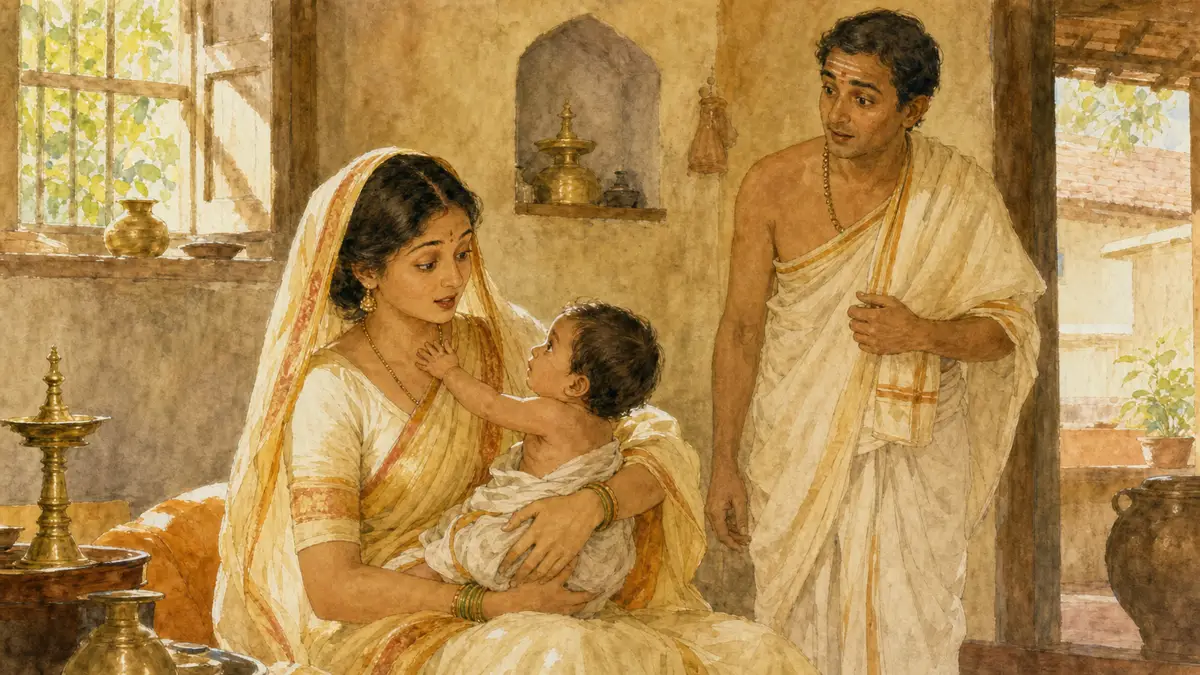
The parents did everything that people suggested. The child still did not speak. Someone said: “This boy does not speak, but he hears everything. He possesses all knowledge.” Thus seven years passed, and the boy still did not speak. His father Madhav began to worry about how the thread ceremony could be performed. He thought: “How will the boy be able to recite the Gayatri mantra? We are unfortunate. Worship of Shiva is useless. We have only one son, and we had great hopes that he would care for us in our old age, but he is mute.”
The parents became very sad. Then Narahari went to his mother and comforted her with gestures. He entered the house and brought a piece of iron. He looked at it intently and turned it into gold. The parents were amazed by such a miracle. They gave him another piece of iron, and it too was turned into gold. They embraced their son and said: “Son, you are the light of our family. We grieved that you were mute. Now we grieve because of our ignorance. We want to hear your childish babbling.”
He laughed in response to their words and pointed to the yajñopavita, indicating that he would speak after the thread ceremony. The parents were happy about this. They called the best astrologers to choose an auspicious time for the thread ceremony.
In history, it has happened that holy sages who observed mauna and had attained a high spiritual level chose a womb for incarnation. When they chose, they retained their memory from the very moment of birth. They were in fact sages, but in a child’s body. This case is also described in the prehistory of the Hastamalaka Stotra. Such children, being in fact sages, treated their parents indulgently. They knew who they were, the meaning of their life, and their path. They simply borrowed a body from their parents, waited until it grew, and did not try too hard to stand out, so as not to cause concern to others in childhood. When the body had grown, they set out and followed their path.
The Thread Ceremony and the First Words
They also began to gather everything necessary for it. The residents of the city were surprised by all these preparations. They said: “Why are they spending so much money on a mute boy? Despite all these preparations, he will not be able to understand the Gayatri mantra.” And people discussed this among themselves. Finally, all the rituals required for the ceremony were performed. While the appropriate sacred verses were being recited, the yajñopavita was placed around Narahari’s neck. Then Narahari’s father initiated him into the Gayatri mantra. Narahari repeated it in his mind.
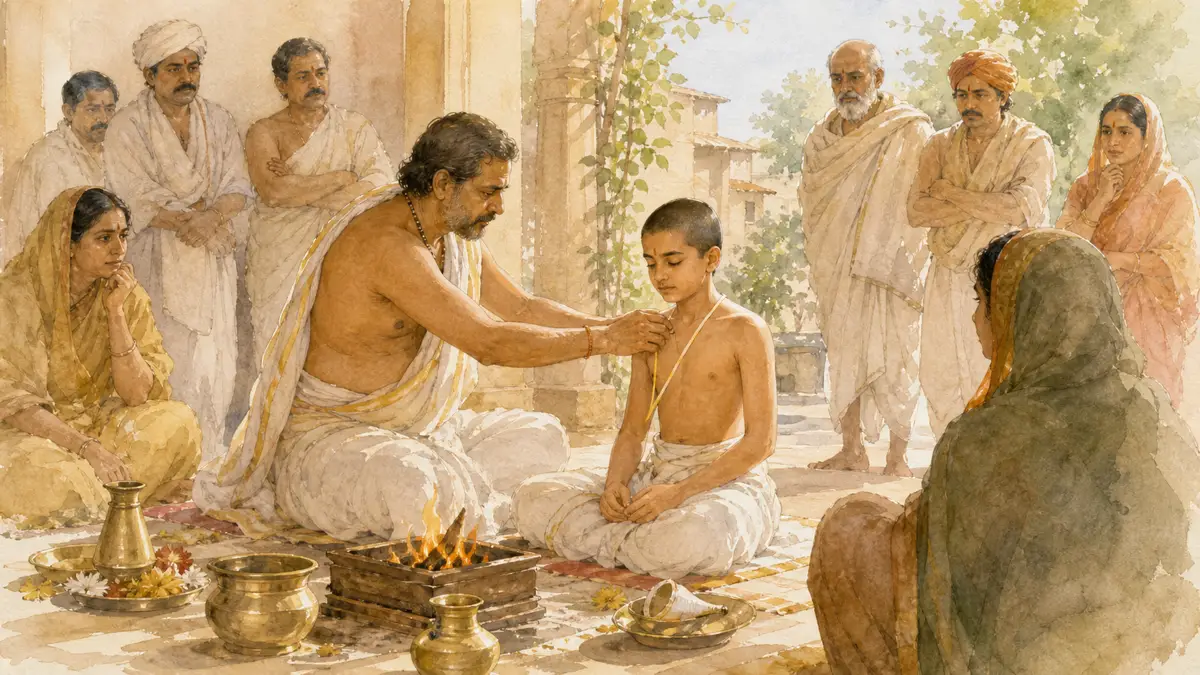
The thread ceremony of the Gayatri mantra reminds the young man for whom it is performed of Pranava — the symbol of the Absolute, Medha — intellect, and Shraddha — diligence — the three main guiding principles in education. Possessing great power, the Gayatri mantra is worship of the sun, so that the one who repeats it may absorb the radiance and richness of the sun.
Thus, the triple thread was tied on him, as is customary in the Brahmin ceremony. This triple thread reminds one of the Absolute, awareness, and faith, diligence on the spiritual path. This defines the threefold meaning of the life of everyone who is initiated with such a thread.
In the final days, students live with their teacher or Guru in a school usually located in the forest. Rich and poor boys, princes and paupers live and study together. It is a life of service to the Guru and his family. They practice yoga, study the sacred scriptures, art, and science, and live a simple life in the spirit of celibacy and self-discipline. After the training is completed, the Guru instructs his disciples to speak only the truth, to work without forgetting dharma, to serve their elders, always to remember the teaching of the Vedas, and to respect and honor parents, teachers, and guests as divine beings.
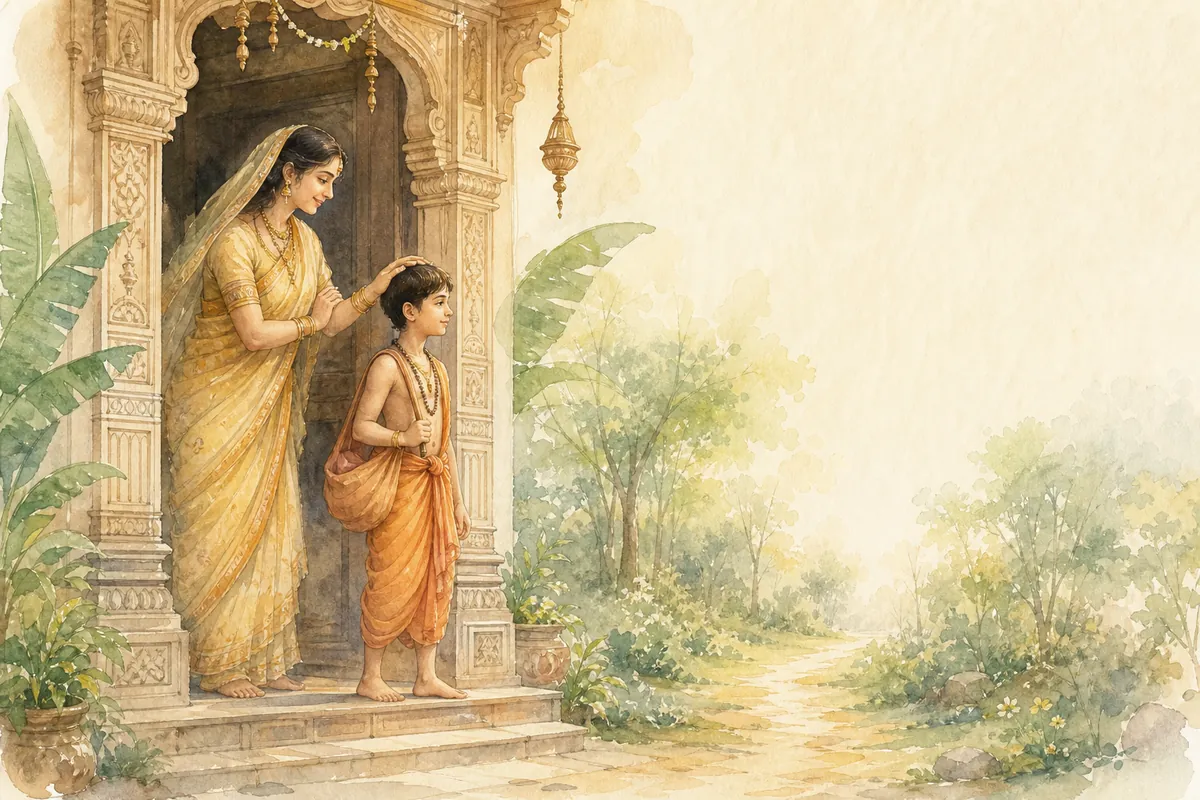
When Narahari’s thread ceremony was over, his mother Amba Bhavani gave him the traditional Mantra-bhiksha and instructed him: “Observe the traditions, study the Vedas, and live in accordance with dharma. Live on the food that you receive as alms.” At these words, Narahari unexpectedly began to recite the Rigveda. When Amba Bhavani gave him Bhiksha a second time, he recited the Yajurveda, and when she gave him Bhiksha a third time, he recited the Samaveda. All who had gathered for the ceremony were struck dumb with amazement at seeing the mute boy chanting the Vedas. They said: “Truly, this is an incarnation of God,” and worshiped him.
After the ceremony was completed, the boy said to his mother: “You instructed me to live on alms, and I am going to follow your advice completely. Give me your permission to leave.”
At these words of his, Amba Bhavani’s eyes filled with tears, and she said to him in an agitated voice: “Son, I thought that you would take care of us. You have been mute until now. We so wanted to hear words of love from you.”
Narahari said to his mother: “You will have four more children who will serve you, because in your previous birth you served Shankara.” Then he placed his hand on her head as a sign of protection, and at once she remembered her former birth. She realized that he was Swami Shripad Vallabha. She bowed to him and gave him permission to leave.
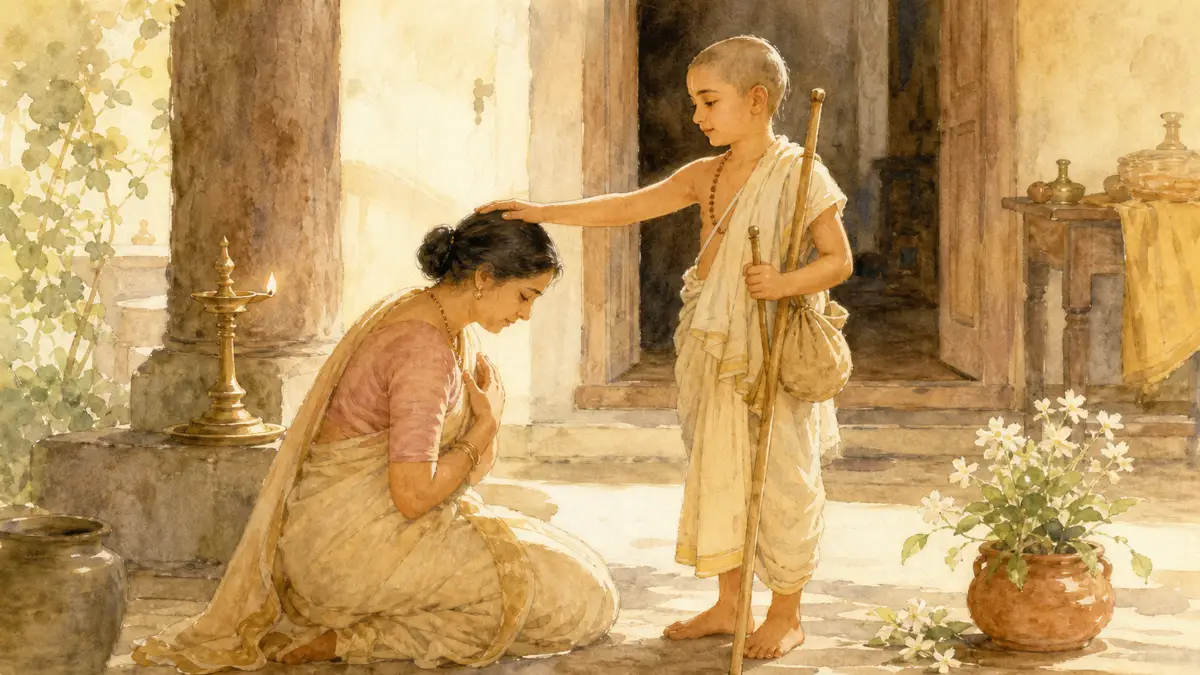
However, her mind was still not at peace. She said: “Son, does any dharma prescribe taking sannyasa at such an early age? You should live as a brahmachari for twelve years, then lead a family life, enjoying worldly life, and finally accept sannyasa.” Then Narahari explained the teaching of Brahman to his mother.
The Traditional Order of Vedic Life
The traditional order of Vedic life involves twelve years of training at a young age in the Guru-kula, that is, in the Guru’s family, when a little boy would go to the Guru’s family, along with other such boys. For twelve years he studied the Vedas, received instruction in various arts, ethics, philosophy, martial arts, the ability to build relationships with others, and so on. At the end of twelve years, he made an offering to the teacher and entered worldly life, passing into the status of a grihastha. But the one who had the abilities and the desire did not pass into the status of a grihastha, and remained a brahmachari. Remaining a brahmachari, he prepared for a higher status, the status of a sannyasi. Sannyasi means “one who has renounced the world.”
The one who was a grihastha was obliged to fulfill family and social duties, rituals, household offerings, to start a family and work as usual. The one who followed the path of sannyasa followed the prescriptions of his religious order, that is, to engage only in spiritual practice and service.
A householder (grihastha), by around the age of fifty or sixty, was expected to have raised his children, settled them in life, helped them stand on their own feet, married off his daughters or arranged marriages for his sons; then he was considered to have fulfilled his duties to society, and according to varnasrama-dharma he was also supposed to withdraw from worldly affairs and become a vanaprastha. To become a vanaprastha meant that he had to settle somewhere remote in a hut together with his wife and begin practice, something like a free retreat, begin meditation and sadhana, reciting japa. Many remained at this status of vanaprastha. Others went further, increased the power of their tapas, and gradually moved from the state of vanaprastha to the state of a sannyasi.
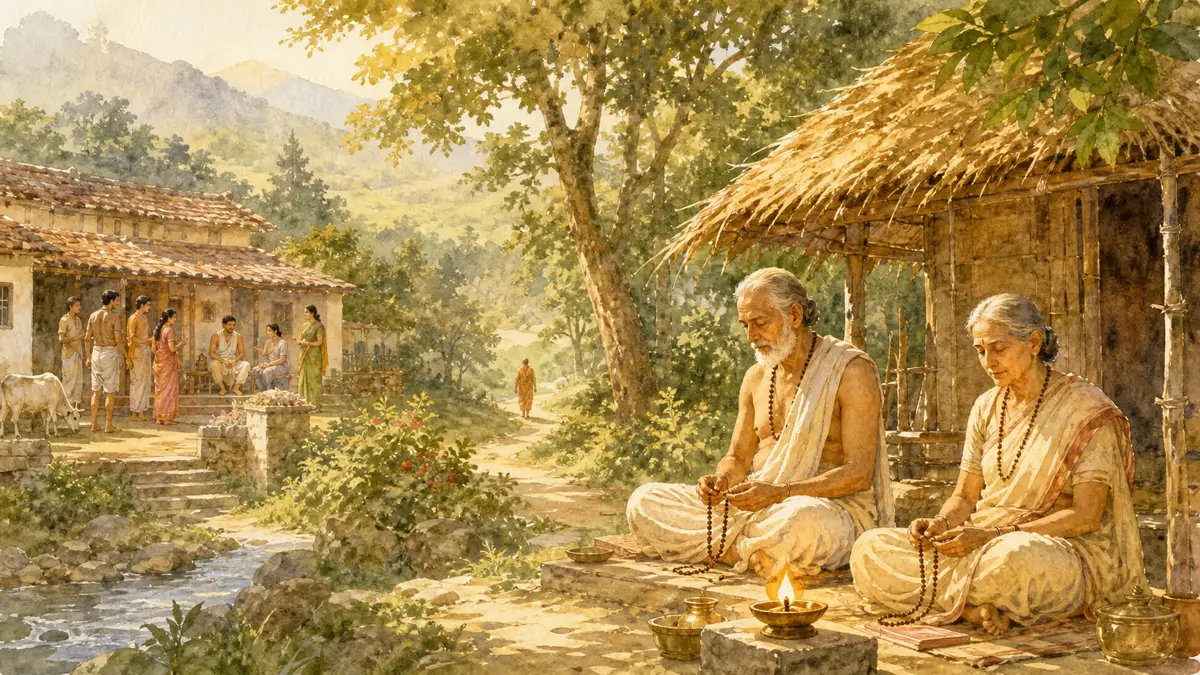
There are different types of sadhana within these statuses; they are called kutichaka, bahudaka, hamsa, and paramahamsa. The highest sannyasis—avadhutas, hamsas, and paramahamsas—are those who have fully taken the vow of renunciation and are attached to nothing. It is believed that when a person has practiced enough in the status of vanaprastha, lived as a hermit, and performed sufficient sadhana and tapas, at the end of his life he should take sannyasa, renunciation of the world. At the moment of taking sannyasa, he definitively died for society, parted with his relatives, and joined some religious order, or else continued on his own entirely independently.
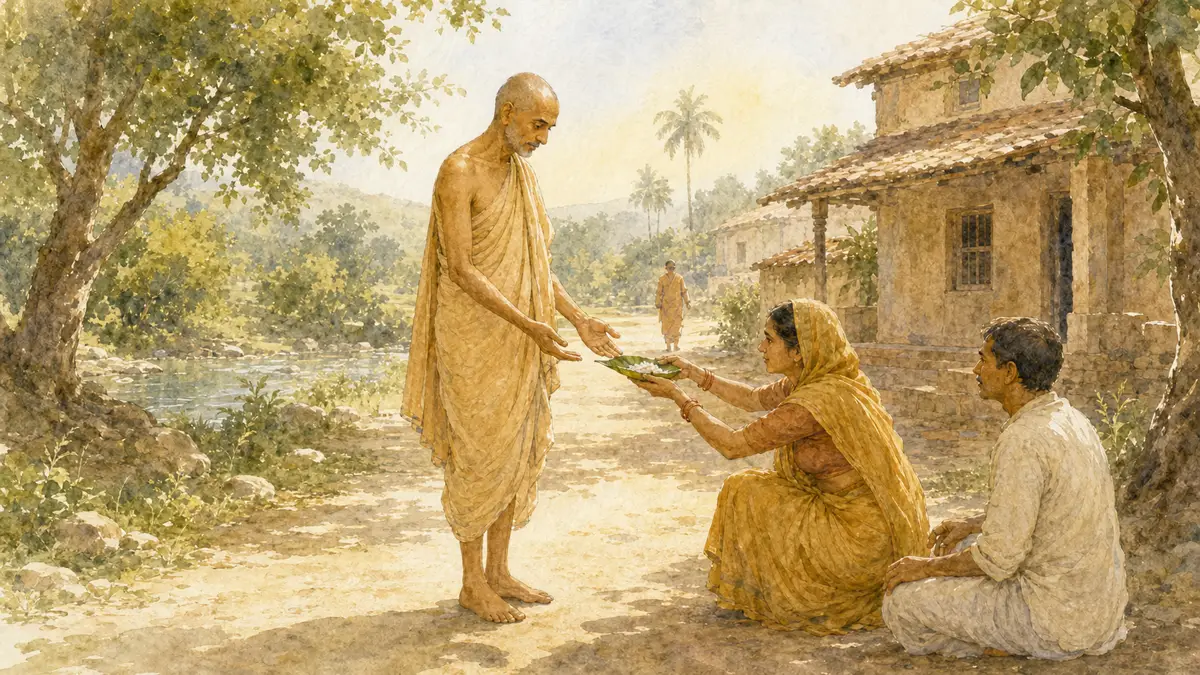
He was prescribed to move constantly northward and recite the Brahma-mantra, if he had no other initiations, all the time holding the sankalpa in his consciousness, meditating on Brahman, living on alms in a special way—that is, eating only what was given to him, having no clothing except the robes of a sannyasi, and, according to his vow, accepting food not from every house where alms were offered, but from a certain number. For example, if three families gave in a day, he would receive alms from no more than three families; and if he was not given anything that day, he would skip prasad and wait for the next day. That is, if he went around three courtyards and was refused in all three, he would think: “The Lord is telling me to fast today,” and wait for the next day. If the next day he visited three families and they also did not give him anything, he would think: “Such is my bad karma; in this way it is being burned away,” and skip prasad. A sannyasi learns to rely on the will of God.
This is a very ascetic practice: he has nothing except a begging bowl, and some even threw away the bowl in order to be completely unattached, asking for alms on palm leaves or into their hands, and what they could eat from their hands, that they ate.
Renunciation in the Modern World
These are the classic high standards of renunciation and sannyasa in ancient traditional India. Now, of course, the situation has changed. With the advent of the scientific and technological revolution, modern Vedic sannyasis began to use radios and cars, fly on airplanes, be on the Internet, and so on. Some sannyasis, for example the nagas, still remain completely naked and live according to their customs and principles, while other schools of sannyasis integrate quite well with new technologies. Nevertheless, the question of renunciation always remains. Renunciation means learning to live an inner spiritual life based on contemplation, regardless of what this teaching looks like.
When you begin practice in retreat, this too is a serious practice of renunciation, especially when the retreat is long or you live according to monastic principles. One should always remember that this principle of renunciation is not for the sake of renunciation itself. As the saint Srila Prabhupada said: “Monkeys also resemble naked sannyasis: they live in trees and do not wear clothes.” External renunciation is also called “monkey renunciation,” imitation. But true renunciation presupposes that you shift the focus of your consciousness to your inner work, to constant spiritual labor.
Usually, we do not immediately move toward renunciation. Perhaps in the future some of you will adopt a serious level of renunciation and spend most of your life—say, the last fifty years of your life, or thirty—in mauna, in hermitage. This is entirely possible according to our rules: in retreat, or in some other status. There are many statuses. However, one must move toward such a step in one’s life consciously; one must spend a long time purposefully preparing oneself. There is no point in doing this in the first years; that is completely wrong. It should be done when you have fully formed as a yogin, have gained spiritual experience, and have no problems whatsoever; then it can be done—after twenty years of spiritual practice in monasticism, thirty years. Then it will be a serious spiritual choice. If you try to do this after two, five, or seven years, expect difficulties, expect problems, expect that you will not fulfill your obligations—you are not spiritually experienced; your karmas are still completely unprepared for this.
Perhaps someone will want to spend many years in dark retreat; this is not forbidden either, but one must be ready for everything. You need to prepare yourself in this life so that readiness is gradually nurtured and cultivated in you. Perhaps someone will not take on such a status, but will spend their whole life in active external expression: dancing, singing, practicing karate, preparing prasada, or building temples. Perfecting oneself externally is also normal, a legitimate status. Why? Because everyone’s karmas are different. I would not say that one is worse than the other. The point is that if you contemplate, you can unite contemplation with both the first and the second. All this is because everyone has different karmas: different inclinations and different deities in the channels. It cannot be said that only this way is possible, or only that way. Over time, this will reveal itself within you as an inner deity, as your inner destiny, your inner inclination. In the monastery there are various conditions and statuses for this.
Nevertheless, the principle of inner renunciation means: whatever status or way of life you may be in, there is always detachment from egoism, contemplation, and subsequent self-surrender; and you know how to do this and are able to engage in inner work.
