

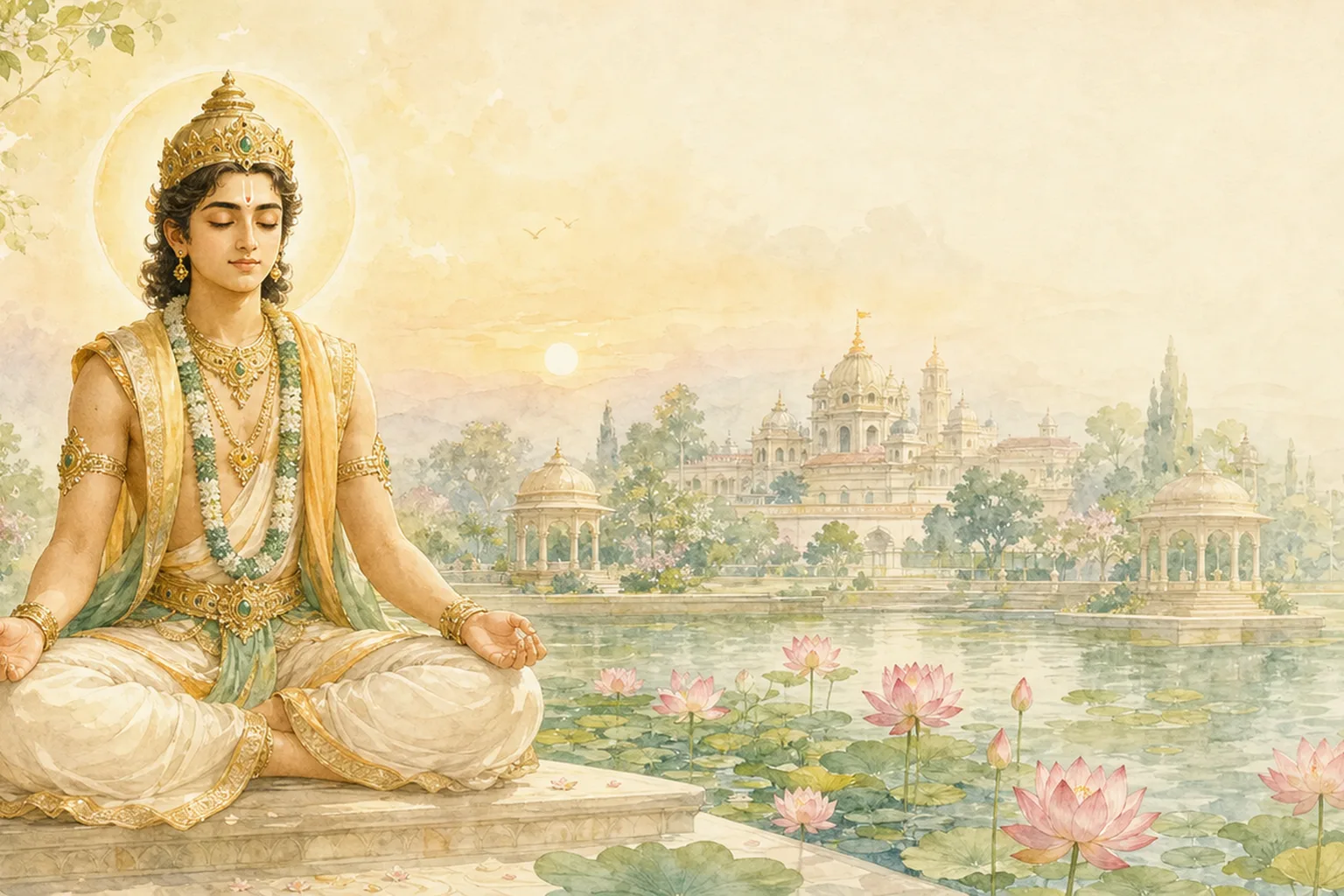
Commentary on the text “Yoga Vasistha. The Story of Prahlada”
This chapter is highly important for practicing an understanding of the teaching of Prajna-yantra in Laya Yoga. If you read the “Yoga Vasistha” attentively, you will discover many fundamental sections of the Teaching set forth here in very simple language. For example: the teaching of parasat-tarka logic, sankalpa-vidya, and the teaching of divine pride (the chapter about Indu’s ten brothers). The fifth chapter is the teaching on the yoga of the illusory body and divine pride.
It begins with the story of Hiranyakashipu, who had a son named Prahlada. Hiranyaksha and Hiranyakashipu were two guards in the Heaven of Vishnu, Vaikuntha-loka. The story begins with these guards once refusing entry to the four Kumaras, four sages who were eternal youths. Because of their arrogance and pride, these youths cursed them. According to this curse, they had to be born on Earth four times. One of these incarnations was to be as Hiranyaksha and Hiranyakashipu, and Vishnu was to slay them. Only after four births and deaths were they to attain Liberation. In another birth they were to become Ravana and his brother, and in the third birth, Hamsa and Shishupala; Krishna was to slay them (Vishnu in the form of Krishna). Thus, the curse of the sages was to be expiated by the guards of Vaikuntha-loka (the Heaven of Vishnu) after these four births and deaths that they had to undergo at the hands of the god Vishnu.
This Hiranyakashipu was the reincarnation of one of the demons. Since Vishnu had already killed his brother Hiranyaksha after Hiranyaksha had plunged the entire Earth into darkness, into a lower dimension through his despotic rule, Hiranyakashipu vowed to take revenge on Vishnu. To this end, he began persecuting all worshippers of Vishnu in the temples. The gods prayed to Brahma for salvation, and in response to their prayers Vishnu assumed the form of Narasimha. When Hiranyakashipu vowed to take revenge on Vishnu, his Guru (the Guru of the asuras) told him to perform tapas, directing it not to Vishnu or Shiva, but to Brahma, in order to gain power even greater than that possessed by Vishnu. Indra and the other demigods, knowing that nothing but trouble could be expected from Hiranyakashipu, and that his wife was carrying their future child, his son, thought about how to get rid of Hiranyakashipu.
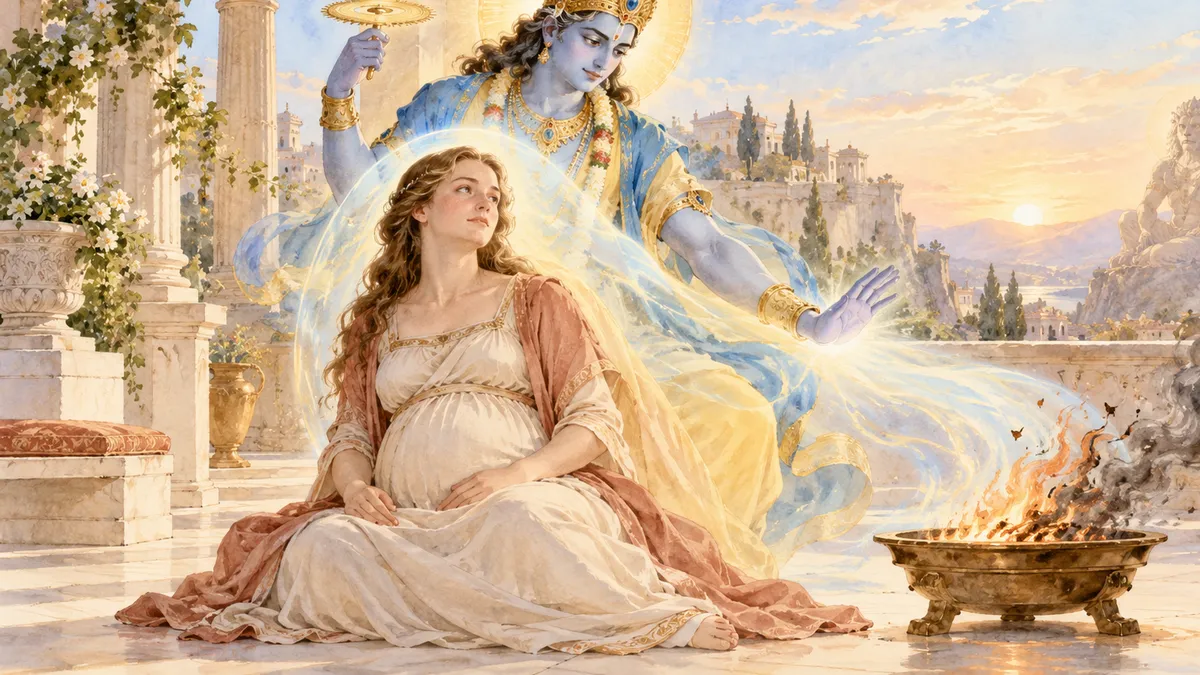
Indra decided to send the god of fire (Agni), who would destroy the child in the mother’s womb. But Vishnu, knowing that Prahlada, his great devotee, was to be born, neutralized the power of the god of fire, and the god of fire could do nothing to the child. That is, although Vishnu also wanted to punish Hiranyakashipu, he had plans for this child. And, in the end, Hiranyakashipu’s wife indeed gave birth to such a child. Although Hiranyakashipu persecuted everyone who worshipped Vishnu, wishing to eradicate his very name from history along with all the temples, a child was born into his family who, on the contrary, decided to worship Vishnu. When, in his fury, he decided to kill his child, Vishnu himself assumed the form of Narasimha Deva, the form of an enraged deity. Since Hiranyakashipu had been blessed by Brahma so that he could be killed neither by god nor by man, neither on earth nor in heaven, neither by day nor by night, Vishnu assumed precisely the form that enabled him to bypass all the conditions of the boon granted by Brahma: the form of half-man, half-lion. In the end, he killed him. And Prahlada was left alone.
Prahlada’s Reflections after His Father’s Death
“Prahlada, who remained alive, buried all his relatives and comforted the wounded. Astonished by the scale of the destruction, the survivors stood motionless for some time.
Prahlada thought: ‘Who can help us now!? Hari has destroyed all the families root and branch. Alas, our enemy has quickly reached the pinnacle of military victory. The gods, who could not raise their heads while my father was alive, have now occupied our world. My own relatives have drooped, left without occupation or inspiration, pitiful and miserable. The demons, who had been strong and mighty only recently, have now become weak and humble, like the gods were before.’”
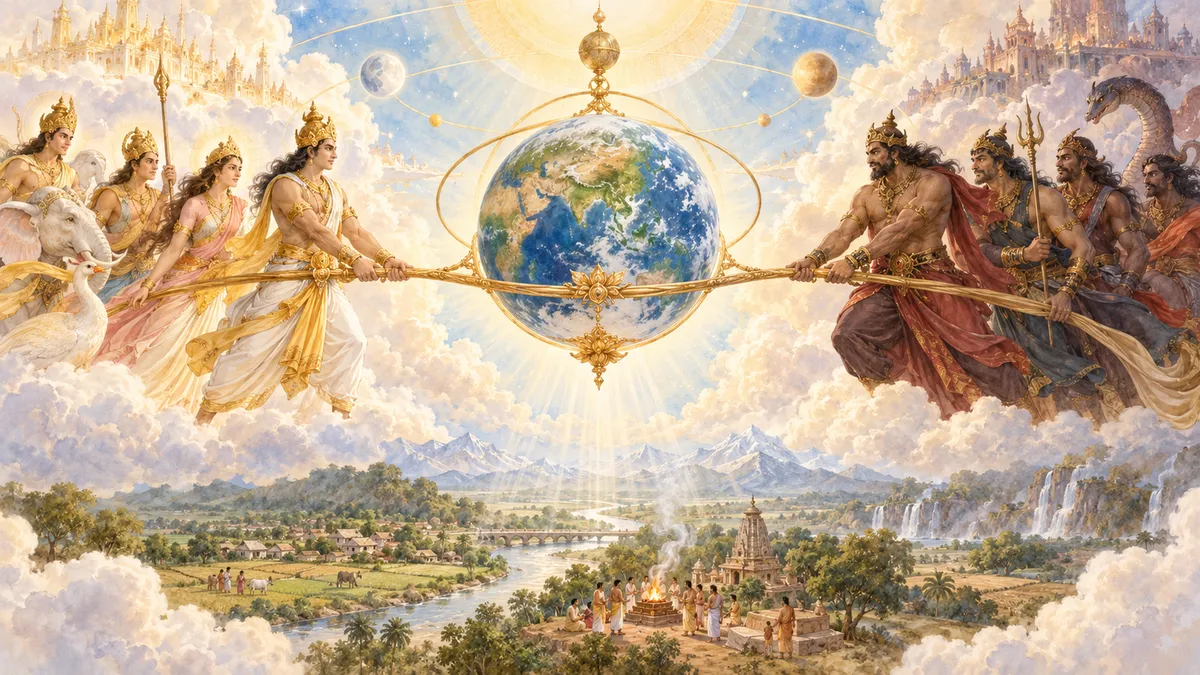
The Asuras, who are called demons here, are usually the Daityas and Danavas, the sons of one of Brahma’s daughters, or, according to another version, the sons of the rishi Kashyapa. Brahma had two daughters, Diti and Danu (light and darkness, infinity and finiteness). The gods are the sons of Diti. The Daityas, Danavas, and Asuras are the sons of Danu. In other words, some are the sons of infinity and light, while others are the sons of darkness and limitation. Clashes always took place between them. The gods embodied the principle of sattva. The Asuras embodied the principle of rajas. Vishnu was always the patron of the gods because he was the patron of sattva. The Asuras sometimes received the patronage of great gods such as Brahma or Shiva, but only temporarily, as a result of their austerities. They always possessed greater power, but less intelligence and capacity for understanding. The demigods, such as Indra and others—in this case, mainly the gods of Svarga-loka—were less warlike but possessed greater clarity and capacity for understanding. Therefore, at first the Asuras usually drove them back, but sooner or later the gods prevailed.
“What an amazing joke of fate! A timid deer brought to an unfamiliar village is afraid even of the sound of a falling leaf. So too, demons who have seen the enemy’s might become frightened of everything.
The gods took away the wish-fulfilling tree. Just as the demons once looked at the defeated gods, so now the gods look at the defeated demons. The demigods and other beings who once served at the court have gone into the forests on Mount Meru and live there like forest birds. My mother and the other queens are now embodiments of grief. Alas, my father’s fly-whisk serves Indra. Because of Hari, we are in incomparable and indescribable misery. The mere thought of our situation makes us hopelessly wretched.”
Prahlada continued to think:
“Just as the snowy peaks of the Himalayas are never scorched by the burning heat of the sun, the gods who live in Vishnu’s shadow never succumb to despondency. Just as a little monkey sitting on a tree branch teases a huge dog on the ground, the gods, being under Vishnu’s protection, torment us demons.
Vishnu protects and sustains the entire universe. Even if he is unarmed, no one can withstand him.”
Why do the Asuras and gods exist at all, and why are battles fought between them? Initially, this was conceived to maintain balance in the Universe, and Brahma himself reasoned as follows: “If the Asuras become peaceful and stop troubling the gods, there is a chance that the gods will become carried away by their favorable position, stop practicing, and their powers will begin to wane. Then people will no longer be able to receive the results of their sacrifices on Earth. They will stop sending blessings to people. Chaos will also arise in the human world. Thus, this Universe will fall out of balance. But as long as the Asuras exist, the gods do not become too absorbed in their pleasures in the heavenly realm of passion.” Therefore, in reality, these are two opposing forces that maintain balance or equilibrium in the Universe.
For us humans, there is good and evil, bad and good, but the higher gods see all this differently. There are various forces which, by interacting, maintain balance in the Universe.
Prahlada’s Revelation and the Principle of Divine Pride
“He alone is the hope and support of all beings in this world, and therefore one must seek refuge in him with all one’s might—there is no other way. No one has surpassed him, and he alone is the cause of the creation, existence, and destruction of the universe. From this moment on, I too will become a worshipper of Vishnu and will live as if filled with his presence. The sacred mantra ‘Namo Narayanaya,’ dedicated to him, is capable of blessing his devotee—may it never leave my heart.
However, one who is not Vishnu cannot attain any blessings by praying to Vishnu. One must not only pray but also become Vishnu.”
These two lines express the very essence of the Advaita Vedanta teaching and the principle of divine pride. Prahlada said: “He who is not Vishnu cannot pray to Vishnu.” In other words, if you yourself are not Vishnu, you cannot fully worship Vishnu. There is a similar phrase in Sanskrit concerning Shiva: “Shivam hutva, Shivam yajet.” If you want to worship Shiva, you must yourself become Shiva. This is the difference between integration in Advaita Vedanta and the bhakti practices of dualistic worship in Vishishtadvaita. A Vishishtadvaita bhakti practitioner would never say such a thing; to him, it would be tantamount to heresy. For Advaita, on the contrary, the principle of worshiping a deity means completely identifying with the deity, becoming that deity. When there is no difference between the jiva and the devata. Why is there no difference? Because Brahman, the Absolute, contains within itself both the jiva and the devata, both the jiva and Bhagavan.
Here, Vishnu is referred to precisely as the embodiment of the Absolute, Bhagavan. Dualistic bhakti assumes that the jiva is always separate from Bhagavan and, despite being identical to him in quality, is always separate from him in quantity. Advaita, on the other hand, speaks of the necessity of identity. What does the necessity of identity mean? It means that one must enter an analogous state of mind, a state of presence. In other words, if I worship Vishnu and think, “This is Vishnu, while I am a human being,” then this is Dvaita or Vishishtadvaita. In the state of Advaita, while practicing Laya Yoga, I give rise to the following bhava: “I am Vishnu,” entering a state of presence analogous to Vishnu, in whatever way I am capable of doing so. If this is the method of tantra, of tantric transformation, then I generate an illusory body and integrate in this state, imagining that everything is nondual. I perform the practice in this state.
The Practice of Illusory-Body Yoga
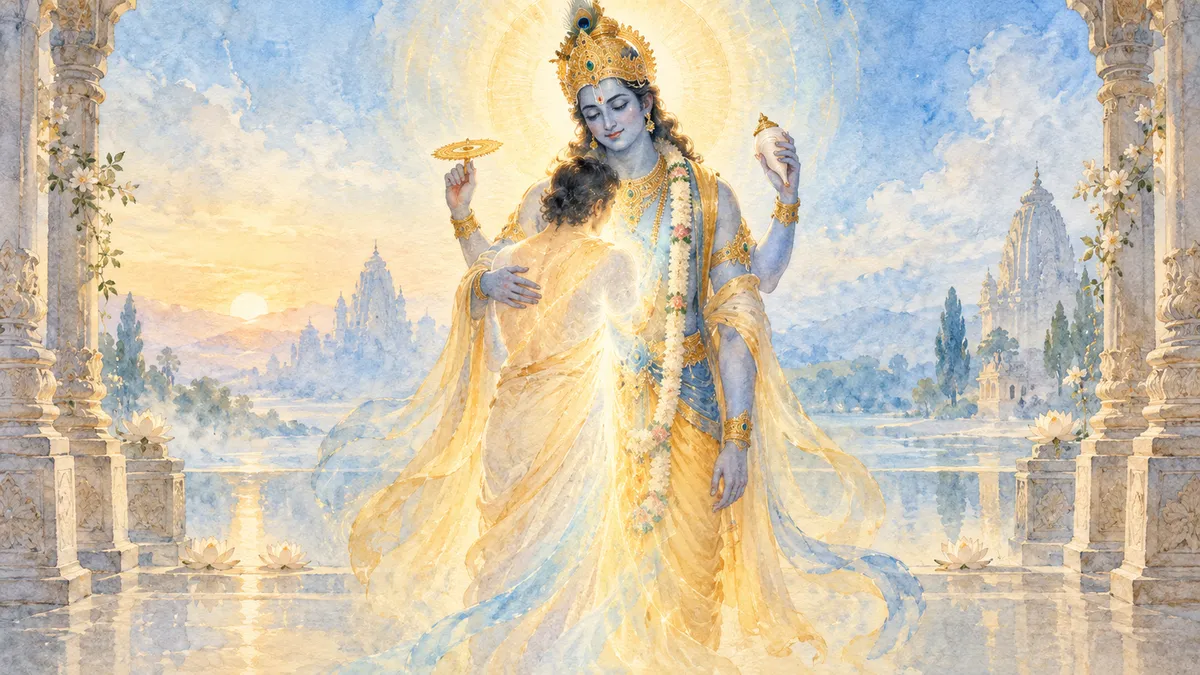
“Therefore, I am Vishnu. He who is known as Prahlada is none other than Vishnu. There is no duality here. Vishnu rides Garuda, and now Garuda carries me. In my hands are the things that Vishnu usually carries. Lakshmi, his consort, stands beside me. All the divine splendor of Vishnu has become mine.
All the symbols of Vishnu are now my symbols. The entire universe, which appears and disappears, manifests from my chest. My color now is Vishnu’s blue. I am dressed in yellow garments. Who is my enemy, and who now stands against me? Since I am now Vishnu, anyone who opposes me is undoubtedly living out his final days. The demons standing before me cannot display my radiance. All the gods now praise me because I am Vishnu.”
This stage is the classic bhava of generating divine pride and the practice of visualization in illusory-body yoga. Regardless of which Ishta-devata you practice with, the course of your thoughts is approximately as follows: you perform the visualization and generate bhava, divine pride.
“I have transcended all dualistic feelings and have myself become Vishnu. He in whom all three worlds are concentrated, who has conquered all the hostile forces in the universe, dispels the fears and anxieties of others. He is me, and I offer my salutations to him.
Vasishtha continued:
Having thus become Vishnu, Prahlada thought that it would now be good to pray to Vishnu. He thought: “Here stands another Vishnu, who is also seated on Garuda with all the divine attributes, qualities, and powers.”
If this practice is not merely a practice of the inner deity or solely of divine pride, but a practice that includes the yoga of the outer deity, then we visualize the Ishta-devata directly before us with the same attributes. While remaining in an illusory body ourselves, we integrate with the Ishta-devata, who is visualized externally. Then we perform the emission of light in order to activate its wisdom and blessing, and the absorption in order to receive its wisdom and blessing. At the same time, as I said, this is a state of nonduality. That is, Vishnu in two bodies performs integration and worship with himself.
“I will now pray to him as tradition dictates, but in my mind.
Having decided this, Prahlada prayed to Vishnu mentally, as tradition dictates. Then he prayed to him externally as well. Having finished his long prayer, Prahlada rejoiced.”
Manasika Puja and Mental Offering
When you practice the yoga of the illusory body and perform the yoga of the external deity, in addition to emission, absorption, and mantra recitation, you can also perform the offering of the five elements, the offering of the Gayatri mantra, the sadhana of the kavacha, and the sadhana of the 108 names. If your visualization and bhava are strong, then your inner offering practice (manasika-puja) will have the same power as the external one.
A sadhu once fell into a well and could not get out. He wanted to perform puja (a ritual offering), but when he found himself in the well, he decided to perform this puja while sitting in the well. The power of his mind was such that, after performing the puja in the well, he freed himself from it solely through the mental offering.
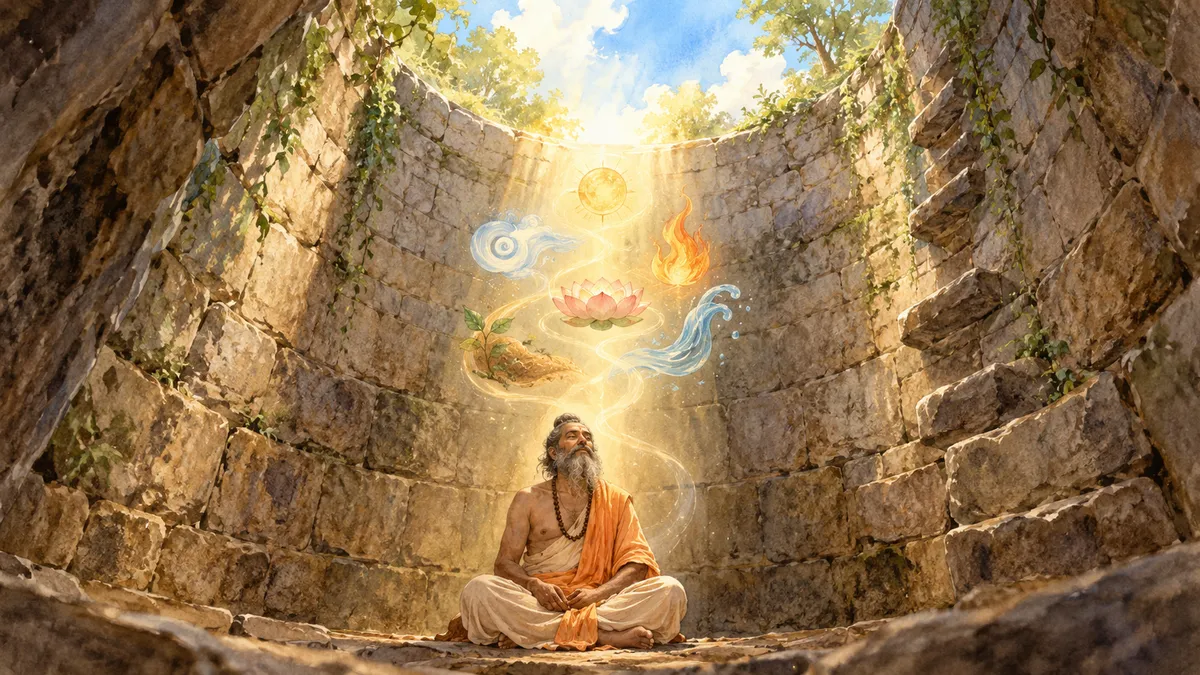
When you make a mental offering (manasika-puja), you generate subtle forms, for example, as in the Brahma mantra. If you do this purely and with bhava, these subtle forms saturate and purify your subtle body, and positive signs appear in your dreams.
“From that time onward, Prahlada prayed to Vishnu every day.”
Your mantra to the Ishta-devata, prayer, and manasika-puja should gain strength day by day. A person who has trained themselves to make mental offerings visually can simply arrive and, without performing any rituals on the external level, purify a room with manasika-puja, a mantra, or prayer alone. Or, simply by making an offering, you can heal a person, change a situation, or actualize a sankalpa.
Suppose you need to achieve something: you mentally perform the Brahma mantra, make an offering with the syllable SHRIM, and actualize the version in which your sankalpa comes true. This is because SHRIM is the syllable, the bija, of the goddess Lakshmi, associated with iccha-shakti, the embodiment of will. Or suppose you need to strengthen your abilities in knowledge; you perform the Brahma mantra, adding the bija AIM.
The Gods’ Reaction to the Transformation of the Asuras
“Seeing his efforts and following his example, all the demons in the kingdom also became devotees of Vishnu. Rumors that Vishnu’s former opponents had become his devoted worshippers spread like wildfire. The gods in the heavens were astonished—how could demons become worshippers of Vishnu? They went to ask Vishnu about it.
The gods said:
‘O God, what kind of mystery is this? The demons have always been your opponents. That they have become your worshippers seems like a bad joke. Where is their devilish nature, and where is the worship of you that arises only in the final incarnation of individual consciousness?’”
Since Vishnu is the embodiment of pure sattva, it is believed that one can remain in pure sattva only when the coarse karmas of rajas and tamas have been exhausted—that is, when a person is living their final incarnation on Earth, and the next incarnation must be at least among the demigods of Svarga-loka in the Heavens of Indra.
As long as a person’s soul is immature, there is much rajas and tamas in them. They cannot remain in pure sattva. They cannot be divya. But when the soul is evolutionarily mature, there is little rajas and tamas in it, and that soul is immersed in sattva. It has many abilities, clarity, and divine qualities.
The gods were greatly astonished that the asuras, who had possessed much rajas and tamas, suddenly began worshipping Vishnu, who was the embodiment of sattva. They were even outraged by this, since in their understanding it was contrary to the nature of the laws of the Universe.
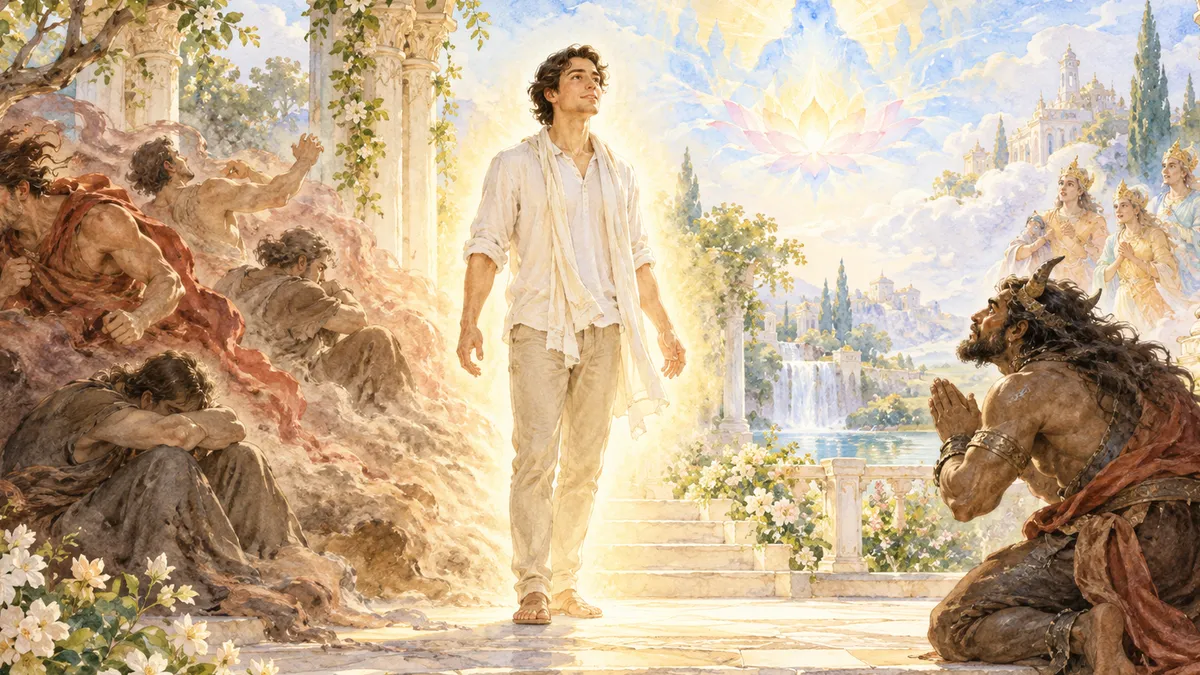
“The good and luminous qualities necessary for this are not suitable for demons—it is utter nonsense. After all, the qualities inherent in a being always correspond to its fundamental essence. It is painful to hear that such creatures suddenly became your worshippers overnight. If it had happened gradually, through the development of good qualities and wisdom, we would have understood it. But the fact that devilishly cunning creatures became your worshippers almost instantaneously—it is hard even to believe.”
The gods suspected some trick or deception in this. They thought that the asuras had decided simply to lull Vishnu’s vigilance and win the gods’ trust by becoming weak, in order to strengthen their power and then strike, since such are all the qualities of the asuras. They can show friendliness for a while to increase their strength, and then twist around and deliver such a blow. Therefore, the gods did not believe this.
Vishnu’s Answer and the Teaching of the Three Gunas
Vishnu replied:
“O gods, do not suffer from doubts and disappointments. Prahlada has begun to pray to me. This truly is his final birth, and he has earned Liberation. The seeds of his ignorance have been destroyed. He will no longer be reborn. It is painful and meaningless to hear that a good person has become bad. But it is pleasant and good to hear about someone who had no good qualities and has become good. The changes in Prahlada are for your own benefit.”
What is called a generally accepted good quality, or a divine quality, is sattva. The indicator of spiritual growth is that sattva increases within you, while the amount of tamas and rajas decreases. Usually, a person is born with a certain proportion of tamas, rajas, and sattva, connected with their sanchita karma, but through the application of personal karma (purusha-kara), they can change this proportion. Sadhana is nothing other than changing the proportion of tamas, rajas, and sattva within oneself.
For example, if a person has ten units of sattva, five units of rajas, and three units of tamas, sattva predominates in them. They need to purify themselves just a little more, reduce tamas to one unit and rajas to two units—this is enough to be reborn in the heavens. But if a person’s proportion is ten units of rajas, five units of tamas, and two units of sattva, one can say that it will be difficult for such a person to practice, meditate, and contemplate. Their entire life will simply pass in a struggle with the kleshas, transgressions, sins, and remorse.
It is very important that everyone finds their own community according to the proportion of the three types of karma that corresponds to them. Gods are drawn to gods, asuras to asuras, sattvic people to sattvic people, and rajasic people to rajasic people.
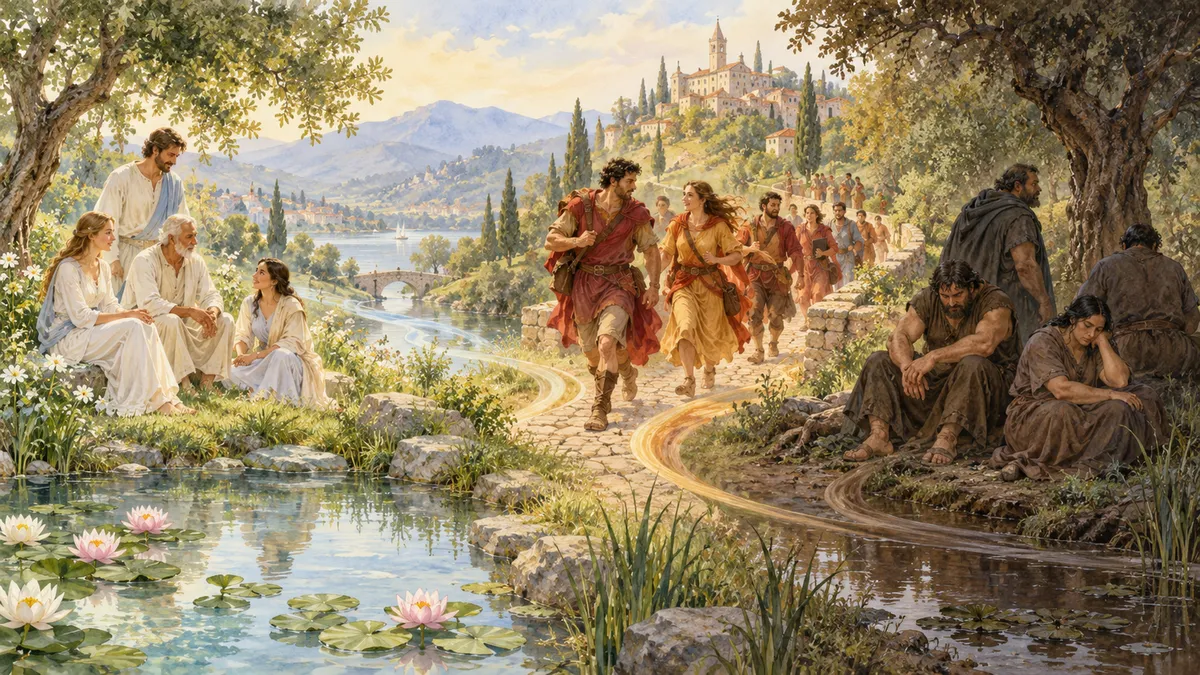
For example, if a tamasic or rajasic person enters a community of sattvic people, they will feel unhappy, and the sattvic people will not accept them. If a rajasic or tamasic person enters a monastery, they will constantly commit sins and repent, commit sins and repent; penances will be imposed on them, and this will continue endlessly. They will feel awkward and joyless because the level of discipline in sattva is different from that in rajas. Alternatively, they may overcome themselves, develop a new quality within themselves, and this proportion will change and rise to the level of sattva. Suddenly, they will feel that things are auspicious; they will feel that they have finally found their proportion.
In the same way, if a person possessing sattva enters a community of people with rajas and tamas, they will not be accepted there if they lack sufficient clarity.
Spiritual practice is nothing other than changing this proportion: rajas and tamas must be reduced, while sattva must be increased—this is evolution. The gods, siddhas, and sages abide in pure sattva; they have transcended the three gunas, but their general state is sattva. Sometimes they also use rajas and tamas if they possess sufficient shakti to carry out certain missions. For example, Krishna is considered a purna-avatar because he used all three gunas.
Sattva corresponds to peaceful deities, the principle of rajas corresponds to joyful deities, sometimes wrathful ones, and the principle of tamas to wrathful deities.
Prahlada’s Prayer and the Manifestation of Noble Qualities
Vasishtha continued:
“Having calmed the gods, Vishnu disappeared, and the gods went their separate ways. They became friendly toward Prahlada.
Every day, Prahlada prayed to Vishnu through thought, word, and deed. As a result, noble qualities—wisdom and equanimity—very quickly arose and manifested within him.”
When you contemplate, your sattva increases, and your subtle qualities begin to manifest. The qualities of rajas are strong self-expression, the desire for powerful manifestation, abruptness in movements, the desire for change, and the desire to be constantly in motion. All great rebels, revolutionaries, criminals, and kings are rajasic people who directed the power of their rajas toward certain activities and, depending on their shakti, manifested certain actions. All great wars were organized by rajasic people subject to the elements of fire and air.
In contrast, the state of sattva is a state of calm. All priests, sages, scholars, and people of the arts are those who have a great deal of sattva. All saints, awakened beings, and siddhas are those who have realized a sufficient potential of sattva.
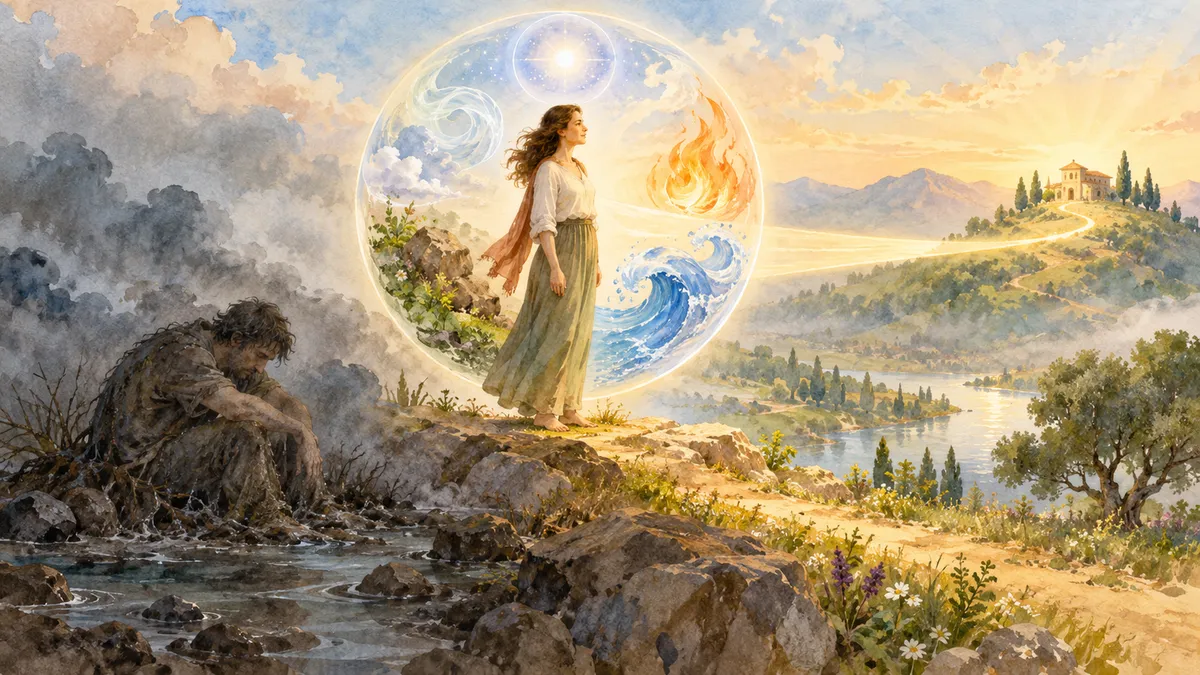
Sattva means that the element of space, the element of consciousness, predominates, while the other elements are in harmony. When a person is seized by rajas, their elements are often in disharmony. For example, when the elements of fire and air are working intensely, such a person’s actions are often destructive. There is a category of people for whom, whatever they undertake, everything slips from their hands, breaks, or turns out wrong because the elements of fire and air are unbalanced. If such a person sets out on a journey and wishes to accomplish something, they will not succeed. This is because their air and fire move ahead of them and destroy the situation itself, especially if the air and fire are in the right channel.
In those who are in a state of sattva, all the elements are balanced, and the element of consciousness, the sixth tattva, predominates. As a result, there is tremendous clarity, and they can simply direct their sankalpa in accordance with that clarity and achieve everything.
If tamas dominates in a person, earth and water predominate in them. They are very inert; there is no clarity, understanding, or will—no sankalpa—within them. While a rajasic person may still possess great willpower, one who has strong tamas possesses neither clarity and understanding nor will. They cannot manifest or express themselves. Such a person does not achieve success. They are most likely a victim of circumstances.
Meeting Vishnu and Receiving His Blessing
“He did not seek pleasures; not even a thought of them arose in his mind. Having cast aside the desire for pleasures, his mind was left without support. Vishnu learned of Prahlada’s state. He arrived at the place where Prahlada was praying to him. Seeing Vishnu himself in his palace, Prahlada rejoiced even more and continued to pray:
“I seek refuge in the God in whom all three worlds exist, who is the highest Light that destroys all darkness of misunderstanding and impurity, who is the best protection, the refuge of the helpless and those who have lost hope, the one unborn God whose refuge one should seek. I seek refuge in the One whose voice resounds with truth, who dwells in the hearts of all beings, in whom this entire vast universe exists without change, who is unborn and immutable.”
Vishnu said:
“O Prahlada, you yourself are an ocean of good qualities and the best among the demons. Tell me any desire that leads to the cessation of suffering, and I will fulfill it.”
Prahlada said:
“O God, you dwell in all beings and grant them the fruits of their desires. I beseech you, choose for me a desire that you consider infinite and eternal.”
Vishnu said:
“Very well, Prahlada. May the spirit of knowledge possess you until you come to rest in infinite awareness, so that all your delusions disappear and you attain the highest state.”
Vasishtha continued:
“Having said this, Vishnu disappeared. Prahlada finished his prayers and, after chanting hymns in honor of Vishnu, sat down and began to reflect.”
When Prahlada began practicing in this way, Vishnu appeared before him after some time. When a deity appears as a result of the sadhana of the illusory body, this is called “conception,” that is, when you receive the darshan of the deity. “Conception” is followed by the stage of “gestation.” The darshan of the deity (“conception”) also corresponds to the stage of shravana, direct transmission, direct introduction. After that, one must become established in it by contemplating this state in order to eliminate all doubts—this is the stage of manana. Prahlada then continued this practice.
Prahlada’s Self-Inquiry
Prahlada thought:
“Vishnu commanded: ‘Inquire constantly.’ Therefore, I must constantly inquire into my own nature. Who is this ‘I’ that speaks, walks, stands, and acts upon the stage of this world? First, I will find the answer to this question.
Certainly, I am not this external world, which is inert and consists of trees, bushes, and mountains. But neither am I the body, which was born due to the activity of the life force and lives only for a short time. I am not sound, nor a word, name, or expression, which are perceived by the inert ear and are merely movements of air devoid of form and existence. I am neither feeling nor the sensation of touch, which is also fleeting and can function only thanks to infinite consciousness.”
Thus, from formal meditation we move toward essential understanding through reflection (manana). At first, we may simply perform the practice of “Aham Brahmasmi,” Atma-vichara, or the yoga of the illusory body on a formal level. Then our essential practice becomes connected with reflection and a reassessment of our understanding. We become convinced that our “I” is not contained in the body; our “I” is the subtle body. The subtle body is within the physical body, like fragrance in a flower or flavor in honey. It is not explicitly present in the physical body. Through analytical meditation, raja yoga, and dream yoga, you can become aware of your subtle body. Then you understand that the most important practice takes place at the level of the subtle body. Visualization opens the entrance to the subtle body. Whenever you perform visualization, you activate it and enter the astral dimension.
Motivation and the level of awareness are connected with the subtle body. Practice bears fruit and produces results when you are able to activate your subtle body; at that point, the practice ceases to be formal.
Many people begin sadhana with external expression, such as rites, rituals, external worship, and so on. But this is the practice of pious actions for householders (karma-kanda). True practice genuinely begins at the level of the subtle body, when you work with motivation, awareness, visualization, jnana yoga, and contemplative presence.
It is very important to be able to engage the energy of the subtle body in sadhana and activate your imagination. If you know how to do this, you will always practice auspiciously. For example, if you practice kundalini yoga without motivation and cannot see your prospects in kundalini yoga, but the mind creates some intention, thinking, “I will follow the schedule and perform this practice,” and you simply apply the method while the energy does not awaken at all, this is because your subtle body is not engaged. But if you think about kundalini, listen to the experiences of practitioners, dream about it, imagine the energy awakening, and bring this breath of kundalini-shakti into the method, into kumbhaka, into chandali yoga, all these experiences begin to occur to you. Those who do not know how to engage the imagination, the principle of the subtle body, and the inner sankalpa of the subtle body find it very difficult to attain results even after many years of practice. Conversely, those who are capable of doing this gain good experiences with minimal effort.
In other words, in sadhana you should resemble primitive hunters who, before killing a deer, draw it and throw spears at it, performing a magical act. When they have thrown their spears at the deer and struck it, this means that the magical ritual has been carried out, and the hunt will now be successful. On the astral level, the magical operation has already been completed; all that remains is simply to find the deer and finish the hunt.
At the subtle level of the astral body, you must already be in the state of the accomplished result. The state of self-recognition in parasatarka logic means that you first do everything at the subtle level, and at the subtle level everything is already, as it were, accomplished. Then you adjust the physical level, as it were, to what has been done at the subtle level. Conversely, if you make an effort in sadhana or service at the physical level, but your motivation has not carried out the inner work, and you have not activated intention and imagination, you will encounter major obstacles or difficulties while exerting your will.
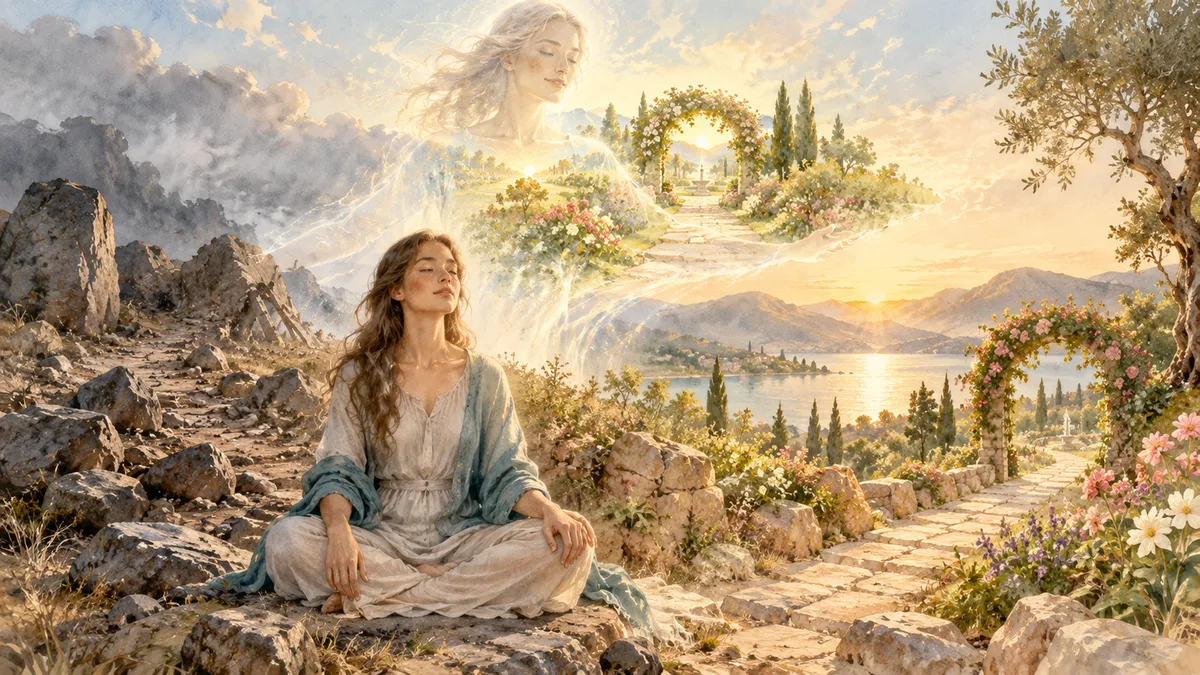
The higher a person’s spiritual level, the more they can activate their subtle body when doing anything. The ability to activate the subtle body is determined by the level of medha-shakti, the ability of the sahasrara chakra to radiate subtle prana, energy. When such a person concentrates on something, powerful images arise in the astral world. These images directly surround them, and if they saturate these images with intention, it is as though deities or illusory doubles emerge from the crown of their head, and they invest these illusory doubles with intentions. For example, they say: “Go and carry out what I need.” These illusory doubles fly off and carry out the task before their physical body does, drawing situations together, entering the minds of other people, attracting certain energies, and the situation at the level of the subtle body is, as it were, already realized. Then the person goes somewhere, and everything happens easily for them, as smooth as silk; they are called a “lucky person.” This is because their medha-shakti has sent out illusory double bodies; these illusory bodies have already done the necessary work in the subtle world and conveyed the thoughts to the right people. These right people seem to meet them by chance and seem to offer precisely what they wanted. They have formed the necessary circumstances. The person moves forward and encounters how this tunnel of reality manifests in life. This is the power of intention, or medha-shakti.
Awareness of Pure Consciousness
“Nor am I the sense of taste residing in the changing and restless tongue, which is occupied only with tasting. I am not the sense of sight, which is also fleeting and is a distorted understanding of the one who sees. Nor am I the sense of smell, which is an imaginary creation of the nose.
Therefore, I do not possess these imaginary qualities. I have no connection whatsoever with the activity of the sense organs.”
To enter the subtle body, one must transcend visible perception. There are external visible objects, there is the process of seeing (visual consciousness), and there is the one who sees. There are external audible sounds, there is the process of hearing, and there is the listener (the one who listens).
When we enter the subtle body, what matters to us is the very process of seeing and hearing, which is based not in the physical body but in the subtle one. When we practice jnana yoga, what matters to us is the witness-observer itself, the one who hears and sees.
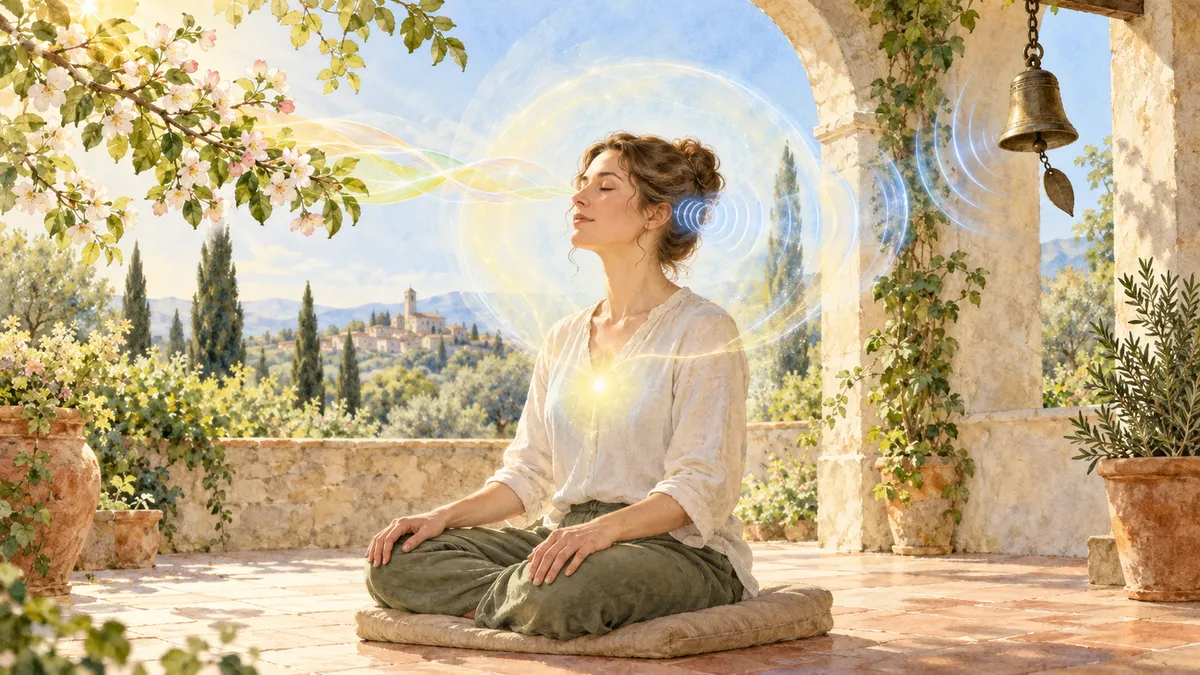
“I am pure consciousness, inconceivable bliss.”
Prahlada continued to reflect:
“I am the all-pervading reality, devoid of objectivity and therefore devoid of notions and concepts. I am pure Consciousness.”
To feel oneself as an all-pervading reality without concepts and external objects means to continually enter the subtle body and discern within the subtle body an even subtler consciousness. This consciousness belongs not to the subtle body but to the causal body. When, through contemplation, we are able to discern this subtle consciousness, jnana-deha is activated. Our entire spiritual practice unfolds under the banner of the three bodies: the body of wisdom, the body of vibrations (the illusory body), and the manifested body, which is currently the physical body.
To practice and strive toward the Fruit means moving in the direction of these three bodies. The body of wisdom means discerning within one’s subtle body the empty space of pure awareness. Pranava (the illusory body) means forming or recognizing in the astral body the pure manifestation of this emptiness in the form of a wealth of forms. The subtle body always manifests as blossoming, diversity, multiplicity, and richness. All the images of saints and deities that you see are pranava-deha. This realization is very important to us; it has a key form and key significance. All of this is pranava-deha. If we depicted deities and saints in the style of jnana-deha, we would portray them differently: without ornaments, almost completely naked, in emptiness, without rainbow hues; they would simply be in pure space, with not a single ornament on them, only the body. Minimalism and utmost simplicity—this is how jnana-deha is usually depicted.
But when it comes to pranava-deha, there is no minimalism here. The decorations, the beaded garments, the rainbow-colored patterns—all of this plays its part and blossoms luxuriantly; all of this is the principle of the illusory body of the astral world (pranava-deha). And if we were depicting saints in the style of shuddha-deha or siddha-deha, we would depict them as human beings; there would be no patterns or decorations around them. They would wear simple clothing, and there would be trees, houses, and something human—in other words, this would be the form of their sacred manifestation. They would have pure, refined features, but human ones; you would not see anything fantastical.
These three styles of iconography correspond to three ways of perceiving bodies. We depict precisely the illusory bodies of saints in the pranava-deha style of iconography because this dimension is very important to us, at least at the present level.
As you can see, the background of all the deities is similar; it is approximately blue or light blue. It embodies the principle of space. The principle of space is the pure awareness of jnana-deha. It is, as it were, the empty, unmanifest essence of any deity or saint. And from this empty, unmanifest essence, their illusory body appears, like a fish leaping out of water—that is, pranava is born. The illusory pranava-deha always possesses a wealth of forms and diversity; it is always shimmering and can extend itself considerably. Such is its manifestation.

Siddha-deha, on the other hand, always has a concrete, material, solid manifestation. That is, even if a saint has a body on the physical level, he has one body and two arms, as usual. He does not have six arms or many bodies.
For example, when applied to ordinary objects, these three dimensions can be found among any objects. Let us suppose that there is only this one microphone; there are no patterns or shimmering around it, and I do not see any other illusory microphones. I can touch it; it is solid, definite, and a specific microphone. If I say, “This microphone,” everyone understands which microphone it is. But if we consider the microphone in the dimension of pranava-deha, the best way to gain an understanding of it is to look at the microphone through a crystal. If we look at the microphone through a multifaceted crystal, this microphone may appear as a multitude of illusory, rainbow-colored microphones; there will be many of them. Teachers often give students an initiation into the illusory body by giving them a crystal through which they are to look at the deity. When they look at the deity, numerous deities appear in a circle. This is the principle of the illusory body. Or the Guru dresses beautifully, sits on a throne, and all the students look at him through the crystal. The Guru says, “Do you understand? These are my illusory bodies; this is me, as it were, in the dimension of pranava-deha.” In this dimension, this is shuddha-deha, while pranava-deha is another dimension.
The Three Dimensions of a Microphone
The microphone itself is empty; its emptiness means that it arose from the pure space of awareness—this is jnana-deha. Thus, the microphone contains three dimensions. The dimension of pranava-deha is also connected with thought and speech; that is, at the level of thought and speech, we can conceive of the microphone in a non-definite way. For example, in addition to the gross physical microphone, there is the word “microphone,” the thought “microphone,” and the microphone as a principle. All of these are subtle, mental concepts; they are the form of the microphone’s pranava-deha. And this gross, concrete, physical microphone is its manifest aspect.
Realization of the Three Bodies in Sadhana
Our sadhana, as we move toward the Fruit, is always connected with the realization of these three bodies: the body of wisdom, the illusory body, and the manifest body. On the path of the lower tantras, these bodies are realized as the result of effort. They are the Fruit. But on the path of Anuttara Tantra, it is often said that the Fruit, the Path, and the Ground are one and the same. From the perspective of the Sahajya path, the attainment of the three bodies occurs as self-recognition; that is, we already recognize these three bodies within the stream of our mind. For example, we allow for the possibility that the illusory body of Dattatreya, complete with all perfect qualities, already exists in the stream of our consciousness right now.
Different Approaches: Asceticism and Blossoming
Usually, those who practice jnana-deha sadhana are always very ascetic in their outward appearance. For example, the Zen style, raja yoga—only emptiness and nothing else. This is not expressed externally in any way; the mind, too, is very strict and ascetic—there is emptiness and minimalism. This is, for example, the style of the sutra, Zen, Hinayana, and Mahayana. Tantra is oriented not only toward attaining emptiness, but also toward attaining the illusory body (the astral body). Therefore, there is always a great deal of blossoming, various divine manifestations, divine qualities, and so on. This is the principle of Tantra.
For example, when I meditated on emptiness, my living conditions were very austere; I observed mauna, did not communicate with anyone for years, had a bag containing all my possessions, and had very few contacts and very little information, with no ostentation whatsoever—only emptiness and nothing else. Food, padmasana, emptiness, and prayer beads—that was my entire environment. This is minimalism, the principle of jnana-deha.

But now, in the Monastery, we emphasize the three bodies, including the illusory body. This is the principle of the manifestation of a wealth of forms, diversity, blossoming, and play. Jnana-deha exists, but there is also the manifestation of the astral body and siddha-deha, the manifested dimension. These three dimensions manifest everywhere: in sadhana, in drawings, and in external life. Our task is, through the natural state, to unite it with the three dimensions, purifying and cleansing them completely until these three dimensions are fully transformed, purified, and become the three enlightened bodies, our three primordial energies.
