

Commentary on the text “Yoga Vasistha. Chapter 5. The Story of Prahlada”
The story of Prahlada in the “Yoga Vasistha” is very important, since it shows the principle of view, meditation, and conduct. It reveals these three aspects. It also teaches the principle of the yoga of the illusory body, of divine pride. This chapter is the key to understanding many of the practices that we perform. If you read the story of Prahlada again and again, you will receive very great inspiration.
It begins with Vasistha telling Rama about how the asuras lost the battle to the gods when Vishnu intervened in this battle and came in the form of Narasimha and destroyed the demon Hiranyakashipu. This demon Hiranyakashipu took rule over the three worlds from Indra himself. As is known, he had Prahlada, one of his most famous sons. Hiranyakashipu thought very highly of himself. He had the three worlds under his command, since his power was like the power of Indra, a mighty army, siddhis, and wonderful children.
The gods were worried and prayed to Brahma for salvation from Hiranyakashipu. Moreover, his own son was against the way he behaved. He venerated Vishnu. Then Vishnu assumed the form of Narasimha and destroyed Hiranyakashipu in order to protect Prahlada. He took on a wrathful form in the guise of half-lion, half-man.
Despite the fact that Hiranyakashipu had received siddhis, blessings from Brahma not to be killed by man or beast, or by any being, neither by day nor by night, neither on earth nor in the sky, Vishnu assumed such a form in order to surpass all of Brahma’s blessings. Half-man, half-lion, he was neither man nor animal. He was killed neither on earth nor in the sky, but on the lap of Hiranyakashipu himself.
When Hiranyakashipu was killed, all the other asuras fled, and the palace was destroyed. There was enormous destruction; in fact, the entire world of the asuras was destroyed. Prahlada himself was frightened by the destruction that was taking place, since he also cared for the kingdom of the asuras. He then began to think that it would be better if his entire kingdom accepted the protection of Vishnu. He thought that now all the families of the asuras had been destroyed, and the gods, who during the lifetime of the asuras could not even raise their heads, had now occupied the world of the asuras. And all his relatives had become dejected, left without protection, pitiful and unhappy.
Prahlada begins to reflect on suffering and impermanence:
The demons, who were strong and powerful just recently, have now become weak and humble, as the gods were before; fate is an astonishing thing! A timid deer brought to an unfamiliar village is frightened even by the sound of a falling leaf—so too the demons, having seen the power of the enemy, are frightened by everything.
The gods have taken the wish-fulfilling tree. As the demons once looked upon the defeated gods, so now the gods look upon the defeated demons. The demigods and others who once served at the palace have gone to the forests on Mount Meru and live there like forest birds. My mother and the other queens are now the embodiment of sorrow. Alas, my father’s fan now serves Indra. Because of Hari, we are in incomparable and inexpressible misfortune; the mere thought of our situation makes us hopelessly suffer.
Prahlada continued to think:
Just as the snowy peaks of the Himalayas are never scorched by the burning heat of the sun, the gods who live in the shade of Vishnu are never subjected to despondency. Just as a little monkey sitting on the branch of a tree teases a huge dog on the ground, the gods under the protection of Vishnu offend us, the demons.
Vishnu protects and sustains the entire universe. Even if he is unarmed, no one can withstand him. He alone is the hope and support of all beings in this world; therefore, one must seek protection from him with all one’s strength—there is no other way. No one has surpassed him, and he alone is the cause of the creation, existence, and destruction of this universe. From this moment on, I too shall become a worshiper of Vishnu and shall live as if filled with his presence. The sacred mantra “Namo Narayana,” dedicated to him, is capable of blessing his devotee—may it never leave my heart. However, one who is not Vishnu cannot attain any blessings by praying to Vishnu. One must not only pray, but also become Vishnu. Therefore, I am Vishnu.
The Transition from Bhakti to Advaita
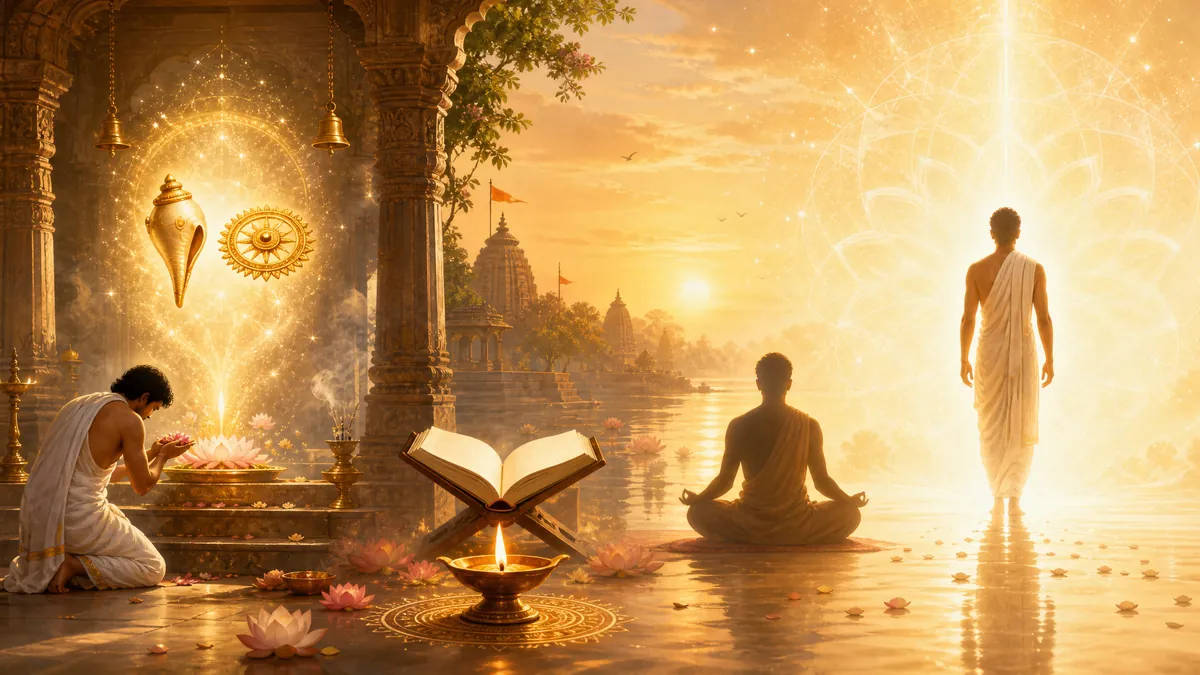
Here Prahlada moves from the dualistic path of bhakti, of worship, to the path of Advaita. He gives rise to divine pride. On the path of bhakti, the subject is usually not taken into account in the practice of worship. There is always a division: the worshiper and the one who is worshiped. Vaishnavachara, as the second achara, is dvaita. At most, it is Vishishtadvaita. There is always Vishnu, and there is the one who worships him. There is a barrier, a distance between them. They say that the jiva can never become Bhagavan. Bhagavan is Bhagavan, and the jiva is the jiva. Bhagavan possesses six qualities; the jiva does not. The jiva possesses anava, karma, mala, limitations. Vishishta makes a compromise, saying that the jiva is qualitatively similar to Bhagavan, but not quantitatively.
But the following acharas affirm jnana, and jnana is nonduality. On the path of nonduality, the worshiper is identical to the one whom he worships. Therefore, the phrase is important here: “shivam bhutva, shivam yajet” — you can truly worship Shiva only if you yourself become Shiva. True worship occurs through self-recognition of oneself as the deity. This is what Prahlada speaks about.
The Practice of the Yoga of the Illusory Body
He who is known as Prahlada is none other than Vishnu, and there is no duality in this. Vishnu rides on Garuda; now Garuda carries me. In my hands is what Vishnu usually carries.
Here Prahlada gives rise to divya bhava, divine pride, likening himself to Vishnu in meditation. Then he says: “My vahana is Garuda. I have a body just like Vishnu’s. I hold his attributes: the mace, the conch, the chakra.” This is the practice of the yoga of the illusory body that you perform. Perhaps the originators of the teachings on the illusory body were not the Tantrikas, but more ancient saints such as Prahlada, who received transmission directly from Vishnu.
Lakshmi, his companion, stands beside me. All the divine splendor of Vishnu has become mine.
All the symbols of Vishnu are now my symbols. The entire universe, which appears and disappears, comes forth from my chest. My color now is the blue color of Vishnu. I am dressed in Vishnu’s yellow garments. Who is my enemy now, and who is against me now? Since I am now Vishnu, anyone who is against me is undoubtedly living his final days. The demons standing before me cannot withstand my radiance. And all these gods now praise me, because I am Vishnu.
Tantric methods are methods of transformation. At lower levels, Tantric methods make it possible, through worship, to obtain siddhis and blessings. But at higher levels, Tantric methods are Anuttara Tantra. At intermediate levels, Tantric methods are transformation, transfiguration, becoming a deity and possessing the same signs as the deity.
On the path of the illusory body, our task is to transform into a deity, Dattatreya, and to saturate the illusory body with his inner content: emptiness, bhava, luminosity, to reveal the thirty-two signs of the divine body. Some of these signs concern siddhi, some prana, and some view and consciousness. In general, they speak of “thirty-two signs,” but this does not mean that if you count them, there will be exactly thirty-two. It simply means the diversity of the qualities of the illusory body. It has pure prana; it possesses view, contemplation, and various shaktis: jnana, svatantrya, iccha, kriya, aishvarya.
I have transcended all dualistic feelings, and I myself have become Vishnu. He in whom all three worlds are concentrated, he who has conquered all hostile forces in the universe and who dispels the fears and anxieties of others — he is me, and I greet him.
Vasishtha continued:
Having thus become Vishnu, Prahlada thought that it would be good now to pray to Vishnu. He thought: “Here stands another Vishnu, who is also seated on Garuda, with all the divine signs, qualities, and powers. I shall now pray to him as is prescribed by tradition, but in my mind.”
Having decided this, Prahlada prayed to Vishnu in his mind, as prescribed by tradition. Then he prayed to him outwardly as well. Having completed the long prayer, Prahlada rejoiced.
Dhyana Devata and Jnana Devata
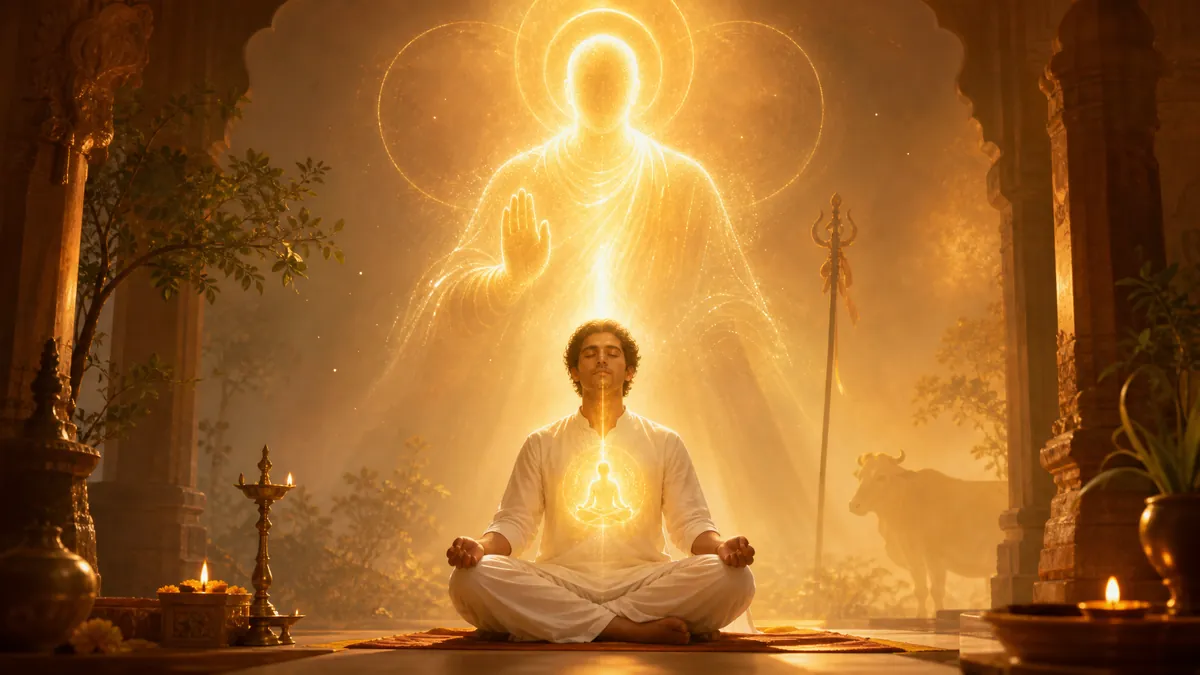
In the yoga of the illusory body, we perform transformation and then make offerings to Dattatreya. You, in the form of Dattatreya, make an offering to another Dattatreya. Thus, there is no duality here, but there are different energies of different levels.
Usually, the deity into which we transform is called the dhyana devata. Through meditation, we transform into the deity. And the deity that exists originally, even before us, is called the jnana devata, the deity of wisdom. The dhyana devata is the junior deity; the jnana devata is the senior deity.
Our task is to invoke the blessing of the jnana devata so that it sends the blessing to the dhyana devata, and the dhyana devata, having been saturated with the blessings of the jnana devata, absorbs it into its heart, so that the jnana devata never leaves it. The deity of meditation, the dhyana devata, is created by coarser aspects. The deity of wisdom, the jnana devata, exists as such already in the deep currents of our consciousness, in the buddhi. Both, in a certain sense, are illusions. But the jnana devata deity is the essence, while the deity of meditation, the dhyana devata, is a derivative. One must understand the relationship between these two deities.
From that time on, Prahlada prayed to Vishnu every day. Seeing him and following his example, all the demons in the kingdom also became worshippers of Vishnu.
When we transform into the illusory body, this is the dhyana devata. When we turn to Dattatreya, read texts and invocations to him, we address him as the jnana devata, so that he may enter and send rays of blessing, penetrating our illusory body of the dhyana devata, the deity of meditation.
The Amazement of the Gods
Rumors that Vishnu’s former opponents had become his devoted worshippers spread like wildfire! The gods in heaven were astonished — how could demons become worshippers of Vishnu! They went to Vishnu to ask him about it.
The gods said:
Lord, what is this mystery? The demons have always been your opponents. The fact that they have become your worshippers seems like a bad joke. Where is their devilish nature, and where is the worship of you, which arises only in the final incarnation of individual consciousness?
Since Vishnu is worshipped in the sattva-guna, and the essence of the asuras is not sattva but rajas, the gods were usually considered to be those who worship Vishnu, and they were greatly surprised. In their view, a person worships in the sattva-guna, and this is his final life. But how the asuras could worship Vishnu without abiding in the sattva-guna was very astonishing to them. They did not even like it very much. They considered it some kind of hypocrisy.
The good and luminous qualities necessary for this somehow do not suit demons — it is sheer nonsense. After all, the qualities of beings are always in accordance with the fundamental essence of these beings. It is painful to hear that such creatures became your worshippers overnight. If this had happened gradually, with the development of good qualities and wisdom, then we would have understood it. But that devilishly cunning creatures became your worshippers almost instantly — it is hardly believable.
Vishnu replied:
O gods, do not suffer from doubts and disappointments. Prahlada has begun to pray to me. This is indeed his final birth, and he has earned his liberation. The seeds of his ignorance have been destroyed; he will no longer be born. It is painful and meaningless to hear that a good person has become bad. But it is pleasant and good to hear of someone who had no good qualities and became good. The changes in Prahlada are for your own benefit.
Vasishtha continued:
Having reassured the gods, Vishnu disappeared, and the gods dispersed. They became more friendly toward Prahlada.
The Teaching on the Three Gunas
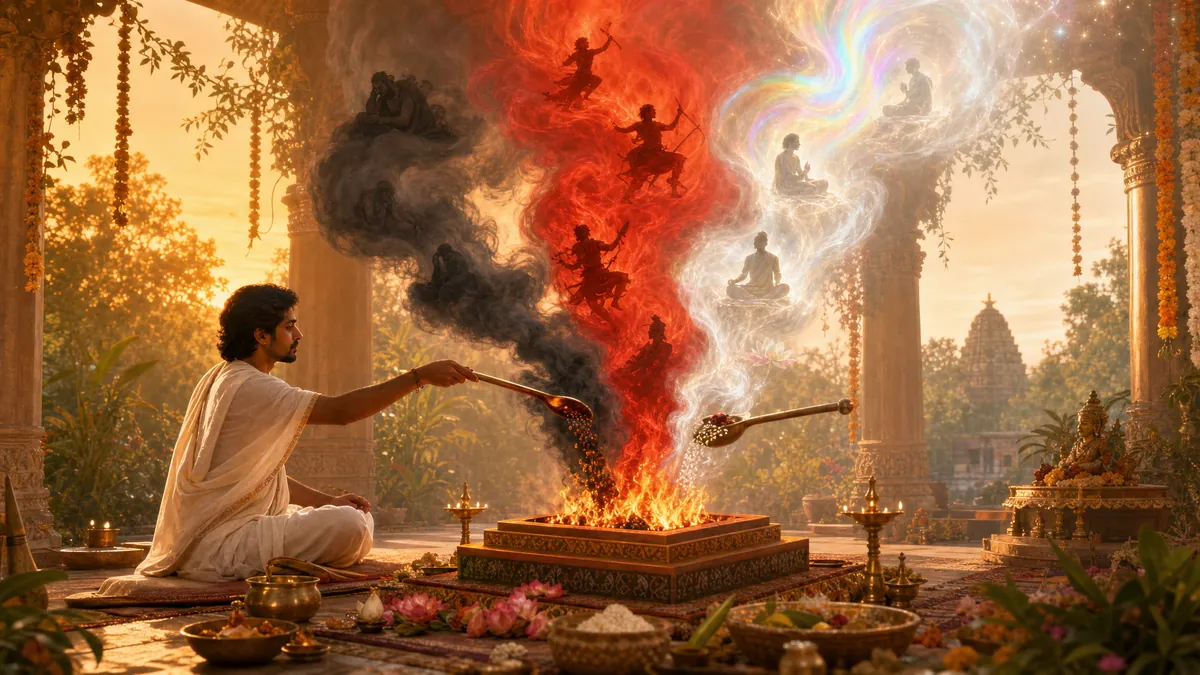
A person must eradicate tamas and rajas within himself; then sattva will remain. If a person retains pure sattva, this is residual prarabdha karma, which means that he will no longer incarnate in this life. In this life, he will manifest his sattva as help to others, charity, and abilities. When sattva is completely exhausted, he attains liberation. This is how it is considered. But if the karma of rajas and tamas remains and is not lived out in this life, the person will have to be reborn.
Question: In vira sadhana, three kinds of karma are used, as well as rajas and tamas. Does this mean that one who practices vira sadhana will not be able to attain liberation?
I think that is not quite so. In order to practice any vira sadhana, one must possess a sufficient potential of presence and a great deal of sattva. Even if you are not divya, you can use rajas on the spiritual path only if rajas has been outlived in you. If it has not been outlived, you cannot use it. It will conquer you.
Every day Prahlada prayed to Vishnu in thought, word, and deed. As a result, noble qualities—wisdom and equanimity—arose and manifested in him very quickly.
You must pay attention to which qualities dominate in you. The qualities of sattva imply wisdom, equanimity, various abilities, perhaps for the arts, for analytical thinking. Luminous qualities of the state of the soul. All of this is sattva. If you have neither wisdom nor equanimity, it means you have little sattva.
If your mind is restless, constantly bringing you irritation, anxiety, or making you enter into conflicts with others, this is rajas. And if you are constantly in a dull state, if you have no abilities, not even anxiety, but only drowsiness, dullness, inertia, sluggishness in thinking, this is tamas.
Neither rajas nor tamas is suitable for spiritual practice. Tamas must be transformed into activity, into service, into movement. There is no point in meditating or doing sadhanas if tamas predominates in the mind. This means that the senses have not yet been purified and are not suitable for meditation. The body must be engaged in gross service, in karma yoga. One must act actively. One must manifest one’s karmas for the benefit of service, for the benefit of living beings. With self-giving, with complete self-giving, through this develop concentration, self-giving, non-attachment to the fruits of actions, the ability to live not for oneself, but for others. That is, to develop all one’s best qualities.
When tamas has been outlived and a mixture of rajas and sattva appears, then one should begin sadhana, meditation, and the study of texts. Rajas must also be outlived. If the mind is restless, if it is impossible to stop thoughts, if there is an uncontrolled stream of thinking, if speech is coarse, if there is a constant restless movement of thoughts, no ability to concentrate, no clarity arises, and for inspiration something stimulating is needed all the time, this is a sign that one must focus on acquiring sattva. And burn through one’s inner rajas with contemplation and self-liberation.
Finally, when the qualities of sattva awaken in you, your karma will leave you by seventy percent. You will become a different person. A person in whom sattva predominates feels good even in the world—these are the qualities of the gods, the devas. Such a person is very balanced, clarity predominates in him, he has a philosophical turn of mind, he learns without difficulty, engages in self-education, and easily grasps the meaning of texts and sacred scriptures. He is always harmonious, unselfish, flexible, gentle, empty within. It is easy for him to perform any service, he always gets along with other people, his elements are under control, and he has various talents that unfold if he wants to focus on them. His mind does not trouble him, his sense organs do not trouble him strongly, and he can easily control them.
Meeting with Vishnu
He did not seek pleasures; not even the thought of it arose in his mind. Having abandoned desires for pleasures, his mind was left without support. Vishnu learned of Prahlada’s state. He came to the place where Prahlada prayed to him. Seeing that Vishnu himself had come to him in his palace, Prahlada rejoiced even more and continued to pray to Vishnu.
I seek refuge in the god in whom all three worlds abide, who is the supreme light that destroys any darkness of misunderstanding and impurity, who is the refuge of the helpless and those who have lost hope, the one god, unborn, in whose refuge the best safety should be sought. I seek refuge in the one whose voice sounds with truth, who lives in the hearts of all beings, in whom this entire vast universe exists without change, who is unborn and immutable.
Vishnu said:
O Prahlada, you are yourself an ocean of good qualities and the best among demons. Tell me any desire of yours that leads to the cessation of suffering, and I shall fulfill it.
Prahlada said:
O God, you live in all beings and grant them the results of their desires. I pray you, choose for me the desire that you consider infinite and eternal.
Vishnu said:
Very well, Prahlada, may the spirit of knowledge possess you until you rest in infinite awareness, so that all your delusions may come to an end and you may attain the supreme state.
As we embark on the path of monasticism, we all vow to maintain the spirit of inquiry until all our ignorance disappears, right up to complete awakening. This spirit of inquiry is not only intellectual; it is also vichara, inner self-inquiry.
Vasishtha continued:
Having said this, Vishnu disappeared. Prahlada finished his prayers and, after chanting hymns in honor of Vishnu, sat down and reflected.
Vichara as the Foundation of Spiritual Practice
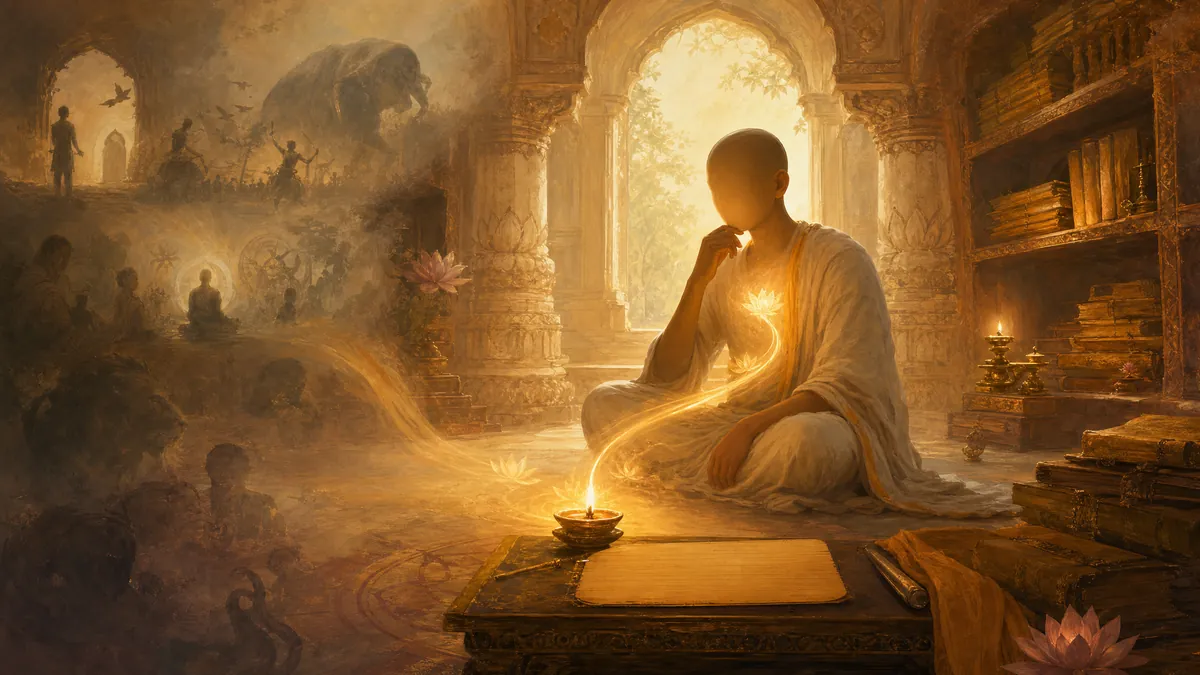
Vishnu taught Prahlada atma-vichara. Inquiry, vichara, is the root of any Vedantic or Tantric sadhana. All the problems of people, of asuras, lie in the fact that they lack vichara, they lack self-inquiry. A lack of self-inquiry leads to wrong views. Then, from a wrong view, wrong assessments of reality are made. From wrong assessments of reality, incorrect conclusions are drawn, false goals are set, and wrong actions are taken. Because of this, living beings are unhappy.
For example, I recently came across some interesting expressions, literature, a magazine from a hundred years ago, an assessment of technical achievements. In one of the magazines from 1890 it was written: “A carriage without horses (meaning an automobile) is certainly interesting, but it will probably be available only to the rich, and it is unlikely to become widespread.” A wrong assessment. If they had looked one hundred and twenty years ahead, they would have been surprised that carriages without horses, automobiles, changed the world. It is funny for us to read this. But our ancestors could not have foreseen it. Another English commission of the academy of sciences, examining the incandescent light bulb, says: “Of course, this is an interesting invention, but we see no practical sense in it.” They, too, would have been surprised, because the incandescent light bulb defined the technological face of modern civilization for the last hundred years. In the fifties, some magazine, describing television, the latest developments in science and technology—at that time it was television—wrote: “This is a very interesting invention, but for it to spread throughout the whole world is commercially and technically unrealistic. Most likely it will remain some kind of entertainment for certain individuals.”
Thus, we see that a great many human forecasts were wrong because of a lack of the capacity for omniscience. The gods possess the capacity for omniscience. They can see the future and predict the scenarios of the future’s movement, the development of civilization. Human beings do not possess this. Why do they not possess it? A lack of vichara.
Hiranyakashipu’s lack of vichara prevented him from understanding that Vishnu would come in the form of Narasimha and destroy him; he continued to fight the gods and threaten Vishnu, imagining a great deal about himself. Thus, a lack of vichara leads to our incorrectly assessing reality, creating wrong meanings, wrong actions, and setting wrong goals. When we have enough vichara, we can understand reality, assess it correctly, create true goals in life, and achieve them. Why do living beings not practice dharma? A lack of vichara. Why are living beings occupied with wars, earning money, and interethnic disputes? This is also a lack of vichara. If they had enough vichara, they would be sitting in retreats, meditating, serving dharma. They would understand that most karmic actions are meaningless; this helps neither from the point of view of rebirth nor from the point of view of the well-being of all humanity. The mission of our sangha is to spread the principle of vichara, to establish this principle, and to help humanity. So that this principle gives rise to a new type of thinking, so that it changes the existing system of thinking of people on earth.
Prahlada’s Self-Inquiry
Prahlada thought:
Vishnu commanded, “Inquire constantly,” therefore I must constantly inquire into my own nature.
Who is this “I” who speaks, walks, stands, and acts on the stage of this world? First I will find the answer to this question.
Certainly, I am not this world that is outside, which is inert and consists of trees, bushes, and mountains. But I am also not the body, which was born because of the activity of the life force and which lives only for a short time. I am not sound, not a word, not a name, and not an expression, which are grasped by the inert ear and are merely the movement of air, devoid of form and existence. I am not the sense or sensation of touch, which is also instantaneous and can act only because of infinite consciousness. Nor am I the sense of taste, residing in the changing and restless tongue, which is occupied only with taste. And I am not the sense of sight, which is also fleeting and is a distorted understanding of the one who sees. Nor am I the sense of smell, which is an imaginary creation of the nose.
Prahlada begins vichara by separating himself, through analytical meditation, from the jnana-indriyas: from the consciousness of the nose, smell; from the consciousness of taste, the tongue; from the consciousness of the eyes, sight; from the consciousness of touch, the skin. A distance must arise between you and perception through such separation. This distance is determined by the inner observer. While experiencing taste—to observe taste; while experiencing touch—to observe touch; while experiencing sight—to observe the process of seeing, to abide in the one who sees. While listening—to observe what is heard, to abide in the one who listens. As soon as you begin to observe what is being experienced, rather than simply experience it, you will discover this observer; you will penetrate into the listener, the taster, the smeller, the toucher. This is the beginning of vichara. Pratyahara takes place, a turning inward. All external objects must be reduced to the jnana-indriyas. And the jnana-indriyas themselves must be investigated and immersed in the mind, manas. Manas itself, through investigation, must be discovered as emptiness and immersed in buddhi, awareness. And awareness itself, through meditation and contemplation, must be immersed in the Atman. Such is the path of Laya Yoga, dissolution through vichara, self-inquiry. When we forget to do this, samsara seizes us. When we become established in vichara, even the strongest samsara is powerless to do anything to us.
Therefore, I do not possess all these imaginary qualities. I have no relation whatsoever to the activity of the sense organs. I am pure consciousness, inconceivable bliss.
I am the all-pervading reality, devoid of objectivity and therefore devoid of notions and concepts. I am pure consciousness. Only thanks to this consciousness can all things, from a small pot to the mighty sun, be perceived and realized.
Next comes an entire song of Prahlada, his further reflection and analytical meditation. We will discuss it further. If you remember and read this song, you will be overcome by an incredible feeling of inspiration. Like shastra-kripa through Prahlada. Here the attainment of Prahlada’s enlightenment through meditation, Vishnu’s blessing, and analytical reflections is described. In the same way, you must combine meditation, analytical reflection, and the receiving of blessing.
The Great Self, Devoid of Self-Reflection
Now I understand the truth: there is the great Self, which is omnipresent and devoid of conceptualization and self-reflection.
Omnipresent means space-like, without center or boundaries. Devoid of concepts means abiding beyond the mind. Devoid of self-reflection means that even thoughts, to the slightest degree, cease to disturb. Reflection is digging through internal data. Reflection is keeping inner diaries. Nowadays, with the help of technology, people engage in reflection in a refined, sophisticated way. Many keep diaries and blogs. Got up at five in the morning, ate, looked to see who was there. Every day they write things down, identify with them, and think: “This is my inner spiritual life.” Looked there, received a letter from this person, thought such-and-such. Others read these diaries and write something too. This is called the blogosphere, an entire sphere on the Internet where people collectively keep shared diaries. This is collective self-reflection. But neither individual nor collective self-reflection helps one attain enlightenment. Because our Self is devoid of any self-reflection. All our reasoning is merely the periphery; it means nothing. At the initial stage it is important as analytical meditation. But later one must enter simply into space, simply into no-mind, into presence, and live this twenty-four hours a day.
Prahlada entered this state and understood it.
Through this Self all senses and sensations become perceptible, for it is the inner light. Because of this inner light, all these objects become, as it were, material.
As long as you are not able to get rid of self-reflection at once, at least you can refrain from reacting to it. It is said: “abiding in presence, do not generate thoughts; and if you cannot, then at least do not give them importance.”
As long as self-reflection is inevitable, you must teach yourself to free yourself from self-reflection by simply observing the nature of the mind, by simple vichara, by investigating where these thoughts arise from. At the moment they arise, instantly shift the focus of consciousness to the source, to the space from which thoughts arise. Then the thoughts themselves and reflection itself will lose their foundation, direction, strength, and power over you.
The Harmfulness of Self-Reflection
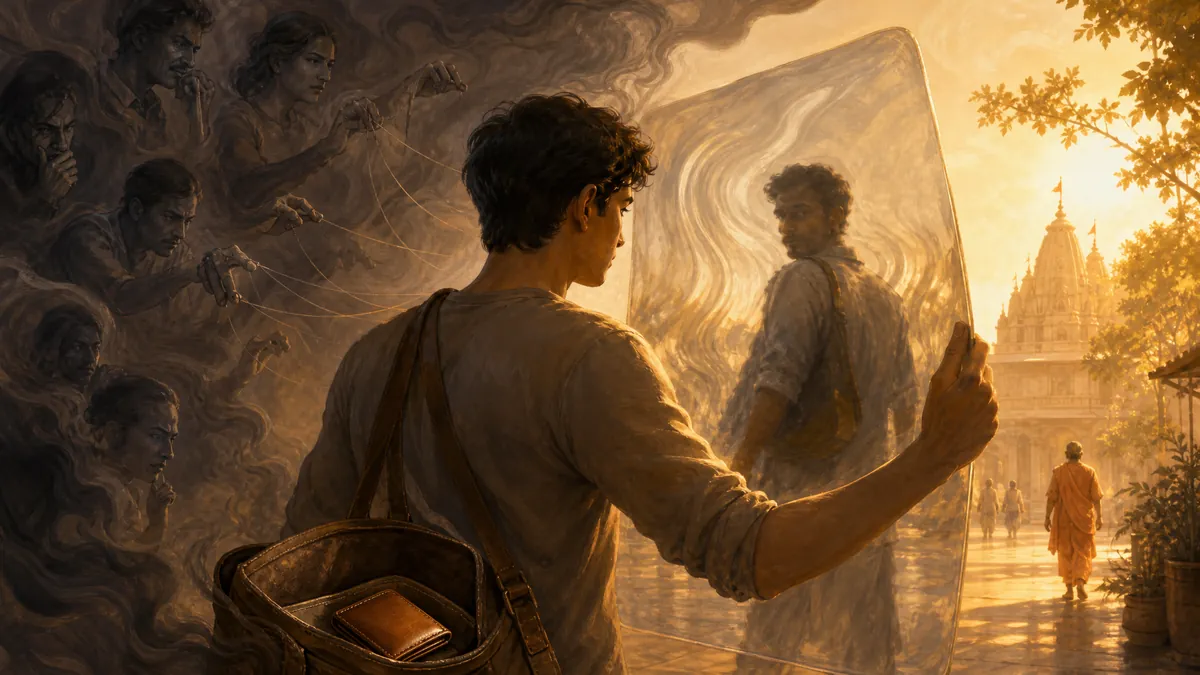
What is the harmfulness of self-reflection? Its harmfulness lies in the fact that it has power over you. It enchants you, confuses you; it specifically changes your vision. It subjugates you, it controls you. It does not allow you to see reality as it is, pure and empty. For example, there is a person, and this person did not steal your wallet, but the thought simply came to you that this person stole your wallet. You began to think this way and you see that he walks like someone who stole a wallet, speaks to you like someone who stole a wallet, suspiciously. You become convinced: yes, he definitely stole the wallet. Anger toward this person arises in you. And then you open your bag and see that the wallet had always been lying in the hidden pocket. You feel ashamed of your thoughts, you think: “How foolishly I thought. The wallet did not go anywhere, it is in its place. This person has nothing to do with it at all. But my reflection caused anger and all my projections. I almost ruined my relationship with this person.” Reflection made you dance to its tune. It began to control you. It distorted your vision. This is the harmfulness of reflection.
When you discover the space of awareness, reflection will no longer have power over you. Thoughts will appear on the periphery of consciousness, but it will be a play. You will think like this: “It does not matter what I think; what matters is the space and bhava. It does not matter whether the wallet was stolen or not, whether I think about it or not; that is not important. What matters is the space and bhava.” When you remember this and return instantly, all these thoughts will disperse like bubbles on water. Then it will simply be the play of the energies of manas-shakti. But if reflection prompts you to emotions, makes you do something incorrectly, agitates the mind, then it is dangerous reflection. Such reflection must be recognized as poison, as an enemy. Immediately strike it down mercilessly with a blow, as a warrior strikes with the blow of a sword. With the blow of investigation, vichara. You must instantly find its emptiness and dispel it. To be no-mind, to abide beyond the mind — this is what it means to be in the true view. When you are the mind, then all problems and karma are with you as well.
