The Path of Practice: Vigilance, Traps, and a Story from the Mahabharata
30.09.2026
0 мин. чтения
0
Share
copy
search
add
share
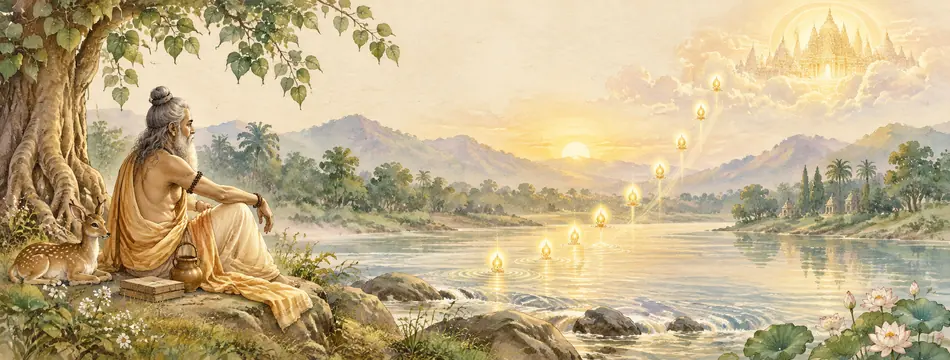
When you come to and practice at a monastery, you should have a certain vision of your prospects (in a relative sense, of course). The prospect for a novice is monasticism; the prospect for an inexperienced monk is to become an experienced monk; the prospect for an experienced monk is to become a master of contemplation and practice; the prospect for a master of contemplation and practice is to truly free their mind from illusions and attain one of the levels of enlightenment. The prospect for one who has attained enlightenment is to become in the next life an immortal deity possessing a rainbow body, or to become an immortal deity during this lifetime if the power of their practice makes this possible. The prospect for an enlightened immortal or deity is to become a great deity who creates and destroys universes through the power of their mind. The prospect for a deity who creates universes is to become completely one with the Absolute, to become the Absolute itself. This is roughly how the stages of practice unfold on the path of divine pride. On other paths, the processes are approximately the same.
This prospect is always realized or, conversely, fails to be realized depending on how wisely we conduct our practice, build our spiritual lives as practitioners, avoid deviations and falls, transmute desires, and overcome inner and outer obstacles.
When you live in a monastery, you must always be extremely vigilant, regardless of whether you are a beginner, a novice, or a monk with many years of practice, retreats, and teachings behind you. The only difference is that the vigilance of an experienced practitioner consists solely in awareness, whereas the vigilance of an inexperienced practitioner also relies on something external. You must always be attentive in your relationships and in observing the subtle principles of samaya. One of the instructions to monks says that before saying anything, a monk should always consider how his words will affect things, and so on. Great attentiveness should also be exercised when studying the Teaching in order to master all its subtleties.
There is a saying: “It is not enough to become a monk; one must remain one and derive the full benefit from monasticism.”
Remaining a monk does not mean that, in an external sense, you retain the status of a monk. In the external sense, this is fairly easy to do; what is meant here is that it is important to maintain an even pace of spiritual practice at all times and gradually, year after year, increase your results and pass through various stages of realization.
Planning Practice and Developing Meditation
For example, you should plan your practice approximately as follows: “If, during my novitiate, I was distracted in mahashanti meditation and barely approaching concentration, then in two years I should have stable first dhyana whenever I want, and in three years I should have stable second dhyana, and five years after that—stable fifth dhyana.” This is roughly how your meditation develops.
Recalling his path, an experienced monk might say: “In the early years, I was always losing presence or did not know about it at all. But after several years, I began to understand what presence, attentiveness, and awareness were. Several years later, I began to understand all this more deeply, and now I no longer lose awareness, or, if I do, I return quickly. And several years after that, my presence became so deep that in everyday life it is with me every second; I cannot lose it even if I wanted to, although it can still be lost under extremely powerful influences: in sleep, with intense pain, under certain overwhelming desires, or during severe stress.” Finally, a practitioner who has realized authentic experience knows that their awareness cannot be lost by them either in sleep, through pain, in dreams, or under stress, because they have become completely imbued with contemplation.
When you practice correctly, your progress is inevitable. The same applies to other lines of teaching.
Karmic Knots and the Four Maras
During spiritual practice, the karmic knots that could become the cause of your future births are untied. In a single lifetime, all future karmas are unraveled. Therefore, a monk must always be extremely vigilant.
Sometimes inner subconscious patterns manifest, and one must know how to self-liberate them.
Sometimes worldly desires manifest. The four main maras always test a monk. For an inexperienced monk, the four maras are very real enemies. For an experienced monk, they are like a coach, a teacher who constantly tests their awareness.
Sometimes pride arises from insignificant accomplishments.
Sometimes selfishness manifests itself, along with absorption in the inner “I.”
Traps on the Spiritual Path
Sometimes, after practicing diligently at first and gaining some experiences over the course of several years, a person becomes complacent, becomes someone who is “going with the flow,” and “loses definition.” He feels a certain joy and self-liberation, but loses his bearings, meaning, and purpose. He thinks something like this: “Everything is one, everything is good, everything is wonderful.” He is like a drug addict experiencing a high, but this is merely bliss—in other words, it is the first trap he has fallen into. You must know all the possible traps well.
Sometimes a person gains experiences of clarity. For example, he may be deeply aware of himself, yet still have certain dualistic ideas by which he is held captive. In experiences of clarity, one can see gods, past lives and future lives, and the creation and destruction of the universe in each world. During experiences of clarity, the yogin is overwhelmed by the inexpressible, but that very thing can bind him. He then enters into a certain view or state of “delusion,” in which one has a conceptual understanding of truth. Being captivated by clarity is the second of the two traps that lie in wait for experienced practitioners.
There may be experiences of emptiness, when the yogin realizes that everything is actually illusory. All loved ones, friends, and everything that was once very dear to his heart suddenly appear as a dream, as a complete illusion. The yogin seems to awaken and thinks: “In reality, all this is a creation of my mind. Nothing is real.” Alienation and nihilism begin to arise in him, along with a tendency to cling to emptiness while denying everything else. Being captivated by emptiness is a trap for practitioners who experience emptiness in meditation.
An experienced practitioner knows all possible deviations and traps perfectly and diligently avoids them.
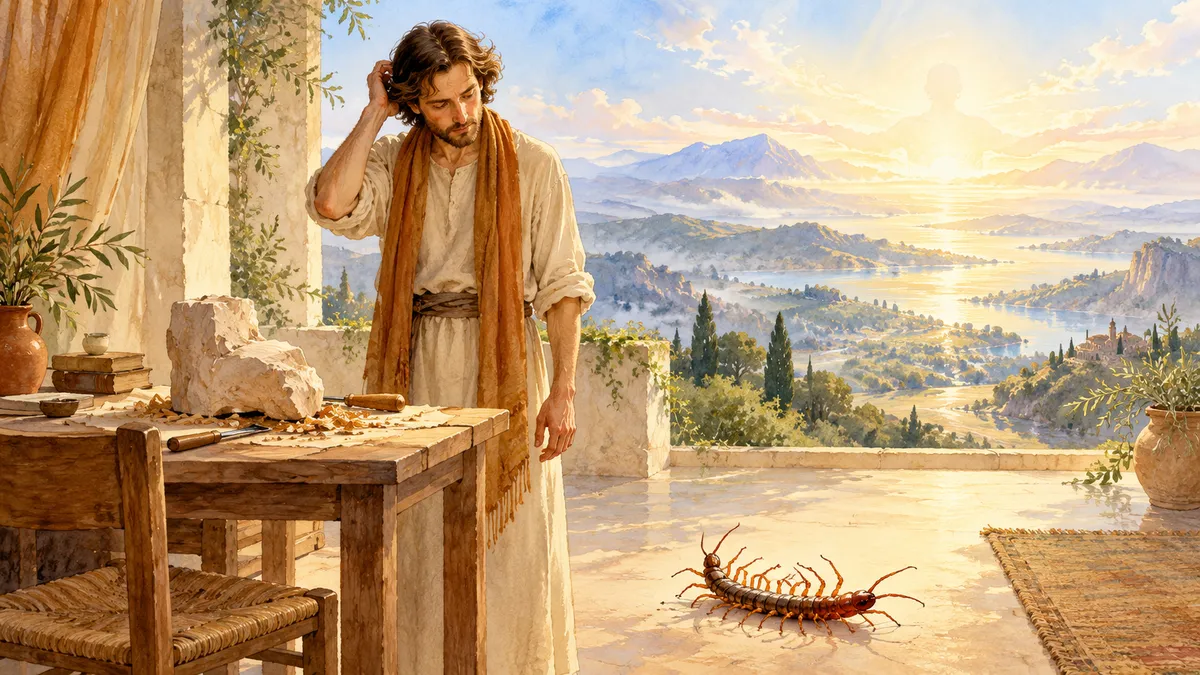
Sometimes there is a loss of action in awareness, when the yogin is unable to perform his usual actions after moving to a new level of consciousness. He thinks something like this: “Who needs this? Who is supposed to do it?” Previously, he simply acted, but now he begins to think and analyze a great deal; however, this analysis is superficial, and the yogin cannot pull himself together and do even a simple thing. He is like a centipede that began thinking about its forty legs and fell over, having forgotten how to walk.
Sometimes there is a loss of action in the view, when the powerful teaching of nonduality suddenly penetrates the practitioner. He is shaken by its depth and grandeur, realizing that in the face of the teaching of nonduality, his little “I” is so fruitless and futile that there is not the slightest chance of preserving personal self-identification.
Sometimes there is a disregard for the method and an emphasis on nondual wisdom, when you think something like this: “If everything is one and self-liberated, then the method is unimportant, as long as one continually remains in this awareness.” But in fact, the method can provide a very deep insight that can never be attained through anything else or through wisdom alone.
Sometimes, on the contrary, one becomes engrossed in the method, when the yogin is captivated by a particular method of practice and loses awareness in the process; his mind clings to something without understanding emptiness or duality.
The Spirit of Vigilance and Overcoming Illusions
It can be said that spiritual life is a story of such illusions and the ways of overcoming them. Throughout their lives, all spiritual practitioners have made such mistakes, fallen into deviations, and learned through their own experience to overcome them.
I see new generations of monks arriving, but everyone tends to make the same mistakes and fall into the same illusions, because human consciousness is more or less the same. But if you know the teachings, you can easily avoid them. If you have a spirit of vigilance, wakefulness, and your mind is purest, then you have nothing to fear. If you have a spirit of constant vigilance in the Dharma, there is no need for you to feel confused; you simply need to nurture this spirit.
There was one mataji who had been a novice with us. One day she said to me:
– I will never turn away from the truth. It is impossible for any mara to tempt me.
I said to her:
“He has already tempted you. This bravado and categorical judgment are eternalism in thought. You place too much faith in your inner data, too much faith in your certainty. And if I were in your place, I would put it this way: ‘I will try to do everything possible, observing every second what else this mind might deceive me with. But no matter how hard it tries, I will try to do everything possible.’”
When a person adopts such a point of view, they know that maya is deceptive, the mind is very subtle, and samsara is powerful. A true practitioner understands that today their mind says one thing, and the next day it will say something else, so in principle it cannot be trusted, whatever it may say. It is necessary to establish oneself on a deeper layer of consciousness and nurture only the spirit of awakening. Whoever relates to the mind in precisely this way and understands such a spirit of awakening truly becomes invulnerable. If you have such a spirit of nurturing carefulness, you can expect to enter the company of the gods, the company of the immortals.
The World of the Gods and Pure Karmic Vision
The first chapters of the “Mahabharata” describe two episodes. The first episode tells how King Mahabhisha had to be reborn from Indra’s world and become a mortal human being, while the second episode describes the lives of eight gods who were cursed by a sage.
The immortals and the gods exist in parallel with the human world. They live their full lives just as humans do, but to communicate with them, one must purify one’s consciousness and enter their karmic vision. Mortals, that is, people who lack the purity of karmic vision, have no awareness of the world of the immortals or of the gods, because their powers of consciousness are insufficient.
When you enter pure karmic vision, you gradually begin to perceive the new subtle laws by which the gods or immortals live.
For example, the sacred sangha, “Divya Loka,” is a kind of projection of such worlds.
In the worlds of the gods, desires are not valued; meditativeness is valued. In the worlds of the gods, attachments are not valued; the highest value is placed on essence. In the worlds of the gods, there are no rigid laws: everyone abides in freedom, but each person’s creative powers and abilities depend on the level of their immersion in presence. In the worlds of the gods, there is no impure vision, only vision founded on purity and harmony.
Signs of Correct Practice
As your contemplative practice progresses, your qualities of sattva (radiance) must necessarily increase. The strengthening of your divine qualities is one of the criteria showing that your practice is proceeding correctly. Your self-control should grow stronger and, over time, become constant, because a true monk is one who constantly controls himself. Harmony, compassion, love, self-surrender, humility, dispassion, the vision of one “taste,” and contemplativeness are qualities that grow within you as a result of practice. Your essence becomes stronger, your relationships become harmonious, your divine pride becomes subtler, your discernment deepens, your clarity increases and may manifest in any area—these are the signs of your correct, flawless practice.
Commentary on the text “Mahabharata.” The Adventures of Ganga
“Truthful in speech, victorious in every battle,
Mahabhisha was sovereign of the realm.
In honor of Indra he sacrificed swift-footed horses,
Honoring him with many willing offerings.
For this, he received Indra’s grace:
In heaven, in immortality, his life continued.”
King Mahabhisha performed an ashvamedha yajna—the horse sacrifice. According to Vedic concepts, whoever performed this ritual could be reborn in Indra’s heaven and become an immortal god.
“One day, before Brahma, calm and stern,
The gods appeared, having come to pay homage.
Ascetics with regal faces also came,
And Mahabhisha was at the great assembly.
And Ganga, the finest of rivers, came to the grandsire,
Radiant, to pay homage and converse.”
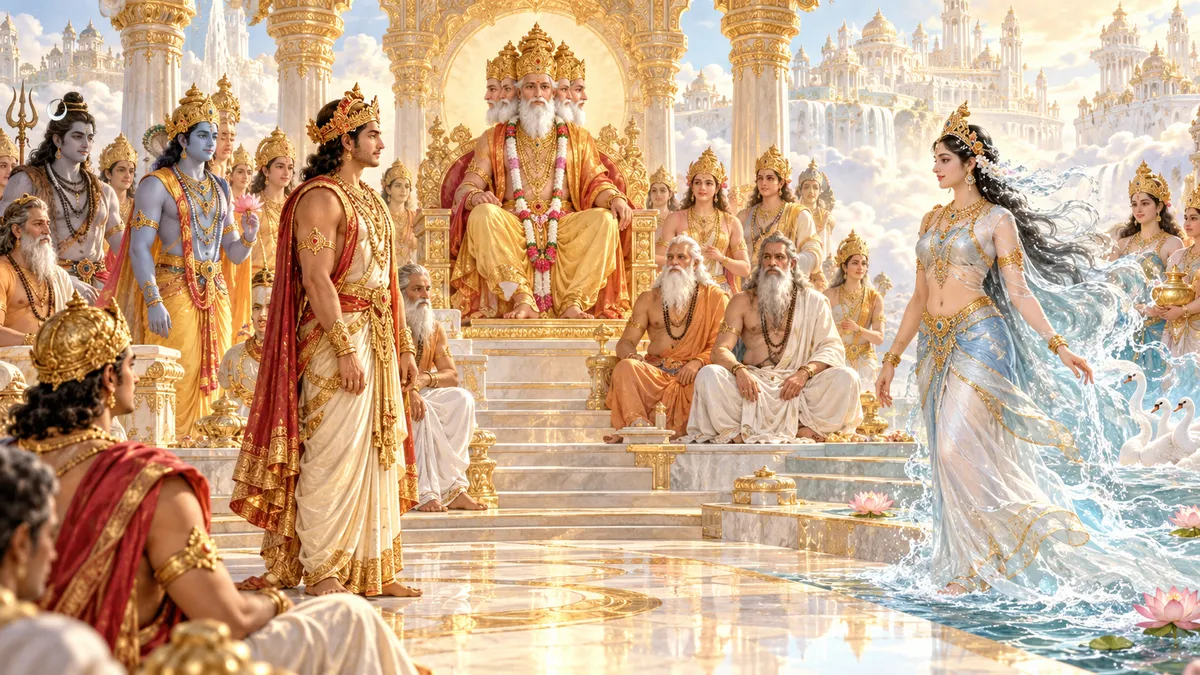
Here it speaks of an assembly of immortal and divine beings. When the “Ganga” is mentioned, this does not mean the Ganges River itself, but the divine spirit of the river, the river deity. For example, in an impure karmic vision, the river appears as flowing water, but in a pure vision, it is a deity that manifests in the external world in the form of a river.
“Suddenly, a wind blew from the east
And lifted the beauty’s dress high.
Embarrassed, the gods bashfully lowered their eyes,
And only Mahabhisha, driven by passion,
Watched as the dress billowed in the wind.
Then he heard Brahma’s curse:
‘Born among mortals, you shall return to them,
And, as a mortal, you shall be born again for death!’”
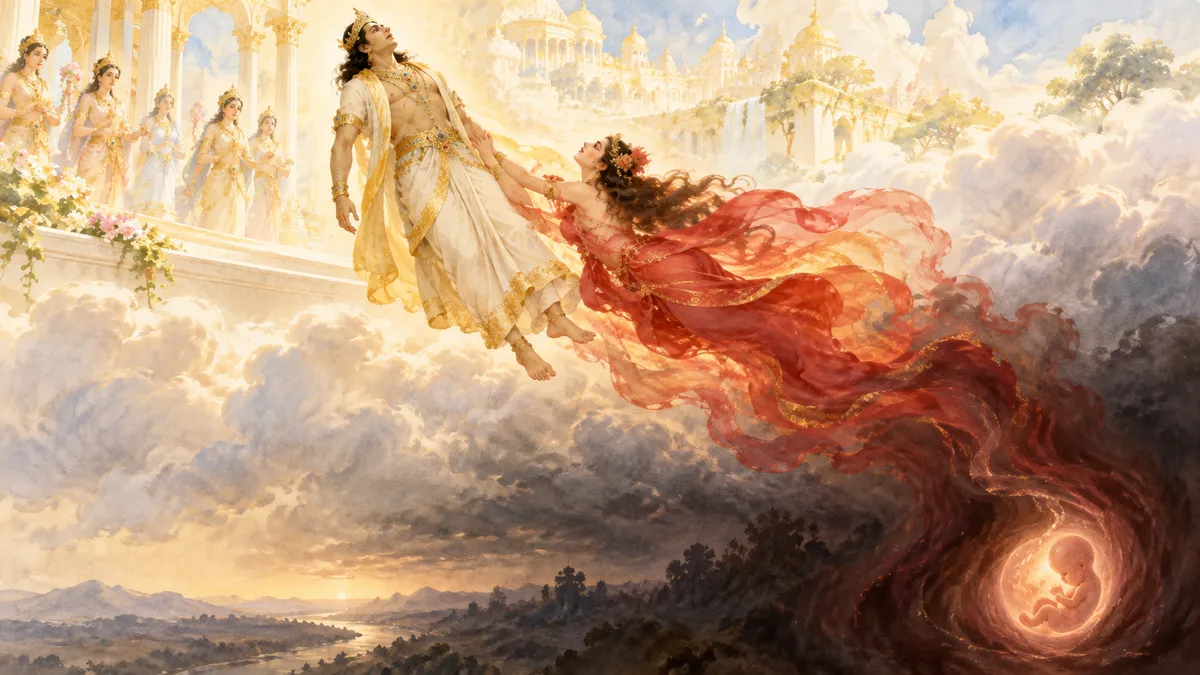
King Mahabhisha, while dwelling in the realm of the gods, made a mistake—he lost awareness under the influence of the energy of passion. When it is said that Brahma cursed him, this means that the creative power of his mind, due to the loss of contemplation, created the cause according to which he had to be reborn in the womb of an earthly woman.
Whenever we lose contemplation and come under the influence of the kleshas (passions), our creative power, as it were, curses us—that is, we create the cause to be born in the next life, unless, of course, we purify it. Brahma is one of the creative forces within our consciousness, and unlike the gods, who were all in contemplation, Mahabhisha lost his contemplation and, having experienced gross lust, created such karma. Therefore, he was forced to leave the realm of the gods and take birth in the womb of a mortal woman.
“Mahabhisha remembered, having left the immortals,
All the good and wise ruling kings.
He decided: ‘Pratipa will be his father,
He rules gloriously and judges righteously.’
And Ganga, seeing Mahabhisha, at once
Turned her heart and mind toward him.
She went on, approaching the hour of sunset.
Before Ganga, eight divine beings, the eight Vasus,
Appeared then on the deserted road.
Their legs could barely move through mud and dust.
She asked: ‘I see you in a pitiful guise.
Where are your former beauty and splendor?’
‘O Ganga,’ the Vasus answered in despair,
‘We are now cursed by a terrible curse.
For a minor deed, tormented in our souls,
We have been angrily cursed by the blessed Vasishtha.
By mistake, accidentally, we approached
The holy one who was secretly whispering his prayers.’”
After this assembly, the deity Ganga met the eight Vasus, who were in coarse human bodies. The Vasus are eight gods. When she asked why they looked so wretched, they said that they had been cursed by the rishi Vasishtha.
“The ascetic cursed us in furious anger:
‘You shall be conceived in a mortal womb!’
We cannot argue with one who knows the Vedas,
But we shall trouble you with a request, O River.
Become our mother, so that we may emerge again
From a heavenly womb, and not an earthly one.’
She looked upon them, radiant and beautiful,
And Ganga clearly said: ‘I agree!
You will appear in the world from divine flesh.
But whom will you name as your human father?’
The Vasus replied: ‘From the human race
We have chosen a noble father for ourselves.
He is Pratipa’s descendant, whose name is Shantanu,
Truthful, not inclined to sin or deceit.’
She replied: ‘I shall deliver you from misfortune,
And bring delight both to you and to him.’
For the Vasus, hope opened amid their suffering.
They said: ‘O You who flow through the three worlds!
Only then shall we return to our heavenly lineage,
When you cast your sons into the water.”
Ganga replied: “I will not contradict you,
But so that he may remember meeting me,
When I appear before him as his wife, –
I will give Shantanu the last son.”
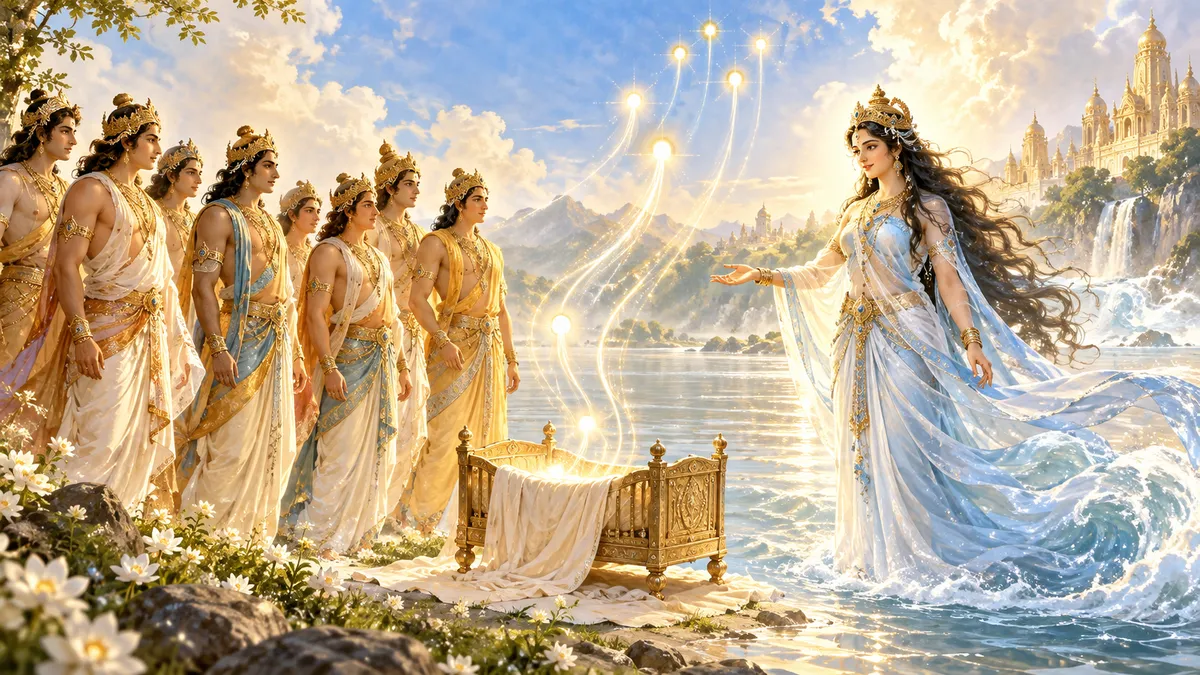
The gods made an agreement with the deity Ganga to cleanse this karma through rebirth in the human world. They said that they would enter a body created by a worthy king and be born as infants, after which the bodies of these infants would be cast into the water. Their lives would thus be cut short, and they would quickly leave their physical bodies, cleansing their karma.
“The Vasus exclaimed: ‘May happiness be ours!
We shall each give him an eighth part
Of our manly strength, and you shall give birth
To a mighty son by that lord.
He will uphold the good and become widely renowned,
But your son will die without leaving an heir.’”
And the Vasus found peace and health
As soon as they reached an agreement with the River.”
“Pratipa, drawn toward the good of all,
Loved the river’s wondrous, beautiful waters.
By the River Ganga, filled with piety,
He spent many long years in prayer.
One day, radiant and shining brightly,
A seductive young woman came to him,
Like the eternally youthful goddess of love,
The lovely Ganga in a wondrous valley.”
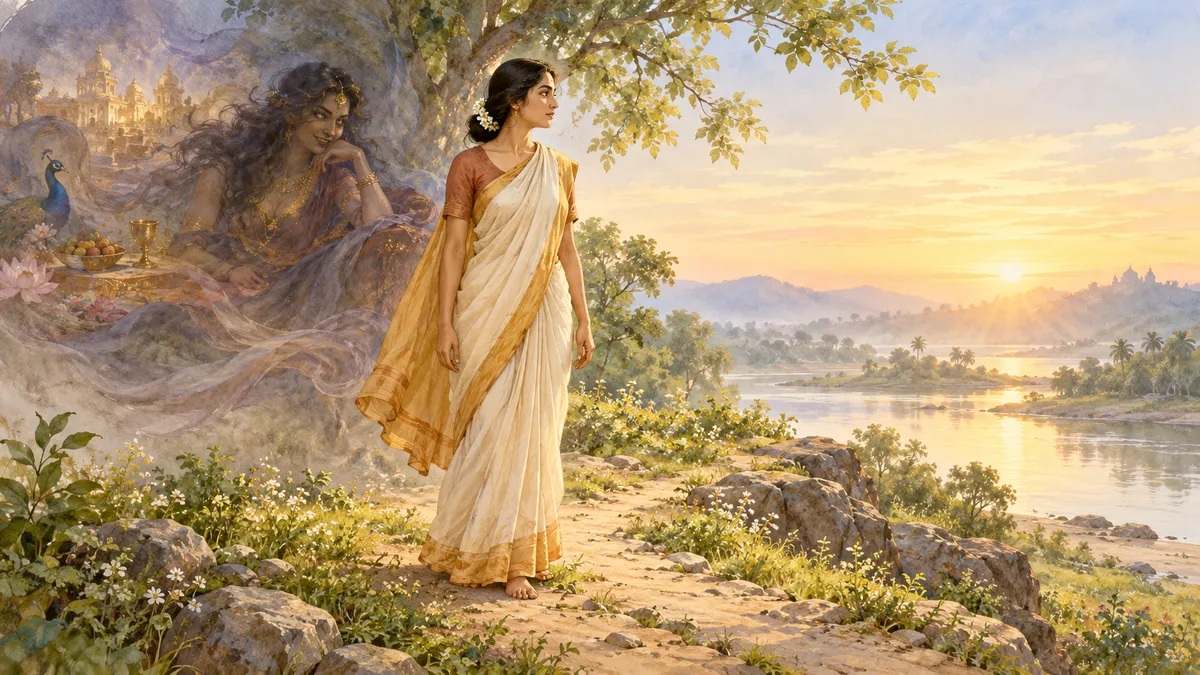
Deities of waters, springs, and forests can freely assume any form. For example, when necessary, they can take the form of a human being. They can assume such a form for only a short time. Spirits of mountains and forests possess the same ability. Sometimes, when rituals or offerings are made to them, they may come in human form and accept these offerings. Deities of a higher rank can project their illusory bodies into the human world, while they themselves do not leave the worlds of the gods. They can create many emanations of themselves.
“Her face breathed happiness and peace.
Boldly she sat upon the king’s right knee,
Mighty and strong like a shala tree,
The beautiful woman with a wise smile.
Pratipa said to her: ‘What do you desire?
What gladdens your heart, beautiful one?’
‘I have desired you, my reason knows
That it is shameful to humiliate a woman with a refusal.’”
Pratipa replied: “Devoted to the good,
I will not even lie with my own wife.
Still less with a woman of unknown caste –
Such is my vow, inviolable and true.”
“Lord, I am no lower than you in caste;
I come to you for the sweetness of passion.”
In fact, Ganga wanted Shantanu to be born as a result of her marriage, for he would grant liberation to the eight gods. To achieve this, she had to resort to various tricks.
“My youthful beauty is desired by you;
By possessing me, you will know delight.”
Pratipa answered her firmly:
“Violation of the law would destroy me.
I will not do as you wish.
You have seated yourself upon my right knee,
Where daughters and daughters-in-law sit, O maiden,
While the place for a beloved is on the left.
You have no right to become my wife,
Since, heedless one, you sat on the right.
But if you wish to draw close to me,
Then become my daughter-in-law and my son’s wife.”
The goddess spoke these words in reply:
“O righteous one, you will not break your vow.
I am ready to unite with your son,
To find myself a husband from a holy lineage.
For you, O great ascetic, to please,
May I become devoted to the Bharata lineage.
To glorify you, centuries would not suffice;
You are the source and beginning of blessings and honor.
Let us agree: however I may conduct myself,
Your son, reflecting on my actions,
Shall never ask where I come from,
And with my arrival he shall attain happiness.
To his virtuous and honest sons,
He shall owe heavenly bliss.”
Having spoken, she vanished from the ruler’s sight.
He began awaiting the birth of his son.
He, a bull among warriors, performed honorable deeds
Together with his virtuous wife,
Laboring for the sake of goodness and peace,
And a son was born to the gray-haired couple—
That very Mahabhisha in a new form,
As the all-powerful word had decreed.
Pratipa, gentle in spirit,
Gave the boy the humble name Shantanu, meaning “the Peaceful.”
As a result of Brahma’s curse, Mahabhisha was born as the king’s son. He was named Shantanu. The vasu deities chose this son of the king in order to be born into his family and thereby cleanse their karma.
“May he conquer the world through compassion,
Diligently observing the laws of goodness.
He grew up honoring sacred precepts and rules.
When Pratipa reached maturity, he instructed him:
‘A beautiful, charming, richly dressed woman
Once came to me, my son.
Perhaps she will soon appear before you
With a desire for goodness and love in her eyes.
You must not ask: “Who are you, and whose are you?”
Unite with her, overcome with love.
Do not ask about your beloved’s actions;
You shall have sons by your wife.
Delight with her, so that she, being young,
May delight in you, pleasing you.’
Having spoken these final commands,
And having anointed his son Shantanu king,
Simple-hearted, free from greed and malice,
He departed and settled in the forest wilderness.”
“Shantanu, who went out at night in search of prey,
Often hunted all kinds of game.
Always choosing a hidden path
Where buffaloes and antelopes roamed.
On the Ganges River, along a lonely road,
The courageous archer would sometimes encounter
Celestial singers and demigods;
The earth rang beneath his feet.
One day Shantanu encountered a beautiful woman,
And he marveled at her lovely form.
A goddess approached, radiant with beauty,
Rising before him upon a pure lotus:
Fresh, white-toothed, charming and carefree,
In the finest garments, flawless in every way.
She shone brightly and innocently,
Like the heart of a rare lotus.
The ruler gazed, trembling and enraptured;
His eyes drank her in, never satisfied.
She drew near, desired to the point of pain,
And he drank her in, thirsting more and more.
He too, radiant with royal power,
Kindled in her the ardor of joyful passion.
She gazed at the warrior with ardent longing,
She gazed at him, unable to satisfy her eyes.
The lord, filled with ardor, asked:
“Are you a heavenly singer or an apsara?
A serpent or a danavi—the enemy of life?
A human child or a goddess?
Do you shine with heavenly beauty or earthly beauty?
But whoever you may be, be my wife.”
Hearing the tenderly resounding words,
She was ready to fulfill the condition with the vasu,
And, pleasing the king with her ringing voice,
The wise young woman said:
“I shall become your obedient wife,
But whatever I may do, O Shantanu,
Whether I seem good or bad to you,
Swear that you will never argue with me.”
In reality, this was simply the deity’s lila. An enlightened deity has no need for wives and husbands or for any other obstacles. One may say that she merely assumed such a form and enchanted the king’s consciousness in order to save the gods—the vasus. Using the magical powers of enchantment, she clouded the king’s mind to draw him into her play and thereby save the deities.
“But if you insult and condemn me,
I shall leave, and you will no longer be my husband.”
Sometimes such cases are described in the stories of humans and gods. And when people enter the karmic vision of the gods, that is, the mandala of the gods, the gods bind them with samayas, vows, and say: “Our relationship will be this and that. But should you violate it, I will immediately disappear.” Such vows are precisely the principle of samaya.
When we enter a higher karmic dimension, we always act on the basis of samaya, that is, subtle vows and subtle relationships.
“I agree,” he said, showering her with delight
That knew neither measure nor end.
Having received her as his longed-for share,
The mighty king enjoyed himself freely with his wife.
He resolved: “Whether she proceeds straight or crooked—
I shall remain silent and never question her.”
And the king was delighted by her beauty,
By her virtue and purity,
By her calm and even manner,
By her pleasing him upon the bed of love.
It was Ganga, that goddess-queen,
Who blissfully flows through the three worlds!
Having now assumed a human form,
She retained the beauty of a goddess.
From that time, the godlike Shantanu
Became the husband of the River, the mighty lord of kings.
She delighted the ruler with dancing,
With languorous pleasure and skillful caresses,
And her caress was rewarded with his caress—
Pleasuring him, she herself enjoyed delight.
Shantanu, absorbed in his love and pleasures,
Enchanted by the best of wives,
Did not notice how the months and years flew by.
And they flew like swift waters.”
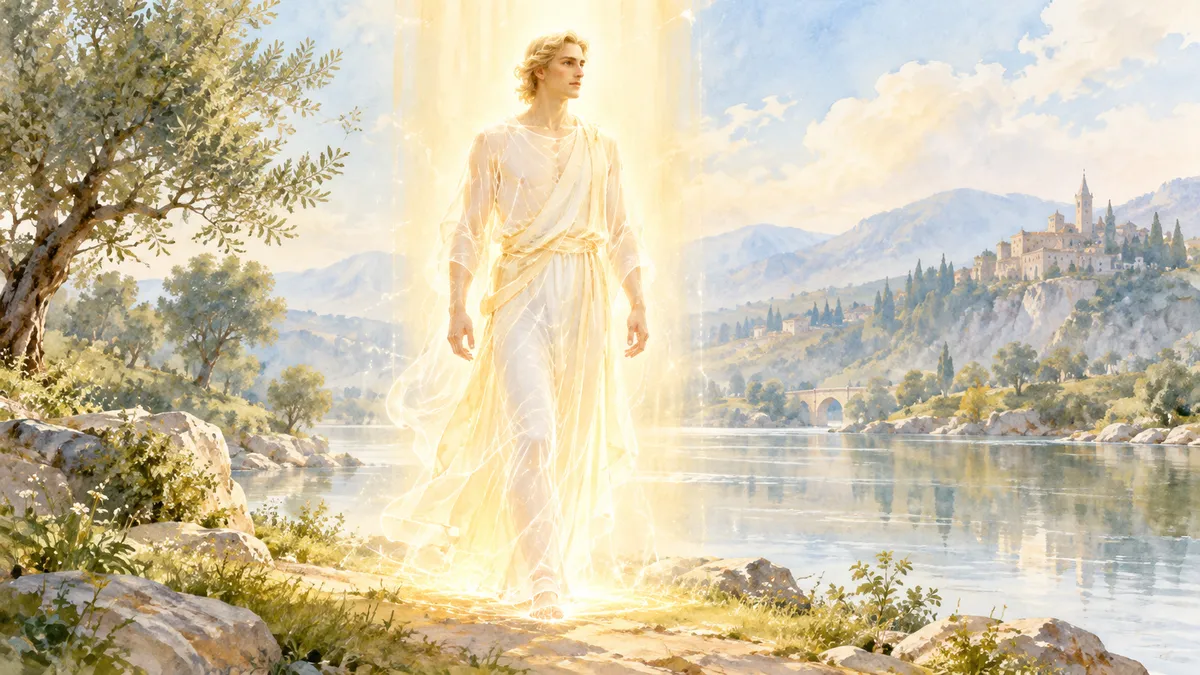
For a deity, it is no difficulty at all to create an illusory body through magical power and project it into the human world, and this body will act like an ordinary human body. It resembles a body of flesh and blood and can give the impression of being human; one can even touch it. Yet in reality, it is not made of gross physical elements, but woven from subtle-material pure elements, shuddha-tattvas, from the energy of light.
The Birth and Liberation of the Eight Vasus
“Time passed, summer and autumn followed one another,
And his wife bore him eight sons.
This was how it happened: as soon as a child was born,
Immediately, the queen casts him into the Ganges.
Shantanu suffered from hidden grief,
Yet he remained silent, never arguing with his wife.
When she gave birth to her eighth son,
A wondrous child, dear to his father’s heart,
He cried out, “I will not allow the eighth to be lost:
‘Do not dare kill him. Who are you, and whose are you?
Retribution for this evil deed shall come to pass.
Beware, O contemptible child-killer!’”
She said to her husband: “Do not torment your heart,
You who desire a son, the best of fathers!
I shall not let the last son perish,
But I shall leave you forever.
I am the sacred waters restored to life by the wise Jahnu,
I am Ganga, the benefactor of countless ascetics.
I lived with you because that was the will
Of the immortals, for a divine purpose.
I encountered eight deities, the eight Vasus,
Subject to the wrathful power of a curse:
Vasishtha cursed them so that the proud gods
Would be transformed into powerless, wretched humans.
And to become their father, O ruler and warrior,
Only you on earth proved worthy.
And I, in order to restore the beginnings of their immortality,
Became a human mother for them.”
When giving birth to the infants, Ganga swiftly destroyed their bodies. But since they were not humans, but gods, this was in fact a great blessing for them. Life in the human world was not very favorable for them, but thanks to Ganga’s actions, they did not have to live in polluted human bodies. They cleansed themselves of the karma of the curse by being born in human bodies, but were immediately killed, and therefore quickly ascended to the heaven of the immortals.
“You fathered eight deities, O bright-faced one,
And thereby became a lord in heaven as well.
With you I came to know the joy of conception,
And I freed the Vasus from their curse.
I gave the fallen ones my solemn word:
When they are born again in human form,
I shall drown them in the River Ganges,
Granting immortality to each once more.
Now I am leaving you forever;
The gods and rivers await me.
Look after your godlike son,
For he shall be a renowned sage and brave warrior.
In his vows he shall be as hard as tempered steel,
The son bestowed by Ganga, Gangadatta!”
Karmic Vision
Contemplation
Ganga
Mahabharata
Spiritual Practice
Vigilance
Samaya
Author Гуру
Read 18 times
Articles
Vidya AI
Search
Lectures
November 1, 2026
Mantra of the day
ОМ НИТИМАТАМВАРАЙА НАМАХ ОМ Лучшему из нравственных – поклонение!
Auspicious Times(Rome)
Brahma Muhurta:
04:52 - 05:47
Abhijit Muhurta:
11:33 - 12:14
Sayam Sandhya:
16:45 - 17:27
Mokshada Ekadashi (6 November)
Ekadashi of liberation. Helps to achieve spiritual enlightenment.