

The Power of Faith as a Spiritual Treasure
When believers gather together, they sing and bow. The destiny of a sadhu is to practice, bow, sing praises to God, and meditate. If none of this happens, the day has been wasted. Faith and awareness require cultivation—daily cultivation. If faith is not cultivated, it quickly fades. But when we cultivate it, it becomes strong, indestructible, and pure, and nothing can hinder it—not the world, not desires, not ignorance.
The question is how to acquire strong faith—faith so strong, deep, and conscious that it can free us from the illusions into which we fell when we were born. Strong, pure faith is truly a resource, a vast spiritual resource; it is a jewel. A treasure. For some, treasure means diamonds, billions, cars, and yachts. For a sadhu, faith is his treasure. With this treasure, he can do anything: change his life, create himself and his future, protect himself, heal, help others, and change the world. It is a universal treasure with which he can do anything in the universe. Faith is the foundation of creation. True, strong faith is a rare magical treasure, a precious jewel that a sadhu must first cultivate and then preserve.
The Purpose of the Soul’s Incarnation
Perhaps we were reborn here in order to cultivate such faith and temper it under the conditions of a three-dimensional material body and the material world. Perhaps we thought: I need an incarnation in order to evolve and move forward; I need a body, because only in this body can I experience pain, suffering, and pleasure, feel the thrill of life, and temper my faith and awareness. This is most likely the reason for our incarnation.
There are people who feel that something is missing from their lives. Everything seems fine, but they lack excitement. They live in a metropolis, go to the office, and have a large bank account—everything seems quite good. But something is missing from life. Businesspeople go hunting, or safari tours are arranged for them. I have heard that the Japanese live in a highly technological environment and lack contact with nature, so an enterprising businessman organized tourism to a Siberian village. It is called “going potato harvesting.” The Japanese pay money—yen or dollars—to fly to Siberia, to some village; it is called “ecotourism.” They are given shovels, and they go to the vegetable garden and dig up potatoes. Living in a technological environment surrounded by asphalt, they never see potatoes growing; they need to touch the earth somehow, and they find it interesting. We do not have that. It would never occur to us to engage in this kind of tourism. But for them, it is thrilling; it is something interesting.
There is another kind of tourism for wealthy people. Somewhere in the north, on an island, an enterprising businessman renovated a former prison building, fitted it out again, restored it, and offers certain businesspeople the opportunity to spend time there for a substantial fee. To experience it, to immerse themselves in the atmosphere for a day or three days. For a considerable sum. People do such things. They lack certain sensations. Other people go BASE jumping, hang gliding, windsurfing, paragliding, and skiing. All of these are the soul’s desire to experience certain emotions. I am not talking about parachuting; we have masters among the karma sannyasis. It is the desire to experience certain sensations that will give the mind fresh impressions.
Our physical life can also be compared to such an extreme sport for the soul. This is because in the world of the gods, souls are liberated; they do not suffer, they control reality themselves, and reality is manageable. They live in pure worlds and have pure, harmonious relationships. They do not encounter the harsh reality of the material, physical world. Souls that are not very mature in contemplation cannot receive profound blessings while living in such a beautiful, gentle, harmonious reality. They feel that something is missing.
Most likely, we were souls of this kind who wanted to have this harsh experience of the material body and the material world—an extreme experience. We wanted to incarnate, to feel bones, muscles, pain, sensations, and touch. This was because we were not satisfied with subtle contemplation of space, with contemplation of subtle luminous bhavas. We were inspired by something coarser; that is the reason for incarnation. Many souls made this choice. An extreme sport. But they hoped that their level of consciousness would not decline, that they would not forget their practice upon incarnation, and that they would keep everything under control.
But something went wrong during the incarnation. There were certain contours of consciousness, certain blocks of consciousness that were switched off at the moment of incarnation, and it took a very long time to restore them. Sometimes a Mars rover is launched to another planet, its communication is monitored, and then contact is lost, some units fail, and some programs malfunction. So much effort has been expended, yet communication is lost. Our body is a kind of Mars rover sent from the subtle world into the physical universe, into this world of phenomena. Our soul desired this, but in the process of incarnation it forgot; many areas of memory were blocked, and the connection with God was severed. It took some time to receive an education, to be brought up, and to come to our senses. And here we are. We are already listening to how to resolve this situation, how to return to our original, pure, liberated state. Texts such as the “Ishvara Gita” are a kind of instruction manual, program documents.
Memories of Past Lives and the Encounter with the Dharma
I have said in many cities and ashrams that when, in my youth, I meditated for long periods in retreat, I had memories of past lives, of various past lives. These included lives both on Earth and beyond Earth, in the Egyptian civilization, in the Mayan or Incan civilization, and in other civilizations. There was one such memory: I am awaiting incarnation, and this latest incarnation appears to spiritual vision as my parents’ home and a window through which I need to enter, as if flying in from above. As I prepare for this incarnation, various souls come, and we talk about Brahman and Liberation. The same topics, the same questions—nothing new. Only the subtle world and the subtle body. I told some souls: I am already preparing to incarnate, there is no time left, but follow me, and we will meet there; I will find you, or you will find me. It seems that either I have found you or you have found me.
People sometimes write to me—I do not even know these people, who they are; they are not even disciples: I have found you, what should I do next? We have found each other; the teaching has found you; Dattatreya has found you, because the guru is not alone, nor does he act on his own; he is a representative of certain energies and forces. This means that Shiva has found you, Dattatreya has found you, Guru Brahmananda has found you, the entire Tree of Refuge has found you, and you have found it. This encounter has taken place.
The next question is: what should we do? How should we now make use of this opportunity, this treasure, this dharma, this teaching, in order to realize what was begun before? Your spiritual life began earlier, before this incarnation. If it had no prior causes, you would not have encountered the dharma in this life. The causes for practice are created earlier, much earlier, in the past. Images and sequences of events must first arise in the subtle body before they can manifest in this material life.
Commentary on Chapter Eleven of the “Ishvara Gita”
Having mentally cast aside all actions for My sake, becoming free of desires and ego, he surrenders to Me alone.
How can one cast aside all desires and the ego? And cast aside all actions as well. How can one surrender to God? How can one become wholly “God’s own”? How can one become a conduit of divine will, so that one can say: not my will, but Yours. So that one can say: I am not my own, but God’s.
This is very important, because divine will lies at the foundation of the entire universe. The key to happiness, the key to mastering reality, the key to wisdom lies in becoming a pure conduit of divine will. When we move away from divine will, we become suffering beings. Distance from divine will is experienced as discomfort, fear, suffering, dissatisfaction, and a vague sense of having lost something very important. This can deepen further, developing into anger, suffering, apathy, and all negative feelings. This is a clear sign that we are moving far away from divine will.
Conversely, drawing closer to divine will brings increasing contentment and a growing sense of wholeness and fullness. It brings increasing wisdom, clarity, joy, and happiness, culminating in rapture, bliss, joy, and glorification. Everything depends on how close we have drawn to divine will or how far we have moved away from it, because divine will itself endows us with tremendous inspiration, tremendous freedom, tremendous happiness, and tremendous wholeness.
The Path of Self-Surrender and Surrendering Oneself to God
But the question is how to surrender to the divine will. Contemplative practice is a way to discover divine wisdom and then this very divine will. The ancient Slavs and their magi also had magical practices in which they prayed to the gods, and warriors going into battle silently repeated a magical sankalpa: I am not my own; I am God's. To be “one's own” means to be personal, to remain in the ego, whereas to be “God's” means to reach the transpersonal level.
In Sanatana Dharma, this intention is constant. It is called “atma nivedana”—surrendering oneself to the supreme Atman; prapatti yoga—self-surrender, giving oneself to God, to the divine reality. For many people, it is very unclear how to surrender, what I will gain from it, how the process of surrender takes place, why surrender, and to whom? There are many questions that need to be clarified. But by studying the texts, communicating with the guru, and reflecting, sooner or later we clarify all of this.

First—who should surrender to whom? The body, mind, and ego must be surrendered to the Atman. The lower “self” with which we are now identified must be surrendered to the higher “Self.” The Atman must be recognized as Brahman, as the Absolute. The body and mind are resubordinated to the Supreme, to the Absolute.
Why is this necessary? It is necessary in order to restore the principle of the primordial Creator, of primordial cosmic harmony. At the time of creation, Ishvara, God, Shiva, did not expect that there would be such foolish souls who would use their freedom of will to distance themselves so far from Him that they would lose their connection with Him. But that is what happened.
Freedom of Will and Divine Compassion
Why did this happen? Many people ask: how could God allow me to suffer like this? Sometimes some people even become angry with God and say: how could God allow me to be poor, to be unable to start a family, or to be ill? They say He is compassionate, so where is His compassion?
The point is that a worldly perspective, a worldly vision, cannot be applied here. God is not a concept; He is a complex, multidimensional reality, and we are participants in this multidimensional reality. A multidimensional reality presupposes that each of its parts has freedom. As complete particles of God, we possess freedom of will, and we have exercised this freedom of will. We were not restricted, but for some reason we exercised this freedom of will in a way that was not entirely right. This is the cause of our delusions and suffering.
Those who have studied even a little about artificial intelligence, neural networks, and machine learning in robotics have probably heard that machines pass Turing tests. For artificial intelligence to develop, mature, begin to learn on its own, and pass basic Turing tests—to prove that it is human and deceive a person into believing that it is not a robot—it must be given a certain amount of freedom. If a person subjects it to rigid algorithms and strict control, it will not embark on the path of self-learning, will not rise to a high level, and will remain a formulaic machine. Therefore, scientists developing artificial intelligence build self-learning and self-development programs into it, giving it varying degrees of freedom and latitude in acquiring knowledge, without imposing rigid restrictions on it. This is because restricting it and interfering with it means making it weak and underdeveloped. It is like a child: if you control a child too much, they will grow up insecure and with low self-esteem. They will achieve nothing in life. Give them too much freedom, and they may grow up spoiled. But they must not be excessively suppressed either.
The same is true of artificial intelligence. A human being is also similar to such a creation as artificial intelligence: God cannot suppress a person too much, because they would not develop and would grow up insecure. God gives them freedom. But human beings, being completely inexperienced, constantly misuse this freedom of will. Misusing it means committing sinful deeds, performing wrong actions, setting themselves in opposition, falling into tamas, and cultivating pride and ego within themselves.
There is no other way for the soul than to allow it to commit all these wrong actions, become repeatedly disillusioned with them, and independently decide to turn toward God. If this is not allowed, the soul will not become disillusioned, will not gain such experience, and its decision to turn toward God will also be superficial. It is similar to artificial intelligence being allowed to educate and train itself, even if it sometimes harms itself.
When, using our free will, we begin to study the shastras, embark on the spiritual path, follow spiritual principles, and practice the path of Liberation, this means that we have already committed enough wrong actions, have become disillusioned with them, and have decided to embark on the path of right action, the path of Liberation and right awareness. In order not to go astray, it is important to study the instructions given by Ishvara, literally as guidance. It is like a game with many hints. We can turn to a friend or a spiritual teacher, study various texts and shastras, or reflect on our own by analyzing. It cannot be said that dharma, the truth, is hidden from us. After all, the texts are available, and the ashram exists. Yet not many people seek to realize themselves and attain Liberation. Something hinders them. Ishvara has left such instructions; he gives specific guidance on how to attain Liberation, how to surrender to him, and how to restore the connection.
Resubordinating the Small “I” to the Great “I”
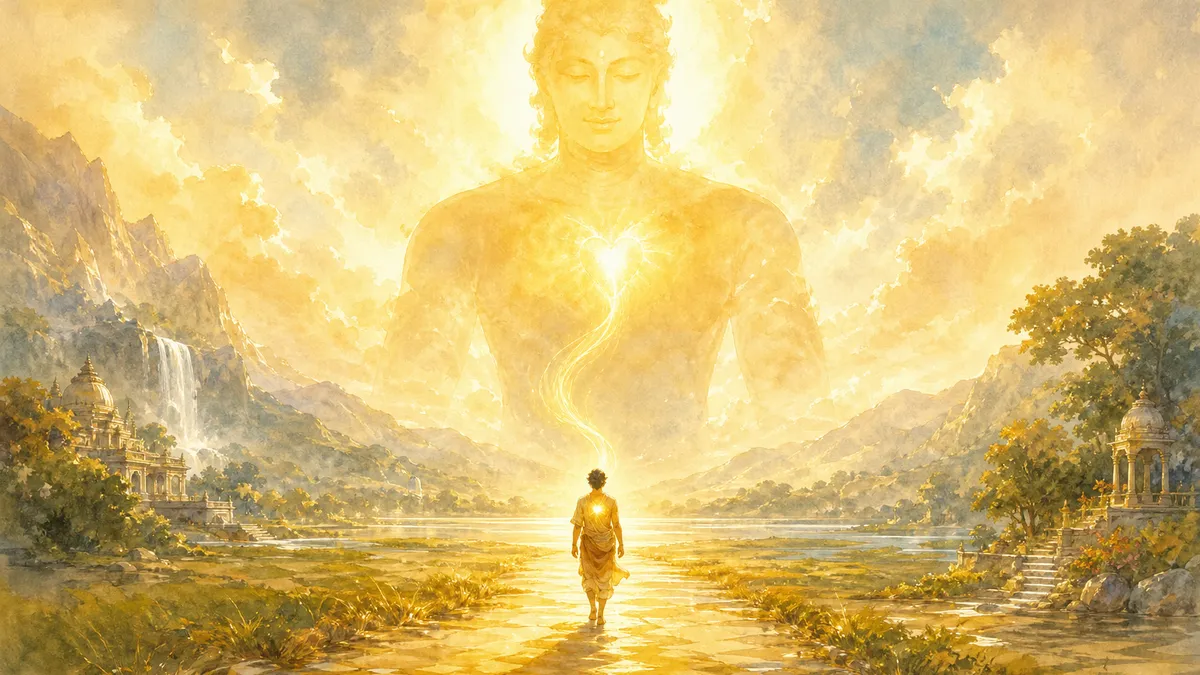
What within us surrenders to God? Our small will, our iccha-shakti, our “I,” our ego, our mind and body must establish a connection with the divine will, with divine wisdom, jnana-shakti and iccha-shakti. Relying on this connection, the small “I” must be resubordinated to the great “I.” Ultimately, our higher, great “I” is our true self. It turns out that we must resubordinate ourselves. Our small “I” must resubordinate itself to our great “I.”
Submission to the divine will, surrender to the divine will, and the discovery of divine wisdom within ourselves are natural processes. We are not returning to something invented or unnatural; we are restoring the original, primordial order of things as it should be. But at some point, it was disrupted. We do not create Realization anew. We do not strive for something that did not exist before; we return to the perfection that already was and has always existed primordially, even before our birth.
Shiva says:
Having relinquished attachment to the fruits of action, ever content, even while performing actions, he is not bound; he is not bound by them.
The Principle of Action Without Attachment to Its Fruits
How can we learn to perform actions without being bound by them? By not appropriating the fruits of our actions. Krishna tells Arjuna: you may act, but do not appropriate the fruits. This is the essence of bhakti yoga and the essence of karma yoga. How can this be done? Act not for yourself. Act for God. Learn to be a conduit of the divine will.
We can employ material energy and operate with any material things, but we must subordinate them to God. Take a video camera, for example. A video camera can be used to make worldly films that lead people into illusion. But it can also be used to record satsangs that awaken people. The same material object can be used for different purposes.
The art of engaging everything in service to God is the way to act without accumulating karma and to perform actions without enjoying their fruits and results. Take a car. It can be used for travel and entertainment, even for committing crimes or making money, or it can be used for service. Take a house. One can live in it. One can eat meat, drink wine, or set up an office. Many things can be done there. But one can also turn it into an ashram, install an altar, hold retreats, give satsangs, conduct worship, and discuss the Absolute Truth.
This is an example of how the same things can be used in different ways. We need to understand how to use our entire environment, all our material possessions, all our actions, and all our free time in the service of God.
The Secret of Material Prosperity Through Service
If we can do this, we will discover that our karma is purified, and a paradox will occur: these things will not disappear; on the contrary, they will begin to multiply and flourish, and there will be even more of them. This is because we have made the right choice, and the divine forces and divine energies support and approve this choice.
There are people who were materially modest in life and lived humbly. Then they began to render service, to perform seva, and became monks, possessing no property at all in accordance with monastic rules. But because they serve, they attract great energies. They use them, but not for themselves; they use them for God, for the dharma, and for others.
Therefore, divine forces and divine energies are granted to them. Lakshmi and the beings who serve her see that these people can be entrusted with material energy: they have no greed, no attachment, and no ego. No matter how much they are given, they will not appropriate it; they will use it for the benefit of the dharma. Then they can be given according to their merits, and even more.
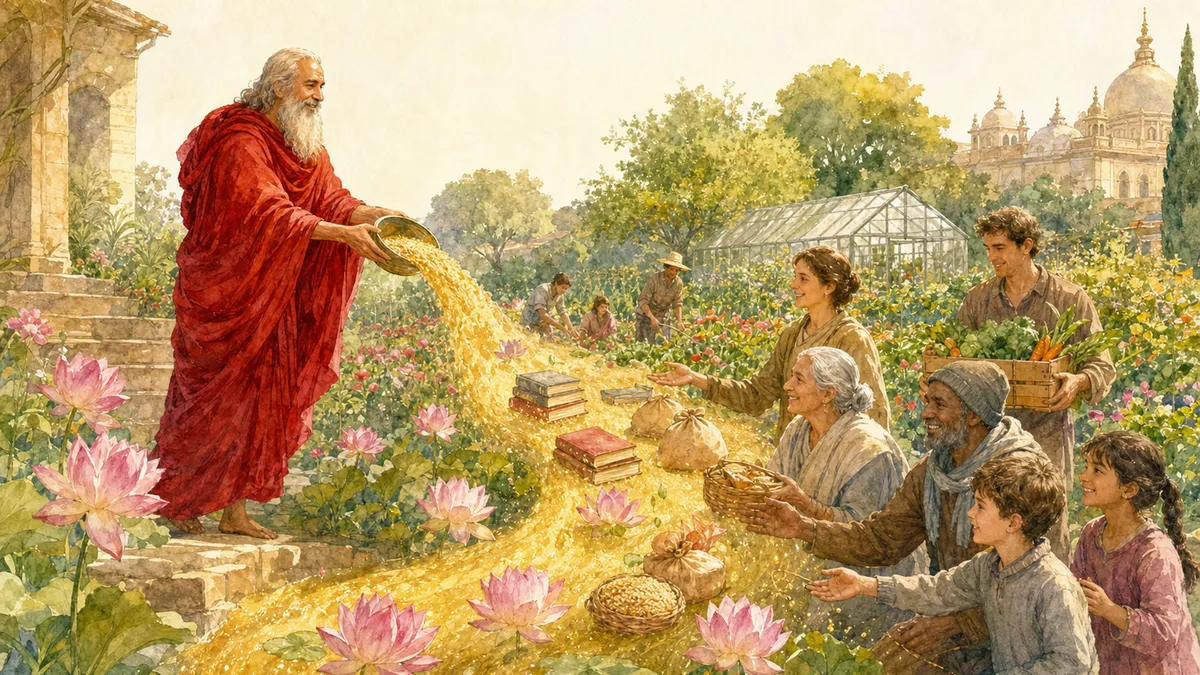
This is the secret of material prosperity. The secret of material prosperity is to engage everything in the service of God. When you engage everything in the service of God, your source of energy becomes inexhaustible.
If you act as a limited individual, there is not much you can do. Your capabilities are limited; you are merely human, living within cause-and-effect relationships and the constraints of time and space. But if you become a servant of God, nothing is impossible. Anything can happen. Because nothing is impossible for God. When you channel the energies of God, anything can happen. You can work with great energies and set great goals, and they will somehow miraculously manifest through you. This is the principle of self-surrender; this is the principle of karma yoga.
One who has no desires in the mind, who has abandoned all attachments, knowing that this is only the body, attains that supreme state while performing actions. Action in which one is content solely with what comes of itself, which transcends duality and is performed for My pleasure—such action destroys samsara.
When acting, one should be content with what comes of itself. One should not act out of dissatisfaction. One should act not for one’s own pleasure, but for the pleasure of God.
It is difficult to understand under what conditions God experiences pleasure and under what conditions He does not. For He is ananda itself, fullness itself, and He does not act; He has no interest whatsoever in our offerings. Indeed, Shiva does not need flowers, incense, or water. But what does Shiva need, what does He recommend to us? Devotion, faith, and self-surrender. Flowers, incense, and hymns are merely a way to activate the processes of faith and self-surrender within us.
The Path to Parameshvara
Thinking of Me, bowing to Me, making offerings to Me, contemplating Me, the Lord of Yoga, the yogin attains Me, having known Me as Parameshvara.
Brahman in the aspect of Parameshvara, in the aspect of Ishvara, is the Absolute reflected in sattvic maya. The body of the Absolute reflected in sattvic maya is Ishvara. This body is an infinite, luminous, supramental space. This supramental space can delve into the affairs of this universe and the material world, assume any form, interact, create, manifest, and destroy. On the subtle level, it enters every particle; it senses every experience, every pleasure, every thought, and every desire of every living being.
Thinking of Me means “smarana,” remembrance of God. Bowing to Me means “pada,” worship. Contemplating means “dhyana.” Making offerings means “dana.” In this way, the yogin attains Parameshvara.
The Descent of Divine Grace
Directing their minds toward Me and constantly speaking of Me with one another, My devotees attain unity with Me. For those thus engaged in yoga, I shall dispel all the darkness generated by maya with the light of the lamp of knowledge.
This is what Shiva promises. Those whose minds are directed toward Me and who worship Me here constantly—to them, ever yoked to yoga, I grant the grace of yoga.
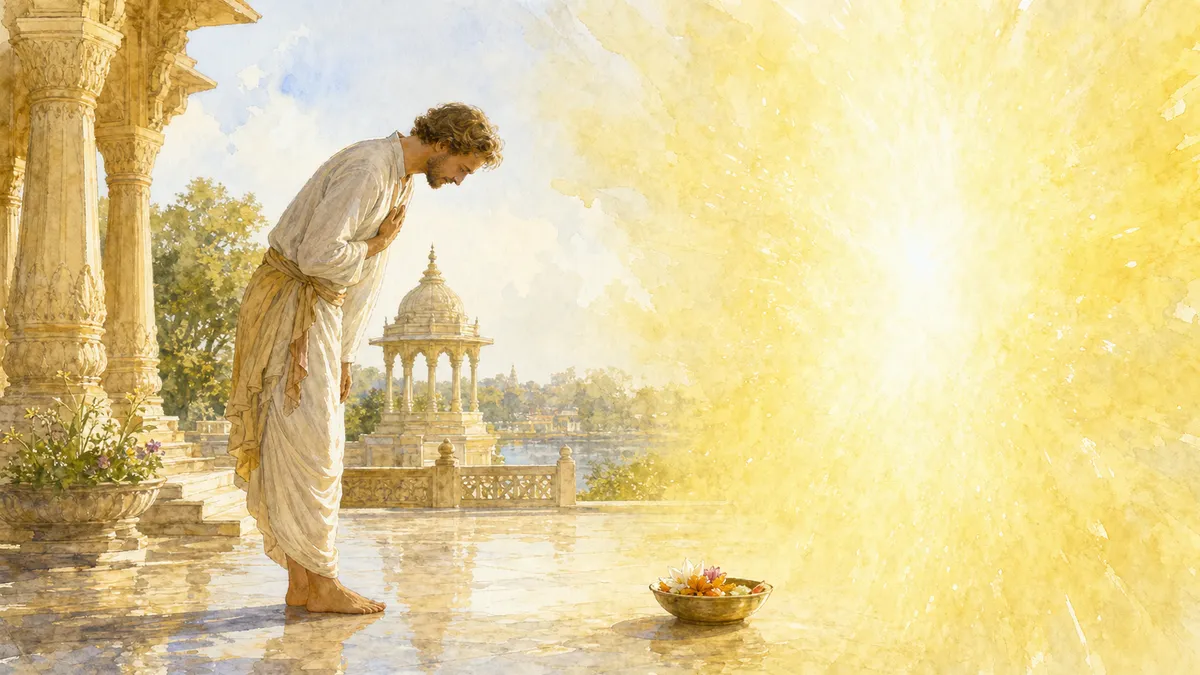
The result of upasana, worship, listening, chanting and glorification, remembrance of God, and service is the descent of grace, the descent of divine mercy. For example, when you perform arati or pujas, or simply sing bhajans, you may feel your mood improve a little. You came with problems and suddenly feel that all the problems are going away. This is the first sign that divine grace has touched you, even if only slightly.
Or your mood may not merely improve; spontaneous joy may simply arise. There was no joy, but it arose out of nothing. You think that you did not really do anything—you merely sang and sat by the altar. Then subtle clarity may open up. Subtle clarity means that you gain insight into certain truths and receive answers to questions that had troubled you before. Then this subtle clarity may unfold as an insight, as the descent of revelation.
You sit by the altar before Dattatreya, meditating, reciting mantras, trying to contemplate—there may be various practices—but suddenly a divine revelation descends upon you. You understand something, some profound truth that you could not even have conceived of, and it becomes as clear as day. Or spiritual vision opens up, and in the subtle world you perceive certain auspicious omens, auspicious signs. This means that you have established contact with the deity.
Contact with Divine Dimensions
Deities are beings not of the earthly world. Divine manifestations and establishing contact and communication are akin to making contact with extraterrestrials. Those who have taken an interest in the UFO phenomenon know that there are such concepts as close encounters of the third and fourth kinds. The third kind means seeing them nearby; the fourth means communicating with them; the fifth means being abducted altogether; and the sixth means conceiving a child or having a chip implanted. Such a classification exists. It concerns establishing communication with extraterrestrial civilizations.
But in this case I say: in our tradition, we have long been establishing communication with an extraterrestrial civilization every day, twice a day—with Dattatreya, with Shiva, with the Refuge Tree—trying to engage in close encounters of the third and fourth kinds. The result of such contacts is the descent of grace.
We do not need any extraterrestrials; they may be asuric, semi-demonic beings from subterranean worlds, technocratic civilizations. They were all described in the Vedic sutras long ago; everything about them is known. The worlds called Bilva Svarga, subterranean paradises, technocratic civilizations that have advanced beyond humans in certain respects. We are not interested in such contacts.
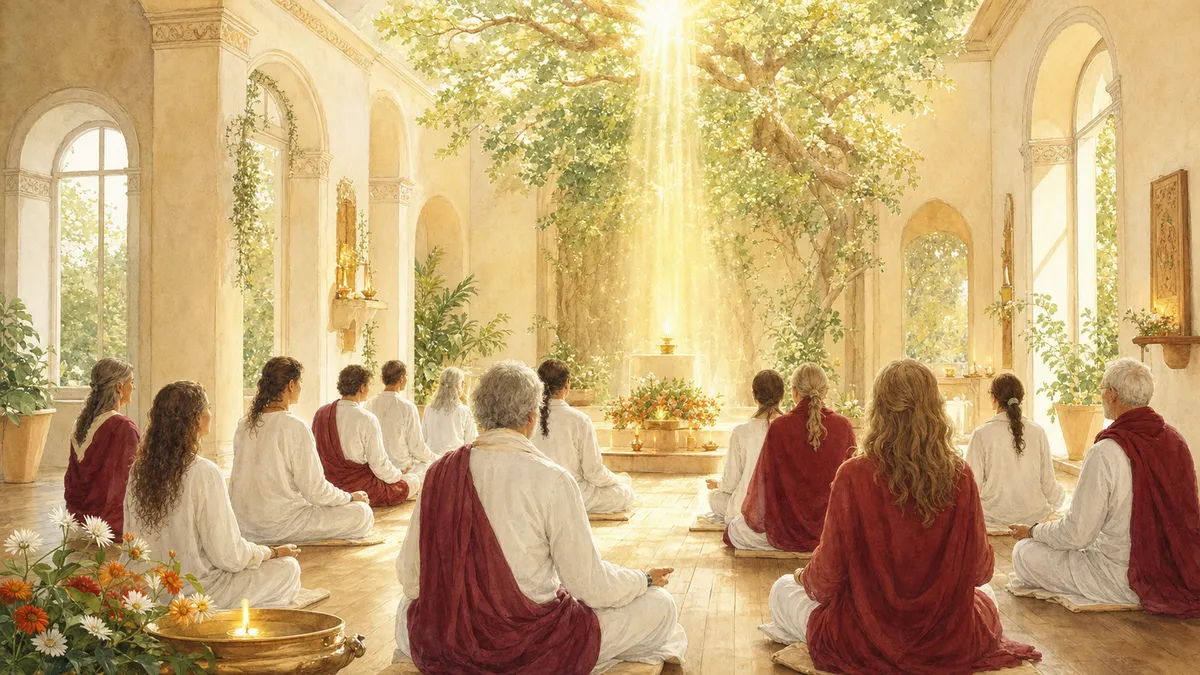
But contact with divine worlds has always existed in the Vedic tradition. There is the principle of the mandir, temple worship, which is specifically intended for mental, telepathic contact with divine beings and, ultimately, with God.
The fact that such contact occurs means that you receive a blessing, you experience the descent of grace, perhaps your subtle spiritual vision opens, revelations arise, or ananda arises, or signs appear. Sometimes saints experienced signs such as the materialization of ash, sacred objects, vibhuti, or sacred sounds, or a deity appearing in pure light, bestowing a blessing, and then entering the heart. A vision may arise in which the deity places a sacred object, a lotus, on the crown of the head.
These are signs that you have established contact with a dimension of divine reality—perhaps with your inner deity, perhaps with deities of higher dimensions—but you have established this contact. The altar is a kind of device, like a computer, through which you establish a direct, wireless connection with the divine dimension.
Such a descent of grace may increase and increase, even to the point where prana enters the central channel, breathing stops, the breathing rate decreases, the length of each breath shortens, the sahasrara chakra fills, one enters a deep meditative, nondual contemplative state, and experiences elevated emotions. These are all signs of proper contact with divine beings and with God.
Constant Connection with the Divine
Those whose minds are directed toward Me, who constantly worship Me here and are continually yoked to yoga, I endow with grace.
The descent of mercy, the descent of grace, is a normal and important spiritual experience on the spiritual path. In addition to meditating, practicing concentration, training the mind, and learning to experience dhyanas, kundalini yoga experiences, mindfulness, and contemplative practice, we also experience the descent of divine grace.
Contact with divine dimensions is always accompanied by such a descent, because gods and saints are immersed in the greatest state of joy, happiness, bliss, in the space of ananda. They themselves are such a divine space of ananda. Contact with their consciousness is in itself a natural descent of grace.
Then certain karmic knots that could not be untied for a very long time are loosened, and certain dualistic notions are eliminated. Certain paths in life are unblocked. Sometimes, when you look at a person with spiritual vision, you see that the path to wealth is closed, the path to relationships is closed, the path to success is closed. You wonder whether anything is open to them at all. Then suddenly you look and see that the spiritual path is open. In that case, they have no other way but to follow the path of dharma. All blessings will come through it.

The descent of grace means that closed paths become unblocked. The path of wisdom opens; the path of will and operating with reality opens; the path of a happy life and bliss opens; and the path of certain creative abilities and contact with higher dimensions opens—all of this becomes accessible through the descent of divine grace. It may manifest for a short time: mystical powers, mystical abilities, the experience of samadhi.
The Unity of All Divine Manifestations
Those others, devotees of other deities, who worship them while contemplating Me, shall attain Liberation.
Shiva says here: those who worship other deities, other gods, if they worship them while contemplating Me, shall attain Liberation. This is a fundamental point. He does not say that those who worship other gods are of the devil. He says: all gods abide in me; they are all one.
Therefore, we regard all gods and divine manifestations as manifestations of the one consciousness, the one Brahman. In our chosen deity, we see the unity of all deities. In the root guru, we see the unity of all gurus. This is the principle of Anuttara Tantra and the principle of Advaita Vedanta.
For example, if someone worships Christian saints, Slavic deities, Buddhist deities, or Taoist deities, but understands this principle—the principle of nonduality and unity—then they worship the same Absolute, the same Ishvara.
Worship of the Lingam
Having relinquished attachment to sons and other things, free from despondency and attachments, one should worship Parameshvara in the linga without attachment. Whoever always worships the linga, having renounced all pleasures, I endow with supreme power within a single lifetime. The lingam, the essence of supreme bliss, the One, stainless, the essence of knowledge, all-pervading, abiding in the hearts of yogins.
What is the linga, the lingam? It is a symbol of nonduality, a symbol of the natural state, like an expanse of light.
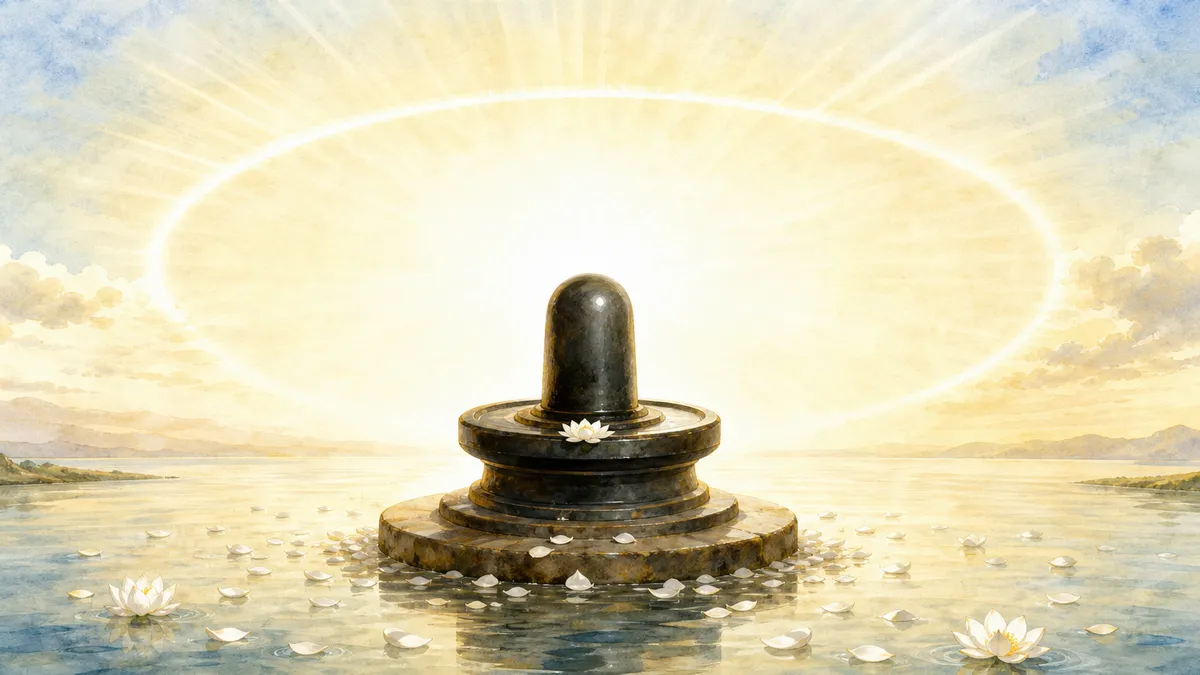
Whoever worships it through contemplation sees Shiva and Dattatreya everywhere. In water, in fire, in space, in the sun, while contemplating Ishana, one should worship the greatness of the linga. All this is the lingam; everything abides in the lingam. Therefore, one should worship the eternal Lord in the linga, wherever it may be.
The lingam signifies the formless state of God, a state of God that has no specific attribute, name, or form, yet manifests as the energy of consciousness.
