

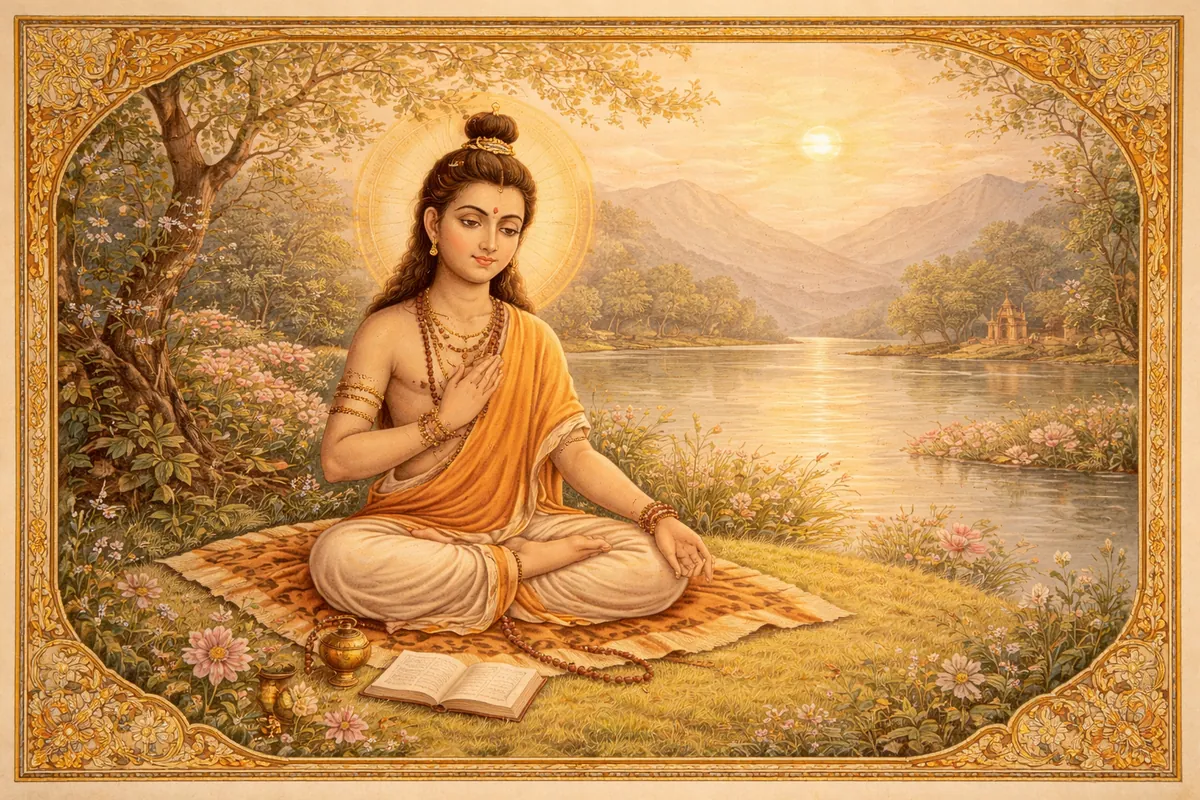
The core of the Teaching of Sanatana Dharma is Advaita Vedanta. The Teaching of Advaita Vedanta is not something that can be studied by reading a few books, listening to a few satsangs, meditating a little, and saying: “I understand, Advaita, everything is clear.” Sometimes it happens this way: people say, “Yes, I know Advaita, I’ve read it: cool!”
Comprehending the Teaching of Advaita Vedanta is a process; it lasts a lifetime. You will never comprehend Advaita, because it is never possible to comprehend Advaita fully, even in a billion years. Suppose you become a deity in the process of evolution, Brahma the Creator, for example, and you create new universes, and you will say: “I am a humble student on the path of comprehending Advaita,” because Brahma also cannot fully comprehend Advaita.
It is an endless process of comprehension and deepening, but it is possible to comprehend Advaita deeply enough in this life so that samsara no longer troubles you — that is, not completely, but enough so that at least samsara does not trouble you, so that in the next life you will not have to be born in samsaric worlds uncontrollably, go through birth, and so on.
Such a sufficiently deep comprehension of Advaita is called moksha (liberation), or kaivalya. The Teaching of Advaita is the view on which we build our entire life, and our fate and our life depend on how we understand it.
Sources of the Teaching of Advaita Vedanta
The Teaching of Advaita in the text “Avadhuta Gita” is expounded by Dattatreya; his song is one of the greatest symbols of Advaita.
It is set forth in the Vedas, in the part called the Upanishads. At the end of each Veda there are Upanishads. Therefore Vedanta is called “the end of all knowledge,” but it is called so not because the Upanishads were located at the end of the Vedas, but because Vedanta, meaning Advaita Vedanta, summarizes and completes all knowledge in general.
The Teaching of Advaita Vedanta is also expounded in the “Yoga Vasishta,” in the “Tripura Rahasya,” in the Puranas, in the Itihasas, and in the “Mahabharata.” It is expounded by Sri Adi Shankaracharya in the texts “Viveka Chudamani,” “Tattva Bodha,” “Atma Bodha,” “Aparoksha Vibhuti,” as well as in “Brahmanachintana” and “Dasha Shloka.”
And before Shankara, this Teaching was expounded by his guru, or the guru of his guru, Sri Gaudapada, in the text “Mandukya Karika.” And another one as great as Gaudapada was Vidyaranya, and he expounded Advaita Vedanta in the text “Panchadashi.”
The Teaching that is expounded in Advaita Vedanta is called Brahma-vidya — the Teaching about Brahman. But it is considered that all the Puranas, Itihasas, the “Yoga Vasishta,” the “Tripura Rahasya,” the “Moksha Dharma” as part of the “Mahabharata,” or later commentators: Vidyaranya, Gaudapada, Shankaracharya — are already a later interpretation of Advaita. But Advaita itself in its true essence is the Upanishads, of course; the Upanishads are the Vedas.
That is, if we want to understand the original source of Advaita, we simply need to take the Upanishads, the Upanishads of the Muktika canon. There are two canons: one is Muktika, and the other is Mukhya. In one there are one hundred and eight Upanishads, and in the other there are only ten, selected by Shankara, but all these Upanishads speak of non-duality, speak of Brahman.
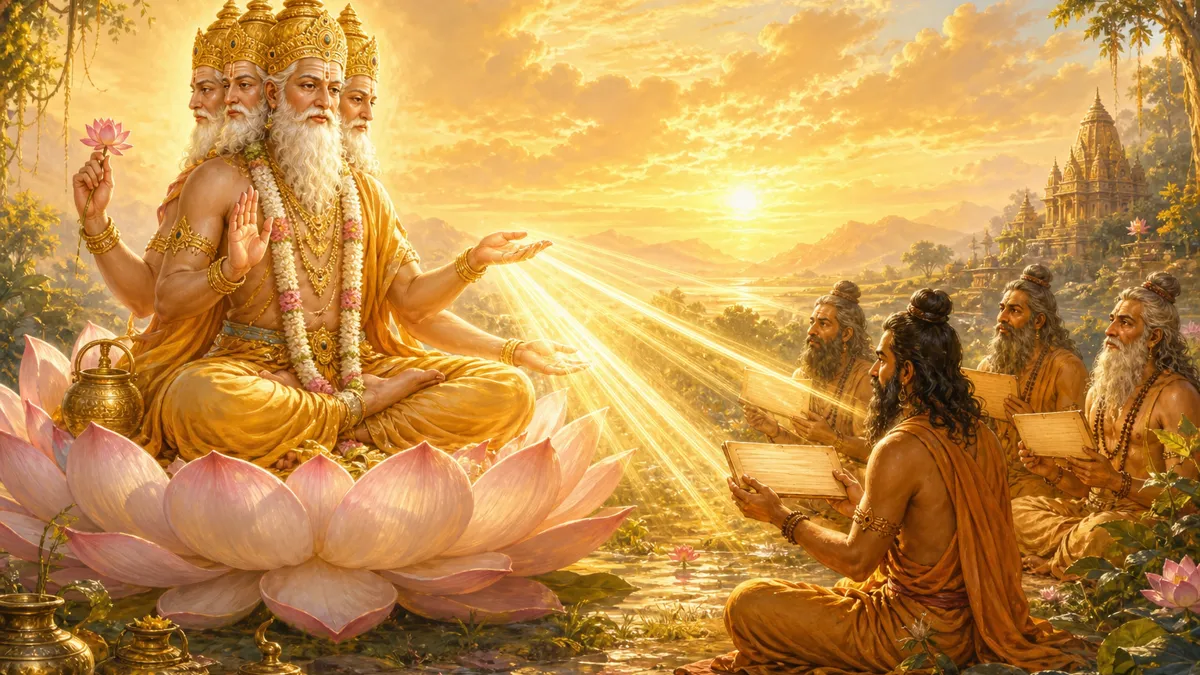
The original source of the Teaching of Advaita is the Vedas and the Upanishads; they were given by Brahma. It is said that there were two attempts to deliver the Vedas to Earth: the first time unsuccessfully, because the asuras stole the Vedas on the way to Earth, but the second time Brahma transmitted them — such was the lila. Brahma transmitted the Teaching of Advaita, seeing that souls were suffering and deluded. He transmitted them through the four Vedas: the Rigveda, the Samaveda, the Yajurveda, and the Atharvaveda. And in the Vedas he set forth the rules of worship, of mantra recitation, rules of conduct for sadhus and householders, philosophy, and, most importantly, the vision of Advaita.
Why did Brahma transmit the Vedas? Because he saw that the jivas, the living beings for whom he had created the universes, were in great confusion and delusion, that they were overcome by ignorance and were suffering; he felt the necessity and responsibility for this. And the rishis and saints, such as Vasishta and others, the sons of Brahma, the manasa-putras, the mind-born sons of Brahma, recorded these Vedas. And what we have now, what is called Sanatana Dharma, is the Vedic Teaching, the Vedic culture that unfolded around all of this.
Brahma-vidya and Pancha-kosha-viveka
So, the Teaching of Advaita Vedanta is Brahma-vidya, the Teaching about Brahman; it is also the Teaching about the path of how to attain this Brahma-vidya, and such a path is called viveka-vidya, discriminating wisdom. What is viveka-vidya? Viveka-vidya is also called pancha-kosha-viveka, the ability to distinguish the sheaths from the higher “Self,” the ability to distinguish the five sheaths.
Pancha-kosha-viveka, viveka-vidya is a teaching that the guru explains to the disciple (note, not to the first person who happens along, but only to a disciple). In the past, very high standards were applied to Vedic knowledge; it was believed that if Vedic knowledge was explained not to a disciple endowed with sattvic qualities—faith, devotion, the spirit of samaya, and even noble birth and intellect—then it was the same as spilling out knowledge, simply spilling it away. If we are to quote the tantras, they say that giving knowledge to the wrong people is the same as mixing milk with dog feces.
There were very high standards for upbringing and for the selection of disciples, because Vedic knowledge in itself cannot be comprehended by an unprepared person who does not possess the proper qualities. And the Teacher takes upon himself a part of the disciple’s sins, as it is believed, so he must approach this with great responsibility. There existed the system of the guru-kula, of upbringing and culture from childhood, a very profound system for transmitting knowledge, which now, unfortunately, is being lost; even in India it is no longer what it used to be, because the India of the times of Satya Yuga and Dvapara Yuga and the India of the times of Kali Yuga are two somewhat different Indias, and as for other countries where there is no traditional Vedic culture of transmitting knowledge, there is nothing to say.
Why is it so important to transmit Brahma-vidya, pancha-kosha-viveka, methods, mantras, and so on to those who are prepared? In the “Yoga Vasistha,” Vasistha says:
That teacher who tells an immature person that everything is an illusion, that everything is Brahman, will go to hell.
Because these are very great and transcendent truths; they cannot be comprehended immediately, on the fly, just like that, without proper work, purification, and preliminary preparation. The price for comprehending them is very great, and this must be understood. Advaita contains very great truths, and pancha-kosha-viveka, pancha-kosha-vidya, Brahma-vidya are already different sections of the Teaching of Advaita.
The Foundations of Pancha-kosha-viveka
What does pancha-kosha-viveka-vidya say? It says: you are not this body; you must learn to analyze, but analysis must be done after you have acquired stable faith, the power of faith, the spirit of samaya, the spirit of sattva, and the spirit of purity. Therefore we always begin with faith, with very strong faith, pure qualities, and control of the mind.
Because sometimes I meet lay disciples, and they say to me: “Well, I couldn’t restrain myself, I drank.” I say: “How is that even possible?” It is hard to shock me; I am the kind of person who is not subject to any shock, but even I am sometimes astonished, let us say. It simply does not fit in my head; it is just like direct introduction—the mind simply stops for a steady three minutes when I hear such things. That is how it happens; that is how samsara treats people. But what about yogic control, self-discipline, the pure qualities of sattva? There is not enough merit.
Self-discipline, control—one who does not control himself through self-discipline is not a sadhu. One must take the basic qualities very seriously: yama, niyama, and pure vision. One must overcome the mara of kleshas—the first enemy on the path to wisdom. The mara of kleshas must be overcome, defeated either by cunning or in some other way, but it must be overcome; however, this is not simple. Then Vedic knowledge will settle in the heart and become your own.
Therefore a pure life and self-discipline are very important. We are not required to be ascetics; external asceticism is not particularly encouraged, but controlling the main kleshas is very important: controlling the mind, taming the ego.
Overcoming the Mara of the Skandhas
When we have tamed the mara of kleshas, we must deal with the second mara. The second mara is the mara of the skandhas. If the mara of kleshas is coarse desires and impure thoughts, then the mara of the skandhas is clinging to the koshas, to the sheaths—precisely the successive series of self-identifications hidden in our subtle bodies, when we think: “I am the body, I am the mind.” And by the power of pancha-kosha-viveka, by the power of discriminating wisdom, we must overcome this mara of the skandhas.
For example, there is clinging to the body: if we think that we are the body, then we consider the body to be ourselves; we consider it ours. There is attachment to the body. For example: you go up to the mirror and look to make sure your hairstyle is beautiful. If you shave your head bald, you will not feel very good; you will feel: I am not so beautiful. But it is not you who are not so beautiful; it is simply that the body has changed a little, while you are not the body.
And we must analyze where the I is in the body, what the “I” is in the body, and discover that we are not the body. For example, when a person has injured his hand, he says, “I injured my hand”; he does not say, “I injured myself.” He says that I injured something that belongs to me, that relates to me, but the person himself is not in the hand, not in the thumb, not in the ear, not in the intestines — it is a mechanism, but you will not find the person there, consciousness; it is a mechanism that we possess, but out of unconsciousness we attribute it to ourselves, saying: I am big, I am small. You are neither big nor small. I am a man, I am a woman — you are neither a man nor a woman, but you may have a small body, a large body, a beautiful body, a not very beautiful body, male or female — this is the kind of cyborg you have been given, a biocyborg, and you simply operate it. This biocyborg has biological batteries; the average charge for all humanity is calculated for eighty years. There is an actor, Armen Dzhigarkhanyan, and when I heard his interview, he said: “If the batteries have run down, then they have run down.” We must understand that we are not the body, and separate ourselves from the body.
Analysis of the Subtle Body
But then comes the turn of analyzing the subtle body. And what is the subtle body? It is a city, it is a collective organ, a city in which there are eighteen substances. What are these substances?
Five karma-indriyas: consciousness that moves the hands, legs, eyes, tongue, and genitals;
Five jnana-indriyas: consciousness that governs sight, hearing, smell, taste, and touch;
Five pranas: prana, apana, samana, vyana, and udana;
In addition: manas, buddhi, chitta: mind, awareness, and the storehouse of memory.
And all of this is the subtle body. In the subtle body there are all experiences, all impressions, astral images. But we are not the subtle body, and discrimination means separating ourselves from the subtle body.
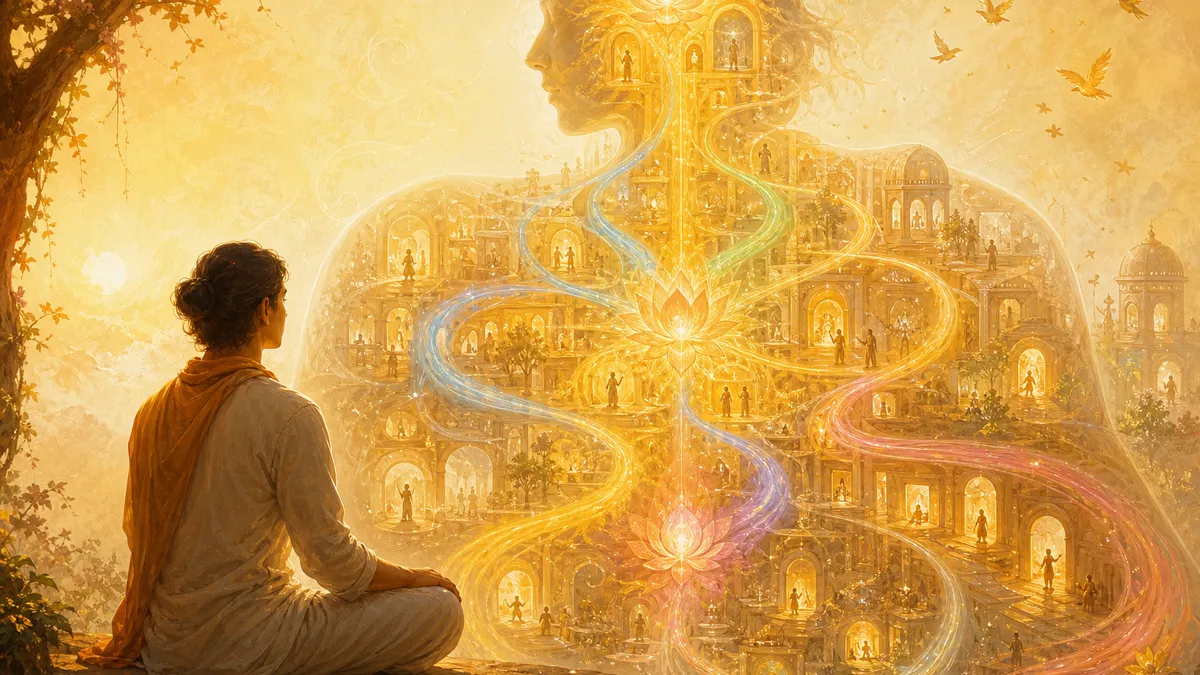
The subtle world is, in fact, a world of great illusions, great temptations, and seductions. When you experience the subtle body, you must apply the Teaching of Advaita in order to separate yourself from the subtle body. Sometimes, when a person first comes into contact with the subtle body, it makes an enormous impression on him: he sees certain beings, or enters the astral world in the subtle body, he has an experience of clairvoyance, a vision of spirits, and he begins to understand: the world looks different, not the way I used to think. This impresses him greatly, he begins to think about this subject, cling to it and discuss it, and he may even make it the occupation of his life.
I saw a person who scans everyone for the subtle body. He will sit for a while in a group, and then report to me: “Look, that one has an entity in the subtle body, and this one has attachments, and that one has something through the maternal line.” I observe him: he literally lives there, he is eighty percent in the subtle world. But I answer him: you managed to examine everyone, but you forgot yourself — who are you yourself?
Pancha-kosha-viveka means that we understand that we are not in the subtle world, and the subtle world is not us; it is simply a sheath. There is one room — this is the physical body; another room — this is the astral body, but our task is not to wander through these rooms, but to find God. In order to find God, we must leave this room, we must understand that this is not ourselves.
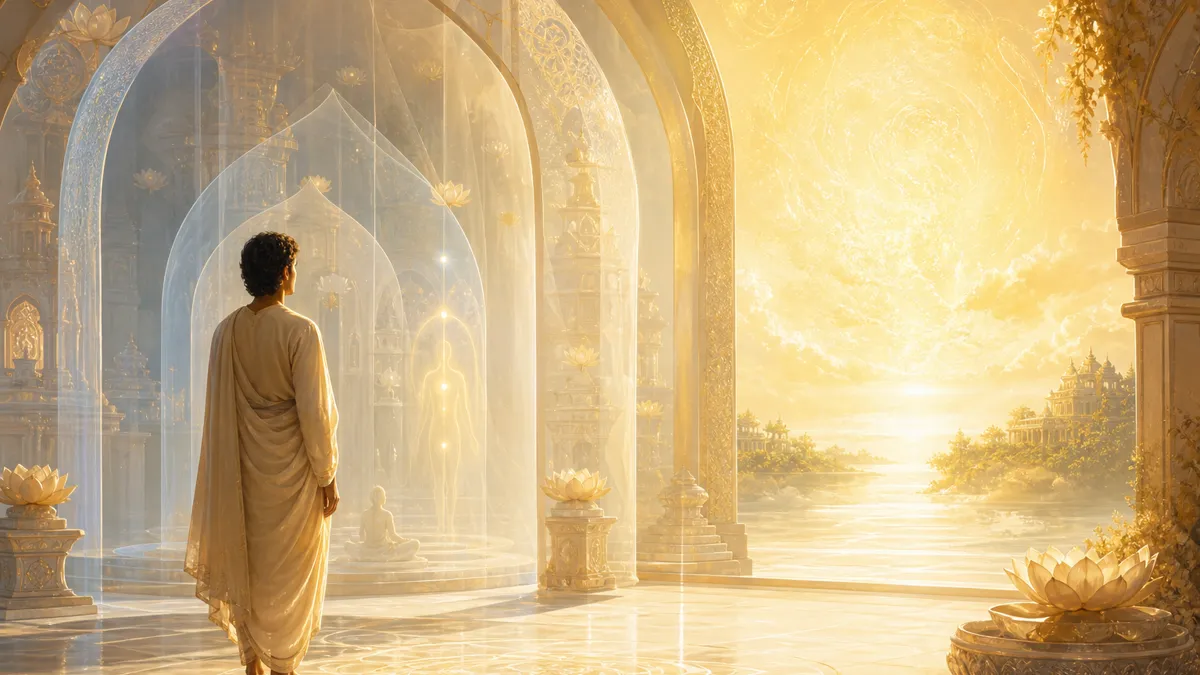
We are not in the subtle body; the subtle body is a cloud of ignorance that envelops our Higher “I.” And where we are not, there is nothing of ours; this is very important to understand. And where there is nothing of ours, all of that is not ours, and all of that is not us.
For example, we borrowed the physical body from the five elements, but we are not the physical body. As long as a person thinks that a thing is his, he thinks about it, worries, becomes attached, clings to it, but when he understands that the thing is not his, he immediately changes his attitude toward it, doesn’t he? For example, if a person finds out that he has a child and that this is his own child, he may become strongly attached to him and experience parental feelings. And then they tell him: but you are not the biological father, we did a genetic DNA analysis and found out that this is someone else’s child, and that’s it: he is in shock. And somehow his attachment goes away; that happens. He knows that this child must be handed over to another parent.
In the same way, we must understand that the body is not ours; it is borrowed from nature, it is nature: we have borrowed earth from nature in the form of muscles, bones, flesh; water in the form of blood; fire in the form of digestive fire; wind in the form of prana. All of this is a knot, an accumulation of the five elements, but it is not we ourselves. These are certain knots that have become fastened together, but when the time comes, the five elements untie these knots. Yet this is not us; it is a temporarily borrowed apparatus, a mechanism made of the five elements.
The same applies to the astral body: in the astral world, the subtle energies of the mind have become linked together; the mind and the subtle energies have also joined together. The astral body is the cause of rebirth. And it is considered that if the astral body no longer has any causes to attach itself to gross matter, to the physical body, then there will be no more rebirths. But for this, one must train consciousness in such a way that it no longer gives rise to the desire to cling to the gross body and no longer gives rise to the desire to cling to the subtle body and generate a new subtle body; or, if it wished to manifest in the form of the subtle energy of prana-mind, it would manifest purely, as an illusory body in the form of a deity.
Therefore, we train our mind through the practice of the illusory body: if you want to manifest in the form of prana, in the form of a body, that is not forbidden, please do so, but learn to manifest purely, not out of karma, but through visualization, through the seed mantra.
The Causal Body
So, when we understand that we are not the astral body, we are able to separate ourselves from the antahkarana (the inner instrument). Then we no longer depend on the subtle world; nothing that exists in the subtle world impresses us. We do not depend on it; we no longer build our home in the hope of a subtle body.
Then the next level opens up: the causal body. The causal body is the cause of the astral, subtle body. The astral body is the cause of the physical body. The physical body depends entirely on the astral body, although the astral body is invisible; the physical body is completely governed by it. The astral body determines what the physical body will be like: whether it will be healthy or ill; when it will be born, when it will die. The astral body governs the physical.
For example, if in the astral body you generate a sankalpa—the siddhi of long life, strong health, longevity—the astral body gives a command to the physical body and says: live long, be strong, robust, and healthy, and so it will be. If you generate the command “I am invulnerable,” the astral body gives the command to the physical body: be invulnerable, and you will be invulnerable.
One shaman in Africa, a sorcerer, for a long time made amulets of invulnerability. He tested them on himself and said: “No one will be able to kill you or harm you.” He would hang these amulets on himself and say: “Shoot me with a hunting rifle.” And people would shoot; the bullets would fly past or fall and ricochet. And one soldier also ordered such an amulet for himself. He fired, and the bullet fell. He did not believe it. He said: “May I put the rifle right up against you and fire? If the amulet is powerful, will it work or not?” The shaman refused for a long time, but then allowed it. This man put the rifle right up against him and fired. But when he fired, the barrel and bolt of the rifle were torn apart, the bullet exploded in the rifle and injured the soldier, while nothing happened to the shaman; the shaman was absolutely protected. This is the power of the subtle body. That is, the subtle body gives the physical body the command: “be invulnerable,” and the physical body becomes invulnerable. Because the physical body is like a flower growing from the subtle body, but the subtle body itself grows from the causal body, from the karana-sharira; the cause of the subtle body is found in the causal body.
The causal body can be compared to the backstage area in a theater. There is the theater, the stage on which the action unfolds, the texts, the actors, the monologues, the performance; and there are the wings, from which everything emerges, where everything is prepared. The causal body is like a space of pure consciousness; it is the space of emptiness, of dreamless sleep, but everything emerges from it. Yet when you penetrate the causal body, you discover emptiness and silence there. You will not find name, form, or any kind of bustle there. The causal body is bliss, which is why it is called ananda-maya-kosha (the sheath of bliss).
In the causal body there is knowledge; it is witnessing, observing consciousness, similar to how you slept in dreamless sleep and were happy—no worries, no anxieties, you simply slept, there were not even any dreams. If you sleep in a sleep with dreams, there can also be problems there: you may dream of something, of being chased or quarreling with someone, and you may also suffer. But in dreamless sleep there are no dreams, there are no objects; there is simply you as consciousness, and you wake up and say: “I slept, but I saw nothing.” But the fact that you remember that you slept indicates that some part of your consciousness understands this, that it grasped it, that there is no break. Some very subtle layer of consciousness was still present, because your identification was not interrupted. And so the causal body is dreamless sleep; it is the most natural state of every living being. Laya, dissolution, takes place in it.
In general, laya, or pralaya, exists in five cases, and one case is precisely when we fall into deep dreamless sleep; another case is death—this happens during death; there is also the case when Brahma falls asleep for the night, during the night of Brahma, and the entire universe comes to a halt; there is also the case of maha-pralaya, when the entire universe is destroyed and the body of Brahma is destroyed. All these are different five types of laya, dissolution.
Question: If a person sleeps in dreamless sleep and wakes up, theoretically, could he not have been conscious there? And he thought: “since I woke up, I must have been sleeping,” he thought this at the level of surface consciousness?
There is always a layer of consciousness that preserves its identification, because if this identification did not exist, the mind would not be able to restore its continuity; it restores this identification precisely because that continuity was there. However, dreamless sleep can be unconscious, when almost nothing is realized, but in the case of saints, sages, jnanis, it is conscious, and then the ananda-maya-kosha, the sheath of bliss, is experienced in its fullness. This is the bliss of emptiness, in which there is only “I,” the observing consciousness. And when this “I” experiences the sheath of bliss, it rejoices; therefore it is called ananda-maya, for there is much bliss in it.
It is, as it were, the primordial basis from which the souls of all living beings proceed. The subtle bodies, the souls of all beings—gods, humans, animals, and asuras alike—proceed from this basis. And when we enter it, the world disappears. Those philosophers and yogis who sing the praises of non-being, of emptiness, have tasted a little of dreamless sleep. But in dreamless sleep there is still a subtle veil, a subtle ignorance; this state is still enveloped by maya, because consciousness, the “I,” is present there, and there is the concept of individuality. And the yogin must, by the power of discrimination, separate himself from this concept of “I” and go further; he must go into the cause of the subtle body, into prakarana, into the cause of the causal body, into turiya. And the cause of the causal body, prakarana, turiya, is that which is beyond waking, beyond dream sleep, beyond dreamless sleep; it is that great state which is free from “I” or “not-I,” and this we call Atman or Brahman.
Knowledge of Brahman
And when we are able to separate ourselves from one sheath, from another, from the third, and become established in Brahman, then it is said that we become Brahma-jnanis, knowers of God, or Atma-jnanis. For this we must pierce these three layers: waking, the dream state, and the illusory astral world.
The astral world, in general, cannot be trusted—never; it is a world full of illusions. If one enters it, it should be done in a completely controlled way, through the illusory body; otherwise, the astral world must be regarded as a complete illusion, as maya. Never get involved in such games with the astral world, because you may decide to play with the astral world, and then the astral world will play with you. The astral world is an entire universe of illusions; it is like the Internet, a world of information, a world of images. If you go onto the Internet, there may be an avatar somewhere on a forum, a little girl, or on social networks, and you do not know who is there behind the little girl. Or they write that huge spaceships are approaching Earth—who knows what they write on the Internet—but none of this can be believed, none of this can be believed. Or they write one thing, and you click on the link, arrive at a website, and there is an advertisement. And this happens constantly. The Internet shows a little of how the astral world is arranged; the astral world is even worse, it is one illusion piled upon another.
If you want to play with the astral world, to rely on it, you will enter into illusion. This should never be done; one should not flirt with it. And in the “Yoga Vasistha” there is the story of Lila, the story of King Galava, whom a fakir sent galloping on a horse through the subtle world, about the enormous illusions that were experienced when the king, without leaving his place, lived an entire life within a few minutes.
Therefore, when you touch the astral world, you must have a clear attitude: neti-neti, not this, not this, I do not need illusions, do not react to anything, do not perceive anything, even if a deity descends to you and says, “I will give you instructions,” say, “Thank you, I already have a Guru, I have already received all the instructions I need. And the Guru’s instructions were this: not to receive instructions from anyone.” Because if you are led by the subtle world, there will be no end to it, and then the subtle world will possess your consciousness, and you will become its slave. But you must become the master of the subtle world. Yet one can become the master of something only if one is separated, detached, if one has vairagya, dispassion, in relation to it; if you are involved, you cannot become the master. One should rely on this world to the extent required by the conditions and circumstances of relative life, no more, but no less.
It is difficult to compare; these worlds are structured somewhat differently. This world is more material, and it is harder to be mistaken in it; the astral world is more subtle, and a person intuitively trusts what is more subtle, therefore it is much easier to be mistaken in the astral world. In this world, you should not be enchanted by it, but you should not reject it, reject your duties, while you are in this body, there is also the karma of this world. But in the astral world, you are not obliged to fulfill your duties. You can say: I separate myself completely, all this is illusion.
Attainment of turiya — the fourth state
So, when you have trained your consciousness, which is independent, does not identify with the physical body, with the physical world, does not identify with the astral world, and you have entered the causal body, and with the help of the subtlest observing consciousness have separated yourself from the causal body, you experience turiya, the fourth state, the state of Brahman, brahma-jnana. This is possible only if you have boundless faith, boundless love, boundless devotion, and viveka, discriminating wisdom.
The experience of this fourth state frees you from the need to be born anywhere, whether in the subtle world or in the physical one. This experience eliminates all your ignorance. For example: there was a snake (it was a rubber snake), and a person was frightened by the rubber snake, and at the sight of the rubber snake he became very frightened, and he had a way out when he simply rejected this rubber snake, fell into oblivion, when he fell into deep sleep. And while he slept deeply, detached from this rubber snake, it did not frighten him, but as soon as he woke up and saw it, it frightened him again. Or when he hid from the snake around the corner, as long as he did not see it, everything was fine, but as soon as he came closer, the snake frightened him again. Finally, when he picked up this snake, touched it, and understood that it was rubber, all his fear immediately disappeared. And he could already hold this snake in his hands, or be near it; he was never frightened anymore.
In the same way, the ignorance of samsara cannot be eliminated simply by abiding in the causal body, by forgetting the entire relative world; it cannot be eliminated by denial. This ignorance can be eliminated only by understanding the nature of God and the illusory nature of the five sheaths. When, thanks to pancha-kosha-vidya, you have understood the illusory nature of the five sheaths, then samsara no longer impresses you, you no longer need to be born in samsara, you have no suffering from samsara.
Question: Is it possible to consciously jump into the astral world, then into the causal, and then into turiya, or should one go straight into turiya?
There can be different options. The explanation in the Advaita Vedanta tradition is usually given gradually, from body to body, but if you have performed practices and become established in some higher bodies, you will experience them immediately, and the experience of these bodies will devalue attachment to the lower bodies.
Question: And if there is no experience of the higher bodies, or of the astral, then you won’t be able to skip over them, will you?
You will have to experience everything in sequence.
Question: That is why I am asking: should one first bring awareness into sleep, and then go further?
Exactly. You will not be able to introduce awareness directly into the causal body, dreamless sleep, if you have never once had awareness in sleep with dreams.
Question: And if there has been awareness in sleep with dreams several times, if there is a little more experience?
Try to be conscious here, in this world, because the way you behave here and become accustomed to perceiving yourself naturally carries over into the subtle bodies. Try always, in this world, to be aware of yourselves as conduits of divine will; try always to be in unconditional self-surrender and love for God, and such a spirit, such an attitude, will purify and purify you, and penetrate into the subtle bodies.
Once I had such a dream, a very long time ago, perhaps twenty-five years ago, when in a dream I found myself in some gathering of certain beings in a subtle body, where they were discussing some worldly topics. I became very indignant and said: “What are you discussing here? Come on, let’s sing bhajans; you have all forgotten God!” And they were surprised; after some time everyone began to talk about God, then there was such a bhajan, and everyone became so inspired that this vision itself simply disappeared, and I jumped out of it, and the soul raised its vibrations and, like an arrow, flew upward, all the way to a state of light. This happened because in everyday life I constantly had such an attitude: when people around me gathered and said something, I would intervene and say: “What are you, foolish? What are you even talking about? You should be talking about God! Come on, let’s do it now, right away!” And people’s mood would immediately change; some of them would either leave, while some of them would stay and begin to listen and speak about God. And such a habit also works in dreams.
Learn to be in God in everyday life, and this will naturally penetrate into sleep and into subtle things. Learn always to be in a state of self-surrender here, always in a state of humility, of emptiness here; learn not to cling to the ego here. Learn to feel yourself as a conduit of God’s will; learn to feel yourself as a soldier of God.
The Difference Between a Worldly Person and a Saint
A worldly person is one who wakes up in the morning and asks: “What do I want?” And a saint is one who wakes up in the morning and asks: “What does God want?” A worldly person thinks: “How can I fulfill my will, what I want; how can it come to pass?” And a saint thinks: “How can the divine will be fulfilled?” This is the difference: all saints have completely given themselves to God and serve God; they are in a state of self-surrender. There is not a single saint who would say: “All right, God, everything is clear, but I will do my own business myself”; nothing like that can exist in principle. If someone does that, then he is not a saint, because saints understand that it is impossible not to serve God; this is the law of the universe, the law of nature.
According to this law, every living being must be a conduit of Divine energy, and if it does not conduct Divine energy, it is like a genetic failure, like an unhealthy cell of the universe; it is like a break in a cable in the electrical network, like a blockage, a jam in a pipeline or water supply system; it is some kind of violation.
If we do not serve God and live selfishly, then we are such an unhealthy cell of the universe, because the laws of the universe, the laws of Sanatana Dharma, are to be conduits of Divine energy. And those who serve God consciously are such conduits; these are gods, siddhas, saints; they live, abiding in happy dimensions: Mahar-loka, Tapa-loka, Deva-loka. And those who do not serve God abide in earthly worlds, like ours. And here they do not serve God, do not conduct Divine energies; there is little sattva. There is much tamas, much rajas; the three gunas exert a strong influence, time exerts an influence, the body does not live endlessly long as it does among the gods, space and time are not controlled. Well, one should have served God.
When we understand this and become conscious conduits of Divine will, such a spirit of self-surrender, such a spirit of attitude, grows into sahaja samadhi, and this sahaja samadhi will also penetrate into dreamless sleep. One must always have such a spirit.
How do soldiers differ from civilians? In that civilians live for the sake of family, for pleasures, for entertainment; they are, as it were, on their own, while soldiers are always in service, they always act with some purpose, with some mission; they fulfill some will that surpasses them—in this case, the will of their superior, their commander. They arrive at some point on the planet not by their own will, not because they decided to have some picnic; they arrive on assignment; without an assignment they do not go anywhere. And all sadhus, all saints, are such soldiers of God; they are all the time conduits of Divine will, of a will that surpasses their own.
If you accustom yourself to being such a conduit of Divine will, to being in such perfect obedience, this will be the right practice.
