

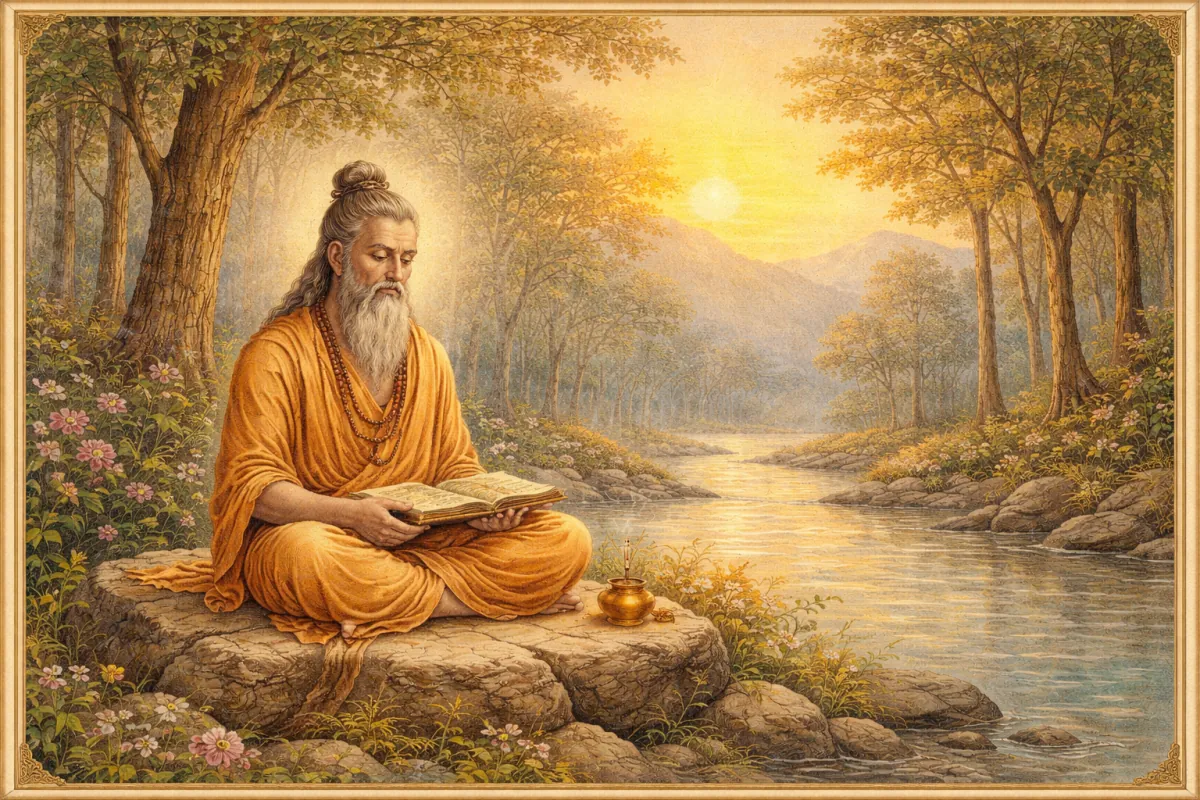
Commentary on the text Yoga Vasistha. Chapter 6. On Liberation
When you entered the spiritual path, became disciples of the Guru, members of the community, it means that you became samaya brothers and sisters. You entered a special spiritual space of ethics, a special culture of sadhus. This must be understood. When you have entered the space of sadhu culture, you must understand what the culture and ethics of a sadhu are, and leave worldly culture, the culture of the ego, of the human being, behind.
When you become disciples of the Guru, another, new life begins for you. Even if you yourselves have not yet fully understood this, it is so. I assure you, it is so, a thousand times over. In a new life one must learn to think in a new way, speak in a new way, act in a new way. When you want to act in the old way, you must understand that such a way of thinking, way of speaking, way of acting is not suitable for a sadhu. Different principles, different ethics, a different train of thought.
This is not so simple; you will feel that re-educating yourself is not easy if you are thirty or forty years old. Even twenty. The old way of thinking will constantly try to knock you off course. But this is precisely what sadhana is — re-educating yourself. Only then do you have the right to become a sadhu.
Because sadhana is not something that happens by itself. It is not a natural phenomenon. Suppose you want to eat. After you have eaten, after some time you want to go to the toilet. After some time you want to sleep. All these are natural phenomena. You do not need to learn this. Self-discipline is not needed for this. It is a given according to prarabdha karma.
Sadhana, spiritual ethics, spiritual understanding — all this is what you create yourselves. What is cultivated, what does not exist from the very beginning. It is the result of tapasya, self-discipline. When you entered the spiritual path, you must learn to act from a state of self-discipline, self-education. To cultivate a new attitude, a new work of consciousness, new thinking in order to become a sadhu. If you think selfishly — the thinking of the old person, you will not change, you will not educate yourself. In the space of such consciousness, you will not have the spirit of awakening, purification, the spirit of holiness.
The Practice of Self-Analysis and Repentance
Now we will conduct such an experiment. Whoever in the last three days has thought badly of another, or spoken badly of another, stand up. Or done so. If you continue like this, it is a sin, samaya brothers and sisters. It contradicts what I teach. I teach to see purely, to think purely; you are mistaken, this is the wrong path, even if these are small things.
You must immediately understand this, within yourselves, quickly understand it, repent, and step away from it. To repent means to say: “This is not me. I will not be like this, this is not mine.” Even if it happened, distance yourself, pull your consciousness out of it. And then make a prostration. I, as your teacher, have now reminded you of this. This is my task, to help you not go astray. When a disciple goes the wrong way, the teacher says: “Look, this is not the path you should take.”
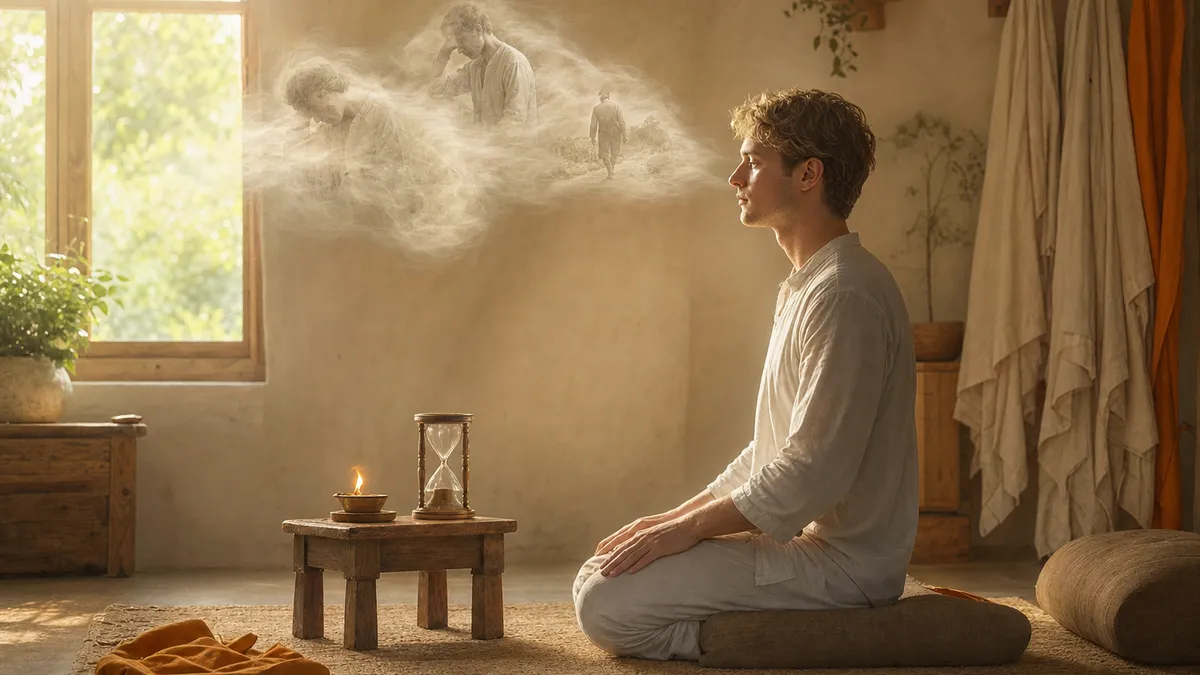
You have analyzed all this over three days, and now imagine that in such a mode you must act every three seconds. And without reminders. Not over the past three days, but over the past three seconds. You need to take this style into your arsenal. Three seconds have passed, and the analysis has immediately taken place. Not after three days. And without a reminder. You yourselves must remind yourselves.
When you learn to act this way without my reminder, you will do it after three seconds. It is not necessary to perform repentance physically; the main thing is to separate yourself in the soul from the wrong train of thought, body, speech, and mind. Then you will act as a sadhu. Acting as a sadhu, you will purify your mind, and this is the right path. This is the path of a true sadhu. For this, you do not need anyone to remind you, if you shorten this interval from three days to three seconds and do it yourselves. Because a sadhu is always very vigilant. A sadhu educates himself. One must become one who educates oneself.
The Ethics of Relationships and Samaya
We have ethics. Ethics regulates relationships with one another. We make the most mistakes in relationships with one another. Because we are very attached, we meditate on one another. We are very oriented toward the external world. Out of habit, we try to project inner negativity onto others. This is very connected with the Vishnu-granthi. All this is the karma of the knot of Vishnu being worked out.
When the knot of Vishnu is untied, all your problems in relationships will disappear. You will understand: there is no one who builds relationships. There is no one with whom to build relationships. It is one consciousness; god communicates with god. One play. Ethics will be observed naturally. But for this, one must always remember.
The fourth rule of the fourteen root vows is to maintain harmonious relationships with your dharma brothers and sisters. You must respect God in one another; you must look at one another purely. Even if karmas project something, notice it immediately and say: “This is the wrong path.” And perform repentance. Then it will be self-liberation. Constantly train yourself. Then your samaya will be flawless. The samaya connected with relationships.
The Difference Between a Sadhu and an Ordinary Person
The habit of thinking purely, acting purely, and reflecting purely does not come at once. Time is needed. You need to re-educate yourself. This is what distinguishes a sadhu. An ordinary person says: “Why on earth should I re-educate myself? I am wonderful as I am. But he is acting incorrectly; he is to blame. The problem is in him, not in me.”
A sadhu does not think this way: “I am not perfect; I am not so wonderful after all. There is perfection within me, but it is deep inside. Yet I myself have not yet reached perfection. I must educate myself. The problem is not in the other. The other is only a mirror; he reflects all my virtues and shortcomings.” A sadhu always has the issue of educating himself, unlike an ordinary person. A sadhu always understands his imperfection and works with it. When you have such a train of thought, then you are already on the right path.
There is a story of a saint who was meditating while sitting in the dark. Some worldly person passed by, and it was dark; this person urinated on him. Because it was dark. Then the saint stood up and said: “Look, ego, this is what you deserve.”
He thought like a sadhu. Whenever anything happens in your life, you should not look for the problem in other people. You must understand that this problem is in your karma, in your ego. You must understand that this is exactly what it deserves. It is your karma. Turn toward it directly, fearlessly look this karma in the eye, and acknowledge it. Then, in that moment, an understanding will arise in you: “I am not the one who receives the fruits of karma. My true Self is beyond this; I am separate from it.”
A Time of Change and the Acceleration of Karma
Now many astrologers and worldly scientists are making predictions, and in many ways their forecasts are similar; they say that a special time is now beginning. The universe is now engaged in weeding out people who do not correspond to the new spiritual vibrations. There is much speculation on this subject. The Internet is simply overflowing with speculation and reflections about the year 2012. This topic has already stirred up the minds of ordinary people as well, not only practitioners.

Previously, practitioners were fond of talking about the transition into the sixth race, the apocalypse, and so on. But now this has reached ordinary people, even scientists. Statistical data show that truly great changes are taking place. All these conversations are an indicator that major changes are ripening in the collective subconscious. The world is moving toward renewal. Now everyone feels this.
Any renewal accelerates the development of karma. Therefore, those who possess merit will receive the manifestation of merit. Those who have kleshas, negative karmic reactions, will receive the return of karmic reactions. In this case, a sadhu must educate himself in order to freeze his kleshas and awaken his merit.
Vasishtha gives Rama the following instructions:
O Rama, when you do what is necessary in a given situation, the mind should not be attached to actions, thoughts, or objects.
Wherever we may be, whatever we may be doing, our mind should not be focused on an external object, on thoughts, or on the action itself. It should abide in a certain point of clarity, a point of understanding and awareness of its own nature. Only by acting from this point can we act correctly. At this point, transmutation and self-liberation take place. This is the point at which we see God, speak with God, feel the spirit of Dattatreya, when we are one with him. At all other points, when we are attached to actions, objects, or thoughts, we lose this.
In the same way, it should not be attached to heaven, the underworld, or anything else. It should not be bound by external relationships, the natural movements of the inner senses, or the life force. The mind should be neither in the head, nor in the palate, nor between the eyebrows, nor at the tip of the nose, in the mouth, or in the eyes. It should rest neither in darkness, nor in light, nor even in the shelter of the heart. The waking state, dreaming, or deep sleep should not hold it. Even the vast pure space should not be its home.
Here, very important, unique instructions are given on the supportless state of mind. On awareness beyond concepts.
When I was in the Gayatri community and met with its leaders together with Babaji, we spoke about this state. I said, “This state is called niralambha samadhi.” Another person said, “Yes, yes.” Babaji smiled and said, “Only it must be experienced.”
If we speak about amanaska, niralambha, but do not work with it ourselves, these will be stories about eating a cake told by a person who has never eaten it. You need to learn to eat this cake every second. All my instructions are precisely stories about how to eat this cake yourself. If you eat this cake, it will gradually bring harmony into your actions, words, and relationships.
Unattached to color, movement or stillness, to beginning, end, middle, or anything else, the mind should not cling either at a distance or nearby, neither in front, nor in objects, nor in itself.
This is a very important instruction on awareness and meditation. Vasistha gave many instructions on the view in this book. But here he gives instructions specifically on meditation and awareness. View, meditation, and conduct are the three pillars of the spiritual path. Even knowing the view of Advaita, we must establish our mind in the correct state of awareness and work with it.
On the other hand, until we have learned to abide in correct meditation and correct awareness, we must remember the principles of ethics and the rules by which we live. How does a monastery differ from a worldly community? We live according to certain ethical rules. We act according to these rules. These principles, rules, and ideals are called samaya. They are very important for us. They must be observed. Because they express the spirit of the teaching, the precepts of the saints, and they express the meditative state itself.
Sensory sensations, the ignorant state of happiness, concepts, and objects should not have power over you.
If we are not aware, then sensory sensations, or concepts, or various experiences have power over us, and our mind is not stable. Such a person cannot be trusted; he is not his own master. But Vasistha says:
The mind should remain in pure consciousness, as pure consciousness, with only a slight outward movement of thought, realizing the complete uselessness of the objects of this world.
Our basic consciousness is in the supportless, objectless state, while on the surface a slight movement of thoughts is allowed. It should be enough for conversations, communication, preparing prasad, service, everyday relationships, and so on. Everything we do is a slight movement of thoughts. And the deep, true essence is in the supportless.
If you live this way for a long time, following these instructions, purification happens by itself; inner self-control and self-discipline develop on their own. But for this you must be constantly vigilant. Do not slip down to the level of the ego and the senses. They should not have power over you. Even if someone says something unpleasant to you, what difference does it make? It should not have power over you. Make a bow in your soul and praise him.
A man approached a certain saint and abused him; the saint bowed and said, “Greetings to you too,” and went on. By this he said, “These are your problems; you are unhappy, and that is why you behave this way. But I am happy, and I am not going to fall under its influence. Therefore, I also wish you happiness.” This is the humility of a sadhu; this is the spirit of the purity and loftiness of a sadhu.

You should not respond to rudeness with rudeness; you should not respond to a bad action toward you with a bad action. In pure vision, you should forgive another person, relate to him purely and with humility. Thanks to this, you will purify yourself from rebirth in the lower worlds. You will close these paths. This is the meaning of ethics, samaya, and pure vision.
Dissolution of Individual Consciousness
When all attachments are severed, individual consciousness becomes non-individual consciousness. And then what needs to happen takes place. Whether it is action or inaction. In such a state, individual consciousness is not attached to the results of action.
Gradually, if you learn to act, think, and contemplate in this way, your individual consciousness expands, and it becomes not individual but transpersonal, boundless, expanded. In such a state, it ceases to be attached to what it does. Karma ceases to affect it.
Or, going beyond even this state of slight understanding of objects, allow the individual consciousness to dissolve into supreme peace.
Within you there is this supreme peace. You must seek it until you find it. And when you become established in it, you simply need to remain in it. Then, whatever you do, you will be unshakable. Naturally, you will observe all kinds of Vinaya and samaya rules.
Signs of a Self-Realized Sage
Such a sage is forever free from suffering and fear, whether it seems to others that he is acting or inactive. Everyone loves and honors such people. Even if in the eyes of others he appears agitated, inwardly he is rooted in wisdom. His consciousness is not adorned by happiness, and he is not darkened by misfortune. He pays no attention to the brilliance and attractiveness of the world. Having attained self-realization, he lives in constant contemplation, and therefore he is attached to nothing in this universe.
The first sign that such a person has become established in self-realization is that he has no sinful activity of consciousness. Sinful activity of consciousness means obscurations, kleshas. He has freed himself from the influence of bad worlds, impure entities; his kleshas no longer have power over him. The second sign is that pure vision becomes natural for him.
Having risen above opposites, he appears to be in deep sleep even while awake.

Such a person possesses continuous self-control. Whatever he does, his self-control allows him to track the subtle space of awareness. It is impossible to make him lose his temper; he is always unshakable. He never has problems. Whether you give such a person salty prasada, sour prasada, or very tasty prasada, there will be neither anger nor indignation in his soul. Whether such a person lives in a palace, in a cell, in a foul place, or in a clean and beautiful place, there will never be indignation, protest, or anything else in his soul.
Such a person does not crave external objects. He understands: everything is within. And he rejoices in what is within, while he does not attach much importance to external objects or to other people. He perceives life playfully. He treats everyone equally and with compassion. And if someone insults such a person, do you think he will fight with him or hate him? Not at all; he will feel compassion for him. He will think: “These are his problems. It must be difficult for him if he acts this way. His mind must not yet have found serenity and peace.”
The State of Deep Sleep in Wakefulness
The state in which the intellect is freed from its inherent movement of thought and in which only the sense of peace exists is known as the state of deep sleep in wakefulness.
The state of such a saint is like the state of deep sleep during wakefulness. In the ordinary state, he walks and speaks, but he himself is as if in deep sleep. He is aware of the astral world and aware of the causal world.
Again, during the Kumbh Mela, journalists interviewed Pilot Babaji. They asked: “You were a pilot; you even had to drop bombs on people. And now you are a saint.” Babaji said: “That was many years ago; then I was different, but now I am different. Now, if you have the courage, if you wish, you may even kill me. I do not object. I will accept everything.” This is complete non-attachment to oneself and to what is done. Such saints are in the state of dreamless sleep while they are awake.
One who abides in it lives spontaneously, freed from any type of mental distraction and disturbance, unconcerned with a short or long life. When the state of deep sleep in wakefulness fully matures, it is known as turiya, or the fourth state.
This state of dreamless sleep while awake is not yet complete liberation. It is the basis of true contemplation, which opens in everyone who reaches the stage of birth. But it is the foundation for further ascent. It matures and passes into the state of turiya.
The Maturation of the State and the Transition to Turiya
Sahaja samadhi gains strength from the eighth stage through the sixteen kalas and goes further, becoming turiya, turiyatita—the fourth state beyond wakefulness, dreaming sleep, and dreamless sleep.
Having become established in it, the sage perceives the universe as a vast playground, and life as a cosmic dance. Completely free from suffering and fear, from the delusions of the seeming world, one established in the state of turiya no longer makes mistakes. He is always immersed in bliss and goes further, toward a state of immense, inexpressible bliss.
Vasishtha then says that this inexpressible bliss follows turiya. It is an indescribable and incomprehensible state.
The state of one who has become liberated in this life can also be expressed in words in this way: turya, or deep sleep, awakening, the state of complete freedom. But the state that follows this is inaccessible to description in words. It is beyond turya. O Rama, strive to attain it.
The Path from Sadhu to Jnani

Our practice should lead to our becoming established in an ever deeper state. First you become a sadhu. It takes about twelve years for a person to become a sadhu. To learn to think like a sadhu, to act like a sadhu. You move into another category of people, another race, another class. People live their own lives; they have their own culture, their own values and ideals in life. But you no longer belong to this class; it is not for you.
Having come here, having become disciples or monks, novices, you are trying to become sadhus. This means you have different ideals in life, different values, a different ethics, psychology, and way of thinking. Even your energy must become different. You need to follow another road. The path of people is not for you. Many times you will still see how your ego, your mind wants to act in the old way, in a human, worldly way, on the basis of jealousy, envy, aggression, judgment, and attachment. Then you must remember and say to yourself: “This is not my path. I must follow another path.” A sadhu acts differently; a sadhu’s thinking is different.
But the state in which a person is in deep sleep while awake is no longer that of a sadhu; it is higher. It is the state of a jnani. You can attain it if you are impeccable sadhus. If for a long time you lead the way of life of a sadhu. If you educate yourself according to the system of a sadhu. Think like a sadhu, observe the principles of a sadhu, train the mind.
Vasishtha says: “Rama, strive to attain it.” That is, strive to attain the state of a jnani. For you, this is the main task of your life. The main task of your life is to become a good sadhu, and then to attain the state of a jnani. In the world, people set many goals and tasks. To earn a lot of money, to arrange family life successfully, to receive a prestigious education — all these are goals in life. Having come here, you have renounced these goals. You have sacrificed a great deal in order to get here. Then you must understand what your goal here is. Your goal is to become a good sadhu. You must purify yourself through karma yoga, through observing the principles of samaya, ethics, contemplation, and meditation. Having become a good sadhu, you will easily be able to move into the next class, the class of jnanis. But you will need time to become a truly good sadhu. Much must be changed within yourself, much re-educated, much purified within yourself.
Vasishtha’s Instructions on Non-Duality
First become established in the state of deep sleep while awake. Remain uninterested in the existence or nonexistence of the body. Knowing that the body is only an illusion. You are wise, O Rama, and you have attained inner awakening. The mind of a person who knows his own essence does not fall downward. Here there exists only pure consciousness. Therefore do not allow the notions “I am such and such” or “this is mine” to arise in you. Even the word “self,” “I,” is used only to convey thoughts. Truth is beyond these descriptions. There is no duality, there are no bodies, and therefore there are no relationships between them. There is no shadow on the sun. Although I speak with you, assuming a certain duality, in truth there is no such division.
Only by becoming good sadhus and becoming established in contemplation will you reach the understanding of a jnani. At present, various limitations obstruct this understanding. These limitations are called mala — impurities of the mind, dualistic veils. Mala, vikshepa, avarana. Various kinds of veils in the mind hinder the understanding of non-duality. Your task is to patiently rub and rub away these veils. Sooner or later your mind will become pure. It will become like a clean, transparent mirror. All the veils will disappear, and the radiance of the higher Self will never leave you.
When the truth is known, erroneous perception disappears. One’s own essence is consciousness — pure, eternal, devoid of change. It is light in itself. Whereas the body is impermanent and impure.
When this happens, your awareness will separate and become distinct from the body. Your awareness will be able to travel separately from the body, to meditate separately from the body. You will not identify yourself with the body.
The body is animated by the life force or by other elements. It cannot stand in any relationship to the Higher Self. Even if the entities of the body are considered as separate realities, there can be no relationship between them. But if this duality is unreal, then the thoughts themselves become absolute. Let this truth become firmly established in you. There is no bondage, no liberation — for anyone, ever, anywhere. It is clear that all this is only the one infinite consciousness, the essence or the Higher Self.
When consciousness goes beyond the body, you will truly become established. Your view and contemplation will become one. This will cease to be abstract philosophy. With the help of the teaching, you yourself will be able to create your beautiful future. Why will you be able to create a beautiful future? Because you will go beyond the past, future, and present. You will separate yourself from the flow of time. As long as you are in the flow of time, it is impossible to create your beautiful future. It is impossible to create anything.
If you listen to the concepts “I am happy, I am unhappy” or “I am ignorant,” then they will bring you endless suffering.
The Nature of the Mind and Past Impressions

Our mind operates according to a certain system. The mind is a complex program, an operating system. It acts on the basis of past memory. For example, in a kindergarten in Russia there was a girl who would stand up and say: “Be cursed.” She was transferred from one group to another. The head of the kindergarten said to one teacher: “No one can cope with her. If you cannot cope, we will expel her from the kindergarten.” She was a good girl, but if she did not like something, she would speak that way. The assistant teacher said: “I am submitting my resignation. It is impossible to live with this.” Everyone was somewhat afraid of her.
When a parapsychologist was called in, he looked into this girl’s past life. It turned out that in her previous life this girl had lived in medieval Europe; she had been in an environment where everyone mocked her and no one loved her. Then she thought: “Since no one loves or respects me, let them at least fear me.” She began to study magic in order to instill fear in others. But in the end she grew old and became a useless, forgotten, abandoned old woman, who died in a state of resentment toward the world, in hatred. At the same time, however, she had accumulated enough merit. The result of such a pattern of thinking was that she became such a child.
Consciousness as the Basis of Everything
The body began to exist only from the life force. It exists thanks to this force; its speech is caused by it as well. All the senses also function thanks to this force. The intellect within it is only infinite, indivisible consciousness. It has spread everywhere like space. It is reflected in consciousness, and this reflection is called the mind. When the mind leaves its body-prison and is transported, it experiences its essence, which is consciousness. Where there is the fragrance of a flower, there is also a flower. Where there is mind, there is also consciousness. But the mind alone is the sole cause of the apparent world. Because consciousness is omnipresent and infinite. Although it is the original cause of causes, it is not the cause of the apparent world. Truly, that cause is misunderstanding.
The cause of our apparent world is delusion, misunderstanding, avidya, illusion. All living beings are, to one degree or another, in misunderstanding.
Pretas are in misunderstanding, and therefore everything appears defective and negative to them. Even if you give a preta an offering, it will not be able to eat it; it will spoil. Its consciousness is in such a state that everything is defective, everything is negative.
Asuras are in a state of misunderstanding because of intense jealousy and envy. The asura’s pattern of thinking is such that if you speak, the asura thinks that you envy him or are going to attack him. If you are silent, the asura thinks that you are hatching plans for how to attack him. If you repent, the asura thinks that this is your cunning move to lull his vigilance and then attack him. And if you do not repent, then all the more so, everything is clear with you. Not a single chance. The asura’s vision turns everything completely upside down.
The delusion of the gods of passion consists in refined enjoyment, ruling, and patronizing, and all of this is mixed with self-love.
All living beings live in those worlds that correspond to their misunderstanding. The misunderstanding of living beings creates worlds, lokas, and they gather in these worlds.
Just as a lamp instantly dispels darkness, so the light of self-awareness instantly dispels the darkness of ignorance. Therefore, one must investigate what is called individual consciousness, the mind, or the inner psychological factor.
When we begin to investigate, this is a general term for the process of turning inward, purifying and studying the diamond of awareness. We will not be able to discover this diamond of awareness and tame it right away. Quite some time will pass before we feel our way to it and begin to understand it little by little. But there is no other path. This is precisely the principle of the spiritual path: to turn inward, discover the diamond of inner awareness, purify it, and become established in its knowledge.
