

Commentary on the text “Sri Siddhanta Shikhamani”
Not only does the disciple bow to the Guru, but the Guru also bows to the disciples. Perhaps not physically. But I can bow physically as well; it is no problem for me. Why does the Guru bow to the disciples? Because the Guru knows well who the disciple is. He is Shiva. The disciple may not know this, but the Guru is the Guru precisely because he knows it. It is just that this Shiva lacks something, does not understand something. Something needs to be purified, something needs to be understood, so that he will believe in it. And not merely believe, but actually feel it; and not merely feel it, but manifest it as wisdom, power, clarity, happiness—the various shaktis that would free him from the backpack of karma that this Shiva has attached to himself. He decided to play, but for a certain moment forgot that he is Shiva, and this backpack of karma stuck to him. Such is the situation.
The Path of Self-Surrender and Non-Duality
“One should perceive Shankara as the one who inspires and impels to action, and oneself as the one who is impelled, guided. One must constantly worship Him with such an attitude and not strive for non-duality.”
“Not strive for non-duality” means that non-duality will find you by itself if you practice well. If, while being in a dualistic state, not yet having purified karma, you strive so simply and immediately for non-duality, then you have no platform, no foundation for this non-duality. But when you establish the right connection with God, God gives you from within the darshan of self-recognition, and non-duality, as it were, overtakes you, envelops you, and reveals itself as the most natural nature. But when we strive for non-duality, it is something artificial, false.
Such an artificial striving for non-duality (intellectual, perhaps egotistical, when Advaita is perceived without self-surrender, without devotion on the lower tattvas, that is, through the manas-tattva and through ahamkara) is fraught with nihilism and various kinds of errors such as “loss of action in the View,” “loss of awareness in the View.” Therefore, on the path of kriya-pada, the sadhu gives himself into the hands of God, and God grants him the darshan of non-duality. Such is the path. If, without giving ourselves into the hands of God, we strive to know non-duality at once, then Shiva may play various tricks on us, explaining the difference between the View and behavior.
The soul must feel God as the guide, as the Ruler, as the Lord, as the one who must always and everywhere be trusted, as the one on whom one must always and everywhere rely, as protection, as support without support, as that before which one must always surrender, as that to which one must devote oneself, as that which must be loved, discovered, kept in one’s heart, followed, and to whom one must dedicate all one’s actions, all one’s merits, every word, every thought, every breath, every kopeck of profit, every success and every failure. This must be such an intimate and close state that you always have somewhere to send all of this, someone to whom to dedicate all of this. And then life becomes a blessing. This is the path of self-surrender (prapatti-yoga), atma-nivedana (surrendering oneself to the Atman). If we do not have such a spirit of self-surrender, we will inevitably come to a standstill in spiritual life, because practice will inevitably expose our karma.
The Process of Purifying Karma
What are method and sadhana? They are a plane that shaves off the coarse layers from us, and behind the coarse layers subtle layers appear; it shaves again, and behind the subtle layers even subtler layers appear, which can no longer be ignored. The coarse ones can still be ignored within oneself, but the subtle ones... You no longer know where you yourself are and where these layers are, who will ignore whom, who will be guided and who will guide. This plane keeps shaving further, and there are even subtler layers there, where even our identity is lost, where we do not quite understand what the difference is between us as the observer and the observed. This is the process of purifying karma.

If one does not practice, karma will not be purified; it will remain, prarabdha karma will gradually unfold, and sanchita karma will lie dormant until the next incarnation. But one who walks the spiritual path applies methods that, like a plane on wood, shave off these layers one after another. And if this is done without the spirit of self-surrender, faith, devotion, the ability to rely on the Refuge, Guru Yoga, Ishtadevata Yoga, such subtle karmas will inevitably be laid bare, and we will feel that we are vulnerable before them, defenseless before them, because they are subtler than we ourselves are. Within us there is something more subtle than what we think of ourselves. And here we will give in, we will be tempted, enticed, and carried away by these karmas. This is precisely what happens to all living beings in the cycle of reincarnation.
But since we have decided to leave this cycle of reincarnation, we surrender ourselves only to God. If you are a strong sadhu with the samskaras of jnana, then your surrender will be more contemplative in nature. You take the position of Vedanta, neti-neti, and say: “I will not settle for anything less than the Absolute. I will firmly hold to view, contemplation, and conduct.” But if you do not feel such strength of jnana within yourself, if it has not yet been revealed, then devotion, love for God, faith, and self-surrender are very important.
Spiritual Maturation
This is not something that comes immediately. The soul is unskilled in spiritual life, and for the first twenty-five years of spiritual life you will be like a teenager. In fact, monks’ age is counted from the moment of monastic initiation, that is, they are like children for the first twelve years. Only after twelve years do they enter adolescence. That is, in the spiritual sense, they are only being born. A karma-sannyasi can also count his spiritual age from the moment of initiation. The physical age may be thirty or forty years, while the spiritual age from the moment of transmission, of entering sadhana and tapasya, may be only five years. A five-year-old child, a ten-year-old child... Then comes the difficult adolescent period, when people speak of “difficult children,” when there is opposition to parents and society, self-assertion. This also happens in spiritual life, when a monk has received certain experiences, has realized something within himself, and he is searching for his place in the Universe, in the sangha, seeking a new identity for himself. The old identities seem to have exhausted themselves, while the new ones have not been found. And he too begins to go through such difficult periods.
Love for God, devotion, and self-surrender will harmonize all of this; they will make all of it unimportant. One who has faith and devotion to God thinks: “Whether my period is difficult or easy, whether my planets (vidyas) are very harmonious or the grahas are simply tearing my soul to shreds, all of this is unimportant! I surrender everything to God, both the bad and the good. Whether my karmas are like this or not like this, I surrender all of it to God as well.” A jnani does this in the spirit of contemplation, self-liberation, and contemplative self-surrender, while one who follows the path of faith and devotion does it in the spirit of faith and devotion. But the most favorable combination is the combination of these two paths: bhakti and jnani, kriya-pada and jnana-pada.
Two Paths: Markata-nyaya and Marjara-nyaya
There are two paths called markata nyaya and marjara nyaya. Markata nyaya is the path of the baby monkey, which leaps after its mother from branch to branch. The mother moves, and the baby learns from her; it actively manifests its own position and learns. Marjara nyaya means the path of the kitten. The kitten does not need to search for anything else; it only needs to say, “Meow, meow, meow,” and its mother will take it by the scruff of the neck and carry it where it needs to go (to water or to milk, or show it to the owner); it only needs to call its mother, it relies completely on its mother, it knows nothing else, but trusts its mother, and the mother solves its problems.
The path of faith and devotion is closer to the kitten; the path of the baby monkey is closer to yoga-pada or to jnana-pada. We combine both paths; we are not one-sided bhaktas or one-sided jnanis. All four padas must be present in spiritual life. When all four padas and these two main approaches are present in spiritual life, this is the best and most correct path. In view, we rely completely on God; that is, view is reliance on God. In contemplation, like the baby monkey, we ourselves try to contemplate and also to follow God through contemplative practice, personal will, and personal effort. We manifest personal will as sadhus, but this personal will is attuned in unison with God and is completely devoted to Him. That is, our sadhana is not for the ego; it is for better understanding the divine will and carrying it out. Thus, our motivation is like that of the kitten, while our contemplation and conduct are like those of the baby monkey. Our view is like that of the kitten, and our contemplation is like that of the baby monkey. Such is the combination.
Ramakrishna first came through devotion. At the slightest thing, Ramakrishna would say: “Mother, Mother!” He worshipped Kali. And then jnana awakened within him, and he became a good, strong jnani. When jnana awakened in him, he went beyond Kali. After all, he always called upon the Mother: “Mother will bless me! Mother will protect me! Great Mother!” But then, when he went beyond the worship of Kali, he became a jnani, and a jnani means that a yogin begins to move from his narrow conception of the Ishta-devata to an all-embracing view, seeing the unity of all gods and all paths in his Ishta-devata and in his own path. Then Ramakrishna went and received Vaishnava diksha and for three days walked as a Vaishnava. A devotee of Kali himself received an orange dhoti, prayer beads, a mantra, and worshipped Vishnu. Then he received Muslim diksha and walked as a Sufi. He worshipped Radha, Krishna, then worshipped Vishnu, then was like a Sufi, then he received the blessing of some Christian saint and worshipped Christ. He said: “Three days were enough for me to receive from any tradition the same grace that I received in my own tradition.” And since he was an absolutely purified and prepared soul, within three days he received blessings everywhere. After three days Jesus appeared to him. He passed through various kinds of upasana until all the forms of the gods dissolved into the non-dual view, and he simply took up the principle of the non-dual view. That is, Ramakrishna is known as a great devotee (bhakta), and in the end he manifested as a great jnani, as an Advaitist, or as a tantric jnani. He came to this ocean through reliance on his deity.
The Relationship of Master and Servant
“The Great Lord is that very Master (pati) of the world. The ‘I’ embodied in the physical body, that is, the person dependent on him, is an animal (pashu). This distinction is like that between Master and servant, but where could it arise in the case of non-duality?”
The body is like a dependent animal (pashu). The Atman (Shiva) within us is like the Lord (pati). At first, the yogin must subordinate his ego, subordinate his body to this Lord, must learn to rely on Him all the time in order to be guided by divine wisdom and divine will. Such submission does not come immediately, because at first we do not see this Lord and do not feel how to submit to Him. Moreover, we do not really understand that we need to submit. Out of habit, we act unconsciously. And the ego in general has its own concept of independence; the ego does not understand that there is something higher than it—the Source—and that one must submit to this Source for the sake of one’s own good. Asuric consciousness does not consider at all that the ego should submit to anyone. The ego has its own mental power, and it thinks: “Why should I submit? I myself am strong!” And then what? God says: “Well, don’t submit. You have complete freedom; act.”
But when the soul does not submit to God, it is always unhappy. Whatever power and relative wisdom it may accumulate, it always suffers, because happiness is contained in God; it is not contained in the ego. Happiness from the ego in ahamkara-tattva, manas-tattva, is a pitiful reflection of happiness. And therefore the yogin must come to an understanding of surrender to God, of voluntary and conscious submission to God. Moreover, he must understand that God is indeed he himself, therefore surrendering to oneself is, in fact, normal. If you have not submitted and surrendered to yourself, then it means that you are in division, that you yourself have inner problems. But because a person does not understand that God is within him, and that God is he himself, he believes that God is somewhere outside, and therefore he does not strive to submit to Him and does not know how to listen to Him.

A False Understanding of Acceptance
But a wise yogin who knows the view of Vedanta understands this and thinks: “How, then, am I to surrender to the inner God?” If the Advaitist is superficial (a neo-Advaitist), then he does not consider the question of surrender to the inner God important, because he mistakenly takes the ego to be God. His identity is established not in the first tattva, not in the fourth and not in the fifth, but in the sixteenth, in ahamkara-tattva, in manas-tattva. And at the same time he thinks: “Since everything is Brahman, then my ego is Brahman. Okay. I don’t need to purify anything, I don’t need to surrender. My ego is Brahman. I need to accept this. I accept my ego.”
There are many techniques of acceptance nowadays. You know? “Accept your lust,” “Accept your anger,” “Accept your envy.” The path of acceptance, in a certain sense, is the right path if it is understood correctly from the standpoint of the holy view of Vedanta. To accept does not mean to follow; to accept does not mean to fall into slavish dependence. But this is often exactly what happens to those who try to accept the kleshas, who try to accept the ego and accept themselves in New Age-style personal growth courses.
That is, what does “I accept Myself! I accept my anger” mean? It means that I allow myself to be angry. And when I allow myself to be angry, I become a slave to my anger. Acceptance means submission to the inner God against the background of manifestation, the complete outliving of one’s anger and any other klesha, when they lose their power. This is true acceptance. And such acceptance is always carried out through surrender. You cannot accept without surrendering yourself to God. If you accept something in yourself or in others without surrendering yourself to God, you become a slave to what you accept; you cannot digest it, you establish new forms of dependence. Therefore acceptance must always be accompanied by surrender, humility, and obedience before God.
The Search for the Inner God
And, of course, this is not humility before something external, not obedience to something external. It exists, but as training for the transition to inner humility and obedience. This is not subjugating oneself to some ideology, some concept, some name, some form. One could say that it is the subjugation and surrender of oneself to the very subtle inner voice of awareness. It is so subtle and so faintly audible that it is very difficult to understand what within oneself one should submit to and surrender to. This inner God is so difficult to recognize! Thoughts can be recognized, but if you surrender to thoughts, you will suffer, because thoughts are good today and bad tomorrow. If you surrender to subtle images in the subtle body, then the images too may be good or bad, heavenly or asuric.
The process of surrendering to God is accompanied by our constantly clarifying: “Who, then, is God within me?” And when we reach a point where we still cannot understand who God within me is, we again turn to the external God: to God in the Scriptures, to God in the Ishta Devata, to God through the darshan and instructions of the Guru. We again turn to theology and clarify that God is Brahman; He has no form, has no name; He is sarva-karana-karanam — the original cause of all causes, and we must get to the bottom of this cause. These are very fascinating investigations. Can you imagine how fascinating? To get to the bottom of the cause of everything! All conspiracy theorists can simply take a rest.
Conspiracy Theorists and the Search for the True Cause
Conspiracy theorists are very popular now; they are constantly trying to get to the bottom of everything: “Who controls everything? Where do all these roots grow from? Where is this whole world structure of global governance? What worldwide conspiracy is preventing us from living peacefully?” They feel that something is wrong with this world and they search: “Someone is probably to blame; someone organized a global conspiracy. Exactly, some kind of spy Masonic conspiracy. Someone is preventing us from being happy. Someone is preventing us from living joyfully and happily, loving, being enlightened.” They are people of great clarity, after all. These are retired military personnel, officers who have free time and access to the internet. They search for documents, investigate, and constantly engage in this kind of vichara. For what purpose? In order to know what the cause of suffering is. That is, in essence, they are performing basic practices. They arrive at an understanding of the causes of suffering, but since karma and conditioning do not allow them to understand everything correctly through the scriptures, they search by roundabout paths. Some “Conspiracy of Jewish bankers,” “It turns out the Rockefellers, Rothschilds, Morgans, DuPonts are to blame for everything! And this whole large clan — the Bilderberg Group, consisting of three hundred leading clans of the world. It turns out they are the ones sucking blood!”
Other conspiracy theorists take a different path. “It turns out it is the reptilians, aliens in a conspiracy together with the U.S. government, who are taking control of earthlings and preventing us from living and developing peacefully.” This is also a very serious topic. Moreover, if you look into it, there are real facts there, so there is nothing to object to. Facts are stubborn things. A third group investigates more deeply. They say: “The physical world is only the beginning; there are egregores. And it is precisely egregores that suck energy out of people.” A fourth group has various entities: “We are all operators of consciousness. The flyers (formerly called spirits, maras), it turns out, are preventing us from living peacefully.”
And everyone has their own version, their own theory as to why there is no happiness in life, why this world is the way it is. It is simply because this is samsara. This is originally such a world, in which there is such karma, such a predisposition of the soul, such a proportion of sattva, rajas, and tamas.
The Sadhu and the Search for Sarva-Karana-Karanam
But a sadhu seeks the cause of all causes (sarva-karana-karanam) in a different way, not like a conspiracy theorist, because in fact that is a false path, since you will never find this cause by investigating the material world. A sadhu seeks it through the search for God. He understands that the cause of all causes is God. He investigates one tattva after another in order to get from the thirty-sixth tattva to the very first. There it is—sarva-karana-karanam. Ishvara is the cause of all causes! And Ishvara is generated by Shiva. Shiva is Brahman Himself, the Absolute. That is who stands behind all this! That is why everything happened in this way. That is why everything is conceived so intricately.
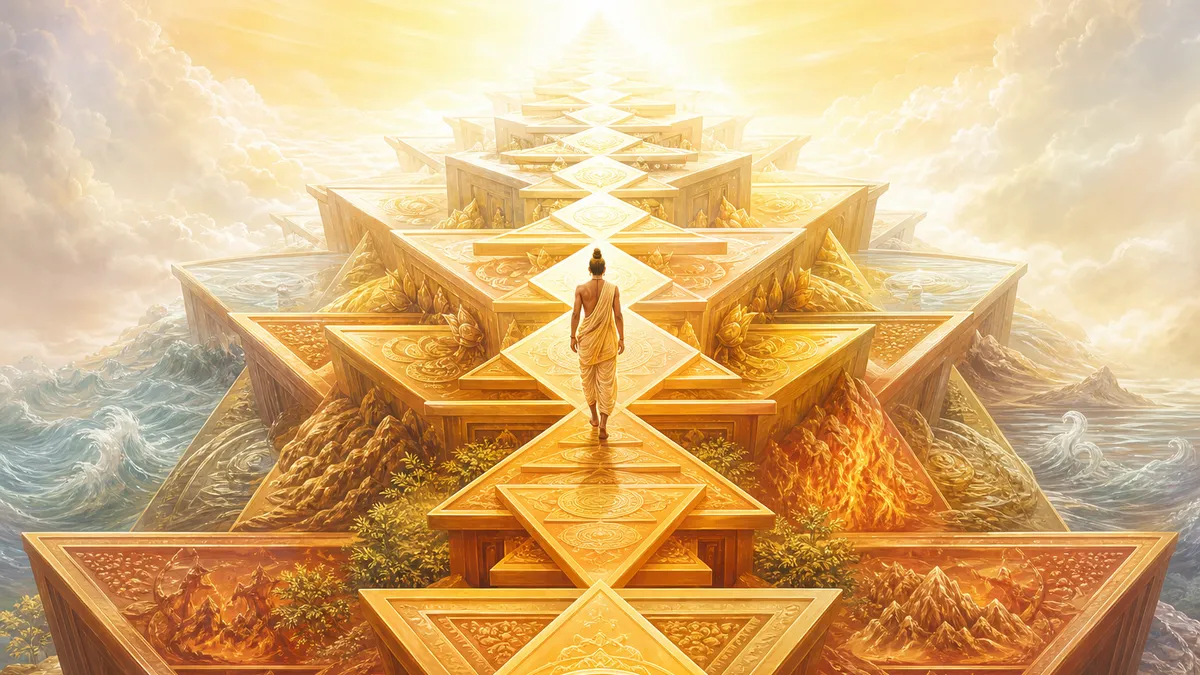
And our material world is at the level of prakriti-tattva, at the level of the five gross mahabhutas, that is, the fifteenth, sixteenth, twentieth, and all the way up to the thirty-sixth tattva. It turns out that we are on the outskirts of the Universe; we live in the grossest tattvas. The reason we suffer is that we do not perceive this cause of all causes; it is distorted in our perception. We need to ascend much higher on the ladder of tattvas.
Pure Tattvas and the Source of Eternal Happiness
And where does Liberation begin? Where does eternal happiness and eternal bliss, which cannot be destroyed, begin? It begins with the fifth tattva. The sixth (maya-tattva) is the last veil of subtle illusion, in which pralaya-kalas like to become fixed, considering it the final Nirvana. But eternal and indestructible happiness begins with the pure elements of the Universe, with the pure tattvas: Sadvidya-tattva (the fifth), Ishvara-tattva (the fourth), Sadashiva-tattva (the third), Shakti-tattva (the second), and Shiva-tattva (the first). Beyond the tattvas is that which is called Brahman, Para-tattva. The Absolute and its pure energies are the source of primordial happiness.
And in the process of investigation, a sadhu must seek within himself this absolute purity, absolute freedom, absolute wisdom, and gradually accustom himself to surrendering to it, to submitting to it. It is precisely to them that one must surrender, to them that one must submit, and to nothing else.
“When awareness of the Supreme Essence (tattva) comes, the state of non-duality also comes. It is not for everyone, not for a person devoid of knowledge. The perception of duality is the cause of actions; the practice of worship rests upon it; therefore, one who is established in such practices as the worship of the linga should not practice non-duality.”
The Non-Dual View and the Preparation of the Disciple
The practice of the non-dual view is intended for those who possess wisdom and the proper qualities. If the non-dual view becomes accessible to a person who does not possess the proper qualities, he may go astray. Therefore there is such a precept, mentioned in the “Yoga Vasistha”: not to transmit the non-dual Teaching to unprepared people. And according to tradition, the process of selecting the disciple comes first. That is, the disciple must possess the appropriate qualities described by Shankara; if the qualities are absent, they are cultivated. This is called the cultivation of qualities, the sixfold qualities of sattva. In addition to this: viveka, vairagya, and the aspiration for liberation. When the process of selection and cultivation of qualities is complete, the Teacher transmits knowledge, transmits the philosophy, naturally together with faith, devotion, and Guru Yoga. When the knowledge has been transmitted, the disciple meditates and attains the experience of non-duality. Such is the traditional path.
The concept of non-duality should not be extended to the objects of Refuge, because one can destroy faith and devotion through the thoughtless application of non-duality where it must be applied correctly. For example, with regard to the objects of Refuge, we practice duality within non-duality. This means that we understand both identity and difference (bheda-abheda). If, with regard to the objects of Refuge, we apply only non-duality, non-distinction (abheda), then what does this mean? We look at the murti of Shiva and the murti of Dattatreya and think that in an absolutely non-dual state there is no difference between worship and non-worship, between devotion and non-devotion, and therefore we have no motive to cultivate devotion. There is no difference between a stone and Shiva, between worship and an offering. If we handle non-duality incorrectly, it can hinder us in spiritual life.
Therefore Sri Ramana Maharshi said: “Do not transfer the principle of illusoriness to the objects of Refuge: to the Guru, to the chosen Deity, to that which you worship; otherwise, at the beginning of spiritual life, this may hinder you.” But when you learn to combine worship and the spirit of non-duality, this is already practice in the style of anuttara-tantra. Then there is no difference between the worshiper and the worship.
“Everything that consists of elements (earth and others) is the result of creation, and the creator is Maheshvara. In reality, all this is not Mahesha, just as clay is not the potter. This entire world is formed from eight elements, beginning with earth and the sacrificer (Atman). The whole world constitutes the body of Ishvara; this Atman governs all the elements of creation (tattvas).”
Creator and Creation: The Relationship Between Shiva and the World
The Creator is often described as a great potter, as one who shapes the forms of all living beings. But what does he shape them from? There are different theories. Some say that he shapes them from himself, from his own body. Others say that he shapes them from matter (prakriti). Just as clay is distinct from the potter, the potter is not identical with clay; he is never clay; clay is dead matter. Therefore the world is created, but He is distinct from the world. The whole world consists of Shiva, but Shiva Himself is transcendent; He consists of the transcendent dimension, while the world consists of gross matter (prakriti). At the same time, the world is Shiva. How, then, can this contradiction be resolved?

Shaiva Siddhanta says: “The world consists of material energies. All these energies are Shiva’s energies, and all of them are within Shiva’s body. But there is a gradation of energies. There are dense energies that make up the five elements, the gross mahabhutas, manas, buddhi, ahamkara-tattva, and others, and there are subtle ones. But all these are the same energies of the Absolute, the same energies of Shiva. Dense energies are the reflection of divine energies in maya-tattva—a special tattva that is also part of Shiva’s body. When dense energies are reflected in maya-tattva, they are called kanchukas.
Kanchukas — Limiting Energies
Kanchukas are limitations, subtle limiting energies. One of them is connected with desire, attraction, the feeling: “I lack something” (raga-tattva). Another is connected with the sense of being the doer: “I am the doer, I act, the fruits and results belong to me.” The third is connected with limitation in time: “I am limited in time, I am born, I die, I grow.” The fourth is connected with limitation in geography, with the notion of location in space: “I am here, they are there.” For example, right now we are definitely not in Nepal and not in America; we are here. And this knowledge itself is a kanchuka; in fact, it is ignorance. In reality, we are everywhere right now: both in Nepal and in America. But the kanchuka does not allow us to feel this.
When your conceptual mind dissolves its dualistic perception, you will feel differently: “I am here, but in fact I am like infinite space. I am everywhere at the same time; I am at any point in the Universe. It is simply that my body is here; I am more localized here, but in general, I am a quantum-probabilistic consciousness spread throughout the entire Universe. I am at any point of consciousness: right now I am on the Moon, and on Mars, and in the Kuiper Belt, and even a little at the center of the galaxy, but more so here. My body is a superposition, a point of intersection of gross fields, and therefore it manifests more here.” This is how you can feel yourself.
In exactly the same way, when the kanchuka connected with time dissolves, you will feel: “I am not born, I do not die.” Now we feel: “We are in this year, we are in this time, we are right now. We are not in the previous century.” We are definitely not in the sixteenth century, and we are definitely not in the twenty-fifth. In the twenty-fifth, souls are still only waiting; they are somewhere in potential, while the past is simply memory; it no longer exists. It is described in encyclopedias, and it is stored in humanity’s collective memory, in the collective unconscious. But we experience ourselves in the present.” But when the kanchuka connected with time dissolves, we understand: “I am always, I am everywhere, I am in the past and in the future, I am in eternity, I am not born and I do not die. My consciousness encompasses enormous stretches of time, and this time is motionless. I am localized in this particular temporal-spatial continuum only by my gross tattvas, my gross bodies, while through my spirit, my pure consciousness, I abide in beginninglessness. Akala. I am beyond time!”
Kanchukas are limiting energies that do not allow us to feel this way. But it is within us. When the kanchuka associated with consciousness (it is called vidya) envelops our body, we feel: “My knowledge is limited, I do not know everything, I know almost nothing. I need to study books, texts, sciences in order to understand something, because there is a limit to my knowledge. This is knowledge, and this is ignorance.” This is the limitation, but originally it is a reflection of the energy of omniscience within us, which has been refracted and is no longer felt by us. When such a kanchuka disappears, a feeling arises within us: “I know everything.” An intuitive feeling of omniscience, of all-knowledge, arises. And this is not just a small feeling. It is a very deep feeling. Perhaps you do not know specifically how to extract the square root of pi to the tenth digit after the decimal point. But this omniscience does not concern specific things; specific things will come later. It is about fundamental, all-encompassing, ontological, foundational knowledge. When this kanchuka disappears, such knowledge manifests in you.
“There exists neither complete separation nor complete unity for Parameshthin—the God embodied in the Atman, whose body is the manifestation of the world. Since the earth and the other elements do not possess consciousness, and the embodied Atman does not possess the fullness of knowledge, they cannot be completely identical to the Omniscient Mahesha.”
Pure, mixed, and impure tattvas
Thus, all gross elements are not Shiva Himself, they are not Dattatreya Himself. Shiva creates the Universe, but He Himself is separate from it. These are His energies, but these energies are the lower tattvas. After the fifth tattva, the mixed tattvas begin. This means that there are both pure and impure ones there. Up to and including the fifth tattva, there are only pure tattvas, and after the purusha-tattva, the impure tattvas begin. And it turns out that our level of self-identification is precisely within the impure tattvas. That is, we are so unfortunate that we have identified ourselves with the impure tattvas.
The realm of impure tattvas is samsara itself. That is, samsara is a realm in which living souls are identified with the impure tattvas. And in what realm do the gods of samsara, saints, rishis, and siddhas live? This is the realm of the mixed tattvas. There are many pure lands, magical worlds, mental worlds, mental heavens, which are called devachan. This is the realm of mixed tattvas, where there is a little tamas and rajas, but sattva mainly predominates—the realm of mental heavens. All of this is pure tattvas. Those who want to go to heaven enter the mixed tattvas. And finally, the higher realms—the causal world, the causal body, as well as turiya, which follows the causal body—these are the purest tattvas.
Samsara is a world that is also called ashuddha-adhva. Ashuddha means impure, adhva means dimension, a space-time continuum, a certain realm of the Universe. And we, our level of identity, are in the realm of impure tattvas. Our consciousness has gathered us together precisely here—in the realm of ashuddha-adhva (the impure tattvas). For some reason, our karma is such. And all seven billion beings here have such karma.
Therefore, our task is to purify ourselves so that our identity becomes established at the level of the pure tattvas. The path of surrendering oneself to God, of submitting oneself to God, is to constantly listen within oneself to Shiva, who consists of the pure tattvas, to constantly find within oneself primordial purity, primordial wisdom, primordial omniscience, primordial original beauty that has neither name nor form, to submit to it, trust it, establish oneself in it, and surrender to it. Without such self-surrender, our identity will keep slipping down to the mixed tattvas or to the grosser tattvas. The question of submitting to God within oneself, of surrendering to God within oneself, is always a difficult question, because at first we cannot clearly see this God within us. And what remains for us? To pray and pray: “Manifest Yourself, Shiva! Grant grace so that we may at least know what to submit to within us, what to surrender to?”
Question: “Guruji, do the three gunas appear when maya appears?”
In a visible form, the three gunas appear in prakriti-tattva. And maya-tattva is an even deeper state, because the gunas have not disappeared. Maya-tattva is the three gunas in equilibrium, while prakriti-tattva is the three gunas in subtle manifestation; they become visible to us, perceptible.
Question: “Therefore, when the divine energies are reflected in maya, do the pure-impure tattvas appear, because those three gunas are still there?”
Yes, the kanchukas. All of this is also the play of the gunas.
“If Mahesha is considered omnipresent, then He must be worshiped in everything, and not only in the linga. Therefore, one who is devoted to the linga must abandon the notion of Shiva’s omnipresence. Although Shambhu is omnipresent, He is present in a special way in the Ishta-linga (His home); therefore, the devotee should worship Shiva in the Ishta-linga, without being distracted by His presence in other places.”
Worship of the Ishta Devata and Non-Duality
What is meant by this? Here it speaks of worshiping the linga (lingam), but this is the same as worshiping the Ishta Devata. That is, if you worship the Ishta Devata, you must believe that Shiva is present in the Ishta Devata at this very moment, right now. And although you hold the non-dual view according to which Shiva is present everywhere, including in a stone, you must not be led astray by this view, since your devotion must be cultivated in the process of concrete worship of a specific Ishta Devata. This is the approach of kriya-pada.
What does the Anuttara Tantra say in this case? The approach of jnana-pada and the Anuttara Tantra is as follows: in view, we abide in non-duality and consider that Shiva is everywhere; we consider that our chosen Deity is the unity of all deities; in contemplation, we abide in open awareness, like the sky, and unite open awareness by integrating it with the Deity in a state of self-surrender; and in conduct, we cultivate worship and devotion to the specific Ishta Devata whom we are worshiping at that moment. Then there are no contradictions.
“Although Shiva is omnipresent, He is represented in a special way in the Ishta-linga, His refuge. The omnipresence of Mahesha is confirmed by all the Sacred Scriptures, and yet, when worshiping Him, the main places of His abiding are the Ishta-linga and the like.
Since the whole world, animate and inanimate, arose from Mahadeva, it cannot be different from Him, just as a pot is not different from clay. The world that appeared from Shiva-tattva is not different from this tattva, just as foam and waves are not different from the ocean. Just as a cloth, having arisen from threads, consists of threads, so too the world (moving and unmoving) appeared from Shiva and is considered Shiva Himself.”
The Three Principles of Creation: Nada, Bindu, and Kala
There are three concepts: nada, bindu, and kala. Nada is the Absolute Himself, sounding as the sound OM. When the humming of the Absolute arises in the Absolute, this is nada, the primary transcendental sound, and it corresponds to the first tattva. That is, it is the Absolute, full of potency; He is not yet creating, but He is filled to the brim with such potency. He is ready to create, and therefore He hums. The vibration of the sound OM, the humming, when at the end we pronounce Ommmm and everything dissolves—this is the principle of nada.
Bindu means that the transcendental humming of the Absolute grows into a condensing bindu, from which a flash of singularity occurs and a new creation appears. This is the principle of the second tattva. That is, bindu means that the sound has condensed in order to form another new Universe, to set the process of Creation in motion, to unfold time and space, and to create the causes for the manifestation of different beings.
“Kala” means “signs, varieties, multiplicities.” Kala means that emanations have appeared, carrying diversity. These are the subsequent tattvas, when differentiation takes place, seed syllables, deities, gods, attributes, and mandalas arise. The gods and attributes manifest in the form of the gross five elements and living beings, and the entire manifold world, the entire manifold material Universe, being the intersection of different shaktis, begins to be created, to manifest, and to appear.
Another name for all of this is Shiva, Shakti, Nara. That is, nada, bindu, kala are the primordial undifferentiated Shiva as the Absolute, filled with the potency to create; then the flash of singularity from the bindu, from which the Universe and the diversity of creation begin to unfold in compressed form, when the Gods, tattvas, attributes, and seed syllables, spreading endlessly, begin to form the subtle world, human bodies, and the diversity of material elements.
“Shiva abides in the form of the world through the unfolding of His Shakti, just as fabric takes the form of a tent when it is stretched. Therefore this entire Universe, moving and unmoving, is filled with Shiva and consists of Shiva, exists together with Him, and is inseparable from Him, like the snake from the rope.”
The Illusory Nature of the World
Our world and our Universe, other worlds and other Universes—all of this is a single mass of pure consciousness. In fact, on the subtle level this world is pure Light, which is homogeneous. It is present in dream sleep, in dreamless sleep, in the gross material world, in the world of the gods, in the world of hells, in the world of asuras, in the world of spirits. Everywhere you will find the very same quantum-probabilistic, blurred picture of the world, which consists of pure Light. But at the same time, within this Light, diverse shaktis are endlessly born from bindu particles, forming new Universes. And these shaktis seem to stitch through this homogeneous Consciousness, creating various worlds here and there. In the same way, our world too is stitched through with these divine shaktis. Thus arises the three-dimensional illusory hologram of our Universe or of other Universes, but all of this is only the play of this divine shakti upon the fabric of the single awareness of Shiva.
“The world shines in Shiva, in whom there are no distinctions, and who is eternity (sat), consciousness (chit), and bliss (ananda). Just as a snake is seen in a rope, the outline of a thief is seen at night in a post, and water in a mirage.”
In other words, when we look at the material world, we take it for what it is not. It seems that way to us, but appearance possesses great power. Even scientists have come to the conclusion that all objects are, as it were, empty inside, because if one measures the distance between atoms and electrons, it is enormous. That is, atoms and electrons themselves are not pressed so tightly against one another; there is a huge distance between them. From the nucleus to the electron there is a huge distance, from one nucleus to another there is a huge distance, and between them there is emptiness. Then the question arises: “Why are we not permeable?” The atoms of one and the other are at a great distance from one another; they could simply pass through one another like a mesh. The point, however, is that they also possess energy, and there exists an energy that creates the illusion of materiality, of impenetrability.
In reality, there is nothing dense or material. But the illusion is such that we are mistaken and consider this world to be truly existing, taking it for what it is not. For example, there is a saying: “There is no need to saw off a hare’s horns.” Because it does not possess them to begin with; there is nothing to saw. Or: “No one will marry his daughter to a man who has saddled a rainbow.” Why? Because such a man does not exist. Or: “No one will break a sweat climbing a staircase seen in a mirror.” Why? Because it is impossible from the outset to climb that staircase. And water from a mirage cannot quench thirst, because from the outset the water in a mirage is not real. But often this is exactly how we act.
Recently I was in Zaporizhzhia and gave a lecture. There was an open satsang. There were people there who had also studied something and meditated. At times they stood up and asked me strange questions. It seems they did not even understand what I was lecturing about: “Why do you divide things into this and that, into religions and traditions?” It is the same as asking me: “Why do you offend Ussuri tigers?” I have nothing to do with tigers; I have never even seen them in my life. That is, the question is completely misdirected, and what can you possibly answer to such a question? The very fact that you begin to answer such a question is already foolishness; that is, even answering it is foolish. But these people, who had read something and studied something, were trying to find some flaw in what I was saying, while not understanding themselves what they were asking. I simply laughed. There is not even anything to talk about here.
But if we transfer this situation to the entire material world, then it is the same thing. There is no point in thinking about the name of the child of a barren woman, because from the outset that child does not exist. It is the same with the world, with the Universe. But we are constantly mistaken, constantly confused. There is no point in competing with a king from the future, because his kingdom threatens no one; it simply does not exist, no one has seen this king, his kingdom is invisible, it has not yet manifested. But souls are constantly bewitched, enchanted by this illusoriness, and then they act, realizing manifold karmas and accumulating new ones. Then they come to the conclusion that they need liberation from all of this, that they are tired. But if they understood the principle of illusoriness, they would immediately enter the state of freedom and dance with happiness and joy.
In the “Yoga Vasistha” there is a chapter about three princes who never existed. Those who have read it probably remember how they ate from saucers that never existed food that no one had cooked, and these princes were originally unborn. That is, all of this becomes absurd. The unreality of existence is revealed when we realize that everything proceeds from the first tattva. Only Shiva is real, and everything else is no more than the play of His energies. The main thing here is not to “overdo it” and fall into nihilism. That is, we must take the play of energies into account, because such is our given reality, but take it into account only in behavior, not in view. If we take it into account in view, then we make the mistake of eternalism. There are two mistakes: nihilism and eternalism. In view, we must see complete illusoriness, while in behavior we must take things into account. Then we are in the middle.
Shiva’s Special Presence in the Hearts of Devotees
“Just as a tree exists by taking the form of leaves and branches, so the one Shiva manifests in the form of the earth and the other elements of creation. Although Shankara, Parameshvara, is present throughout the entire world, being its Atman, He nevertheless shines especially in the lotus of the hearts of devotees. He abides in a special way on Mounts Kailasa and Mandara, in the Himalayas, on Mount Meru, and in the hearts of His worshippers. Just as the universal Atman, having divided itself, lives in all bodies, so too Shankara eternally shines in the hearts of His devotees. O Rudra, this auspicious body of yours in the form of the linga, peaceful and sinless, eternally shines in the hearts of those who belong to you. Thus speak the eternal shrutis. In the pure, unattached to worldly existence, endowed with the power of discrimination, bearing the marks of Shiva—in the hearts of such great people dwells Shiva, the Universal Atman. Parameshvara eternally shines within the Maheshvaras, who are constantly content and who have destroyed the fruits of karma through knowledge. A Maheshvara, having no attachment to other gods besides Shiva and being fully immersed in worship of his Ishta-linga, becomes a prasadi when he realizes this world as a manifestation of Shiva.”
Submission to the Inner God
Submission to God, self-surrender to God, humility before the inner God—this is inner work that requires constant attentiveness. For example, pride arises in us. But in whom does pride arise? It arises in the mind, in the ego. When it manifests, we must say to ourselves: “Mind, what have you imagined for yourself, what have you conceived about yourself, who are you? What do you amount to? Are you not a conglomerate of thoughts, are you not a product of society, upbringing, and a set of various stereotypes?” This is similar to what Kozma Prutkov said: “People are like sausages: what they are stuffed with is what they carry within themselves.” “Mind, are you not such stuffing? What do you think of yourself? Surrender to God within.” When we think in this way, pride disappears, and divine majesty truly begins to manifest.
Divine majesty and pride are different things. Pride is a klesha, while divine majesty is grace, but it no longer belongs either to the ego or to the mind; you do not desire it. You simply bathe in the experience of divine majesty, but you cannot appropriate it, cling to it, abuse it, or make it the prey of the ego, because the ego surrenders to it.
Submission to the inner Atman, surrender to Him—this is the work that a sadhu must perform daily. But if the ego is disobedient, if the mind is disobedient, they do not want to surrender, they do not want to submit; they want to pursue their own policy, they constantly want to act in their own way. And this is permitted. Divine freedom (svatantrya) allows it. As they say, “by the Lord’s allowance.” That is, it is permitted, but then it brings suffering. When the mind voluntarily goes astray, becomes utterly entangled, it begins to suffer, and then it begins to pray: “God, save me!” But from the very beginning, one should not have departed from one’s own nature.
The mind of a true sadhu is like a bird sitting on the mast of a ship that is heading out into the open sea. This bird does not fly far away. It flies around and sees that there is only sea all around and nowhere to land, so it returns again to the tip of that mast. A wise sadhu keeps his mind like this bird: he does not let it fly far away; he subdues his mind, like this bird, to God. The same is true of the ego. A wise sadhu does not allow his ego to grow, does not allow it to seek goals outside God, does not allow it to make plans outside God, does not allow ambitions to arise outside God, does not allow it to strive for fruits and results outside God. In general, he keeps the ego on a short leash; he constantly teaches the ego to submit to God and surrender to God; he teaches it to listen to God, to be humble and obedient to God.
This has nothing to do with anything external. It does not mean submitting to some person, obeying in a superior-subordinate relationship, listening to someone outside, or surrendering to something external. We are speaking, first and foremost, about an inner process. External ethics exists, but it is only a reflection, a hint of this inner work. The traditional practice of obedience, of course, exists in all the religions of the world, in all the ashrams of the world, in monasteries. This is normal! But it is only a precursor, a training, a faint reflection of true submission and true obedience within. Such external ethics or rules of self-discipline are only, so to speak, a demo version, a sample, something experimental: “Here, try what it is like to be in submission, in obedience, in humility. And then do the same thing within.” That is, outwardly, no one especially needs your obedience and humility; no one craves it. It is needed by the disciple himself, so that he may learn it within. The most important obedience and humility are internal.
When a person has acquired some inner obedience and already possesses inner self-discipline, then the external is not particularly necessary for him, although some people leave it that way for their whole life. For example, Saint Francis, who was the founder of the Franciscan Order, was very humble and obedient. He was so humble that he was even afraid to take a step without God. And once, when he became the head of the Franciscan Order, he went somewhere on a journey, took a novice with him, and said to him: “So that my ego does not become proud, give me some service, some seva, every day.” That is, he asked the novice to allow him to perform some act of obedience before him. He had no ego at all. He placed his own disciple, his own novice, as a superior over himself, so that he would give him seva. This is an example of holiness, when a person is completely free from ego, when he has completely submitted his ego to God.
Self-Transcendence and Self-Recognition
The work of a sadhu consists in constantly listening to God within himself, and not only listening, but hearing. After all, many try to listen, but who hears? And it is not enough to hear; one must submit to His voice, be completely devoted to Him. But the ego is always inclined not to submit, but to do things its own way. And each time the sadhu must hear that voice of God within himself and say to his ego and his mind: “Submit, devote yourself, surrender.”
When such devotion and submission to the inner God, self-giving and humility deepen, the next stage arrives — self-transcendence and self-recognition. Then the ego begins to lose its positions of power; identifications with the ego and the mind fall away. We simply stop considering ourselves to be the old ego. We begin to think: “Why on earth should I consider myself this old gloomy personality? I do not want to have anything to do with this person at all! What a strange person! Yes, he suffered, and then entered the path of liberation, but that is already finished; the work has already been done.” We begin to realize the divinity within ourselves; we want to identify ourselves only with divinity. “I am no longer this gloomy personality; I am divinity itself! I am Shiva Himself, playing in this body! Yes, in the body I still have limitations, but in my soul I am completely free.”
And the next stage is self-recognition (pratyabhijna). “I am completely free, I am happy, I am a happy being. I am not an unfortunate being confused by the mind and karmas; I am a completely happy and completely fulfilled being; I am a completely whole (purnatva) and pure (unobscured) being. Self-recognition means that we make a discovery about ourselves and think: “Wow! I could not even have imagined that I am so pure, holy, and divine!” But we do not consider this “I” to be the body, the ego, because there is a great chance of making a mistake. It should never be projected onto the mind and the body. Let the mind and body know their place. As Swami Janardan Nair said: “I myself am dirtier than a dog. This is all Guru Brahmananda; it is all by his grace.”
Establishment in Divine Qualities
A sadhu relates to his mind and body with humility; he does not consider them divine. But within himself he fully identifies himself with God, and he recognizes himself as one with God. When surrender has taken place, he completely changes himself; his identity changes completely. He no longer identifies himself with that former person, the gloomy personality he once was; that is already finished.
Then he gradually becomes established in new qualities:
Purnatva (wholeness): “I am whole! I need nothing for happiness. Nothing at all, except food and the ordinary needs of the body. Psychologically, inwardly, I am happy through God Himself. I can pour out and transmit this happiness to others who are in need, but I myself need nothing, because happiness is within me; I myself am the source of happiness!”
Svatantriya (freedom): “I am absolutely free! Freedom is my essence! I abide in this freedom; nothing can limit me. The body has limitations, but the spirit has no limitations. I am the very essence of freedom!”
Nityatva (eternity): “I am eternal; I no longer fear reincarnation, I do not fear the passage of time, because I know that what is within me is eternal and indestructible. The body is born and dies, but I am eternal, I always am, I cannot go anywhere. In principle, as consciousness, I cannot disappear anywhere at all; I always am and I will always be. What I considered to be myself is no longer me. I am what I now consider myself to be. I am eternal, I am everywhere, I am everything!”
Vyapakatva (all-pervasiveness): “I am present everywhere! The entire Universe is my great body. As consciousness, I fill everything.”
Sarvajnatva (omniscience): “I know everything! Even if I do not know everything in detail, I know the essence of everything. I myself am the source of infinite knowledge. I no longer need to read books. This knowledge is present within me.”
This is experienced when such self-recognition of Shiva-tattva (Shivatva, the nature of Shiva) takes place within us.
The Nectar of Surrender and Joyful Self-Recognition
All these qualities are the qualities of Ishvara, the qualities of Shiva. When they open within us even to a slight degree, it means that from now on these pure tattvas and pure qualities will grow and grow, deepen and deepen. And all we need is to remain in a state of surrender.
Therefore it is said that the highest practitioners drink the nectar of surrender. They have completely entrusted themselves to God, completely surrendered, completely submitted to Him; all their suffering has ceased once and for all, and they simply remain in this, abide in it. This is true nididhyasana.
All that remains for them is joyful self-recognition, when the yogin realizes: “Oh, I am also like this, and also like that!” It is like discovering presents under a Christmas tree: “Another gift like this, and this one, and this one! How many of these gifts are there here?! Infinite!” One shakti is blessing, a second is grace, a third is grace, a fourth is grace! You think: “How many more of them are there?!” Infinite! Such a yogin constantly abides and bathes in grace.
This is the result of surrender, but for this one must truly, with all one’s soul, learn such surrender:
- Learn not to have one’s own ambitions, yet not lose oneself, but act correctly
- Learn not to have one’s own plans, but to surrender to God’s plans
- Learn not to have one’s own desires, but to learn to fulfill God’s desires
- Learn not to cling to one’s own will, but to be a conduit of the divine will
Inner Self-Worship
There is a text called the “Ashtavakra Gita,” where the saint Ashtavakra sings:
“Wonderful am I! I bow to myself!”
Self-recognition is always linked with self-worship. When you recognize your nature as Shiva, you cannot help but worship it; therefore you worship this inner nature of Shiva, this inner God. You cannot help but worship Him. He can only be worshipped; nothing else can be done with it. And who worships? Your mind, your ego within, having realized its inner God, begins to surrender to Him, submit to Him, give itself over to Him, and worship Him.
Therefore, the path of Anuttara Tantra is inner self-worship, inner surrender, and inner self-recognition (pratyabhijna). This does not mean that the ego wants worship from others, some honors and privileges. Inner self-worship means that you have discovered God within. You cannot ignore Him, you cannot relate to Him indifferently; you are endlessly delighted by Him, amazed by Him, in awe of Him, endlessly surrender to Him, endlessly listen to Him and desire to be one hundred percent guided by Him. And then the grace emanating from this inner God (anugraha-shakti) liberates your mind and your identifications.
Bhagavan Shri Guru Dattatreya Avadhuta ki — jai!
