

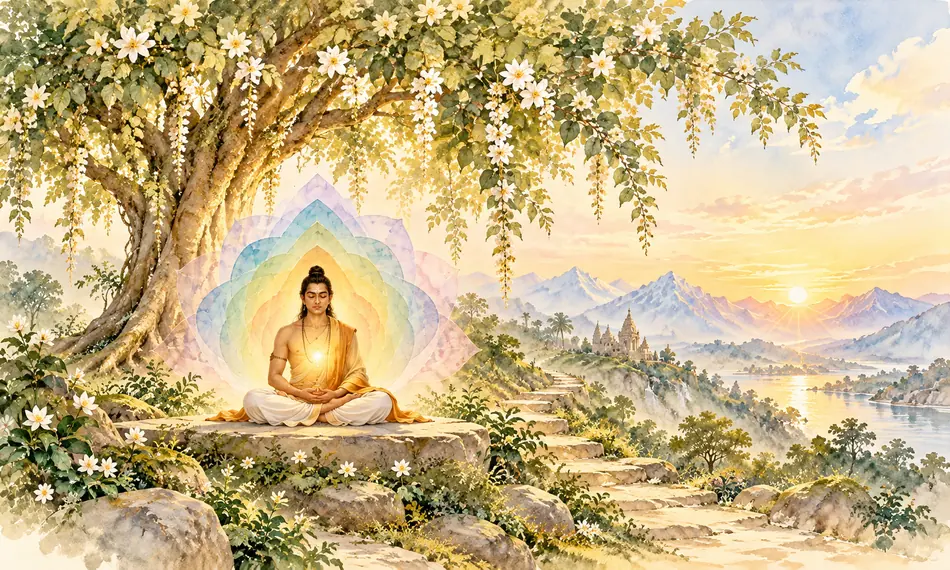
We all follow the path of Sanatana Dharma. In its spiritual realization, the soul seeks its Self; it slowly ascends the path that leads to Liberation. This is an immense journey through cycles of birth and death. Ultimately, this journey culminates in a direct, steadfast, indestructible experience of God. When this journey is complete, the soul is liberated from the cycle of birth and death, from dependence on samsara, and transitions into a new state—the state of nityasiddha, nityamukta. It is an eternally perfect, eternally free soul. It continues its infinite existence in complete unity with the divine source.
We are currently in samsara, which is why this unity has been lost; we have to overcome enormous difficulties in order to gradually restore it. It was lost because our soul encountered dense layers of universal energies, gross material energy, and for a time lost the memory of its divine nature. In order to exist, our soul began creating sheaths (koshas), and in the process of creating these sheaths it became so entangled that it lost the memory of its divine, pure, expansive nature. It began to identify itself with the sheaths; the sheaths began to obscure the light of the divine Self; identification and life in illusion, in samsara, began.
But now, apparently, our soul has come to its senses, chosen the right path, and is moving in the right direction. Following the path of Sanatana Dharma means walking the path of the eternal divine law, the path of spiritual evolution.
Nine Principles of Faith in Sanatana Dharma
Spiritual evolution in Sanatana Dharma is connected with nine principles of faith, the nine shraddhas.
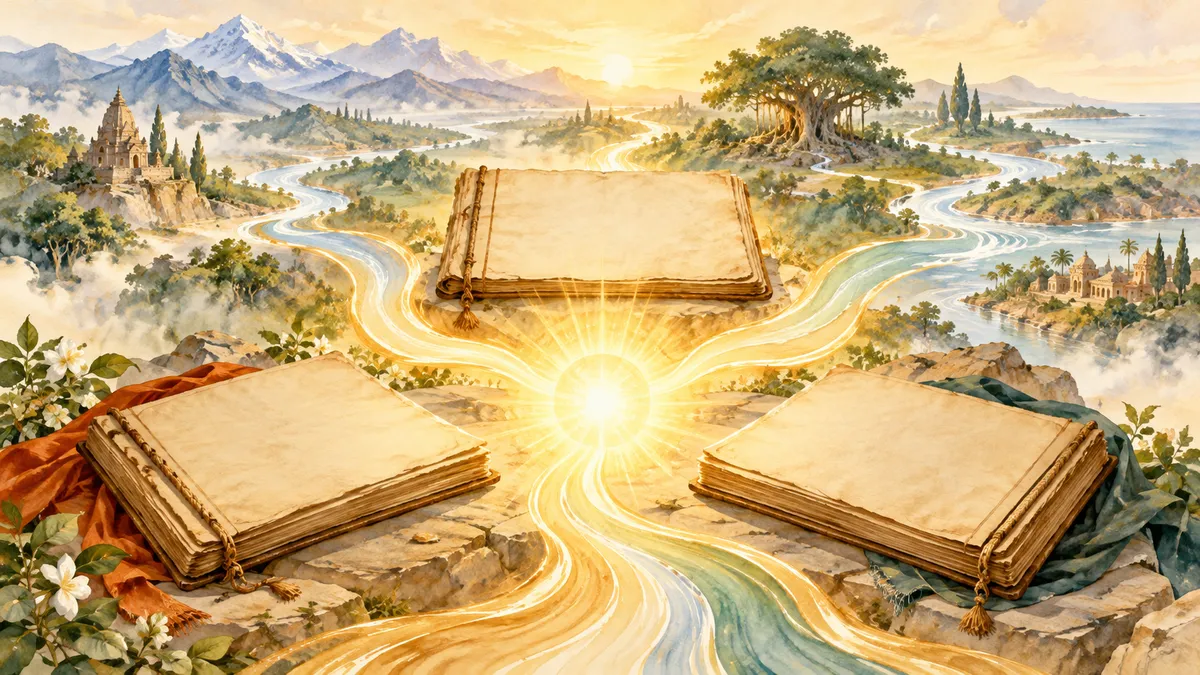
All sadhus believe in the divine light of the most ancient sacred scriptures in the world. These primordial scriptures are non-human, apaurusheya. They are the words or the energy of the blessing of the Absolute itself; they are the foundation of Sanatana Dharma—the eternal path of Liberation, the eternal religion that has neither beginning nor end. In our tradition, this foundation is the prasthanatrayi: the Bhagavad Gita, the Upanishads as part of the Vedas, and Badarayana’s Brahma Sutra (another name for Vedavyasa). And when we rely on these three original sources, we are considered to belong to the tradition of Sanatana Dharma. Then, from these sources spring countless branches: the Puranas, Itihasas, Upadeshas, and Tantras, which constitute the inner, mystical line of transmission. All of this is the Vedic tradition of Sanatana Dharma.
Those who follow Sanatana Dharma believe in one all-pervading supreme being, in a single infinite meta-intelligence—Parabrahman, who is both the creator, preserver, and destroyer of all reality.
Those who follow Sanatana Dharma believe that the universe passes through infinite cycles of creation, preservation, and dissolution.
They also believe in karma—the law of cause and effect. According to this law, each soul creates its own destiny through its own thoughts, words, and actions. Our past actions, words, and thoughts come to us in this life as karma (prarabdha and sanchita karma). And our present thoughts, words, and actions will come to us in the next life as our prarabdha and sanchita karma.
Followers of Sanatana Dharma believe that the soul reincarnates through many births until it has exhausted its karmas and attained moksha—liberation from the illusion of karma and samsara. They believe that this moksha is realized through the knowledge of divine wisdom and the acquisition of the power of divine wisdom (jnana-shakti).
Followers of Sanatana Dharma believe that divine beings dwell in invisible worlds, and that through worship, reverence, invocation, mantra, meditation, and inner visualization, one can establish contact with them and receive their blessings.
The Tree of Refuge and the Divine Hierarchy
For us, the Tree of Refuge embodies the divine beings. The gods Brahma, Vishnu, and Shiva; the rishis Vasistha, Vishvamitra, Jamadagni, Kashyapa, Gautama, Bharadvaja, and Atri; the four Kumaras; Bhagavan Avadhuta Dattatreya; Shri Adi Shankaracharya; Shiva Prabhakara Siddha Yogi Shri Guru Brahmananda—all of these constitute the Tree of Refuge with which we establish a connection. This Tree of Refuge represents the universal ladder of the cosmic hierarchy, in which we also find our place and along which we move ever higher.
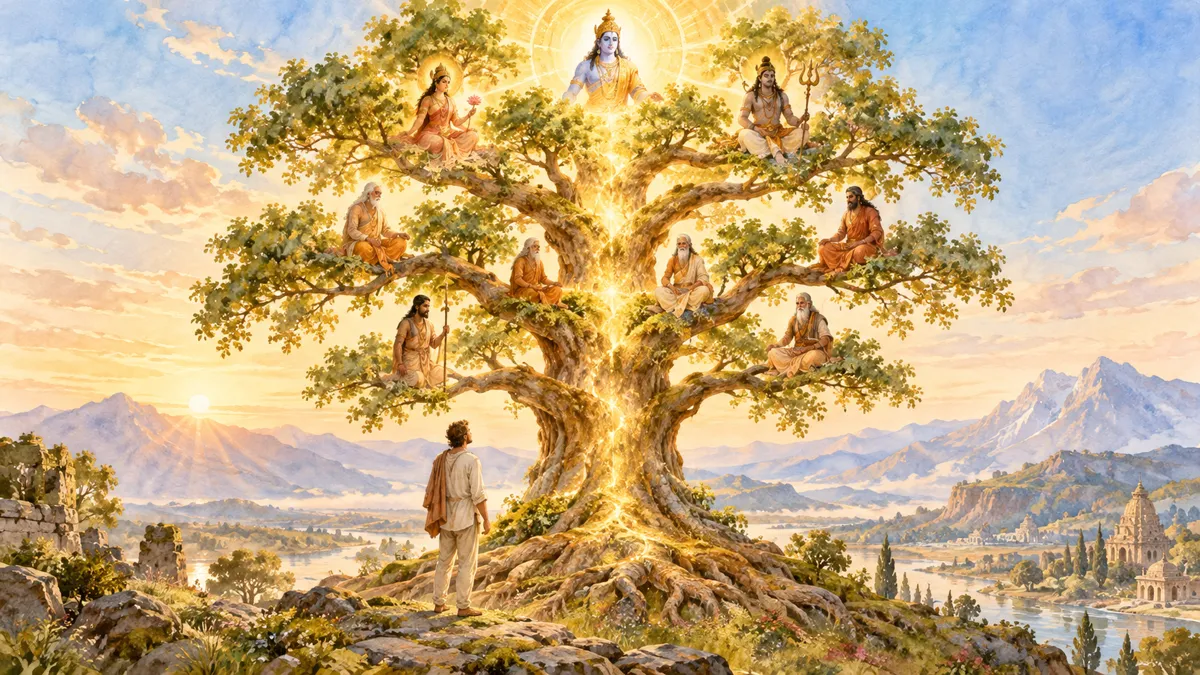
The Vedic tradition says that a human being is not the crown of nature, nor the culmination of evolution. A human being is simply a transitional creature, one of the minor races. The human race is not among the most highly developed races, but human birth is unique because Liberation can be attained through it. Above the human race there are many other divine beings who have already traversed this path of liberation. Enlightened pitris, gandharvas, guhyakas, kinnars, vidyadharas (holders of knowledge), siddhas (divine miracle-workers), devatas (gods), mahadevatas (great gods)—all of these belong to the family of divine, semi-divine, enlightened beings that we also join when we embark on the spiritual path.
If the Vedic Tree of Refuge were made detailed and fully unfolded, it could be so vast that it would not even fit in this hall. And the Master is a guide into this family; he presents the disciple to this divine family and prays for the disciple to be accepted into this Vedic tree. And ultimately, we too find our place in this divine Vedic universe.
All these divine beings are in a state of samadhi, in a state of infinity. They have already traversed their spiritual path and realized various levels of enlightenment. In essence, we see only their forms, but in reality they are all one; this is the one Brahman. In Sanatana Dharma, some say that there are thirty-three million gods, while others say that there are three hundred and thirty-three thousand gods. But in reality, all this diversity of gods is an illusion, because there is only one Brahman, and everything else is merely its modifications, its energies.
For example, the goddess Saraswati is Brahman presiding over understanding, the arts, and the sciences. The goddess Lakshmi is Brahman presiding over prosperity, success, and determination. Shiva is Brahman presiding over yoga and asceticism. Vishnu is Brahman who creates the universe. Indra is Brahman who governs the entire universe.
Thus, the entire Tree of Refuge is in fact one God, one universal megaconsciousness. Nevertheless, this consciousness is so deep and developed that it can manifest in the form of personifications, in the form of energies with their own personal qualities and names. For example, there are a thousand names of Shiva, a thousand names of Dattatreya, and a thousand names of Lakshmi. And when we attune ourselves to the saints of the Tree of Refuge, they bless us; they await us in their divine worlds until we purify ourselves of our human karma, rid ourselves of human illusions, rise to their level, and also become divine. For they know that our position in samsara is not very favorable, that we have gotten ourselves into quite a predicament.
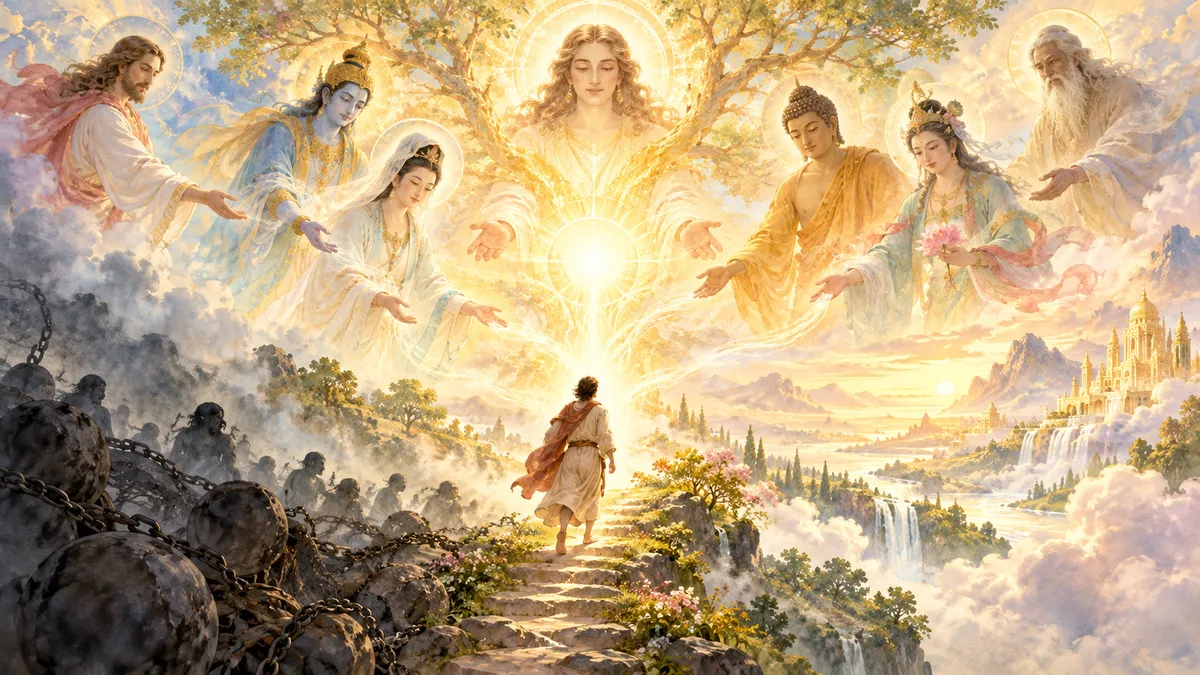
If a soul has entered samsara, this means that it has gotten itself into quite a predicament: it is born and dies, born and dies. There is no immortality here, no multiple embodiment, no control over time and space. And divine beings know that being human is not easy. But because they possess boundless wisdom and compassion, they always send us their blessings. Through holy sages and avatars, they give us sacred scriptures, masters, spiritual practices, and revelations.
The Path of Spiritual Evolution
Sanatana Dharma is not a human tradition; it is a tradition of revelation, that is, a descending tradition, which is why it is called apaurusheya. In these revelations, they say that our destiny, our purpose, is to follow the path toward becoming divine humans: from limited, samsaric human existence, to proceed toward the state of a sadhu—a spiritual seeker, a seeker of the divine. Then, from the state of a sadhu, to rise even higher—to the state of a jnani, an enlightened sage. And from an enlightened sage, to rise even higher—to the state of a siddha, that is, one who has perfectly merged with the divine and mastered its energies, who has ceased to act and entered into the divine play, who has completely dissolved the ego and become a flawless instrument of the divine will.
From the state of a siddha, we must move toward the state of a devata (deity), that is, one who has fully manifested their divine qualities and assumed some responsibility for service in the universe. From the state of a deity, we must move toward the state of a mahadevata, that is, a great deity such as Brahma, Vishnu, or Shiva, one who creates, sustains, and governs the universe, one who creates millions of worlds through the power of thought. And all of this is the path of our further evolution, as indicated by the sacred scriptures of Sanatana Dharma.
Divine beings, saints, rishis, and siddhas are always close to us. And when we take refuge, it is very important to rely on the Tree of Refuge, make offerings to it, praise it, serve it, and always keep it in our memory.
Followers of Sanatana Dharma believe that a spiritually awakened master, a sadguru, is important for knowing the Absolute. But personal discipline, purification, and the aspiration for Liberation are also important.
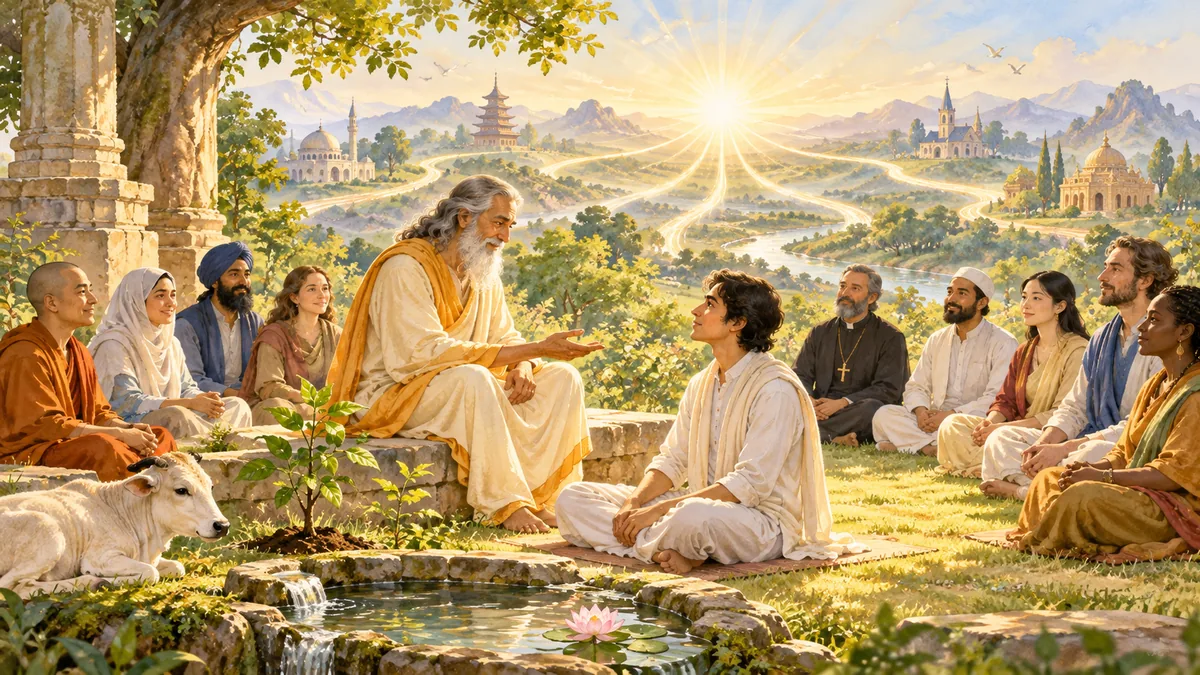
Followers of Sanatana Dharma believe that life is divine in its very essence; it is sacred and revered in every living being. Therefore, they never harm others, practicing ahimsa.
Followers of Sanatana Dharma believe that all religions lead to one God, and that all religious paths are facets of the one light of God. Therefore, they accept the idea of the unity of all religions.
And these nine shraddhas, the nine tenets of faith, are a brief summary of what followers of Sanatana Dharma believe. When we believe in this, we can continue along the path, because faith is the foundation.
Pancha-nitya-karma: Five Auspicious Actions
In addition, there are five auspicious actions known as pancha-nitya-karma. They explain how to live, in what atmosphere and in what culture we need to live when we follow Sanatana Dharma. Pancha-nitya-karma allows us to purify our lives so that they contain no problems or obstacles, enabling us to accumulate merit and follow the spiritual path.
Dharma is a life devoted to fulfilling one’s duty, a life of righteousness.
Upasana is cultivating a spirit of reverence for the divine. When we follow Sanatana Dharma, we need to turn our minds away from worldly material culture by one hundred and eighty degrees and learn to revere the divine in everything. The gesture of “namaste” that we make when greeting one another is precisely a gesture of reverence for the divine in everyone. We must learn to revere the divine not only in images of holy beings, not only in the Guru, but also in our brothers and sisters in the Dharma, in ourselves, in the people around us, and even in every plant, every stone, and every speck of dust.
Why? Because the entire world is permeated with divinity; divinity is the foundation of creation. The world, the entire universe, consists of a substance called God. How can we fail to revere it if the world is God itself, according to the Vedic tradition? The other matter is that our eyes do not always allow us to see it because of identification with the five sheaths. Upasana (cultivating a spirit of worship), Ishvara-pranidhana—these are what we should practice from the very beginning of our spiritual life.
Sometimes we begin on the physical plane, trying to practice asanas, jala neti, and pranayamas, but it is far more important first to cultivate within ourselves a spirit of reverence for the divine. The most important asana for the mind is the asana of faith and reverence for the divine. We must firmly establish our mind in this asana; then our spiritual life will be successful.
Utsava is the honoring of holy days. Utsava means that we perform practices on holy days, such as Datta Jayanti, Guru Purnima, Shivaratri, the birthday of the param-guru, or the day of his departure. For Brahmananda, these are one and the same day, because he demonstrated the ability to enter mahasamadhi on the same day on which he was born in his last body. This is considered the greatest achievement. On holy days, we can perform tapasya and make offerings to divine beings. But in reality, from the standpoint of Advaita, we should transform our entire lives into holy days, so that every day is holy and not a single day is unholy. When we are in the right state, holy days are always with us.
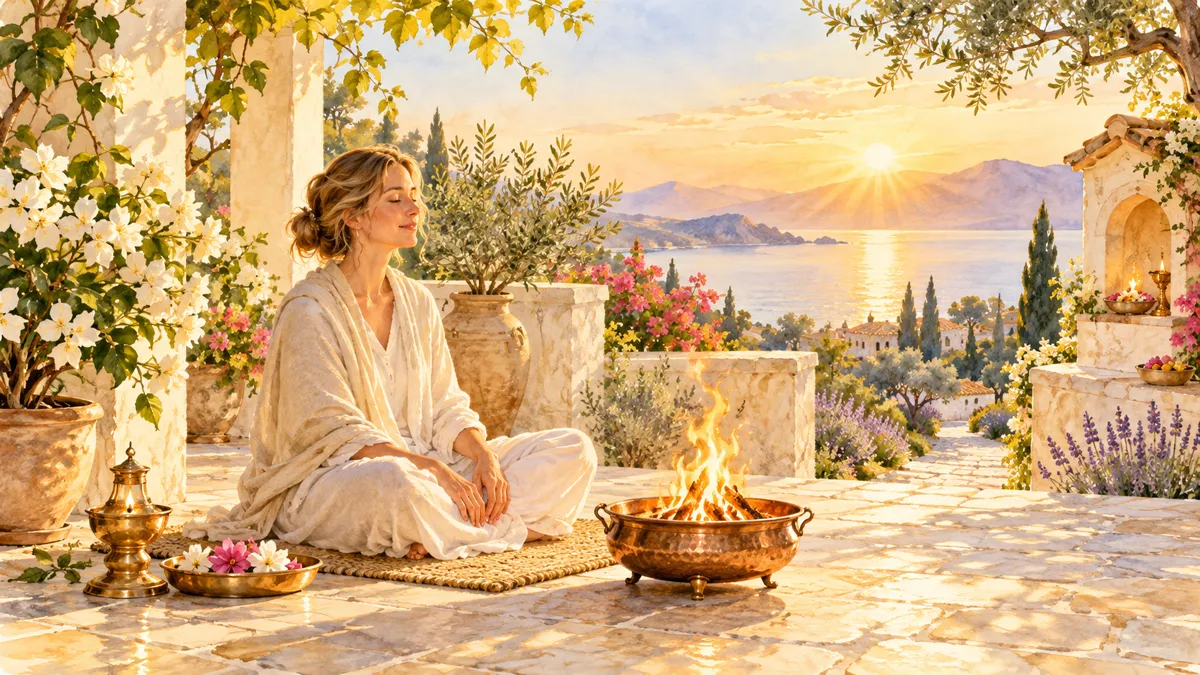
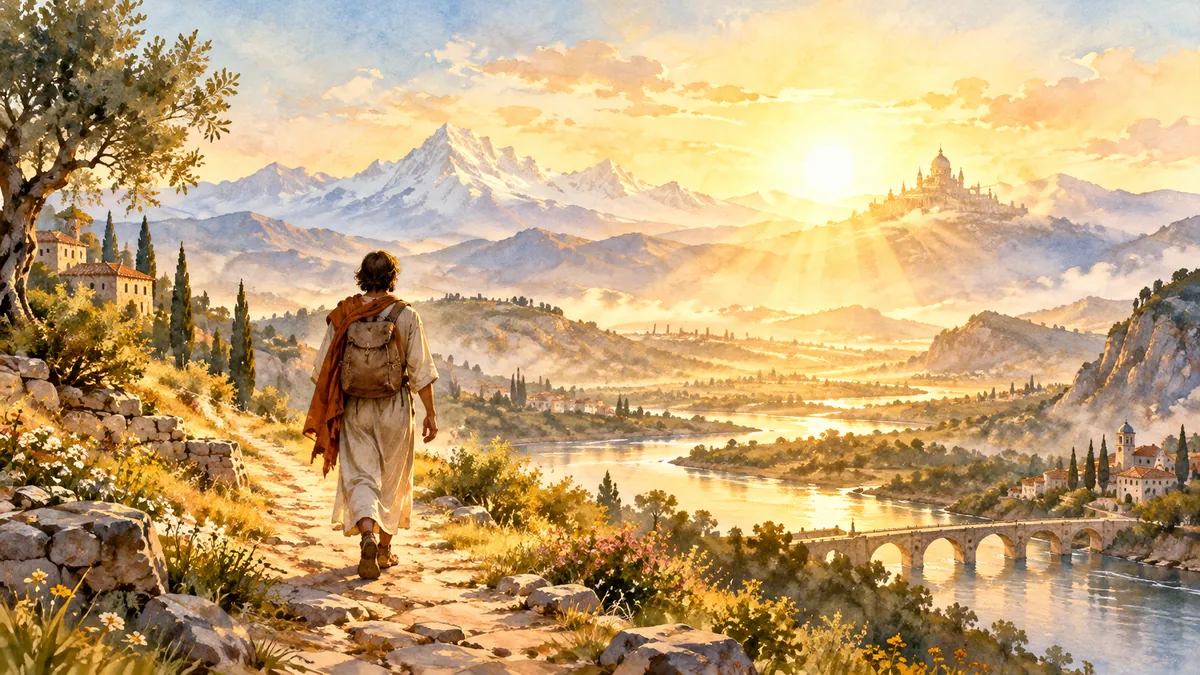
Tirtha-yatra — pilgrimage. Pilgrimage means that throughout our lives we visit sacred places that can bless us, such as Kailash, Divya Loka, Haridwar, Varanasi, and the Kumbh Mela. Sacred places accustom us to the idea that we need to establish connections with the divine dimension, that we need to engage in practice. But in the absolute sense, we must arrive at a vision in which every place is sacred, in which the truly sacred place is revealed within our consciousness at the moment of deep samadhi. No place is profane when we are in pure vision. Ultimately, we must transform the entire Earth into one sacred place; we must attain such an awakened vision.
Samskara (sacrament) is an initiation, diksha. When the guru gives the disciple a spiritual name, he also transmits the guru mantra to him, whispering it into his ear, literally breathing it into him. It is believed that from that moment the disciple is born, and his name is the first name in the list of names of the future deity. That is, if the deity has a thousand names, or perhaps even a million names, then when you are born in the future as a deity, this name will be the first name on that list. It is like planting a seed.
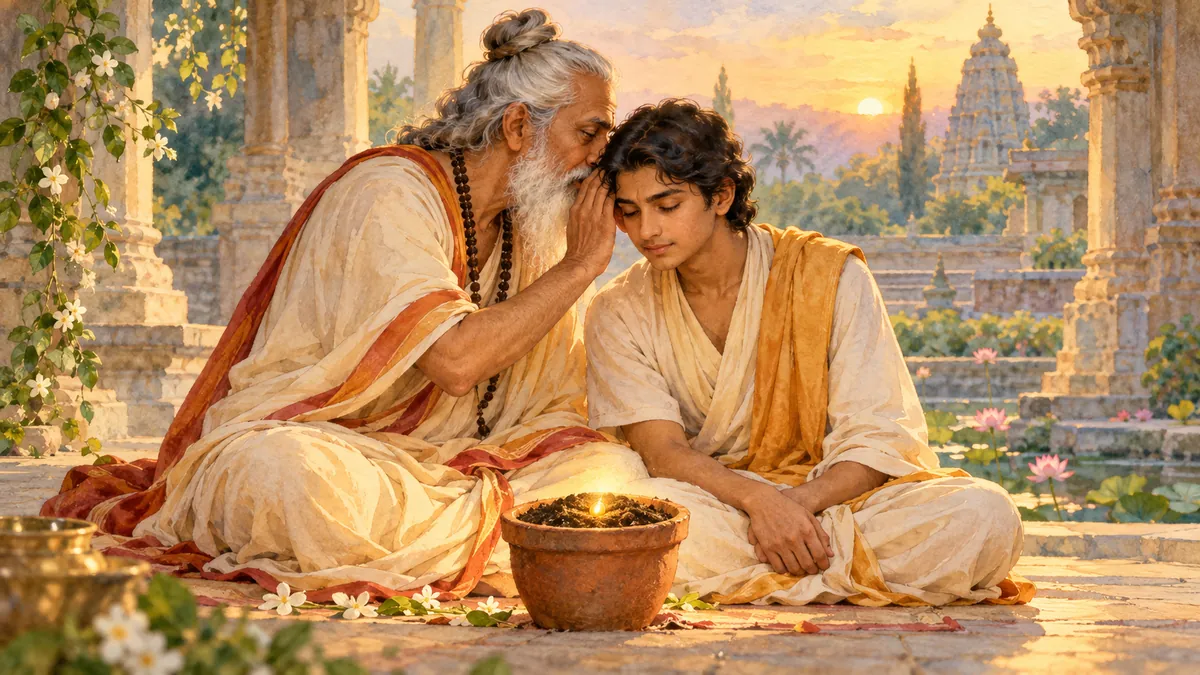
If you handle this seed properly, preserve the spirit of samaya, faith, and pure vision, water this seed daily with proper worship, remembrance, preservation, and maintenance of samaya, service, faith, and devotion in your heart, then this seed grows and grows. As a result, it grows into a great Tree of Enlightenment. There are various dikshas (initiations), for example, shastra-kripa-samskara diksha. The purpose of diksha is to create an imprint and help the disciple establish a connection with the divine dimension of the Tree of Refuge and the Master.
Thus, when we follow the nine principles of faith (the nine shraddhas) and the principle of pancha-nitya-karma (the five auspicious actions) in our lives, we are ready to embark on the path of Sanatana Dharma, to meet the Master, follow the spiritual path, and receive transmissions. We are ready to move from the general Vedic path onto an even more secret and deeper path—the path of Advaita, the path of the Siddha Tantras, which offers the possibility of attaining supreme Liberation and Enlightenment in a single lifetime.
Important Objects in the Life of a Sadhu
Several things are very important for every sadhu. First of all, there are the parents, since they give him birth in the material world. Relations with parents should be harmonious and auspicious. If your relationship is disharmonious, it must be brought into harmony. This does not mean that you need to do everything your parents say. Sometimes parents may be dissatisfied with your spiritual choice, but this is not a problem. You still need to love them. If they see that you are a good, loving person, sooner or later they will bless your choice. In other words, relations with parents must necessarily be harmonious.
The second important object in the life of every sadhu is the Guru. The Guru is a guide; as Pilot Babaji says, he is the bridge through which the disciple travels from the human world to the world of enlightenment and divinity. At first, the Guru is perceived as a person, but in reality the Guru is not a person; rather, it is a principle that can act through a person.
And for us, besides the root Guru, the param-guru, that is, the guru-grandfather, is important. In our case, this is Guru Brahmananda — our spiritual protector and patron in the divine worlds. We invoke Shiva Prabhakara Siddha Yogi every day in our hearts with the mantra “Om Namo Namah Shivaya Om Shiva Prabhakaraya.” In addition, the Guru-acharya is also important. For us, this is Shri Adi Shankaracharya (the founder of Advaita Vedanta), because we live in accordance with the spirit of his teachings when we follow the path of Advaita. Our view and our meditation are based entirely on Shankara’s texts and teachings. In addition, the sadguru is important. The sadguru is God Himself in our hearts. For us, He manifests as Bhagavan Dattatreya — our chosen deity.
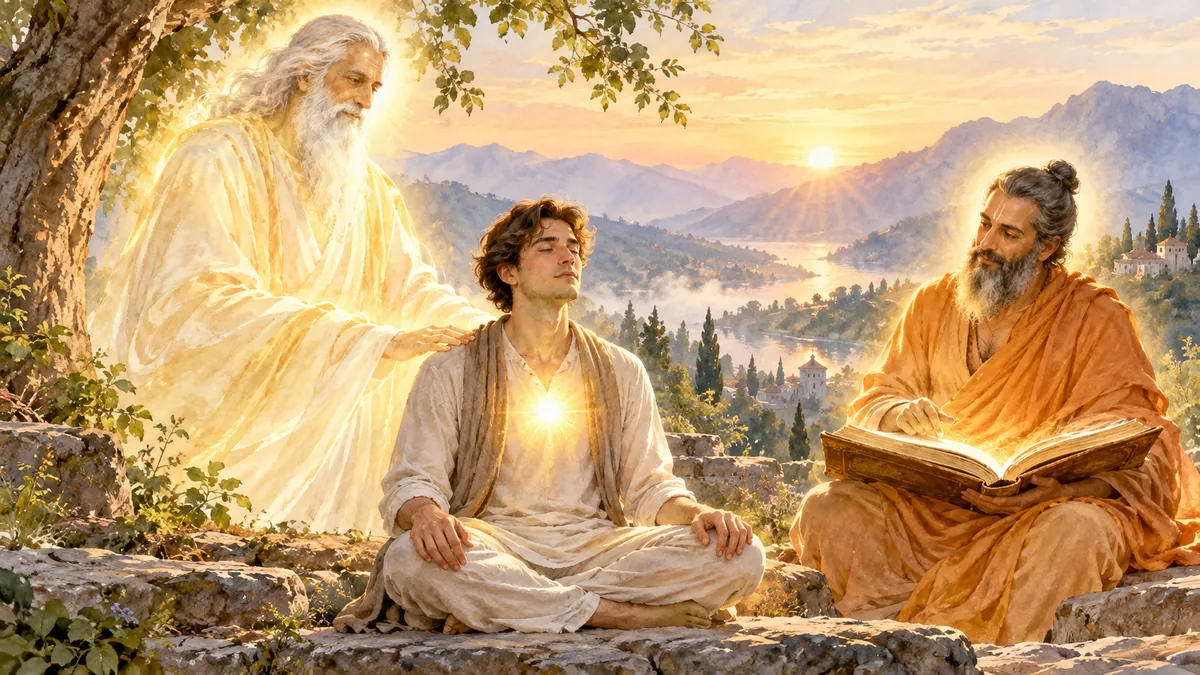
For every sadhu, the two most important mantras in his life are of great significance. These are the seed mantra of the chosen deity and the guru mantra. Through the seed mantra, he attains complete realization, transforming into the chosen deity. Through the guru mantra, he attains complete realization, receives direct initiation, and establishes a connection with his root Guru. One does not have to recite many mantras; one may recite only these two mantras throughout one’s entire life: the guru mantra and the seed mantra of the chosen deity.
The Five Sheaths and Material Energy
The energies of the five elements operate in our body; our body is created from the elements of the five elements. It is created from prakriti (gross material energy). The entire universe is prakriti, that is, gross material energy, whereas the spirit, consciousness, and the Absolute are purusha. Prakriti always operates in time and space; it comes into being and unfolds. The Absolute (purusha) is beyond time and space; it is inactive.
When we live in material energy, we live in a certain material illusion. Liberation means realizing purusha within oneself — the divine being, boundless consciousness. But for this, we must free ourselves from the power of prakriti over our consciousness. Prakriti has power over us because our soul, our immortal divine Self, is placed within five sheaths. All five of these sheaths are matter. This matter may be gross or subtle. And when we identify with the sheaths, we confuse our divine Self with the sheaths.
The five sheaths conceal the Atman. The Atman itself cannot be concealed, but it seems to us that it is hidden. What do these five sheaths conceal? They hide the Atman from our cognitive activity; they limit our intellect, our consciousness, and our understanding. Identification with the sheaths is the cause of suffering. Such identification is called tadatmya — false identification. False identification occurs when the sheaths are regarded as the self, and changes in the five sheaths are attributed to our Self.
The Five Sheaths and Their Manifestations
The physical sheath (annamaya) is the sheath of food. The energetic sheath (pranamaya) is the sheath consisting of the five vital winds. The astral sheath (manomaya) is the sheath of the mind. The sheath of the intellect is vijnanamaya. The causal sheath (anandamaya) is the causal body.
When we feel “I am sitting here,” it is the physical sheath that is operating. When we feel “I am hungry,” we are experiencing the energetic sheath. When we feel “I am worried,” it is the astral sheath (manomaya-kosha, the sheath of the mind) that is operating. When discrimination is activated in us and we make a choice, for example, when we feel “I am a lawyer,” it is the sheath of the intellect (vijnanamaya-kosha) that is operating. When we feel “now I am happy,” it is the causal sheath that is operating. But we are none of these sheaths; we are boundless consciousness beyond the five sheaths.
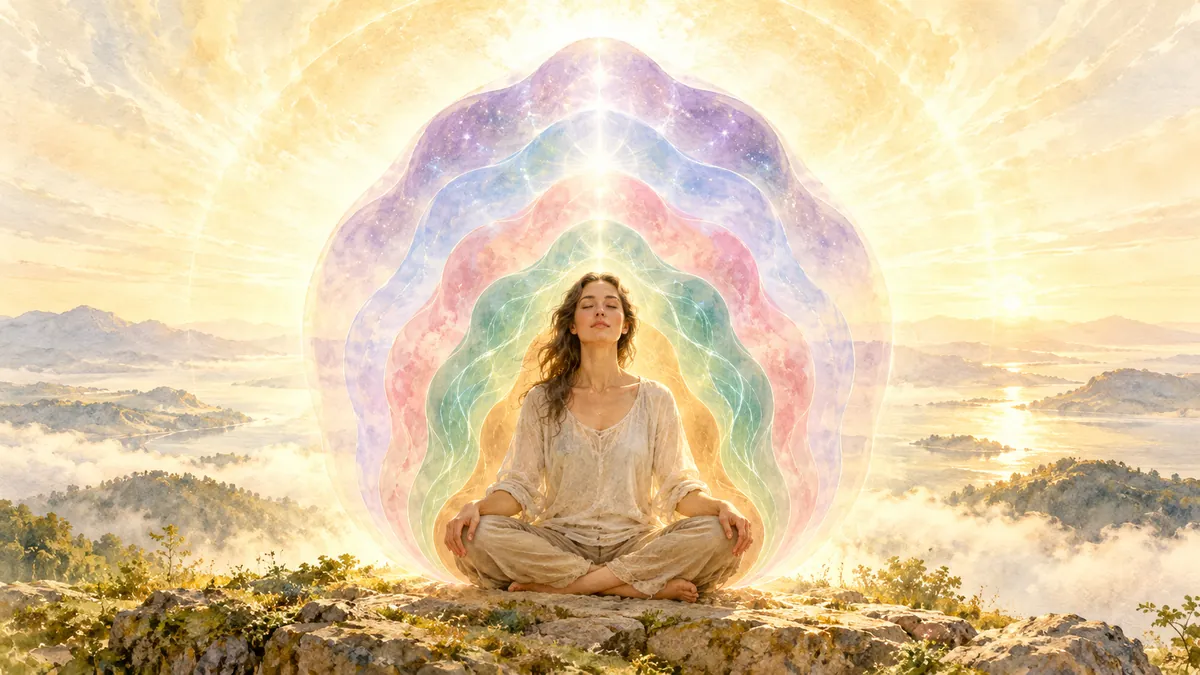
All desires arise from the sheaths, and we need to develop pancha-kosha-viveka (discerning wisdom) within ourselves in order to separate our consciousness from the sheaths and establish ourselves in the subtle divine essence. When we are identified with the sheaths, the state of asmita (forgetfulness of the divine Self) arises. Asmita leads to avidya (ignorance), to various false ideas about our divine essence. And then our life becomes a following of the five sheaths rather than a following of our divine Self.
Cycles of the Five Elements in the Energy Body
Our energetic body also contains five elements, and every hour the dominant nostril changes, that is, the breathing pattern changes. Over the course of an hour, we experience a change in energy, beginning with the earth element. From one element to the next, up to the element of space, one svara operates, meaning that one nostril is dominant while the other is passive. After the space element, the nostrils switch, so the svara operates differently.
During each hour, we take approximately nine hundred breaths:
For twenty minutes (approximately three hundred breaths), the earth element operates in our body
For sixteen minutes (approximately two hundred and forty breaths), the water element operates in our body
For twelve minutes (approximately one hundred and eighty breaths), the fire element operates in our body
For eight minutes (approximately one hundred and twenty breaths), the air element operates
For the remaining four minutes (approximately sixty breaths), the space element (akasha) operates in our body
Over sixty minutes, which amounts to approximately nine hundred breaths, all the elements become active in our body, beginning with the earth element and ending with the space element. Then they weaken. The last ten breaths, when the space element (akasha) is active, constitute a transitional period when one dominant nostril changes to the other, meaning that afterward the other nostril becomes dominant. During this transitional period, sushumna is active.
The Influence of the Elements on the State of Consciousness
During each hour, we experience various fluctuations in our mood. During the first twenty minutes, our mood is heavy, like the earth. During the next sixteen minutes, we experience the state of water; we may feel like having a little fun or flirting, but this quickly passes. During the following twelve minutes, we have a forceful state of consciousness, a desire to do something and be active, because the fire element is active in the manipura chakra. After that, for eight minutes, we experience a very free state within ourselves, a desire to move and not become attached to anything, because the air element is active. But this, too, passes. During the remaining four minutes, we feel a desire to become detached, contemplate, and be in a state of space. After that, the svara (dominant nostril) changes in the body, and everything begins again.
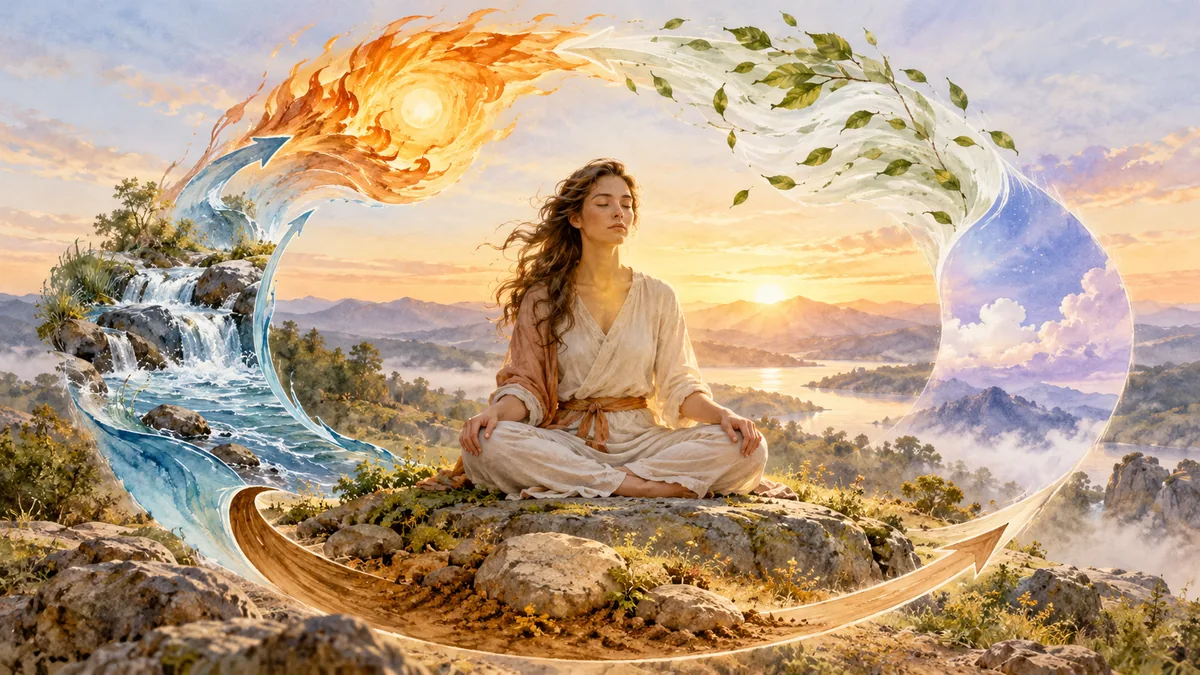
The transitional period, when the nostril changes and we move from the ether element back into a new state of the elements, is the time when the central channel (sushumna) becomes active. It is precisely at this moment that we can experience a profound realization of nonduality if we remain attentive.
At sunrise and sunset, as well as at astronomical noon (these transitional periods are called sankhya), this time becomes longer, which is why it is especially auspicious to meditate during these periods. If we can meditate in the morning and evening (at sunrise and sunset), the amount of prana in the central channel (in sushumna) can be increased through meditation. It is for this reason that sages recommend meditating, performing rituals, and practicing sadhana at sunrise or sunset.
Thus, our consciousness depends on how the elements change. But we must find within ourselves the indestructible nondual consciousness of the divine, which does not depend on the changing tattvas. We must seek it and discover it.
