

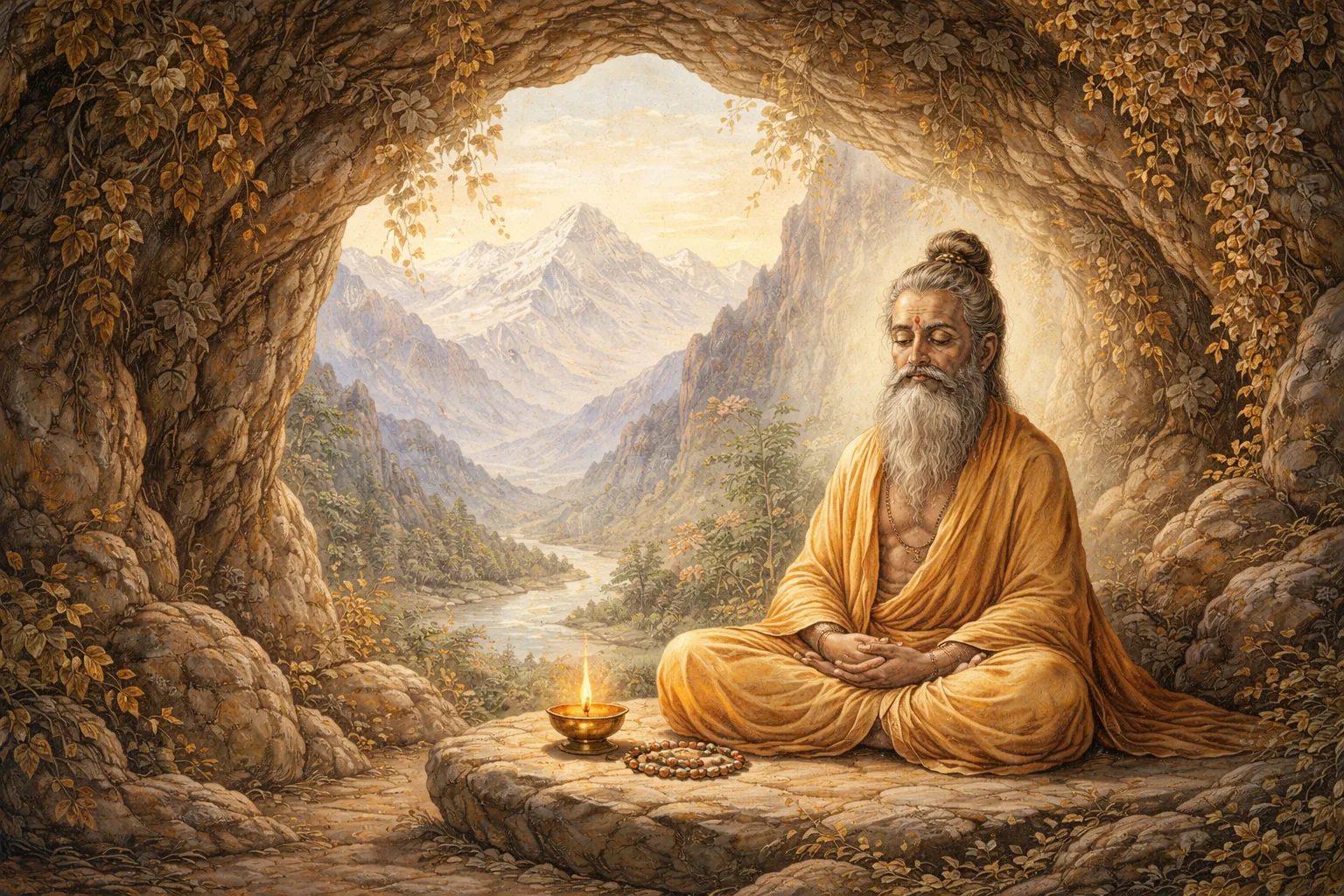
Overcoming the Feeling “I Am Meditating” in Contemplation
Question: How can one get rid of the feeling “I am meditating” during the meditation of contemplation?
In fact, there is no need to make any special effort to get rid of this feeling. One simply needs to try to penetrate more deeply into the nature of the “I.” When we deepen our contemplation and turn it toward the “I,” we try to investigate the nature of consciousness and find out where this “I” exists. For example, in atma-vichara we try to concentrate on the feeling of “I” and determine where it is localized, what color, taste, and smell it has, and what it actually is in general.
But the more we investigate it, the more we discover its insubstantiality, emptiness, and illusoriness. Ultimately, it eludes us. We discover that everything we thought of as ourselves, as “I,” is something ephemeral, a complete illusion. We discover that the “I,” the nature of consciousness, is emptiness, luminosity, spaciousness, non-conceptuality, and qualitylessness. It can take on any form; nevertheless, behind these forms there is no self-existent reality.
In the process of meditation, we become clearly convinced of the emptiness of the “I,” of the insubstantiality of the ego, of all manifestations of the body, and so on. Such conviction nullifies egoistic self-perception and egoistic self-identification.
In order to get rid of effort or the feeling “I am meditating” in the process of contemplation, one should simply try to relax even more and leave everything as it is, that is, not even try to get rid of this feeling. Having left everything as it is, one should continue to deepen contemplation, and then the idea “I am the meditator” or “I am meditating” will itself begin to leave you. Here an important point is this: can you let yourself go or not, can you, in the depths of yourself, abandon hope and grasping?
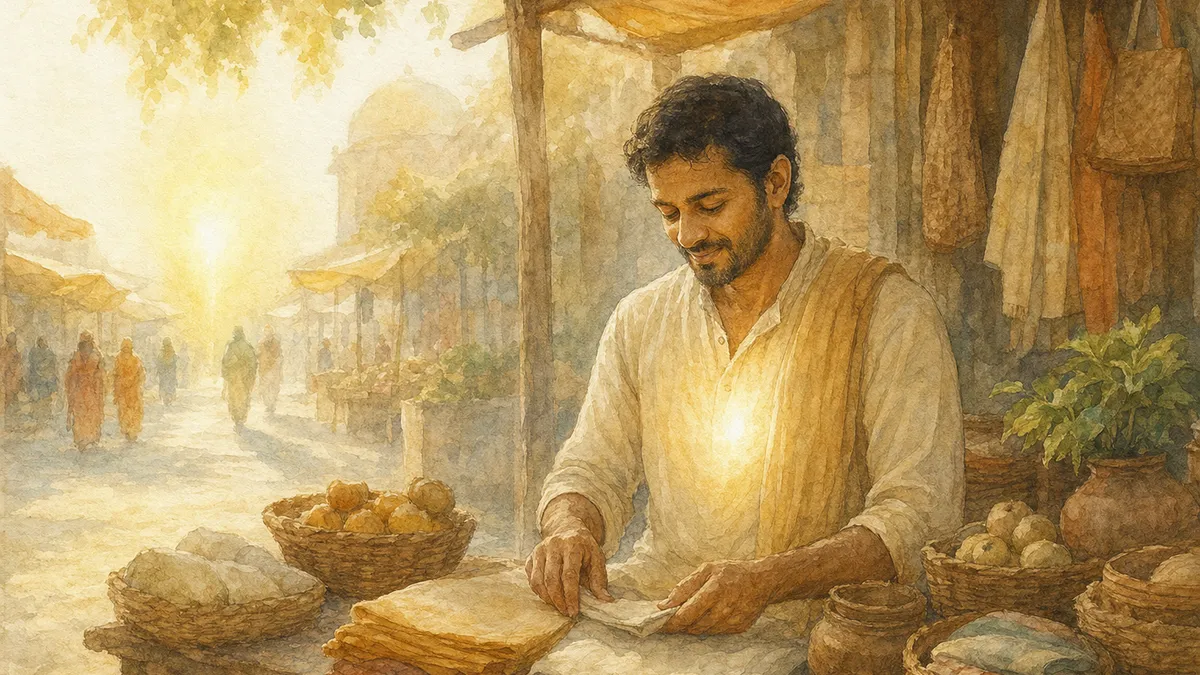
For example, in ancient times the Sufis trained disciples in this way. A man who wanted to become Bayazid Mustami’s disciple came to him, and he gave him this instruction: “Go to the market and trade there for two years. And after two years, come back.” It would seem, what does the market have to do with discipleship? In fact, the most direct connection.
If a disciple trusts the master so much that he is capable of changing his destiny in this way (performing such a practice for two years), it means that a colossal inner work is taking place within him. He completely empties himself over these two years, living, it would seem, in entirely ordinary conditions. He does neither pranayama nor asanas, he does not sit in retreats, but inner emptiness manifests through the ability to let himself go, through self-surrender, through trust in the master, and through the ability to remain in such an unegoistic state for two years.
When, after two years, the disciple comes to the master, the master says: “You are accepted. Now you are sufficiently empty.” Which of you is ready to trade at the market for two years or do something else of this kind, leaving behind all your plans and personal goals? This is not easy. For one who is empty within, it may be easy. Approximately such emptying leads to the fact that we can let ourselves go, eliminate grasping, hopes, and fears, and cease to be a limited personality.
The Difference in the Approaches of Ancient and Modern Practitioners
For us, practice begins mainly with intellectual explanation, with understanding. For example, I personally have always striven for understanding in spiritual life. If I had practiced at the age of about eighteen, I would have thought: “What is the point of trading at the market? For me, there is no meaning in that.” I would have tried first to understand everything with my mind, to figure out what needed to be done, what it would lead to, and what the goals were.
In our time, everyone practices in roughly this way, because the mind of a person of the twenty-first century is completely different from the mind of a mystic of the first millennium. Each time corresponds to a certain disposition of spirit, a certain karmic vision. Ancient mystics were more open. They were in greater contact with life, with being. Their mind was not so sophisticated and rational; they were more irrational. They had more trust, and therefore they could perform such practices.
Modern people are excessively rational and intellectual, and therefore they want understanding in everything. That is precisely why we place emphasis on understanding. For example, when contemplation is explained to you, you try to understand thoroughly everything connected with contemplation.
Love for God in Laya Yoga
Question: Does love for God exist in Laya Yoga? How is it realized?
Yes, it does exist. Only we need to understand who the one who loves is, what God is, and what love is. That is, in Laya Yoga everything is not as simple as in theistic (dualistic) religions. In theistic religions, which are conceptually conditioned, everything is extremely simple: there is you as a soul, you love God just as you love your wife or mother; there is God in heaven, and He must be loved.
But in Laya Yoga we fundamentally do not operate at the level of concepts; we self-liberate all concepts. Such a level of relationship exists, but it must be clarified from the standpoint of contemplation, of nonconceptual awareness. When we abide in eternalist concepts, such as “I am a person,” we have the limitations of “I as a person.” When we create an eternalist notion of God connected with conceptual designations, we limit absolute consciousness with our projective thinking. Only when we clarify all of this does true love for God become possible.
What is love for God from the point of view of Laya Yoga? It is abiding in bhava, in self-surrender. When you have learned deeply to contemplate and have opened the unified Sphere through your contemplation, this feeling of the supreme Source arises in you, giving tremendous experiences of eternity, universality, love, devotion, incomprehensibility, and infinity.
Wherever you cast your gaze, you see one state everywhere. This is an experience that in philosophy is called “Sarvam eva Brahman” (all is the Absolute). Wherever you direct your gaze, you experience this. This is possible only if you are deeply immersed in presence.
And then one-pointedness in contemplation arises in you, similar to the passionate love of a person who is madly in love. You cannot forget this one-pointedness; you maintain it continuously. In the end, you understand that the personal “I” must completely dissolve in the supreme Source, and an understanding of absolute devotion and absolute self-surrender arises in you, into which the individual “I,” one might say, completely dives into this ocean.
All of this can be revealed through proper training and proper practice of contemplation.
Manifestations on the Relative Level
On the relative level, this can also be described as Guru Yoga, the principle of samaya — all these are related concepts. One could say that for us God is the supreme Source, Parabrahman, the great Ground from which the creation, destruction, and maintenance of the universe proceed, whose qualities are infinity, incomprehensibility, fullness of bliss (paripurna), unstainability, eternal purity, self-perfection (arya), and the capacity for manifestation as play (lila). And love for Him is the continuous unfolding of consciousness, continuous directedness, including through any feelings.
Thus, if you clarify the principle of nonconceptual naked awareness, then and only then can you truly understand what love for God is.

Parallels with the Christian Tradition
For example, in the Christian tradition of Hesychasm, or in the tradition of the Coptic Christian Gnostics, a contemplative practice very close to Laya Yoga is described. The Fathers of the Christian Church, speaking of love for God, in fact speak in concepts identical to those of the teaching of Laya Yoga.
For example, they say: “God is formless. He is like light. This light is noetic and beyond thought.” “Noetic” means that it is connected with the principle of awareness; “beyond thought” means that conceptually it cannot be comprehended. “He is like light” points to the luminous Ground. Further, they say: “He can be realized in the utmost immersion of the mind in self-contemplation.” In fact, it all comes down to our perception and consciousness being attuned to our higher subtle bodies and synchronized with them.
The Teaching of the Three Freedoms
Usually the teaching of Laya Yoga is called the teaching of the three freedoms, or the teaching of ultimate freedom. The three freedoms mean experiences of complete freedom associated with body, speech (energy), and consciousness. Everything we are at this stage is body (the energy of the body), speech (prana), and mind (consciousness). The three freedoms mean that all these three states, in the process of practice, are liberated in us and abide in absolute freedom.
In fact, the teaching should lead to liberation from limitations. It is not the case that, by practicing the teaching, we bind ourselves with certain restrictions. On the contrary, the teaching helps us free ourselves from the inner limitations we have.
Once I had an interesting conversation with a person who reasoned roughly as follows:
— Oh, a monastery. But those are such restrictions. I am used to freedom, while in a monastery one has to meditate, observe principles, take hierarchy into account, and many other things.
I said:
— That is quite an interesting view of life. Do you work?
He said:
— Yes.
— Do you have a wife?
— Yes.
— And do you have an apartment?
— Yes.
— Do you cross the street on a red light or on a green one?
— On a green one.
— When you are driving a car, do you stop if a traffic police officer waves his baton?
He answered:
— Of course, how could it be otherwise.
— And you want to tell me that you have no restrictions? You are afraid of the restrictions that exist in a monastery, yet you yourself live amid a huge number of various restrictions. Moreover, there are also many restrictions within you. You live your whole life in all of this, you are so used to it that you do not even notice. And it is not your conscious choice; it simply happened to you.
When we speak of practice, of the teaching, it implies that we understand: some restrictions are truly necessary, there is nothing frightening about them, and therefore we consciously accept them. For what purpose? To attain liberation, to go beyond all limitations, to gain absolute freedom. It is similar to a student who decides to study and endure certain restrictions in order to become a free specialist in the future. This is the very principle of yoga.
If we understand our own limitations and try to get rid of them, we can apply yoga, techniques, meditations. All of this is also a certain kind of restriction, tapas, but we consciously accept them in order to get rid of all limitations. There is nothing limiting in this if you understand this mechanism.
The Essence of the Three Freedoms
In the true sense, the teaching of Laya Yoga is called the teaching of the three freedoms. This means:
- The body is free from any restrictions, for example: fixed behavior, the need to perform rituals, and anything else
- Freedom of speech means that speech is completely free from prayers, mantras, worldly speech
- Freedom of mind means that the mind is completely free from concepts, dogmas, intellectual theories, philosophies, conditioned thinking
“Completely free” means that their true essence abides in the natural state beyond any limitations.
Someone may say: “But when we do techniques or any practices, we tune ourselves to them in some way, we apply them.” That is so. But being in freedom and being beyond all limitations does not mean rejecting anything. Because rejecting anything is also a limitation.
To be without limitations, in complete freedom, means conscious all-acceptance, when you yourself understand what is necessary for your practice and, using freedom of choice, apply certain methods.
For example, being in a state without limitations means:
- Whether we perform a mantra, contemplation in the bhajan mandala, or asanas, we do this not in an eternalist way, but with our consciousness, at every moment of performing this practice, we remain in a state without limitations
- When we recite mantras, along with speech and mantra there is contemplative presence, and this means that there are no limitations, because mantra and speech are self-liberated
- When we perform yoga techniques, pranayamas, asanas, we unite with them while abiding in presence, and this means that consciousness is completely self-liberated at that moment
- When we study theory, we try to be in a state without limitations, in contemplative presence, and this means that theory is self-liberated from the very beginning
Thus, we have a full spectrum of practices or experiences; nevertheless, our three components (body, speech, mind) self-liberate, that is, they are in absolute freedom, and we are not bound by anything in our practice. This is a fundamental point that distinguishes our practice from lower ways of practice. If you have understood this principle, everything falls into place for you.

Three Kinds of the Natural State
There are three types of the natural state. These three types correspond to the basis, the path, and the fruits of practice. Of course, the natural state is in fact one. When we speak of three types, this is our dualistic vision, when we look from the standpoint of our own limitations, from the point of view of the relative world.
The first type of the natural state is the primordial natural state (adi-sahaja), that is, the Absolute in itself. One could say that this is God in His self-sufficient manifestation. The primordial natural state has always been; it existed before our birth. It is self-knowing Wisdom. It is primordial pure, unstained Consciousness, which does not depend on whether we know about it or not, whether we attain liberation and enlightenment or do not. It is the supreme Mind as such, beyond our knowledge of it; that is why it is called primordial (adi).
Another type of the natural state is called darshan-sahaja. This is the natural state that we realize through darshan, when we enter Guru Yoga and the state of transmission, or else it is the state that suddenly flashes in our mind for a time when we meditate. One could say that before we were separated from it, but now we have entered the transmission, begun to practice, and certain experiences have appeared in us; a flash of this natural state has arisen in us, we have become acquainted with it, received darshan from it, and now our mind, our body have begun to know it. Perhaps we have not yet realized it fully, nevertheless contact has already taken place.
Finally, the third type of the natural state is called purna, that is, full, or complete. This means that we have not only become acquainted with the natural state, but have worked with it throughout our entire life, nurtured it, and now it has borne its fruits, that is, it has manifested in the form of the result—the three awakened bodies. This means that we have fully united with it in energy and in the body, that now the primordial natural state has, as it were, descended and manifested in our physical body in the form of enlightened qualities, and our three awakened bodies have also manifested: jnana-deha (the body of wisdom), pranava-deha (the body of energy), siddha-deha (the perfect, immortal physical body). Thus the circle has closed, and that which was self-perfect, separate from us, has now manifested in our physical body and energy.
And this is precisely what the practice of contemplation consists in. At first the natural state is separate from us; we cannot even imagine where it is. We do not even know about it. It exists like gold coins sewn into a beggar’s pocket; the coins are always in his pocket, but the beggar cannot discover them and make use of them, because he does not even know about them.
Then we become acquainted with the natural state, and the aspiration to realize it arises in us. This is darshan. For example, you receive verbal transmission from the guru or direct introduction, or, in the process of practice, you yourself discover it through experience. This means that it has flashed and appeared in our consciousness.
Finally, when it gains strength through continuous maintenance, it becomes purna (full, realized), and then its fruits manifest.

Understanding Primordial Perfection
Many people, when they hear the teaching on primordial perfection, fall into misunderstanding. For example, when I once gave a lecture at Lugovaya, explaining the principle of Vedanta: “You are already God,” “You are already Brahman,” “Everything is an illusion,” I quoted Shankara’s text “Vivekachudamani” for an hour and a half and gave commentary on it. One person, who looked rather simple, had come from a village, listened very enthusiastically, and at the end of the lecture he asked: “Why practice then? I came to become a monk, but it turns out everything is an illusion.” And that very day he went back to his village. I thought: “Perhaps I should not have read this philosophy to him.”
A rare soul, of course, may attain enlightenment even during a lecture, and therefore practice will no longer be needed for such a person, but I doubt that this was precisely such a case.
Even if we understand the principle of primordial self-perfection and the principle of the illusory nature of suffering, bondage, and even liberation itself, this does not mean that all relative distinctions have immediately self-liberated.
In the absolute sense, a dog also has Buddha-nature. Both the Buddha and the dog are manifestations of the primordial self-perfected state. In the absolute sense, the dog is just as perfect as the Buddha. Nevertheless, in the relative dimension, if a dog becomes hungry, it has completely different emotions, it suffers, and it has its own limitations. The Buddha has three enlightened bodies, whereas the dog thinks that it has one body, and that it is not enlightened, but canine. It experiences many limitations, and even if you tell it that it is self-perfected, this will not help it in the slightest.
All people abide in primordial self-perfection; nevertheless, some realize the three immortal bodies and attain complete freedom, while others remain absorbed in kleshas and ignorance, and therefore are forced to be reborn. This is precisely the difference between adi-sahajya-sthiti and purna-sahajya-sthiti.
It can be said that everyone abides in primordial awakeness, in the state of adi-sahajya: dogs, ants, birds, people—everyone, whoever they may be. But in the state of purna-sahajya, that is, in the fullness of the natural state, only rishis, siddhas, enlightened gods, and saints abide. And this, of course, should never be confused.
It seems that everything is primordially perfect; nevertheless, from the relative point of view there is realized perfection and there is unrealized perfection. Realized perfection differs from unrealized perfection in that realized perfection has fully united with matter, with prana (energy). Unrealized perfection is in a state of potential, like a powerful potency that has not yet revealed itself.
Now we will speak about some subtle points of the practice of contemplation. When we engage in contemplation, our goal is the accomplishment of the “great transition.” It can be said that from the state of a human being who has limitations, through the practice of contemplation and the application of skillful methods, we strive to pass into the state of a deity—a being that is completely beyond limitations.
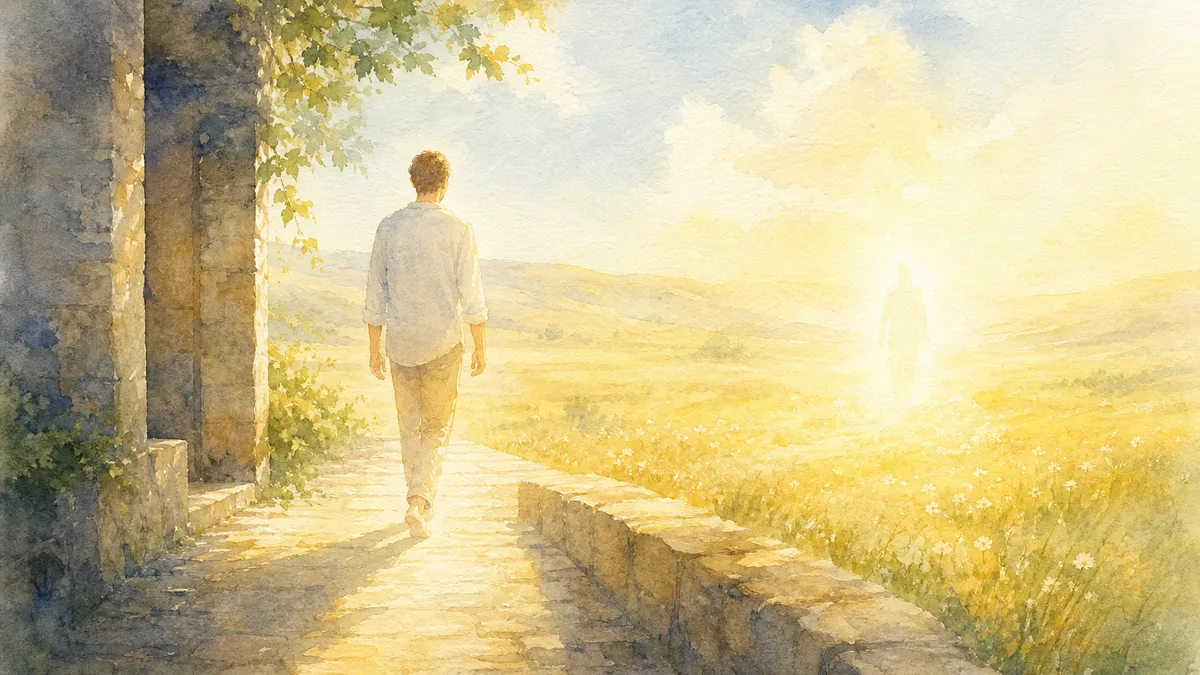
The Great Transition. Stages of Spiritual Growth
When we grow in the spiritual sense, our progress is measured approximately as follows:
- First, an ordinary person, a layperson
- Then, a yogin (sadhu), that is, one who practices sadhana, for example, as you do now
- The next stage is the state of a master. This is no longer simply a sadhu, but one who has mastered the practice
The goal of training is to attain genuine mastery in practice. If we train for thirty years but have no virtuosity in our practice, this means that we are simply not training enough.
- When the stage of mastery reaches its culmination, the stage of siddha begins, that is, that of an awakened being
- When a siddha gains fullness in practice, he becomes a mahasiddha, that is, one who can freely manifest his enlightened energies
- When a mahasiddha accomplishes the “great transition,” that is, fully leaves the impure human dimension and enters the state of a single “taste,” he becomes a deva (deity)
The Future in the Form of Deities
In the future, each of you, advancing in practice and reaching this stage, will become some kind of deity. Before merging with the impersonal Brahman, each of us will pass through a great many stages. For example:
- Some will become vidyadharas (protectors of the teachings)
- Some will become helpers of practitioners and will protect them from obstacles
- Some will be responsible for maintaining the balance of forces in the universe
- Some will watch over the elements
- Some will oversee the development of certain ethnic groups
- Some will become deities who watch over the development of animals and plants
- Some will be responsible for geophysical or biochemical processes on planet Earth
- Some will patronize certain sciences, crafts, and arts
- Some will be holders of the magical lineages of yoga, tantra, and the teaching on contemplation, namely Laya Yoga
In other words, beings that have no limitations have certain functions; they also manifest. They also retain certain personal qualities and certain motivations, but not like those of ordinary people. Their personal qualities are self-liberated, and their motivation is not karmic, but playful. Such beings usually become patrons of those with whom there is a karmic connection from the past. Everything depends on one’s inclination, on which family of deities one belongs to.
Some, for example:
- Will help souls become liberated in the bardo during rebirth, that is, perform the transference of consciousness and clarify the minds of those who are dying
- Some will operate with subtle samskaras at the level of humanity
- Those whose mind is global will operate with enormous planetary and even galactic processes
All of this is very individual and connected with your specific inclination and belonging to a particular family of deities. It can be said that this is your future in the form of deities.
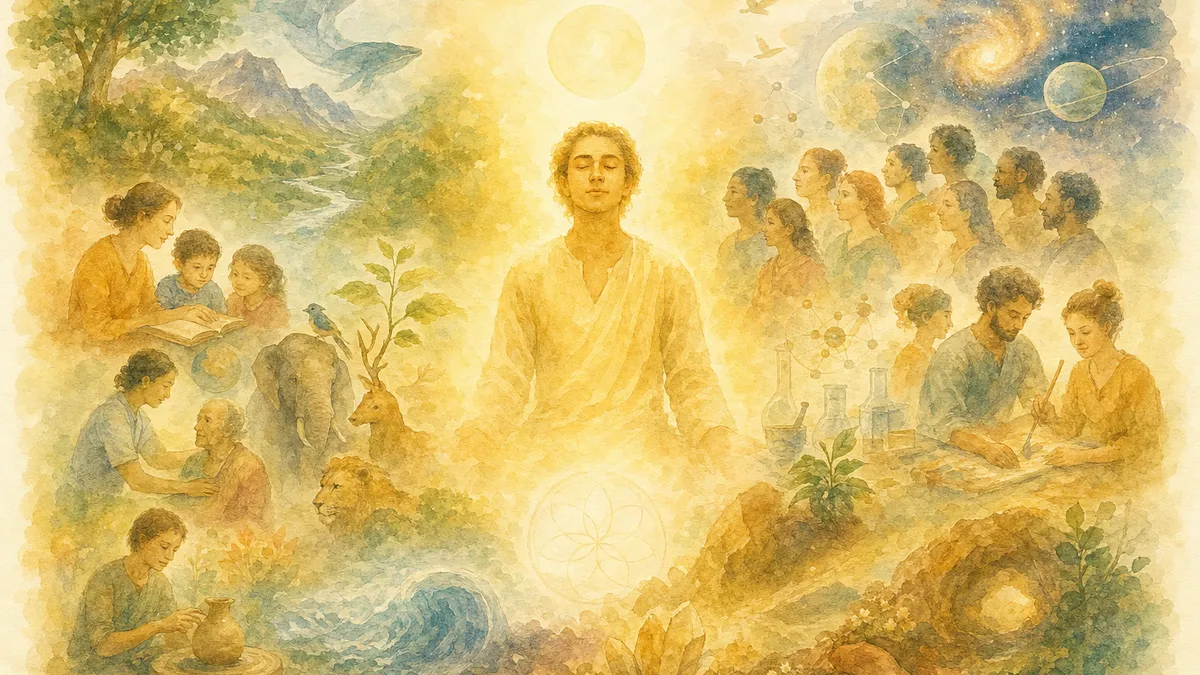
Great Deities
Finally, when a yogin, having some status in the form of a deity, continues to practice contemplation, he surpasses even this status of deity and, from the ordinary state of a deva (deity), becomes a great deity — one who can emanate countless illusory bodies. This is the state of holy gods. This is an even more transcendent state. Usually people have little contact with such beings. If the first type of deities is closely connected with the Earth and they can be seen in meditation, then the second type of deities (the gods of Brahma-loka) already operate with global categories, and therefore only very highly advanced souls can see them.
In fact, many processes on Earth are watched very attentively and vigilantly by various divine beings. By virtue of their capacities and karmas, they guide the evolution of humanity, block negative states or, conversely, even provoke them for specific purposes. They observe ethnoplanetary processes, geopolitics, geophysical processes, block negative phenomena or create a situation in which the spiritual growth or evolution of humanity can develop, and oversee various achievements in the fields of science, technology, and so on. These are very subtle domains into which it is impossible to enter with ordinary human consciousness. It can be said that for people this is a great mystery.
But the gods of Brahma-loka are even more transcendent consciousnesses. They operate with enormous volumes of time and space, completely inaccessible to humans. They have an entirely different logic and ethics. They possess multidimensional bodies. This is the next stage on the path of awakening. One who has developed his contemplation and has moved from the level of ordinary deities to the level of the gods of Brahma-loka becomes precisely such a creator god. Such gods, by the power of consciousness, can create their own tunnels of reality the size of our universe and manage them.

Finally, at the last stage of evolution, such gods completely merge with the Absolute, already manifesting themselves as the Absolute.
From Karma to Play
This is approximately how the transformation, the “great transition,” takes place in the process of spiritual practice. It can be said that from an uncontrolled reality, from the impure karmic vision of samsara, we move into the mandala — into the world of the pure dimension, the world of absolute freedom, where we live on the basis of our inner states. From the state of karma we pass into the state of play (lila).
Karma means our being programmed by the law of cause and effect, from which we cannot escape. Play (lila) is the principle of deity; it is something not characteristic of a human being, but characteristic of saints or the Absolute. It is a fully spontaneous state based on inner freedom (svatantrya) and on one’s own will (sveccha-chara). Play means that you are capable of manifesting or uniting with any circumstances, or self-liberating them.
Contemplative Presence and Points of the Position of Consciousness
So, in order to realize such a principle of transformation, such a principle of transition, we develop contemplative presence. Contemplation is the most complex topic, in the understanding of which many errors arise. And with the aim of clarifying contemplation, I wrote a text called “The Mysteries of Contemplation.” Here there is a third chapter called “Points of the Position of Consciousness.”
These, of course, are not some points that we can designate; they are rather a state which, for the sake of understanding, can be conditionally divided according to the state our consciousness is in during contemplation.
Sometimes we try to clarify some theoretical question, but our consciousness is not in the right position. No matter how much we try to clarify it, we cannot have an answer. In such a case I say: “Try to change your consciousness, try to enter into a deeper presence, because in this position of consciousness there is no answer to your question.”
It is like the Zen goose in the bottle: you can ponder it logically for a thousand years, but you will never get an answer, because in the conceptual position of consciousness the answer simply does not exist. But as soon as you enter presence beyond concepts, the goose immediately gets out of the bottle — nothing could be simpler. It is simply another dimension of seeing the problem.
So, what are these points of the position of consciousness?
The Point of Ignorance
This is a position familiar to all people, when consciousness is active, when we act on the level of thoughts and feelings, when we are seized by external objects. It can be said that this is the ordinary state of the mind, which is captured by external objects, a state of ignorance in which we take this reality to be the truth, when we do not have something deeper, such as observing consciousness.
A very ordinary example can be given. When you are doing something and something happens that you do not like, you become angry. Why does this happen? Because the idea of “I” is strong in you, faith in external reality, in external objects, is strong; therefore the desire arises to protect your “I” from this external reality, to maintain your status. In other words, anger arises as a defensive reaction to some threatening situation occurring outside.
At the point of ignorance, our own psychological continuity is connected with external objects, and since external objects are always impermanent, suffering or confusion arises. The point of ignorance is ordinary sleeping consciousness (maya, avidya, ajnana), when there is no contact with the higher Self, when we have turned away from the supreme Source, when we see disparate objects and position ourselves as a subject (ego, personality) that is separate from being, from the world, from the supreme Source, and is in opposition to other objects, without realizing the inner unity with everything.

The Point of Resonance
The next point of the position of consciousness is the point of resonance. This state corresponds to the approaching concentration described in the text “Visuddha-magga.” The point of resonance means the ability to resonate. It can be said that the point of resonance is a kind of turning point where a deeper awareness arises in us, where we can either enter the state of ignorance again and fall asleep, or we can begin to return to the supreme Source, begin to contemplate.
It can be said that at the point of resonance two paths, two roads, open up: the first path is samsara, the second path is nirvana. Our further destiny and the universe into which we enter depend on where we turn.
For example, during the practice of walking contemplation, a certain clarity arises in you, a certain deepening of awareness. You feel inspired by this and want to deepen this state more and more. You experience approximately this feeling: “This is it. So this is how consciousness can deepen.” This is the point of resonance. But you have two paths from this. The first path is to allow consciousness to enter again into the old rut of distractions, duality, and so on. The second path is to hold this consciousness and allow it to go into a new rut of deepening this state.
The Point of Unstable Contemplative Equilibrium
When you have passed the point of resonance and have decided to enter contemplation even more deeply, you enter genuine contemplation. But this contemplation is still unstable; it still requires constant effort, which is why it is called this. You are forced to apply your own will. And such an effort is also called voluntary mindfulness. You are forced to be constantly aware so that such presence does not slip away from you; nevertheless, you are already moving in the right direction. If, however, you lack mindfulness, you again slip back to the point of resonance, and then to the point of ignorance, and therefore conditioning begins again.
Perhaps you have felt this. When you practice intensively in retreat or read any texts, consciousness deepens, everything becomes very clear. But then you finish the practice, begin to communicate, problems pile up on you, and you already feel that all the experiences that were in the retreat have gone somewhere, that you have again become an ordinary person. You dream again: “When will I enter this state? Maybe the next retreat will help me return to this state again.” Why does this happen? Because consciousness did not hold steady and slipped, passing through the point of resonance, into the state of ordinary ignorance.
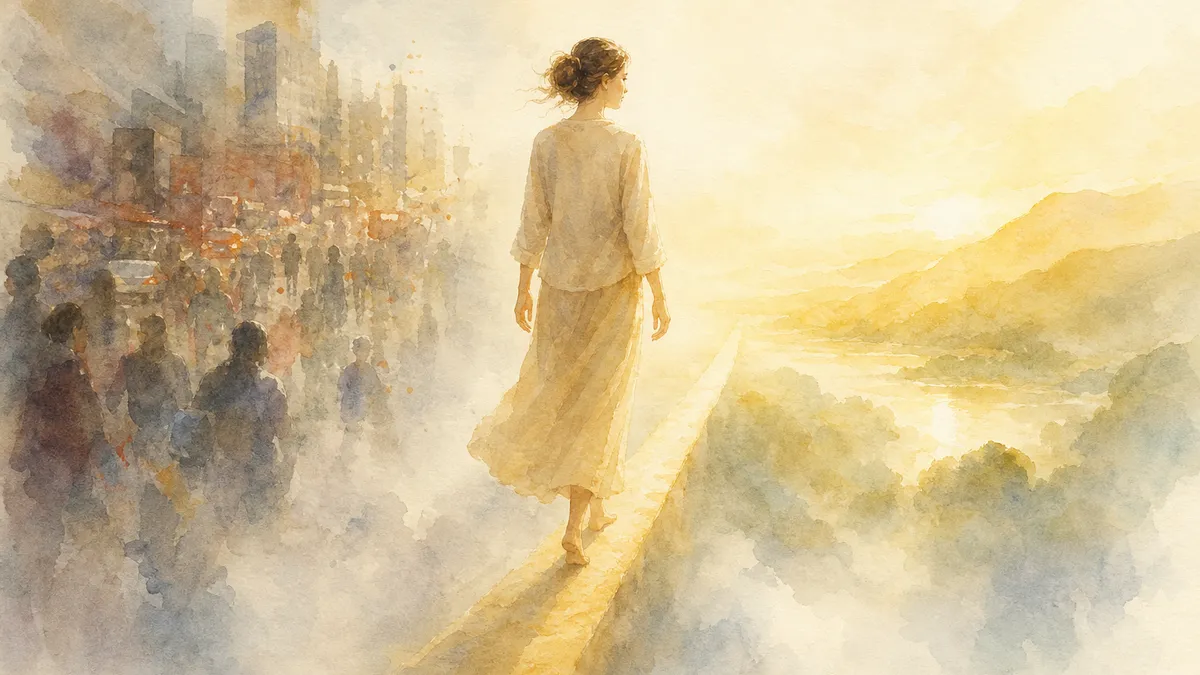
The Point of Stable Contemplative Presence
If you maintain contemplative presence with effort, then gradually unstable contemplative presence develops into stable presence, and you move into the next state of consciousness. This is the point of stable contemplative presence. That is, you have already trained yourself to such an extent that your consciousness has become fixed in a state where you cannot lose a certain level. Whatever happens, you cannot lose it; nothing can incline you toward lower states of awareness.
This is already the level of a saint who remembers God continuously day and night and has attained a certain experience of the single “taste.” Here, any impressions that arise are united with presence. In some texts this is written about in this way: “There is peace and serenity in the heart. You keep to the middle. With your spirit you embrace the entire universe.” Regardless of whether you are eating, walking, talking, whether pleasant or unpleasant things happen to you, you have already found this state, continuously maintain it, and can unite it with everything. This is already a fairly stable presence.
One can observe how practitioners very often change their point of view. For example, once many practitioners came to “Divya Loka” for a two-week retreat. On the second day, two people left the retreat. The next day, four more people left. The rest held out until the end. Sometimes it happens that a completely insignificant thing is enough for a person to change their point of view entirely, especially if their consciousness is unstable. This is what such unstable presence means, when we orient ourselves toward some sensations connected with the external.
But when we have stable contemplative equilibrium, we take responsibility for the decision we have made, and therefore our consciousness never changes or wavers. Even if the moon falls to the earth, we will not abandon our contemplation—such is this point.
I read a story about a hermit monk who meditated for many years in the mountains. He attained stable equilibrium in contemplative presence. Near his cave lived an evil spirit that harmed him in every possible way. One day this evil spirit decided to kill the monk. When the monk was walking along the road to fetch water, the spirit brought down a rock. Behind the monk, as he walked, deeply immersed in presence, such a huge boulder fell that the earth shook from the impact. But the monk did not even turn around. Somewhere on the periphery of his consciousness the thought arose: “It did not fall on me, after all.” That is, he went on, without even turning around to see what had happened. This means that even powerful shocks are not capable of knocking you out of presence if you are deeply immersed in it.

For example, once during a retreat I was engaged in a deep practice of mindfulness. The kettle was overfilled, and the water was very hot. I held a mug with one hand and poured water with the other. My main task was not to lose mindfulness. And I saw that I was pouring boiling water past the mug, so that it was landing directly on my hand. The boiling water was pouring onto my hand, while I was contemplating and thinking something like: “Boiling water is pouring onto my hand. The main thing is not to lose mindfulness.” Then I thought that something was not quite right. Nevertheless, I did not scream or throw away the cup and the kettle. My consciousness was so absorbed that the awareness that this was wrong or painful came only afterward. This is roughly how a person feels when they have stable contemplative presence.
But this does not mean that you walk around like a somnambulist when you have entered stable contemplative presence. Many people really do think that if you are in presence, cars do not concern you when you are crossing the road. This is incorrect. It is a deviation, a suspension in inner clarity. True presence means that we can unite with all circumstances and respond flexibly to any situations; nevertheless, at the same time, we do not lose our inner “I.”
The point of self-transcendence
What happens next, when day after day, for months, weeks, and years, we remain in stable contemplative equilibrium? The point of self-transcendence arrives. Until you have discovered stable contemplative equilibrium, there can, of course, be no question of self-transcendence and self-surrender, because self-surrender must always be to something or someone from the point of view of contemplation. In order to carry out self-surrender, so that the ego can dissolve into something, it must see this clearly. But if you do not have some clear vision of to whom or to what to perform self-surrender, you will have a lack of understanding.
Of course, at the initial stage, self-surrender as a pro forma exists in the form of the practice of Guru Yoga, as the practice of service—this is a very useful practice. Nevertheless, the genuine level of self-transcendence, prapatti (self-surrender), occurs at the stage of stable presence.
So, this point signifies such a state of the yogin’s consciousness when the personal “I” begins to dissolve completely in the Supreme Source, when it begins to move entirely onto this plane, when assessments and judgments cease to be made. How can this state be verified? One must assess whether dualistic assessments and judgments are being made or not, whether there are attachments, fear, and hopes, or whether there are none.
For example, if you have presence, by observing how a person reacts in everyday life, you can clarify whether he maintains the state of presence or loses it.
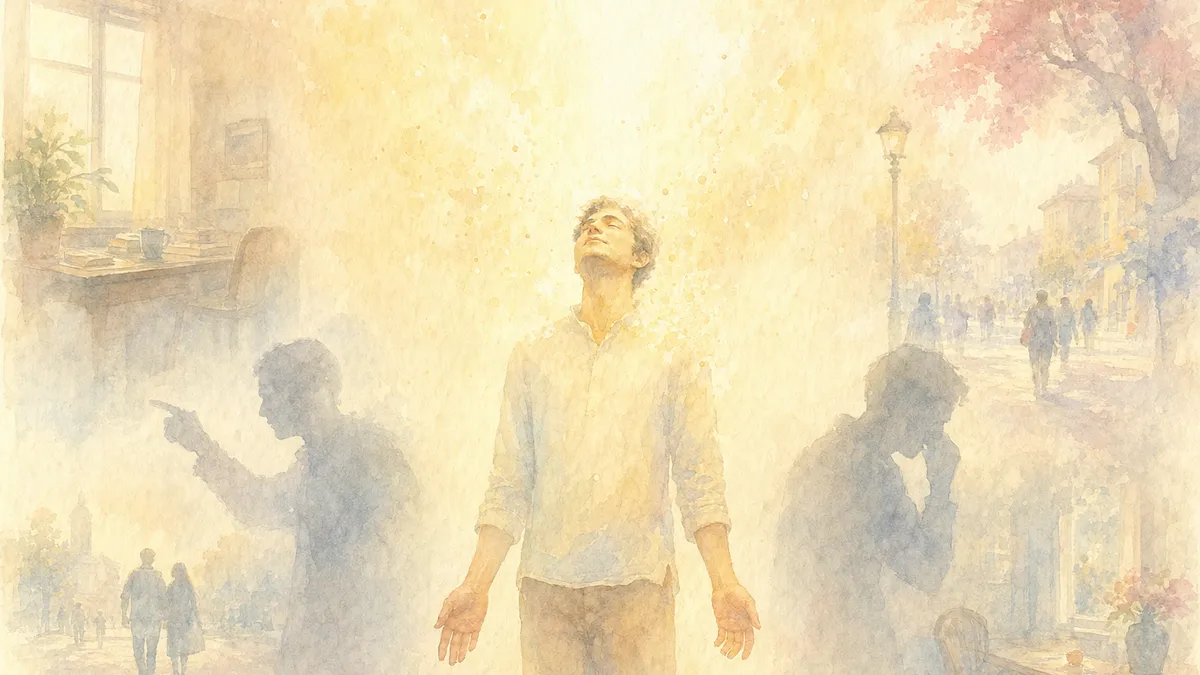
There is such a story. A yogin whose teaching consisted of patience was giving a lecture. Another yogin came to this lecture. He listened attentively to everything, and at the end approached and asked:
— Sir, so what are you lecturing about? What teaching are you imparting?
The yogin replied:
— This is a teaching on patience.
— Excuse me, I’m a little hard of hearing. What did you say? What teaching?
The yogin answered again:
— On patience.
The other asked again:
— What, what are you saying?
And the yogin who was giving the lecture on patience angrily shouted at him:
— You fool! I am transmitting the Teaching on patience! What don’t you understand?
Then the other yogin said, smiling:
— Now I understand what teaching you are transmitting.
So, at the stage of transcendence, our assessments are no longer made. Whatever sensations we may experience—very positive or very negative—self-liberation occurs at the moment of their experience. In fact, no assessments, no judgments are made. One could say that our personality has reached maximum emptiness and reunited with the spirit. This reunion is so complete that we already feel we are not living as an ego, but precisely as Spirit. This is a completely non-dual state; therefore, in the state of Spirit, assessments and judgments are no longer made.
The simplest example is this. If you are walking in a state of self-transcendence and experiencing tremendous joy, being deeply immersed in the Source, and someone comes up to you and slaps you in the face, your energy is set in motion and your joy increases even more because of it. You do not make judgments such as: “How dare he? Why did he do that? What did I do to him? This is unfair.” No anger appears in you, because you instantly leave this situation behind, do not reflect on it, and simply continue on in even deeper joy. This situation does not seize you at all; no emotions arise regarding what happened, and you continue on, reverently thanking this person for such a shaktipat. This is approximately how it happens on the inner level.
It is another matter that, on the relative level, as a game, you may manifest certain emotions in order to help this person, but in any case, within you this is completely self-liberated, because you have no assessments, no judgments.
Once I stayed in the apartment of one person. He was not my disciple; he was simply curious. He kept trying to find out how I felt, what I sensed, how I would act if he did this or that. He wanted to understand what this consciousness was. He said:
— Well, it can’t be that you don’t react to anything. You feel everything, after all. And if I hit you, how will you feel? You will probably also get angry or try to respond to me.
I said:
— I am the master of my state, so you cannot influence it in any way. You may do whatever you like, but only I determine what my state will be. Perhaps if you want to beat me, I will simply run away from you, but my inner state will not worsen because of that. I will neither be angry with you nor analyze what happened, but will simply think: “Well, there are all kinds of odd people. But what have I got to do with it? It is not my problem, but his.” And this is my inner ecstasy; my joy will not worsen because of it. I will simply change my place of residence, and that is all.
There is an interesting story about two psychotherapists who came to a conference and constantly met in the elevator on their way to the lecture hall. The elevator operator who was in the elevator cabin saw the same scene for many days in a row: one psychotherapist would turn around and spit in the other’s face, while the second would simply take out a handkerchief, carefully wipe himself off, and then giggle. The elevator operator was very surprised by what was happening. It bothered him so much that he decided to find out why they were doing this. He lay in wait for the second psychotherapist and asked him:
— Please tell me, what is going on between you two? Is this some kind of game you have? Why does he do that? You are both such well-known psychotherapists, philosophers.
To this, the psychotherapist said:
— The thing is, I myself do not know why he does this. I am a well-known person, and he is a well-known person. Perhaps he envies me, or his theory contradicts my theory, so he is angry with me because of that.
The lifter asked:
— Well, why do you simply wipe yourself off and giggle every time? Why don’t you answer him?
He replied:
— The thing is that, as a psychotherapist, I know for certain that this is not my problem, but his problem. So why should I deal with it?
A yogin lives in roughly the same way when he knows for certain that it is not his problem when something manifests. He has already solved his own problems, so he has neither assessments nor judgments about it.
The Point of “Single Taste” and Self-Recognition
The final point, or position of consciousness, is called the point of “single taste” and self-recognition. At this stage, the complete reunion of the individual “I” and the supreme Source takes place. Everything becomes equal. All dualistic concepts (life — death, samsara — nirvana, inner — outer, past — future, left — right, upper — lower, feminine — masculine, pure — impure) are united.
At this stage, the yogin contemplates everything as one. Everything appears as a single Sphere. There are no more distinctions, since they have all been annulled; everything has self-liberated. Now everything is seen as a manifestation of the one Spirit. All five elements (earth, water, fire, wind, space) are seen as a manifestation of the one Consciousness, which is why it is called a single “taste.” It is precisely this point that is the position of consciousness where the three awakened bodies are attained, complete immortality is attained, and reunion with the supreme Source takes place.
Interaction Between Different Positions of Consciousness
So, there are six positions of consciousness that exist in the process of developing contemplation. When we practice, our consciousness is necessarily in one of these six positions. Adequate communication between people is possible only if their consciousnesses are in the same position. If one person’s consciousness is at the point of ignorance, and another person’s consciousness is at the point of self-transcendence, they will not understand each other, because it will be a dialogue between a deaf-mute and a blind person.
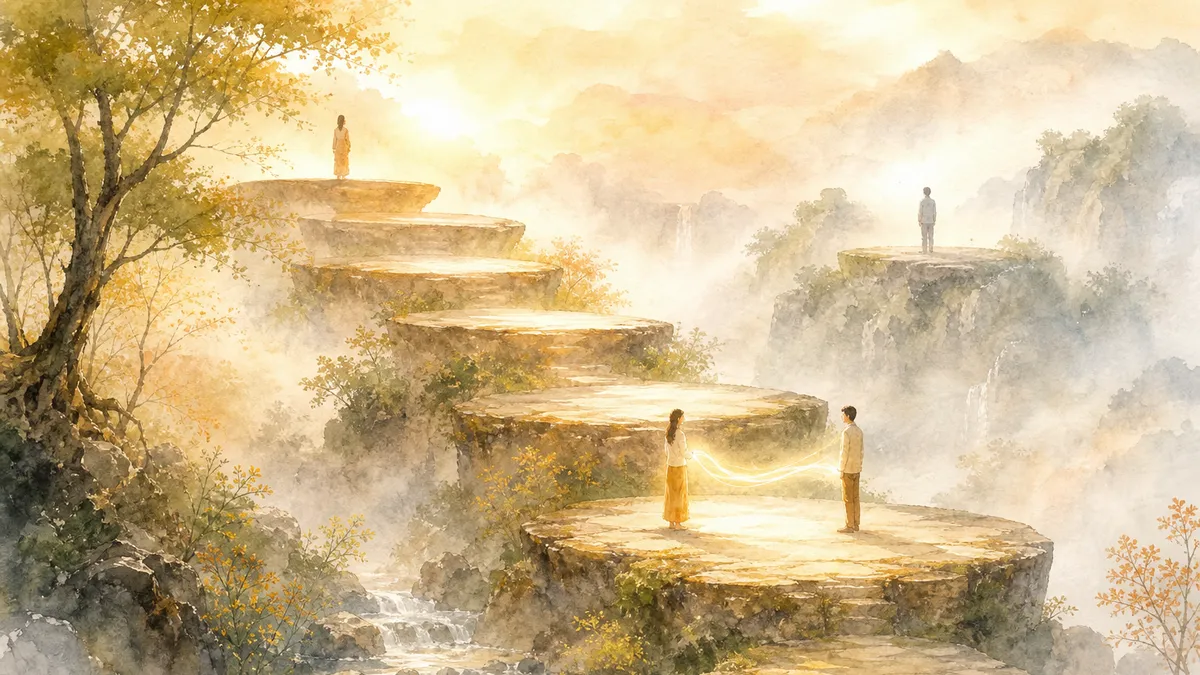
For example, a person who is in a state of ignorance cannot understand a contemplator; in principle, he cannot understand what the contemplator is doing. Once, in 1994, in a village, I was practicing contemplative walking and running. It was a secluded place with a wide road, so that one could integrate during running and walking. There were guarded collective farm fields there where corn and potatoes were growing. A watchman on horseback chased after me, apparently thinking that I wanted to help myself to the collective farm harvest. He caught up with me and tried to find out what I was doing there. Then I wondered how I could explain to him what I was doing here. I began with this question: “Have you read the Vijnana Bhairava Tantra?” Because it is very difficult to explain to a person who abides at a different point of consciousness that, as it turns out, you are performing a triple sankalpa and integrating with space.
In the same way, when a yogin is at even higher points, it is impossible for him to convey his experience adequately. For him to be understood, consciousness must be changed, that is, one must enter another position of consciousness. And by practicing Guru Yoga, we try to enter such a position of consciousness where the master, the teaching, and the siddhis abide, uniting with them. We try to attune ourselves in order to understand their position of consciousness and to attempt to contemplate from that level ourselves.
Today’s practice of the bhajan mandala is devoted to invoking the Absolute and the three enlightened bodies, qualities, that is, sat-chit-ananda, which can be translated as being-consciousness-bliss, or emptiness-awareness-experience. Usually, the bhajan mandala is conducted either as an invocation of a specific siddha or as contemplation and union with certain aspects of the Absolute, the supreme Source.
