

Usually we begin our classes with the mantra Om. And before we perform it, I will try to explain what kind of practice it is. Previously I did not give such explanations, but then I came to the conclusion that even the simplest practices need to be explained.
When we come into contact with the teaching, we often may not understand its depth or may consider certain aspects to belong to a particular cultural tradition. But when studying the teaching, it is very important to understand that engaging in spiritual practice is connected not with belonging to any cultural tradition, but with belonging to a spiritual tradition. At the same time, one should not equate a spiritual tradition with a cultural tradition.
For example, a spiritual tradition originates from gods, siddhas, saints, some of whom may have been Hindus and lived in India or in Tibet, while others may have been Russian; that is, nationality in this case does not play a major role. Since the spiritual tradition of the siddhas is universal, it is not connected with any ethnic or cultural limitations.
Some people practice the tradition of the siddhas within the framework of their own Indian cultural tradition. We, for example, being Russian, can quite adequately and harmoniously practice the teaching of the siddhas within our own Russian cultural tradition, without any pangs of conscience or complexes. A person living in Germany can practice the teaching of the siddhas within their own German cultural tradition, because this teaching is not connected with the external.
Engaging in spiritual practice does not mean putting on appropriate clothing, taking a rosary in your hands, and making certain ritual gestures. All of this is external and connected with a particular context. But when we perform certain methods, we must understand the teaching precisely as the essence of a certain method or practice that we apply.
For example, once I was giving a teaching, and one person said: “I really like your teaching, but when we chant the mantra Om or perform prostration, isn’t all of this Indian, while we are Russian people, so perhaps we could do it differently.” I answered him: “This is not a question of Russian or Indian. It is simply a method, a practice with which you work.” For example, if in martial arts someone demonstrates a particular combination to you, the question does not arise as to whether it is Chinese or Russian. It is a question of technique, of method, and therefore it is necessary to respect the method. The true teaching is not connected with any cultural limitations; on the contrary, the purpose, the aim of the teaching is to free us from all limitations.
So, before any practice, we usually chant the mantra Om and perform what is called namaste-kriya or pradhana-mudra. What does this mean? Usually it is said that namaste is a gesture of greeting, but in the teaching of laya yoga it is not so much a gesture of greeting as a gesture of entering another dimension of consciousness, that is, a state of presence and awareness.
This gesture or action is called namaste-kriya, or pradhana-mudra, when we close the solar and lunar channels in our body, striving to direct the energy into the central channel. We hold our joined palms at the level of the heart (anahata chakra), that is, at the place where our essential nature is localized. When we perform pradhana-mudra, we enter a state of awareness and, at the same time, try to relax, let go of ourselves, and attune ourselves to our subtle body, as if establishing a connection with the buddhi channel, or the causal body. If we do everything correctly, at that moment we connect to this channel, activation takes place, and we enter another dimension of awareness precisely thanks to this action. “Kriya” means a purifying action.
Thus, we begin our class by leaving the unconscious state, or karmic vision (samsara), and entering another dimension connected with immersion in the buddhi channel, that is, in the channel of our causal body. In other words, we try to look at the world through the eyes of contemplation. And at this time we also recite the mantra Om.

The Mantra Om as the Primordial Vibration
The mantra Om (AUM) is the primordial vibration, which is the sound manifestation, or sound analogue, of the Absolute. Its first sound (A) is connected with the creation of the universe, the second sound (O) is connected with the maintenance of processes in the universe, and the third sound (M) is connected with the dissolution or destruction of the universe.
The teaching of sphota-vada (the teaching on vibrations inherent in the Tantric tradition) says that the entire world consists not of gross matter, but of vibration of varying density. What appears to us to be gross matter is in fact vibration of different frequencies. This vibration is akin to sound, and sound in Sanskrit is called “sphota,” which is why this Tantric teaching is called sphota-vada. And when we recite the mantra Om, we can say that we reproduce the primordial sound of the Absolute, connected with the aspects of creation, preservation, and destruction of the universe. At the very least, this is what we should understand when we perform such an elementary action: greeting, Om, and namaste. But the practice of Om is actually much more complex.
Guru Yoga and the Refuge Tree
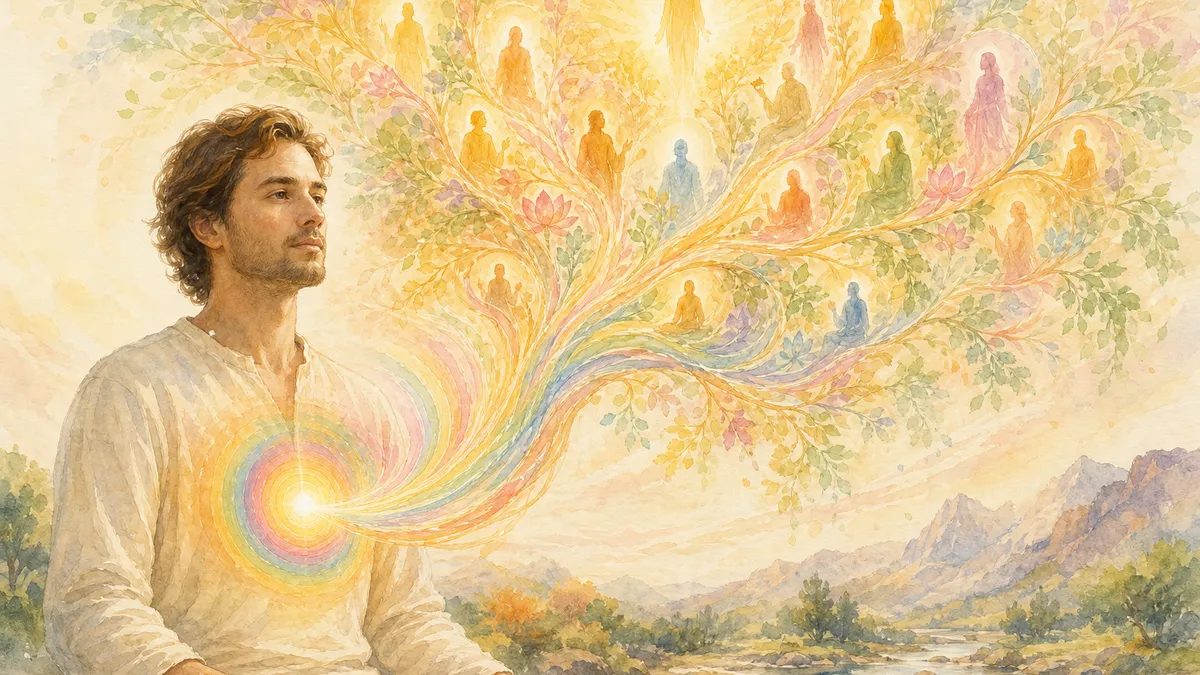
While reciting Om, we perform Guru Yoga. What does this mean? We visualize the syllable Om in the center of the chest in a five-colored rainbow radiance; that is, the syllable Om symbolizes our boundless potentiality, while the five-colored rainbow radiance symbolizes the five primordial elements that emerge from this potentiality. It can be said that the syllable Om is the creative tattva, and the rainbow radiance around it is the five primordial energies that create our Universe.
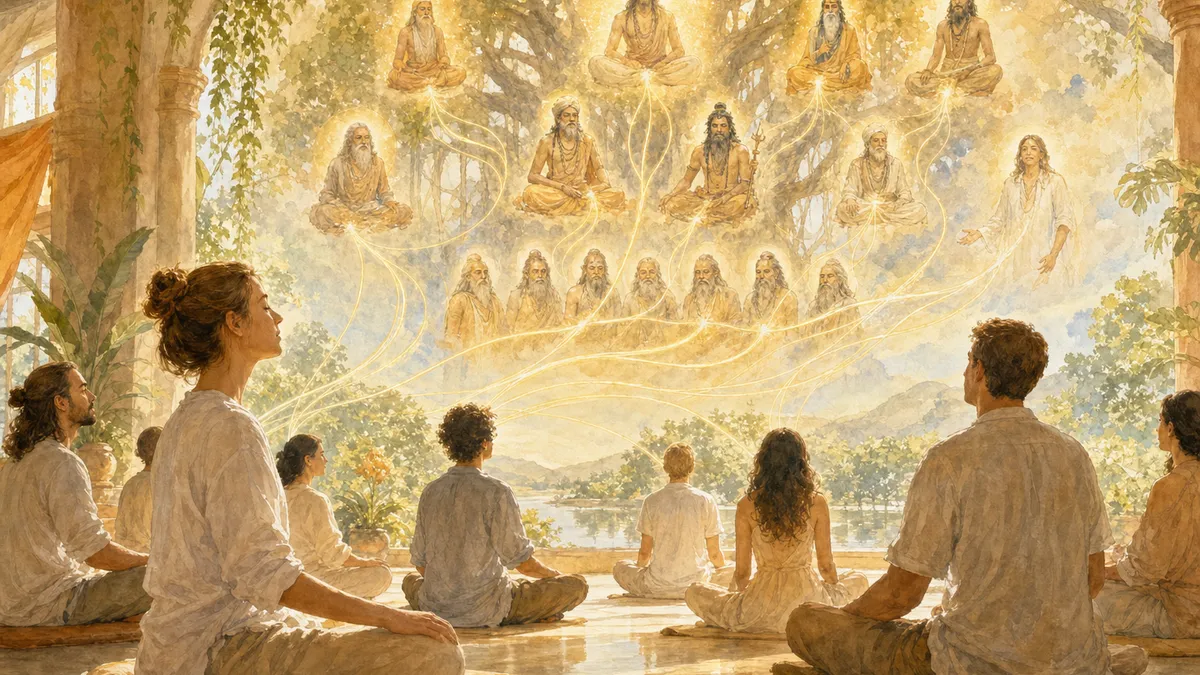
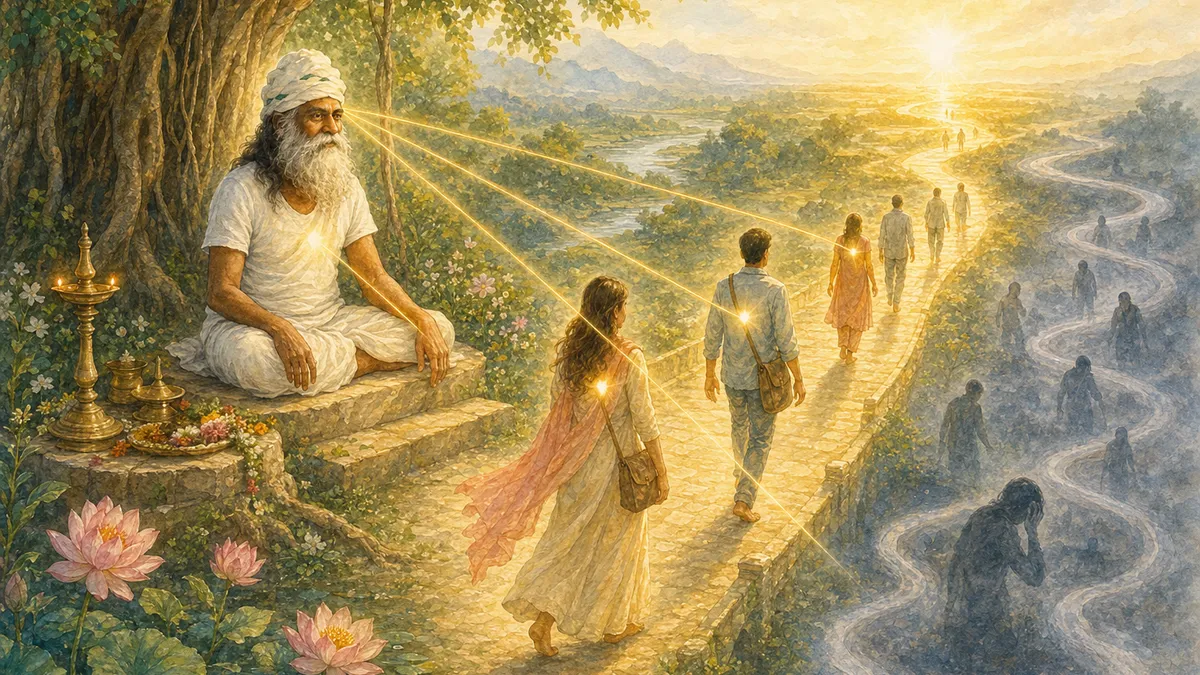
When we chant Om for the first time, we visualize the Om sign in rainbow radiance in the center of the chest. When we chant Om for the second time, directly in front of us we imagine how the light emanating from this rainbow radiance manifests the so-called Refuge Tree. The Refuge Tree is the lineage of saints and siddhas with whom we establish a connection. In other words, if every time before a lecture we truly perform namaste and Om, this is Guru Yoga.
Guru Yoga is a very important practice that permeates all the processes of the teaching of Laya Yoga. That is, Guru Yoga is the establishment of a spiritual connection with saints and siddhas through the spiritual teacher, the establishment of a connection with the Refuge lineage, and ultimately with the gods and with the Absolute itself. It can be said that Guru Yoga is something like activating services on a mobile phone and on the Internet. In order to receive any services, you need to enter a PIN code, that is, to declare in this way that your card needs to be activated; if you do not declare this (do not enter the PIN code), you do not gain access to these services. Something similar, only on a much subtler level, happens when we perform the practice of Guru Yoga. Through visualization and the recitation of the mantra Om, we activate the subtle wisdom of the saints, rishis, and mahasiddhas who are in another dimension; we connect to the Refuge Tree.
The Refuge Tree is an entire cohort of saints, siddhas, gods, and rishis who are the founders and patrons of our teaching. The closest among them are Achintya Baba, the siddhas Gorakshanath and Matsyendranath, the rishi Tirumular, the holy siddha Dattatreya, the god Indra, the Brahma gods of the Saraswati lineage, the god Brahma of Infinite Light, and the seven holy rishis (another name is the saptarishis), usually identified with the seven stars of the Big Dipper (Jamadagni, Vishwamitra, Atri, and others).
When we visualize the Refuge Tree and pronounce Om for the first time, we imagine Om in the center of the chest; the second time, we imagine how the Refuge Tree visually appears on our visual interface and sends us an enlightening impulse, a stream of light that enters our anahata chakra, where Om is located. Finally, when we chant Om for the third time, all of this dissolves, and our body becomes immersed in light and saturated with it. This is the rather complex practice that is performed every time we simply fold our hands and chant Om. That is, we enter into contemplation and perform Guru Yoga. When we perform these actions, we must be aware of why we perform them, what their result is, and how to perform them correctly.
The transmission of Guru Yoga with Om is a separate transmission; if there is time, I will speak about it in detail. This is an important practice that I recommend students practicing the teaching of Laya Yoga to perform always. But since the topic is somewhat different, we have spoken about it briefly.
When we have sung the mantra Om and entered into contemplative presence, we have connected to the Refuge Tree of the saints; that is, we have established a subtle-material, one might say energetic (wave) contact with the patrons of our lineage: with Saraha, Matsyendranath, Gorakshanath, Ramalinga, Dattatreya, and the seven rishis. Even if we do not fully understand what this energetic contact means, nevertheless, thanks to the connection with the spiritual teacher and the sangha, thanks to working with the lineage, this becomes clear over time.
When such contact occurs, it is called Guru Yoga; that is, we enter into a certain energy-informational contact and begin to receive blessings from other dimensions. As long as there is no such Guru Yoga, we will still be limited by our own egocentric vision, even if we listen to lectures and perform certain techniques. Therefore, in Anuttara Tantra, spiritual practice is very closely connected with Guru Yoga.
Guru Yoga in the absolute sense means the discovery of one’s natural state. However, since our natural state is blocked by the veils of obscurations, mental imprints, and karma, we first perform Guru Yoga with some more accessible external objects. That is, we envision all the saints, siddhas, and our direct teacher—that is, the master of the lineage from whom you receive the Teaching—as something unified and whole. Thanks to this, we enter contemplative presence and come into contact with our true “I.” In the context of Guru Yoga, it can be said that saints or the spiritual teacher, to use clear technical language, are a kind of resonance module through which we establish energetic and wave contact with the higher dimensions of our consciousness.
Qualities of a Practitioner
So, what qualities should a disciple have who seeks to practice and study in the tradition of the Laya Yoga teaching? Traditionally, such qualities are described in many texts. For example, Sri Shankaracharya describes the qualities of a disciple in such texts of his as “Atma Bodha,” “Viveka Chudamani,” and “Aparoksha Anubhuti.” For us, Shankara is the greatest authority, since we follow the tradition of Advaita. For Vedic philosophy, and especially for the teaching of Advaita, Shankara is as much an authority as the Buddha is for Buddhists or Christ is for Christians.
So, Shankara says that a disciple must possess certain qualities before practicing a teaching such as Laya Yoga or Anuttara Tantra. Often, a person who tries to apply an exalted teaching discovers, after years have passed, that something is not working out for him. Then he has to reassess himself anew and cultivate the qualities he lacks. Therefore, from the very beginning it is very important to understand which qualities need to be developed within oneself.
If we dwell in fantasies and do not assess our qualities and our spiritual level quite adequately, greatly overestimating it, there is a high probability that we may not receive from the teaching the benefit that was promised by the saints, siddhas, or sacred texts. That is, it is very important to determine one’s belonging to a particular class. For example, there is the class of divya (divine beings), the class of vira (spiritual heroes), and the class of pashu (the bound, the limited). Of course, no one wants to classify themselves as bound; everyone wants to position themselves as a yogi of a higher class. But there is nothing humiliating in this. One must look soberly at one’s present qualities in order to work with them, because if from the very beginning you position yourself as divine, then there is no need to teach you at all, since one who possesses divine qualities no longer needs liberation, being like Ramalinga or Ramana Maharshi. But if we soberly assess our qualities and know what we need to work with, we have the opportunity to awaken our potential.
The Four Main Qualities According to Shankara
So, what qualities does Shankara describe? He says that these qualities are as follows:
1. Viveka — the ability to distinguish truth from non-truth.
2. Vairagya — dispassion, detachment.
3. Mumuksha — the aspiration for liberation.
It is assumed that, having come here, you aspire to liberation from your limitations and to the attainment of enlightenment. But how much do you actually aspire to it? How far can your aspiration go? If you try to test your aspiration, you will see that it manifests differently in each person. Can you, for example, allow your aspiration for liberation to go as far as Milarepa’s?
4. Shat-sampat — that is, the six virtuous qualities. This can be called a sixfold quality.
This is calmness of mind, that is, composure, self-control, control over the senses. If you have no composure and no control over your senses, if you can easily be thrown off balance by being provoked into anger, irritation, and other emotions, then can it really be said that you are a yogi, that you practice high teachings? If this manifests in you, then I can say the following: it is better not to engage in practice for the time being, but to focus on developing composure and self-control within yourself. If you meditate a lot, practice techniques, and go through retreats, you will enter such areas of the subconscious where you will be deprived of this control and composure, where you will encounter spirits, gods—that is, such incredible forces, surpassing you, that you will not be able to control yourself. Yoga is not for the weak; the spiritual path is not for those who are easily confused or shaken, so it is necessary to devote some time to developing these qualities.
5. Titiksha — strength of spirit.
Strength of spirit manifests in the fact that we must have great commitment to the path we have chosen and bear personal responsibility for our decision. Looking at spiritual seekers, I sometimes simply marvel and think: “Revolutionaries, for example, could go to prison for their idea, or be sent into exile in Siberia.” Of course, we should not think that we too could go to prison for our convictions, so as not to create such samskaras. Nevertheless, this example reflects their incredible strength of spirit and commitment to an idea. In fact, a person is ready to give his life for certain social reforms. That is how strongly he believes in his idea.
However, among people engaged in spiritual practice, unfortunately, such strength of spirit is often not observed. But if you cannot possess such strength of spirit, it is impossible to realize the teaching to a sufficient degree. Strength of spirit is a very important condition when you follow the spiritual path. Of course, when you practice yoga, you do not need to go to Siberia or endure hardships, since there are enough hardships or restrictions even in everyday life. It is enough to have the strength of spirit to love the one who irritates you, not to show irritability or anger, and to persistently do your daily morning practice. Even for such small things, a certain strength of spirit is needed in order to resist inner temptations, worldly desires, and certain egocentric tendencies.
6. Shraddha — this is faith.
It can be said that this is openness and trust. If you are inwardly blocked, stubbornly clinging to something of your own, unwilling to be positively disposed and open in order to listen and integrate, if you listen to the teaching with half an ear, filtering it and discarding what does not correspond to your ideas, the teaching, of course, will not help you. When we follow something, we must certainly trust it and show maximum openness. One might say that this is even a certain vulnerability (in the good sense of the word), when we remove our inner defenses. Just as happens in confession or at a doctor’s appointment, we in a sense open something within ourselves, showing our true “I,” and not some social picture, a beautiful “polished” image. That is, we do not defend ourselves and do not fall into false pride, positioning ourselves in some artificial way.
One person once approached me and said: “I have realized Advaita. I know all this; everything is going fine.” I said to him: “I am very happy for you. Forgive me, but I cannot teach you, because I teach those who have not realized Advaita, but are trying to realize it. I am happy for those who have realized it, but I do not think I should give them advice.” That is, if you have realized Advaita, that is your personal happiness, and in this case one can only rejoice for you. I said: “I do not teach teachers and saints. I teach ordinary people who have their own limitations and who are sincerely interested in learning. And if you are not interested in learning, if you are a saint or think that you are already realized, then the most I can do is be happy for you. However, the process of learning is something different: when we enter into a certain contact, soberly assessing our real situation, we realize that we have limitations and sincerely try to get rid of them.”
Qualities of a Disciple
In another classification, it is said that a disciple should possess such qualities as faith, diligence, understanding, cooperation, and attentiveness. For example, if you have faith, you become imbued with the teaching and the methods of practice and begin to work with them. If you have diligence, you can practice them daily, and they begin to bring you results. If you have attentiveness, you apply all the instructions without making mistakes. Through cooperation, you discover such nuances of practice that you could not understand before. All of this comes together into a process called discipleship, or learning.
So, let us imagine that these qualities have been born in us, and then we can already move on to some higher concepts and receive transmissions.
16 Stages of the Waxing Moon of Inner Awareness
At this seminar, I plan to give the transmission of the Brahma Mantra. This is a very important practice connected with meditation on Brahman. I also intend to give a teaching called “The Teaching on the 16 Stages of Contemplation,” or “The Teaching on the 16 Kalas.”
If we speak about the goal of spiritual practice, then the goal of spiritual practice is the attainment of liberation from one’s limitations, the attainment of complete freedom. But when we engage in practice, we should have more precise formulations and understand what this means. If we do not have precise formulations and criteria, we may interpret all of this very arbitrarily, and therefore, instead of freedom from limitations, we may acquire new limitations. The teaching on the 16 stages of contemplation is, one might say, the core of the teaching of Laya Yoga. This teaching allows us to trace our progress from the very beginning. If you remember it, the entire logic of spiritual life will become clear to you as if in the palm of your hand.
The First Stage — Transmission
The first stage consists in the fact that when we experience limitations, we simultaneously feel our infinite potential. But because we are limited, we experience suffering. Why do limitations exist? Because, unfortunately, we live in a reality that is not governed by our consciousness. For example, we are mortal, we freeze from the cold, we become ill, we cannot, like gods, change the sex and form of our body, and we are limited by physical laws and constants. We cannot act as operators in relation to reality, because the laws of this world (temperature, climate, pressure, gravity, the body’s biochemistry) do not obey us. We age against our will. It has never happened that a day or a year passed, and we approached the mirror and saw that we had begun to look even better! Unfortunately, everything happens the other way around and not according to our will. This is evidence that this universe was created neither by us nor for us. In this universe, we are not operators, but, one might say, passive recipients of services. It is similar to how you were connected to a service called “life,” but after some time it may be disconnected without asking you. That is, we did not create this global network, this global universe.
When we understand this, we become aware of our limitations, suffering arises in us, and so does the desire to transcend these limitations. We are not immortal like gods; unfortunately, we cannot change reality by the power of our intention. All of this indicates that we are in some kind of tunnel of reality that is beyond our control. We see neither the past nor the future, unless we are great clairvoyants; we cannot choose variants of the past or future or model it. One could say that we are in some narrow, limited tunnel of reality that leaves us very little choice. And such a state is called “abiding in impure karmic vision (samsara).” We are subject to the cycle of birth and death. When we begin to realize all of this at least a little, our search begins; we seek a way to change the corresponding situation. And then we meet a spiritual master, the teaching, and enter into the process of transmission.
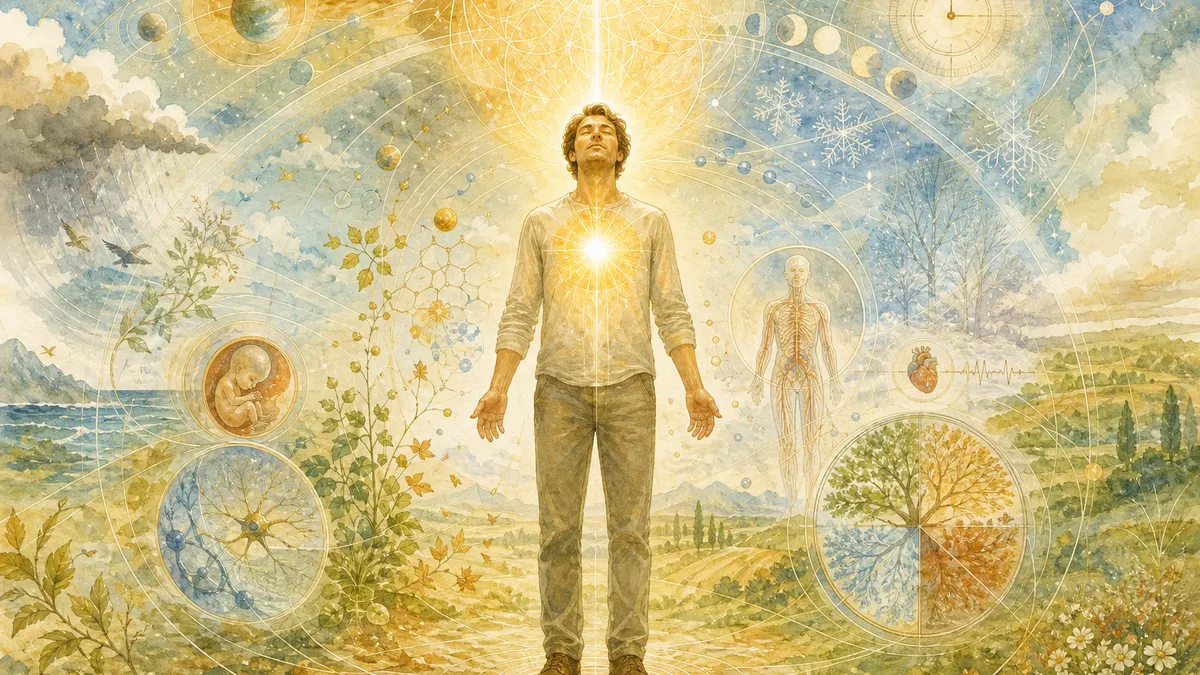
The first stage in studying the teaching on the 16 stages of contemplation is “transmission,” when we receive a “taste” of the primordial state, that is, when we discover a certain potential in order to work with it further. And this state is likened to conception. In other words, when a certain subtle experience of nonconceptual awareness appears in you and you clarify a little what it means to be in contemplation, this means that something is being conceived within you. For example, you practice concentration and meditation, then receive transmission into shambhavi mudra, and nonconceptual awareness is born in you. And as soon as you have felt this nonconceptual awareness a little and your consciousness has expanded, it can be said that you have approached the first stage. This is the stage of conception. That is, your future child has received conception within you.
The Second Stage — Gestation
The second stage is “gestation.” Even when you have received transmission into non-conceptual awareness and something has begun to work out for you, this means that now you need to work with it; you need to nurture this state as carefully as a mother nurses a child, to allow it to deepen. You need to clarify it completely — whether it is like this or not like this. This is also called manana, that is, clarification.

The Third Stage — Birth
The third stage is “birth.” For example, you received transmission at one of the retreats, and for approximately two years spiritual work was taking place within you; you engaged in meditations and basic practices. A certain “taste” of mindfulness and non-conceptual awareness appeared in you, and you tried to hold to it constantly, that is, you worked with some sankalpa and gestated this state for several years. Then a certain critical threshold comes, where you move to a qualitatively new level. Bang! A flash! Illumination occurs in you, a large-scale expansion of consciousness. This indicates that you have moved to the third stage, which is called birth. It is as if you were connected to the global universal network, reunited with the Supreme Source, and gained an authentic experience of the Supreme, of your absolute “I.” The channel of buddhi opened; you caught the signal that your causal body sent you.
Our higher “I,” the causal body, and the Atman (in Sanskrit — karana-sharira, the causal body) always exist. One could say that this is God within us. It exists just like the heart, the liver, and the spleen, whether we want it or not. Each of us, in our inner potential, is boundless and absolute. But because consciousness is coarse, it does not remain on high vibrations; we simply do not perceive it, and therefore we live in our limited karmic vision.
I have read that some scientists began measuring the radiation frequencies of consciousness. They came to approximately the following astonishing conclusion: ordinary people emit frequencies of 200–400 Hz. I am not very well versed in these units, but approximately so. Further, they said that people endowed with parapsychological qualities, mediums, emit at a frequency of approximately 800 Hz. Finally, saints who have attained realization emit at astonishing frequencies equal to approximately 20,000 Hz. The vibration frequency of subtle bodies differs very greatly from the frequency of ordinary people. One could say that to come into contact with the Primordial Source and open the channel of buddhi is to transfer one’s consciousness to a higher vibration frequency.
The teaching on vibrations is not some fashionable invention of the twentieth century. In Vedic civilization, the teaching on vibrations was known many thousands of years ago and described in ancient texts as an entire philosophical system called sphotavada. There are quite a few texts on this topic. Sphotavada says that everything in the world, including material things, consists of energy, and energy is nothing other than vibration of various frequencies. And saints are those who are established on the highest vibrations, on the highest frequencies of consciousness. Those whose minds are obscured, however, are established on lower frequency vibrations. And the stage of birth is the stage when we finally establish our consciousness on very high vibrations. However, even if such a birth has occurred and we have experienced a powerful expansion of consciousness, this still does not mean that we have attained liberation. This can be called a flash of fleeting samadhi. It is identical to what in Zen is called satori. Such a flash, for a time, splits the cocoon of individual perception. Nevertheless, our karma and our ego are strong enough that a single flash of such a state cannot truly bring about some global transformation within us. And we must continue to work precisely with this.
The Fourth Stage — Nurturing
The fourth stage concerns precisely the maintaining of this channel of connection with the Supreme Source. It is called “nurturing.” Nurturing consists in our making the “great decision.”
In the teaching of Laya Yoga, there is a concept known as “making the great decision.” After we have come into contact with the Supreme Source, we “make the great decision” to remain continuously in contemplation. It can be said that the entire life of a yogin is divided into two parts: before “making the great decision” and after. Before “making the great decision,” we were, as it were, ordinary people; we considered ourselves to be doers, the world was real for us, we made plans, clung to them, and strove to realize them. But when we experienced birth and opened the channel of our higher “Self,” everything changes: we see that everything is an illusion, that the world consists of vibrations, that there is neither bad nor good. There is nothing absolutely bad — only what we do not like seems bad. There is nothing absolutely good — only what we like seems good. The world appears as a causeless, spontaneous, eternal play of energy. There is no clinging to our own individual “I,” no hopes, fears, or attachments. Instead, in sacred vision, the world appears to us as holy. It is empty, yet at the same time all energies manifest within it. It can be said that the opening of such a channel directly reveals to us the essence of the teaching of Advaita Vedanta.
According to the teaching of Advaita Vedanta, the entire world is nothing other than an illusion; we are in fact not we, but the Absolute, Brahman; other people are not other people, but His illusory energies. From the point of view of Advaita Vedanta, the law of karma, the law of cause and effect, does not exist; that is, these laws do exist, but only at a lower level. From the point of view of Advaita Vedanta, any manifestation is a manifestation of the Absolute, Brahman. For example, speaking from the point of view of Advaita, I, just like you, did not actually come to this hall, and this is not a seminar. You are the Absolute, and I am the Absolute, and this is not a seminar but the play of the Absolute, in which He assumes the role of teacher, student, and the process of learning. That is, it is lila, the divine play, in the course of which the Absolute plays with Himself and enlightens Himself. From the point of view of Advaita Vedanta, there is no subject, there is no object. The seeming world of visible forms is nothing more than a dream.
Therefore, in Advaita Vedanta there are various statements (mahavakyas) that describe this. For example, one such mahavakya is:
“Aham Brahmasmi” — “I am God,” “I am the Supreme,” “I am the Absolute.”
Another is:
“Prajnanam Brahma” — “Pure awareness is the Absolute,” “Pure contemplative presence is God.”
A third is:
“Tat Tvam Asi” — “You are That” — this means that every thing (every object) is absolute.
When we move on to the third stage, we awaken to the understanding of Advaita. We see that nothing exists separately, by itself, but that everything in this world is part of something global, unified, and whole. By and large, there are no gods, no people, no hells, no heavens. In a relative sense, of course, they exist, but we are speaking now about view. That is, from the absolute point of view they do not exist; they exist only from the relative point of view. Both gods and demons are the play of one single Brahman. Hells and heavens are simply different energies (peaceful and wrathful) of one single Sphere. There is no subject, there is no object, because in Brahman there is no duality.
It can be said that we are deluded when we look at the world; we interpret reality incorrectly. Just as a rope in the darkness appears to be a snake, so we too are mistaken, incorrectly interpreting reality: that which is Brahman we take to be worldly, material, real; that which is play, the energy of Brahman, the Divine play, lila, we take to be complex cause-and-effect relationships; ourselves, the embodiment of Brahman, we take to be an individual, separate personality.
In his texts “Aparoksha Anubhuti,” “Atma Bodha,” “Viveka Chudamani,” “Brahmanu Chintanam,” Shankara says: “Man, wake up! In reality, nothing exists except Brahman. You are deluded; you are misinterpreting sensory data. You consider yourself a separate person; you separate yourself from this world.” And this is indeed so. In the impure karmic vision of samsara, the favorite trick of our false ego, our “I,” is to declare itself to be something separately existing and real, while declaring the world to be a heap of disparate objects and establishing some kind of external dualistic relations with them. All of this is called duality, leading to suffering, birth, and death. But at the third stage, when the buddhi channel opens, this duality is overcome and we enter the dimensions of Advaita not thanks to philosophy, not thanks to the conceptual reflections of the mind, but thanks to our own living experience. This own living experience is called shunyata-mahasiddha, or pratyaksha-advaita.
Unlike Advaita, which uses philosophy and concepts, we say that our school is Advaita based on direct experience, on mystical experience. In other words, even if you are not very well versed in Shankara’s texts, but have received transmission from a spiritual teacher and worked with the technique, you can obtain a living experience of what Shankara writes about through your own mystical experience. And all of this happens precisely at the third stage. It can be said that at the third stage a person experiences a mini-enlightenment, as a result of which his vision of the world changes radically.
For example, I can say that I regard the world as a manifestation of my own consciousness. I do not separate the world from myself. If anything happens, I consider it inseparable from myself. I have no great goals or plans for tomorrow, for the future. All these goals are part of a game. It is also not characteristic of me to cling to the past: I do not keep diaries, do not analyze the past, do not experience any subconscious complexes connected with anything at all concerning the past. I see that the past, present, and future are an integral process of time that occurs in my consciousness simultaneously, or in a single moment. I do not separate my inner life from external space. And when I say “I,” this is a very inadequate definition of me, used only because communication requires it. In reality, I speak of myself as “not-I,” because if one says “I,” then who is “I” really? I consider myself space; moreover, I do not merely believe this and think that it is so, but I know it. Therefore, it is not so easy to confuse me or lead me into any kind of experience.
I am saying this not in order to tell you what an interesting person I am, but to show that each of you can experience this if you engage in spiritual practice. The sense of my personality has undergone a certain transformation and dissolved, and therefore I do not strongly associate “I” with this image, personality, or labels. Rather, by “I” is meant the global universal consciousness that is also inherent in you, that is within you. There is no personal merit or pride of mine in this. This universal consciousness is also present in you, and you have the same full and absolute right to it. This is approximately how you become aware of yourself at the third stage, which is called birth.
Birth means that this state has been born, that is, it has come out of you and become manifested. Previously it was invisible and incomprehensible, but now it has manifested. But this does not mean that at this stage we should calm down, congratulate ourselves, and think: “Well then! My spiritual life is over.” It can be said that this is only the beginning, because further on we must work with this state, we must cultivate and nurture it. That is, we must strive, without being distracted, to maintain it continuously. And if we try, we will see how difficult a task this is. It is one thing to experience it for a short period of time, and another thing to remain in it in the morning, during the day, in the evening, at night, when you are working, walking, eating, sleeping.
The fourth stage is called “nurturing.” Just as a newborn child must be well cared for, so we carry out inner alchemy, inner work, by observing this state that has only just been born. We must nurture it carefully. It is usually said that a yogin should not be distracted from presence when he is sitting, lying down, or standing. Only if you are not distracted do you nurture it; but if you are distracted, then, of course, you are not nurturing it.
Imagine that an infant is abandoned, not fed, and completely forgotten for three months. Can it be said in that case that you are nurturing the child? Of course not. And imagine that a person received such an experience in retreat and then forgot about it, once again entering the circle of everyday concerns. Can it be said that he is nurturing this experience? Hardly. But the essence of the stage of nurturing lies precisely in the fact that every second we try to care for it and work for it.
Of course, before this it is important to receive confirmation from a spiritual teacher as to the authenticity of this experience. We must clarify that this is precisely that state and that it can be worked with; that is, that your child was born normal. If you do not receive such confirmation, you may be mistaken and think: “Oh, I experienced such magnificent Light, spirits appeared to me! I must already be a Buddha.” If you try to work with this state, and more senior masters or monks say: “You know, in my opinion, something is not quite right here,” then it is necessary to reflect on this. In various traditions, a great deal of attention is paid to confirmation, so you must make absolutely sure that this is precisely the experience on which you can rely.
You can even analyze for yourself whether this state is correct or not. For example, there is a saying: “If your mind is not altered (that is, it is constant and does not change), then you are in the natural state.” What does “not altered” mean? It means that your spirit does not waver in heat or cold, in joy or sorrow, in suffering or pleasure. Even under the harshest circumstances, you maintain a normal, even state of mind, and in this case it is said that you self-liberate everything.
Another criterion: if you have understood the principle of non-conceptual awareness, then concepts and theories can no longer bind or grasp you; that is, you are not at the level of the mind, but beyond the mind. And when thoughts arise, they are seen by you not as something real, but as a kind of play. If you are able at any moment to stop your thoughts, immediately forget about them, detach yourself from them, this means that you have become quite well established in non-conceptual awareness. But if you attach great importance to thoughts and their expression, and do not manage to self-liberate them, then this cannot be called that state.
So, nurturing begins precisely when you have clarified that this is exactly that state, and now you need to care for it, to live with it very carefully every second so as not to lose it. It is like carrying a vase filled to the brim with water, so you are very attentive. And when a person practices, he may have experiences or he may not. But practicing the path of presence does not mean immediately having experiences. You may see neither gods nor angels. You may not have any staggering experiences with stars and fireworks, but you will have a very subtle state, as if an inner shift has occurred. That is, you are in the same world and in the same universe, but everything has changed a little. Everything has become more subtle and completely different, more inward and conscious. Even such a change changes everything, because you no longer identify with anything. If you correctly nurture this state, you will certainly have experiences in the form of awe, delight, expansion of consciousness, and signs in dreams. These experiences will certainly occur, but a little later, not immediately. There are no experiences because either we are distracted, or we are nurturing not what is needed, but some dualistic state.
The Fifth Stage — Education
Finally, the fifth stage is called “education.” This is a more advanced stage, when we are already constantly in presence and begin to give this presence the quality of flexibility. In fact, even reaching the fifth stage is a great achievement, because it is assumed that by this time a person has already realized, or almost realized, the state of sahaja samadhi, which is often called “the samadhi of the flowing river.” This means that it is flexible, spontaneous, natural. And one could say that the stage of education is the stage when we are already approaching this state of “the samadhi of the flowing river.” At this stage, we not only maintain mindfulness of presence, but place ourselves in various situations, including uncomfortable ones, manifest certain hidden karmas that may have remained unmanifest, and observe how well we hold presence under these conditions.
An elderly monk came to a teacher who taught in a mountain monastery and asked permission to participate in the retreat. The teacher asked him:
“What virtues do you possess?”
The monk replied:
“I do not possess great virtues, but I can control my anger; I have conquered my anger.”
The teacher said:
“That is a great virtue! You should not think that this is an insignificant achievement.”
When evening came, all the students gathered together, including this elderly monk, to listen to the teacher. The teacher said:
“Be attentive! New people have appeared here among us, so keep a close eye on your things so that nothing goes missing.”
This monk even turned crimson with rage and asked:
“Whom did you have in mind? I come from a good family; there is nothing to reproach me for. I observe my vows.”
The teacher said:
“You see, I deliberately said that in order to bring out the anger still hidden inside you. You thought you had overcome it, but as soon as you found yourself in an unusual situation, everything that was hidden within you immediately manifested.”
In the same way, when at this stage we think that, thanks to the discovery of the natural state, we have defeated all our enemies, all the hidden kleshas, this may turn out not to be the case at all. And the cultivation of contemplative presence is precisely such a practice: we allow various situations to arise, or even consciously place ourselves in unusual situations, in order to provoke the manifestation of hidden tendencies, and we observe how well we maintain presence. That is, cultivation means that we train flexibility; we learn to maintain our awareness regardless of whether pleasant or unpleasant people are near us, whether we are in a monastery or in a worldly environment, whether we suffer or enjoy ourselves; we learn to remain the same in the diversity of situations.
In ancient times, siddhas attached very great importance to the stage of cultivation. For example, Tilopa trained Naropa in very radical ways, which is why there are many legends about him and various texts have been written. Once Tilopa taught Naropa in the following way. When the local prince was riding on an elephant surrounded by numerous guards, Tilopa said:
“Go and knock him off the cart. That will be amusing!”
Naropa, as an obedient disciple, went and tried to carry out this instruction from his teacher. Of course, the guards did not let him near the prince and beat him severely. When Naropa, barely alive, dragged himself back to Tilopa, he asked:
“Well? Have you still not lost your resolve to practice? Have you not become disillusioned with the teaching?”
Naropa replied:
“No, since I see how limited I still am, I am ready to endure far greater trials. I very strongly want to comprehend the teaching and develop presence.”
It is said that Naropa had to jump from high towers and endure various sufferings. Tilopa taught him by rather radical methods—the methods of the siddhas. Such methods are not used today. Nevertheless, this is a classic example of how the cultivation of this state can take place. It is said that Naropa received twenty-four such lessons: twelve lesser and twelve greater trials. And in the course of this, all his karmas, hidden in his subtle bodies, were manifested and self-liberated, thanks to the mastery of his teacher. If Tilopa had not given him the opportunity to undergo these trials, it is quite likely that Naropa would not have been able to attain enlightenment. In our time, it is generally not customary to teach in this way; that is, the stage of cultivation does not mean that one necessarily has to do some radical things. Rather, it means constantly, vigilantly, and flexibly observing in any situation those moments where you have “slip-ups,” those moments where your grasping, egocentrism, hopes, or fear manifest, and not putting up with this, but, on the contrary, paying close attention to it.

The Sixth Stage — Tempering
The sixth stage is called “tempering.” That is, when we have already cultivated our presence, we need, as it were, to temper it, to give it the quality of stability. At this stage, the yogin often goes either to the mountains or undertakes some special practices connected with pacification, with invoking spirits, divine beings, or some non-physical beings. Through the power of his consciousness, he tries to harmonize and pacify these energies. Or he helps others, takes on their karma, and in this way tempers his presence. That is, it is assumed that by this time his spirit is so strong that he can do this. The sixth stage (tempering) is precisely the very approach, the very methods by which Tilopa taught Naropa.
Once Krishna was swinging on a swing and having very frivolous conversations with Rukmini, his wife. Then he suddenly jumped up from the swing and disappeared somewhere, and then appeared again. And Rukmini asked him:
“Where did you disappear to so suddenly?”
Krishna answered:
“There was one devotee of mine, a Brahmin, walking in great ecstasy and singing a mantra to me, relying completely on me. But then he passed by a place where washerwomen from a low caste were washing clothes. Without noticing, he walked with his feet over the clean linen. The washerwomen became very angry and wanted to beat him, so I went to help him. But this devotee was so immersed in bliss and ecstasy that he experienced no suffering. When they began to beat him, he simply continued reciting the mantra, relying completely on me. So I returned, seeing that they would not be able to do anything to him, since he was abiding in such ecstasy.”
Tempering is something like this: when the yogin is so deeply immersed in unity with the absolute Source that he is able to self-liberate even the most difficult circumstances.
The Seventh Stage — Setting Free
The seventh stage is called “setting free.” Now we allow our natural state, which has matured, to move spontaneously, effortlessly, and naturally; that is, we no longer limit ourselves in any way (neither by cultural prohibitions, nor spiritual ones, nor any external ones), and there is no artificiality in us. It is precisely at the seventh stage that what is called the “samadhi of the flowing river” is fully realized. In other words, the yogin has become so flexible and spontaneous that he constantly abides in inner awareness; he no longer has attachments, nor any need to limit himself by anything. He acts solely from inner awareness.

Saints are often described as being immersed in play, lila. For example, the “Bhagavad Gita” describes Krishna, who, generally speaking, did not even resemble a saint; nevertheless, he is spoken of as the greatest saint, an avatar. But in childhood Krishna stole butter and played pranks; in his youth he amused himself with the cowherd girls; later he became the king of Dwaraka and took part in the battle on the field of Kurukshetra. In general, looking at his outward actions, it is difficult to say that he was a saint, an outstanding being. But when difficult times came, he showed Arjuna his Absolute form, that is, what is called the vishva-rupa. And on another occasion he showed King Yudhishthira the dimension of his “Self.” When they went far to the north, into the Himalayas, he led him to a place where time and space ended, where there was a space of dazzling light and nothing more. Krishna said, “Do you see? This is my true Essence. Now you have truly seen me.” This indicates that Krishna was not limited by his physical body, and that any actions for him were nothing more than play.
A saint who has deeply immersed himself in presence sets it free, allowing everything to manifest naturally. It is said that he does not act, but plays. For example, it is known that Krishna had 16,000 wives, although some say that these were not wives, but various states, and that this should be understood in a subjective sense. Nevertheless, there is a story about how Narada, another siddha, came to him, also immersed in the state of play, and said:
“Krishna, you have 16,000 wives, and I do not have a single one. Give me at least one, otherwise I am somewhat bored.”
Krishna said:
“I can give you only that wife who will not be with me at the moment when you see her. That is, this wife must be free from me at that time; otherwise it would contradict custom.”
Narada thought, “There are 16,000 wives, and Krishna is only one. Since Krishna is in this palace, he is not in another palace. I will go to the next palace and choose a suitable wife for myself.”
But when he moved to another palace, he saw Krishna there as well. When he transported himself to the third palace, Krishna was there too. He went through all 16,000 palaces, but in each of them Krishna was sitting and conversing with one of his wives. Then Narada realized that Krishna had played a joke on him, because, possessing boundless potential, he could emanate his energies in such a way that his physical and subtle body could divide and project itself as much as he wished.
The Eighth Stage — Play (Lila)
The next stage is “play,” “lila.” When the natural state is set free and manifests creatively, the yogin is no longer bound by doing, by self-identification as the doer, by the sense of “I,” by the past or the future. He is in a completely different tunnel of reality. He is not bound by the law of karma as ordinary people are, although residual karmas may still manifest. It is said of him that he does not live, but plays. He is in a pure dimension, in the state of play. He acts completely spontaneously and lives from moment to moment. He is in the present at every moment, living it totally, absolutely. Neither good nor evil, neither pure nor impure can any longer strike his heart, because he is in such a unified, integral state. When this state becomes fully rooted, the yogin is at the stage of play.
Play is something that is difficult for ordinary people to assess, something that is difficult to speak about. It is entirely spontaneous action and a state of non-doing. The Puranas often describe the plays of saints or gods, and it is said that when such play takes place, at first it seems that one thing is beginning, but the true meaning of the play is revealed later. That is, God reveals His purposes much later. For example, there was the saint Neem Karoli Baba. Once, when his disciples went into the forest and became hungry, he said: “There, under the trees, the manager of our monastery always hides food from you.” The disciples really did find food and other things. And Neem Karoli Baba said: “You see, the manager is greedy; he steals food from the ashram and hides it in the forest.” But, of course, it never occurred to the manager to steal food, carry it into the forest, and hide it. Neem Karoli Baba materialized the food, but presented it as though the manager were stealing it and hiding it for some reason. Nevertheless, after some time this became clear to the disciples.
The ninth stage — the creation of the mandala
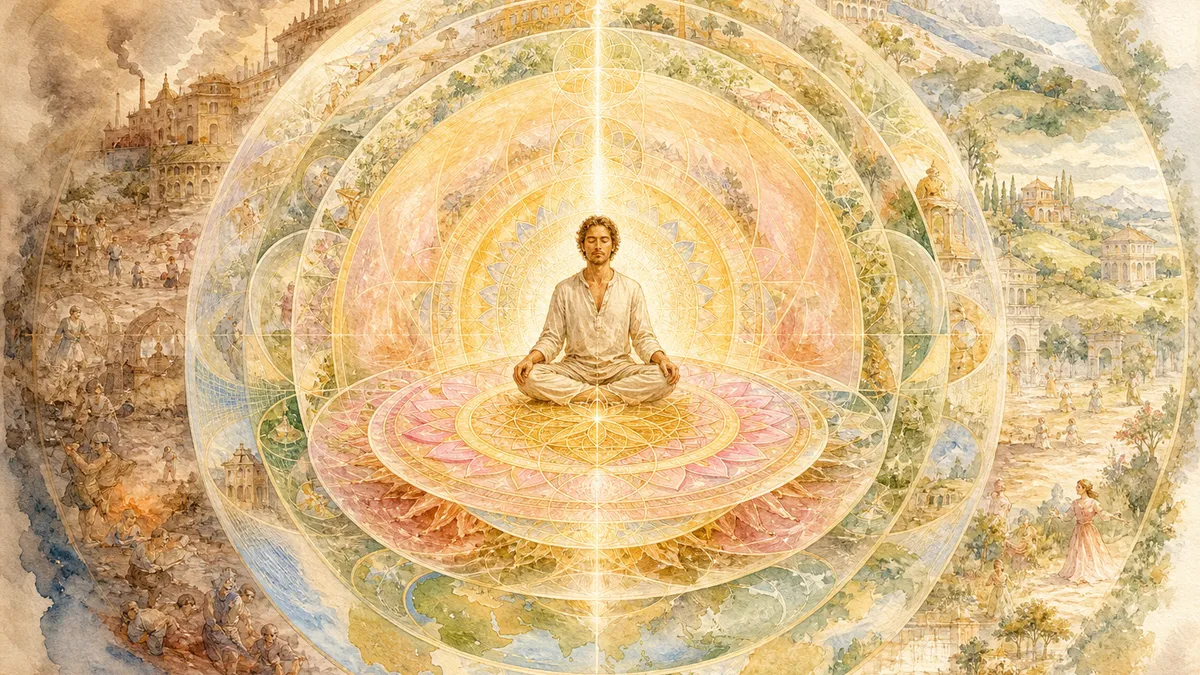
When such play takes place constantly, the next stage begins, which is called “the creation of the mandala.” The creation of the mandala means that the play radiates continuously and transforms the surrounding reality. One could say that a person steps out of the habitual karmic vision and creates an individual tunnel of reality that is completely governed by his consciousness, while he himself is at the center of this universe. It is no longer the external world that governs his karmas; rather, he himself is the central deity in relation to his own universe. A mandala is, one might say, a holy or sacred pure dimension, at the center of which the yogin holds the status of lord, ruler. Such a yogin is called a mandaleshvara.
Analogues of mandalas in worldly life may be any complex structures or systems. For example, if we consider a schoolteacher and the students in a classroom, then the classroom is a mandala, that is, a complex structure or system, and the teacher, as its leader, is the mandaleshvara, its lord. A car or a technical device can also be called a mandala, and the operator who controls it is called a mandaleshvara, that is, a ruler who governs it by the power of his consciousness.
The mandala as a controlled reality
When we speak of a mandala, we are not referring to some external manifestations; in this case, the entire world, or the entire universe, is a mandala governed by the power of the operator, or by the power of consciousness. A mandala is an entirely different dimension of life, when the yogin completely steps out of the karmic vision of the human world and enters a sacred, holy dimension. It is usually said that this is no longer an impure karmic vision, but a pure one. In the mandala, all sounds appear as mantras, all living beings, for example people, are seen as deities, all houses look like palaces, and all events that occur are perceived as lilas, that is, the plays of the Supreme Mind, the plays of the Absolute.
The yogin gives rise to the mandala as an individual tunnel of reality precisely through the power of his natural state, which he has generated and developed. For example, in ancient times many saints were known who gave rise to such a mandala and, together with their followers and adherents, completely moved into them to live. Such mandalas are called in the texts “Pure Lands” or, in Christian terms, “Paradises.” One could say that this is a certain reality that was opened in the stream of a saint’s consciousness, and other people (for example, disciples karmically connected with him) can enter it.
Examples of the mandalas of great saints
For example, there is the mandala of Maitreya, called the “Tushita Heaven.” This is a world created entirely from Maitreya’s mind by the power of his thought, visualization, and intention, where he is the central deity. This world was created not in external space, but in inner space; that is, one could say it is the psychocosmogram of a great saint. And in this world live those who have a karmic connection with this Buddha. It is precisely thanks to the spiritual connection that they can enter this world and live there. Incidentally, it is believed that many practitioners with a scientific, rational cast of mind live in this world.
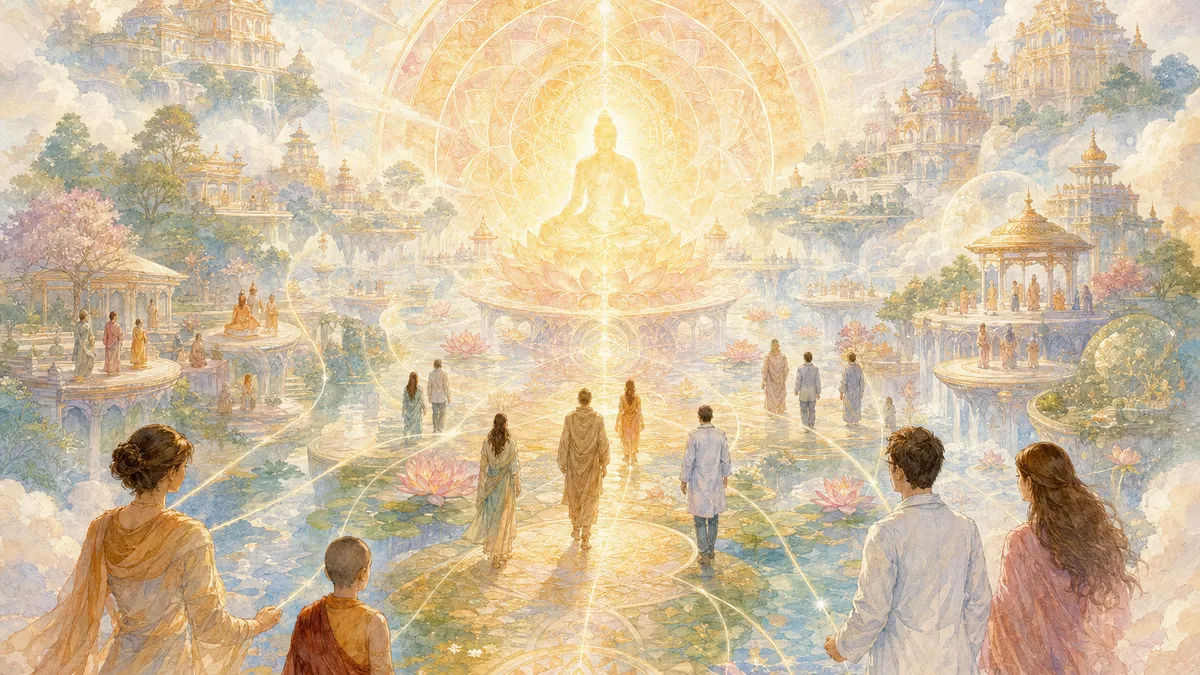
There are pure lands of Buddha Amitabha, who said: “Anyone who recites my mantra, for example, ‘Namo Amida Butsu,’ and thus establishes a spiritual connection with me can enter my world.” There are reality tunnels created by other saints: Krishna-loka (Goloka Vrindavana) — a world consisting of the mind of the avatar Krishna; Shiva-loka (Kailasa) — a world created by the god Shiva; and many other dimensions of reality related to various religions.
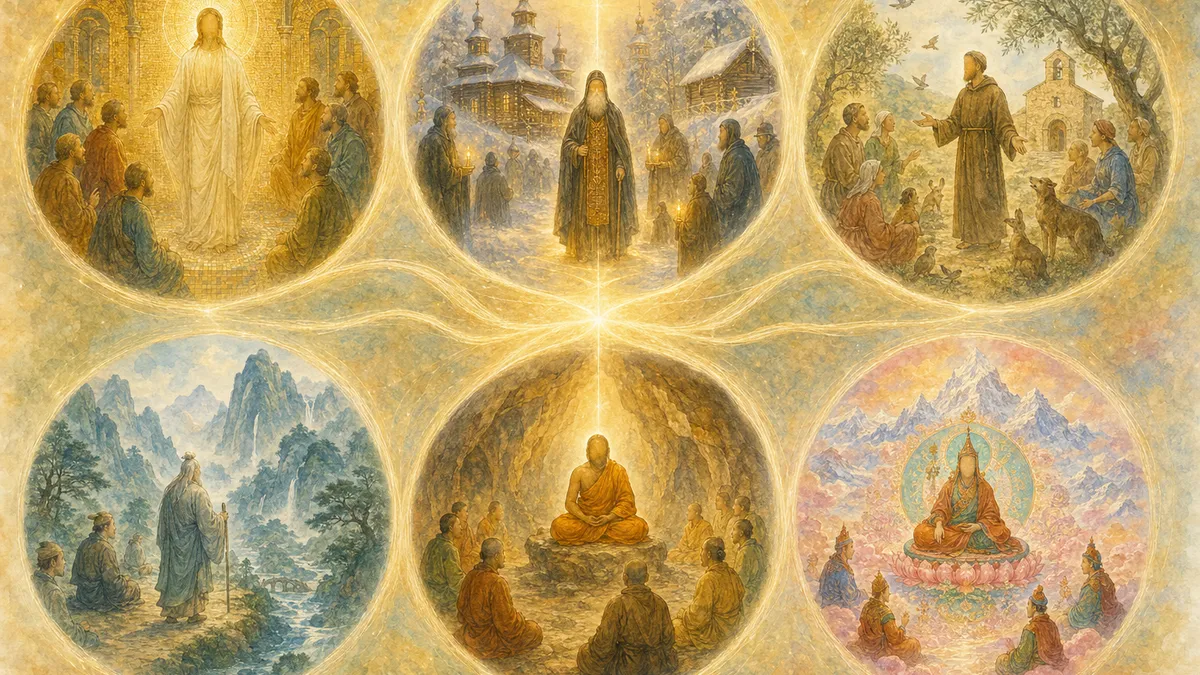
In fact, every saint possesses such a reality tunnel: Jesus Christ, Sergius of Radonezh, Francis of Assisi, Bodhidharma, Padmasambhava, Lao Tzu. But each possesses precisely the reality tunnel that is connected with his particular characteristics. This is the mandala, that is, a world created on the subtle level by the power of its founder’s intention. In ancient times, large numbers of the disciples and followers of these saints could transition into such worlds. In the mandala, its creator and lord is the mandaleshvara; he acts as the central deity, while all the others are, as it were, deities of the periphery.
The Highest Goal of Spiritual Practice
Thus, the creation of a certain reality tunnel is already a very high stage in the creation of a mandala. It can be said that all the previous stages were necessary in order to move on to this stage. The teaching on the mandala and the creation of a new reality is another rather large section of the teaching, which is usually not discussed with beginners. If we speak specifically about this stage, then the true goal of spiritual practice is the construction of one’s own reality tunnel, that is, a controlled reality — a mandala.
When we live in an uncontrolled reality, it is called samsara — the inexorable cycle of birth and death, the abode of suffering and ignorance (Mrityu-loka), the wheel of samsara. All this happens because we are in impure vision, which is conditioned by our dualistic consciousness. For example, Christ said that if a house is built on sand, it will inevitably fall apart. George Gurdjieff said that a person’s consciousness, if he is not awakened, is like a machine, because he is not aware of himself. It is precisely this state of consciousness that is characteristic of ignorance.
Satprem, a disciple and follower of Sri Aurobindo, has this expression: “Those who are not now will die.” What did he mean? He said that if you have not created such a reality tunnel, then during your lifetime you, as it were, do not exist; and if you do not exist during your lifetime, if you are not the master of your destiny, then you will die. In other words, if you were not, then you are mortal, but those who are will live forever. What does “those who are” mean? It means those who have created such a reality tunnel. And he went on to say: “The one for whom changing the body is no more than changing clothes will live forever.” And Ramakrishna had this expression: “What we call a human being is in fact only a shell, a pillowcase.”
A saint who has created his own reality tunnel outside the physical body sees everything in a completely different way, and for him changing the body is not the same as it is for an ordinary person. And the construction of a mandala, or the creation of such an individual reality tunnel, is the highest goal of spiritual practice. Such a mandala can be created precisely at the ninth stage according to the teaching. It is, in principle, impossible to create it earlier, because it is not created from ordinary building materials, but from subtle spiritual self-awareness.
Controlled and Uncontrolled Reality
So, how can the mandala be defined? It can be said that the mandala (an individual reality tunnel) is a controlled reality, a kind of psi-interface, the realm in which you live. It is created only by you and only for you. For example, the reality tunnel in which we live now was not created by us. By whom, then, was it created? It is believed that we live in a collective reality tunnel called “collective karmic vision,” and that the entire universe was created by more powerful forces, such as the creator god Brahma. We live in a universe that was created not by us and not for us, but by other forces. We are within the collective karmic vision of the world of human beings and are completely dependent on it.
How can this be explained? In ancient times, the Buddha explained it using the example of a horse and a cart, since at that time such an analogy was relevant. Since horses and carts are not very relevant today (some people see them only in movies), I will try to explain it using other examples. In some tantras it is written that teachings should be presented according to the mentality of the listeners, so I will use another analogy.
Imagine that, while working on a computer, you are using someone else’s network. You enter it simply as a user and try to do something. But the laws by which this network operates are not very clear to you; you depend on the forces that created it, and they are not subject to you. You can act there only on a very limited scale; otherwise, if they wish, they can simply disconnect you from the network. This is what an uncontrolled reality is. You are provided with certain services for a time, yet you do not have very much freedom.
And what is a controlled reality, a mandala? And how does it develop, if we speak of presence? For example, imagine that you create some small personal page for yourself. It is created by you, not by anyone else. Then you create a large field of information, for example, a website. Next, you expand it and create an entire portal. And when the portal no longer satisfies you, you create a mega-portal in order to manifest yourself creatively and freely. Over time, this mega-portal grows into an alternative network. This is already a network created not by anyone else, but by you; you no longer depend on providers, because you have lawfully established your own network. Being its sole creator, you are always at its center. And such an alternative network, a virtual universe where your consciousness stands at the center and is its only governing system—this is what a mandala is. One could say that through contemplation you create precisely such a mandala. If there is no contemplation, then, of course, it is impossible to build such a mandala.
The Four Floors of the Individual Tunnel of Reality
It can be said that the construction of such an individual tunnel of reality is like a house with four floors:
- The first floor is connected with surface consciousness, when you develop awareness in ordinary life, in the state of jagrat (waking)
- The second floor is connected with the subconscious and the world of dreams, when you bring your awareness into the world of the subconscious
- The third floor is connected with the causal body, with the world without forms, the state of dreamless sleep
- Finally, the fourth floor and the roof are connected with the clear light, with the primordial absolute state, the state of Brahman
Full realization and the construction of the mandala mean that you build such a house with four floors, which is no longer subject to birth and death, which cannot be destroyed, and in which you are, as it were, the mandaleshvara, its master. For example, if a person has not built such a tunnel of reality, or has only one floor, the most he can control is only the surface consciousness; therefore, at the moment of death he is again subjected to karmic influences.
It can be said that the creation of such an individual tunnel of reality is the growth of your personal “I” into a transpersonal state, one might say, into a mega-personality. The creation of such a mandala depends on the presence of your awareness. Death, for example, is a destructive force that dissolves the individual tunnel of reality if it is not deep. If, however, the individual tunnel of reality is deep, death will not be able to dissolve it.
For example, a mandala created by saints or gods permeates the world of form and the world without forms. The gods in such mandalas are their sole creators. Not in the sense that these are some egocentric claims to possessions, but in the sense that it is created not by anyone or anything else, but by the subtlety of their consciousness. All the previous stages and practices were needed precisely in order to build such an individual tunnel of reality.
It can be said that an ordinary person who does not work with his consciousness does not have his own tunnel of reality (or his tunnel of reality is very weak), and therefore he enters the collective tunnel of reality, the collective mandala called the karmic vision of humanity. But a yogin who realizes awareness leaves the collective karmic vision; he begins to create a tunnel of reality that proceeds from his inner awareness, and leaves the group tunnel of reality.
The Great Transition into Pure Vision
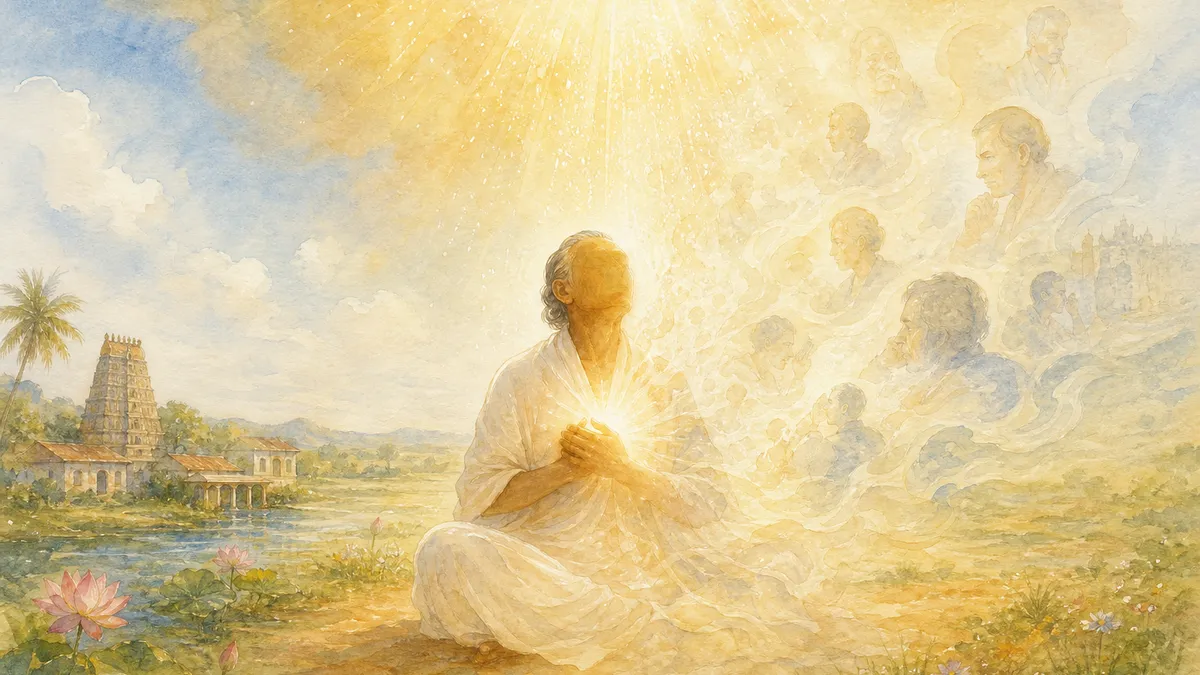
What is the next stage? It is a complete transition into this state. When such a tunnel of reality is strong and the yogin has become deeply established in it, he leaves impure karmic vision and fully transitions into this new tunnel of reality with his physical body. Saints who realized the illusory body (or rainbow body) and disappeared from the physical world together with the physical body are often described, for example: Saint Ramalinga, Saint Tukaram, Saint Namdev, the Tamil siddhas. All of them became so firmly established in this tunnel of reality that they accomplished the “great transition,” that is, they left the impure karmic vision of samsara and fully entered a separate reality created by their own consciousness.
There is a story about Namdev. He lived in a village, and no one understood his great state. One day he was playing the veena — a stringed instrument. He said: “I am preparing to pass into another world. Anyone who wishes may go with me.” The local residents stood there and wondered whether to go or not, and what kind of world it was. And Namdev said: “This is very great fortune! Even without engaging in any practices, any yoga, you can, simply through your connection with me, move into this world.”
A lively discussion began among the residents about who wanted to move into another world. But no one ever dared to do so. Then Namdev entered samadhi and tossed the veena upward. It disappeared, and after that the sounds of wondrous music were heard, and the singing of the gods began. However, the people still stood there and pondered whether to go with him or not. Then Namdev himself began to gradually disappear, and in the end he disappeared completely. Only then did the local residents suppose: “Yes, he has probably gone to heaven.” They were all very attached to their own vision, and therefore did not take advantage of such an opportunity. It can be said that Namdev accomplished the “great transition,” leaving his tunnel of reality and fully entering pure karmic vision.
From Mandala to Loka — the Status of Lokeshvara
Finally, when at this stage a saint strengthens his tunnel of reality and transforms it into an entire universe, it is no longer called a mandala, but a loka. Unlike a mandala, a loka is an entire world, or dimension of reality. Such a saint in this universe is a lokeshvara. A lokeshvara is the central deity, the lord of the universe, or the lord of a particular mandala. This is no longer simply the lord of a particular tunnel of reality; it is such a great consciousness that it already operates in global categories, on scales of eternity at the level of Brahma.
Therefore, some texts say that many saints who have fully traversed the path of evolution occupy the post of Brahma in this life. What does it mean to occupy the post of Brahma? It means that their presence has become so powerful that they have created such a vast tunnel of reality that it is comparable to the size of the universe.
Dattatreya describes something similar in the text “Tripura Rahasya.” It says there that several royal heirs discovered an entire universe inside a small hill, created by the power of a yogin. In this universe he was simultaneously the Creator, the Lord, and the Destroyer, that is, he performed the functions of Brahma, Vishnu, and Shiva.
Such is this final, or eleventh, stage of the practice of contemplation.
In all the stages listed, the basis is nothing other than our own awareness, our natural state.
