

Proper Motivation When Listening to the Teaching
First, before listening to the Teaching, one should cultivate the right motivation. Cultivating the right motivation accounts for 80%; everything else accounts for twenty. If the right motivation has been cultivated, it is enough for the Teacher to utter the single letter “A,” and you will benefit as though he had lectured for six hours straight. But if there is no right motivation, the Teacher may expound the greatest, deepest, most incredible truths, yet it will all be useless. If there is a glass of water and it is poured into your mouth, your thirst will be quenched. If there is a bucket of nectar, but it is poured past your mouth, it is all useless. Motivation means that we bring the water directly to our mouth; that is exactly how we attune ourselves, but often it is quite different.
I have been giving lectures since 1995, for fourteen years; thousands of people have listened to them, but not everyone manages to “bring it to their mouth,” so that the words penetrate the heart, dispel ignorance, and awaken them. At first, my “I” as a Teacher, as a sadhu, rebelled, suffered, and could find no peace because of this. I thought that perhaps I was incapable of transmitting the Teaching, or perhaps the disciples were not listening properly. It truly rebelled fiercely because of this, but then it simply accepted the situation, since everyone bears their own measure of responsibility, and I realized that I neither needed nor had the right to assume other people’s responsibility for them. I take responsibility for myself as a Teacher to the extent that I can, but I cannot assume responsibility for another person. Even Brahma himself cannot assume it, for he grants freedom of will. And who am I to assume responsibility for someone else?
Sri Ramana Maharshi said: “People come, ask questions, and I speak about my realization; I do not consider myself a Guru. Those who wish to listen, listen.” This is very wise; it is indeed so: a Teacher cannot assume responsibility for a disciple. He can take responsibility for his lectures, for himself, and for arriving at the lecture on time. But he cannot take responsibility for the disciple’s attention, motivation, or intention. Neither Buddha nor Dattatreya can do this, because freedom of will and freedom of choice have been given, and the right to choose has been granted—this is personal responsibility, and everyone must understand this.
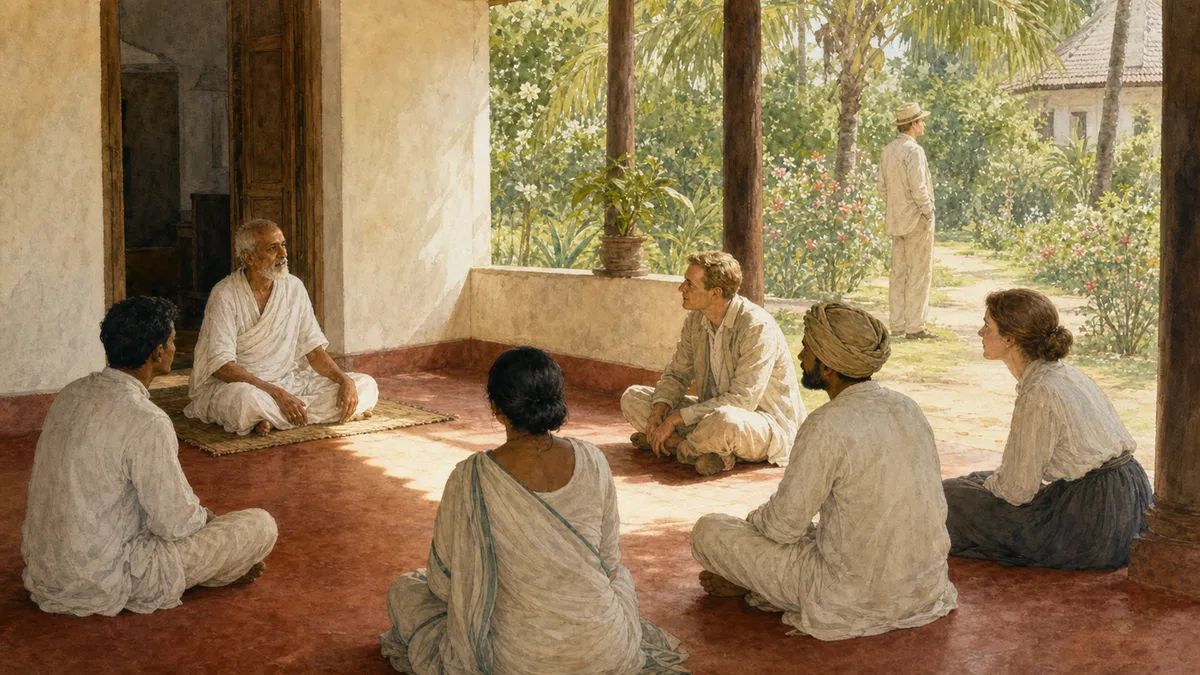
When I understood this, my “I” stopped protesting and rebelling. I thought: “Everyone must do this for themselves. I cannot force a person to become enlightened, accept responsibility, or cultivate motivation; that is spiritual work. All I can do is transmit the Dharma, draw attention to it, and point out the direction.” In other words, the process of transmitting the Dharma is not a one-sided game; it is a game involving both sides, in which the Teacher and the disciple participate together: one transmits, while the other listens, accepts responsibility, and creates motivation. Therefore, when you listen, it is your work and your practice.
Then I thought: “Perhaps it is good for a person to be deluded; perhaps they need it. Why hinder what brings maturity and provides an opportunity to undergo the experience of samsara, the experience of karma, and to suffer—not without that, of course—but after all, this is part of learning. If a father learns his child’s lessons for them, that will not be learning, nor will it be help.”
Sometimes disciples tell me: “This person needs to be told; they are such-and-such.” I think: “But why? Their Higher Self within must give them the impulse so that they realize it themselves. Everything I have to say, I already say.”
The Law of Non-Interference and Cosmic Harmony
The interference of devas in human free will is always an issue. The gods could descend, extract a soul from the body, purify and enlighten it, and grant it certain siddhis. But they are in no hurry to do so in response to our prayers and invocations, because they follow the same approach. They bestow blessings and siddhis and offer help, but not directly, without interfering. There is a law not of interference, but of subtle guidance. It is a very wise law; it expresses the cosmic state of Rita (cosmic harmony). This law indicates that we grow gradually, taking responsibility for our own awakening and cultivating motivation little by little.
If I decided to assume responsibility for your awakening, I would act differently. But since I cannot do that, and only you can accept responsibility for your own awakening, everything is always up to you. That is motivation—right motivation. When you have cultivated this right motivation, it is precisely then that the sutra, the words of the Teacher, hit the mark and complete this work.
The Mongoose’s Quality—the Antidote of Kindness
“Venerable Nagasena, you said that one should adopt one quality of the mongoose. What is that quality?”
“It is known, Your Majesty, that when a mongoose wants to approach a snake, it saturates its entire body with an antidote, and only then approaches the snake and seizes it. In exactly the same way, Your Majesty, when a yogi practicing yoga goes among worldly people who are full of anger and malice, overcome by quarrels, strife, wrangling, and obstinacy, he should anoint his mind with the antidote of kindness. This, Your Majesty, is the quality that should be taken from the mongoose.”

The first thing we cultivate is the Four Immeasurables, the antidote of kindness. Until this antidote of kindness has been developed, we are not safeguarded against falls and mistakes. This profound goodness exists within us. The supreme embodiment of goodness is Brahman itself, but this profound goodness is often concealed by mental concepts and kleshas. The antidote of kindness means that we constantly attune ourselves to this profound goodness. This profound goodness must burn away the kleshas, burn away the deluded mind. By definition, a yogi cannot be evil or ill-disposed; that is inconceivable. If such qualities are present, then he is not a yogi; he is on a devilish path, merely a person whose consciousness has been seized by Mara. For Atman is goodness, the greatest and most profound goodness.
This goodness does not mean that you must always do nothing but smile, although that is desirable; none of this is merely external goodness. Inner goodness is much deeper and means that you are sincerely filled with goodwill toward a person, toward any being, wishing them to develop their qualities, unfold their nature, and become a deity. You are sincerely on their side.
In the human world, people are often in opposition and conflict with one another. But to discover and cultivate this goodness within yourself means that you support others, that you are on everyone’s side, that you have no enemies, no one at all whom you must oppose. If a conflict arises in your relationships, you can say, “I am on your side,” and the entire conflict can immediately be exhausted at its very source. Until we cultivate this goodness within ourselves, technical practices are useless; they can only lead us away from the true spiritual path. Cultivating such goodness is painstaking work in which, every day, we gradually redirect our minds in the right direction.
“For, Your Majesty, there is a saying of the Thera Shariputra, the Commander of the Teaching: ‘Therefore, nurture kindness toward your own and toward strangers, toward everyone; pervade the whole world with kindness—such is the Blessed One’s precept.’”
Kindness means a sincere desire to help others. When such a sincere desire arises within you, you truly enter the spiritual path of nonduality. As long as this desire is absent, you remain deeply separated from the world, and strong duality persists. This state is called karuna or bhritya-chara, and it must be cultivated constantly; its Buddhist analogue is bodhichitta. It is the cultivation of your entire life; it is not something for which you should practice for three days, three sessions a day, and then think, “It is all finished; I can move on to something else.” In reality, it must be cultivated within yourself continuously.

The desire to help others may seem to contain nothing mystical, no transcendental experiences, yet it changes us radically at the deepest levels of essence, meaning, and values. It is the path to realizing nonduality, when you make no distinction between yourself and others.
Now, when we are tightly gripped by our sense of egoism (ahamkara), by our own self-importance, we sometimes forget this. Again and again, we must remind ourselves so that it can manifest sincerely. Usually, a person suffers because they wish to help themselves. This very attitude of wanting to help oneself is the source of their suffering. The more they desire happiness for themselves and wish to help themselves, the more they withdraw into the cocoon of their small “self,” and the more they separate themselves from the Universe, from the Absolute. This alienation reaches its culmination in the lower worlds: Patala, Rasatala, Mahatala. Conversely, the more you cultivate the desire to help others, the wider your mind opens and the closer you come to realization. If this desire is absent, then service becomes questionable, and there is no proper understanding of service. Then the ego (ahamkara) reigns supreme, and whenever ahamkara reigns supreme, impure karmic vision, delusion, and samsara always arise. It is not easy to subdue it; those who succeed become great saints, great sadhus.
The Qualities of an Old Jackal—Being Undemanding and Content
“Venerable Nagasena, you said that two qualities should be taken from an old jackal. What are these two qualities?”
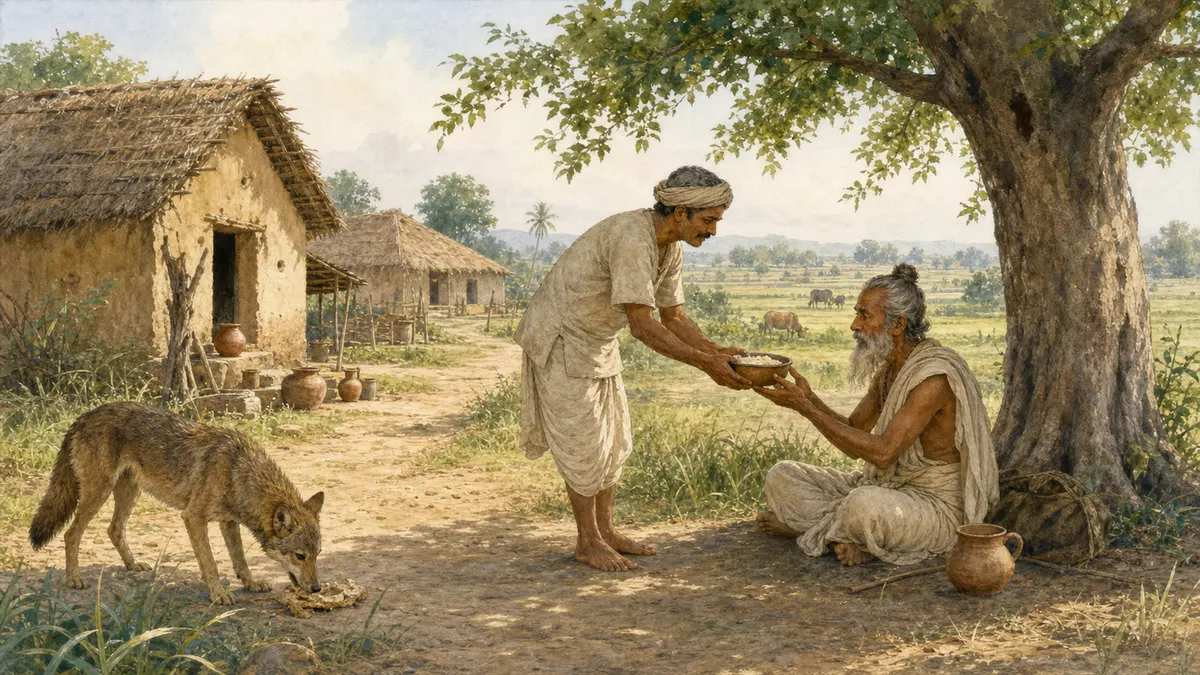
“First, sire, an old jackal does not disdain any food and eats his fill. In exactly the same way, sire, a yogi engaged in yoga should not disdain any food and should eat as much as is needed to keep the body strong. This is the first quality, sire, that should be taken from the old jackal. For there is, sire, a saying of the Elder Mahākātyāyana: ‘One morning I went to the village for alms, saw a leper, greeted him, and approached him just as he was eating. With his ulcerated hand he placed a handful into my bowl; a decayed finger fell off and landed there too, in the bowl. Sitting down somewhere by a fence, I ate his handful of porridge, and I ate it all without revulsion.’”
Spiritual practice and training, when we come to the Teacher, are of course different from a tourist trip to a five-star hotel. The difference is that we do not indulge our desires but, on the contrary, control them; we do not indulge the ego but, on the contrary, try to subdue and discard it. From the outset, the approach to the Dharma is different: through the Dharma, we must change; we must cultivate some things within ourselves and discard others for our own benefit. This is sadhana, this is spiritual work, and there can be no consumerist attitude in spiritual life or spiritual practice; if one does arise, even to a small degree, spiritual practice simply does not work. Spiritual practice works precisely when we change through it, when we perceive everything as darshan, as awakening, as something that serves our realization; then it is seen through pure vision.
In the West, unfortunately, people have not yet developed a culture of engaging with the Dharma. Engagement with the Dharma is often regarded as a certain kind of spiritual consumerism, and this naturally disheartens many Teachers. Since the whole of Western society is thoroughly consumerist, with the consumer as its basic social unit, and since very large ideological institutions work to reinforce this, a certain model of interaction with material energies is formed and is often transferred to the Dharma. But this is a grave mistake, because in that case the Dharma simply does not work.
When we relate to the Dharma correctly, we understand that there is the Dharma and there is us, there is the Guru and there is the disciple; one of the two must change, and you understand perfectly well which one. This is the true, non-consumerist attitude toward the Dharma. But if we do not understand this, then the question of change does not arise for us: we want to remain as we are and receive the Dharma. Yet that cannot happen, because the Dharma is itself change, transformation. It is a challenge to us—it is a challenge!
The proper perception of the Dharma is to accept this challenge and thereby grow and work on ourselves. But if we are not prepared to accept this challenge, our ego may sometimes say, “There is nothing here for me to consume; I derive no pleasure from this.”
What can the ego consume? Comfort, delicious food, the smiles of companions, the nurturing of an egocentric attitude, interesting stories, enticing techniques, retreats, beautiful landscapes. The ego can turn all of these into objects of consumption if we relate to the Dharma incorrectly. Yet for our own good, we must abandon the consumerist approach. Then we will truly begin to grow, like the saints of old, like Milarepa. Because the Dharma is not a process of acquisition—that is what must be understood. What is the Dharma? It is a process of loss. But the loss of what? Selfishness, attachment, dependence; it is the removal of what is superfluous. At first, the Dharma seems to be a process of acquisition: we learn many new things, receive many techniques, acquire various qualities, and cultivate many qualities. But ultimately, we come to the point where we must remove what is superfluous. Having prepared ourselves by cultivating qualities, the main process is nevertheless the removal of what is superfluous. It is not a process of acquisition and consumption; it is a process of self-giving. Loss is not something frightening or bad. It does not mean that you must lose material things if you are a layperson. I am speaking of losing dependence on your ego. The Dharma is a process of giving, of self-giving. Transcendence occurs only through self-giving. Transcendence cannot occur while clinging remains.

Santosha—Contentment with What One Has
“Furthermore, sire, an old jackal makes no distinction as to whether the food it receives is coarse or refined. In exactly the same way, sire, a yogi engaged in yoga should make no distinction as to whether the food received is coarse or refined, tasty or not very tasty, and should be content with what is available.”
Santosha—serenity, contentment with what one has—is a quality of a yoga practitioner. Even if something is not right, you must learn to be content. Contentment with what one has reveals a great deal—it is a quality of a true Master. The four signs of a tamed mind are as follows: whatever food you eat, you are happy; whatever clothes you wear, you are happy; wherever you may be, you are happy; whatever position, situation, or status you may find yourself in, you are happy.

Once, during my lectures, I invited those listening to me to put this directly into practice. I said, “Now, those of you who have men’s and women’s clothing, exchange clothes, and we will see whether you can do it or not.” Some tried, while others could not do it. This must be cultivated genuinely, in earnest. If we strive for transformation, we must be ready for it every day and every moment; otherwise, why call ourselves seekers?
True santosha is the contentment inherent in great saints, for a saint is someone who may walk naked and live in the jungle today, and tomorrow bathe in luxury and sit upon gold; today eat exquisite food, and tomorrow eat disgusting food. But this does not trouble him, because he has attained samyoga, the equilibrium of mind. This inner contentment arises solely from immersion in the Atman and from nothing else.
When we listen to the Dharma, we must strive to attain this contentment and satisfaction: when you are joyful not because something is happening outside, but solely because you abide in the natural state of the Mind.
It is very easy to test one’s realization. For example, someone says, “I am a great yogi, but you are not so great.” Very well, let there be a contest, like a duel; this can be tested. Starting tomorrow, we enter retreat, observe mauna, leave everything behind, and abandon everything. Whoever can remain content for a year is a yogi; whoever runs out after two weeks is not. Whoever can remain content for three years is a yogi; whoever cannot is not. For a truly contented person is someone who is ready to leave everything behind at any moment. He is attached to nothing; he merely plays for the benefit of others.
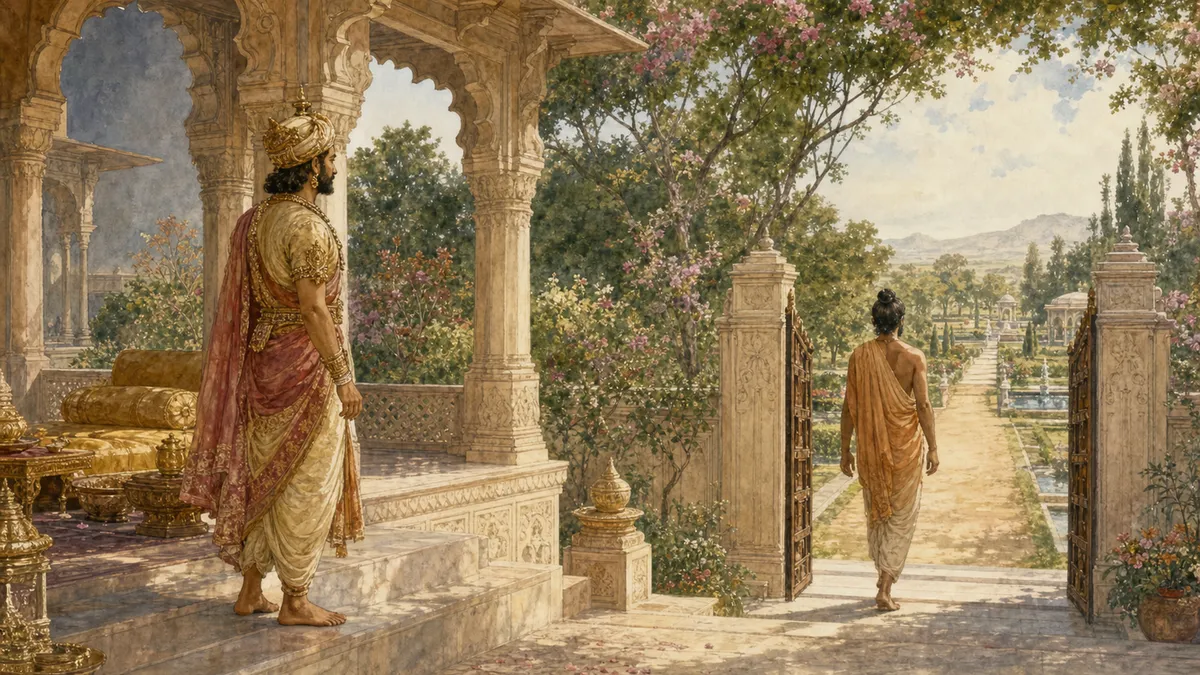
A king once invited a yogi to stay at his palace, and the yogi felt very much at ease there. He stayed for a month, and doubts began to creep into the king’s mind. He began to think, “At least I attend to affairs of state, while the yogi sits on golden cushions, eats from golden dishes, watches the dancers perform, and seems very happy. He is probably some cunning and treacherous man who has somehow influenced me, beguiled me, and is simply enjoying the luxuries I provide him, while in reality he is an ordinary man.” It is always like this: when a saint is among people who dwell in ignorance, sooner or later their minds begin to waver. Then the yogi said, “Let us go for a walk.” They set out and went very far, until the king said, “I am not prepared to go any farther.” The yogi replied, “But I am. You see, this is where your boundaries end, while I have no boundaries. Therefore, you should not think that there is no difference between you and me; that difference lies in the absence of attachment.”
Santosha as the Foundation of Spiritual Practice
When you possess true santosha—contentment—you have no boundaries, because there are no attachments. We constantly strive toward this state. As soon as discontent arises, you should not look for its cause outside; that is futile. In reality, the mind is merely looking for a pretext to explain your inner discontent to you. But inner discontent itself is a state of the soul; it is not something dependent on external circumstances. It is the process of samyoga being disrupted, a state of disharmony.
Santosha (contentment) means that there is samyoga—the equilibrium of the mind, pranas, awareness, Atman, and presence. When this equilibrium is disrupted, contentment (santosha) disappears. Then the mind thinks, “Why has it disappeared? It must be because of that person; that person is coughing so loudly, so it is because of him.” The mind begins to project this discontent onto him. Later, it may say, “I would have meditated so well during the retreat, but the person next to me coughed throughout the entire retreat, so I was constantly on edge and the retreat was unsuccessful.” No, that is wrong: if samyoga is present within, none of this matters. Your inner contentment will flood the entire situation, and you will not seek the cause outside.
Brahma-vichara as the Path to Contentment
To realize samyoga and inner contentment, you must constantly direct your mind toward vichara (inquiry). This vichara should not merely be an inquiry into the koshas or the thinking process. It must be true Brahma-vichara, an inquiry into the Absolute, Brahman. Only true Brahma-vichara can bring santosha, samyoga, and contentment. Then you truly abide in profound satisfaction and experience no problems anywhere, at any time, in any clothing, in any status, while performing any service or eating any food. There are no problems; you are always happy. Attaining such a happy state is the first sign of the stability of your contemplation.

“For there is, Your Majesty, a saying by the thera Upasena, son of the Bengalis: ‘Be content with coarse food; do not seek to indulge in food. One who gratifies his belly is incapable of contemplation. One who is content with little is perfect in the monastic life.’”
I will tell you that before I began teaching, I lived on a blanket in an empty room and slept on the floor. I had one bag; even now, I do not have very many possessions. I planned to live like that my entire life and observe mauna. It did not work out, because the Guru said that this, too, was a form of attachment. It was my ardent desire. I had no other plans: the process of teaching others and various other plans are a way of casting off my subtle yogic ego, when you do not do what you like, but what must be done—a sense of duty. But because this sense of contentment had been revealed, developed, and realized, it never leaves me, whether in those circumstances or in others.
Adapting the Dharma to Social Conditions
In the monastery, I am not inclined to test disciples through an ascetic way of life, and there are many reasons for this. One of them is society. We live under different conditions, in a different country; ours is not the dominant religion, nor are we the titular nation. We must present a certain social image to people. Therefore, you must be prepared for situations in which your contentment is tested amid exquisite food, comfortable conditions, and beautiful things. Such is your karma: you must train your contentment under such conditions. But when you find yourself in other circumstances, you must also be ready to accept poor conditions.
This is because we are compelled to present a certain social image. If we had naked sadhus, as in India, local residents would not understand it, and we would have to explain ourselves to the authorities and other people, but we do not want that. Since people understand the language of prosperity and success, we have adopted that language. There is no problem with adopting one language or another. Nevertheless, the question of santosha and contentment remains. If an Order of naked sadhus were to pass through India, that would be considered normal; they would be welcomed and revered. If they smoked ganja, that would also be considered normal. But I can imagine what would happen if we had a crowd of naked sadhus smoking something... The Dharma must conform to local conditions and generally accepted customs and traditions, without needlessly disturbing them. We have no need to shock the people around us; we must act humbly and carefully.
The Qualities of a Deer in Spiritual Practice
“Venerable Nagasena, you said that three qualities should be taken from the deer. What are these three qualities?” “First, Your Majesty, the deer roams the forest by day and stays beneath the open sky at night. In exactly the same way, Your Majesty, a yogi engaged in yoga should remain in the forest by day and beneath the open sky at night. This is the first quality, Your Majesty, that should be taken from the deer.”
Once, the monk Shariputra was meditating beneath a tree when two powerful yakshas (demigods) approached him. One of them said, “Let me strike him on the head and see what happens.” The other said, “If you strike him, he will leave his body. He is only a human, while we are demigods.” When he approached and struck the monk, the monk continued sitting in meditation. The yakshas were astonished and disappeared. Then another monk approached him; he had seen the two yakshas standing before him and one of them striking him. The monk asked, “Didn’t you see or feel anything?” He replied, “No, my head just hurt a little, that’s all.” This great monk was beyond the reach even of powerful demigods and their blows. Such is the power of samyoga.
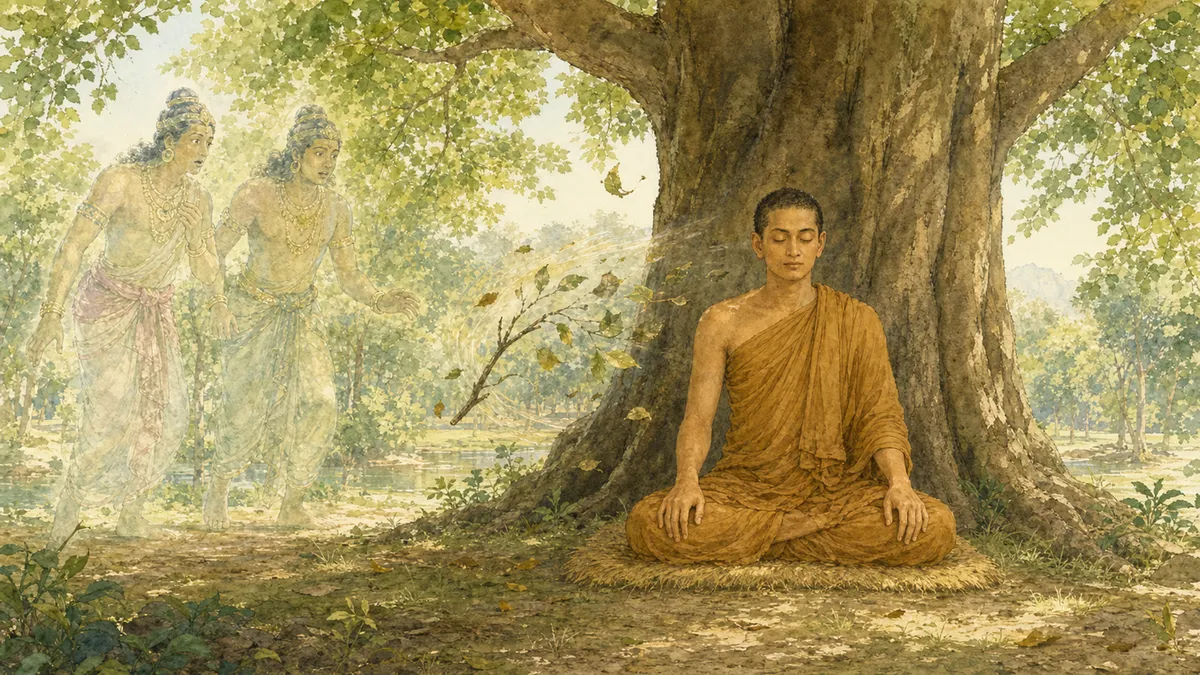
Samyoga as the Foundation of the Contemplative Life
When you cultivate genuine contentment, it develops into samyoga. Samyoga develops into a single “taste.” The life of a yogi-contemplative should become a continuous form of samyoga. Samyoga means equilibrium. For example, if I build a harmonious relationship with another person, samyoga (equilibrium) arises in me. If I develop presence within this samyoga, devatas (deities) are generated and darshan (transmission) occurs. If there is integration with a particular text or sutra and samyoga arises, devatas are generated in the form of clarity, and one receives shastra-kripa (blessing). If there is samyoga with prana, prana enters the central channel and samadhi arises. Thus, the task of a practicing contemplative is to attain equilibrium (samyoga) in all things.
As our samyoga with the world grows, the world changes its attitude toward us. If at first it was like a jealous worldly wife, it then becomes like a sister with whom one has a smooth and pleasant relationship, and finally it becomes like a mother who feeds and nourishes her son. Such is the result of contemplation and samyoga.
