

I greet all monks, laypeople, and all practitioners. I hope you are all well, as we are. Whenever we gather for practices, meditations, retreats, we do so in the name of our goal. At some point, we gave rise to the aspiration to know the highest truth, to know God. And everything we do is an expression of our aspiration.
On the Spiritual Path, faith, devotion, and aspiration are important. It happens that faith is weak, devotion has not yet been born, but aspiration is the only thing we have. We need to cultivate the aspiration to know God, Shiva. When we reflect on our soul, its destiny, past, present, and future, we understand that our soul was born in the Universe for some purpose, and we must come to know this purpose. And when we learn that its purpose is God, the knowledge of God, the knowledge of the Divine, we give rise to the aspiration to know God.
The Choice of the Soul’s Destiny
Each of us would like to see our soul pure, among bright spirits, shining with the light of the gods in all wisdom, beauty, spiritual glory, happiness, and splendor; and no one would want to find their soul in the future in the hellish underworlds, in some gloomy places, among demons, spirits, and servants of hell, as if in tattered rags, poor, blackened, confused, lost to God, exhausted, weak, sick, and gone astray. No one would want to discover their soul in the future as foolish, suffering, in the power of demons and nagas, stuck somewhere in the lower worlds, fallen into a boiling lake in the hellish dimensions, wandering through a labyrinth with no way out in the dimension of pretas (hungry spirits).
Everyone would like to see their soul free, infinite, playful, full of light, strength, splendor, harmony, purity, love, and the blessings of the saints, in a state of unity with God. It is precisely because we want to see the soul this way in the future and do not want to see it otherwise that we give rise to the aspiration for knowledge, for this meaning and this goal surpass all earthly meanings and all earthly goals, all temporary, momentary relationships and connections.
And we can make our soul pure, free, and united with God. But if we do nothing, this will not happen by itself. We must begin the struggle for our soul.
Making the Decision
At some point, we must make a decision. It is believed that such a point comes when we receive Refuge, when we receive diksha from the Guru, but this is external, it is a ritual, it is the formal point of making the decision. But no one knows, except God and you yourself, where this moment actually occurs in your life, where you truly, in your soul, within yourself, make such a decision: to struggle for your soul, to aspire to know God without delay, right now. Then something unnecessary within you falls away, and something new within awakens.

When we receive initiation into the Teaching from our Guru, it is considered that the very fact of being given a spiritual name, the transmission of the Guru-mantra, or the acceptance of the status of a novice, monk, or karma-sannyasi layperson means our decision to follow the law of wisdom, to walk the path of the holy sages. But it often happens that we act unconsciously, and such a decision has not yet matured within us and has not been accepted; it has been accepted by our mind, by our personality, but our soul has not yet followed it, and some more time will be required for it to mature within and be truly accepted. Or, on the contrary, it was accepted long ago, and we are confidently walking the Spiritual Path; the taking of Refuge, the name, the status—these are only formal acts that merely confirmed what had already existed for a long time.
One way or another, at some point we realize that we lived for years immersed in empty amusements, in illusion, idle talk, lack of faith, apathy, laziness, and self-love, and we decided to save our soul from this; we decided to enter the path of the sadhu. We understood that years of precious time had been wasted, and we decided to enter the path of the sadhu in order to save our soul, to immerse it in God.
The saints say that you must act without delay, like a beautiful woman whose hair has caught fire, or like a fisherman whose boat has been carried out into the open ocean. You must understand that your situation is very important for you; it is like a state of emergency: that once in an age, among many lives in maya, in illusion, in samsara, in entanglement, you have awakened to God, you have awakened to the spiritual path of liberation, and your merits, your karma, were sufficient to pacify desires, to pacify the mind, to receive the Teaching, and to walk the Spiritual Path.
And here you must make the decision to begin inner asceticism, to immediately take up the inner work of your soul. Here you need to feel yourself to be like a novice warrior, in order to begin your spiritual path and, through persistent labor, win back what was given to you by the primordial nature of God, but what our soul, over the course of many past lives, has lost and scattered through inattention.
Inner Asceticism
Here it is very important to say to yourself: “I will not postpone my inner asceticism until the future.” Inner asceticism is a path that everyone must walk. Outer asceticism is not the path that absolutely everyone must walk: some need to walk it, some need to walk it halfway, and some do not need it at all, for example, like King Janaka.
King Janaka attained enlightenment in a very strange way: he was lying slightly drunk together with his wife and looking at the sky; that is, outwardly he was not an ascetic at all. But he was fortunate enough to meet spiritual beings who gave him a direct transmission and sang of the purest awareness, which is free from all sensual desires, from all sensual pleasures, from all worries, from all duality, from the ego, from all emotions. And King Janaka was so inspired that his entire old way of life became repulsive to him; he developed an aversion to that thoughtless and unconscious existence. And in an instant all worries, all attachments, all royal entertainments left him; inwardly, he was immediately freed from them. He began to meditate and in a short time attained Enlightenment.
And what he practiced was inner asceticism, inner ascesis, the separation of himself from everything and the discovery within himself of the purest non-dual consciousness. And when he discovered it, he saw that this non-dual consciousness is all-acceptance; it rejects and denies nothing, it can unite with everything, play with everything, yet it is free from everything. And then King Janaka thought: “There is no attachment in me to royal life, but I also have no aversion to it. I will act according to my karma, without attachment or rejection, without becoming attached, acting in order to help others.”
Thus, in giving rise to the aspiration to know God, we must give rise within ourselves to the aspiration to become inner ascetics. Only through inner asceticism are liberation, the knowledge of God, and the attainment of Divine wisdom achievable.
Outwardly, we follow the principles of our status: laypeople follow the status of laypeople, karma-sannyasis the status of karma-sannyasis, brahmacharis the status of brahmacharis, novices the status of a novice, monks the status of a monk, senior monks the status of a senior monk. These are certain principles and rules accepted in society, which are considered favorable for maintaining spiritual life, but our most important work is done not outwardly, but inwardly; this is inner asceticism, inner ascesis.
Inner asceticism does not depend on time, on status, or on what we are doing. It is a mistake to think, “Someday the time will come, I will become such a great ascetic, I will really unfold myself, I will start practicing in retreat, I will leave all this behind.” As soon as you think this way, you are in fact deceiving yourself. You are avoiding practicing inner asceticism right now; you are dreaming of certain favorable external conditions, thinking that some external conditions will greatly help you.
In reality, this is not so: external conditions will help you a little, but they will not do your inner work for you. External conditions are only a small addition; your most important work is inside, and it depends on nothing, and your inner asceticism is what you can do right here and now.
Inner asceticism cannot be postponed until the future; you must understand: nothing can hinder it, neither your service, nor your environment, nor your duties, nor your thoughts, because it is so deep within that the environment, service, the actions of the body, and thoughts are unable to reach it; it is only a matter of your making a decision, when you say to yourself: “God cannot be postponed until the future; God is only here, God is only now.”
The Beginning of Inner Asceticism
When you say to yourself: “The time has come for me to awaken, to leave behind the old gloomy ego and follow the path of the saints toward a new goal of life: to be only in God, only with God, and to live only for God.” And when you make such a decision within yourself, this is where your inner asceticism begins, your inner alchemy, your inner transformation.
And if you need somehow to mark this solemn moment, you can sit by the altar, fold your hands in prayer, pray to the Refuge Tree, to the Ishta-devata, to all the saints of the Refuge Tree and to the Guru, and ask them to help you in this. Ask that they grant you strength in inner asceticism, that they bless you; turn to the root Guru, that they bless you on the path of inner asceticism, so that within yourself you may make such an inner vow: “From now on, may I not turn away from the Path of the saints; from now on, may I walk the Path of spiritual alchemy, of inner asceticism; from now on, I will be firm in my intention to follow the path of the inner work of the soul, of inner asceticism.”
And when we have prayed in this way, expressed our sankalpa (intention), we can mentally make an offering; we need to give rise to yet another intention, so that this intention does not fade, so that we remain strong in spirit and sincere on our path, so that we do not show faintheartedness and later turn away from it.
The Garden of the Soul
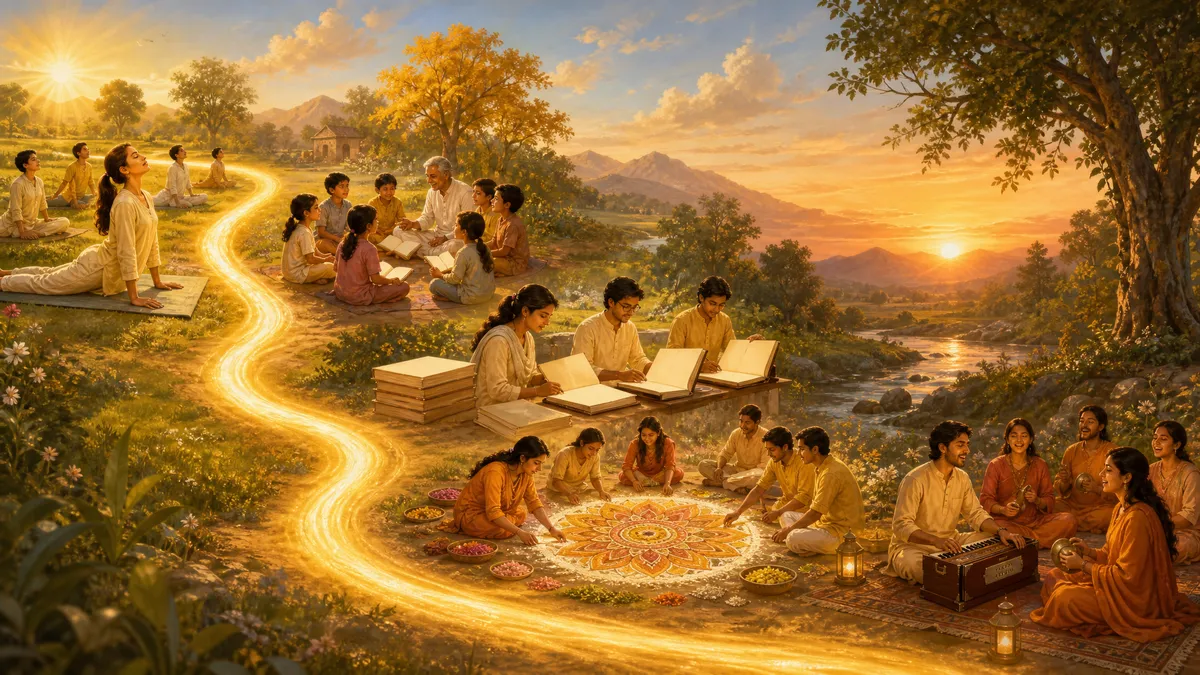
And when we have done this, we need to understand: what does it mean to walk the path of inner asceticism? What does it mean? We need to understand that our soul is like a garden, and in this garden we are the worker who cultivates it. We can let our garden fall into neglect, make it full of cobwebs, rot, weeds, and thorns, but we can also diligently cultivate this garden every day, and then wonderful fragrant wish-fulfilling flowers will grow in it, magical kalpa-vriksha trees with the fruits of eternity and immortality in the divine. It depends on us what this garden will be like. Those who work well in the garden of their soul receive such fruits. Those who do not labor, who abandon it, who visit it only from time to time (once a month), their garden remains uncultivated and neglected.
The divine will is that we constantly cultivate the garden of our soul, that we constantly labor in it tirelessly, sparing no effort and not pitying ourselves, that we cleanse the garden of our soul from the weeds of thoughts and desires, that we loosen, fertilize, and water its soil, that we do not grow lazy, do not sit idly, and do not sleep in the garden of our soul, that we be a good, caring worker in it, laboring continuously, taking no rest by day or by night.
And in this garden a great work awaits us: we must constantly uproot the stumps of self-importance, of the ego; cut off the rotten branches of doubt; tear out, tear out, tear out the weeds of desire. It would seem that you tear them out, yet they grow again; it would seem that you have torn everything out again, but there, there, there this grass has appeared again, and if this is not done, in a week everything there will be overgrown. We must constantly trim the thorns of impure thoughts: we cut them on the right, they appear on the left; we cut them behind, they appear in front. We must do this continuously, day after day, for years, constantly watering the soil of this garden with the water of faith, loosening it with the stick of self-discipline; then we will be rewarded with wonderful fruits and gifts.
Patience and Constancy
And these fruits are beyond the material world, beyond our earthly life, our earthly existence; perhaps they will not manifest immediately, and one should not expect them immediately. Only naive, very foolish people expect the fruits to appear quickly. Such people are like children when they think: “I will plant a seed now, and by morning a big tree should have grown.” They come in the morning, and the seed has not even sprouted. They think: “What is the matter? Let me help this tree get out of the seed; I will pick open the seed and try to pull out the sprout, and it should already have fruits on it.” And three days pass; they become worried, run over, look, and say: “Why is there still nothing?”
If we have impatience, if we do not realize the enormous work that we need to do, if we are caught up in certain dreams and fantasies that any moment now, by some miracle, it will happen quickly, that I will become a saint and will fly into samadhi—these are great illusions. Great hopes (false ones, from the ego), great expectations give rise to great disappointments. When we think that without making efforts, without carrying out any spiritual work, we should already receive something, it will never be so. It is impossible; it contradicts the law of nature. We must change; we must purify our soul and offer it to God.

The Fruits of Inner Asceticism
But if we do everything correctly, cultivate patience and humility within ourselves, and constantly, day after day, work in the garden of our soul, we receive true divine gifts. And then a new life opens up, and the essence of this new life is boundless freedom, divine love, divine wisdom, joy, dispassion toward everything earthly, vain, samsaric, and material, and boundless life in the absolute Truth—a life full of light, of the blessings of holy sages, of the blessings of gods who know God.
And then, in this garden of your soul, the seed of a new, eternal, immortal life is born, and this seed will never fade away again; it is like an inner flame that keeps flaring up, flaring up, and will never fade away again. And then nothing can hinder it: neither a horoscope, nor sins, nor fate, nor obstacles; even time itself cannot hinder it. And this new life, this immortal seed, has a beginning; it is a specific beginning within you — the time of awakening — but it has no end. This flame has a birth, but it has no end, no death.
Inner Asceticism as the Cultivation of the Garden of the Soul
When we have understood our goal and given rise to the aspiration to know God, and have decided to follow the path of inner asceticism, we need to become diligent gardeners of our soul. A diligent gardener notices every weed and weeds every centimeter of his garden. In the same way, we too must look into our soul every day: have you allowed anger, allowed impatience, shown a lack of humility, shown tactlessness toward an elder, shown unconsciousness during a ritual, shown faintheartedness, shown unbelief — you must see all of this within yourself and ruthlessly uproot it, like a gardener who knows which flowers he needs and which weeds he does not need. To look into your soul every day — then this will be your inner asceticism, your inner practice.
Our goal is God; we must remember this, this is the most important thing, and never forget it. We must concentrate on God, on Divine Truth as the goal, as an archer concentrates on the target, and remember our divine goal. Just as a treasure seeker remembers his treasure and fanatically searches for it, digging in different places in the hope of finding something, thinking about the treasure; just as a hunter on the hunt thinks about the beast, searches for it, tracks it, constantly aims at it, so we too must constantly think about God, aim at Him, and track Him constantly.
We must think: “What is God? Where is God? What is the divine state?” When I am in anger, of course, this is not the state in which one can understand God; when I am selfish, self-willed, self-loving, when I want everyone to indulge my will, when I do not think at all about the Divine Will, this is not the state in which one can know God. When I am distracted, when I am scattered, when I am turning over worldly thoughts, this is not the state in which I have taken aim at God — not at all. And we must find God again and again as our goal, day and night, even in sleep, even at night, when we are awakened, we must immediately remember our goal and direct our mind toward this goal, as a mother remembers her child — as soon as the child cries even a little, she immediately runs to him, because she remembers him continuously, even in her sleep.
Taming Pride and Self-Confidence
In order to make God our goal, to be constantly aimed at God, we must tame our pride and self-confidence, like a mad elephant or tiger, because pride and self-confidence greatly hinder this; they are like false goals: when we should be aspiring toward God, we aspire toward something else, toward our ego. Instead of following God, seeking Him, we begin to follow ourselves, our mind, our ego, our will, thinking: how beautiful I am, how great I am, how smart I am, and others cannot tell me what to do, and others are worse than me, and I am better than them, and who are they anyway, and they are worse, and I am better, and I need more, and I am more important.
When we begin to think this way, we make our ego into God; we replace God with our ego, and we begin to invest the energy of our soul, the energy of our thoughts, actions, words, and deeds into this false god — into the ego. The ego is a false god; it is not God, it is a little god, an idol that we create in our soul out of our stupidity, out of our ignorance. And we begin to invest a great deal in it. When we begin to invest a great deal in it, we stray from the goal, we forget the true goal and follow the path of a false goal.
In order not to stray from such a goal, one must constantly check oneself: is your mind looking in the right direction, have I directed myself toward the right goal? And as soon as we see that we have strayed from the path, that we have directed our consciousness toward this little god, this idol, and created it within ourselves, while forgetting about God, we must immediately say: “Mind, you are mistaken; look at what you have done, you thought incorrectly, you behaved incorrectly, you were not conscious, you were looking in another direction, you got lost — come on, return back, return back!” And when we do this, it is at that very moment that the cultivation of the garden of our soul takes place; the uprooting of certain stumps of egoism, inner unbelief, inner desires, and identifications takes place.
Proper Self-Awareness
We must learn to watch ourselves more than others. If we watch others but do not watch ourselves, this can be called a kind of perverted Atma-vichara in reverse, when we ask: “Who is he, who is he?” and forget to ask: “Who am I, who am I, who is God?” Or it is some kind of inverted Brahma-vichara. In Brahma-vichara you must ask: “What is God?” But when we watch others, we ask: “What is he, and who is he anyway, what is he doing, why is he doing that?”
And we need to pay attention to not watching others, to allow others to live as they wish, but to watch ourselves and seek God. And before the face of God within oneself, one must notice in oneself all one’s secret thoughts, impure hidden thoughts, hide nothing, be honest. But hide nothing not in order to acknowledge it and continue it, but in order to cut it off, dissolve and disperse it, and enter a new pure state.
As for the external, it will not be a mistake if you behave modestly and praise others. Sometimes it is even favorable, if deserved, to reproach yourself slightly, but without falling into despondency, while always only praising others. Do not reproach others, at least if such service has not been given to you. One who seeks God always and everywhere seeks peace of mind and inner silence.
We must keep the secret of our inner work, not discuss it especially with anyone except our Master. There is no need to boast, to put your inner work and its small fruits on display; let only God and your Master know about it, that is enough. This will protect you from self-admiration and indulging whims.
Principles of Inner Asceticism
Walking the path of inner asceticism, one must learn to live in such a way as to ask for nothing superfluous. There are very many different things in life, but our whole life will not be enough to try them, experience them, possess them. These include material things as well as subtle-material, informational, and mental things. And inner asceticism consists in not taking, not accumulating what is unnecessary. If our soul is to soar to God, it must be free, unattached, light. But if we accumulate very many unnecessary things (information, assessments, judgments, attachments), the soul begins to grow heavy.
Therefore monks have such a commandment: do not think much about extraneous things; do not ask for what is unnecessary; do not seek the attention or favor of others, love them all yourself; do not allow worldly thoughts to lead you away from God; forget about attention and admiration from male and female friends; do not seek friends and beloved ones outside God in the new life, make God your only beloved, and the Master and the saints your best friends and advisers. Love everyone, but only through God, because a person is not dear for the sake of the person, but for the sake of God, who is within.
It is said in the Upanishads: “not for the sake of the husband is the husband dear, but for the sake of the wealth that is within.”
Inner asceticism means: one must learn to live in inner silence, one must seek that place where there is no mind and where words are not needed, learn to accept everything the Upanishads say: as coming from God. If God needs to give you success, He gives it to you; if it is necessary to send failures, suffering, defeats, this too is for your upbringing.
One must leave behind the mirages of the past, when we sought the wisdom of this world, recognition, wealth, earthly glory, and even not rely too much on worldly experience. Worldly experience helps well in worldly life; in worldly life it is a friend, but on the spiritual path it is most often an obstacle, because no worldly experience is capable of leading us to God. Worldly experience, in a certain sense, even contradicts the Divine Truth. It can be used in the relative world, in service, but in spiritual life, on the spiritual path, it can be an obstacle.
Erudition is good in worldly affairs; in the affairs of God it often hinders, interfering with humility and giving birth to pride, when we think: “I know, I am very smart, I have read this, I know everything.” But in reality, what do you know, what do you know about the world? What do all the scientists of the world know about the world? They know nothing. What can all books say about God? They can say nothing. This is false, counterfeit knowledge. But when we think: “I know,” it becomes part of our ego, already pride, and the proud will never find God, because pride veils their eyes.
When we walk the path of inner alchemy, taking the first steps, we do not need to cling either to our name or to our position. We need to understand that God has His own hierarchy, and in this hierarchy we are still a small child; then humility is born.
Divine Will and the Will of the Ego
The next steps are such that we must understand the difference between the Divine will and our own. God, as the source of the Universe, has no attributes, name, or form; however, He possesses perfect and boundless will, and therefore He is omnipotent. The Divine will is His iccha-shakti and kriya-shakti. If He did not possess will, how could the Universe have been created, or how could Brahma have transmitted the Vedas to people on Earth, how could avatars such as Rama and Krishna have incarnated, how could Shiva’s son have slain Taraka, or Rama have defeated Ravana? All of these are manifestations of the Divine will. How could Indra govern the Universe? Everything we see: niyati (the course of things), rita (the cycles and rhythms of the Universe), all of this is a manifestation of the Divine will.
The Divine will elevates the soul; it brings light, joy, and freedom. It frees the lost soul from the terrible cycle of samsara — birth and death. But there is another will — the will of the ego. The will of the ego is accustomed to pleasing the mind, the body, and the world, and it enslaves the soul. And the will of the ego is always mental. It is connected with the body, with the error of bodily identification; it is always bound by desires and ties one to the earthly elements like an anchor. The will of the ego seeks earthly pleasure for the earthly body and mind. When we think: “Let’s do it this way; it is convenient for me; let it be inconvenient for you, but convenient for me,” this is the will of the ego and the will of the body.
The earthly will binds, tempts, subjugates, and enslaves, and in fact all people who do not serve the Divine will are bound by a will of another order, the earthly will.
What is the earthly will? It is the will of material energy, prakriti, and the desire of material energy (prakriti) is to descend downward, into matter, into identification, into blindness, into delusion, to sink more and more into inertness, into tamas, rajas, into unconsciousness, to branch out more and more, to divide, to generate desires, to generate separateness. The will of prakriti (the material force) is not the will of Purusha, not the will of God.
The earthly will is always dependent on thousands of different causes, and it constantly encounters obstacles, resistance, struggles with one another, for example: wars, clashes; we know that the entire history of human civilization is wars, clashes, various problems, scandals. What does this mean? It is the earthly will, the will of different egos, peoples, ethnic groups, personalities, colliding with one another, constantly conflicting.
But the Divine will is beyond the mind, beyond the earthly elements; it is not bound by time or space; it is luminous; it is not bound by the past or the future; it is free from any concepts such as body, mind, ego; it is independent of any destructible conditions, and it only inspires, liberates, saves the soul, and gives it wings. The Divine will illumines the intellect with divine light; it seeks nothing, needs nothing, and depends on nothing. The Divine will points the soul to the saving path toward the light. The Divine will is pure sattva within each of us. And this sattva strives to manifest, to spread, to bless, to descend, and to liberate.
And our service, service to the sangha, in the monastery, service to the Refuge — this is service to the Divine will, service to this descending, enlightening divine force. Service means constant orientation, connection with this will. And if we connect with it, serve it, then the amount of sattva within us also increases. This is the principle of accumulating merit — to connect with the purest sattva within oneself, to allow it to permeate us, to accumulate within us.
Renunciation of one’s own will and service to the Divine will
One who follows the path of inner asceticism always strives to renounce the temporary, bodily will of the ego in order to attain infinite freedom in the Divine will. The Divine will is very subtle, very invisible, very refined within us. The will of the body, the will of the ego, is very gross; it is understandable to everyone. And inner asceticism consists in constantly detaching oneself from the will of the ego, and constantly listening to the Divine will, being awakened to it, and conducting it.
And when we become perfect conductors of the Divine will, then our body will become illusory; we will feel ourselves to be the illusory body of Bhagavan Dattatreya and all the saints. Just as an avatar feels: nothing superfluous, nothing alien, nothing selfish, only the conducting of the Divine will, when I am the hands and feet of Dattatreya and all the saints. This body has been given to them on full, absolute, indefinite lease.
And if we have decided to follow the path of inner asceticism, we must firmly renounce carrying out our own will in isolation from the will of God. It is easy to renounce worldly desires, the possession of lands, houses, attachments to relatives, the possession of money, wealth, fame, but it is very difficult to renounce one’s own will. Even hermits, even monks, even ascetics experience great difficulties in renouncing their own will, because will is the root of our ego. Will is what we cling to most of all. All of samsara and all our future lives grow out of this false, perverted will. It is the will to be on one’s own, without God; it is the will of our soul that led us into samsara, forced us to fall into the womb, the desire to act independently, the desire to show God one’s independence: “Look, I am smart, I am on my own, I can manage myself, I define myself.” But how can you be smart if, from the very beginning, this desire is already based on the false understanding that you are separate from God?
The Practice of Conscious Non-Doing
So, if we are following the path of inner asceticism, we must learn not only to contemplate, but also to renounce carrying out our own will in isolation from the will of God. Not to act on our own. That is, this body, this avatar, must not be allowed to wander on its own, without masters, because it is merely a biocybernetic organism with artificial intelligence, and if there is no master behind it—the Divine Will—it will go as if on autopilot, simply satisfying desires, simply doing whatever it feels like doing.
That is why it is said, “Do not fulfill the desires of your heart if God is not near you”; do not think about anything if the presence of God is not near your thoughts. You may think about different things, but the presence of God must be beside your thought, and this presence of God will illuminate your thought, devalue it, make it not heavy but light, playful, and liberating; this is the process of self-liberation.
Do not look if God is not looking through your eyes
Do not listen if God is not the witness to your sound,
Do not speak; it is better to remain silent if your lips are not directed by God
This is very important: when we say anything, we must ask ourselves: are my lips, my tongue, being directed by God, or are they being directed by my mind, or by my ego, or by my various desires, various wants? We must ask ourselves this question constantly: is God looking through my eyes, or is my mind looking through my eyes, my ego craving desires and pleasures, or is my soul, which has gone astray, looking through my eyes?
And at the moment when we remember this, we will think: “How can I make it so that God looks through my eyes? Ah, perhaps I need to enter shambhavi mudra; perhaps I need to generate non-judgmental naked awareness; perhaps I need to let myself go, enter the state of conscious non-doing; or at least I need to visualize the Tree of Refuge, the Ishta-devata, pray to them, make this an offering to them.”
Do not enjoy without God
Do not suffer without God
Life in the Presence of God
Enjoyment, suffering, any perception—this should not be done without God if we are following the path of inner asceticism. If we are not following the path of inner asceticism, then it can be done without God as well, but then it is worldly life, life in samsara, life as the delusion of the soul. But if we are sadhus, if we have taken the path of inner asceticism, we must neither suffer nor enjoy without God.
Even if you become ill, do not be ill without God. God must be the foundation, and then you will see that the illness is happening to the body, to the prana, but not to you, because you are with God, and in God there is no illness. And this understanding, this inner strength, will give you the power to overcome the illness.

Do not experience enjoyment without God, because if you experience enjoyment without God (for example, enjoyment from food, from music, from contemplating the beauty of a landscape), you become like a worldly person who also strives for enjoyment. But when you experience any kind of aesthetic enjoyment, the main ultimate recipient, the ultimate beneficiary of your enjoyment, should not be you, but God. He is the supreme enjoyer, and he must receive your enjoyment. After all, he created you so that, through perceiving, you would transmit these enjoyments to him. So that your body and mind would perform yajna, sacrifice, because the perceptions of the senses and various enjoyments are yajna if we transmit them to God.
Do not begin anything until you are certain that you are acting from God, and that everything you will do thereafter will be in God, inseparable from God, and for God. Whatever you are occupied with, learn to be in the presence of God.
True Nididhyasana
I have given many teachings on contemplation, on contemplative presence, the art of self-liberation; all of this is the art of sahaja samadhi, the art of nididhyasana — being in continuous contemplative presence. And the presence of what? It is the presence of God. It is not some state of mind, not some visualization or imagined state; it is the presence of God. And the whole art of contemplation is the art of how to be near God, in God, and with God; it is not the art of being near oneself, in oneself, and with oneself.
Many understand this Teaching in their own way. And then a mind-created presence appears, mental constructs, captivation by clarity. That is, all mistakes in contemplation often arise because we try to generate some presence of our own, an invented presence, some mental presence in which there is no God. And such a mental presence can become a support for a new ego; it will be a kind of presence-based ego, but God will not be there.
The presence of God everywhere, always, in everything — this is the only thing sought by those who follow the path of inner asceticism, and this path of inner asceticism is traditionally described in Vedic culture through three golden principles: shravana, manana, and nididhyasana.
Nididhyasana is precisely life in God, life in the presence of God. Nididhyasana is not when you have fixed the mind on the feeling of “I” and move, or have fixed the mind on anapanasati (on the incoming and outgoing breath), on the movements of the body, walking and thinking: “this is nididhyasana.” This is not yet nididhyasana; these are preparatory exercises for nididhyasana, the basic practice of mindfulness. But true nididhyasana is constant abiding in the presence of God, when you have already found God through manana, when through shravana you received him, read about him, and through manana reflected on it many times. You have seen the face of God, you have already drawn near to him, received experience, and nididhyasana is when you live constantly in God.
Action in Divine Presence
If we do not feel the presence of God, we should not hurry to do anything, because without divine presence our actions will become new karma. It is better to stop for a while, calm the mind, give rise to the aspiration to be an instrument of the divine will and to serve him with self-surrender. Then awaken vigilance within yourself, saying: “After all, I did not become a yogin, an inner ascetic, come to the Master, to the sangha, in order to follow the false will of the ego, which leads to the worldly.” Remain silent for some time, withdraw into solitude, pray to the Refuge, to the saints, to your deity, attune yourself to the divine presence, and only then act.
But often we want to do things faster and better, and then we begin to run about in rajas, in forgetfulness of God, in forgetfulness of ourselves, and there is no presence in this. And then we grow tired, and others grow tired of us. This is not the best path, and it cannot be called inner asceticism.
Inner asceticism is always renunciation of rajas, renunciation of tamas, a transition into a pure sattvic state, the discovery of God, and constant life with God.
Serving God or the Ego
If we feel that problems arise in our life, and we are tired of them, it is time to reflect: whom am I serving, God or my ego? If you truly serve God, properly perform spiritual alchemy, apply inner asceticism and nididhyasana, you will always be free, detached, and full of joy. But if you serve your ego, problems will always arise for you with others, for others with you, and for you with yourself.

And then you must ask yourself a question and reflect: has my personal interest crept into what I am doing, has the ego crept into my words, actions, and deeds? It cannot be that you serve God and there are some problems. Even if they exist, they do not affect you; you are in a different, transcendental plane altogether. But if they do affect you, it means that personal interest, selfish motives, have crept in here.
One must always look, gaze into one’s soul: am I free from self-interest in service? After all, self-interest can be not only material; self-interest can be psychological, existential — the acquisition of certain moral capital can also be an object of self-interest.
Service to God always inspires, regardless of its fruits, while service to the ego often tires one and binds one to earthly affairs. If you see that you have become tired, that you have become attached, it means there was some egoistic motivation, that true inner asceticism was not yet present. Because if you are in a state of inner asceticism, you do not do anything at all: something happens, actions of the body, speech, and mind occur, while you play in ecstasy, you are not disconnected from God for even a second. Whether the results are good or bad, whether you have achieved something or not, whether you are praised or reviled, you are always in God, and you are not tired and have not become attached to anything.
Obstacles and problems come to the one who has not fully submitted his will to God. God, His will, has neither obstacles, nor barriers, nor limitations, but barriers exist for the “I,” while for God and His will there are no barriers.
Divine Will Versus Egoistic Will
If there are my goals, my desires, my plans, even in a monastery, even in service, even in the sangha, whether we want to enjoy ourselves, have wealth, or even practice asceticism, meditation, or serve some plan of mine, it still means that we desire this, which means that the ego is still present.
And when fixation on the ego, on one’s own, on mine, occurs, this is where difficulties begin, because the divine will is then blocked, and without noticing it ourselves we begin to serve our personal, egoistic will; self-giving disappears. Because there is a desire to receive, to have, to achieve, to acquire something, even in a spiritual sense this can be so, and then a person is unhappy.
Therefore I say: when you come to the monastery, do not become achievers, do not become doers, become servants. Do not set yourself the goal of achieving something on a personal level; set yourself the goal of serving God, without the desire for any benefits or results. Then you yourselves will be realized as souls. But as soon as you set egoistic plans, you will be eternally dissatisfied. And from dissatisfaction God cannot be seen; He cannot be realized.
And it often happens that we think a great deal about ourselves and little about God. We want to please our own will, but we do not want to please the divine will. It is precisely because we think much about ourselves and little about God that enlightenment does not occur. It is precisely because we have made ourselves the main thing for ourselves, and have pushed God aside, that enlightenment does not come and there is no satisfaction.
Then we think: “I have been practicing for many years, and I have not realized anything; I am incapable.” The point is not that you are incapable; the point is that you made a mistake and went completely the wrong way: you should have gone right, but you went left, because to make the ego the center of your life, the center of your concerns, your thoughts, to make your own will the center of your activity, means to be deeply deluded. But if you make God the center of your life, His will, even for a second, you will immediately feel how you are truly becoming free, because liberation is precisely liberation from oneself, because karma, samsara, is what we ourselves are. We ourselves are karma for ourselves, we ourselves are samsara for ourselves; clinging to all this holds us.
If our “I” is everywhere and it is in first place, and not God, then such a will will meet opposition, and suffering will arise, because in all of this there is “I” and “mine.” But the one who seeks the fulfillment not of his own will, but of the divine will, has neither hindrances nor barriers anywhere.
How can one understand where the divine will is? Often we do not hear it; it is very subtle, very invisible. One must begin with this: you accept as the divine will the will of senior mentors, the Guru, the saints, the will of the general dissemination of the Dharma. You accept them, at least you try to see the divine will in this. You try to be conduits of this pure descending holy power, and you push your own will into the background.

The Omnipotence of the Divine Will
The one who seeks the fulfillment not of his own will, but of the divine will, has neither hindrances nor barriers anywhere. If anything can hinder him, it is only his own egoistic will. The will of God is omnipresent, omnipotent, immaterial, and relies on nothing except itself; it depends on nothing and obliges one to nothing except love and self-giving. It has no relation to the earthly world, and therefore has no barriers or obstacles anywhere, although it may manifest through an earthly body and through earthly relationships, simply playing with them, but it itself has no relation to them.
Whether something conceived is fulfilled or not, what difference does it make if you are in God? Whether you are reviled or praised, what difference does it make if you are with God? In poverty or in wealth, what difference does it make if you are in God? Does God not equalize all earthly goals? Does He not make beggars into kings, and kings into beggars? And are not all earthly goals and affairs before God an illusion, a game?
And if you feel this way, then you have managed to purify the will of your ego a little, to disconnect from it and to perceive a little of this spirit of play, purity, beauty, grandeur, and non-attachment of the divine will. One side or the other wins—what difference does it make if you are with God? Whether you received something or not—what does that change if you are in God? For God triumphs in any outcome; God is the ultimate recipient of everything, the supreme owner, the enjoyer, the taster, the possessor of the results, the recipient of all yajnas, sacrifices; all fruits are His, all enjoyments are His, and all glory is His. He is the one to whom all fruits, all results, all victories belong. Whether this one or that one is right, whether you like the result or not—what difference does it make? God wins in all cases; God plays as He wishes.
Sometimes, when I encounter certain things in service, I see: this project is not moving forward, this did not work out, and I think: “Excellent, wonderful, for Brahman triumphs in any case; this is the victory of Brahman, it is not my victory, it is the victory of Brahman. My victories do not concern me; what concerns me are the victories of God, and no matter how the situation unfolds, it is God who wins, and since God wins and I am on His side, then I win too.” I am always happy in any case, whether my intentions are fulfilled or not, because I play on God’s side, I play on His team, I am one with Him. All results, both good and bad, are God’s victory. All the victories and defeats of the world, successes and failures, are the triumph of God. And having taken God’s side, His will as your own, having renounced yourself, how could you not share in His triumph? He wins in any case, He triumphs in every situation, He does not make plans, He has no goals, He does not seek the fulfillment of a small human, earthly, body-oriented will.
The Path of Prapatti Yoga
To serve God in self-surrender, to discard the false will of the ego, to be a conduit of His will, His flute, His hands and feet—this is your only task if you have entered the path of inner asceticism and wish to deepen your practice. This is called prapatti yoga, self-transcendence, the art of discarding oneself, atma-nivedana. This is the most important condition when we follow the spiritual path of self-liberation, self-surrender, self-transcendence. A condition for what? Self-recognition, union with God, pratyabhijna.
The path to self-recognition in pratyabhijna lies through another “p”—through prapatti. Pratimoksha, prapatti, and pratyabhijna—these are the three pillars on which the Teaching of nididhyasana, the Teaching of Laya Yoga, rests.
And my blessings are that you follow the path of self-surrender, prapatti yoga, the discarding of the ego, the cutting off of hopes, fears, and attachments, the complete offering of yourself to God, and become illusory bodies, conduits of the divine will, the hands and feet of Dattatreya and all the saints, so that the will of your ego does not hinder you on the spiritual path, so that it submits to the divine will.
Om. Namaste.
