


Commentary on the Tale of Choijit Dakini
Let us provide a commentary on the tale of Choijit Dakini from the standpoint of the teaching. The soul passes through mystical experiences. Mystical experience accompanies the soul before birth. Birth itself is also a mystical experience. Life in the physical body is also a mystical experience. Meditation is a mystical experience; the state after death or outside the body is also a mystical experience.
For us, often, when we become forgetful, it seems that life is life, and mystical experience is something else. In reality, life is a mystical experience; it is just that many people forget this. Just as in a dream you experience the mystical experience of lucid dreaming, but if you become forgetful, you begin doing something of that kind, so too in this life we experience the mystical experience of this life.
Six Types of Intermediate States
Each mystical experience corresponds to an antarbhava. Antarbhava means an intermediate state. There are different types of intermediate states; mainly there are six.
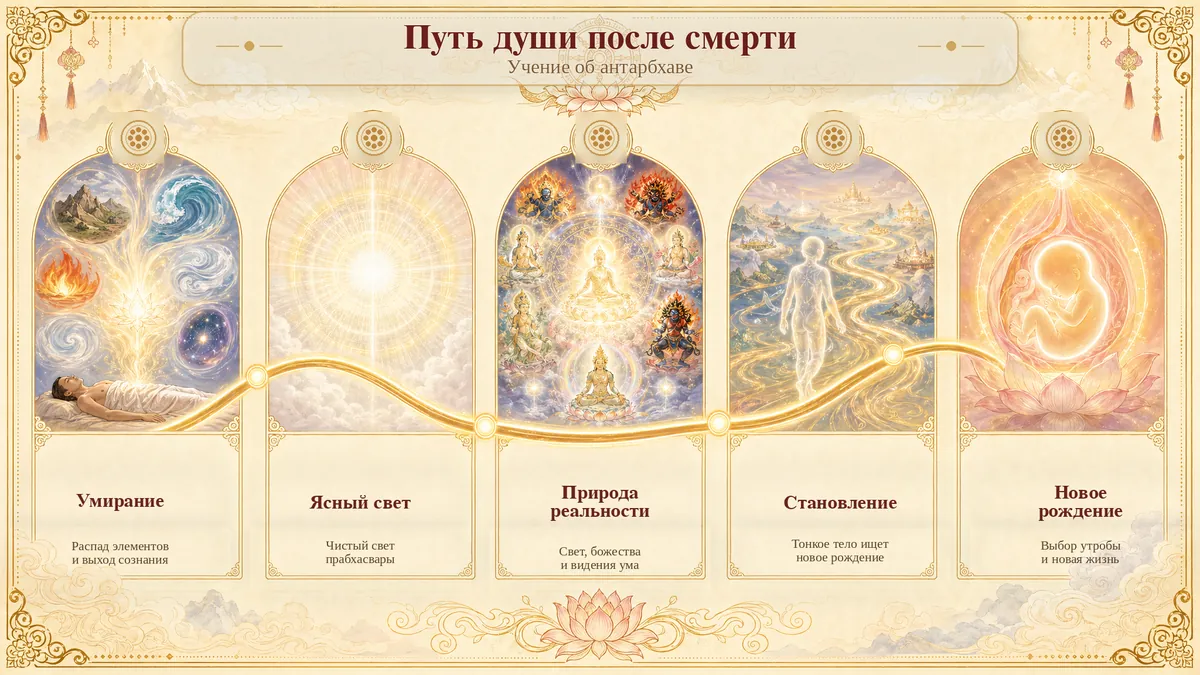
The first type is the intermediate state of dying, when the elements dissolve, the winds enter the sushumna, and the soul experiences the dissolution of the five elements: the five signs of day, the five signs of night, only in full measure.

Then comes the mystical experience of prabhasvara (pure light), when Purusha-tattva is experienced: pure light, Clear Light, emptiness — all of this corresponds to the experience of Purusha-tattva. When all three gunas pass — the white radiance, the red increase, the blackness close to attainment — the fourth, pure light of prabhasvara arises beyond Prakriti-tattva. The gunas are Prakriti-tattva, while pure light begins with Purusha-tattva. Purusha-tattva means that the soul unites with its essence and can directly perceive Brahman — this too is an intermediate state. Intermediate means that the soul does not remain in these states; it travels.

After this comes the intermediate state of becoming. Between these two — between the intermediate state of pure light and the intermediate state of becoming — there is also the intermediate state of the brief nature of reality, when the five elements are seen in their primordial forms of light and as deities. Each tattva manifests as a family of deities, and the soul contemplates various families of deities, blinding flashes of light, spheres of light, thunder; peaceful deities appear, wrathful ones, and the inexperienced soul separates itself from these visions and tries to flee from them. The experienced soul understands them as the nature of Mind and unites with them.
Then comes the intermediate state of becoming. Becoming means that the soul acquires some illusory body and some form, becomes a spirit, and tries to be reborn somewhere, to attach itself somewhere, to go somewhere.
Then the intermediate state of a new birth begins — the soul chooses a womb, a gross body. Then begins the intermediate state of physical life, this life, an intermediate state.

In addition, there is the antarbhava (intermediate state) of sleep, where we enter the subtle world, where we sometimes become aware of ourselves and sometimes do not, depending on the level of practice.
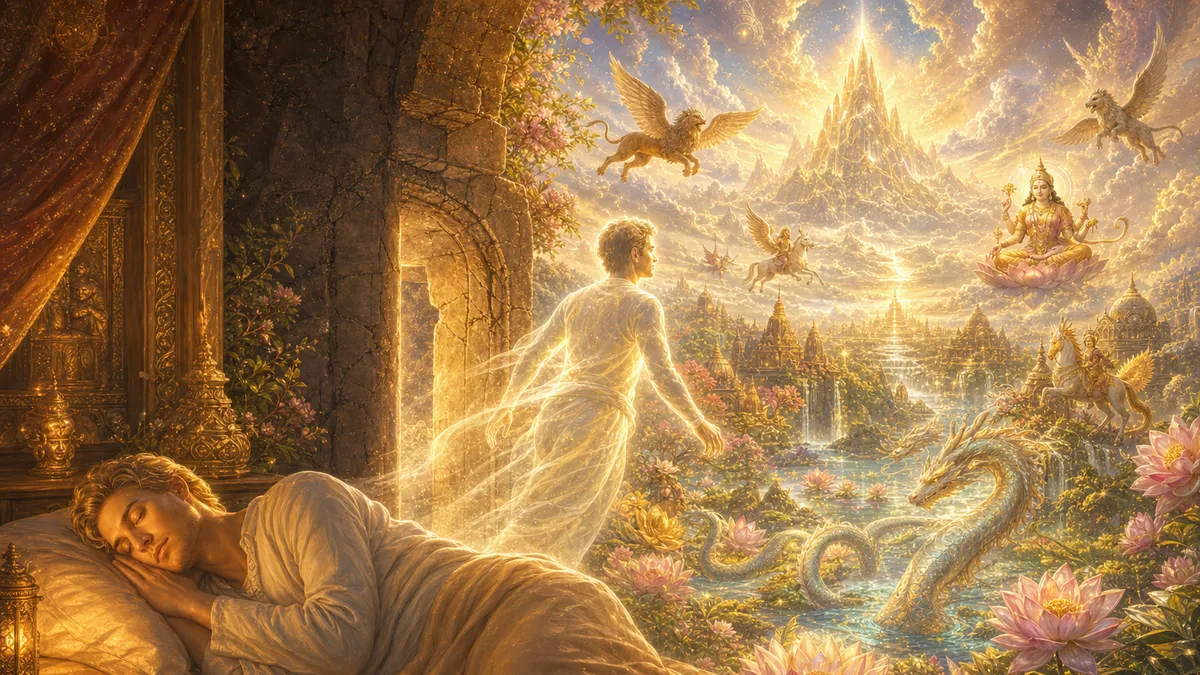
There is also the intermediate state of meditation, when we enter the subtle world or the causal world.

All these are different types of intermediate state (antarbhava). But in general, the term antarbhava refers more to the soul’s abiding between death and a new birth. Here the intermediate states are described as the experience of one lay nun.
I, named Chöjhit of the Lin lineage, have written in this book, for the benefit of all others, about the sufferings I experienced at the moment when my body parted from my soul, about the benefit of good deeds and the harm of sinful deeds. About how I was sent back with news of hell and instructions from Yama.
I, Chöjhit, was ill for 16 days, and although the treatments indicated by divinations and predictions were carried out, and the necessary rites and prayers were performed, there was no benefit. When it became worse, I thought: “Now I will die.” Although earlier I had intended to become a nun, my parents and relatives did not allow me to do so. In childhood, though I listened to religious instruction, I did not reflect on it sufficiently. As for the higher ones, I did not sufficiently honor the Teacher and the Three Jewels. As for the lower ones, I did not give enough alms to the six kinds of living beings.
Three Types of Objects and the Harmony of Life
In our life there are always higher objects — these are the objects of Refuge; lower objects — these are various beings who require our help or protection in accordance with karma; and middle ones, those who are on the same level as we are. To follow the Dharma means to establish proper connections with all three types of objects. We honor the higher ones and make offerings; we help and have compassion for the lower ones; with equals we are friends, exchanging experience and help. This is the basis of the harmony of life in our universe, and we must always check at an intuitive level whether our connections with all three types of objects are good and proper. When connections are harmonious, it means our karma is no longer being tied and is being exhausted.
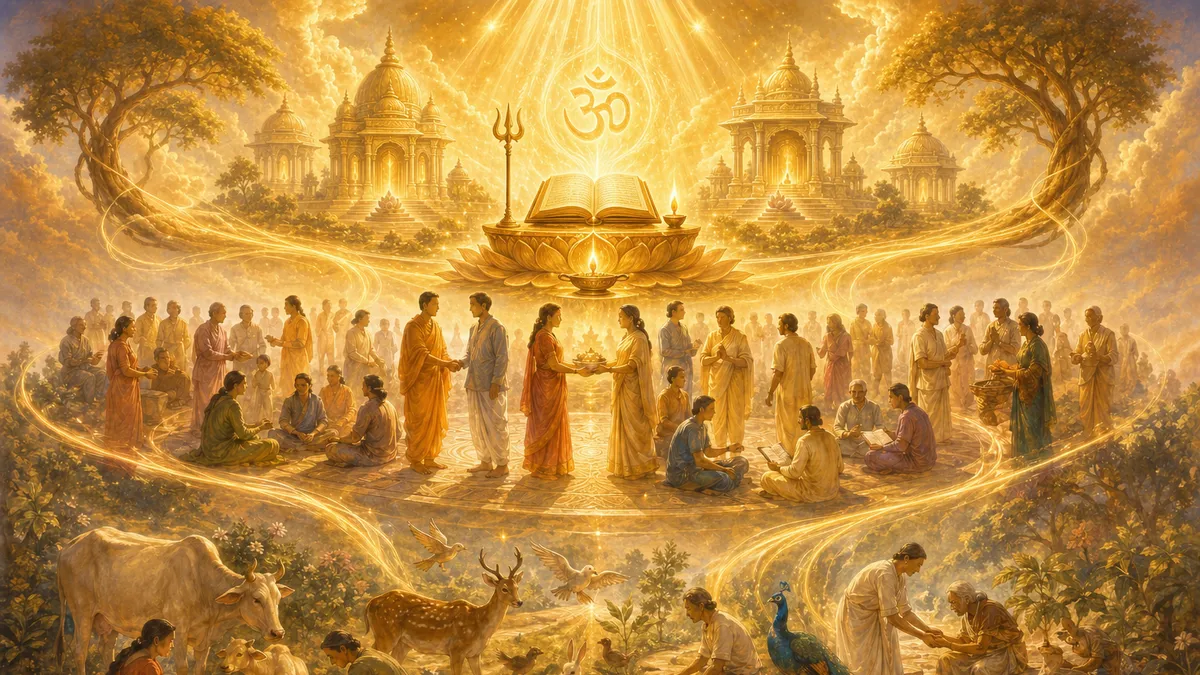
It happens that some people honor the higher ones, but with the middle ones things are not so good. It happens differently: with the middle ones they are inseparable, but with the higher ones there are some difficulties; it is hard to accept faith, self-giving, love, samaya. It happens that someone loves the lower ones, but not the middle ones at all; they love dogs more than people, feed dogs, pet them, and say: “Dogs are loyal, while people are worse than dogs” — this means something did not work out with the middle ones. It happens that they love the lower ones, are friends with the middle ones, but do not believe in the higher ones: “There are no gods, no saints — it is all nonsense.” But a harmoniously proper person is one who has harmony on all three levels everywhere, who has clear, proper relationships everywhere in accordance with the Dharma. This means all his connections are purified; new knots of karma are not being tied.
I made offerings of food only to a few teachers-mentors. What benefit is there in that? I have few other good deeds as well. Ah, poor me, having had the fortunate opportunity, I obtained the human body that is so difficult to acquire, but, having committed bad deeds, I will now die in repentance. Yes, it is already too late now to grieve. Every year I killed twenty to thirty cows and sheep. The fruits of all these sins will fall upon me. Who besides myself will bear them? Surely, having been reborn with an unfortunate lot, I will experience suffering.
The laywoman leaves the body; she reflects, and all that remains is her memory. All sins and all merits arise in memory, and she realizes the burden of sins in the form of the memory of the living beings killed, and merits in the form of offerings made, prayers, and practices. At this time memory becomes very unstable, because sins and merits conflict with one another. Sometimes sins outweigh, sometimes merits do.
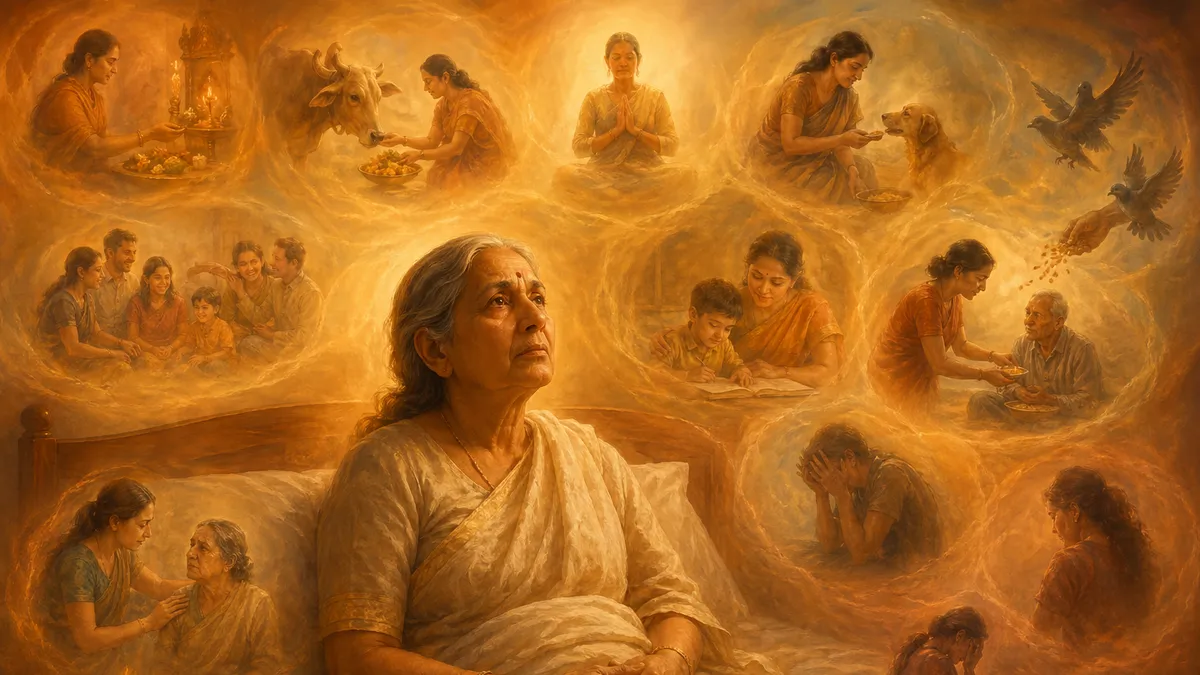
Merits are a feeling of fortune, a feeling of sattva, happy, joyful, pure, reverent memories. It is said that when a person has cleansed his memory of negative recollections and accumulated many pure memories, he has become purified, that he has sattva. Sattva gives personal strength — it is a feeling of fortune, a feeling of connection with the higher worlds, a feeling of higher abilities — all this comes from merits. Sins (papa) take away strength — it is a feeling of the shrinking of consciousness, a feeling of suffering, misfortune, guilt, and obscuration. A sadhu lives in such a way as to purify all obscurations in his life and immeasurably increase all his merits.
After all, my husband and children are unlikely to perform good memorial rites for me. Although my husband will not do many good deeds for my sake, for he is stingy with property and has no religious feelings, I will nevertheless order him, after my death, to distribute some part of our property. “Husband and children, come here,” I called. “It seems that I will no longer recover from this illness. Listen carefully to the three final words of my testament.”
Long-life practices for a sadhu
A sadhu must create a sankalpa of long life and not fall under the sway of negative thoughts, bodily illnesses, or thoughts that take away vital force. A very great deal depends on the course of one’s thoughts. An incorrect course of thought can shorten the lifespan and take away vital force. Thoughts of despondency, anxiety, and worry. Conversely, the correct course of thought can increase vital force. Long-life practices are built on this, therefore a sadhu must constantly, throughout his entire life, perform long-life practices in parallel with his general practice:

- Dattatreya’s Shanti Stotra
- Practices protecting from negative influences
- The recitation of Shiva’s names that grant vital force and protect it
- Dattatreya Kavacha
- Dhanvantari practices, Dhanvantari Gayatri, the main Dhanvantari mantra, the Dhanvantari Mala Mantra, that which Swamini Satya transmitted at the Dharma Maha Sabha
- The hymn to Lakshmi and any other practices that increase vital force, protect from illnesses and obstacles, create a mind of long life, create a mind of strong prana, create a mind of a healthy body
Then such a sadhu will be protected, he will abide in deep conviction of his protection, and he will be almost invulnerable to spirits of illness, negative thoughts, and painful states.
It is absolutely necessary for a sadhu to accumulate such merit of long life, to accumulate great vital force, to accumulate the mind of the merit of the siddhi of long life, since for practice he needs strong prana, fortune, long life, and the ability to withstand negative obstacles. This is a strong sadhu, therefore a sadhu must also be a shaktiman, possessing power. This is one of the siddhis of longevity, health, super-health, and super-longevity that a yogin must cultivate throughout his entire life. He must not be weak, vulnerable to spirits of illness, vulnerable to a bad mind, vulnerable to obstacles. He must be strong and invulnerable, since he enters into battle with the energies of karma, with the energies of samsara, and in any battle here one must be strong.
There is also such a saying: “If you are afraid, do not begin. If you have begun, do not be afraid.” “Do not begin” — in the sense of the spiritual path of liberation; but if you have begun, then do not be afraid, be strong. The strength of a yogin consists of the components of his faith, Refuge, prana, methods, and protection — and long-life practices provide this as well.
Listen carefully to the three final words of my testament. Previously I accumulated insufficient virtue. For various reasons I accumulated many sins. Therefore now, for the sake of increasing my virtue, distribute a third of our property. Give half of my jades and corals to my daughter, and distribute half after my death as an act of beneficence. When doing good deeds, do not mix them with sins. Strive for virtue. All of you — father and children — if you can, follow the Teaching. If you cannot, then at least refrain from sin. If you do not fulfill this, then, as you die, you will repent. If you, husband, cannot do it yourself, then make both of my sons follow the Teaching and do everything possible for religion. Arrange the necessary prayers. You, husband and sons, refrain from sin. Strive diligently for virtue. Husband, give your word that you will not allow another wife to torment my sons and daughter.
My husband replied: “If, after your death, I give away a third of our property, what will the four of us—father and children—eat? The jade and corals must be given to your daughter. If I do not take a woman to manage the household, then, since the children are too small, they will not be able to cope with the household. I will not demean your virtue, but right now I cannot promise what exactly I will do for its sake.”
I thought with regret: “Judging by his words, he will not perform many good deeds. And I myself, while I still had strength, sinned, not thinking of making offerings for the benefit of the Teaching. I did not offer even one coral or jade to each teacher. Taking another wife, the two of them will torment my sons and daughter.”
Because of excessive mental anguish, my head began to spin. It seemed as if I had fallen beneath the earth, and as if many people were pressing down from above. I was very frightened. Then I wandered in a vast ocean and, freezing, felt such pain as though blisters had formed on my body and were bursting. After that it seemed as if the whole earth was engulfed in flames, and in those flames, blazing with a loud crackling, my body burned, and it was very painful. Then lightning began to flash again and again, and thunder sounded as if the earth were trembling. Then, for some unknown reason, I calmed down. What happened afterward for a long time—I do not remember. It seemed that I found myself in the corner of a house, and above my head appeared a five-colored radiance the size of a shield.
From this radiance came many rays. At the ends of these rays were beings with seven heads unlike one another, with human bodies clad in armor, with eyes the size of the moon and the sun. In their seventy hands they held many different swords. They all shouted: “Ha! Ha! Hu! Hu! Kill! Kill! Seize! Seize!” Their cry sounded like the roar of a thousand dragons. I was very frightened. But then I remembered the teacher’s instruction that every light is one’s own light, and every form is one’s own form, and every sound is one’s own sound. One’s own fear is born in one’s own consciousness. As soon as I thought of this, deciding that in reality nothing was happening, everything immediately disappeared. The fear passed, and I calmed down. Then I looked at my own bed. There lay the foul-smelling corpse of a huge frog, covered with my clothes. The children, relatives, neighbors—everyone came up to the bed. Some began to kiss the frog’s corpse on the lips. Others began to cry, holding it by the paws. At that moment thunder sounded, as if a thousand dragons were roaring at once.
Her own body appeared to her as the corpse of a frog; she could not recognize it.
Hail made of blood and pus, the size of eggs, began to fall on me and beat me, causing unbearable suffering. When the weeping subsided, the thunder and hail also ceased, and the pain abated.
The tears of her relatives seemed to her like hail; subjectively she perceived this in her subtle body, since they gave rise to sorrowful thoughts and suffering that struck her subtle body.
Then my younger brother said: “There is no benefit in our sitting and crying. Without a teacher, the rite for the deceased cannot be performed. We must invite a teacher with twenty or thirty disciples. It will be good if, having invited them, we ask them to perform the rite. My elder sister formerly venerated the great hermit Nigulesugchi-Erdeni. I will invite him to perform the rite. I will also call another priest to read the sutra ‘Chodba’ (‘The Diamond Sutra’).” My husband said: “I will invite a Bon priest.”
“My elder sister did not venerate the Bon teaching and did not follow it,” my younger brother objected.
“Do as you wish, and I will go invite the priest and the great hermit,” he said, and left.
Meanwhile my cunning husband, together with my nephew, loaded grain onto a cart, saying:
“We have six measures of barley at home. We will ask the neighbors to grind it.”
What are they going to do? Will they make offerings? But now my illness from fear seems to have passed. If they simply give so much flour to outsiders, they will not return even half of it afterward, I thought, being stingy. I did not even have the thought that I had died.
She remained nearby in her subtle body and saw what her relatives were doing; she observed, but had not yet fully understood.
Soon my eldest son brought a reader and ordered him to read the sutra of the “Diamond Vehicle.” When he opened the ritual book and performed the rite of confession, I was very glad, and my soul grew calm. In the evening the priest with twenty or thirty disciples and the great hermit arrived. I prayed to the lama and asked for a blessing, but he did not bless me.
“If this holy teacher is angry with me, then why did he come here?” I asked, but my husband and children said nothing in reply. While I sat there, anxiously wondering, “Why are they all angry with me?” the great hermit, placing his hand on the head of the frog’s corpse, performed the rite and delivered a sermon.
She did not understand why they were not speaking to her, and she did not realize what her body was; it appeared to her as the corpse of a frog. It seemed to her that everyone was displeased because they were not talking to her. But in fact she was already in a subtle body.
Placing his hand on the head of the frog’s corpse, he performed the rite, delivered a sermon, and recited a blessing, from time to time repeating: “Oh! Chökyid! Your hour of death has come. Leave behind your concerns for children, property, and food. Think that your soul, in the form of the white letter ‘A’ shaped like a white drop, has entered my heart. Go with me to Sukhavati, the sacred realm of the inconceivably radiant Buddha. Let us go there together.” When he gave this command, I thought: “I have not died. I am the same as before. But since my teacher has ordered it, I will go.” However, I could not go, because I was afraid of the frog. But when the teacher uttered “phat,” I calmed down and rejoiced. Judging by the teacher’s words, death had been delayed, but my soul and body had already been definitively separated.
After this, meat, vodka, and flour were offered to the teacher and his disciples. But I was given nothing. “Daughter, serve your mother her share of the food,” the great hermit ordered. The daughter placed a little meat and flour on a dish and, together with tea, set it all near the frog’s corpse, saying: “Mother, please accept this.” Because they gave me nothing, but placed everything near the frog’s corpse, I thought they were disgusted by me and, becoming angry with my daughter, fell into despair.
I felt unbearable hunger and thirst, but I sat and endured it. When, at the command of the great hermit, the mani incantation and other mantras were read aloud and my share of meat and flour was thrown into the fire, from their aroma it seemed to me that I had both drunk and eaten. The hunger and thirst passed, and I became calm.
Spirits in subtle bodies feed on aromas, but they can feed only on the aromas of those offerings that have been offered to them.
When the sacrificial food and the refreshments for the lama and the disciples were finished, they sat down to read memorial prayers. The teacher prepared for contemplation and sat in deep reflection. Because all of them were angry with me and did not give me even a little food, my body and soul suffered immeasurably and were extremely changeable, like a bird’s feather fluttering in the wind. I thought: “It would be better if I took the jade and corals and went to the land of the Victorious One.”
When my daughter and sons began to weep, crying out, “Mother,” hail of blood and pus once again began to fall, striking me and causing unbearable torment; and again, as soon as the crying subsided, the hail of blood and pus, as well as the terrible thunder like the roar of a thousand dragons, ceased. Although the other visions that appeared were just as absurd, I stared at them in horror, afraid of something. My mood often worsened, and I suffered. “It would be good if I sat near the teacher,” I thought, but I remembered his instruction that a woman should not sit near a man. Then I hid behind him and began to listen attentively to the reading of the prayers. The fear passed, and I became very calm. “And now it would be good to somehow draw closer to the great hermit,” I thought.
If the soul is not trained in self-liberation, in devotion to God, in natural contemplation, and is not in divya-bhava, then its mood is very changeable.
When I came closer, it seemed to me that I saw the all-perfect, one-faced and four-armed Avalokiteshvara, who mercifully commanded: “Let her soul, like mine, immerse itself in contemplation.” The fear in my soul passed, and I became immeasurably calm and joyful. I do not know how long this lasted, but then I came to myself. The memorial rites continued. As before, my share of food was placed near the frog’s corpse. As before, the great hermit threw a little food into the fire, and again it seemed to me that I had eaten and drunk. At that moment, someone outside called: “Chökyid, come here.” When I went out to see who it was, someone very similar to my father said: “Come with me. I will show you something and quickly send you back.”
In this state, the soul can meet the spirits of deceased relatives, who may tell it about its condition.

I thought: “In the house there are the teacher and many novices, and they are all angry with me. My husband and children did not give me even a little food. I can no longer stay there. Now I will go away.” Setting out on my way, I reached a beautiful area where neither grass nor trees grew. Before me stretched a wide sandy steppe without a single hillock or elevation. A rider would need twenty days’ journey to cross it. In the middle of the steppe shone the waters of a river that flowed nowhere — neither up nor down — with a width equal to the flight of an arrow. Across it, a bridge had been thrown, whose length was also the flight of an arrow. Between this steppe and the mountains there was a huge, wondrous city. The person who had brought me here said: “Since you have come here, go into the city and see whether you have any acquaintances here. I will go across this bridge. Come there too,” and having said this, he left. Thinking, “Do I know anyone there?” I entered the city.
The Intermediate State of Becoming
So, the intermediate state of dying, the intermediate state of the Clear Light, the intermediate state of the nature of the elements had ended, but since she had not actually died, and this was what would now be called clinical death, since she then came back to life in the end, it was not a complete experience of the process of dying to its very end; they were not lived through to the end. But this state corresponds to the intermediate state of becoming, when the soul is already heading toward a new birth.
There, as in a disturbed anthill, an unimaginable multitude of men and women swarmed. Some of them looked well and wore good clothes. Others had emaciated, ash-colored bodies and poor clothing. They all complained of suffering. Their faces were gloomy. Some were crying. “Could this really happen to me too?” I thought, and my whole body trembled. Among this multitude of people was my shepherd. Noticing me, he exclaimed:
“Ah! Elder sister, have you come here too?”
“Yes, and you are here?” I asked.
“Yes, I am suffering,” the shepherd replied.
“What is this city called?” I asked him. “Why are so many people suffering in it, and what lies beyond this bridge?”
But then some person ordered: “Quickly, come with me there.” When I decided to go with him, that person said: “This is called the intermediate region where the soul abides for those who have died in the world of humans. Some of those who have arrived here have exhausted their lifespan. For seven days they wait here while the forty-nine-day memorial rites are performed for them. Others, although they have not exhausted the measure of their life, were mistakenly brought here by Yama’s servants. They wait until they are sent away from here for ten, fifteen, twenty, and thirty years.
This is something like a place of temporary stay, where the formation and sorting of souls takes place, determining where they should go next. If this laywoman had deeply practiced the natural state during her lifetime, then in the intermediate state of pure light she would have recognized the pure light and united her natural contemplation, her Light of the Son, as described in the tantras, with the great Light of the Mother, and would have merged with it easily, just as a son joyfully leaps into his mother’s arms. If this had been her option, it would have been the option of liberation on the path of Anuttara Tantra, provided that she had closed the circle of the day and the circle of the night. But since she did not have such an attainment, she still had the option of being liberated with the help of the methods of Anuttara Yoga Tantra, for example, the yoga of the illusory body. Being attentive to the signs of the dissolution of the elements, she could have entered contemplation, united with the energy of the dissolution of the elements, and transformed them into the experience of bliss and emptiness.
Then, having tracked the white radiance, the red increase, and the blackness of near-attainment — the three gunas of Prakriti-tattva — she could have recognized the pure light if she had practiced the yoga of the illusory body, and remained for some time in the awareness of the pure light. Then, when the mind began to move and the five-colored subtlest wind blew, bringing her out of this state, at the moment of the reverse process, when the three gunas are experienced in reverse order (tamas, rajas, and sattva), when the black color began to be experienced — this is also called the black eve, the eve of near-attainment — she could have visualized the seed syllable and, through the seed syllable, appeared in the form of the illusory body of her chosen deity. Having attained an illusory body of a certain level, she would no longer have followed the path described here, but would have proceeded further along the path of perfecting her illusory body, meditating on the state of pure light.
The third level (the lowest) is liberation through the transference of consciousness to a pure land. If she had been trained in dream yoga, in the yoga of the pure land, then, without entering this intermediate realm, she would have flawlessly visualized her ishta-devata and, like an arrow flying purposefully toward its target, would have headed to one of the pure lands of the heavenly abodes and been reborn in a pure place, in a heavenly abode. But these three kinds of liberation were unavailable to her, so she ended up in purgatory — in the intermediate state.
This person said: “Those who look good and have food and clothing, in their previous birth, for the sake of the higher ones, made offerings to the Three Jewels, and for the sake of the lower ones, gave alms to the poor. Their relatives and friends prayed and made offerings to every teacher and priest, and thereby fulfilled small, medium, and great virtues. Deeds performed with prayers multiply every day more than a hundred or even ten thousand times. They will become very happy.
The Influence of Merit on the State of the Soul in the Intermediate World
In the intermediate state, spirits acquire a body — a body created by the mind, and it has the form that is imprinted in the mind. Sometimes the mind depicts the body and the clothing that are habitual. For example, if new clothing is offered, such souls return and say: “Why did you offer new clothing? I have no shoes; I cannot wear it,” because the mind has not yet become accustomed to it, and this offering has not reached them. If the memories are good and the mental image of one’s body is good, then the soul reproduces the appearance of such a body. The yoga of the illusory body is also built on this.
We practice in order to perceive our body as the body of the deity Dattatreya, our mind as the mind of the deity Dattatreya, and our speech as mantra, transforming into Dattatreya, into Shiva, and into all the objects of the Refuge tree. Gradually our mind must imprint this well, and even on an intuitive, instinctive level, in any dream, in any state, we must perceive ourselves and become accustomed to ourselves precisely in this way — purely, exaltedly. Those spirits who have much merit — these merits manifest; their bodies possess beautiful features and rich clothing. But those who have little merit, that is, those who have the complex of a poor little wretch and other kinds of pasha — their bodies manifest as dirty, wrinkled, emaciated, like torn poor clothing, like rags — that is how they look. Their subtle mind and prana, having joined together, modeled such a body, generated it.
The person continued: “Those who look bad did not perform good deeds during their lifetime. After their death, their relatives did not hold memorial rites. Even if they offered a few donations, they did not perform the necessary well-wishing prayers and thereby did not multiply them. Although, having not performed good deeds, they will remain here for a long time, this will not atone for their guilt. For some, the term of life has ended. Beyond this bridge reside Yama and his retinue. For those who arrive there, sins and virtues will be counted. Those who do good themselves, or for whom relatives have performed good deeds, will be liberated and sent to higher rebirths. But those who sinned, and whose relatives did not hold memorial rites, will burn and boil, experiencing unimaginable suffering. I myself suffered day and night, wondering what would happen to me. Previously, when I arrived here, one of Yama’s servants appeared and said: “The term of your life has not ended, therefore it is not yet time to come to judgment. Return and wait.”
The Soul’s Free Will in the Subtle World
The soul, while abiding in the subtle world, if it is not the soul of an experienced sadhu, siddha, or saint, is confused, and guides help it, or it is under the power of the spirits governing that locality; that is, they tell it where to go and what to do, since it is completely disoriented and is not capable of liberating itself. But if it is the soul of a strong practitioner, then such a soul could remember the view, remember contemplation, enter nonduality and generate the sankalpa of Sleep, generate the sankalpa of atma-vichara, and give rise to a very deep divya-bhava, and dissolve this world, and dissolve its body — the subtle body that had been created there. Or it could transform into its deity, generate divya-bhava, remember the four key points and begin reciting the mantra, and simply leave this world, and by the power of will head wherever it wished.
The soul’s free will in the subtle world is limited by its imagination, its awareness, and its ability to abide in contemplation. Even during his lifetime, at the level of the subtle body, a sadhu extraordinarily develops his capacity for visualization, imagination, and his free will, relying on methods and mantras. Thanks to this, he can liberate himself from different kinds of psychological reality of the subtle world. This is the manifestation of liberation in reality — not to fall into the tunnels of reality of the subtle world, but to manifest free will through the power of awareness, the power of the method of upaya, transformation, or the view and contemplation.
The man continued: “That is why I am here. Now, sister, go and find out what Yama and his attendants will say. If they also tell you to stay here, come back.” Hearing these words, I was frightened. Then, having ascended the bridge, I saw on that bridge a man lying on his back with his arms and legs spread out. From above he was pinned down by a sacred book the size of a city, and molten cast iron was being poured into his mouth. I asked the man accompanying me: “What sin did he commit?” That man replied: “This one, while living in the world of humans, stole things from other people, but, holding a sacred book in his hands, swore that he did not steal. For eating stolen food, he is punished here by having molten cast iron poured into his mouth. For killing living beings, he will be punished later.”
Meeting with Yama
When, as I had been ordered, I set out for the other shore, inside a vast courtyard I saw Yama on a great golden throne. His body was yellow in color. His hands were in the posture of contemplation. On his head was a crown. He was dressed in sacred garments adorned with the image of a patra. Satin curtains were stretched around him. Above was a silk canopy. Before him many different offerings had been placed. To his right, a servant with the head of a bull held a mirror. On the left side, a servant with the head of a monkey held scales. In front sat a servant with the head of a musk deer, holding a book. There were also other servants of various appearances, with different heads, with open mouths and bared fangs, with eyes the size of the sun and the moon. In their hands they held terrifying weapons: spears, swords, bows, arrows, axes, poleaxes, hooks, saws, hammers, sabers, nails, tongs, as well as an innumerable multitude of knives. They all shouted: “Seize him! Seize him! Kill him! Kill him! Ha! Ha! Ho! Ho!”—they emitted the growls of wild beasts, leapt about, and raged. Before them, in great fear, three hundred men and women awaited judgment.
Among them was a tall, sunburned man with protruding teeth, dressed in a felt robe and a fur cloak. Holding a rosary in his hands, he was reciting a mantra. Yama asked him: “While living in the world of humans, did you receive initiation, teaching, and instruction in the secret mantras, which are the foundation for attaining the virtues of the awakened ones? Did you recite mantras while contemplating the great body of the enlightened one? Did you look into your own soul? Did you look, without delusion, upon your own face? Understanding the unreality and illusory nature of phenomena is the foundation for attaining the virtues of the enlightened one.
Tell me, how did you act? Those who venerated the Three Jewels; copied and read the sacred scripture; made offerings of food to the clergy; repaid the kindnesses of father and mother; gave alms to the poor; recited prayers that had no ill repute; protected the lives of living beings, avoiding killing them; showed great compassion toward other people; and with their body, speech, and thought helped weak living beings, striving to do good, in subsequent rebirths always go to the higher realms. These are the basic conditions for attaining the well-being of celestial beings and humans. Speak, how did you act? Tell also how you purified yourself of bodily sins. Did you make pilgrimages? Did you lead an ascetic way of life, observing fasts?
Thus, the soul is to have, as it were, a conversation with Yama, and the question of the next birth will depend on how this conversation unfolds. Yama is a reflection of the inner deities—he is both an external divine force and, at the same time, a reflection of the inner deity that governs reincarnation, the paths of the soul. The soul’s next path depends on which aspects it is prepared to show Yama. If it performs the correct self-liberation, it may attain moksha. If it says: “In Brahman there are no such concepts, since I abide in Brahman, I am beyond duality.” But if it identifies itself, falls into eternalism or nihilism, then it may worsen its birth. If, however, it answers correctly, and this comes from correct contemplation, then perhaps it will go to the realm of those who practice tantra, anuttara-tantra, Advaita, Shaivism, to a pure land or a heavenly abode, or it may be released altogether, since the deity will be satisfied with the correct answer arising from the natural state.
Did you make pilgrimages? Did you lead an ascetic way of life, observing fasts? Tell me, did you not kill your father and mother, who created your body; did you not kill the teacher who created your soul; did you not compel novices to apostasy? Did you not commit the five irredeemable sins?
There are Vinaya assemblies where each month we perform a similar confession before the senior monks. But when we do it, we must do it sincerely; we must not conceal anything, because something unrepented remains with us and is recorded in the storehouse of negative karmas, while something repented is as if crossed out. It is like deleting your browsing history on the Internet: it no longer counts against you and can no longer be tracked. But in the case of Yama it is impossible to conceal anything, since his questions are rhetorical, for, penetrating deeply into the soul, he already sees everything: all memory, the actions of body, speech, and mind—everything is visible, everything is open there. Even if the soul takes such a denying position and says: “It was not I who did this, I did not do anything like that—this is not true, everyone is lying,” everything is visible there, everything is recorded.
All these great sins are the cause of suffering in the realms of hell, pretas, and animals.
Tell me, did you destroy sacred buildings; did you kill those who listen to the teaching; did you sow doubts in the minds of believers? Did you commit other sins similar to the five inexpiable sins? Tell me, did you cause harm in body, speech, and thought to the holy one from whom you received initiation, teaching, and instruction in the secret mantras, causing him to break his vow? Tell me, did you violate an oath by falling into heresy and confusing the souls of priests, teachers, and friends? Did you torment the innocent? Did you commit a great sin by beating and robbing devout men and women going to holy places? Tell me, did you commit the ten black sins.
Among them, from the sinful deeds of the body: did you take what was not given to you; did you kill; did you engage in perverse intercourse? From the sinful deeds of speech: did you speak lies and slander; did you utter harsh words; did you engage in idle talk? From the sinful deeds of thought: did you have envious and greedy thoughts; did you adhere to false views? From disbelief in the teaching of the secret ones, did false views arise in you? Did you neglect the followers of the Teaching? Did you do evil to the clergy by denying them food? Speak without concealment.
The Fate of a Virtuous Person
“O khan. Deign to listen,” that person replied. “I am the one called: ‘He Who Increased Power Through the Force of Virtue.’ I was very devout. I showed mercy to the weak. From childhood I recited the mantra. I intended to become a monk, but my parents and relatives did not allow me to do so. Although I married, if any teacher came to the house, then, for the benefit of living beings, I welcomed him, saw him off, and, as far as possible, showed him respect and helped him in every way. I listened to many instructions, initiations, and sermons, but had little free time to reflect on them.
So that a lamp might be placed before the great statue of the awakened one, I sent two bricks of tea. I offered tea to the monastic community of one monastery. For twenty years I provided sustenance to a hermit who devoted himself to contemplation in a mountain cave. When he passed away, I donated a brick of tea and pronounced the appropriate good wish.
So that the “Sutra of the Fortunate Kalpa” might be copied and read a thousand times, I donated one lan and tsen of gold, a horse, and two bricks of tea, and diligently made the good wish. Through offerings I brought joy to the holy ones. I honored and helped my father and mother in every way. I performed enough good deeds not to repent after death. I never mocked people, and since I have no enemies, I did evil to no one. I did not steal, rob, or feud. From the age of thirteen until I arrived here, I recited the hymn to Manjushri every day. Ten thousand times, without interruption, I recited the mantra. When a teacher arrived who recited mani, I offered him a piece of silk equal in value to a khainuk. I also copied a good wish and handed it to him. Such are my virtues. As for sins, I used as food the meat of many killed animals, but I myself did not kill. These are basically all my good deeds and sins. Deign to judge them, showing mercy.”
“Check in the mirror and the book whether all he has said is true or false,” Yama commanded. The servants with the heads of a bull and a monkey looked and said: “As for good deeds, even in childhood he completed two fasts and three vows in succession. He recited the mantra countless times. Everything else he has related is true. As for sins, the three of them stole a large yak and cast lots as to who would kill it. The lot fell to him, and he killed the animal.”
As soon as this was said, a white man appeared from the sky and announced: “This man has performed an inconceivable multitude of good deeds. There is not even a sesame seed’s worth of sin upon him. He may be sent to the sacred realm of the awakened one. The prosperity of heavenly beings or humans is insufficient for him. Here is the number of good deeds accumulated by him in his past life,” and he poured out a heap of white stones the size of a house.
A black man also arrived and said, “During his countless rebirths, this man has accumulated many sins. He cannot attain even the prosperity of a celestial being, let alone the highest state. There is no place for him other than hell. Here are the sins he accumulated in his former life,” and with these words he poured out a heap of black stones the size of ten handfuls. When the black and white stones were weighed, the good deeds proved heavier and more numerous. The sins were lighter and fewer in number. When it was reported that, by the power of good deeds, the sins had been purified, Yamaraja commanded: “Oh, you will attain bliss by receiving a human body and accumulating many virtues through the performance of new deeds—each better than the last. Since the human body is better than the body of a celestial being, I shall send you to be reborn, as fate has ordained, as the son of a rich man and, having stepped onto the path of holy faith, to rise to the higher realms forever. And now go along this yellow, variegated road.”
That man said: “If there is someone here who is to go to the world of humans, let him tell everyone to strive for virtue and refrain from sin. Those with an evil fate will not be freed from suffering. Those with a good fate will be elevated and sent to higher rebirths.”
The Fate of a Sinner
In the same way, another man was questioned, and he said: “I did not know that the sins and virtues of those who come here are counted so precisely. Since I had no surplus property or food, and my wife was not particularly pious, apart from the usual taxes, we did not give very much for other donations. I was unable to perform good deeds with my body, speech, and mind. When I still had the opportunity, I received no initiations from my teacher other than the initial one. My wife would not allow me to give alms to pilgrims who knocked at our door. I am also guilty of killing enough fish to feed myself for twenty days, as well as twenty or thirty domestic birds, pigs, sheep, and goats. Under the influence of bad companions, I took part in the robbery of a man and a woman. Now I repent, but it is already too late.”
When, having said this, he struck himself on the chest, weeping, and began to tremble, the servants of Yama, holding knives, cried out, “Ha! Ha! Ho! Ho!”—they whistled, howled, and jumped about, preparing to rush at him. Even I was very frightened.
Then Yama said: “Judging by what he has told, his virtue is slight. Check whether it is true that there are no other sins against him.” As before, the servants of Yama looked in the mirror and the book and said: “Ha! If you had no sins other than these, you might have escaped punishment. It is impossible to count the fish you have killed. Look for yourself in the book. You caught and killed many birds, pigs, sheep, and goats. Look: you yourself killed twenty-nine birds, fifty large pigs and piglets, forty-three sheep, a cow, and a yak. Look: when, setting snares, you hunted wild animals in the mountains, you burned more ants and other insects than there are grains in an ear of barley. The four of you, joining together, attacked and robbed pilgrims to holy places when you could, and when you could not, you stole from them. Look for yourself in the book and the mirror.”
When this was reported, Yamaraja commanded: “Yes, you are indeed the one who, having accumulated no good deeds, will meet an evil fate. Because in your past life you committed vile acts for the sake of obtaining food and clothing, you will suffer in an endless succession of rebirths. The fact that you, with your rotten heart, attacked and robbed pilgrims and worshippers, causing them harm, is a sin greater than the fact that, showing no mercy even to yourself, you committed the five inexpiable sins and the five sins similar to them, and killed living beings. Take him to the ‘Hell of Those Who Die Again and Come to Life Again,’ the ‘Hell of Black Lines,’ the ‘Hell That Destroys Collectively,’ and the other eight hot and eight cold hells. Because he ate sinful and stolen food, pour boiling, red-hot cast iron into his mouth.”
When such an order had been given, a white man appeared and said: “What has he done that he is being sent not to higher rebirths but straight to hell? Here is the number of good deeds he accumulated in this birth,” and he poured out ten handfuls of white stones into a heap. A black man also arrived: “It is impossible to enumerate the unimaginable number of sins he accumulated over the course of countless rebirths. Here are the sins he accumulated in this life,” he said, and poured out a pile of black stones as large as a mountain: “there is no place for him other than the terrible hell.”
When some of Yama’s servants threw a lasso around the sinner’s neck, while others hooked his heart with hooks and led him to a square iron city, the man said: “If there is someone here going to the world of humans, let him tell people not to commit sins as I did. Otherwise the hour of deliverance from suffering will not come for them.”
The Fate of the Physician
Then, in the same way, they questioned a man carrying a leather bag of medicines on his back, and he said: “In the world of humans I was a physician. I was wealthy and, since I knew about the benefits and harm of virtuous and sinful deeds, for the sake of my virtue I ordered the ‘Chodba’ sutra to be copied in gold ink and read more than one thousand one hundred times. For this I presented the scribe and the reader with a yak, a cow, a helmet, a sword, and six measures of barley. To the person who read the Vairocana rite five hundred times, I donated two suits of armor, three horses, seventeen yaks, and two arable fields, and uttered the necessary good wish. Regardless of who came to my door—whether man or woman—I refused alms to no one. I myself, without interruption, read all the hymns to Manjushri. I read prayers and other mantras many times. I was not greedy and received nothing beyond what was given for treatment. I helped many living beings. When I was invited to a sick person and could help, then, in order to prevent his death, I immediately went to provide assistance and did so out of good intentions. I did not use improper medicines or methods of treatment. I hope that after my death my wife and son will hold great memorial rites. As for sins, since I lived in the transient world, other people killed many domestic animals in my house. I myself did not take the lives of living beings.”
As before, Yama’s servants looked into the mirror and the book and reported: “As regards good deeds, everything is correct. As for sins, when your relative fell ill, you were invited to treat him. Coveting his property, you gave him an improper medicine. By prolonging the illness for eight months, you exhausted his possessions. But then you gave a beneficial medicine, and he did not die but recovered. For having prolonged the illness and taken possession of a good suit of armor, you will be punished. In addition, you yourself killed one hundred and seventy-five cows and sheep in your own house.”
As before, Yama’s servants counted the white and black stones and reported that there were somewhat more white stones. But when they weighed them, although there were more good deeds, the sins proved heavier.
“Yes,” said Yama, “if you had not treated that sick man badly, you would have obtained the body of a human or a celestial being. Now, however, make him constantly drink boiling poisoned water. Drive a thousand iron nails into his body. When he has atoned for his transgression and virtue becomes weighty while the sins grow lighter, I will send him upward.”
No sooner had Yamaraja given his order than Yama’s servants hooked the sinner’s heart with hooks and, shouting, “Kill! Kill! Seize! Seize!” led away that man, who said: “If there is a person here departing for the world of humans, let him tell physicians not to give improper medicines. This sin and its consequences are very great.”
The Fate of the Repentant Murderer
Like the previous ones, they also questioned a man dressed in blue felt clothing, and he said: “I was my father’s only son. One day my father said: ‘My only son must take as his wife the daughter of a noble man.’ And so I married the daughter of a very rich man. However, soon we began to quarrel. Of the two hundred cows and sheep we had, the greater part went to lawsuits. Then I set fire to two houses belonging to my wife’s relatives, where a total of seventy-five cows, sheep, goats, and horses burned. I myself waited by the door of one of the houses while the people, trying to save themselves, ran outside, and I killed a man and a woman with a bow. After that, by agreement, I married another woman. My property increased. Taking into account what my relatives gave me, it became equal to my former property. But my soul grieved when I thought about what a sin I had committed.
I reflected on what means to use in order to be cleansed of the sin, and when I asked many holy teachers about this, some said: ‘You will be cleansed if, having received initiation and instruction, you meditate on them.’ Others asserted: ‘You will be cleansed if you make a pilgrimage to holy places.’ Still others advised: ‘Since the teaching of the Great Compassionate One is very useful for salvation, if you observe fasting and abstinence and recite the mantra aloud one hundred million times, the sins will be cleansed.’ Others again asserted: ‘You will be cleansed if you recite the penitential prayer one hundred times and perform the rite in honor of the peaceful and wrathful deities.’ Some said this: ‘You will be cleansed if, as an offering, you prepare a feast for many mani reciters and great hermits.’
I myself thought that I could not be cleansed of sin by any single means. It was necessary to carry out each of the deeds they had advised, and so, without warning anyone, I set off to wander like a beggar. I climbed up to a high mountain pass that almost reached the heavens. I descended all the way down to Kama. I visited sacred places, mountains and temples, as well as holy, blessed teachers. Without concealing my sins, I repented before them with sobs, saying: “I have such and such great sins. I am doomed to an evil fate. I regret and repent.” I performed as many prostrations, pilgrimages, and other religious deeds as I could. After two years I returned to my homeland.
Then, having received initiation and guidance from one teacher, a great hermit, I devoted myself to contemplation, just as that saint had taught, who had understood the essence of the soul, mind, and emptiness. When a certain teacher arrived preaching abstinence, I went to him and over the course of a year fulfilled the vow of fasting one hundred times.
At a suitable time I observed the vows of fasting and abstinence two hundred times. Reading the mantra diligently every day, I recited it eight million times. I ordered the sutra of the “Great Vehicle” and “The Repentance of the Bodhisattvas” to be copied in gold ink and each text to be read a thousand times. I gave many gifts and much food. To one old hermit, who asked that, together with performing a rite to the gentle and fierce deities, a prayer for the fulfillment of wishes be read two hundred times, I gave a good horse, a cow, a piece of jade, and a piece of silk. When, from places a day’s ride away, a mantra reader and a great hermit arrived, I offered each of them as many gifts and as much food as I could and, making prostrations, asked them to read prayers. I also made an offering to a teacher of the Kadampa sect. The teacher who revealed to me the spiritual qualities of man constantly dwelt in a mountain cave. I greatly revered him, showed respect, and relied upon him; therefore, until the time I came here, I zealously offered him meat, butter, flour, clothing, and other things. By this I earned his grace. There were many signs that my sins had been cleansed. Now see for yourselves whether the sins have been cleansed or not. If they have not been cleansed, I shall not regret all that I have done.”
When he had told this, Yamaraja said: “Many commit sins, but few repent of them. You, however, acted skillfully. There is no merit at all in committing sin. But if you repent, you will earn purification from sins. If one repents using all four methods of repentance, one will be purified even after committing the five unredeemable sins. For your repentance you used all four methods, and therefore your sins have been cleansed. If one undertakes pilgrimages and fasts, then through physical suffering the sins of the body will be cleansed. If one reads prayers and the mantra, then the sins of speech will be cleansed.
If the mind comprehends the unity of beginning and end, then the sins of thought will be cleansed. Although you committed so great a sin, because you have performed such a multitude of good deeds, you will become a person useful to every living being that comes into contact with you, and you will be able to guide them. In your next rebirths you will constantly be reborn from one human life into another, and by hearing, understanding, and reflecting on the action of the hidden tantras, at the end of the fourth rebirth you will become awakened. This mottled yellow road is the path of the celestials and humans. Go along it.”
As soon as this command was spoken, the man rejoiced and said: “If there is anyone here going to the world of humans, let him tell sinners to repent of their sins, as I did. Those who diligently do good and are cleansed of sin will go to the high-born.”
The Fate of the Yogachara
A Yogachara dressed in a cotton cloak was also questioned, and he said: “I am Biliguun-Vachir from the Tsangpo River in the Tsang region. From childhood, having been introduced to the Teaching, I diligently studied philosophy. Later I received initiation, guidance, and instruction in the hidden tantras from my teacher. I listened attentively and followed them steadfastly. I benefited living beings. I did not accumulate property. Apart from not giving enough alms, I have no other religious sins.”
The servants of Yama with the heads of a bull and a monkey looked in the mirror and the book and said:
“Ha! There are many ‘who have not accumulated sins’ like you. You studied philosophy somehow or other. Having received initiation, guidance, and teaching from a great teacher, you lusted after and seduced his daughter. Having deceived the wife of a holy man, you entered into relations with her as well. The wife and daughter gave you the teacher’s food and drink, and you fed yourself as though you were him. When the teacher found out about this and began to scold his wife and daughter, and they wept, you said: ‘Teacher, while listening to the Teaching from you, I have heard so many evil words,’ and, taking a stone, wanted to strike the teacher. You violated the precepts and used foul language. Thinking evil thoughts, you confused your soul. You interrupted the fulfillment of the vows of body, speech, and mind. For a year you did not perform the rite of contemplation, but told other people that you had acquired supernatural qualities and were filled with perfection, like the Buddha. You gave your appearance the look of an awakened one.
Saying, ‘I am enlightened,’ you constantly remained among laypeople, misleading them with your absurd behavior and causing harm to all other people. You inclined everyone who had dealings with you toward evil deeds. Look for yourself. Your teacher’s wife offered that teacher jade and, having commissioned the performance of a tantric rite for two tsen of gold, made repentance. Having made an offering to the monastery community, she recited the prayer for the fulfillment of wishes one hundred times. Having erected a statue and recited the hundred-syllable prayer one and a half million times, she atoned for the sin of violating the vow and was completely purified. But you, without making repentance, violated your oath. You have accumulated many other sins as well. Maliciously causing harm to the body, speech, and mind of the teacher from whom you received initiation, guidance, and teaching is a sin greater than killing people, horses, dogs, and a million other living beings; therefore there is not even any need to examine your deeds. You will go straight to the dungeon, and the hour of atonement will not come for you. Take him to those who will not receive deliverance.”
When Yama’s servants hooked his body with a thousand hooks and led him to the red-hot iron city, that Yogācāra said:
“If there is anyone here departing for the world of people, let him convey that it is very important to observe unbreakably the vow given to the teacher from whom one has received initiation, guidance, and teaching on the secret tantras. If they violate the vow, then let them repent, using the four ways of turning body, speech, and mind away from sinfulness. In general, it is necessary to begin the fulfillment of the vow with repentance and the recitation of the hundred-syllable prayer.” Having said this, he departed.
The Arrival of the Great Teacher
At that moment Yamarāja said, “He has arrived,” and stood up. When I looked upward, I saw a very stout monk dressed in a long robe and a red cloak. On his head was a cap made of bearskin. Behind him, along the upper road, beating drums and loudly chanting a mantra, came three thousand men and women. That monk said:
“I am Manichi Chötsog, going to the sacred heavenly abode. If there is anyone here who has associated with me, let him follow me. The place where you are is the intermediate realm and hell. I am going to the sacred realm of paradise.”
No sooner had he said this than the gates of hell opened of their own accord. Yama’s servants dropped their knives to the ground and themselves fell unconscious. At that very moment, hearing such words, an unimaginable multitude of men and women ran after him from all sides, crying, “My teacher!” Yama’s servants, having risen, rushed after them. Some were allowed to leave. Others, more than three hundred men and women, were hooked with hooks and brought back down with the words, “What have you done that you should leave?” and returned to their former place. Among those who went upward there were many women and few men. Among those who were brought back down there were many men and few women. I did not know that monk and had not associated with him, and therefore I did not follow him.
Then I addressed Yama: “Who is this monk who led away so many men and women? Judging by the fact that he was not subjected to an examination of sins and virtues and departed, freeing so many from severe punishment, he must truly be powerful. Why were those who were led downward not sent upward? Why are there many men and few women among those returned downward, and many women and few men among those who went upward?”
Yamarāja answered:
“That monk Manichi Choitsog, nicknamed ‘The Lion of the Spoken Word.’ Since childhood he especially revered the Great Merciful One. He himself recited and everywhere reminded others to recite the six-syllable spell, the mantra. Those whom he led after him, and who departed from here, had previously met with him and listened to his instructions. They are connected with him by the bonds of offerings, the body, and the Teaching, and received his blessing. Those who revered him, using their body, speech, and thoughts for this, bound themselves to him with the ties of faith and received his blessing—the Great Merciful One, out of compassion, will take them under his protection. But other people cannot be sent along the path leading upward without examining their sins and virtues. Some of those who were sent downward had no spiritual ties with him at all. Others, although they had for a time established a spiritual connection with him, later ceased to revere him and thereby violated their vow. If they had not ceased to revere their teacher and had not violated their vow by secretly condemning him, they would have gone upward. They were unable to accomplish so important a deed, and therefore they themselves will experience the sufferings they have deserved, and now is the most suitable moment for this.”
Thus, a powerful enlightened being appeared here, who simply led a portion of souls after him along the path to the pure land. But those who had a pure samaya connection with him were able to follow him, while those whose samaya connection was not strong enough to overcome the force of their sins or the force of their karma were returned back. This can be called liberation through faith, devotion, and Guru Yoga.
Question: Om, Guruji. It seems this saint did not have a divine illusory body; she described him as a corpulent monk in a bear hat.
Yes, possibly; that is, he may have practiced not the illusory body, but the sutra method, concentration, meditation, prayers, or the method of anuttara tantra.
Question: On the other hand, this was her vision, wasn’t it?
Yes, she could have seen according to her own vision; the vision of living beings does not always coincide—some see in accordance with their own perception.
The Difference Between Men and Women in Spiritual Practice
“The men who were returned downward, saying, ‘I am a man,’ were arrogant. Not reflecting on death and thinking that things would always remain so, they did not turn their thoughts to the teacher. They did not show them honor and respect. They did not absorb even a fraction of the Teaching. They did not visit places where mantras were recited. When their wives and daughters, taking gifts, went to perform white virtue—to listen to the teachers’ sermons and the recitation of the mantra—their husbands, begrudging their possessions, scolded them: ‘You go there not because you are pious and reflect on death. Taking what is better and tastier, you go because you feel passion for those monks.’ They also spoke abusive words to the teachers, calling them hypocritical deceivers of people. For this they too will now suffer greatly.
The men who went upward did not commit such acts. They themselves listened to sermons with reverence and showed their respect through offerings. They did not scold their wives and daughters, but said to them: ‘Go to the assembly of the monastic community. After death this will prove useful.’ The women who went upward revered the teachers and preachers of the Teaching, offered them gifts and food out of respect, and thereby brought benefit. Now, during all their rebirths, they will go upward. In general, it is very beneficial to have the Great Merciful One as one’s protector, and also to recite the mantra and remind others of it. But there are few people who act in this way. Even merely establishing spiritual contact with a person who has chosen the Great Merciful One as his protector will be of very great benefit. In my work one cannot rely on the assumption that all people are the same,” remarked the Lord of Hell.
When we follow the path of Dattatreya, when our chosen deity is Dattatreya, it is believed that the servants of Yama are afraid to approach such people. Likewise, those who follow the path of Shiva, who wear rudraksha beads and vibhuti, are also avoided by the servants of Yama, since they are under patronage and protection. However, everything depends on faith and the degree of realization, on one’s connection with the Refuge.
