

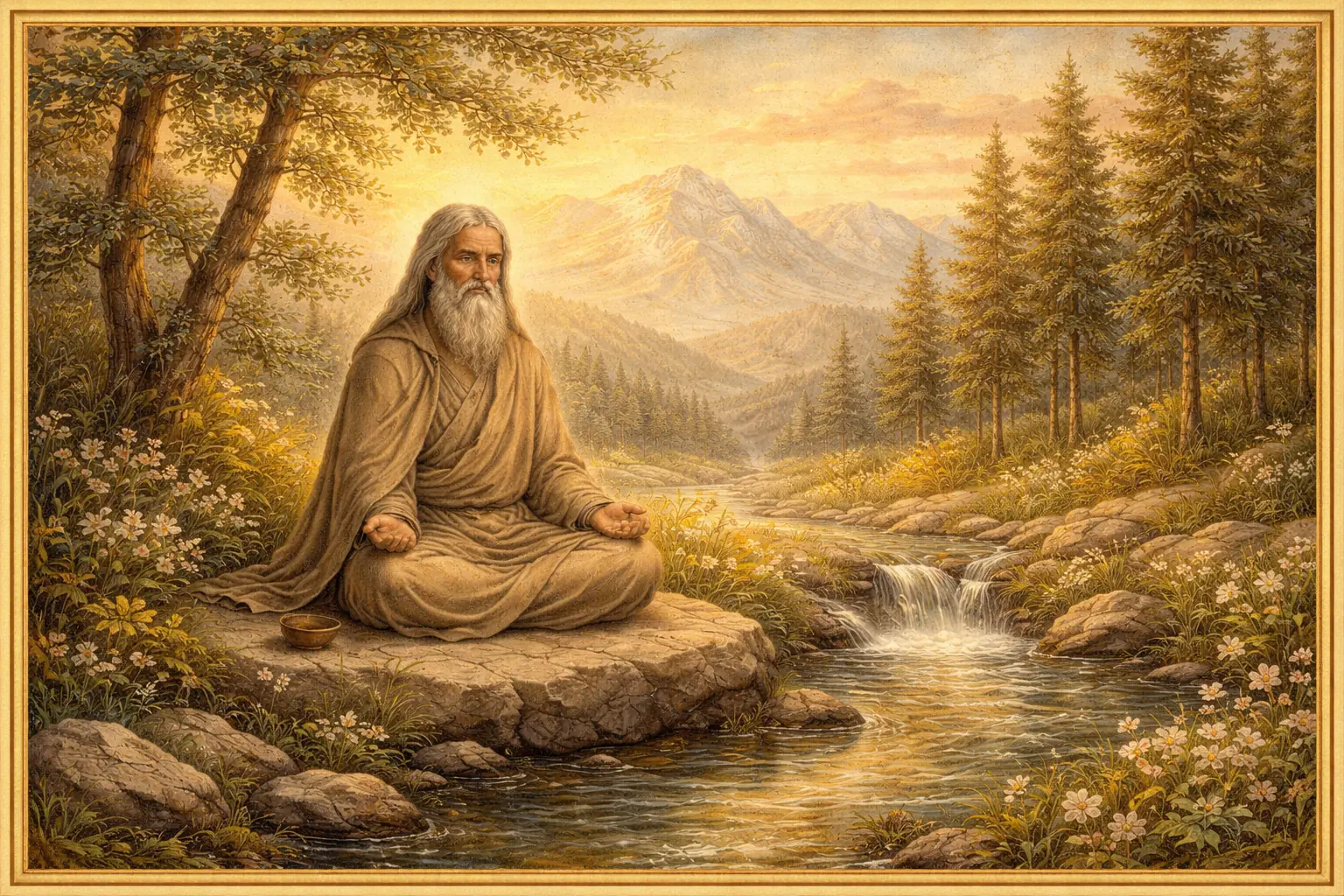
There are five analogies that can be used to describe the experience of the natural state.
The Sphere is vast, like infinite space;
Awareness is omnipotent, like the great earth;
The Mind is unshakable, like a mountain;
Self-realized awareness is clear and bright, like a lamp;
Crystal-clear consciousness is utterly lucid and free from all dualistic thoughts.
Metaphors and analogies make it possible to convey the feeling that arises as a result of proper contemplation. In the heart of your “Self” there is a vast space. As soon as you remember it, it begins to unfold. Your awareness possesses omnipotence, like the great earth. As soon as you remember it, this omnipotence comes forth. Deep within you, your awareness is utterly clear and bright; it is like a blazing torch, profound and intense. If you relax while maintaining vigilance, it comes to the fore. This awareness is utterly pure, like a crystal. If you remain in it for a long time, it is laid bare, manifests itself, and accompanies you in all your actions. To be in the natural state means always being aware of yourself as infinity, as space, and not allowing the mind to shrivel up.
Whether you are eating or drinking something, working in the kitchen or outdoors, communicating or sitting in meditation, never allow the mind to shrivel up, to contract to the size of the body, to the size of the small “I.”
To abide in the natural state means always feeling inner omnipotence. Never feel weak, helpless, or insignificant. This applies to the ego, but not to your Essence. Always be aware of your inner omnipotence.
To abide in presence means to be unshakable, like a mountain. If you are vigilant, you never lose your composure, even if the earth falls into the sky, even if the sun and the earth change places. Where do you draw the strength for such steadfastness? From awareness, which, like a mountain, cannot be moved.
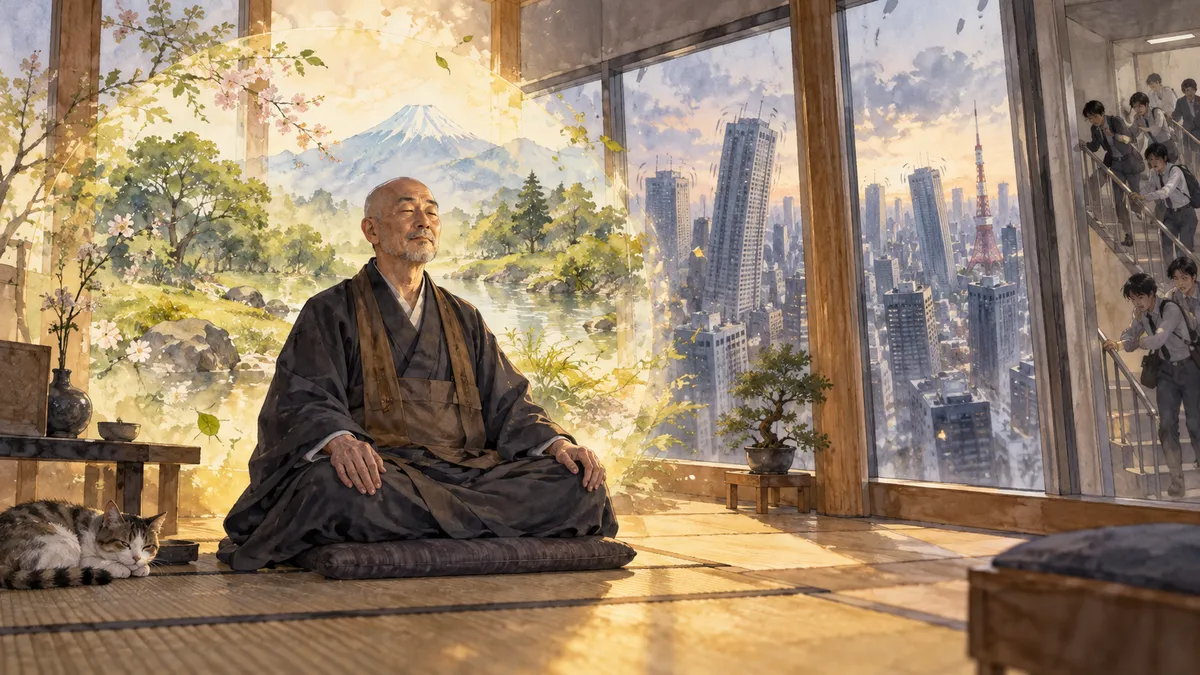
During an earthquake in Tokyo, a Zen master lived on the eightieth floor of a skyscraper. When the earthquake began, all the disciples quickly ran downstairs from the meditation hall; only he remained. No matter how much they called out to him, he said that everything was fine. When the earthquake ended and everyone came back upstairs, he was asked, “Why didn’t you run away with us?” He replied, “I ran away too, but to a safer place—to the nature of Mind.”
To abide in presence means to have clear and bright consciousness in which there is no dullness, lethargy, stupidity, numbness, obscurity, or ignorance. It is always bright, awakened, alert, intuitive consciousness. It is very alive, like a torch that blazes brightly and illuminates everything.
To abide in presence means to be in clear, thought-free, pure Being, which is like a transparent crystal. There are no impurities or cloudiness in it.
Whenever you begin any action, you must check yourself against these five analogies. Before doing anything, you should attune your mind with the help of these five analogies, and only then proceed. Why is this important? Because your actions will be erroneous, clouded, and lead to new karmas if you act from a different state of mind. But if you act from the proper state of consciousness, your actions will always be impeccable.
Additional Analogies for the Natural State
The experience of the natural state can also be described as follows:
Like a cloudless sky, the inner Sphere is boundless and free from all obstacles.
Even if you believe that you are not free and are limited, your inner Sphere is boundless and free from obstacles. Whenever you acknowledge this, allow it, and begin to feel it, you enter the natural state.
Like the surface of the ocean, the Mind is stable, unshakable, and free from dualistic thoughts.
Even if you are assailed by various dualistic thoughts and judgments, deep within consciousness the Mind is stable, like the mirror-smooth surface of a still lake. This fundamental state cannot be shaken by the movement of thoughts or emotions. It is important to refine perception sufficiently to recognize it. It is like an underlying current, an underwater stream that exists and is present in every action and movement.
A wise yogi is one who continuously tries to recognize it.
For example, when you do something without recognizing this flow, the action takes hold of you, and you become the doer.
For example, you meet someone, and they insult you. If you fail to recognize the flow, suffering and disharmony arise within you. If you manage to recognize this flow, you will see that it is playing through the person insulting you, that in fact the entire situation comes down to a play, while the person is merely a conduit for this play, which responds to your karma. Then everything is seen differently.

In the absolute sense, there are no men and women, friends and enemies, mothers and sons—all of this is the play of this flow. But in the relative dimension, things seem different to us, and then attachments and the suffering they cause arise.
If God had wanted us to be men and women, sons and mothers, He would have made it so forever. However, all of this is impermanent and like ripples on water. This means that all relationships are entirely illusory. Conversely, when we discover this flow, we become established in the absolute truth.
It is as if there were people around you, but some spirit had possessed them all, and they had become conduits for that spirit, which means they could not simply be trusted.
In the same way, if you understand this principle, you can see that the supreme Source, the absolute Spirit, has entered everyone, and that every person is, first and foremost, this Spirit. Then attachments and dualistic relationships become impossible.
Like a bright lamp on a windless night, consciousness is stable, clear, and radiant.
At the moment of recognizing this subtle flow from which all perceptions arise, you discover its clarity, radiance, and stability. You also discover that you leave this radiance, clarity, and stability of your own volition, due to the habit of distraction and the habit of the peripheral mind’s movement. This ill will is called asmita (forgetfulness of the Atman). Asmita causes consciousness to leap out and lose the flow, so this enemy (asmita) must be stopped.
To stop this enemy, one must remain continuously alert, present, and awake in every moment of action.
Four Levels of Self-Liberation
There are several levels of self-liberation.
At the first level, self-liberation is likened to striking a target. It is also said to resemble a snowflake falling into the ocean or the instantaneous recognition of a friend in a crowd. You instantly direct naked awareness toward the thoughts that arise, and then the thoughts begin to melt away. If you have naked awareness, thoughts self-liberate—this is the first level. It resembles snowflakes falling into a warm ocean; upon touching the ocean, the snowflakes melt. Naked awareness is the ocean, and thoughts are the snowflakes.

At the second level, self-liberation is likened to a snake freely uncoiling itself. This means that as soon as thoughts arise, they immediately liberate themselves. The habit of abiding in naked awareness has deepened, so you do not even need to look at the thoughts; thoughts instantly self-liberate the moment they arise. This is possible only when you abide correctly and continuously in natural contemplation.

What is the third level of self-liberation? It is called “a thief sneaking into an empty house.” This means that you have become so firmly established in empty presence that when thoughts arise, they find no support on which to settle. Finding no support, they disappear, just as a thief who enters an empty house leaves disappointed after finding nothing there. The thief is perception and thoughts, while the empty house is your consciousness.

Whoever masters these three levels of self-liberation uncovers the secret of contemplation.
Finally, at the fourth level, thoughts are inseparable from the natural state; they do not even need to self-liberate, since they are an expression of its play. They are like ornaments or a snake whose venomous fangs have been pulled out. This means that it makes no difference whether you think or not, whether you have emotions or not, whether you are in thought-free meditation or in motion. Why does it make no difference? Because the radiance of primordial awareness is never obscured.

One who knows the secret of the four stages of self-liberation is a true contemplative. And one who does not know it is, of course, a novice, a layman, an amateur. Such is the opinion of the saints.
Principles of Practicing the Natural State
In order to practice the natural state, keep both mind and body relaxed, but do so without excessive effort.
To practice true contemplation, you should enter such a flow of relaxed alertness. Then everything works out for you without your making any particular effort.
Creative people have a concept known as being “in the creative flow.” Everything goes brilliantly for them when they enter a special state on the verge of inspiration. This is possible only when you are in the right state of relaxation, when you do not cling too tightly to your goals, when you have attained emptiness in your heart and act from that emptiness.

If you collect donations while acting from this emptiness, you do not need to collect them; people will bring them to you of their own accord, and you need only be quick enough to hold out the donation box. Why? Because your inner emptiness, impeccably guided by intention, will transform the space around you; you need only listen to this emptiness and allow the body to move in the right direction.
I spoke with a Vaishnava who distributed books. He had intuitively grasped this principle and said that when you distribute more than three hundred books a day, it is no longer you who distributes them, but Krishna who distributes them through you.
It all depends on how fully you can remove yourself at the moment of action. If you remove yourself at the moment of action and allow the inner emptiness of the heart to manifest and act, then it is no longer you who acts, but this emptiness, and the result is excellent.
I knew a mataji who was also a devotee of Krishna. She always prayed like this: “Krishna, I do not distribute books; I am merely Your instrument. It is better that You distribute the books Yourself, while I simply surrender myself to You.”
This is the correct understanding of the principle of self-surrender.
In the same way, if you constantly think, “My body and ego are merely an instrument, while I continually surrender myself to the supreme Source and allow it to act through me,” then this inner emptiness will be laid bare and manifest through you, and therefore every action of yours will be perfect. You simply need not interfere with it, but guide it with great flexibility.
Casting aside all doubts and agitation, remain in equilibrium.
This is the next principle. Once you have learned to relax, you must abide in equilibrium. You must preserve the equilibrium of mind, breath, and body, never allowing minor or even major doubts to disturb it.
For example, when someone tries to sort out a conflict, we say: “First, bring your mind into equilibrium. If your mind is not in equilibrium, all of this will be pointless, because you do not see the situation clearly.” Is it impossible to resolve a conflict if the mind is not in equilibrium? Conversely, if the mind is in equilibrium, everything will resolve itself. There is no need even to sort anything out with anyone or about anything. Without knowing this secret, people will never find peace or harmony.
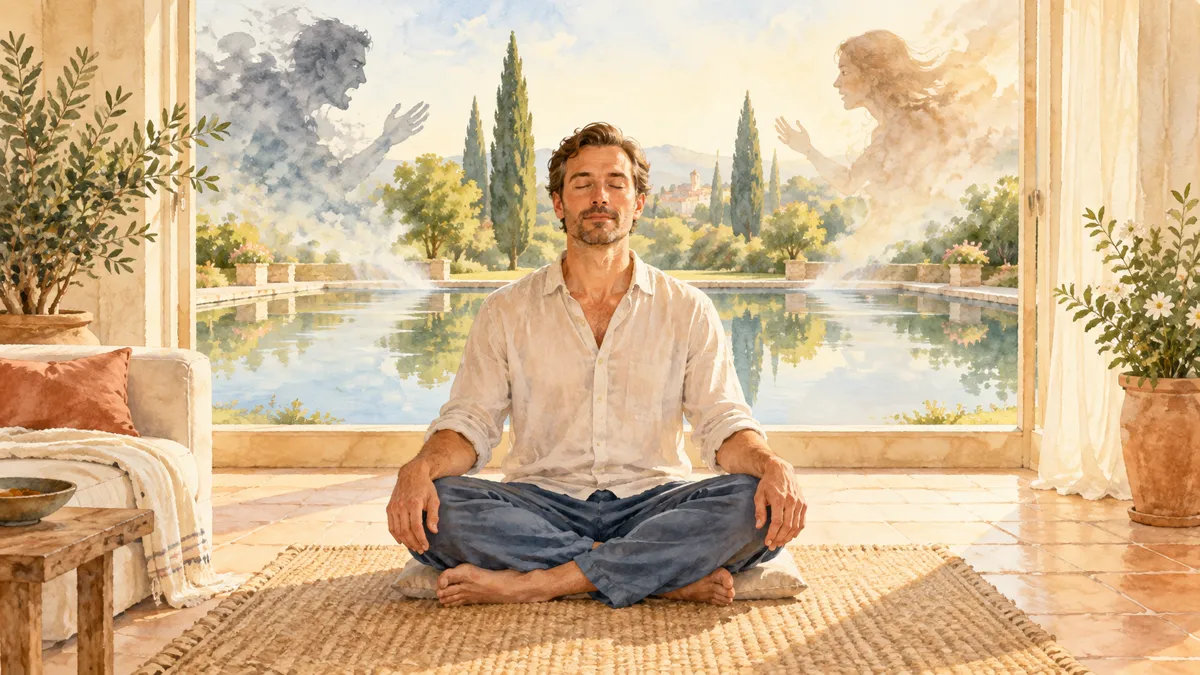
While practicing the natural state, identify everything you encounter with unborn emptiness and remain natural and relaxed.
Inner emptiness is in fact inseparable from outer emptiness. To identify with unborn emptiness means paying attention not to objects, but to the space in which they are suspended. If you pay attention to things and objects, you do not see the illuminating emptiness. If you pay attention to the space in which all objects are suspended, you are a mature practitioner.
The principle of space is present within all objects, both inside and outside; all objects have emerged from space and are suspended in it, as it were. Space is the foundation of everything. For example, to discover the space in this room, you do not need to do anything; you only need to remove the objects. The space has always been there, but we did not see it because of the clutter of objects. In principle, if you knew this secret, you could immediately understand that space is present here without removing the objects. In the same way, an accumulation of emotions, mental judgments, interpretations, and sensory perceptions clutters the space of our mind, which is both outside and inside. If you pay attention to the space in which all objects are suspended, you discover the primordial principle of awareness and are no longer deluded.

One could say that space is an essential characteristic of every object. In Laya Yoga, space is very important, since it is the subtlest tattva, the one closest to natural contemplation. It contains no maya, no material qualities.
To practice divine pride means to meditate on the sublimity of space.
To practice attunement to the descending force means to attune oneself to outer space and receive an impulse and inspiration from it.
To practice the sankalpa “Infinite Space” means to be aware of infinite space within and unite it with outer space.
To practice atma-vichara means to attune oneself to the sense of “I” (aham-vritti) and recognize the spaciousness and non-locality of this sense of “I.”
To practice shambhavi mudra means to gaze softly straight ahead while walking or sitting, attuning oneself to space.
To practice the sankalpa “Dream” means to see everything as an illusion, whose background is once again space.
To practice the unity of the inner and the outer, the sankalpa “Everything Is One with the Mind,” means to recognize that the inner and the outer are primordially one in space.
The Correct Understanding of Relaxation
Keeping the body relaxed does not mean completely abandoning all forms of activity. Actions should be performed smoothly, in a relaxed and spontaneous manner.
Relaxation does not mean laziness, tamas, or a lack of will. You can do many things extremely well. It means having space for inner spontaneity, not constraining your mind with goals, judgments, and past impressions, and performing actions that are woven, as it were, into a single thread of awareness. Then every movement, every action, becomes strung on a single thread. It is something like a pattern you are weaving, like a dance. Everything is one with contemplation.
Keeping the mind relaxed does not mean making it insensitive or dull. One should strive to enhance and refine its capacity for clear awareness.
Keeping the mind relaxed means finding spaciousness, spontaneity, and play within it, finding its unconstrained state and expressing it as ultimate flexibility in everyday life. This does not, of course, mean any kind of sluggish or frozen state.

For one who has attained self-awareness and is capable of maintaining this state, identifying everything with unborn emptiness means that one must now try to allow everything encountered externally and experienced internally to attain liberation in emptiness.
This is possible only if perception abides beyond thought, in the paradoxical, beyond the senses. Abiding beyond thought, you can operate with thoughts without being grasped by them; abiding in the paradoxical, you can engage with the ordinary without being colored by it. This can be done only when there is no effort on your part. Effort implies someone who makes it, but beyond thought and in the paradoxical there is no one who makes an effort. This means that you can identify everything with emptiness while abiding in the space of effortlessness. And then, even on the relative level, you will not identify with effort, since the body and the conceptual mind will be making the effort, while the primordial ground will remain free from all effort; it will be spontaneous and not constrained by plans or efforts.
These instructions are the quintessence, the distilled essence of all the sutras, tantras, and upadeshas. They are like a treasure. And even if you were to seek still more exalted teachings, you would never find them, because these instructions came from the mouths of the awakened ones. The question is how fully you can understand and apply them.
