I hope that those present here are precisely those who are interested in the teaching of Laya Yoga, who feel respect for this teaching and consider it the greatest treasure leading to liberation. I am counting precisely on an audience that is interested in receiving this teaching. I myself take the process of learning and the teaching of Laya Yoga itself very seriously. I consider it the work of my entire life, and even of many lives, and I treat the saints—the founders of our tradition—as well as the very principle of learning with the greatest reverence and awe.
When we listen to the teaching, when we enter into the teaching, this is a very important and significant process for us. In my view, this process is far more important than many so-called secular or worldly processes, because it is something non-human, apaurusheya—something that surpasses worldly, ordinary existence, something that gives us the highest meaning, the highest values, and leads us to the higher worlds, from death to eternal life.
When we come into contact with a teaching of the apaurusheya (non-human) category, it is very important to understand that a teaching given from the world of gods, rishis, and siddhas requires the highest respect and reverence toward it. Our destiny depends precisely on how we are able to establish a connection with the spiritual teaching, with those who transmit it, and how we manage to integrate it into our own life. And our destiny, our life, is something very precious to us. Therefore, when we come into contact with the teaching, the best way to establish a harmonious and positive connection with it is to approach it with complete awareness, responsibility, and reverence. This is the only correct way to establish a spiritual connection.
Such a spiritual connection is traditionally called “samaya” in the teachings. Outside samaya, the tantric teaching is not transmitted. In other words, even if such a teaching is transmitted as a set of psychotechniques, it will bring no benefit in the absence of a samaya connection. On the contrary, when a disciple understands what the principle of samaya is and comprehends the teaching, he receives the greatest benefit from it even within a single lifetime.
As I have already said, I consider the teaching of Laya Yoga extremely important for myself, incredibly profound, incomprehensible, and inspiring delight and admiration. By dedicating my life to the teaching of Laya Yoga, I have brought into my life something very precious and transcendent. I am certain that anyone who comes into contact with this teaching can also acquire something very vast and precious, something that will help him free himself from his own limitations and transcend life and death.
Seminar Contents
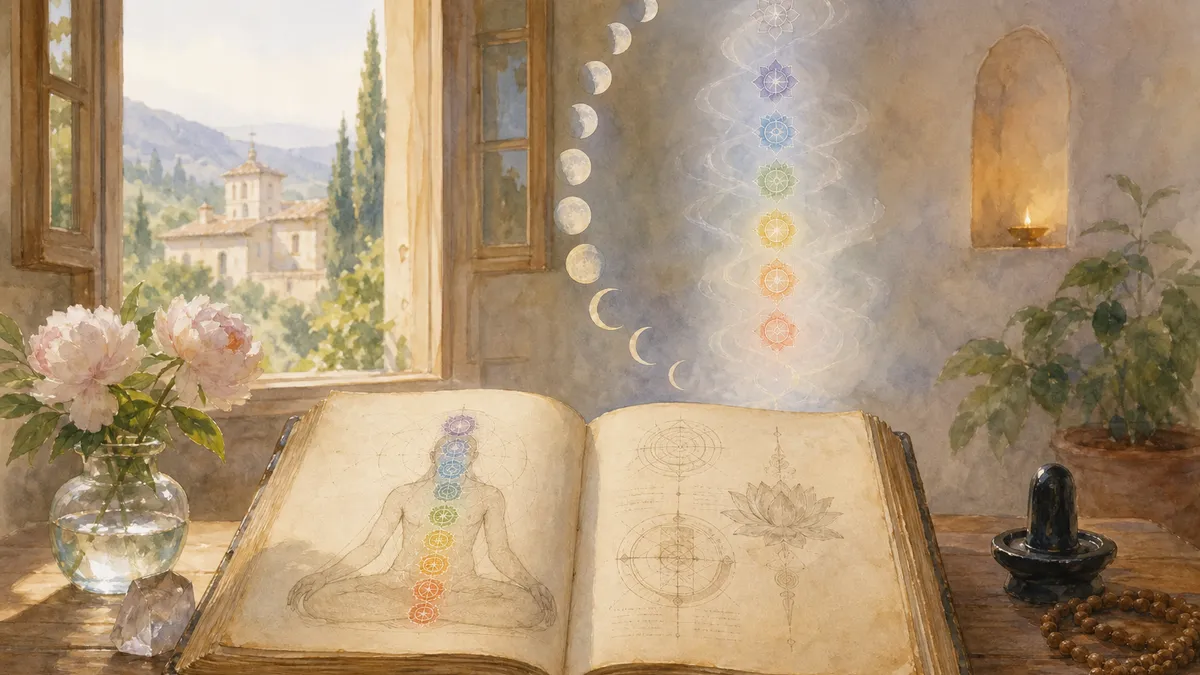
So, two teachings will be transmitted at this seminar. The first is the teaching on the sixteen stages of the waxing of the moon of inner awareness, on the stages along the path of inner contemplation. The second is the teaching of Shat-Chakra Yoga, based on the teaching of Tattva Vidya set forth in the “Shiva Svarodaya,” and the teaching on the six chakras set forth in the texts “Goraksha Shataka,” “Shat Chakra Nirupana,” “Gheranda Samhita,” “Hatha Yoga Pradipika,” and others. These are very important teachings that will allow you to look at spiritual practice in a new way, even if you have been practicing the teaching of Laya Yoga only for some time.
But before we begin presenting these teachings, we can talk about certain fundamental approaches, about how the teaching interprets human life.
The Human Being as a Fallen Divine Being
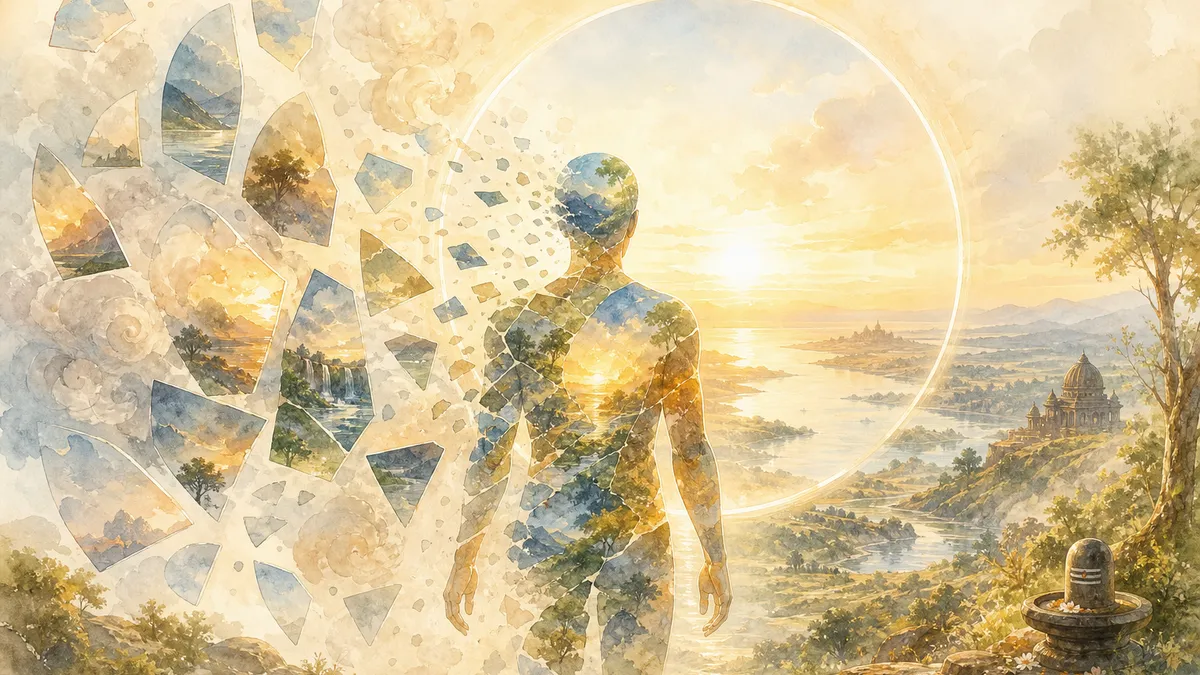
From the point of view of virtually all religions, especially Christianity, the human being is a fallen being. From the point of view of the teaching of yoga, the teaching of tantra, the human being is also a fallen being, but not because he is sinful; on the contrary, because he is divine. Precisely because we are divine by our nature, we can state that now, in our present state, we are fallen—that is, we have fallen. In other words, a very exalted state is inherent in us from the beginning, but we have lost this exalted state.
If you analyze the texts of the ancient Vedic civilization, you can learn that the ancient Aryans, our ancestors who lived in the territory of the north of present-day Russia 5, 10, or 15 thousand years ago, possessed a tremendously high culture and the highest technological achievements. It was a divine civilization, a race of gods. The level described in such texts as the “Ramayana” and the “Mahabharata” is merely the remaining glimmers of the greatness of the mighty civilization of our ancestors.
But at present, the human being is a creature abiding in ignorance. Why did this ignorance arise? The point is that an error (bhranti) crept into human life. This error is connected with the fact that a person’s higher states of consciousness were as if switched off, and his subtle bodies ceased to function. Such higher states of consciousness are called buddhi (intuitive consciousness) and Atman (the higher “Self”). As a result of the error that crept in (bhranti), the human being lost his wholeness (prabandha) and plunged into ignorance (avidya).
Ignorance means identification with one’s physical body, the habit of considering oneself to be the physical body, matter. He shifted onto a materialistic platform. All the mystery, all the magic of life, everything sacred and holy was gradually emptied out of his life. And in this way our civilization lost its spirituality and shifted its emphasis to the cult of consuming materialistic values. The entire civilization is enchanted by the cult of consuming materialistic values. I am not saying that this is bad, but it is not enough. If we reduce our life only to self-sufficiency, to the cult of consuming materialistic values, and there is nothing holy, magical, or sacred in our life, such a civilization is at the very least spiritually poor; moreover, it is wretched. The only way to restore such wholeness (prabandha) is to begin engaging in spiritual practice.
Subtle Bodies and Modern Science
For example, in modern academic science the concept of the subtle body is completely absent. When modern scientists hear about subtle energies and the subtle body, they state that these energies cannot be measured, seen, and so on. But one can object to this by saying that before the twentieth century, the electron, atom, proton, neutron, and radiation also could not be seen or measured. The inability to measure, see, or detect the subtle body, the inner energies, merely means that modern science does not have sufficient technologies, and its instruments do not possess the proper sensitivity to measure such phenomena as the astral body, the energy body—what is called the soul. Nevertheless, in ancient yogic texts this is postulated as the most indisputable fact. And when we acknowledge the presence of subtle bodies within us, we come to the conclusion that we will be able to acquire deeper vision and restore prabandha (wholeness) if we purify our subtle bodies.
Usually in tantra it is considered desirable to give examples accessible to mass consciousness when expounding the teaching. Buddha Shakyamuni gave examples connected with a cart and a horse, but a city dweller sees a horse and cart very rarely, and therefore such an example is ineffective for him. So I will give another example.
The human body can be likened to a mobile phone handset in which the “life” service has been connected for a certain time. Mobile network operators can be likened to gods, powerful higher energies that govern reincarnation. We live in this body only as long as the “life” service is connected, but when our supply of energy or merit is exhausted, nothing will help renew this service. If we look from this point of view, we will see that mobile communication itself is based not on the handset, but on subtler energies, on radio waves, which are invisible; nevertheless, they are precisely what is most important. In the same way, the human body is only a carrier of information, while the most important element of human consciousness, that which determines destiny, is contained in subtle energies. And our entire destiny and life depend on the extent to which we master these subtle energies and purify them.
The Difference Between Humans and Gods
Unlike the gods, a human being is a mortal creature; he is limited in space, time, energy, and knowledge. The gods are immortal; the gods can move freely in time, into the past or into the future; for them there are no limitations of space, and they are also free in terms of energy. The gods are extremely free beings, although they have different levels. The gods are authoritative and volitional operators in the universe. In other words, they are not passive extras, not weak-willed toys handed over to the power of karmic forces, physical laws, and constants existing in the universe. They themselves can manipulate these constants and change them as they like.
Why are the gods so powerful, unlike human beings? All their power lies in their understanding of the principles of subtle energies, which are unknown to the ordinary person. The gods are immortal because they are able to control subtle energies and the elements of their bodies for as long as they wish, drawing energy from the Source. But if we look at the human being, we will see that the biochemistry of the physical body is beyond his control. It is something far too complex, despite all the attempts of scientists to decipher the human genome and manipulate genes.
In the same way, time is something that surpasses the human being, something very complex. A human being not only cannot control time, but cannot even properly comprehend what time is. We can say the same about space. In other words, in his ordinary state, the human being has no command over the fundamental physical laws and constants of this world, the elements, time, space, and energies. In reality, the human being is a highly dependent, vulnerable, and limited creature. A slight change in the level of radiation, the general temperature, or the activity of the sun can greatly affect human life in particular and civilization as a whole. This happens because the level of operation available to the human being is low.
It is said that the human being perceives the world as cut off from the whole. This state is called vikalpa. Vikalpa is a conceptual, dissected, and fragmented vision of the world. For example, when we become strongly attached to something and thoughts about it arise in us, we lose our wholeness (bhranti) — this is precisely the influence of vikalpa. The only way to regain one’s wholeness and rise from the level of a mortal to the level of a deity is to radically change one’s perception of the world by obtaining certain mystical experiences.
Three Levels of Experience
It is believed that experiences exist on three levels: external, internal, and secret.
We usually perceive external experience when we live in everyday life.
Internal experience may be accessible to those who possess supersensory perception and extrasensory abilities. Internal experience is connected with the experience of the astral body. If your energy is sufficiently pure, you practice yoga, and you have no leaks, you can experience the subtle body leaving the physical body — this is a fact. You can quite often experience the separation of the soul from the body, a transpersonal, out-of-body experience. Out-of-body experiences are now of great interest to transpersonal psychologists. This branch of psychology has finally even been recognized in the scientific community at the international level.
The secret level is connected with the experience of pure consciousness, space, and emptiness. It is connected with the experience of the nature of our consciousness, the mind as such. If in internal experience we experience mainly the astral body and the state of sleep with dreams, then in experiences of the secret level we experience dreamless sleep and the state of the causal body, which is called karana-sharira.
The restoration of our wholeness and the return to the state of a deity, to unity with the Absolute, consists primarily not in experiencing external materialistic experiences, but in experiencing internal and secret experiences.
The Foundations of Tattva-Vidya and the Five Elements
Thus, the teaching of shat-chakra yoga is based on the principles of the Vedic science of tattva-vidya. Tattva-vidya says that we possess five elements, and that the ignorance which has crept into our life, bhranti (error), and which led to the fall of the human being from the level of a deity, is mainly connected with the identification of consciousness with these five elements.
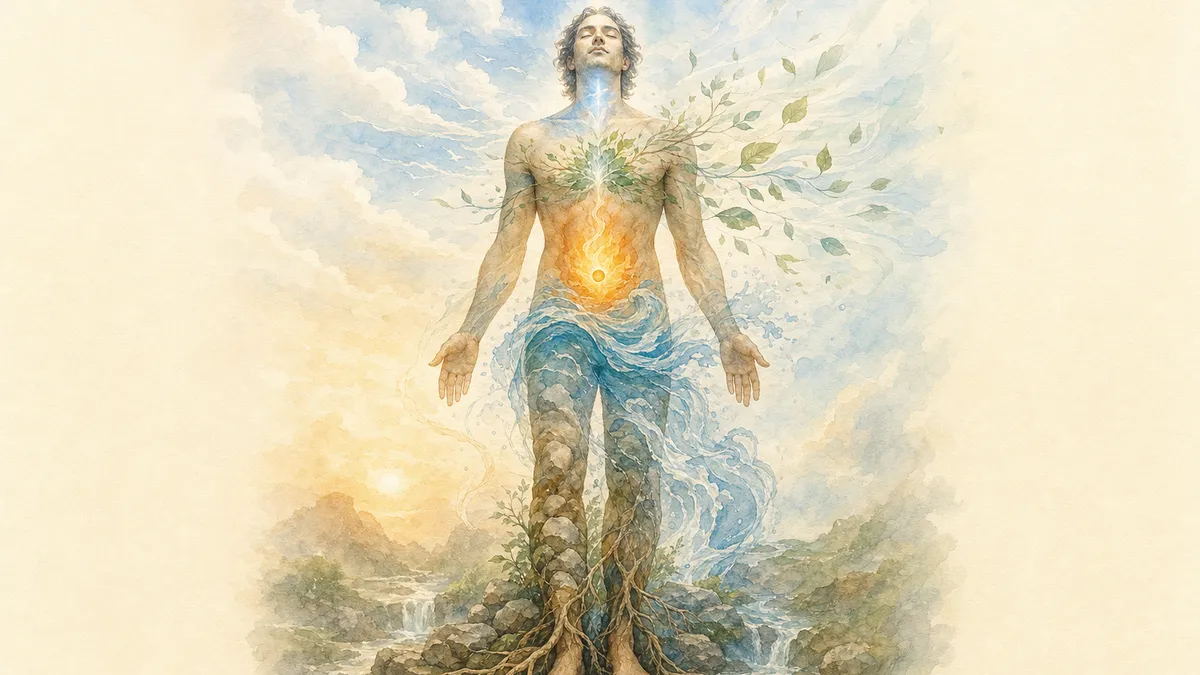
The five elements are the five fundamental energies of which our body consists. They are as follows:
- the earth element (located in the human body from the soles of the feet to the knees);
- the water element (located from the knees to the sexual organs);
- the fire element (located in the area of the navel);
- the air element (located in the area of the lungs and heart);
- the space element (located in the area of the throat and head).
Understanding the five elements that make up our body and energy is very important for us in spiritual practice. Often, when a yogi meditates, various experiences may arise, and he does not understand why these experiences occur. For example, he does not understand why a month ago he had an excellent meditative state, but now it has disappeared, and instead drowsiness and dullness have arisen. Or he does not understand why a year ago he could sit in retreat for a long time, but now a time has come when this has become difficult for him. Why sometimes there is lightness and joy, sometimes detachment, and sometimes, on the contrary, a desire to act. The fact is that we are completely dependent on the elements that compose us. And since the elements act cyclically, our state also changes periodically. To understand how these elements work and to learn to control them means to understand one’s subtle energetic structure.
The Five Pranas and Their Characteristics
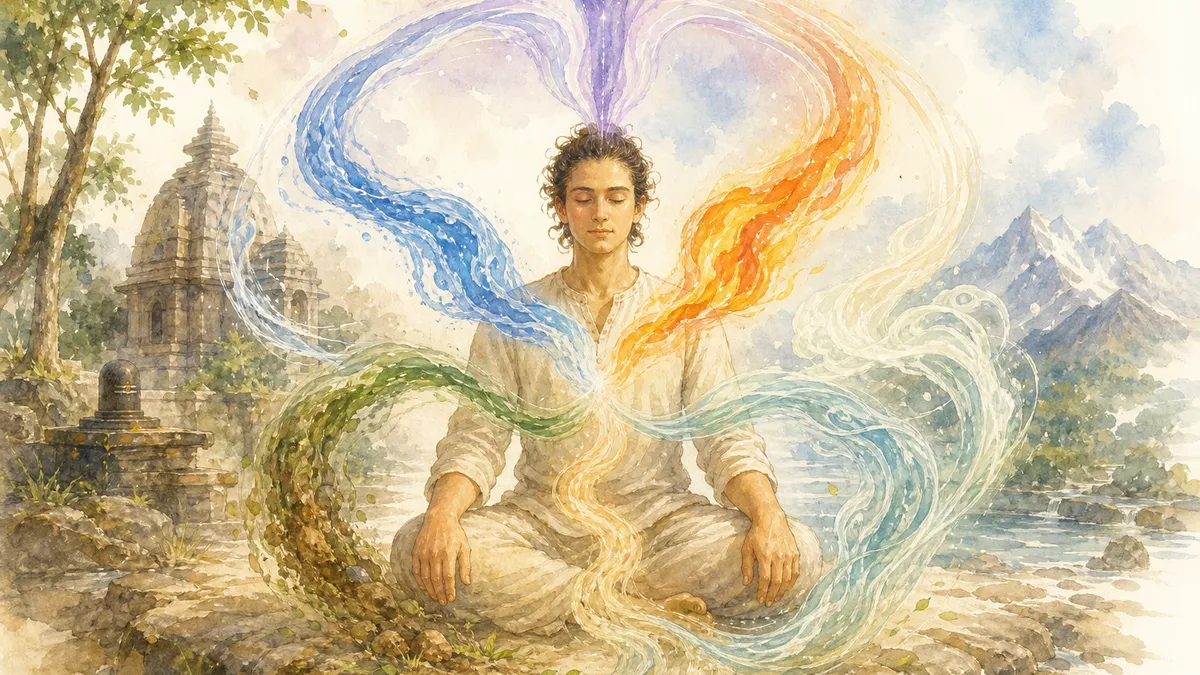
So, within our body there are five main pranas (prana means energy). These pranas are connected with the five elements.
The prana of earth is yellow in color. It is associated with a feeling of heaviness in the body.
If you have read the biography of the Brahmin Saraha, who was recognized as a saint both in Buddhist tantra and in the Hindu tradition, it describes the trial he underwent at the hands of the king, when the king did not believe in Saraha’s spiritual realization. And during this trial, Saraha demonstrated a super-heavy state of the body. When he was placed on scales, no matter how many weights were put on the other side, they could not outweigh Saraha’s state, because he was using precisely the power of the prana of earth. If one masters the prana of earth, one can change the heaviness of one’s body at will.
The prana of water is white in color. It gives a feeling of coolness in the body.
Many who have experienced encounters with the spirits of the dead or with ghosts say that they emanate cold. This is indeed so, because the svadhisthana chakra, the element of water, is connected with the astral world, where the souls of the dead dwell.
The prana of fire is red in color. It gives a feeling of heat in the body.
The prana of the element of wind is green in color. It gives a feeling of lightness.
The prana of the element of space may be colorless, blue, or gray, depending on the situation. It gives a feeling of clarity, subtlety, and transparency of consciousness.
Thus, when visions arise during meditation or you see various colors, these are most likely experiences of the pranas. Pranas are the expression of the elements. And it is usually said that the elements can be either in balance, in excess, in deficiency, or in perfection. A person actually lives only as long as his elements remain in balance, as long as they are balanced. If a person falls ill, it means that his five elements are losing balance and leaving a harmonious state. And when a person dies, that is, leaves the body, it indicates that his five elements in the body have become completely unbalanced and have broken down.
Elements in the Physical Body
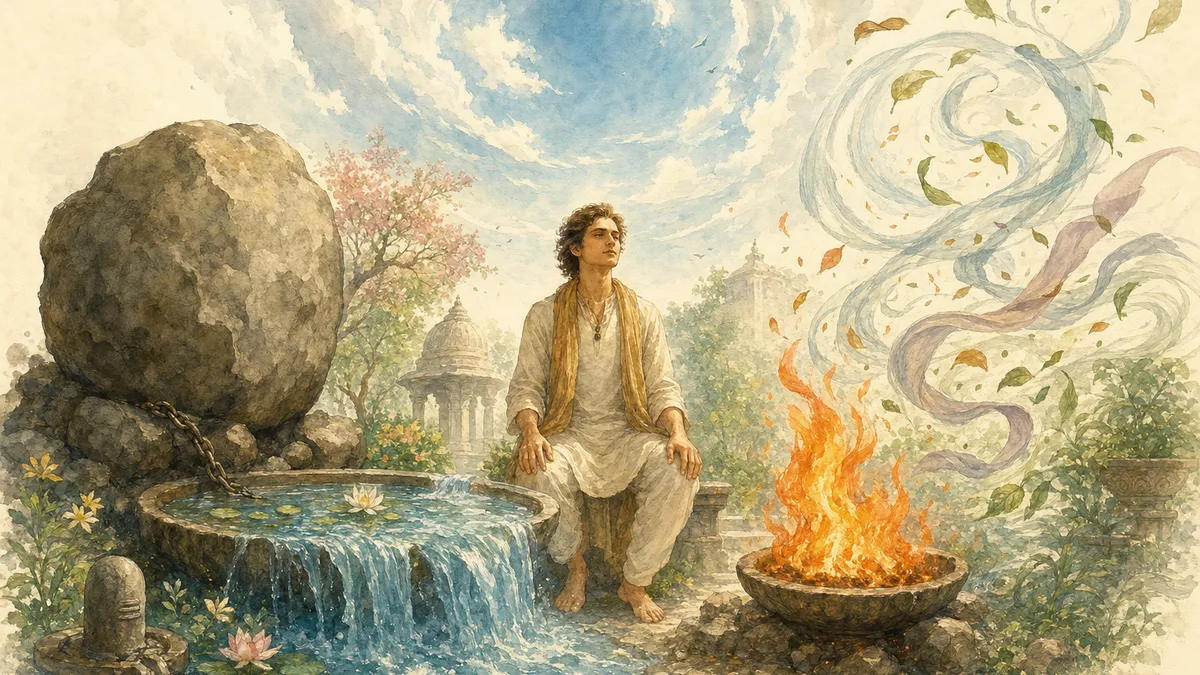
In the human world, our physical body consists mainly of the elements of water and earth. These are two elements that are very important for our life. Of course, the elements of fire, wind, and space are also present in our body.
The element of earth in our body is all the solid parts: bones, muscle tissues.
The element of water is the fluids inside our body: blood, lymph, urine, semen, internal secretions.
The element of fire is digestion, the digestive fire that you feel while eating food.
The element of wind is the energy that circulates through the channels and meridians when you feel it during yoga practice and pranayama.
Finally, the element of space is the various cavities and voids within the body and within the tissues.
Depending on which element predominates, which element is in excess or in deficiency, we feel one way or another.
You probably know that certain nations have particular character traits. For example, some peoples are traditionally considered “hot” by nature. Others are said to have a “broad soul.” Still other nations have an element of a certain frozen quality, sluggishness. National characteristics in traits of character are connected with the predominance of certain elements in one locality or another, which determines the state of the elements within the body.
The Influence of an Excess of Elements on a Person’s Condition
What does a person feel when they have an excessive state of certain elements?
If the earth element dominates, a person sleeps deeply, has a feeling of heaviness in the body, and has few conscious dreams or none at all. Breathing with the earth element may also be heavy. A person with a predominance of the earth element is, as a rule, a dogmatic traditionalist who firmly clings to established foundations.
If there is an excess of the water element, the mind may be clear, but the person often sweats and urinates, that is, goes to the toilet. Such a person tends to get along with people easily; he is quite flexible, but he has a tendency to drift with the waves, to remain in a relaxed consciousness, as if becoming diffuse.
If there is an excess of the fire element in the body, a person may feel heat and often experience thirst. The mind at this time is alert, but restless, even somewhat aggressive. It may even be visible how radiance emanates from such a person.
It is believed that when any element predominates, a person may encounter obstacles. But if all the elements are harmonious and balanced, then no obstacles arise.
If a person has an excess of the air element, he is fussy and constantly strives to do something. His body feels light, but he constantly feels excited, which makes it difficult for him to sit still in one place. In life he is guided by the following philosophy: “The grass is greener where we are not.” He can never calm down—this is a sign of an excess of the wind element. Such a person hates all restrictions and rules, and therefore tries in every way to destroy them, not understanding that sometimes they can be useful.
If the space element dominates in a person, his mind is open and clear, and he has few desires. But if he has an excess of the space element, it is said that such a person has no roots, nothing to cling to, nothing to hold on to. He has no stability either in ideals or in goals. He is, as it were, completely not of this world.
Favorable Periods for Various Actions
It is believed that when the earth element dominates, it is good to engage in long-term affairs and plans. At a time when the water element dominates, relationships and current affairs will be successful (for example, small transactions and the like). The time when the fire element dominates is suitable for generating new ideas and developing certain creative plans. The time when the air element dominates is suitable for dynamic, active actions, including military actions. The time when the space element dominates is favorable for meditation, contemplation, detachment from the worldly, immersion in oneself, and samadhi.
But in general, the dominance of any one element is not normal. As a rule, a yogin strives to learn to control his elements in such a way as to strengthen or harmonize one element or another at will. Mastery of the tattvas, that is, the elements, is the very principle of the teaching called tattva-vidya, that is, the teaching about the elements.
Dreams and the Elements
When a person has an excess of the earth element, he may see himself as if he is pressed down by a mountain or buried under earth. This sometimes happens if a yogin practices kundalini yoga and his muladhara chakra is strongly activated.
If a person has an excess of the water element (for example, as a result of concentration on the svadhisthana chakra), he may have dreams in which he sees seas, oceans, lakes, or pouring rain.
If a person has an excess of the fire element, he may see a huge, raging flame, fires, a burning forest, or an enormous wall of fire.
If a person has an excess of the air element, he may have visions in which he flies, hovers in space, glides above the earth as if on ice, or rides on horseback, or runs.
All such dreams are significant experiences indicating the activation of certain elements.
Visions in Meditation
Also, during meditation you may have various experiences, especially during breath retention, in kundalini yoga.
When you work with the earth element and it is activated, you may see something smoky rising from the level of the tailbone. Of course, you do not see this with your eyes, but with spiritual vision, since these things pertain to the subtle body.
If the water element is activated in you, you may see a subtle shimmering or trembling, similar to mirages.
If you have an excess of the fire element, you may see something like sparks or fireflies within your consciousness.
If you have an excess of the wind element, you may see a light similar to the flame of an oil lamp, which may spontaneously arise in the center of the chest.
Finally, if you have an excess of the space element, you may see something like the expanse of a clear sky with no clouds.
All of these are inner experiences that may arise during meditation and pranayama.
Speech and the Elements
Speech, through which we communicate, is connected with the five elements. Depending on which element predominates in a person, their speech may be expressed in one way or another.
It is believed that when a person enters a trance and their earth state is activated, glossolalia may spontaneously begin in them—what is called “speaking in other tongues.”
If the water element is active in a person, then at that time they may speak in the style of sandhya-bhashya (this is also called the language of the dakinis), that is, their language becomes very figurative and poetic. For example, the text “The Master’s Codex” was written by me in approximately such a language. It is the language of energy connected with the water element. This is the language in which dakinis—powerful deities who practice the teaching of tantra—express themselves.
If the fire element predominates in a person, teachings that they have never received before may spontaneously arise in the stream of their consciousness, because their astral body is activated.
If the air element predominates in a person, their speech may be a spontaneous expression of the words of the Dharma. For example, a person once came to me whose speech simply “flowed” without stopping. He quoted tantras, sutras, and verses from memory and considered himself to have attained the highest realization. I asked him:
“Could you express the state of the Dharma without words?”
He thought for a moment and said:
“Only when I speak am I in this state.”
I thought that, most likely, it was precisely an excess of the wind element that was affecting his speech in this way. And the element of space and subtler states, such as the element of consciousness, were not yet accessible to him.
Finally, if the space element, or akasha-tattva, is activated in a person, their speech is connected with the higher teachings of yoga, in particular laya yoga or anuttara tantra. It is capable of synthesizing, seeing in the world, and manifesting the very essence. A person in whom the space element, the vishuddha chakra, is active is very inclined to speak not about particulars, but about what is most important: the natural state, the Absolute, the global, the most essential. For example, I very much love giving lectures on presence—this is connected with the fact that I often experience the element of space.
Finally, if the element of consciousness, the mahatattva, which transcends the five elements, is activated in a person, their speech will be connected with crazy wisdom, with nonconceptual self-liberation. Their speech will not be speech, but paradoxes. For example, earlier I felt a great need to communicate precisely in this way, feeling that no other means of self-expression were an adequate expression of my own state. One could say that this is more of a Zen style.
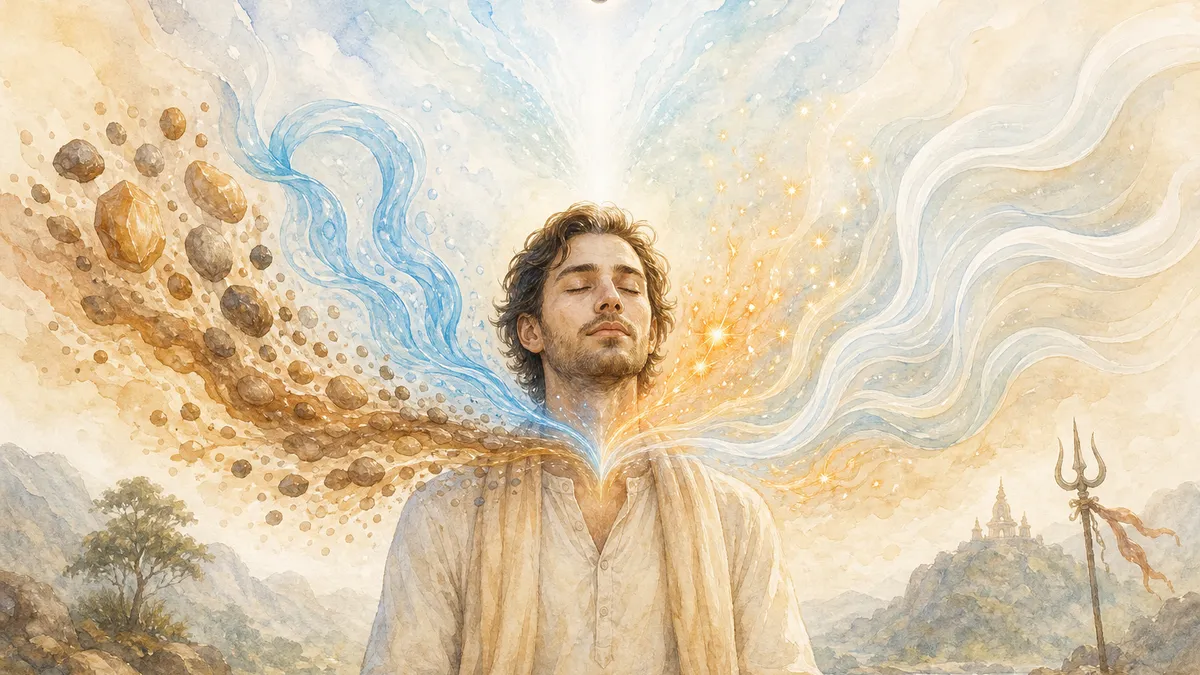
All of this ultimately depends on which tattvas (elements) predominate in our consciousness.
Experiences in the Mind
If the earth element is active in a person, they experience apathy. It sometimes happens that a person has no enthusiasm, feels discouraged, and has such drowsiness, cloudiness, and lack of inspiration. This is most likely connected with the fact that, due to circumstances, astrology, or the surrounding environment, the earth element predominates in them; they are, as it were, currently at the level of earth, prithivi-tattva.
If a person has such a flowing, peaceful, flexible consciousness, then most likely the water element is currently predominant in them.
If a person has enthusiasm, sometimes even turning into aggressiveness, this indicates the dominance of the fire element.
When a person feels emptiness, all-embracingness, and all-pervasiveness, these are signs that air is active.
Finally, when a person feels detachment, clarity, emptiness, and nonconceptuality, the space element predominates in their body.
Thus, all of us, as living beings, are entirely dependent on which tattvas (elements) fill us at a given moment. In the course of spiritual practice, the yogin strives to bring the elements under control so that they do not dictate how he should feel, but so that he himself, by managing the elements, can manage his own state. Our environment, destiny, success in life, relationships with others, and, of course, our capacity for spiritual practice depend on which elements dominate in our stream of consciousness. For example, if the element of air is agitated in you, then no matter what you do, your attempts to sit in retreat will be unsuccessful; your mind will simply dart aimlessly from one thing to another.
Subjugation of the Elements
What happens when a yogin, practicing shat-chakra yoga and working with the tattvas, subjugates the elements?
For example, when the earth element is somewhat pacified, the body can sit motionless. The yogin can sit as long as he wishes without changing posture; his body can remain in a seated position for a very long time. This happens when the earth element is subjugated and the prana of earth can enter the central channel (sushumna). This is achieved mainly through concentration on the muladhara chakra. And, of course, gross desires (for example, anger, aggression) are under a person’s control if he has subjugated the earth element.
If a person subjugates the water element, at the very least sexual desire leaves him. He understands the subtle interaction of prana during sex and knows how not to waste this prana through ejaculation, so as not to lose the precious substrate of life, and how to preserve it and direct it inward, spreading it throughout the whole body. Essentially, all Taoist teachings on the sublimation of sexual energy are connected precisely with mastering and controlling the water element. Then the yogin’s face becomes as if slightly lustrous. It is also believed that a yogin who has mastered the water element does not sink in water when swimming. For example, during the time of the Inquisition there existed a peculiar “witch test,” in which they checked whether a woman accused of witchcraft would sink in water. It was believed that if she did not sink, she was definitely a witch. But this, for example, could simply have been a consequence of the activity of the water element.
If a person has subjugated the fire element, he may have many visions and experiences in meditation, and possess siddhis, such as clairvoyance. The ability to travel astrally is also connected with the subjugation of the fire element. Such a person can very easily leave his physical body through the manipura chakra in the navel and travel over great distances.
If the air element is active, a person feels lightness throughout the whole body, and complete subjugation of this element gives the siddhi of levitation or bhuchari siddhi (the ability to jump while sitting in the lotus posture). For example, if you practice pranayama well, you will feel extraordinary lightness in the body, because your anahata chakra will constantly activate the flow of wind that gives this sensation.
If the space element is subjugated, then a person can manifest his illusory forms. For example, while being in one place, he can create a phantom image, a hologram of his form, which can be seen by others.
Imbalance of the Elements
What happens when the balance of the elements is disturbed?
When this happens, it means that an element is manifesting uncontrollably in a person’s body. Most diseases are connected precisely with an imbalance of the elements. If a person learned to harmonize and balance his own elements, he would never need to go to doctors or take pills. An imbalance of the elements generally occurs for several reasons.
First, because of an improper way of life.
Second, if a person lives in a place where the surroundings and ecology themselves, as it were, provoke an imbalance of the elements. For example, if a person lives in a very restless information environment, it can be said with certainty that he will have an excess of the wind element and a lack of rootedness, that is, a deficiency of the earth and water elements.
The third reason why the elements may be imbalanced is the influence of spirits from the astral world, karmic creditors. Often a person falls ill for no apparent reason, not understanding why, and even if he tries to undergo treatment, it brings no results. Then doctors attribute everything to psychosomatics. In reality, psychosomatics is only the external expression of certain subtle astral currents, while a person may simply be receiving obstacles from astral beings, karmic creditors with whom he has disharmonious relationships.
Finally, the fourth reason why a person’s elements may be imbalanced is simply a certain karmic period, a time when the elements manifest harshly. In other words, it is the influence of the planets, and so on. In general, it is believed that astrology describes a person’s dependence on the five elements on the basis of planetary influences, and that the planets themselves are merely symbols of the five primary elements, the five fundamental elements. And when a person does not control his five elements, he is strongly dependent on astrological periods. It can be said that the influence of the planets associated with the elements can very strongly change his destiny. But if a person engages in spiritual practice and rises above the five elements, becoming rooted through contemplation in the element of space and in the element of consciousness, then the influence of the five elements gradually decreases; therefore, a yogin abiding in the natural state is almost independent of the manifestation of the five elements. In other words, any planetary alignment will be favorable for him, because he lives not at the level of earth, water, fire, and wind, but at the level of pure consciousness.
Pure consciousness is also called the sixth element, mahatattva, that is, the great element. And the task of laya yoga is to surpass these five elements (earth, water, fire, air, space) and become established in the state of the sixth (consciousness), in the state of mahatattva. It is mahatattva, the great element, that gives a person freedom over time, space, causality, karma, physical laws and constants, and also, of course, over birth and death.
Harsh Manifestations of the Elements
What happens when a person falls ill because the elements manifest in a harsh way?
When the element of earth manifests harshly, a person experiences lethargy, drowsiness, and clouded consciousness.
When the element of water manifests in a harsh way, a person’s body may feel cold, he may tremble or experience fear and depression. A very strongly depressed state, when a person even feels like bursting into tears, is precisely the result of a harsh manifestation of the element of water.
If fire manifests in a harsh way, dizziness occurs and there is a sensation as if the entire body is engulfed in fire, blazing from within; pain in the joints and nausea are felt. As a rule, this happens to inexperienced yogins who overdo pranayama and kundalini yoga. Lacking the ability to control the elements and practicing a great deal of pranayama, they strengthen the element of fire, and then it may cause them certain difficulties. At this time, the yogin should practice in such a way that the element of fire is balanced.
When the element of air predominates in a person, he constantly wants to move, and he is very irritated or anxious. His body may also itch.
Finally, if the element of space dominates, the body may feel cool or cold. A person may see flickering or mirages roughly at eye level.
All these are various experiences connected with the gross manifestations of the five elements. But there is a way to harmonize the elements and attain perfection in the experience of the elements.
Perfection of the Elements
That is, the elements may be not only in disharmony or in their harsh aspects, but, on the contrary, they may be in harmony and in a state of perfection. Whether our elements will be in harmony or in a state of perfection depends on how successfully we practice shat-chakra yoga and meditation on the elements. When a yogin practices diligently, concentrating on the muladhara chakra, his element of earth becomes perfect. For example, he always has robust health, he feels a powerful flow of energy coming from the coccyx and spreading throughout the entire body, and he never falls ill.
Once I meditated in November while sitting in a river up to my chest. The water was icy, and I spent about two hours in such meditation. However, I did not feel any problems because of it, because I was concentrating on the muladhara chakra, as a result of which the energy circulated through the physical body as usual.
If a yogin brings his earth element to perfection, then the earth element in his body manifests as the wisdom of equality, a yellow-colored space. Our elements are a kind of spatial portals for entering an entire world consisting of that element. For example, one of my students in retreat concentrated on the earth element, and afterward he had a dream in which he perceived a huge city resembling a square. This city was yellow in color. It was the mandala of the earth element, or prithivi-tattva; that is, this is how the earth element manifested in his subconscious through concentration.
Thus, if a yogin perfectly masters meditation on the earth element, his energy connected with the physical body is under control, and at the very least he attains strong health, while at the very most he attains an unshakable state of contemplative presence called “great equality,” mahasamarasya. Great equality means that the yogin’s mind is so deep and stable that all dual pairs of opposites (pure – impure, good – bad, kind – evil, inner – outer, past – future) are balanced within it. He attains the great state of a single “taste,” when all dual pairs of opposites are integrated into one incomprehensible state.
When a yogin perfectly masters the water element, his water element, which previously limited him, manifests as pure space, and he masters the wisdom called pratibimba-vidya; it is also called the “wisdom of reflection” or the “wisdom of the great mirror.” Thanks to this wisdom, he is able to reflect all phenomena in the universe. He develops a talent for creative reflection and copying.
When a yogin perfectly masters the fire element through concentration on the manipura chakra, he develops what is called viveka-vidya, or discriminating wisdom. This wisdom resembles an infinite space of red color spreading out from the level of the navel. This wisdom is a special subtle state of consciousness that grants the highest intellectual abilities and discriminating power. That is, such a person develops colossal intellectual abilities. These intellectual abilities are connected specifically with analytical thinking.
When, through concentration on the anahata chakra, a person masters the wind element, he develops a wisdom resembling infinite green space. It is also called the wisdom of activity or of all-accomplishing actions. The intention of such a person can manifest in this world with great power. He is capable of endlessly manifesting creative activity that will materialize in this world.
The Wisdom of Great Synthesis
Finally, when a person masters concentration on the vishuddha chakra, subdues and brings the space element to perfection, he masters the wisdom called the “wisdom of great synthesis.” A wisdom opens within him resembling infinite gray-blue space, which allows him to see the essence of all phenomena by synthesizing and generalizing them. In other words, this is a special state of presence that allows all pairs of opposites to be integrated into one state. This is also called ekavidya, that is, unified knowledge.
Thus, by understanding the five elements, we can understand how, depending on the elements, our contemplative presence develops and how our state changes.
The Human Being as a Manifestation of the Five Elements
As human beings, we are in fact a manifestation of these five elements at the level of the physical body. When we move, eat, talk, have sex, create, and work, in reality it is not so much we who are doing all this as the infinite diversity of the elements manifesting in this way through our body. Rather, we are conductors of the various energies of the five elements that manifest through our body.
Our five elements are, as it were, included in a common karmic vision, which also consists of five global elements. That is, the external global elements, such as external earth, external water, external fire, external air, and external space, are not something separate from the elements within our body. It can be said that these are the very same elements, manifesting either inside our body or outside it. And our human world as such consists primarily of these five elements; we are included in the common integral world system of the cosmos and the universe, which consists of the five elements. But this does not mean that all worlds consist only of the five elements.
The Difference in the Composition of the Bodies of Different Beings
For example, in the world of the gods there is no earth element and no water element. Bodies in the world of the gods consist of the elements of fire, wind, space, and consciousness. This is precisely why gods do not experience the limitations that humans experience due to the fact that the earth element and the water element are very inert and uncreative. To bring spirit down into matter at the level of controlling earth and water is accessible only to gods of the highest class, while ordinary gods do not have gross elements in their bodies. It can be said that gods have bodies similar to virtual holograms or electronic-digital copies. This is precisely why gods are immortal; their bodies are subtle-material, and for them there are no limitations of time and space.
In the bodies of the higher gods, for example the gods dwelling in the heavens of Brahma, the element of fire is also absent. That is, they have only the element of air, the element of space, and the element of consciousness, and therefore these gods are not even limited by visual images.
The Path to Liberation Through the Refinement of the Body
The subtler the element of which our body consists—that is, the vehicle for consciousness—the greater the freedom we possess. Gross elements limit our consciousness and obscure our true essence. At present, we mainly have a physical body in which the earth element and the water element dominate. Approximately 90% of our physical body as a vehicle for consciousness is earth and water.
But if we reach the level where we can create a body consisting of fire, in which there is no earth and water, we become similar to the state of the gods—this is precisely the ultimate goal of spiritual practice in the tradition of the siddhas. Unlike ordinary, limited people, saints and siddhas succeeded in creating such subtle, non-material body-vehicles, consisting only of the elements of fire, wind, space, and consciousness, in which there was no earth and water. As a result, they could travel faster than the wind to all corners of the universe. They were immortal, independent of the elements, natural conditions, astrology, and many limitations on which a human being depends.
It is precisely the creation of such an immortal body, consisting of subtle-material elements, that is the ultimate goal of our spiritual realization when we practice the teaching. The practices you will receive—shat-chakra yoga and tattva-vidya—are the first step toward control over the five primary elements.