Five Qualities of Fire as a Metaphor for the Yogi’s Spiritual Path
26.07.2026
0 мин. чтения
0
Share
copy
search
add
share
Commentary on the text “The Questions of Milinda. Book 6. Chapter 3”
“Venerable Nagasena, you said that one should adopt five qualities of fire. What are these five qualities?”
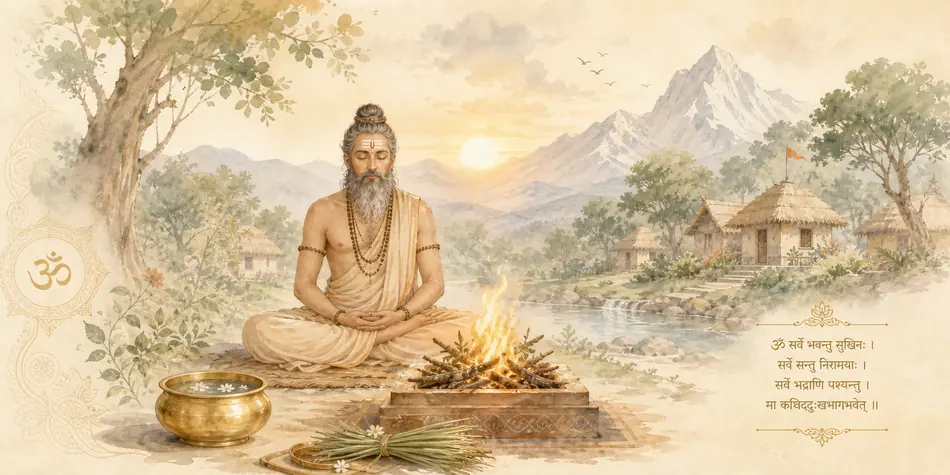
“First, Your Majesty, fire burns grass, brushwood, branches, and dry leaves. In exactly the same way, Your Majesty, a yogi practicing yoga should burn with the fire of knowledge all afflictions, whether external or internal and whether they are based on desirable or undesirable objects of experience.”
The Fire of Knowledge and Discriminating Wisdom
The fire of knowledge is jnana. When the light of jnana arises within us, it gives rise to viveka, discriminating wisdom. Viveka enables us to see what is beneficial and what is harmful or evil for us, and to separate one from the other. If dirt, dust, or husks get into a bowl of milk, we remove the husks, dirt, or dust from the milk and strain it so that it is fit to drink. Likewise, in the process of developing discriminating wisdom, we discover what is harmful, what constitutes impurities in consciousness, and, without hesitation, remove these impurities from the stream of our mind. This is likened to a fire that burns.
How does this occur in the pranas and in the body? An afflictive emotion arises within you, or an adverse situation arises externally, but within you there is a center of awareness and the discerning wisdom generated by that center of awareness, and you, as a witness (sakshi), are the observer, engaged in observation (drashta). You are not a participant but, first and foremost, an observer. This state of detachment, remaining in the position of an observer, gives you distance, a gap in relation to the situation taking place or to your own kleshas; it is precisely this distance and gap that saves you.
If we take an ordinary person who is not a witness to the situation but a participant in it, they have no such gap. The klesha or situation immediately draws them in, and they become subject to it. We, however, use this gap to burn up the adverse energy that has arisen. Then, no matter what we experience or what arises, we remain in the center of consciousness, and the very center of consciousness becomes fire for the negative situation. I have been saying this for about fifteen years now, almost every day, but everyone knows that it is not easy to do in practice. Therefore, I think it is useful to repeat this to ourselves again and again, so that we truly, literally live by it.
The True Power of the Center of Consciousness
When does this center of consciousness actually gain true power? It gains it not when our center of consciousness is merely a point, or when there is a slight state of awareness or Atma-vichara, but only when this center of consciousness attaches itself to something greater within us: to Brahma-bhava, to God, to the Absolute. Simply saying, “I will observe my breathing, I will be a little mindful, and this will protect me from all kleshas and from the whole of samsara,” is naive and unserious, to say the least. Samsara is vast, very powerful, and very dense. It contains many energies, and such small consciousnesses can do nothing against it.
This is the first lesson in humility that the ego receives. The ego must learn its measure; it must know that its efforts and its awareness are limited, that it cannot accomplish much on its own. It must become disillusioned with its efforts and with its personal, individual path, and sooner or later it must fail. Only when it becomes disillusioned with its own efforts and its personal path will it understand what grace is, that grace is important, that self-surrender is important, and that it is important to rely on God instead of relying on oneself.
At the moment when we understand this and true self-surrender arises within us, we say inwardly, “Yes, after all, not my will. I wanted so much for it to be mine, but nothing will come of it. It is better that Yours be done. When Your will is done, everything will be better. Because my will is small, and it often ruins many things.” When we say this, we enter the process of non-doing and truly surrender; many of our attachments and hopes are severed.
Only then does the center of awareness become true power. It is no longer our personal center of awareness, some point in space, but boundless Being itself, God Himself. When God Himself takes us under His protection through the power of His Anugraha, we can withstand the onslaught of any kleshas and dissolve any energies in the Universe. No matter how great these energies may be, we are even greater, because we act according to the principle: “I do not belong to myself; I belong to God.” As soon as we “belong to ourselves,” we are already doomed to limitations and failure. When we cease to belong only to “ourselves” and begin to feel that we belong to God, an immense power awakens behind us.
Mercilessness Toward Afflictions
“This is the first quality, Your Majesty, that should be taken from fire. Furthermore, Your Majesty, fire is merciless and pitiless. In exactly the same way, Your Majesty, a yogi practicing yoga should spare or pity no afflictions whatsoever. This is the second quality, Your Majesty, that should be taken from fire.”
Why should we not spare the kleshas, the obscured states? Because they are truly destructive. If they are not eradicated during one’s lifetime, these kleshas and obscured states may seriously ruin our lives in the future.
For example, after death, many spirits search for heaven. They did not search for it while alive, but once they became spirits, they began to seek it. They remain in an intermediate state, gather in groups, discuss where to go, and various rumors arise: “Heaven is there; there is such-and-such a heaven there”—everyone has their own ideas. Some believe that heaven means power, dominion, and luxury. But when they are told that heaven is love, self-sacrifice, and devotion to God, they do not like it. They think, “Where is the kind of heaven we would like?” and leave, because that heaven does not suit them.
Others think that as soon as they cross a certain boundary separating the spirit world from heaven, they will immediately enter that world, but the guardians of heaven block their way and say, “You are not ready for the radiance of heaven; for now, you must continue purifying yourselves in this world.” The appearance of spirits with pure consciousness gradually changes; they take on the form of divine, radiant beings and become ready to be admitted into the higher worlds. The appearance of those overcome by greed, anger, and various kinds of kleshas manifests as different forms of deformity.
Sometimes such a spirit has some creature on its head, perhaps with horns, or something like a black bird pecking at it. The spirit itself may not be able to see this; it simply does not perceive its own state, but divine beings (devas, angels) can see all of it. When such a spirit stands before the angels, every aspect of its consciousness is scanned down to the smallest detail: its entire past life, every word it uttered, every thought it had, every image it visualized.
In addition to its astral body having a form that expresses its spiritual essence, this scanning takes place, clearly determining the place, status, level, and hierarchy of every being. Nothing can be hidden or falsified there; spirituality is expressed directly: one who is spiritually deformed has a deformed appearance, while one who is spiritually beautiful, rich, and developed has a beautiful, rich, and developed appearance.
The Difference Between the Physical and Spiritual Worlds
In the human world, things can be concealed: one can dress beautifully and wear jewelry, and it does not matter if one is spiritually obscured—outwardly one can still shine, and no one will immediately understand until they get to know that person better. Or conversely, a person may appear ragged and dirty, yet inwardly be very holy, beautiful, and pure. In the spiritual world, form expresses content; there is no difference between form and content. Nothing can be hidden or falsified there. Holiness is expressed as radiance, light, and a refined appearance. Kleshas and obscurations are likewise expressed in the form of some impure, terrifying image. Spirits with many kleshas, afflictions, and obscured states manifest them as faces in their aura, as various negative states, as distortions, and as impure images.
According to their own inner states, such spirits are grouped at different levels and assume their respective status. This is how their future life is determined. All the tendencies that existed in this life pass into the next.
The Preciousness of Human Birth
It is difficult to develop in the subtle dimensions, which is why it is called a “precious human birth.” We have certain karmas, a body, and channels that can block sanchita karma and separate prarabdha karma, so that only one area of consciousness is singled out, with which we can work and develop. There is a conceptual mind. In the subtle dimensions, when the soul is outside the body, the subconscious and conceptual mind operate together. All the factors of chitta, all the mind’s hidden tendencies, manifest simultaneously.
Only highly developed souls who have truly purified themselves and cultivated contemplation can develop and progress in such states. Less developed and moderately developed souls cannot develop properly because this requires using a very subtle layer of awareness.
All inclinations, character traits, habits, ways of thinking, and mentality manifest there just as they were cultivated during one’s lifetime. If someone had an inclination toward philosophy, then after passing through the Bardo period and becoming a spirit, they continue to have an inclination toward philosophy and may participate in disputes and debates. Those who had an inclination toward art, dance, or music become spirits and belong to a mandala associated with music and dance. Those who had an inclination toward spiritual purity seek out and further develop this purity, becoming high-order devas. Those who had an inclination to help others eventually find a mandala and a form of service in which they help others, such as people on Earth or souls transitioning from physical reality to spiritual reality.
All the inclinations one had during one’s lifetime continue to develop, and everyone takes their place in accordance with these inclinations. If a particular klesha or obscured state was fostered during one’s lifetime, then this klesha and inclination also unfold in the subtle world and create an environment around such a being in the form of corresponding images. These images attract some beings and repel others. Therefore, when such kleshas arise, a monk earnestly learns not to tolerate them but to purify them—for example, to control anger, self-liberate it, or integrate it—but in any case, he learns and does not allow the kleshas to take hold of him.
“Furthermore, Your Majesty, fire drives away the cold. In exactly the same way, Your Majesty, a yogi practicing yoga should kindle the blazing fire of effort and drive away the afflictions. This is the third quality, Your Majesty, that should be taken from fire. Furthermore, Your Majesty, fire produces heat while remaining free from attachment and aversion. In exactly the same way, Your Majesty, a yogi practicing yoga should be free from attachment and aversion and make his mind like fire.”
Self-surrender
Sakshi
Kleshas
Non-Action
Viveka
Jnana
Divine Grace
Questions of Milinda
Author Гуру
Read 14 times
Articles
Vidya AI
Search
Lectures
November 2, 2026
Mantra of the day
ОМ САХАДЖАЙА НАМАХ ОМ Естественному – поклонение!
Auspicious Times(Rome)
Brahma Muhurta:
04:53 - 05:48
Abhijit Muhurta:
11:33 - 12:14
Sayam Sandhya:
16:44 - 17:25
Mokshada Ekadashi (6 November)
Ekadashi of liberation. Helps to achieve spiritual enlightenment.