

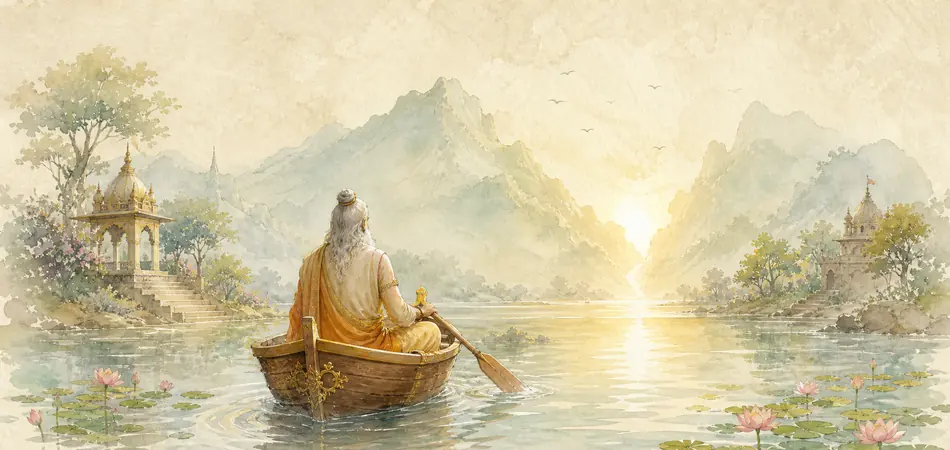
Before we listen to the text “Gorakkha Vijaya,” we can talk about karma.
Matsyendranath is a great saint. So why did he fall into illusion? This seems incredible, but if we consider the five types of karma that every person has, it may become clearer.
We are governed by five types of karma. It is commonly said that there are the following types of karma:
dridha — karma that can be changed with some effort;
adridha-dridha — karma that can be changed with tremendous effort;
adridha — karma that cannot be changed.
For example, there is karma that is very difficult to change while you are in this life. You are human beings, which means that you cannot simply become some other kind of being in this life; however, you can change this karma if you make a tremendous effort. Through diligent practice, you can become deities, gods. This is an example of how adridha-dridha manifests.
There are karmas that can be changed simply by making an effort. For example, if you have not yet mastered the lotus posture, you will be able to sit in it if you purify the nadis and learn to control the wind.
And there is karma that you are unlikely to be able to change. For example, the planets of the Solar System and galaxies move along their orbits, and you are not yet capable of interfering with these karmas.
Five-Factor Classification of Karmas
There is another classification of karmas based on five main factors:
prarabdha karma — the manifested karma of the present life;
dharma karma — the debt that every living being in the universe has (ancestral, family, ethnic, and other debts); it is our embeddedness in the collective karma of humanity and in numerous other minor karmas;
manasa karma — how we are influenced by our environment; it is also called the resonance factor;
buddhi karma — our own will, how we train and develop our consciousness, and how we can influence ourselves and the world;
bhagavata karma — the will of God, the intervention of higher powers, that is, what does not depend on us.

These five types of karma determine our future. The gods are well versed in such matters as human karma. Sometimes they adjust it by intervening in manasa karma, that is, they take resonant interaction into account if they wish to influence someone.
Prarabdha Karma — the Manifested Karma of This Life
What is prarabdha karma? It is the manifested karma of this life. It is like the script of our life that we created in a previous incarnation. When we live in this world, we consciously or unconsciously generate desires. All desires arise when the mind comes into contact with objects of the senses and give rise to thoughts that are imprinted upon our subtle body and accumulate there over the course of our life.
If we seek to repeat certain desires, the corresponding thoughts grow stronger, acquire great power, and influence the next life, determining it. The thoughts most intensely nurtured during the previous life prevail. We can say that with our present thoughts we plant seeds that will sprout in future lives. The seeds that we keep in our hearts over many lifetimes will be able to germinate only under specific conditions; if such conditions do not arise, these seeds will remain in a hidden (latent) state.
Some compare prarabdha karma to a boat floating with the current of a river. A person sits in this boat and does not know how to steer it. We can say that prarabdha karma is a given that we simply have to face. Everything that happens in our life depends entirely on our desires. When we encounter something, it is our own desire and prarabdha karma.
The “Gorokho Bijoy” describes moments when siddhas, tempted by the goddess Shakti, allowed some desire to flash through their minds. These desires were fulfilled, meaning that each of them entered, in the material world, the body they had desired. The degree to which a desire is fulfilled depends on how conscious it is and which layers of the mind are involved: whether it is manas (the gross mind), buddhi (the intuitive mind), or Atman. If it is the gross manas, then the desire manifests in the next life completely unconsciously, and the person is entirely under the control of that desire. If it is conscious will, creative intuition (buddhi), then the desire manifests as something integrated into contemplation. If it is lila, then the desire manifests as play arising from the natural state; that is, the desire and prarabdha manifest as lila, which does not affect the person.
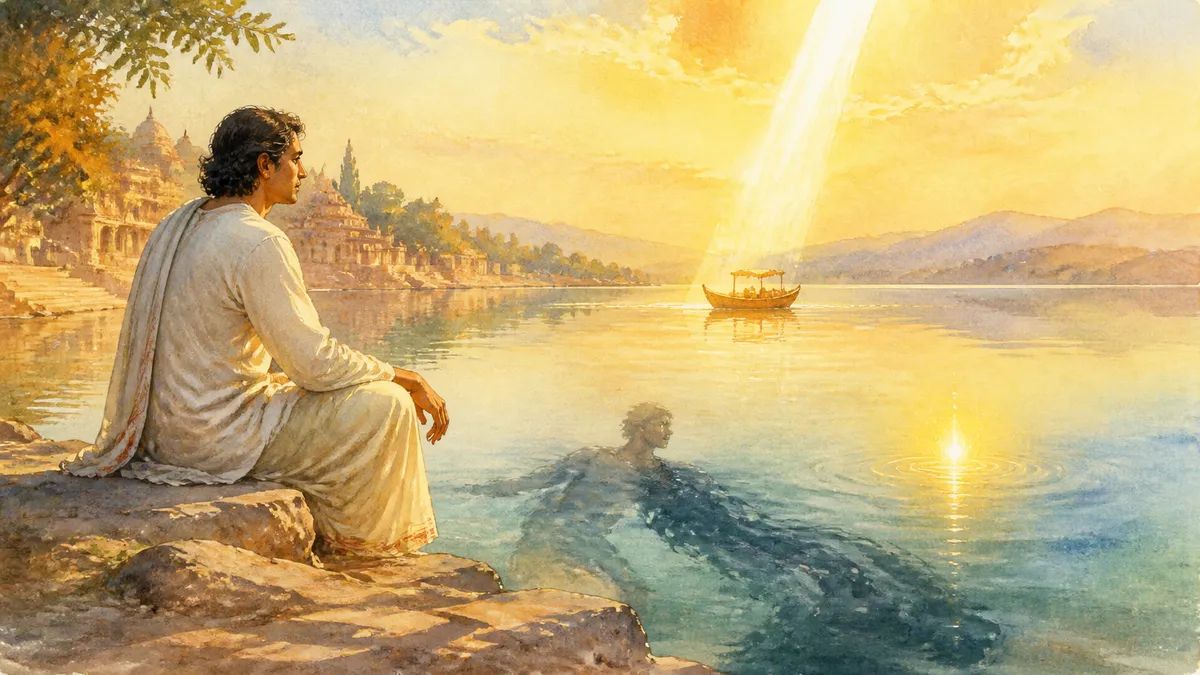
For example, from birth, a person may have been aware that he had no connection with this world and that none of the values of the human world concerned him. He regarded himself more as a participant in a show around whom everything revolved—this is prarabdha karma operating in the form of lila or through buddhi. Prarabdha manifests, yet it does not affect him, or affects him only slightly.
Thus, prarabdha karma is like a boat over which we have little control. We created this boat through the power of past desires, and now it simply manifests as everything that happens to us.
Dharma Karma—Inescapable Fate
The next type of karma is dharma karma. In a certain sense, it is fate—something that cannot be prevented. One could say that it consists of rapids or narrow stretches of a riverbed where the boat is forced to stop; in other words, we simply have to undergo something. These are certain rules of the game within prarabdha, pivotal moments when a person encounters something inescapable.
When a person is born into a particular family, country, or planet, the inner deities, his guardian angels, ensure that he is born in a place corresponding to his prarabdha karma and allowing his potential to unfold to the fullest possible extent. It is difficult to believe that subtler beings attend to each of us, but this is indeed so. Unlike humans, such beings have no limitations; it is not difficult for them to attend to billions of people, observe each one, and devise programs for various interactions in this world. All of this is incredible to a human being, but for deities, such control is entirely feasible. Therefore, it is believed that when a living being faces certain trials, they have been planned by the deities as a powerful lesson for his growth, enabling him to work through past desires and prarabdha karma. Such deities (especially Dharmaraja, who governs reincarnation) carefully monitor how we realize our talents at particular stages of evolutionary development. Our environment, friends, and enemies—all of these are also woven into our karma by such divine beings. One could say that divine beings are extremely subtle, superconscious creative energies residing in our subtle bodies. They are more conscious than we ourselves are, and therefore shape a person’s destiny in such a way that he finds himself in circumstances most conducive to his awakening.

It is believed that the influence of dharma karma cannot be overcome because it creates certain unavoidable circumstances that provide us with a very important evolutionary experience. Sometimes a person encountering dharma karma may experience suffering or fear for his future, feeling that he is subject to certain limitations. But if he manages to recognize this suffering as a powerful lesson that allows him to cut off hope, fear, and attachments, and begins to cultivate awareness, then he will nevertheless be able to free himself from dharma karma. Dharma karma cannot be overcome, but one can change one’s attitude toward it and thus overcome it after all.
For example, if a turbulent river has rapids, a shoal, or a narrow passage, one can learn to steer the boat using a navigation system in such a way as to minimize losses when the boat approaches such obstacles. It can be said that Matsyendranath’s immersion in illusion was a manifestation of his dharma karma resulting from past incarnations, which he was unable to control despite his mastery.
Manasa Karma—the Resonance Factor
The next type of karma is manasa karma. It is a resonance factor. It is our tendency to be influenced or not to be influenced, to respond to our environment. For example, it is believed that associating with saints makes a person holy, while associating with criminals gives rise to criminal tendencies—this is an example of manasa karma, the resonance factor. In other words, there are certain subtle seeds in our subconscious that respond to similar manifestations in the external environment and attune themselves to it. Manasa karma determines, for example, what kind of upbringing a person receives in life, whom they associate with, how susceptible they are to influence, and how they grow spiritually. It is likened to signposts along the way as we sail in the boat of destiny.
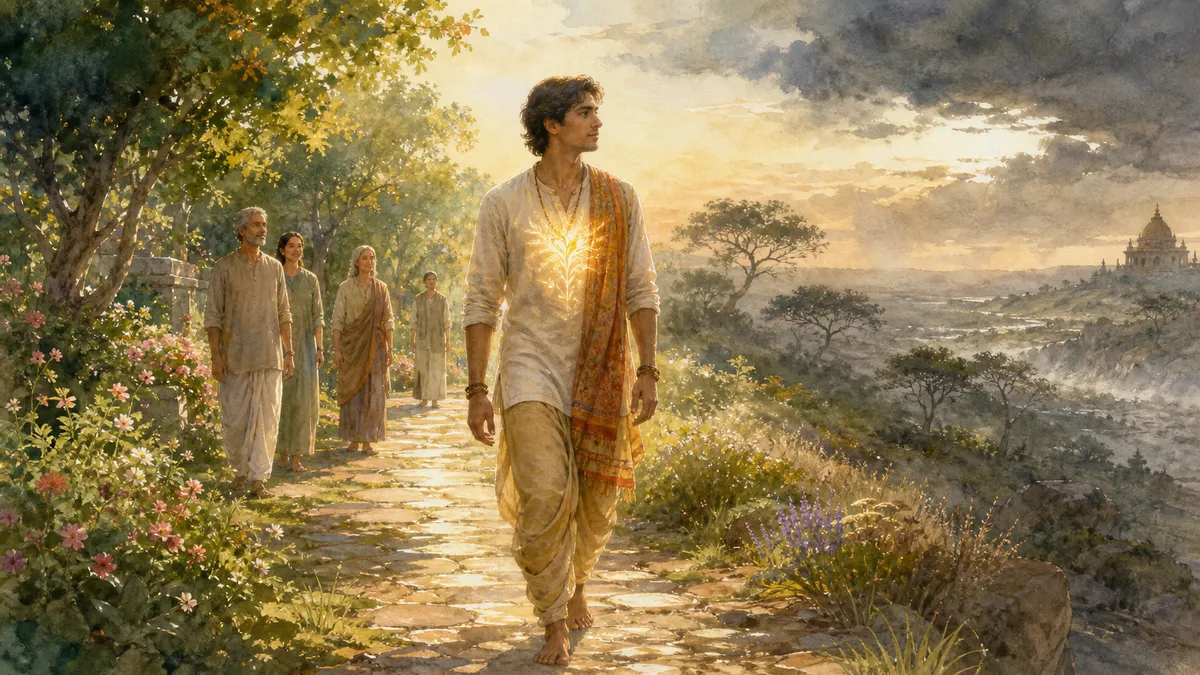
It is believed that deities and guardian angels primarily use manasa karma to influence the destiny of a living being. Knowing a person’s manasa karma, it is not difficult to predict how they will behave in a particular situation. For example, knowing the karma of a novice or monk, I can predict how he will behave if he finds himself in a compromising, harsh, or ambiguous situation. One can say with certainty: “This person will most likely self-liberate the situation, subdue it, and bring it under control. That person, however, will most likely become confused and bewildered, not knowing what to do. This one will try to distance himself from the situation, while that one, on the contrary, will open himself to it, enter contemplation, and make it part of himself. This one will behave very harshly.” These are all manifestations of manasa karma. Manasa karma is like companions who appear along our path and point us in the right direction or, conversely, lead us in a false direction. Depending on your level of awareness, your manasa karma operates either strongly or less strongly.
Buddhi Karma—Creative Intuition and Will
The next type of karma is buddhi karma. This karma is associated with creative intuition, will, and awareness. It can be said that this is our ability to attain liberation through our own efforts; it is our will. Buddhi karma is very important for practitioners of Laya Yoga because we act precisely from the level of creative intuition (buddhi) when we train the mind and develop awareness and presence. For example, a person who abides in contemplation, even if faced with difficult prarabdha karma, unfavorable manasa karma, and some limiting dharma karma, is capable of blocking all these types of karma through the power of buddhi karma.
Buddhi karma can be likened to a perfect navigation system and satellite communication, which allow a person to steer the boat in such a way as to avoid all rapids and narrow passages, read the correct signs, and reject the incorrect ones. If you are attentive, vigilant, and abide in awareness, then all other types of karma self-liberate; whatever you encounter, you always remain on top, you are never defeated, you never suffer loss, and you do not fall out of the field of play of the mandala of pure vision.

The gods, such as the inhabitants of Brahma’s world, possess buddhi karma. It is believed that buddhi karma influences manasa karma. For example, if your awareness is developed, you choose for yourself which external influences to accept and which not to accept. You understand for yourself which advice to follow and which not to follow, what in a book to regard as correct and apply, and what to regard as unimportant. This is how buddhi karma manifests.
Bhagavata Karma—Divine Intervention
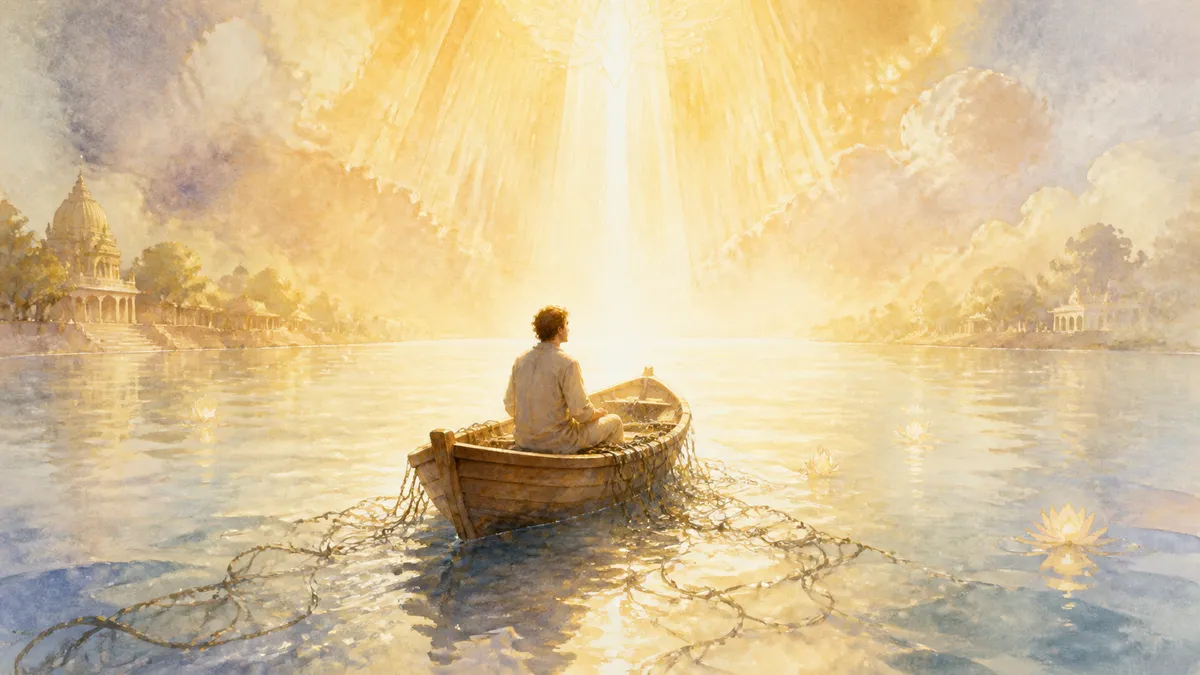
Finally, the last type of karma is bhagavata karma. Bhagavata karma means God’s intervention in a person’s life. It is a transcendental intervention, a descent of grace, shaktipatha—that is, something that does not depend on the person themselves. It is like a person sailing in a boat who sees a spacecraft descending, drawing the boat into itself with its beams and flying off into outer space. Thus, bhagavata karma is something beyond all other karmas. It is believed that when bhagavata karma intervenes, everything else is nullified.
When we engage in practice, through contemplation we become established in buddhi and strengthen our positive buddhi karma. When we fully develop contemplation and receive the descending power, the enlightening impulse, bhagavata karma begins to intervene. The intervention of this transcendental bhagavata karma frees us from all karmas, and thus the knot of numerous karmas is untied.
When does bhagavata karma manifest fully? When we liberate our mind and become established in brahma-aham-bhava.
To realize the natural state means to activate bhagavata karma. For example, the fact that you have become monks or novices is your prarabdha karma. Perhaps you nurtured this desire for many years of your life. The training or communication that takes place in the monastery and through which you receive something is manasa karma. The meditative experience that arises in you as a result of contemplation is buddhi karma. Finally, something transcendental that manifests in you as a result of proper practice and frees you from bondage to all other karmas is bhagavata karma.
