

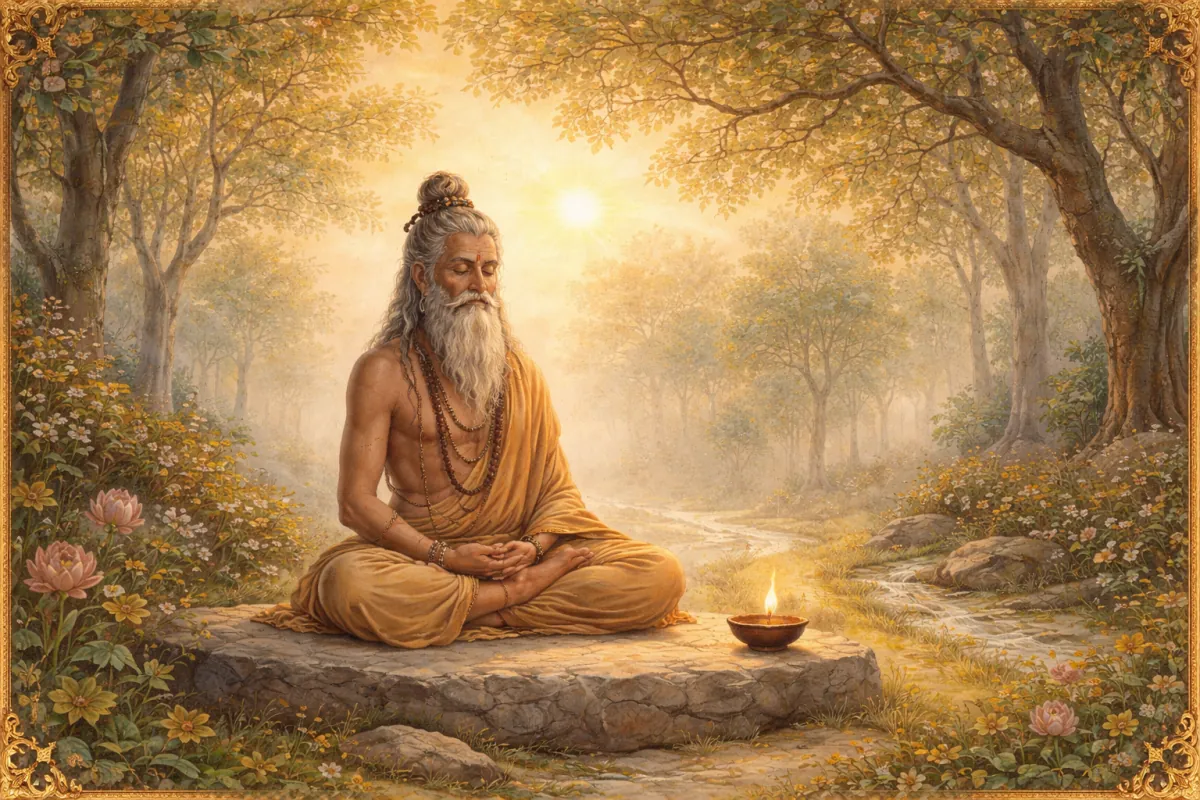
It is believed that a good practitioner, no matter where they end up, can unite with any circumstances, with any situation. This means that through contemplation, they will unify their awareness. They know how to do it, they know why they are doing it. They understand the meaning behind it.
Why do we contemplate at all? In order to get rid of ignorance. Contemplation is a method to obtain wisdom. A practitioner learns to extract wisdom from everything; they do nothing just for the sake of it. Things themselves are not important to them, but wisdom is the most important thing. Whatever they do, they strive to extract wisdom from everywhere. There is no situation from which they could not extract a certain wisdom.
For instance, if you go to a museum, the museum itself is not interesting to a practitioner. An exhibition of samsaric achievements does not impress a spiritual seeker, but contemplation in a museum is very interesting. This is called integration, uniting with situations, and opening the observation of one’s consciousness—this is interesting. In the same way, a practicing sadhu-yogi is not interested in ordinary, mundane affairs, social events, picnics, and so on. They are a person of the Spirit; they are only walking the path, day and night. Everything that is favorable for the path, they follow, and what is unfavorable does not interest them. They are like a fanatic of their cause. But they reject nothing; they simply learn to extract wisdom from everywhere.
Wisdom as the Distinction Between Gods and Humans
Wisdom is the knowledge of the laws by which reality lives, knowledge of the essence of reality. How do gods differ from humans? Gods have wisdom, humans do not. Gods are immortal, multi-bodied, and can control history, time, and space through the power of thought. Humans cannot; humans are limited, live briefly, get sick, and grow old. They do not control the world; the world controls them. They do not control destiny; destiny controls them. So, how do humans differ from gods? They lack the wisdom inherent in the Siddhas and Devas. Our task is to discover this wisdom, to seek it.
Contemplation is not an end in itself. Contemplation is a means, simply a method; the goal is wisdom. Wisdom eliminates ignorance. Jnana eliminates avidya. Siddhas, Rishis, and Devatas possess five main types of wisdom.
Equanimous Wisdom (Earth Element)
The first wisdom is associated with the element of earth (muladhara chakra); it is called equanimous wisdom. Equanimous wisdom allows one to see all things as equal, identical, with a single taste. When bad and good, kind and evil, pure and impure are equalized. When everything is seen as a single mass of consciousness. When our lower root chakra opens (muladhara chakra), non-dual awareness, similar to space, is able to move into the muladhara chakra and unite the earth element in non-duality—we call this equanimous wisdom.
For example, if you transfer your consciousness to the muladhara chakra and simply contemplate while remaining in space, you will increase your equanimous wisdom. Many things will be equalized; bad and good will be seen as one. Pure and impure, favorable and unfavorable, internal and external, male and female, past and future—this wisdom equalizes all polar opposites.
Usually, we think in dualistic categories, so the world for us is divided into black-and-white things. As one saint said: there is nothing bad, there is only that which you do not like. Likewise, there is nothing good, there is simply that which you like, to which you are attached. The universe is neither bad nor good; it simply is, it just exists. It is perfect, but it is neither bad nor good. It is divine, it is perfect, and it simply is. But we do not understand the perfection of the universe because we think in dualistic categories. For us, everything is divided into bad-good, acceptance-rejection. Equanimous wisdom removes all of this; it provides the opportunity to understand simply perfection. Perfection beyond duality, beyond the rejected and the accepted, the pure and the impure.
A good person is perfect, a bad person is also perfect, but in their own "bad" way, they are perfect. But it is perfection. Like a Zen master who was invited to a tavern. The Zen master spoke about how existence is perfect. Then a student said:
"Look, here is a hunchback. He is ugly. How can he be perfect?"
The Zen master said:
"This is a perfect hunchback."
But our limited perception, our dualistic thinking, does not allow us to understand perfection beyond our narrow circle of concepts.
Devatas and Siddhas differ in that they can include the entire spectrum of phenomena in the universe within their concept of perfection. If we can develop equanimous wisdom, we too will gradually be able to see such perfection everywhere.
Mirror-like Wisdom (Water Element)
Another wisdom is mirror-like wisdom. It allows one to reflect all things, copy them, feel them, and tune in. This mirror-like wisdom allows us to subtly sense reality. For instance, to feel other people, to feel nature, the world, time, history, events—to feel everything. This wisdom is associated with the svadhisthana chakra and the element of water. A person who has developed this wisdom usually lives very flexibly; they are a very flexible person, loyal, tolerant, and they feel everything very subtly.
If we do not feel the situation, do not feel another person, do not feel the energy, the world, then we do not understand the laws of nature, the laws of reality, the laws of people, or divine beings, and we make mistakes because of this. Simply, we were not sensitive enough.
If our mirror-like wisdom develops, we develop such sensitivity that we can feel ourselves very well. This wisdom allows us to understand: this is a bad place, this is a good place for sleep. Here, such relationships can be built, and here, others. Ideally, it allows one to unite with the universal element of water. That is, the quality of the water element—flexibility, fluidity.

Discriminating Wisdom (Fire Element)
There is yet another wisdom, the wisdom of the fire element, discriminating wisdom. This wisdom allows one to distinguish, without confusing even the smallest things in the universe, to differentiate, and to bring clarity everywhere. In the human world, there is a lot of confusion because there is little clarity, little discriminating wisdom. Those who have developed this wisdom possess such pure—either mathematical, logical, or simply clear—thinking. They can distinguish well between different categories, different types of people, different elements, various places, different styles, and time intervals. They can catch very small time intervals, nuances of the course of history, the development of cause and effect, the law of karma—all this is discriminating wisdom. When we encounter various complex classifications, levels of the world, hierarchical systems, subordinations—all this comes from discriminating wisdom.
Those who have discriminating wisdom understand well: this is a monk, this is a layperson, this is one path, this is another, this is a lineage, these are teachings, this is contemplation, and this is distraction. They can understand everything down to the smallest detail: these are the ethical laws of humans, this is the ethics of Siddhas, this is the ethics of gods.
Usually, it is believed that discriminating wisdom gives the ability to create and destroy—the fire element.
How to develop discriminating wisdom? One can engage in concentration on the manipura chakra, or one can unite with fire. For example, now you see the fire element. If you look at it without making evaluations or judgments, with a relaxed gaze, you will allow Shambhavi Mudra to simply arise. That is, in a state of space, if you unite with the fire, your manipura chakra will begin to vibrate. But mere vibration in the manipura chakra is not yet discriminating wisdom. It is important to combine the state of space with this vibration and remain in it, using the fire and heat through the eyes as a means of synchronization.
Then your body is like a point, the center of the universe. And in this body, the center is the navel, the manipura chakra. From this center, the state of your consciousness, your inner space, emanates outward and expands to infinity. If you meditate like this for a long time, you will feel how the manipura chakra activates, the fire element activates, pulsation and rotation begin in the chakra, and heat arises. Gradually, from the manipura chakra, this heat can spread through the whole body. The central channel, Sushumna, can be filled and spread as bliss in the body or as inner heat. This inner heat in the manipura chakra is your internal fire element. The gross external fire element is bhuta-agni. But the internal fire element and the external fire element are one fire. That is, they are of similar quality, one element. If you are in a state of awareness similar to space and unite them, it will gradually begin to reveal these qualities to you and teach you.
It is believed that if a person sets out on a journey and they have fire and air in the right channel, the journey will be destructive. That is, from the point of view of worldly affairs, the fire element is not very favorable. For worldly affairs, relationships, and business, earth and water are favorable. But fire is favorable for starting something new, for an impulse, for generating brilliant creative ideas; it is also favorable for battle, together with air. If you want stability in your life, you are better off meditating more on earth. And if you want more harmony, fluidity, and flexibility in your life, you are better off meditating on water.
Fire brings change and transformation. But if you are tired of the state of things in which you live, fire will help you. Simply by contemplating it and integrating with it, you will bring significant changes into your life—good or bad, it depends on your karma. But these changes will come along with fire. Fire is always transformation. The fire element is very important in yoga. The path to Samadhi lies through fire. It does not end with fire, but it lies through fire.
If there is stagnation in affairs, stagnation in life, fire will help a lot. Water will not help. Earth—everything will stay the same. But fire will give the impulse to remove everything old and open up to something new. Dynamism and heat are the qualities of fire.
All-Accomplishing Wisdom (Air Element)
The next wisdom we have is all-accomplishing wisdom, air, anahata chakra. All-accomplishing wisdom allows one to act anywhere, in any way, very flexibly, making any situation suitable for practice.
Air is very unstable, but it is very fast and ubiquitous. Usually, if a person has a lot of air, they do not sit in one place; they are constantly moving and traveling. If you want to live such a dynamic life, if you like change, and want to perform some great actions, you need to unite with air. Air provides the opportunity to do whatever you want. And it is especially important in logical operations.
A person who has strong air, open air, has the ability to make any situation a method of practice. They can engage in spiritual practice everywhere: on the street, in the market, in a crowd, in a cinema, in a restaurant, at work, lying down, sitting, anywhere. At home in the kitchen, they will unite with any situation; nothing hinders them, they are very flexible. Such a person does not hold onto the old; they easily let go of the past.
However, if they have an excess of air, they become flighty and inconsistent—this is a negative quality. They are like a tumbleweed, too much air. They start one thing, cannot finish it, and go after another. They live by the principle: "the grass is always greener on the other side." They are never satisfied. This is also air. Any element has good and bad qualities, excess and deficiency.
But if you need to act actively, earth or water will not help you. You need to unite yourself with air, to meditate on the element of air. It is believed that whoever has active air wins in battle. Air is dynamic and ubiquitous. In ancient times, sages advised military commanders and rulers on what state of mind and prana to start a battle in order to win it.
Whoever concentrates on the vayu-tattva possesses magical knowledge of prana, can bless objects, subdue spirits, and feel the energy of places. All this is the function of air.
Air is the carrier of the power of consciousness, sankalpa. If in a pure state of mind you blow on water, the water is blessed, charged, and becomes pure as well. If in a state of divine pride you blow on rosary beads, the beads acquire a state of purity with the help of air. Any objects are blessed in this way. This works. And when you see pure places like these, it means the quality of wisdom in such places is also better manifested. For example, here the water is pure, which means mirror-like wisdom develops well here. Pure air means all-accomplishing wisdom is also more strongly manifested in this place.
All-Pervading Wisdom (Space Element)
There is also the element of space, and all-pervading wisdom is associated with it. This is the wisdom of synthesis, the wisdom of uniting everything. A person who has developed this wisdom can look at everything from a height and think globally. They do not get lost in details but can integrate everything into a single vision.
Often, when a person lacks this wisdom, their mind is shriveled, very contracted; such people are called victims of circumstances. A person cannot find a way out because they are too absorbed in the present situation. But the element of space provides the opportunity to abstract oneself from any situation and look at it more broadly, on a larger scale.
An excess of the space element makes a person detached, alienated, lost, or abandoned. They seem to lose themselves and their personality, becoming very detached. Therefore, if you want to live a family life, perhaps you don't need much space. Because if you meditate a lot on space, it will bring renunciation, detachment from this world (vairagya); you might become a sannyasi, and even as a monk, everything will fall from your hands, and service will not work out. For people with a strong space element, service is useless; they cannot connect with the tattvas and remain in such an absolutely detached state. On the other hand, they can be good meditators, contemplating, as nothing attaches them. They are very busy, but if the space element is insufficiently developed, on the contrary, a person's mind is very shriveled. They are a victim of circumstances. Their mind clings to trifles, to personalities, to small relationships—that is, they forget about eternity, forget that the world is infinite, the universe is infinite. Space provides the opportunity to understand all this.
For example, one astronaut, traveling in space, suddenly received a darshan of the space element, seeing the Earth from the side. He saw how small the Earth is, that it looks like a ball. And then he thought how petty all these wars and strifes are, one with another: Muslims, Russians, Christians—how petty it all is, really. After all, the Earth is a small ball, the whole world is one humanity, and there are countless such planets. He was greatly changed by this; he sought spiritual society, left his career, and became a spiritual seeker. That is, one such look at the Earth from the side turned his life around. This is the darshan of the space element. All-pervading wisdom.
This is the spiritual meaning, for it is a grand, global quality for a spiritual seeker—to see everything in perspective, to rise above circumstances. Because if we are absorbed in this life, we do not understand that a person is not just for themselves; they are part of humanity, part of the universe, and that the forces of the universe are the evolution of humanity, and we are moving in a common path of evolution. A person in themselves is not a single being; they are part of something vast.
But the element of space simply gives renunciation (vairagya). It is said that when ether dominates in a person's body, nothing works out except meditation. For example, if you have started some business, you need earth and water for it to succeed. If you have the space element, it will not succeed. You won't be able to organize anything.
All-pervading wisdom is associated with infinite space.
Why are people so absorbed in samsara, in worldly desires? Why is it so hard for them to tear their minds away and engage in spiritual practice? Why do global questions seem insignificant and abstract to them? They lack this wisdom; smaller things fascinate them too much.
Reality vs. Abstraction
Once I began telling a person about the philosophy of Advaita Vedanta. This person was not a student, not a practitioner. He said:
"Well, that's an abstraction. I'm not going to live by an abstraction. I have a family, a house, I live in society. I am a wealthy man, and this is an abstraction."
I told him:
"In fact, it is you who live by an abstraction, while I live in reality."
Why is that? Because reality is such that we live in time. A hundred years will pass, a thousand years will pass, a million years will pass, a billion years will pass, ten billion years, ten trillion years... and there was infinite time before us. There will be infinite time after us. This is not an abstraction; this is life, this is the reality of life. We live in the flow of time; this flow is infinite. And we need to understand where we are going, where we came from and why, what is the meaning for us to live in such a flow of time?
I said:
"Therefore, you are detached from life. You do not see the passage of time, you do not see infinity. You think very abstractly. You have singled out very narrow categories and attached yourself to them. But I say, one must live in reality, one must look the truth in the eye. We live in time, this time is moving, and we are moving with it. And we can't run away from this. We can't hide from it. We need to work with it, practice, live, and think about what to do with it. Rather than finding your narrow little world and thinking, 'I live in reality'."

Advaita as Reality, Not Abstraction
The teaching of Advaita is not an abstraction; it is reality.
Also, besides our world, there exists an infinite universe, an infinity of higher worlds. This is reality, not an abstraction. Simply, we live by distracted categories, giving them too much importance, and our so-called everyday life is actually a distracted category to which we have given too much importance. It turns out to be the opposite.
All-pervading wisdom allows one to understand this, allows one to expand their consciousness. But it should not be allowed in excess. If you have a lot of all-pervading space wisdom, you will not be entirely adequate in society. Your earth, water, and fire will be weak. But it is necessary for all elements and all wisdoms to be balanced. Complete harmony is when all five elements are equalized, all five wisdoms are equalized.
Meditation on Elements to Change Destiny
Through meditation on the elements, one can change their life and destiny.
For example, if you have an important meeting and you want it to be harmonious, you should meditate on water. If you want to stabilize a situation, you should meditate on earth. But if you meditate on fire, it will most likely end in a scandal. Or on air—everything will be empty. And on space, it probably won't happen at all.
These elements change our lives. We depend on nature and we must understand nature, opening up to the energy of nature. The nature of energy is not just trees and water; it is, first and foremost, the elements.
Influence of Directions and Travel on Destiny
It is believed that traveling changes destiny because different directions are associated with different elements.
- If you go North, your air power will increase, there will be activity, and "airy" karmas will manifest
- If you go East, then East is the quality of earth and water, and your life will be quite stable and normal
- If you go South, fire increases, you will have more dynamism, more new impressions, but also more danger associated with this
- If you go to intermediate directions: Southwest, Southeast, Northwest, Northeast, and so on—to the islands of French Polynesia, near Australia, or anywhere else—the element of space will dominate
Vairagya, detachment, and globality of thinking will appear in your life. But if there is too much of it, you may become a very vague person. On the islands of French Polynesia, there is a tribe, and they do nothing; they stay in such a half-asleep state from morning to evening. Because for thousands of miles there is nothing; space is everywhere. They see only space everywhere. European businessmen went there, trying to develop something, build, and do business. And after six months, they became the same. Space—being in this space, they too could do nothing. The local residents want to eat a little; the rest of the time they engage in contemplating space and want to do nothing else.
Knowledge of Universal Laws as the Basis of Wisdom
The Tattvas strongly influence our destiny and life. To change destiny, one must travel.
The southern direction is usually considered unfavorable. Because fire has strong destructive qualities and properties. The West-East, East-West directions are considered quite favorable. North—it depends.
Saints extracted all this wisdom from contemplating the action of the Tattvas. Therefore, the laws of omniscience are like traffic rules. If we learn them even slightly, we can look quite deeply into reality and understand how this world is structured.
Gods differ from ordinary people in that they deeply know the laws of the universe. They take them into account in their lives. Humans do not know them, so they often make mistakes. They are sometimes punished by higher beings for these mistakes. Many wars, mine explosions, and natural disasters are created not by physical beings and bad weather, but by various beings who are not satisfied with human activity. There are many local guardian deities; they do not like that people are destroying the environment. Sometimes they punish people for it.
