Recognizing the Divine Play as a Path to Liberation
16.08.2026
0 мин. чтения
0
Share
copy
search
add
share
Commentary on the text “Sripada Sri Vallabha Charitamritam.” Chapter 45. Instructions to Sri Hanuman to incarnate on Earth. Sripada’s stay in Kashi
After we had finished lunch at the home of Sri Bhaskara Shastri, he began his story:
“My dear ones, Sripada’s divine plays defy logic. He blessed many great people in Kashi. He bestowed upon them the necessary yogic powers and siddhis. He said to the groups of sages: ‘I will take another incarnation under the name Narasimha Saraswati. I have a compelling reason for coming directly to Kashi after disappearing in Pithikapuram. This is a great holy place. It is the abode of many siddhas. I will come every day by yogic means to bathe in the River Ganges. I will receive initiation into the order of sannyasis only in the incarnation of Narasimha Saraswati. I command Shyama Charan to be born here so that he may teach Kriya Yoga to householders in the ages to come. Hanuman will become Brahma for the next yuga. I will send Hanuman to Shyama Charan to receive Kriya Yoga diksha. This is the truth.’
Then, by yogic means, He reached Badarika Vanam together with groups of rishis. He initiated many into Kriya Yoga diksha in the cave of Nara-Narayana. From there He went to Urvashi Kunda, 12 kroshas away. He also bathed in the Rishi Ganga. He blessed a great yogi named Sarveshwarananda, who had been performing tapasya for 5,000 years. From there He went to Nepal.
Darshan to Hanuman as Sita, Rama, Lakshmana, Bharata, and Shatrughna
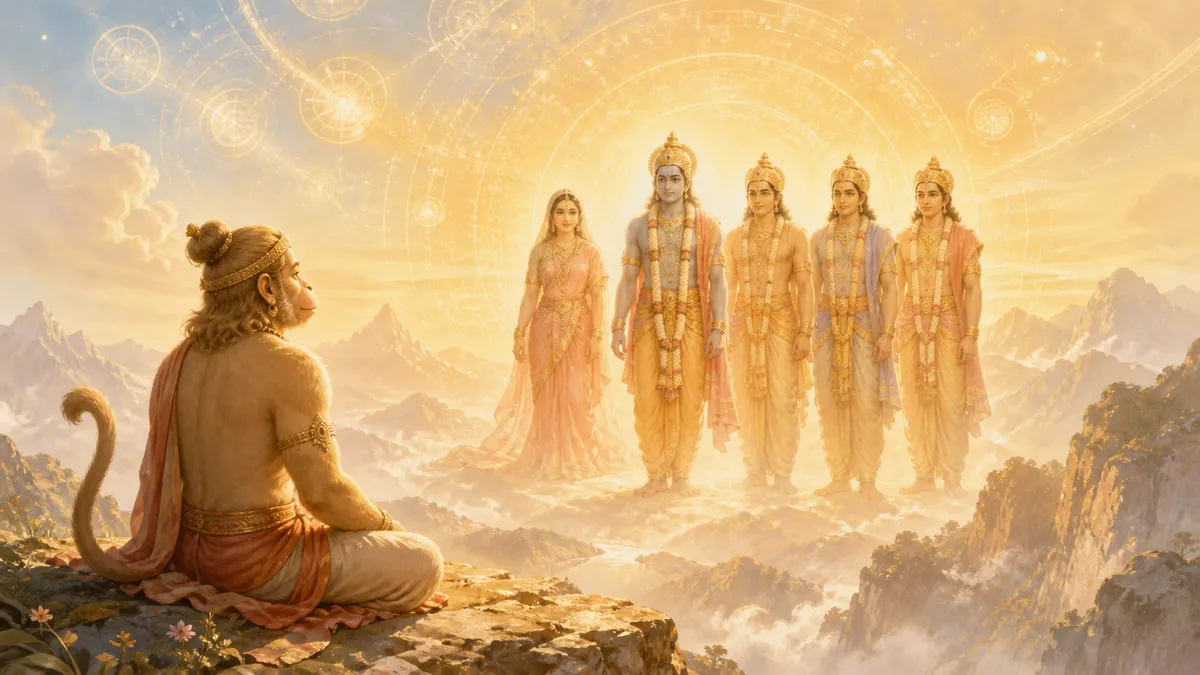
There He gave darshan to Hanuman, who was seated on a mountain in deep meditation on the name of Rama, as Sita, Rama, Lakshmana, Bharata, and Shatrughna. He said to Hanuman:
‘My dear Hanuman, it is impossible to count how many millions of times you have repeated the Agni bija “Ram.” You utter the seed syllable “Ram” every single moment. Chitragupta finds it difficult to keep count. It is incalculable. Even during the great, endless Maha Shunya Kala, you repeated the sound “Ram” millions upon millions of times, and therefore you transcended time. You became Kalatmaka. Chitragupta finds it difficult to calculate your age even in hundreds of thousands of years. You must one day incarnate in this Kali Yuga. Since you are capable of pacifying the tendencies of the senses, you will become famous under the name Sai.’
The Power of the Seed Syllable “Ram”
Hanuman said:
‘My Lord, the sound “Ram” is undoubtedly the seed syllable of fire. I have won the favor of the God of Fire. I became perfect through union with fire. From the physical point of view, I am Your servant. From the point of view of the life force, I am a part of You. From the point of view of the Atma, I am You. Please tell me in what form I should incarnate.’
Sripada smiled and said:
‘Although you were born as a divine incarnation of Shiva, you became a devotee of Rama. In Arabic, “Al” means “Shakti,” and “Aha” means “Shakta,” that is, one who holds Shakti. Therefore, “Allah” means the united form of Shiva and Shakti. You worship Me in the form of Janaki Vallabha. From now on, you will worship Me as Shiva-Shakti, uttering the name “Allah,” as the mlechchhas commonly do.’
Hanuman said:
‘Lord, I know that the sage Bharadwaja performed Savitra Kathaka Chayanam in Pithikapuram during the Treta Yuga. I also know that You were born in the lineage of the sage Bharadwaja in accordance with the boon granted that day. I do not wish to be separated from You under any circumstances. Your ancestral lineage must also be my ancestral lineage. I am Your child.’
Dialogue Between Sripada and Sri Hanuman
Sripada: ‘My dear Hanuman, according to your wish, may your body be born in the lineage of Bharadwaja.’
Hanuman: ‘Allah Malik; this means Allah is the Lord.’
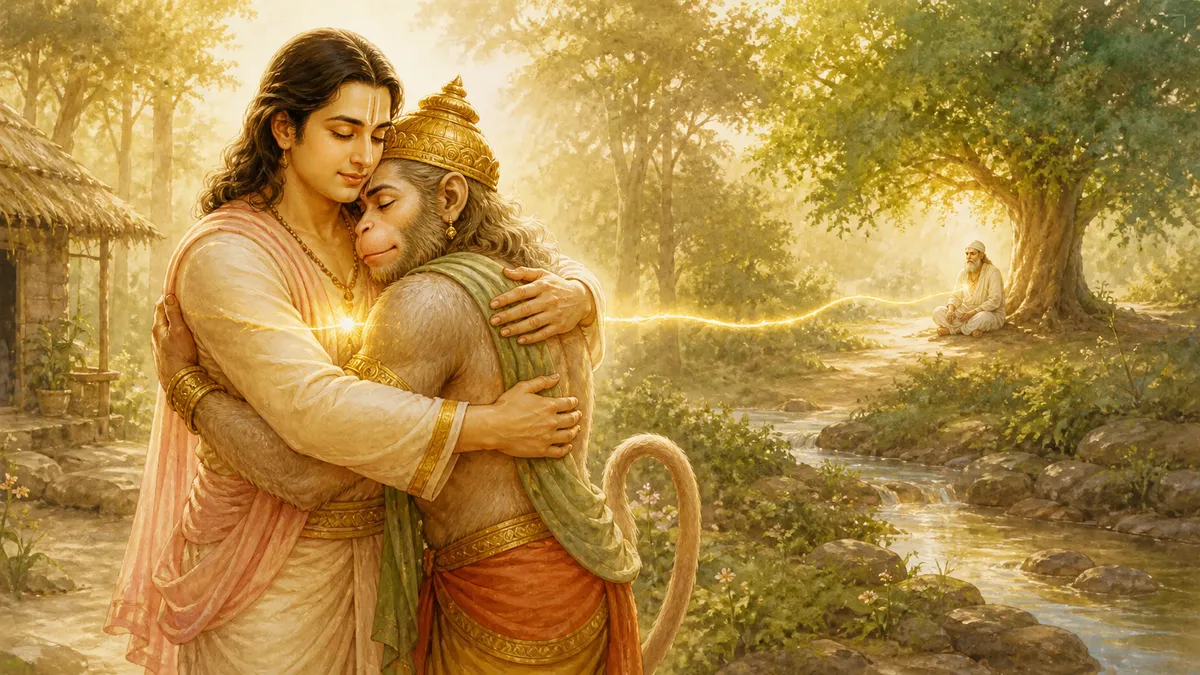
Sripada embraced Hanuman and said: ‘Hanuman, abandon your identification with the body. You are a part of Me.’
Hanuman: ‘Lord, I agree that I am a part of You. Nevertheless, amsha-avataras merge into their original nature after completing their mission on Earth. Then these amsha-avataras lose all their value and importance. Therefore, the amsha-avatara that I am going to assume must remain permanently connected to the original nature and must possess the full wealth of power and might that are present in You as the source.’
Shripada: “My dear Hanuman, you are very intelligent. May all My power and excellence abide in you. I will remain unrecognized in the body of Narasimha Saraswati in Kadali Vana for 300 years in yoga samadhi. Then I will become known as Swami Samartha in Prajnyapura. When the time comes to leave My mortal body, I will incarnate in you when you are in the form of Sai. I will unequivocally declare that I am incarnate within you. You will become known as My incarnation, Sarva Samartha Sadguru.”
Hanuman: “Lord, from the standpoint of the physical body, I am Your servant, and therefore I will chant the words ‘Allah Malik.’ From the standpoint of the jivatma, I will act as a guru with a spark of Your divinity, but is not Sri Charana the Lord Datta Himself? Is it right that there should be any difference between You and me? Non-duality will be attained only if I become You and You become me. Therefore, I beseech You, let me merge into the essence of Lord Datta.”
Shripada Sri Vallabha commanded Kala Purusha to appear before Him. Kala Purusha came and stood with folded hands. Then the great Lord commanded:
“Kala Purusha, Hanuman has transcended you and become kalatita. I wish to grant him the state of merging with Me. I also bestow upon him the title ‘Nadha.’ Henceforth, let him be called ‘Sai Nadha.’ I proclaim this day to be Datta Jayanti. The consciousness within Hanuman may be transformed accordingly into Datta Swarupa.”
All the saints looked at the Lord in amazement. Meanwhile, all the living cells in Hanuman’s body burst open. Mother Anasuya emerged from them. She looked at Shripada and said:
“My dear Krishna Kannayya, what a cunning child You are. O Datta, when I gave birth to You, I naturally expected to experience labor pains. I thought there would be some sweetness in those pains. But You were born without causing me any pain. Now You may have decided to give me that experience of labor pains. I now have severe pain in my abdomen. You are before me. Do You wish to be born from my womb again? What is this? What kind of Vaishnava Maya is this?”
Shripada: “Mother, sons must fulfill the rightful wishes of their parents. Hanuman is in your womb. I grant him the state of oneness with Me. In a sense, through My own Maya, I am being born again from your womb.”
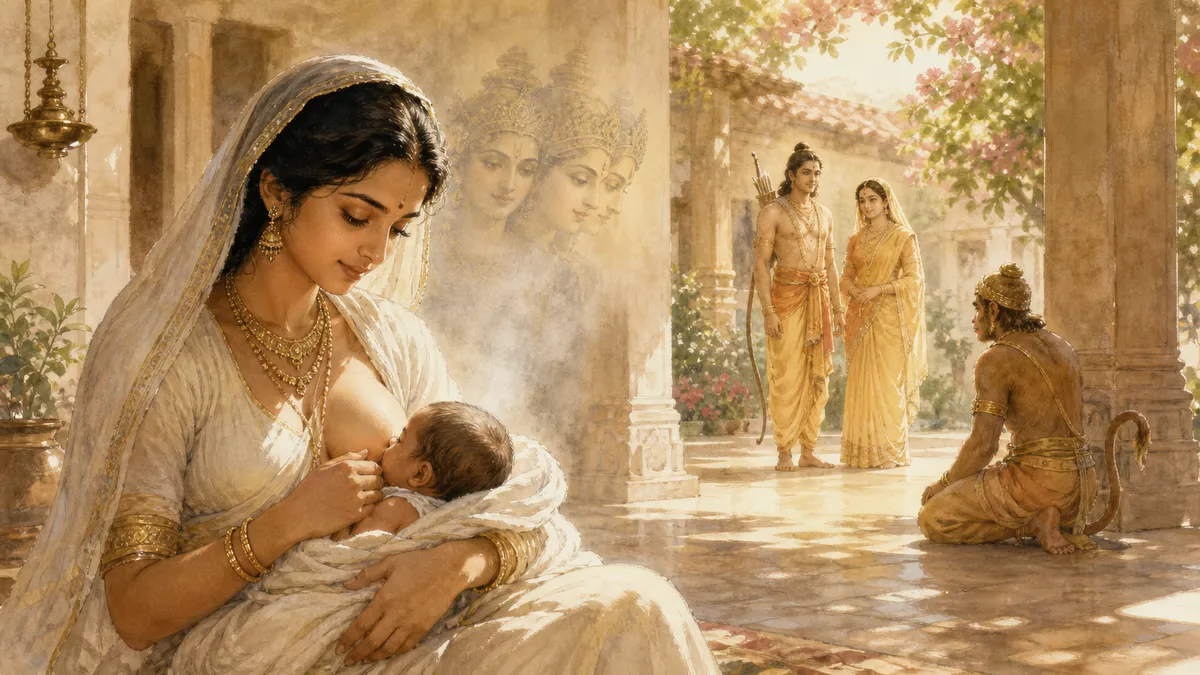
After some time, the labor pains intensified. Mother Anasuya gave birth to an enchanting three-headed form of Datta. After a while, that form disappeared, and a little child was in her lap. Anasuya breastfed the newborn. After some time, this scene disappeared. Hanuman became visible. Only Janaki and Rama stood before Hanuman.
Hanuman: “My Lord, I will strive to unite all that is good in the religion of the mlecchas with all that is good in Sanatana Dharma. There must also be a mleccha guru.”
Shripada: “A great sage named Mahabub Subhani abides within Me. I will have him incarnate as Waris Ali Shah. He will be your guru and teach you the secrets of yoga. Shyama Charan will teach you Kriya Yoga. If you desire any other blessings, you may ask.”
The Advent of Lord Manikya
Hanuman: “Lord, I have heard that You, Padmavati, and Venkateswara are invisible. Therefore, grant me a Vaishnava guru who knows how to worship You.”
Shripada: “I will give you a great devotee of Vishnu named Gopalarao as your mentor. He always remembers Me and is always merged in My consciousness. As a devotee of Lord Venkateswara, he will be called Venkusha. After he leaves his body, place his ashes in a clay pot and bury it underground. When you open the pot at My instruction, you will find a murti of Venkateswara. If you worship this murti, I will be pleased and grant you a boon.”
Hanuman said to Mother Janaki:
“Mother! With love, you gave me a diamond necklace. I broke it apart to see whether Rama’s name was inscribed anywhere in those diamonds. When I did not find Rama’s name, I threw the necklace away. Please forgive me for this grave offense.”
Shripada: “Nothing happens without a reason in the divine presence. I have preserved this Manikya Hara. This necklace is also a form of Datta. Why doubt it? I infused the Manikya Hara with life force through the Atma Jyoti within Me. May this Manikya Hara flourish in the form of a Guru. May this form of the Guru be called Lord Manikya.”
My dear, Shripada Shri Vallabha is the form of Narayana in Badari. He said that a sage named Nara would incarnate on Earth again. Only Shri Charana knows under what name and in what form the incarnation will take place.
Shripada Resides in the Village of Shambala Giri on Mount Dronagiri
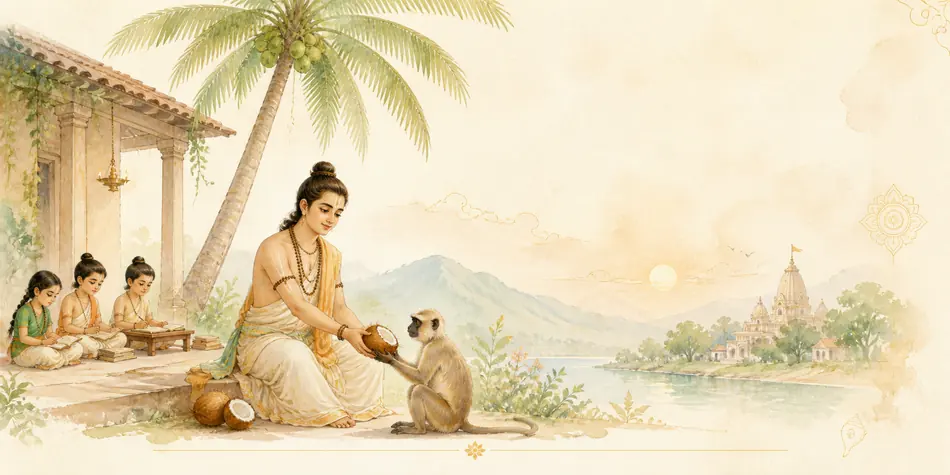
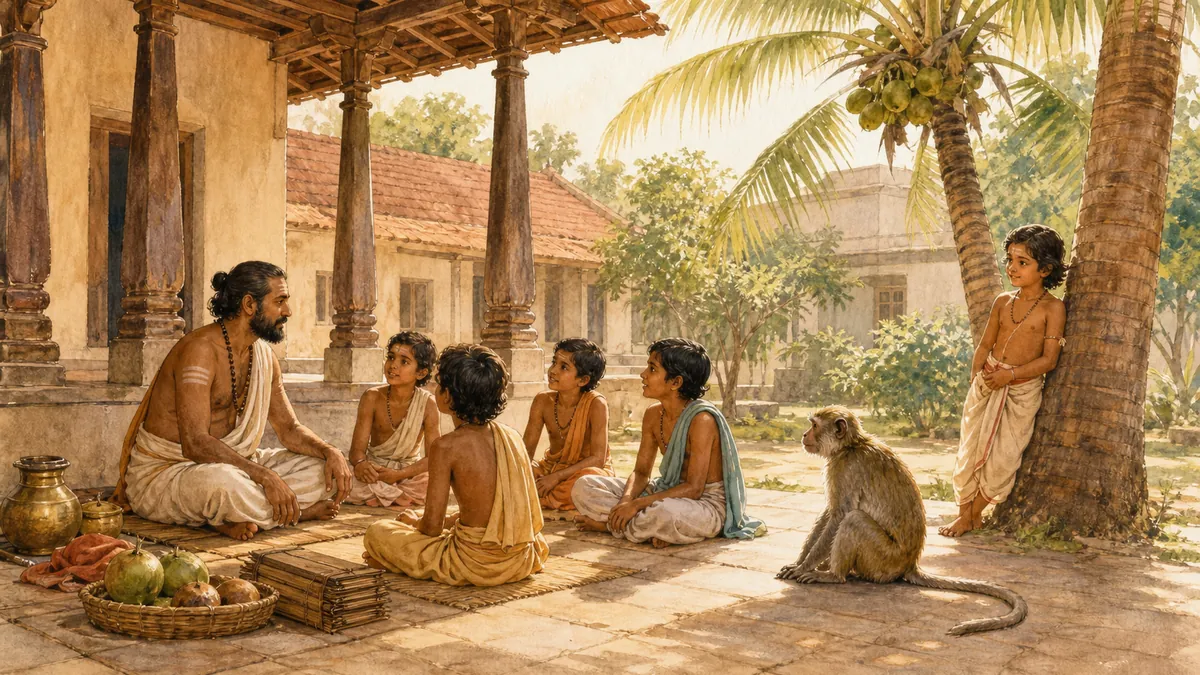
Once in Pithikapuram, Shripada’s maternal uncle, Shri Venkavadhani, was teaching the Vedas to children. A coconut palm grew nearby. A monkey came to that sacred place where the Vedas were being taught and listened attentively to the Vedic sounds. Without damaging the coconuts on the trees or any other objects, the monkey listened intently to the sounds of the Vedas.
Shripada asked his uncle: “Uncle, does the coconut palm have reincarnations, just as God has incarnations?”
His maternal uncle said: “Kannayya! What kind of question is that? A question should have some meaning.”
Shripada remarked: “Uncle, that is not the point! An unripe fruit grows on the tree. This fruit or nut becomes a tree again. This tree once again produces an unripe fruit. As this process continues, the tree turns into fruit, and the fruit, in turn, will become a tree.”
The conversation ended there. Suddenly, a large coconut fell from the nearby coconut palm. Shripada took the coconut in his hands. Looking at the monkey, he said:
“I do not want to send you away empty-handed. I am giving it to you with my own hands as prasad. You must not ask for any more coconuts from my hands. You may take it if you agree.”
The monkey nodded its head in agreement. Shripada gave it the coconut with his own hands and lovingly stroked the monkey. It left very happily. Who knows who this monkey really was, why the coconut was given, and why it fell to the ground by itself? His playful acts are very strange and beyond imagination.
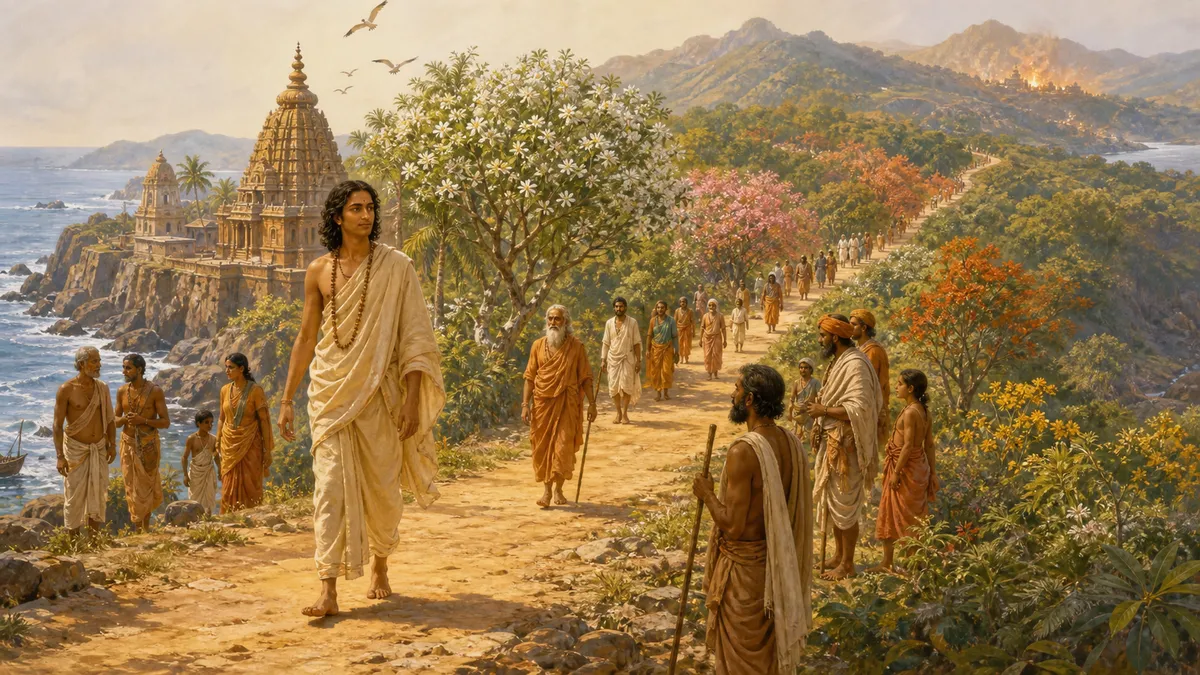
The Great Lord went to Mount Sanjeevani, which is called Drona Giri. He spent several days there with groups of sages. Who knows what He bestowed upon the great yogis there? Then He went to the village of Shambala, where Lord Kalki will incarnate. This place lies in a region that even maha-yogis cannot visit. Great souls who have been performing tapasya in the Himalayas for thousands of years live there. Shripada drank pure water on the crystal mountain in the village of Shambala. The age of those who drink this water remains unchanged, and so from that time onward He remained a 16-year-old boy without any changes in His body.
Shripada’s Ascension to the Heavenly Realms from the Gokarna Region
After that, He traveled to many sacred places, blessing devotees and Maharishis. He reached Gokarna Kshetra. Shripada remained in Gokarna Kshetra for three years. It is a great pilgrimage center. There He revealed many divine lilas. They were countless. He delights in play every moment. From there He came to Srisailam. In the past, Shri Bapanarya performed a great yajna in Srisailam.
The Nature of Divine Play and Karma
Shripada delights in play every moment; He does not act. What unfolds as life for us when He does something is play for Dattatreya. It is play because He has exhausted all His deeds—this is called karma or kriya-nishpatti (the exhaustion of all actions). Why are actions exhausted? Because in divine consciousness all inner states have been exhausted (bhava-nishpatti). In Him, all cognitive activities and all identities have also been exhausted (jnana-nishpatti). In such divine consciousness there is no ego that wants to act or receive the fruits and results, no doer mentality (kartritva-buddhi), no authorship, no self-attribution, but rather the spontaneous manifestation of the energy of divine will and other actions.
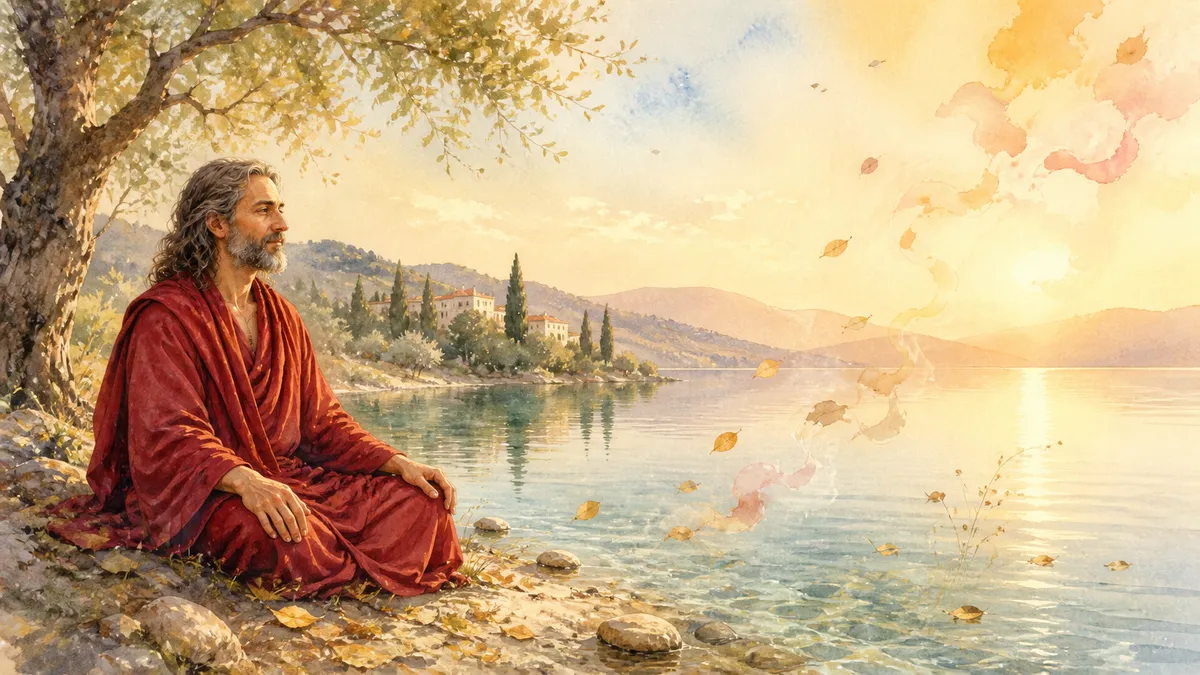
Since divine energy manifests freely, spontaneously responding to a variety of situations, it is utterly playful and has an empty, nondual nature; therefore, saints, especially such a saint as Shripada Vallabhacharya, never act but always play. Karma cannot even touch them, since they have gone beyond cause-and-effect relationships. Likewise, in terms of conduct (action), spiritual growth and the path to liberation for us consist in moving from karma, from causally conditioned actions, to play—recognizing the divine play, entering the divine play, becoming a divine player, and carrying out the divine will as divine play in this dimension and in other dimensions.
Living beings subject to karma are slaves to their impulses, vasanas, and samskaras, and they move along strictly prescribed trajectories. These trajectories are directed by deities, the lords of karma, and charted by planetary deities; the inner deities in the channels, responding to them, complete this picture by impelling minds and bodies to act in a particular direction. This direction is very clear and very strict. The laws of karma and the laws of psychology are even stricter than the laws of mathematics or physics, but when a yogi exhausts all his actions, all his bhavas (inner states), and all forms of identity and cognitive activity, divine energy uses his body as a vessel, and he becomes a conduit for the divine play and sees the world as divine play. He discovers the dimension of divine play.
It turns out that what people perceive as cause-and-effect relationships, karma, life trajectories, trajectories of destiny, retribution for sins, or rewards for merits, from the perspective of deities and siddhas such as Shripada, manifests as divine lila (play).
Recognizing the Divine Play
Divine play means that an action may appear similar, yet it has an entirely different nature; and when we begin to contemplate and free ourselves from the ego, we increasingly recognize the divinity of everything that happens and increasingly recognize the play. Play usually includes the deity carrying out the divine will, the one who plays, the process of the play itself, and the place where the play unfolds (the loka). When we begin to recognize all of this—the world as a mandala, the loka as a deity, the player as the deity itself, and the process of action as play—all these three factors mean that we recognize any situation that occurs as divine play. In this divine play, we recognize consciousness (the Shiva principle) and energy (the Shakti principle); when they unite, gods, deities, avatars, humans, and other living beings manifest.
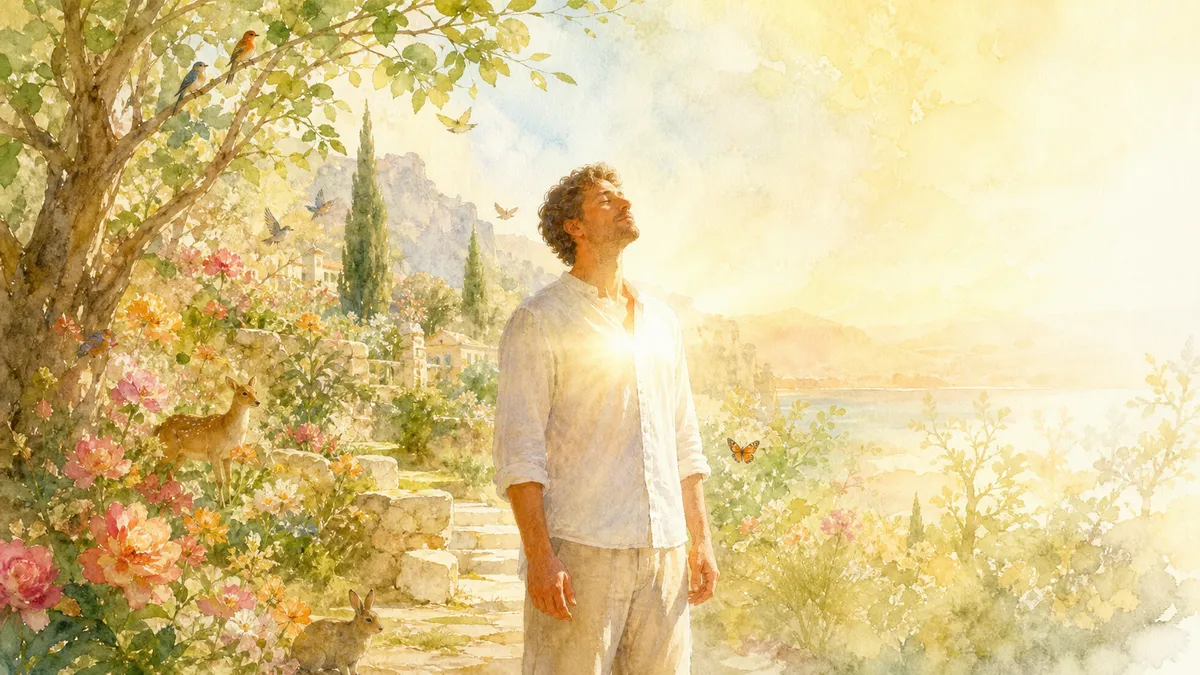
The ability to recognize everything that happens, whether within or without, as divine play is a sign of pure vision, because pure vision easily and flawlessly perceives the divine play; but impure, clouded vision—that is, flawed karmic vision—cannot conceive of the divine play at all. To it, the divine play appears to be something karmically conditioned, but pure, unclouded vision is able to see it. Thus, shuddha-drishti sees the divine play. Dosha-drishti—impure, clouded, flawed karmic vision—sees karma. These are two paths, two choices for living beings: between samsara and nirvana, between the path of moksha and the path of suffering, the path of karma and the path of liberation.
For us, how we see the world and what choice we make are very important. Seeing karma through impure, clouded vision does not require much effort—it comes naturally; we already see all of this. This is the vision of an ordinary being. But to see the divine play with pure vision requires the factor of awareness, greater energy and heightened awareness, and deeper sight.
It is like seeing large objects in the sky: for example, it takes no effort to see the moon or the sun—we look, and everything is visible. But to see very distant objects, such as some radio galaxy, Laplace, which cannot be seen at all with the naked eye, radio telescopes, Hubble, and other kinds of advanced equipment are needed, as well as greater viveka (discernment); then they, too, can be seen. Likewise, seeing the divine play requires deeper vision, purer sight, and pure eyes; and that which strengthens our viveka and enhances our pure sight is the energy of awareness (vimarsha-shakti).
When the energy of awareness accumulates within us, we can see the divine play always and everywhere and can always abide in pure vision. The accumulation of the energy of awareness is always the accumulation of two types of bhava—divya-bhava and brahma-aham-bhava.
Divya-bhava and Brahma-aham-bhava
Divya-bhava is associated with the pure perception of energy, while brahma-aham-bhava is associated with Shiva-tattva, with abiding in nonduality, in emptiness, in the dimension of nirvana, and with identifying oneself as “Aham Brahmasmi.” As the nature of the mind is discovered and the practice of contemplation deepens, recognition of the divine play will also come easily. But even if you are simply training from the very beginning, remind yourself: “This is the divine play”; remind yourself: “This is the mandala world of the divine dimension; these are deities; I myself am an illusory body, a form through which the deity manifests.” This habit of reminding yourself and abiding in the pure dimension, in pure vision, will gradually lead to recognition of the divine play and liberation from karma.
Karma and the Divine Play
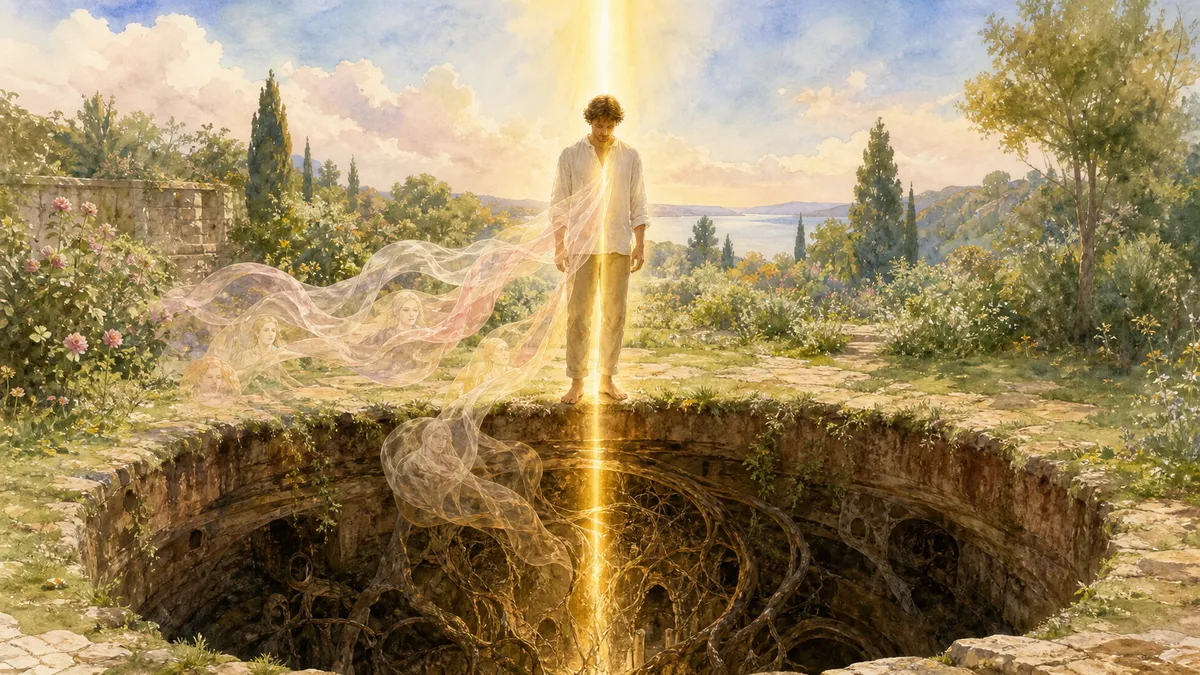
The moment you recognize the divine play, karma recedes and no longer holds sway over you. But if you do not recognize it, you find yourself in karma’s tenacious embrace, and it is not so easy to break free. Suppose someone makes a statement that you dislike, and thoughts arise in you: “Why is he saying that? What authority does he have, and who is he anyway?” You dislike it. Your thoughts begin to branch out, and though you had been in such an elevated, majestic, benevolent state, suddenly, five minutes later, you find yourself in a gloomy state, already like a hungry ghost—this is karma’s embrace. Karma has led you down the path of judgments and thoughts, and you have wandered into some altered tunnel of reality where there is no divya-bhava. Karma has already taken over, and you go about in a gloomy state, no longer wanting to recite a mantra or perform seva, thinking, “I don’t want to see anyone.”
Worldly desires were waiting for your divya-bhava to weaken, for this shield, this force barrier, to fall, because they cannot withstand divya-bhava; they do not survive in it. Just as radiation is deadly to living beings, so your divya-bhava, your contemplative awareness, is to desires. But as soon as you adopt a lower bhava—divya-bhava disappears and something more like dosha-drishti (clouded vision) arises—worldly desires immediately remind you: “How about eating some candy? How about sleeping or daydreaming? How about playing or doing something else?” And you already feel that you somehow no longer want to practice, that you have many desires and much karma, and your dominant vasanas, impulses, and tendencies of this life once again begin to shape your character and personality. You thought you had already defeated them, defeated your personality, but they remind you of themselves again: “Here we are; let’s begin now”—pride, envy, and something else besides. And all this happened only because you failed to recognize the divine play and allowed thoughts and judgments to lead you away.
But if, at the very beginning, you hear someone make a statement and recognize the divine play, interpreting it through pure vision, you might say: “How remarkable—look how Shiva is playing here! What unfathomable games he plays,” or: “This is how Dattatreya manifests,” or “This is how Saraswati or Lakshmi manifests.”
Your pure vision would not allow judgments or desires to arise, your practice would not decline, and, on the contrary, you would draw an impulse of blessing from this situation (darshan of Anugraha-shakti). Something within you would dissolve and shift, and you would understand, for example: “So Dattatreya can play this way too.” Here lies the dividing line between whether you follow the path of samsara or the path of nirvana, whether you are becoming liberated right now, at this very moment, or not, because similar processes take place in the subtle body of souls during rebirth. There is simply no body there, and once the soul begins to dwell on something, it becomes so absorbed that its thoughts already drag it along; it is no longer able to control them, the pranas become involved, and it is led toward a new birth. Or, if it enters a pure dimension, its pranas move it toward a pure land. There, this process has tremendous power: whether one is born in a lower world or a higher one, or remains in a state of equilibrium and dissolves everything.
The Mechanism of Self-Liberation
A sadhu must monitor these mechanisms of self-liberation very carefully, and the mechanism of self-liberation and contemplation is always connected with recognizing the divine play. As soon as you recognize the playful nature of what is happening, you receive darshan, extract divya-bhava, and do not leave natural awareness; all is well, and you continue to contemplate. You let go of the situation as it is, allow it to remain as it is, following the principle of leaving everything as it is, and continue to contemplate. You leave your thoughts as they are without departing from the nature of Mind; they dissolve without changing, without a mantra, without visualization or transformation by tantric methods—they are naturally liberated into their own ground. All of this is the recognition of the divine play.
The Continuity of the Divine Play
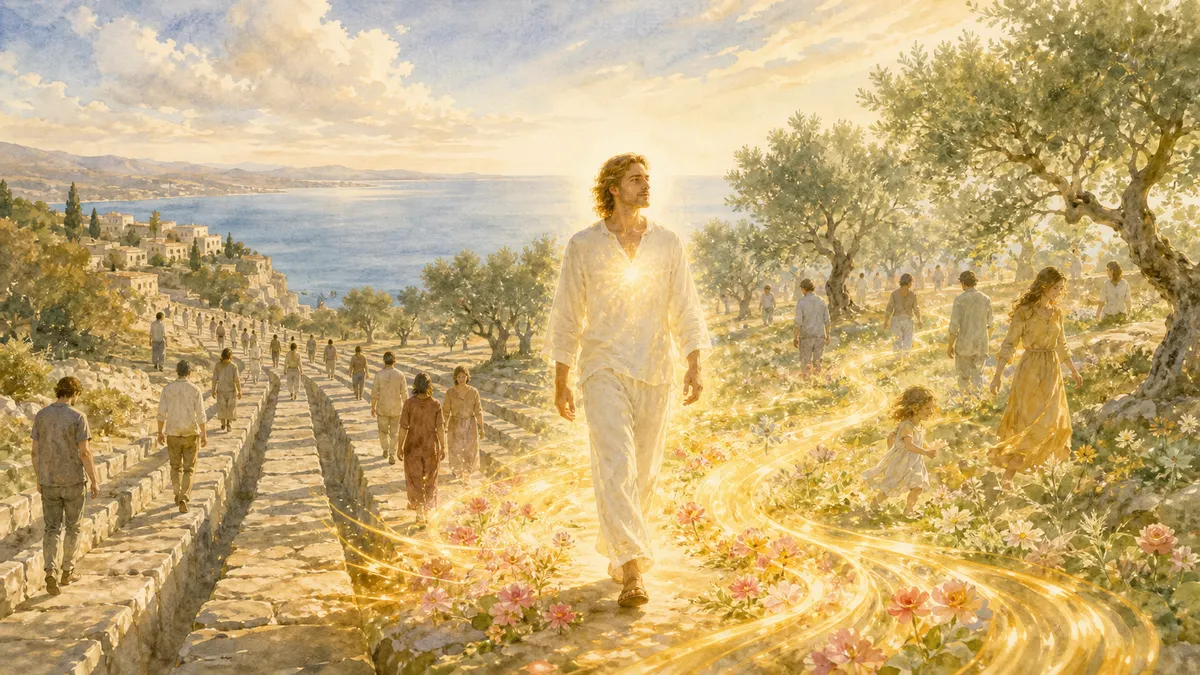
There is not a single second when the divine play is not taking place. It cannot be said that divine plays occur only when some avatar descends—for example, when Krishna was present, there was Krishna-lila; when Rama was present, there was Rama-lila; when there was some other incarnation, there was the corresponding lila, strictly according to the avatars. In fact, however, all living beings—even ordinary beings, ordinary people, ordinary sadhus—are also amshas. Amsha-avatar means a partial incarnation of God. This means that every living being, being an amsha, manifests the divine play; that is, the divine play never ceases. It never ceases, but sometimes our vision does: we saw the divine play and then, for some reason, stopped seeing it.
As soon as we stop seeing the divine play, we see karma, and as soon as we see karma, karma begins within us. You cannot see karma in a detached or somehow independent way: if you see karma outside, that karma necessarily begins to generate karma within you; your thoughts, emotions, channels, and ego mechanism react. All of this is interconnected. You cannot see karma outside while experiencing something sublime within—it is impossible. But when you see the divine play outside, there is also divine play within you, and your inner asuras, kleshas, and karmas are subdued, purified, and transformed into pure vision.
Pure Vision as the Basis of Contemplation
To contemplate means, among other things, besides such practices as atma-vichara, space, the triple sankalpa, the twelve sankalpas, mastering the three golden principles, and so on, to continuously discover the divine play in the external dimension. To see the world purely means to see the divine play always and everywhere; in Shaivism, it is called chit-shakti-vilasa.
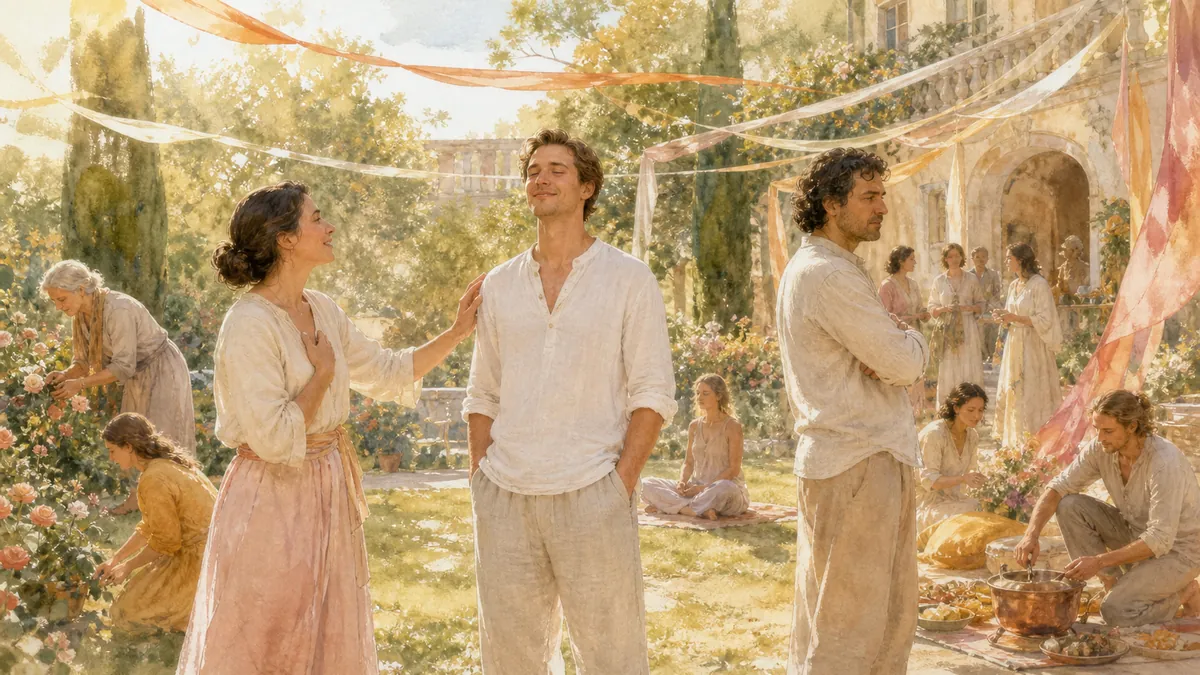
When you learn to see the divine play, you will attain extraordinary stability of consciousness. Neither joy nor sorrow will be able to strike your heart any longer, and you will be able to meet both reproach and praise—honor and dishonor—with equal composure and a single “taste.” No dualistic, obscuring thoughts will cloud you anymore. When you discover the divine play, seva becomes easy, practice is also performed easily, and life itself changes; the quality of life acquires a blessed, festive, carnival-like character. Life itself ceases to be complicated, confusing, or burdensome. Life itself becomes a continuous celebration, a continuous adornment, continuous bliss and joy, because play always has this character.
Grace and the accumulation of insights—flashes of the spirit—and revelations in the dimension of the divine play come easily. But when the divine play is not recognized, life seems difficult, even the life of a sadhu. It is difficult to practice, difficult to follow the principles; somehow, through will and force, you have to compel yourself. Grace seems to have no time for you, as though you were not made for grace. It is as though you enter another dimension where everything is different.
When we understand this, we will discover the secret of how to always be happy like a sadhu, how to practice and attain joyfully, with blessings and playfully, how to live in the world by playing—not acting, but playing. None of the saints on our altar acts; they all play—this is the secret. No deity and no saint acts; only people, animals, perhaps spirits—all those bound by karma—act. Saints and deities play; that is, the world of play is the world of shuddha-adhvas (pure dimensions). They do not play from the ego or on their own, but through the power of the divine; that is, the ego cannot play. Sometimes the ego may imitate play and declare, “This is my lila,” but it cannot play, because only Bhagavan, the Absolute, can play through His energies. Yet since they are one with Bhagavan, Bhagavan can play through them. Recognizing the divine play is the key to entering pure vision and the beginning of liberation.
The Lila of Sripada Sri Vallabha
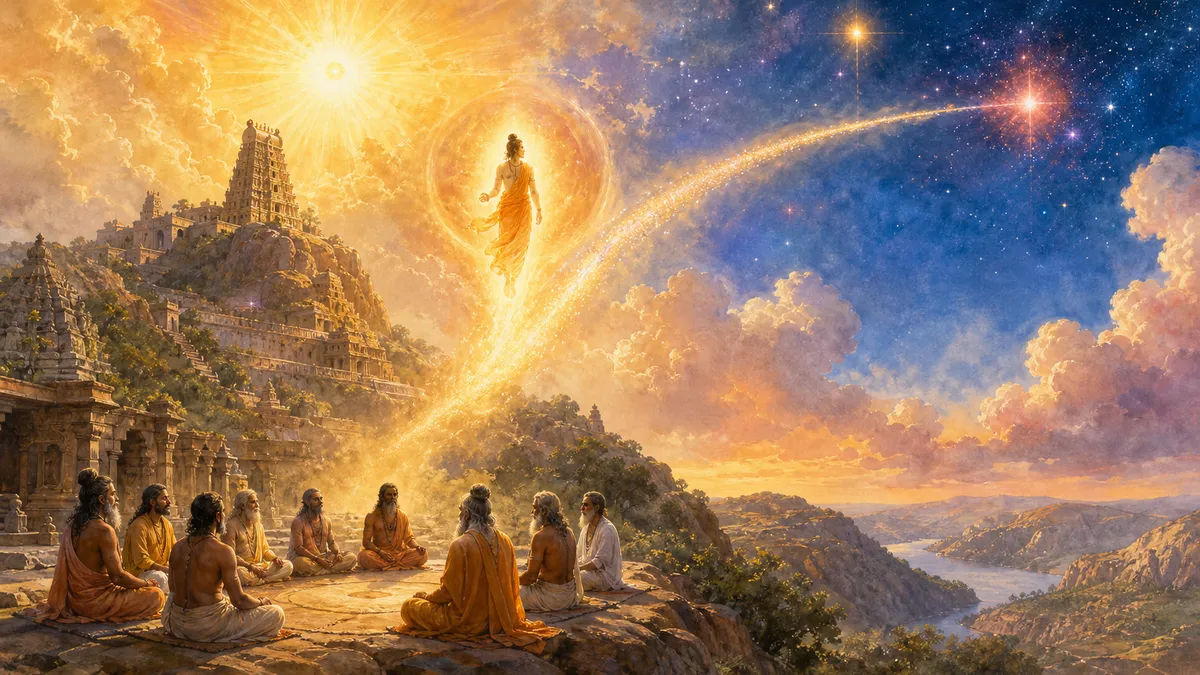
In the past, Sri Bapanarya performed a great yajna in Srisailam and transferred energy from the solar sphere into the Mallikarjuna lingam. It was only because of this that Sripada Sri Vallabha incarnated. From there, by yogic means, He traveled to the solar realm in a body resembling a blazing ball of fire. He then went to Dhruva, and from there to the star Ardra. Four months later, He returned to Srisailam from the star Ardra. At the request of the Maharishi from the star Ardra, He organized a conference of siddha-purushas in Srisailam. A new divine yoga of knowledge was formulated, which He taught at this conference. He sent the siddha-purushas back to the star Ardra. His plans are unfathomable. He is the sole Lord of many millions of universes. After some time, He reached a divine place called Kurungadda.
Victory to Sripada Sri Vallabha!
Sri Sripada Sri Vallabha ki jai!
Question:There are seven principles in the practice of divine play. The first is abiding in amanaska, in clarity; then union with energy and integration. With energy—does that mean it is integrated with the clarity that arose from this awareness, correct? Integration is a blended union; it is as though they merge and become one, correct?
Yes, integration always means that we include the external world, the external dimension, within our consciousness. At the moment of such integration, dualistic concepts dissolve and the impulses of Anugraha are extracted through samanya-vishesha-spanda (from external objects), that is, divine grace is extracted from the tattvas (from external objects). Simply put, we begin to see God throughout the entire external dimension and to experience grace not only within, but also while perceiving external objects.
Question:Observing the principles of the divine, being aware that the world is a projection, and the key points—the practices of the illusory body, correct? The first is manifestation by the mind, the second is maintaining divine pride, and the third is pure vision.
Yes, all these principles are Tantric, and Tantric principles are essentially one. Seeing the world as pure, seeing living beings as deities, seeing all manifestations as divine play—all this is called the yoga of everyday life from the perspective of illusory-body yoga. The yoga of everyday life means that we bring our illusory-body yoga and its key points into everyday life; we bring remembrance into it. When we visualize ourselves in the forms of deities, the key points, the palace, and the pure land, we simultaneously generate awareness of the emptiness, illusory nature, and purity of what we are visualizing. Then, when the visualization has ended, when during meditation we have entered the body, connected perception with the body, and begun to walk and act, our meditation must continue, and all these attitudes must continue as well. This is the yoga of everyday life of the illusory body, including the perception of divine play.
Question:Are the sixth and seventh the arising of lila and mission? Does lila then follow as a consequence?
Yes, they arise on their own, as does your own involvement in this divine play. This means that a connection with the divine will has been established, and divine wisdom and other powers begin to play through you spontaneously and freely, as through a vessel.
Question:So this is already a mission?
Yes, people call this a mission. For people it is called a mission; for divine beings it is lila.
Question:Is destruction, an ending, the energy of Rudra?
Yes, Rudra eliminates ignorance. This is a great self-liberation: just as we dissolve thoughts, Rudra destroying the universe is like Shiva’s destructive emanation (Brahma, Vishnu, Rudra). Rudra shows us: “Look, all of this is emptiness. All of this is the nondual, pure mind.”
Question:If it is that energy, then it seems very, very quiet compared to the others. Is that right? Shouldn’t it be fierce instead?
Rudra’s energy?
Question:Not Rudra’s, but destruction, the end—when they are very quiet?
Yes, in fact, regarding Rudra’s energy, Shiva does not destroy anything; he is merely called the destroyer. In reality, he simply ceases to sustain this universe, this play of energy, with his consciousness and abides in stillness. It is not as though Shiva suddenly went wild and said, “All right, let’s cause an earthquake and have stars fall from the sky here.” The destruction of the universe does not happen like this: “It’s time; now we’ll twist it into a ram’s horn,” as if he decided to put an end to everything here. No, that is not how it works. The energy of destruction has a different nature; those are merely human notions. The energy of destruction means that Shiva ceases to activate the forces of the universal mind that recreated this universe—he simply enters a state of rest. It is just like when you abide in stillness during meditation, and everything is liberated and everything stops—that is what it is. This is a correct observation.
Question:Can genuine faith be cultivated on this basis, as if deepening it and giving rise to true faith in the heart? When the ego truly retreats and bows before it—that is, when you dig a little deeper, it emerges and reveals itself, showing that it has tremendous power and that all these things are nothing compared with its power; nevertheless, there is still that truth which...?
The truth exists. If you abide in the correct view and correct contemplation, then no matter how deeply you dig, you will not lose this truth, and that will be genuine faith. Simply maintain the correct view and correct contemplation without distraction. The correct view and correct contemplation pierce all three worlds, and whatever arises from within—karmas or certain tendencies—cannot shake them. The correct view is nourished by brahma-aham-bhava and divya-bhava. Once you have entered it, it must be nourished constantly so that it remains and does not depart. It is honed through yoga, self-surrender, and humility. Perceiving the divine play is also self-surrender and humility: when you humble yourself, relinquish your own pure vision and submit, you understand that this is the divine play, which must be respected, rather than generating your own mental projections and superimposing the mind’s projective power upon the divine play. In a state of trust, you surrender to essential consciousness when you see the divine play and accept it, because seeing the divine play means inwardly accepting it and agreeing: “Yes, God can play in this way.” Divine plays can be like this as well—then there are no problems.
Question:So this is traya-sankalpa, already projected by the mind—the sankalpa of the Dream, correct?
Traya-sankalpa is a method. Yes, it is a method that makes it possible to realize this, but the very essence lies in maintaining the view and contemplation. Traya-sankalpa sustains contemplation in the correct way and gives insight into it.
Illusory Body
Contemplation
Karma
Dattatreya
Lila
Rudra
Shripada Shri Vallabha
Charitamrita
Hanuman
Amsha-avatar
Shuddha-drishti
Guru's Answers
Author Гуру
Read 13 times
Articles
Vidya AI
Search
Lectures
November 2, 2026
Mantra of the day
ОМ САХАДЖАЙА НАМАХ ОМ Естественному – поклонение!
Auspicious Times(Rome)
Brahma Muhurta:
04:53 - 05:48
Abhijit Muhurta:
11:33 - 12:14
Sayam Sandhya:
16:44 - 17:25
Mokshada Ekadashi (6 November)
Ekadashi of liberation. Helps to achieve spiritual enlightenment.