

Commentary on the text “Be As You Are”
Teachings of Sri Ramana Maharshi, chapter “The Jnani.”
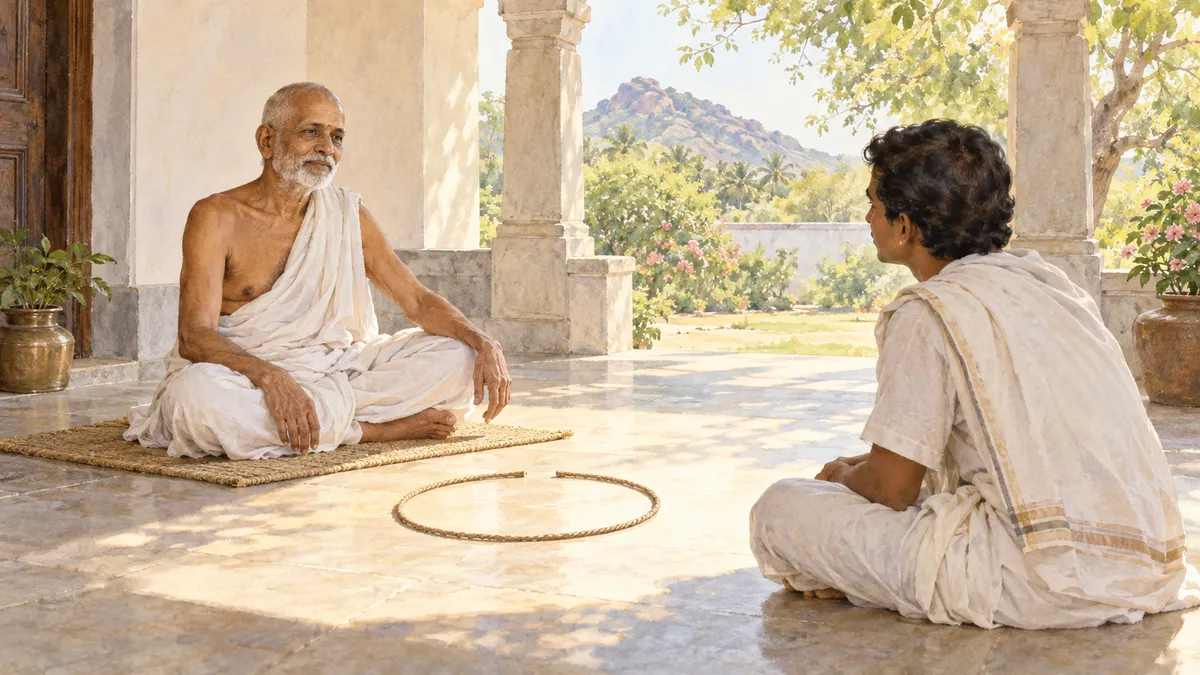
Maharshi: I have said that equality is the true sign of jnana. The very term “equality” implies the existence of differences, but by equality I mean that Oneness which jnanis perceive in all differences. Upon realization, you may see that all differences are very superficial, are by no means essential or permanent, and that the essence of all these appearances is the one Truth, Reality, what I call Oneness. You referred to sound, taste, form, smell, and so on. The jnani does indeed discern these distinctions, but he always perceives and experiences the one Reality in them. That is why he has no preferences. Whether he moves, speaks, or acts—all of this is the One in which his conduct manifests. He is not separate from the one supreme Truth.
Here a layman asked Ramana: “If sugar tastes sweet to me and wormwood tastes bitter, then it seems that a jnani must perceive them in the same way.” But Ramana says that the true sign of a jnani is equality. Equality is the one “taste,” soma-rasa.
What is equality based on? It is based on deep immersion in the Source. It cannot be said that differences are not perceived at all. If a jnani does not perceive differences, this means that he is not a jnani, or that he is a jnani who lacks discriminating wisdom.
Five Kinds of Wisdom
The fullness of realization means acquiring five kinds of wisdom, five kinds of the space of pure consciousness, each of which has its own particular way of perceiving reality.
When presence unites with the earth element (muladhara chakra), the wisdom of great equality arises; that is, everything is perceived solely as oneness and in no other way. Those who remain integrated with the earth element for a long time acquire extraordinarily stable powers of contemplation. They are very unshakable. Whatever happens, their consciousness does not waver.
When presence merges with the water element (svadhisthana chakra), the wisdom of the great mirror is attained—that is, the capacity of presence to reflect and reproduce. Those whose presence is developed at this chakra easily connect with other people and succeed in everything related to reflection.
When presence merges with the fire element (manipura chakra), it manifests as discriminating wisdom, the ability to sense nuances, subtleties, and shades. Suppose a person is unable to sense subtleties and nuances; this indicates a lack of discriminating wisdom. For example, Kashmiri weavers can distinguish up to a hundred shades of black in fabrics. But when discriminating wisdom is lacking, these shades cannot be perceived.
A jnani can sense every shade even more richly than an unawakened being. Yet all distinctions remain for him under the sign of equality, under the sign of the one space. All shades and differences are perceived not separately, but synthetically, as the play or ornamentation of the one space. This should be clearly understood.
For a jnani, an apple is an apple, and an onion is an onion. He will not eat an onion when he is supposed to eat an apple. But for him, both are one and the same Brahman, although they have certain differences. First and foremost, they are Brahman, and only then an apple and an onion.

The differences between objects, beings, and situations are insignificant, playful, empty, and self-liberated; they are like ornaments—such is the vision of a jnani. And Ramana says here: “Therefore, he has no preferences.”
It may be said that the basis of all these kinds of wisdom is all-encompassing wisdom, associated with the space element, in which differences do not confuse or mislead, while the all-encompassing wisdom of space is always discerned in all the other kinds of wisdom.
Disruptive Prana and Self-Liberation
Differences make a fundamental impression on the mind of a living being. Under their influence, the mind becomes severely destabilized. This influence is called “disruptive prana.” Disruptive prana obscures the primordial awareness of a living being. Therefore, when one speaks of attaining the one “taste” in contemplation, it means that the space of awareness must gain such strength that disruptive prana can no longer destabilize the mind. This means that moving thoughts become self-liberated at the moment objects are perceived. Objects of hearing, sight, touch, and the other senses become self-liberated at the moment of contact. One’s own thoughts and sensations become self-liberated, dissolving into the space of the Ground.
From time to time, you should ask yourself: “I have attained a certain level of awareness, but how deeply can I remain equanimous? In what situation? Where is the boundary beyond which I will be unable to self-liberate the situation? Where will my contemplation fail? I can self-liberate a minor insult, but will I maintain the same awareness if I am struck hard with a stick? I can self-liberate a small degree of comfort, but will I be able to remain dispassionate in the face of an overwhelming pleasure that makes one lose one’s mind? I can self-liberate a slight fear, but will I be able to observe with the same dispassion a terror that chills me to the bone? I can self-liberate a little pain, such as a pinprick, by entering into it and integrating it with awareness, but will my contemplation withstand severe pain? I can self-liberate minor mental activity, but what about intense mental activity? I can liberate a little confusion, but will I be able to liberate depression? I can liberate mild despondency, but will I be able to liberate severe tamas or dejection? I can liberate mild surprise, but will I be able to liberate the shock of encountering something extraordinary? Where is the boundary of my presence?” And when you reflect in this way, you clearly understand: “My self-liberation has a certain sphere of influence. Its boundaries extend from here to there.”
Once a practitioner has somewhat stabilized the natural state, their task is to continually expand the sphere of self-liberation—that is, to broaden the space of their consciousness and deepen it ever further, until its depth transcends the limitations of samsara, when nothing in samsara can any longer cause disruptive prana, confusion in consciousness, or loss of awareness.
A true jnani expands the scope of their self-liberation to an extraordinary degree.
It is said that when one of the kings of Kapilavastu attacked the Buddha Shakyamuni’s clan and nearly annihilated it in war, the Buddha, upon learning of this, said, “For some reason, I feel sad today.” In other words, his mind was self-liberated, although he did express a certain regret.
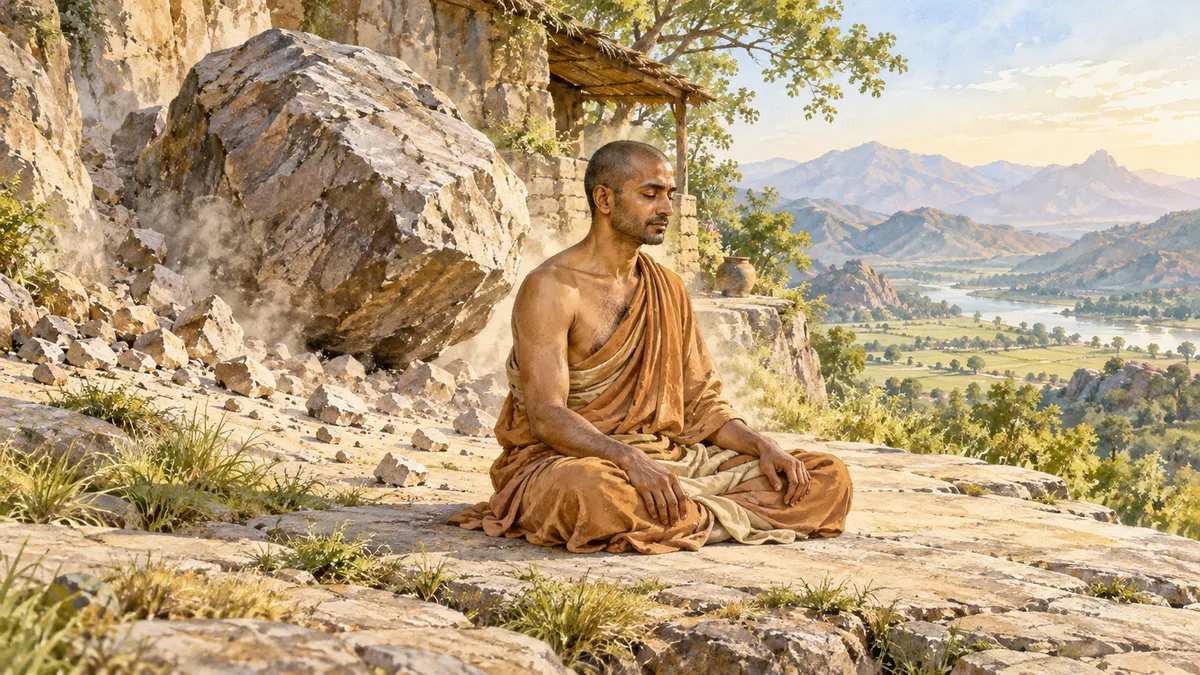
When a monk was meditating on his mountain, an evil spirit decided to do away with him and drive him off the mountain. It sent a huge boulder hurtling down behind the monk, and the boulder landed a meter behind him. The monk heard the crash but did not even turn around, so absorbed was he in contemplation. He thought, “Well, it did not fall on me. So why turn around?” This is the state of the single “taste” of all phenomena.
The ancient patriarchs used to say, “You should be like a mother who does not so much as blink after losing her only son.” “Does not so much as blink” means that she does not lose awareness or turn away from contemplative presence. Here, “son” refers to fluctuations of the mind, external fluctuations, and external influences.
Thus, when we have attained a certain level of the natural state, the next task is to deepen it and extend it to the dualistic pairs of opposites: suffering and pleasure, good and evil, pure and impure, joy and fear, pleasure and pain, comfort and discomfort.
Of course, if you are not stable in the practice of presence, then you simply need to continue training, stabilizing your natural contemplation. Genuine expansion of the scope of the natural state becomes possible at least at the stage of one who can maintain presence in dreams. When you can maintain presence in dreams, you can extend the scope of your contemplative space to encompass broader things. This guarantees that you have attained a certain degree of stability.
There was a saintly siddha named Jalandhari. He was one of the eighty-four renowned mahasiddhas. A queen approached him and asked him to bless her so that she might give birth to a son. Jalandhari said that she would bear a son, but after twelve years of his reign, he would have to become Jalandhari’s disciple, or else he would die. The son was born, lived in luxury, and received a royal upbringing. His name was Gopichandra. When twelve years of his reign had passed, Jalandhari came to his palace and told him that he had to relinquish the throne in order to become a sannyasin. His mother confirmed that such an agreement had been made. But Gopichandra had no intention of giving up the throne, so he ordered Jalandhari to be seized, a pit to be dug, and Jalandhari to be placed in it, with a burden set on top—an entire team harnessed to seventy elephants. He ordered the pit sealed and guards stationed around it. As soon as he had done this, he suddenly fell lifeless, just as Jalandhari had predicted: death had struck him down.
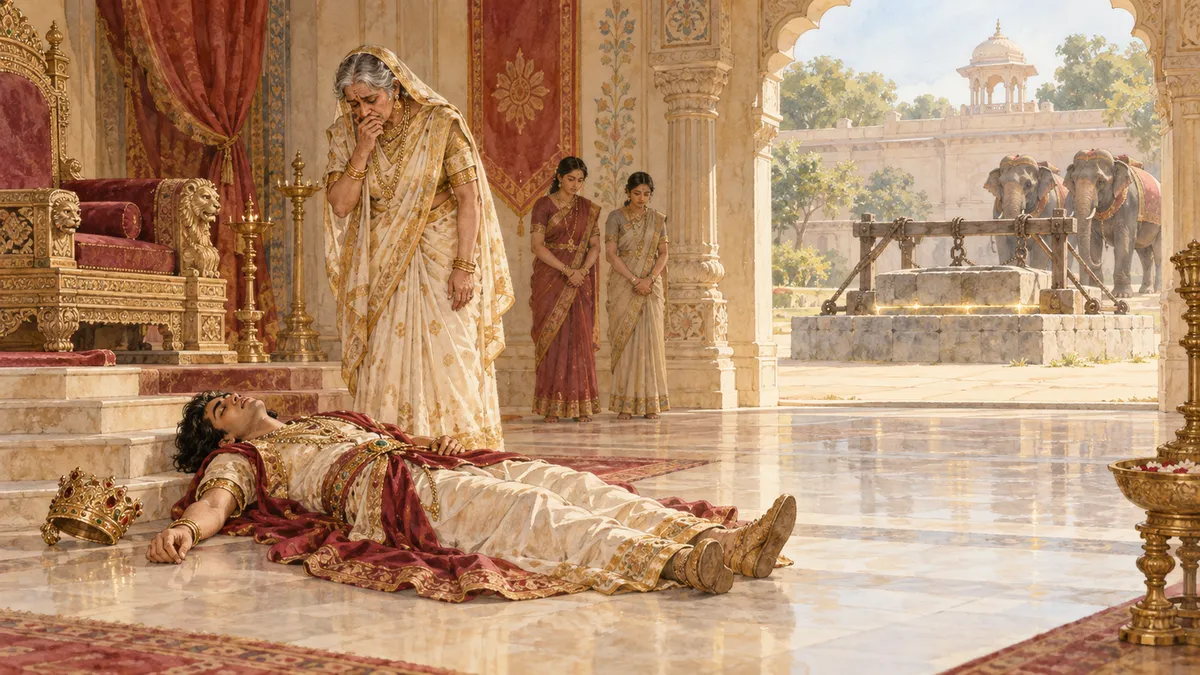
Then, at his mother's command, Jalandhari was pulled out of the pit, and he emerged unharmed. He revived Gopichandra and again told him that he must renounce the throne and become a sannyasin, his disciple. Gopichandra agreed with great reluctance. It is said that he was one of the most disobedient and attached disciples in all of history, so Jalandhari had to make tremendous efforts to train him, since Gopichandra had been thoroughly spoiled during his royal reign. Jalandhari cultivated in him a state of equanimity by awakening a sense of nonduality. In time, Gopichandra became a mahasiddha.
The Actions of a Jnani
Maharshi: You ask about jnanis. They are the same in all states or conditions, for they know Reality, the Truth. In the daily routine of eating, moving about, and so on, jnanis act only for others, doing nothing for themselves. I have said more than once that just as there are professional mourners, so too jnanis perform actions for the sake of others without attachment and without being affected by them.
In fact, “perform actions” is not an entirely adequate translation. Jnanis do nothing. They play, while to others it appears to be action. Self-liberated action arises from the space of non-action; it is play, or lila, adorning the natural state.
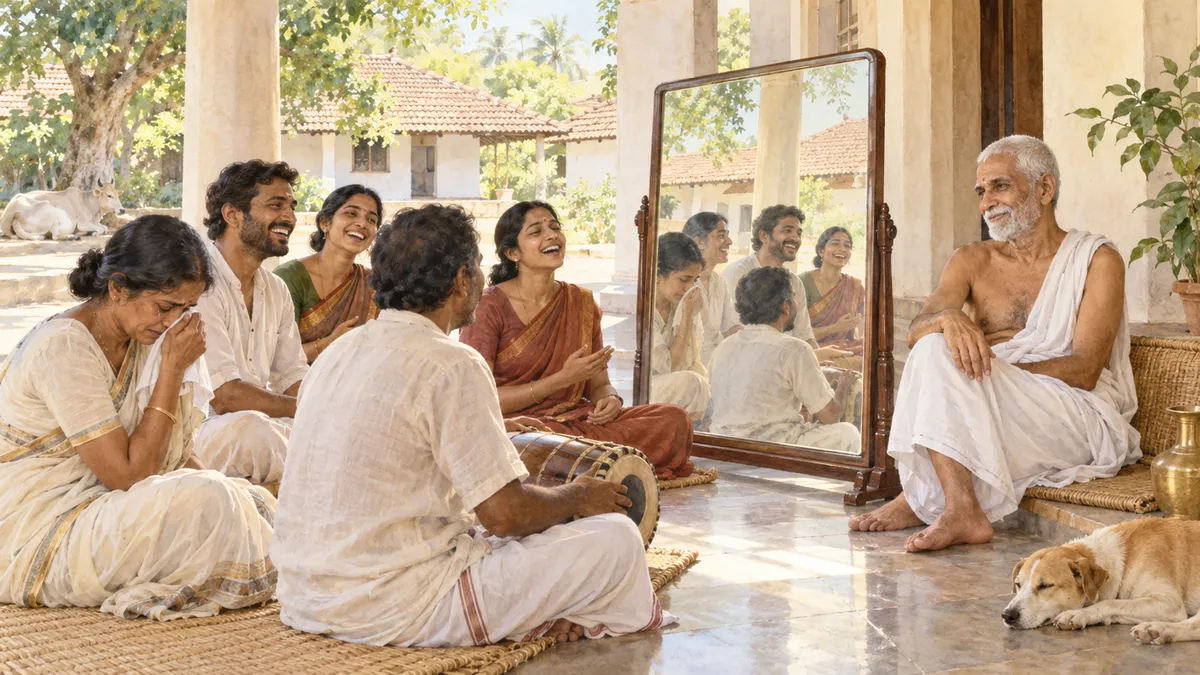
Maharshi: A jnani weeps with those who weep, laughs with those who laugh, plays with those who make merry, and sings with those who sing, keeping time. What does he lose? His presence is like a clean, untarnished mirror that reflects an image exactly as it is. But the jnani, being only the mirror, is unaffected by actions, for how can a mirror, or the stand on which it is mounted, be affected by reflections? Nothing acts upon them, for they are merely supports. On the other hand, ajnanis, the actors in this world—the performers of all actions—must determine for themselves which song and which performance serve the welfare of the world, what accords with the shastras, and what can practically be done.
Pure Vision and the Transformation of the World
How does a jnani attain the single “taste” of all phenomena? Someone might think that it is merely patience and courage in the face of joy and sorrow. In fact, this is not so. Patience or courage are not at issue here at all. By abiding in presence, the entire world is completely transformed. It becomes a pure space, a mandala of pure vision, because presence has the ability to change karmic vision. Then the whole world, from the atom to the largest universe, appears as a sacred, pure, and exalted space possessing a single emotion, a single sensation. And when a jnani abides in this pure space, in the mandala, he is always in another dimension of being. And while in this dimension of being, he no longer experiences any fluctuations. It is like a person who suffered terribly and suddenly found himself in a place where all his wishes are fulfilled, and who always feels joy; although many different things happen there, all of them have a single “taste”—the taste of joy.
In the same way, at the stage of pure vision, the yogin creates around himself a field of pure vision in which he abides continuously. He manifests pure vision on the subtle level when he visits the worlds of the Gods; he manifests pure vision on the gross level when he visits the worlds of hells or pretas, or dwells in the human world; but wherever he may be, he transforms any energy into pure vision.
What does it mean to transform energy into pure vision? There are other terms for this: “to bring into the mandala of contemplation,” “to integrate with the natural state.” That is, it means reuniting the Supreme Source with an object or situation until that object or situation becomes self-liberated.
Seeker: It is said that there are sadeha-muktas (those liberated while still alive in the body) and videha-muktas (those liberated at the moment of death).
Maharshi: There is no liberation, so where could muktas come from?
Seeker: But do not the Hindu shastras speak of mukti?
Maharshi: Mukti is synonymous with the Atman. Jivan-mukti (liberation while still in the body) and videha-mukti exist only for the ignorant. The jnani is not aware of mukti or bandha (bondage). Bondage, liberation, and the classes of mukti—all this is spoken of for the ajnani, in order to shake off the dust of his ignorance. There is only mukti and nothing else.
Pure Lands
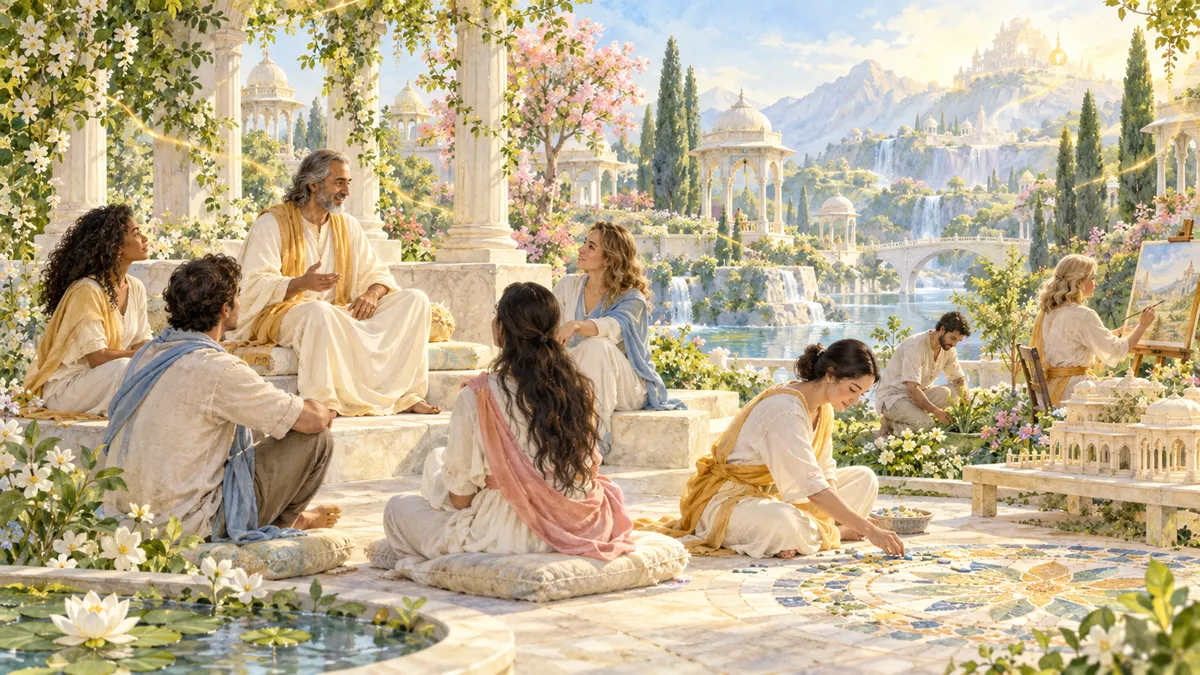
Where are practitioners who have not attained liberation reborn? If they have purified their impure karma, they are reborn in pure lands, where everything is filled with presence and everyone engages in spiritual practice. There is no suffering associated with the five elements there. There are favorable conditions for life and spiritual practice, as well as opportunities to receive teachings. If there is a conscious aspiration, strength of intention, and a pure desire to benefit others, or if pure-land practice has been performed, then such a person, without passing through the bardo, is instantly reborn in a pure land. There, they receive an adult body immediately endowed with all attributes, without losing the memories and abilities of their past life. It is said that they are born there from a lotus flower. But one who has weak faith in the pure lands has to remain inside a closed lotus bud for about five hundred years.
A pure land is a mandala in which a single “taste” is present to a certain degree. The inhabitants of pure lands always possess the four immeasurables. They are immersed in contemplative presence. Their physical bodies are free from the coarse elements of earth, water, or fire. For the most part, their bodies consist of purified elements.
Time and other spatial characteristics flow differently there; nevertheless, these are worlds similar to the human world, where one can have a body, live, communicate, and so forth. All inhabitants of the pure lands are immersed in certain levels of contemplation; that is, they are all practitioners, although not all of them have attained a high level.
Those who attain liberation and are reborn in the pure lands become teachers there and continue instructing the inhabitants of the pure lands on how to attain final liberation. The inhabitants of the pure lands also engage in various activities, mainly creativity and games. Creativity in landscape design, architecture, and art is highly developed in the pure lands. It can be said that “Divya Loka” is a projection of the pure lands, although time will tell to what extent it will be embodied. The pure worlds consist of presence, contemplation, the natural state, and the play of energy that adorns the natural state.
One who develops divine pride and succeeds in pure vision is also reborn in the pure lands. Some pure lands are wrathful; however, not everyone can enter the wrathful pure lands, but only those who have performed tantric sadhanas and developed a profound degree of presence, possessing the ability to unite the kleshas with the wisdoms. Therefore, most people should not yet aspire to enter the wrathful pure lands.
In fact, the teaching of Laya Yoga does not consist in transferring consciousness to the pure lands. Many Chinese schools are based on transferring consciousness to the pure lands. Their followers practice throughout their lives in order to transfer their consciousness to the pure lands and be reborn in the future in one of the worlds presided over by a saint. Each saint has their own pure lands: Maitreya’s heaven, Dattatreya’s pure lands, Goloka Vrindavan—the heaven of Krishna, Kailasa—the heaven of Shiva, Vaikuntha Loka—the pure lands of the god Vishnu, Brahma Loka—the pure lands of the god Brahma. And you will enter the pure land of the saint whose practice you perform. There are pure lands associated with specific mahasiddhas: the Tushita heaven of the gods, the heaven of Vajrayogini.
However, in the teaching of Laya Yoga, pure-land practice should be understood as abiding in pure vision in the present moment. There is no need to reflect specifically on the pure lands in the next life. It is believed that if you practice contemplation correctly, you live in a pure land during your lifetime, because your presence makes this possible.
Signs of Living in a Pure Land
The signs that a person lives in a pure land during their lifetime are:
- their mind is always equanimous;
- their character is gentle and beneficial to others;
- they always experience joy and delight because they abide in contemplation;
- they have a creative mind and therefore express themselves with great depth and subtlety;
- they possess great abilities in whatever they undertake;
- they are immersed in the experience of majesty, and the sense of the sacred never leaves them;
- he has no kleshas, at least no gross or intermediate ones;
- he has no gross clinging or attachments;
- he is not bound by conceptual thinking;
- his actions, words, and thoughts are self-liberated;
- he abides in non-action, although he acts;
- he contemplates infinity and transcendence in every object;
And one more thing: he does not feel sleepy during the bhajan mandala.
