

Commentary on the book “Spiritual Alchemy. The Path of Inner Asceticism”
The entire Teaching, all of Sanatana Dharma in its true essence, the teaching of Laya Yoga, is the path of inner alchemy, inner transformation, the path of inner asceticism. It is not the path of anything external, and external elements such as rituals and technical methods do exist, but as flowers, as leaves in the Teaching. Yet the entire spiritual path in general, in any religious tradition, takes place within. As soon as a religious tradition begins to overvalue something external, it begins to degenerate. And when we walk the spiritual path, we learn to be masters of inner alchemy, inner transformation, inner work.
The Three Principles of Sanatana Dharma
The Teaching of Sanatana Dharma is described by three main principles: shravana, manana, and nididhyasana, and this formula describes for us the path of how to carry out inner work.
First, we must prepare ourselves to do it: receive transmission, study the Teaching, and clarify many things for ourselves. Finally, within ourselves we must make a certain reassessment: separate, as they say, the wheat from the chaff; this is called manana. We must understand what in me is true and what is false; what is fake, what should be discarded within oneself, and what should be relied upon, what should be nurtured and cultivated — all of this is manana.
And finally, nididhyasana means that we must live only by means of the divine, only by means of the truth within ourselves, constantly recognizing the divine, constantly recognizing the truth, holding within ourselves only to it, while leaving behind and discarding everything false, everything fake.
At first, we do not know where the true, the divine is within us, and where the fake is, where God is within us and where maya is. We need to receive good theoretical preparation. But this is not enough, and we must truly reflect: “What, then, should I support within myself, and what should I discard; what should I rely on, and from what should I distance myself?” And finally, when we have understood this and carried out such an inner reassessment, discarded our ego, understood how to separate ourselves from emotions and concepts, and discovered the true within ourselves, we can, we have the right to follow the path of nididhyasana.
Human Love and Its Limitations
Understanding the principle of love is such a rethinking; this is precisely manana and nididhyasana. Until we understand the principle of love, what is true in it and what is false, and until we arrive at an understanding of true divine love, we will make mistakes. Because at first, human love is always inherent in us.
Love is that around which all human culture is built: love for a person, for family, love for children, and for some there may even be love for money — all of this is human love. Human love presupposes love for certain objects, things, and people in a state of ignorance, in a state of delusion. Human love is, in general, all love for the world; this is exactly raga. Raga is passionate attachment that keeps us in a certain world.
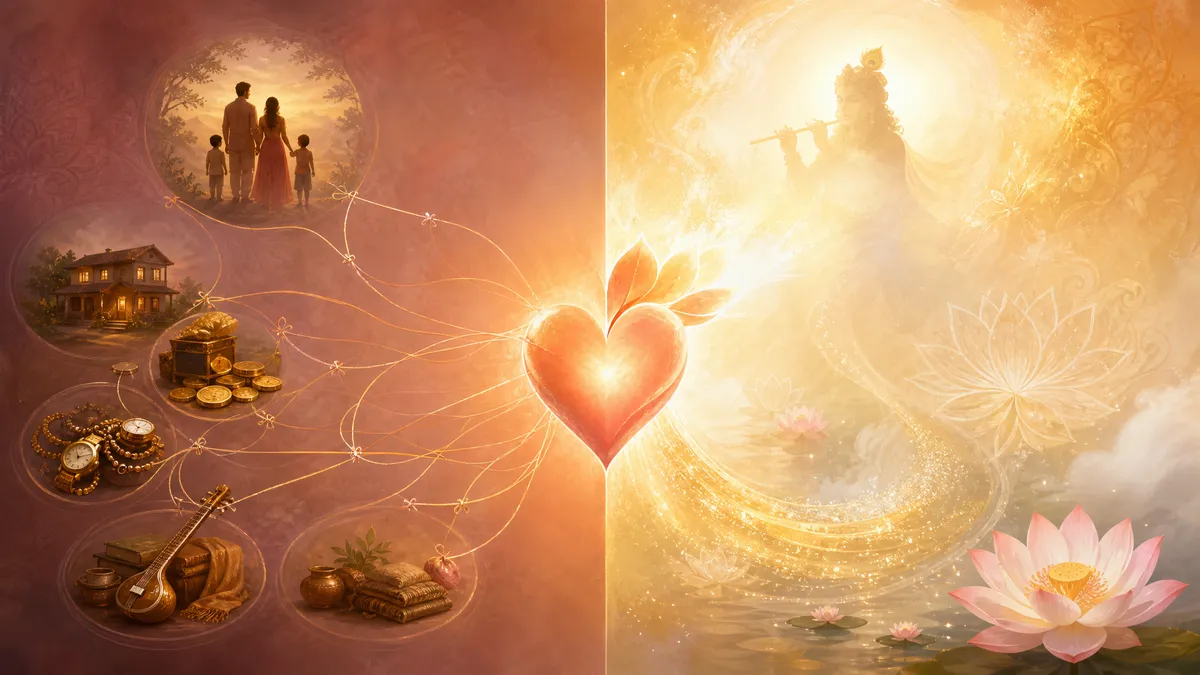
Human love does not shine; it blinds, and it is full of attachments. And it by no means warms the soul; it only scorches. It is based on passions, on attachments, on the emotions of the ego, on some of its delusions. If it is the love of two people, then it is the love of one body for another, one mind for another, one character for another, one personality for another. If it is love for something external, material, it is the love of the soul for possessing something. For example, for possessing diamonds, billions, yachts, villas; but in any case there is a stable egoistic attachment to possessing something.
And this love is blind; there is a saying about it: love is cruel. This love plays a trick on the soul, because the soul is greatly mistaken, being blind. This love does not know God; there is little happiness in it and much suffering. In the world of people, various dramatic stories about love are often widespread: Romeo and Juliet; Laura and Petrarch; Ivan and Marya. And all of these are very dramatic, great, soul-stirring stories, but they all end in suffering. And the fact that there is suffering in this love points to its false, incorrect nature, because this does not happen in divine love; in divine love it should not be so.
Suffering shows that the object was chosen incorrectly, and that love itself is blind. And this love is not sanctified by love from above; it is false, not deep, and blind, because it comes from the “I”; it does not seek God, it finds some surrogate for God and seeks from this surrogate the satisfaction of its attachments. But since the energy is strong and originally there is some divine spark behind it, it unfolds powerfully and brings strong upheavals. But it is accompanied by suffering, and this suffering points to its erroneous essence, because true love is infinite joy, and this love is connected with devotion to God without any attachments, and there is no suffering there.
Human love is merely a pitiful reflection of divine love; it is narrow, changeable, full of passions, and it is always based on the ego, because outside the state of ego, human love is impossible. And this love is always destructible, because the ego is always destructible, the ego is always vulnerable.
Sometimes human love extends not only to other people; it can also extend to oneself. That is, an egoist is a person who has made such a circle and closed his love upon himself. He has made himself the main one, seated himself on the throne, in the center, and loves only himself. But this is the same thing: such love for oneself is also a dramatic love, full of suffering, because instead of loving something absolute, a person has desired and become attached to something temporary, and has wanted to immortalize it.
Such love is always like intoxication of the mind, like opium, since it gives the soul neither freedom nor wisdom; yet it is precisely in such a state that 99% of the people of the modern world live. It is intoxication with various kinds of immature, selfish love. But the most exalted, the purest, perhaps, is still parental, maternal love; it is the most selfless.
One who is absorbed in such love is like a traveler who has fallen into a whirlpool and is drowning. A person, being subject to it, is deluded, because he exchanges God for a human being, or exchanges God for the possession of material things, or exchanges God for fame, for the ego, and he betrays God with all these things; that is, he puts such things first, ignoring the divine. And when such a substitution occurs, such a betrayal of God with something else, such a person cannot be happy in principle; such a person is always doomed to suffering, because he loses his path, his purpose, because he loves not God in the person, but the person himself, not his inner essence.
He sees not the divine in things, but the things themselves; he sees not the divine in anything, but that very thing itself. And then, loving, he serves this, but he serves not God in the person, not God in anything, but the person as a body. Serving this or that, he entrusts his soul not to the divine, but to the human; he takes refuge not in God, but in a person, or in a thing, in the ego; looking at them, he does not look at God, but at the mind, the body, the ego, things and objects of the material world. And then he is like a fool who bows to the suit but does not see, and ignores, the owner of the suit.
And such a person often thinks that he loves, but in reality he has fallen into slavery to the senses because of attachment, like a wild horse that has been cunningly lured into a trap, saddled, and bridled. And the saints say: “Lost soul, awaken; do not get stuck in human love, do not become like a bird caught in a snare; seek love for God and only God.”
Sometimes even people who have entered the spiritual path, who live in monasticism, in a monastery, are visited by similar temptations. Even after becoming novices, they manage inwardly, in their minds, to fall in love not with God, but with the person nearby. But if they are wise, they notice and cut off such tendencies; they say: “Mind, what are you doing? You came here to learn to love God, and you are looking for someone else to become attached to.” If he is an intelligent sadhu, he simply notices this as a tendency of the unpurified mind and simply purifies it within himself. Because if we are in monasticism, in the sangha, this is the very last thing the mind should be occupied with.
But on the other hand, we should not despise people in the world of people who live around this concept; we should not despise their human love, so that our heart does not become hardened. We should not think: “What kind of people are these, occupied with their loves?” At the very least, these are the most exalted feelings they experience; if they are purified, sublimated, and redirected toward the divine, this can become the path of their spiritual awakening. Rather, we need to understand human worldly love as very narrow, very small, and temporary; we need to understand it as that which is the precursor or forerunner of the soul’s real, true love for God. And when love for God awakens in us, only then do we become sadhus — spiritual travelers, spiritual seekers.
The Path from Anava-marga to Divine Love
Such love is also selfish at first; it is simply that we have a certain interest, a certain desire to break out of the limitations in which we find ourselves. We have a certain interest in improving ourselves, in becoming free, and this interest, our personal desire, personal perseverance, effort—all of this is the path of anava-marga, when we want to perfect ourselves, want enlightenment for ourselves, want perfection for ourselves. But the spiritual path is such that there is no enlightenment for oneself. The spiritual path is always a certain movement from the soul toward God.
And when we understand this, wisdom awakens in us, we leave the path of anava-marga and begin the path of jnana-marga, or yoga-marga. And yoga, true yoga-marga, is already a path that includes God, the Absolute, the Supreme Source. And for the yogin, God first comes in the form of his Guru and in the form of the Ishta-devata, because it is impossible to immediately love an abstraction set forth in the texts of Advaita Vedanta. How can I cling to it, aspire to it as Brahman without name and without form; how can I be devoted to it? It is impossible.
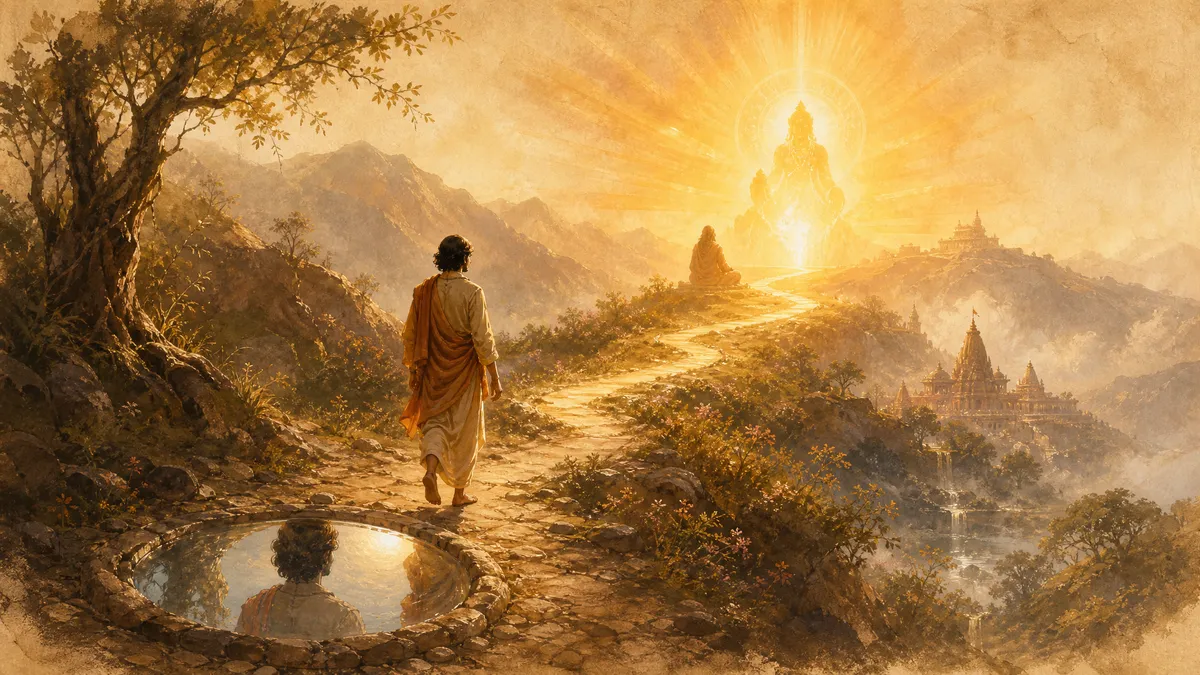
At first, the saints recommend developing faith and devotion toward something that can be seen, something that has a form. And all of this we call the Refuge, the Tree of Refuge. When we purify ourselves by reciting prayers, we need to visualize the Tree of Refuge, at the center of which is the Ishta-devata, at the center of which are all the saints. And this Tree of Refuge personifies God for us.
Gradually, as consciousness becomes more refined, we understand that the saints, the gods, the chosen Ishta-devata Bhagavan Dattatreya, are not a form; they are infinity, eternity, the boundless universal intelligence that assumes such a form so that we can establish a connection with it. And gradually our perception is purified and refined, and we can comprehend that Brahman, the Absolute, which is without qualities and attributes, that God who has no form but is present in all forms, playfully. And then our love is gradually purified and refined.
The Nature of Divine Love
Love for God is faith, the aspiration of the soul, its devotion, devotion to God to the point of self-forgetfulness. For this love, the external object and external expression are no longer so important. A person, an animal, a flower, a tree, a bee, a bird, a mountain, a river—for this love, everything becomes the same, because it sees everything as one; in everything it tries to seek and discern that God who is in all forms. And this love does not bind; it inspires. It is directed not at a person, not at an object, but at the one who is its root, its source. And it is not attached to anything or anyone in particular, except its source, its lord.
And if human love always has some self-interest, jealousy, attachment, then the soul’s love for God is selfless, and it asks for nothing, desires to possess nothing except service to God, except beholding Him, because to desire something else is like a beggar asking a rich man for a bowl of sour soup, while this rich man is ready to give him everything. And such love is more dispassionate, deeper, silent, constant, and it does not disappear over the years. Human love quickly flares up, and then over the years it quickly fades, barely smolders, or disappears altogether.
Nowadays in the world, they say, there is a crisis of incompatibility: eight hundred divorces for every thousand marriages. Twenty years ago, such statistics did not exist. In Europe, the topic of legalizing same-sex marriage is being raised; this love has already become tiresome, people are looking for something new. Moreover, many say that same-sex marriage is already yesterday’s news; Norway, Finland, and other countries—there they are already proposing thirty variants of marriage, thirty variants of different combinations of marriage are possible, that is, even if you use all your imagination, it will be very difficult for you.
This is a crisis of one person’s attachment to another. The human ego has felt a little freedom and thinks: why shouldn’t I make such a configuration, and why not that one? But this love is, in principle, in crisis; it is, in principle, false, mistaken, and that is precisely why there is a crisis of the institution of the family, a crisis of the traditional institution of marriage. Some time will pass, and there will be a crisis of same-sex love, then there will be a crisis of multivariant love, because all these things are false from the very beginning. From the very beginning, the attempt to love something outside, the attempt to make it a support, is mistaken; therefore it flares up and fades away, but love for God grows for a long time in the soul of the seeker. And it grows gradually, like a smoldering flame.
The soul’s love for God has no human passions; there is no passionate desire in it that comes from the ego, but it has its own special fire: the fire of bhakti, prema, faith, devotion. And this love is a privilege; it cannot be given to everyone. One cannot simply declare to an unpurified, egoistic, attached person: “Here, I already possess divine love.” This is impossible, because such love requires discipline, purification, and the taming of the mind.
The Story of Prahlada and the Asuras
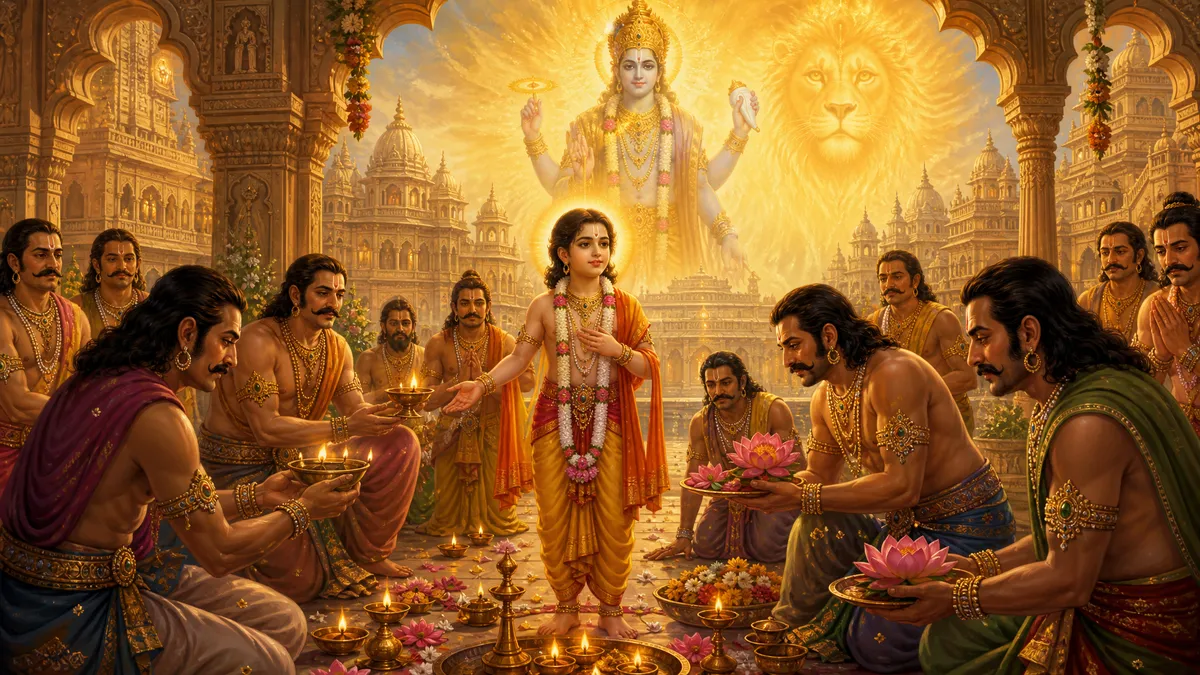
It is like in the story of Prahlada: when Narasimha killed Hiranyakashipu and destroyed the entire kingdom of the asuras, Prahlada began to think: “All my relatives, the asuras, have been killed; the kingdom of the asuras has been destroyed. What are we to do now, how is the asuric civilization to continue existing?” And he thought: “Here are the gods: they are always under the protection of Vishnu; Vishnu has always protected me, and I myself am a devotee of Vishnu.” And he thought: “I will make the entire civilization of the asuras devoted to Vishnu, so that all of them become worshipers of Vishnu.” He said: “Since Vishnu is the most powerful deity in the universe that I know, let us worship him.” All the asuras said: “Now that Hiranyakashipu has been killed, there is nothing else left to do,” and they began performing rituals, invoking Vishnu, and worshiping the god Vishnu.
And this reached the ears of the gods, and the gods were outraged, because it is believed that worshiping Vishnu is possible only in sattva, and this had always been the privilege of the gods, of divine beings; but here some asuras, demonic beings full of rajas and tamas, suddenly also all began to worship Vishnu, and it was as if they no longer had any enemies. And they came to Vishnu with a complaint and said: “Lord Vishnu, some absurdity is taking place: the asuras have begun worshiping you just as we do, yet it is believed that only after many lives can a person come to worship in the sattva-guna, to worship you.”
True Love for God and the Sattvic State
True love for God requires purification, and one can truly love God only in the state of sattva, because human love is rajas. Love for material things and external pleasures is also a mixture of tamas and rajas. But love for God, as the purest and most exalted, is possible only in a sattvic state, and such a sattvic state must still be earned.
When we learn to tame the mind, tame the ego, and observe feelings and emotions, we cultivate sattvic qualities within ourselves. When we practice inner tapasya, austerity, and purify ourselves, sooner or later we become capable of such a sattvic perception of the divine.
Divine love, its flame, flares up gradually, but over the years it grows stronger and stronger. And this small fire, which once flared up in a devoted heart, in due time becomes a great, all-consuming, universal flame. And this universal flame burns up in the soul the forest of our egoism, the thickets of desires, and the jungle of passions. And this fire does not burn; it warms. It does not blind, but illuminates our consciousness.
And until such love is born, until it burns up all our desires, all our illusions that come from the ego, it is difficult to speak of the truths of Advaita in order to realize them, because true Advaita is possible only in the state of a burned ego, when the ego has been burned together with all its attachments, desires, and ambitions. Then the state of Advaita is possible; then it comes. If the ego has not been burned, no matter how much the ego says, “Aham Brahmasmi,” everything is illusion, everything is illusion; it will be like the babbling of a small child.
Divine Love Versus Earthly Love
When love for God flares up in the soul, then human, earthly love seems to it like a heavy dream, an intoxication of love. Earthly love for material things, earthly love for fame, power, honor, pleasures, or earthly love for a person — all of this is a heavy dream, a heavy intoxication of love, because the soul that has come to love the divine, that has caught the taste of the divine, that has come to love contemplating God, being in the presence of God, that has come to love self-surrender to the Divine even in the slightest degree, no longer wishes to love anyone or anything.
Because it understands that this heavenly nectar from a golden vessel is not exchanged for water from a puddle. And only the person who has never tasted this nectar is tempted by various earthly passions and seductions; they tempt him because he does not know the taste of this nectar. But whoever has tasted it even for a moment develops natural vairagya, dispassion, indifference toward all earthly loves.
The soul that has tasted such nectar of love for the Divine, through contemplation, self-giving, seva (service), and worship, dwells day and night in such a nectarean state of love for its beloved, as if in such sweet, contemplative dreams, directing its mind toward its source, and this love has neither flaws nor obscurations.
And here, when we use the word “love” and say that the soul abides in such a state, we are describing the state of contemplative presence, nididhyasana. Contemplative presence is always the soul’s standing before the Divine; it is always the establishing of a connection, of certain contacts with the Divine Source. And this is not merely some cold, lifeless contact somewhere at the level of the mind; this contact includes all our energy, all our inner strength, and it always inspires; this inspiration is experienced as immense joy, immense bliss. And against the background of this joy and bliss, seeking worldly joys, worldly forms of bliss, is simply uninteresting; there is no point.
The Manifestation of Divine Love Toward People
To love God with all one’s soul does not mean becoming hardened and deaf to people, to external reality; on the contrary, if you have love for the Divine in your soul, it must be manifested toward people, because the God whom we revere—Brahman, the Absolute, the Nature of Dattatreya—is the omnipresent consciousness that exists everywhere, including in people. But this is no longer that human, attached, proud, false, ignorant, haughty, jealous love; it is even, quiet, calm love; it is the four immeasurables.
When we practice the meditation of the four immeasurables every day, we attune ourselves to the divine love of Brahma the Creator; we attune ourselves to the love of Bhagavan Dattatreya; we try to become channels of this love, and then direct it toward all living beings. For decades we practice and practice this.
We can notice that the love in the four immeasurables that we emanate toward all humanity, toward all living beings, is not passionate love; it is very subtle, very pure, very joyful. It is full of unconditional love and compassion; there is nothing jealous in it, nothing proud, nothing attached, but it is a very exalted state. It is the love of a wise soul for God, of an awakening soul.
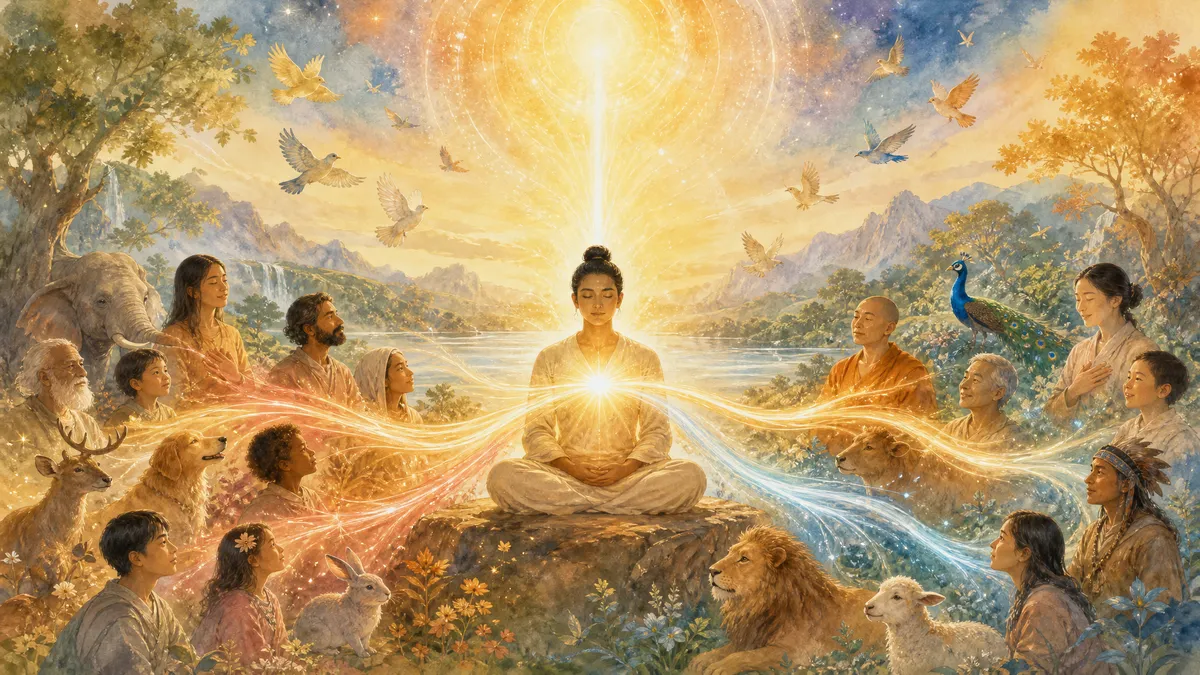
When we make the namaste gesture, we also manifest this love, saying: I greet the divine in you. This love is quiet and humble; it does not look at any earthly things, at human things, and it is wholly directed toward the divine, toward the primordial Lord, toward the Supreme Source, toward the Absolute.
But if a person, hardened in soul, speaks of love for God, then he is, of course, being hypocritical, because it is impossible to love the whole while rejecting its parts. If you meet such an ascetic who loves God very much yet manifests hardness toward others, then either this is some kind of mad game aimed at educating other people, or it is hypocrisy.
The Transforming Power of Divine Love
Love for God illuminates the soul with its rays; it literally floods it with nectar; it purifies it of coarse desires, attachments, self-love, and egoism. If you have even a glimpse of such true love, then you must go further.
If you try to fight attachments, the ego, pride, egoism, self-love, and kleshas on your own, it will be difficult for you, because there will always be a war in your soul: one part of you will declare war on another part of the soul. Your aspiring part will say: I will cut off the kleshas, I will cut off pride, the ego, I will fight attachments; but inside you there will be a constant war—you will be fighting with yourself, and it is difficult to win this war.
But if you develop love for God within yourself through Guru Yoga, through worship, through devotion to the Ishta Devata, through the Tree of Refuge, through the four immeasurables, through honoring elders, through honoring all living beings (both younger and older), through service to brothers and sisters in the Dharma, through seeing the divine principle in everyone—if you develop such true love within yourself, then it will be very easy for you to overcome any encroachments of the ego, and there will be no war within you; there will be peace, joy, and calm.
Three Stages of Liberation: From Self-Liberation to Self-Giving
The soul, under the influence of love for God, blossoms like a magical flower watered with amrita (the elixir of the gods). To be in contemplative presence, in the state of nididhyasana, to be in a state of awareness, means not only directing some part of one’s consciousness and maintaining awareness: at high stages, it means complete self-surrender, prapatti, atmanivedana, that is, the complete offering of oneself.
If you know, in the Teaching there are three important stages that everyone passes through on the path to liberation:
The first stage is self-liberation, pratimoksha. And at this stage we learn to abide in a state of awareness, freeing ourselves from emotions and thoughts through attentiveness, through maintaining presence. And to some extent we begin to free ourselves from thoughts, from attachments.
The next stage is called prapatti — the casting off of the ego, self-surrender, atmanivedana — the offering of the soul to God. And here this is possible precisely when we have complete devotion, complete love, complete self-surrender.
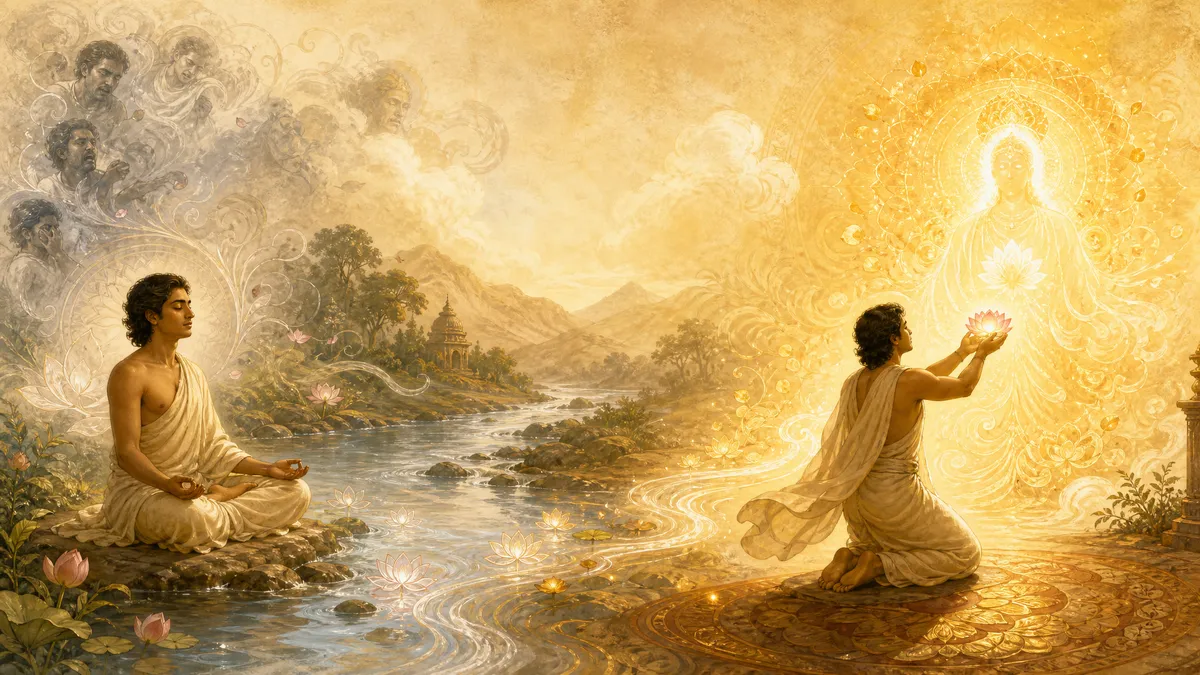
Inexperienced yogis often say: I understand everything, but I cannot self-liberate. And this is so, because self-liberation at the level of the mind cannot deal with the kleshas at the level of energy. The kleshas and attachments at the level of energy are much stronger than our small, little contemplation, our small, little presence; it is still very weak.
But if you have self-surrender and love for God, and you begin to place God first everywhere and always, and yourself second, third, fifth, if you have truly been imbued with the spirit of atmanivedana, self-surrender, if you have such love day and night, in sleep and in waking, in joy, in sorrow, in pleasure and suffering, then for you this happens naturally.
Then, in the process of such self-surrender, ananda manifests, and contemplation ceases to be only a purely conscious process; your entire being, your whole spirit, and all your emotions become involved in it. And then the soul loves the divine without choice, without distinction, without gain, for the sake of love itself, to the point of self-forgetfulness, to the point of self-surrender. And it is born into such a new life toward the divine. This is no longer the life of an ordinary soul that constantly watches itself, tries to live in self-discipline; it is a new life as ecstasy, life as play, it is life in God, it is the life of a holy person.
Life in divine ecstasy
And such a soul, having awakened its flame of pure love for God, no longer struggles with the kleshas; it plays, dances, and sings in rapture. Often, when students used to come to me with problems, explaining the essence of the problem, I would say: “Your problem is not in this; your problem is that you are not dancing in ecstasy — that is the problem. If you were dancing in ecstasy out of love for God, would you really be talking about this?
What you are talking about now is a temporary, particular problem, but the most important problem is that you do not dance and sing out of love. Begin to sing and dance in ecstasy out of love for God, and all this will pass; you will forget all of it; for you it will all become unimportant: someone said something to you in the wrong way, you did not manage to stop the mind in meditation — none of this is important, because if you are dancing in ecstasy, in rapture from God, all this does not impress you too much, does not concern you too much — you are all the time in rapture, in a state of divine ananda, you are ready to love everyone, you are ready to accept everything, you are ready to serve everyone, you are ready to change your personality.
It is not difficult for you to serve others, it is not at all difficult for you to remove yourself, not at all difficult; you act only for God, only for others, you become an empty conduit and vessel of the Divine Will, you become the illusory body of God, you cease to have your own goals in life except the Divine, you cease to have your own ambitions in life except offering yourself to God, you cease to separate yourself from others — this is true holiness.”
And we need to try to leave behind such immature human love and surrender ourselves to love for God, which is called atmanivedana, prapatti — the casting off of the ego. In her time, Parvati surrendered herself to Shiva, Radharani left everything for Krishna, Sita went into the forest after Rama, and these are examples from the Vedic epic and the Mahabharata of how the soul should follow God.
And my blessings are that you leave behind human, earthly love within yourselves: love for yourself, love for the mind, love for the material world, love for illusions, love for pride, for anything at all — all of this is human, earthly love — for the sake of divine love. May you subordinate this love, purify it, and become permeated with the amrita of the gods; only in this case is true liberation possible.
Om Shanti. Namaste.
