

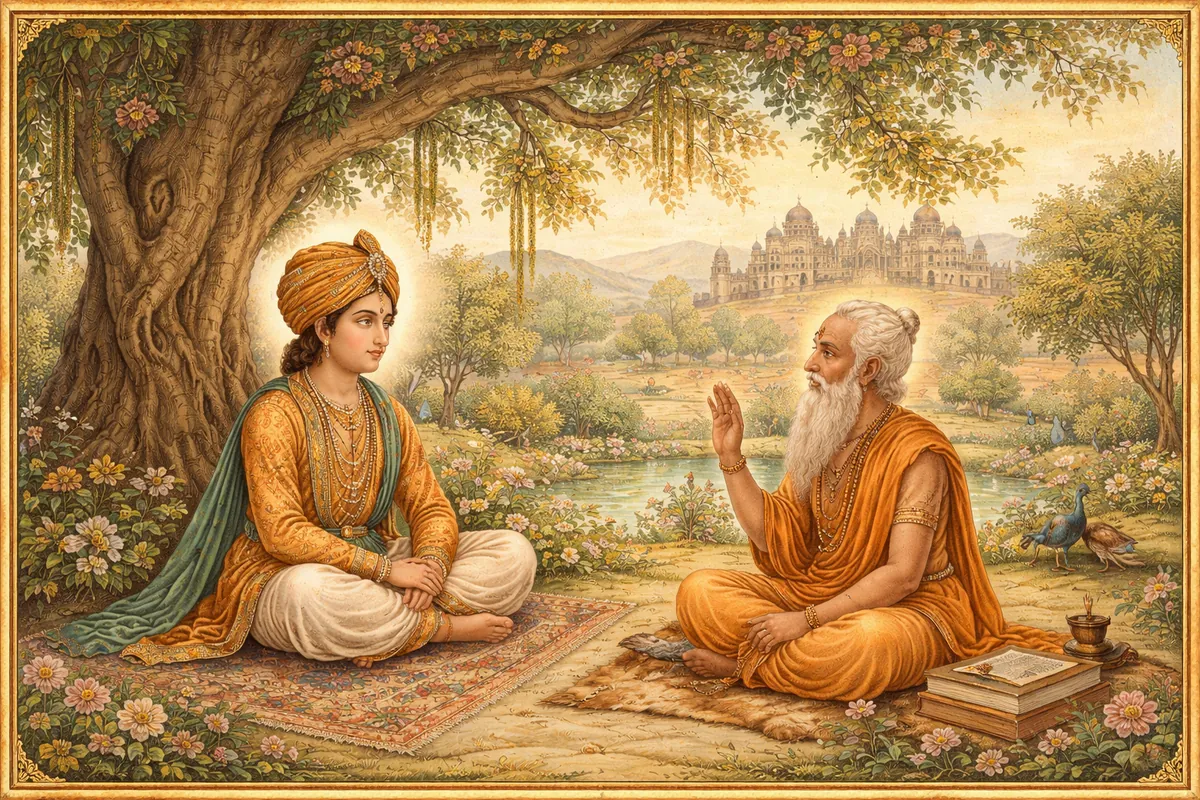
Commentary on the text “Yoga Vasistha. Chapter 5. On the End”
Vasistha said:
— O Rama, then listen to the discourse on the end of the Universe and the attainment of supreme peace. This seemingly infinite world is supported by impure (rajas) and ignorant (tamas) beings, just as a huge structure is supported by pillars. But it is easily and playfully abandoned by those whose essence is pure, as a snake easily leaves a foul-smelling swamp. Those whose essence is pure (sattva) and whose activity is based on purity and light do not live their lives mechanically; they contemplate the Source and the essence of the seeming world.
The path of liberation consists in returning to the Source of this Universe and freeing oneself from the laws of this Universe imposed upon us by material nature. We found ourselves in this Universe by being born in it, and this is a fact. We are subject to the laws of this Universe, for example, the law of karma, the law of time, space, and many other things. In the siddhanta, these are called kanchukas. Kanchukas are certain energies that limit us. These are pure divine energies, but, mixing with material nature and being reflected in it, they become fetters for us. The soul has fallen into these fetters.
Everything begins with the fact that we must deeply comprehend that this world is not meant for enjoyment, it is not meant for worldly happiness, that any attempts to find worldly happiness, to take on the role of the enjoyer, that is, to adopt mithunya bhava, are veiled suffering; this is the path to suffering.
Those who try to enjoy the material world are building their own road to suffering. This does not mean that one should not enjoy, that one should fall into a gloomy state, suffering, and depression. It does not mean that enjoyment is impossible in principle. On the contrary, Sanatana Dharma says that ananda (divine happiness, joy, bliss) is the nature of God. One only has to understand what should be enjoyed and what should not. That is the whole point. And when we do not understand what should be enjoyed and what should not, this is called mithunya bhava.
Mithunya Bhava and Purusha Bhava
Mithunya bhava is a very strong craving for pleasures. It arises as a result of aviveka (the absence of discriminating wisdom). For example, modern consumer culture forms a craving for pleasures through the possession of material things. But when a person develops the desire to act in this spirit, after some time he becomes disappointed, because material things do not provide constant, eternal enjoyment.
And who is a sadhu? It is one who has understood all this to some extent, who has awakened a little viveka (discernment) and understood that one must leave mithunya bhava and seek purusha bhava.
Purusha bhava is the bhava of Ishvara, the bhava of God, the bhava of one who possesses purnatva (is completely self-sufficient), the bhava of Dattatreya, the bhava of Shiva, the bhava of Guru Brahmananda and all the saints. Mithunya bhava (the craving for the pleasures of the material world) is the position of a fool (mudha, a donkey). Purusha bhava and uttama-purusha bhava are the position of a truly wise being.
But to break away from mithunya bhava and move to purusha bhava is in fact a very difficult task, because the soul has centuries-old, one might say millennia-old tendencies of this mithunya bhava, and they are deposited in the form of vasanas, in the form of samskaras. If everything is done quickly, it means literally tearing everything away “from the living flesh,” and the soul will even suffer.
The Difficulty of the Spiritual Path
Why is the spiritual path so difficult? Why is it more difficult than, for example, the study of physics, mathematics, or sports? It would seem that in both cases, you make efforts and become a champion. It would seem that many saints could be produced. Just as in sports. In sports, to become even a master of sports of international class, as one athlete shared in his revelations, one must work for ten years, six to eight hours a day. But in reality spiritual people work much more — twelve hours a day for twenty, thirty, and fifty years. But why is it more difficult to become a saint than to become, for example, a champion or a master of sports?
Or any Doctor of Sciences will say that if you have an inclination and intelligence, then in order to become a Doctor of Sciences, you need to work well for ten years, six to eight hours a day: read books, write texts, study, complete postgraduate studies, doctoral studies, defend a candidate dissertation, defend a doctoral dissertation, write and publish several monographs. And that is it — you are a respected person in the world of science, and everyone takes your opinion into account.
But in spiritual life everything is different: ten years pass, much effort has been applied, yet for some reason you still have not become a respected person in the world of the saints. At best, you are respected among sadhus like yourself. You have not yet become a champion. This is a mystery to many. And many think: “Something is wrong. Perhaps I am doing something wrong? Perhaps the method is not the right one?” Or some doubt: “Perhaps the Teaching does not save? Perhaps it is devoid of grace?”
Do not doubt! It is all the same, but there is mithunya bhava and karma. On the spiritual path, one has to go against the current of one’s own karma. That is the whole point. And purusha bhava (enlightened bhava) does not come just like that. Mithunya bhava creates a great many obstacles. The mind, like a disobedient calf, constantly breaks loose and strives to go its own ways. This is the problem.
The Necessity of Constant Reflection
“When such reflections are carried out through proper study of the scriptures and in the company of the wise, pure understanding arises, in which the truth is seen as if by the light of a lamp. Until this truth is personally experienced through such reflections, it is truly not seen. O Rama, your nature is pure.”
Until we have trained ourselves to constantly exercise our brain, to constantly reflect, the Truth is not visible. Therefore a sadhu exercises himself in viveka (discernment); first he exercises himself in analytical wisdom. Many try to immediately practice concentration, contemplation. What is there to say—some immediately try to abide in the natural state, so as not to bother with trifles.
But there is no need to indulge in illusions. Everything comes gradually. Even when you receive direct introduction, analytical work is necessary; moreover, it must be carried out constantly. Without viveka, without analytical work, without studying texts, without studying philosophy, you will be very vulnerable to the blows of karma, for example, to changes in astrology, to arising situations. Such is the position of an ordinary person.
How does an ordinary person live? First, in kindergarten he thinks: “If only I could go to school sooner! Kindergarten is nothing special, but school will be interesting!” He goes to school, and it turns out that now he has to sit at a desk for ten years, study, and this is boring and quickly becomes tiresome. Then he thinks: “If only I could go to university sooner,” or “If only I could go into the army sooner.” (As a child, I saw a company of soldiers with belt buckles, with assault rifles, in boots. They marched past, stamping their steps, and I thought: “If only I could go into the army sooner!” Where do such thoughts come from? From cultural conditioning, society, the surrounding environment.)
Then the child enters the army or university and understands that something here is not what he imagined, and he thinks: “If only it would all end sooner, and I could go to work. There I will become a free person, there I will be my own master. A free life, new opportunities!” He goes to work, and then what? He is a young specialist, everyone pushes him around, bosses, unfavorable working conditions, and he is forced to work—there is nowhere else to go. And if there is also a family, children, responsibility. Many girls think: “If only I could get married sooner!” And what then? After some time the enchantment fades, the veil falls from their eyes, and they find themselves with two children in their arms, with an unmanageable husband, with a job, and huddling in some unattractive conditions. That is “marriage.” Does this happen? It happens.
A person feels that he has harnessed himself to some burden, but it does not occur to him to make sense of his life, to carry out analytical work. He thinks about what next institution is looming ahead, what next social pattern is being offered to him: “If only this job would end sooner, if only I could retire sooner.” Many think: “When retirement comes, I will be freed from this cursed job, I will receive money.” Retirement comes (that is, if he lives to retirement), and it is clear that his health is no longer the same, and suddenly he feels emptiness, boredom, and thinks: “What next? What else does society offer me, what is the next institution?” And here he understands that life can no longer be hurried. The next “if only it would come sooner” leads where? To the bardo! He understands that he had been jumping through these social patterns, through these social institutions, thoughtlessly, and this “if only it would come sooner” no longer works here. A person finds himself in a kind of worldview dead end: “Where next?” And then he thinks: “Why did I say ‘if only it would come sooner’? How foolish I was! What a wonderful time it was—kindergarten, school, work, when I was full of strength...” And he says: “That was the time... Back then I was like this...” But in fact, at that time he did not consider it a good state at all; he wanted it to pass sooner. It turns out that a person’s whole life passed in a state in which he thought: “If only all this would pass sooner.” This is aviveka (lack of discernment).
The Path of the Sadhu and Achyuta-gotra
A sadhu must engage in an analysis of such a situation; he must develop an entirely different tactic of life; he must learn to identify himself not with temporary things, but with the divine, eternal, and infinite. He must stop driving subjective time onward. After all, objective time cannot be driven onward, but one can try to drive subjective time onward. To be a sadhu means to learn to abide in that which is beyond the race of the mind, beyond the temporal.
Every sadhu belongs not to some gotra, clan, lineage, or family in India. When a sadhu is asked which gotra he belongs to, some of them answer: “To Achyuta-gotra.” Achyuta-gotra is the family of God. “What family are you from?” “From the family of God.” “Achyuta” is translated as “unshakable, eternal.” It is one of the names of Vishnu. There is even Shankara’s commentary on the Sahasranama, the thousand names of Vishnu, where he writes: “This is the one who never loses his nature and power. That which is not subject to change or fall.” Achyuta is the opposite of chyuta. Chyuta is something fallen, disintegrating, subject to change. And a sadhu belongs to Achyuta-gotra—the family of God.
Varnashrama-dharma as the path out of samsara
The question is how, on the spiritual path, one can begin to belong to the family of God and how to get out of this karmic whirl. This karmic whirl is not limited only to our life, the Earth, country, or nation. It has universal dimensions. It is a very great whirl, and we have been revolving in it for a long time. And in the Vedantic tradition there exists an entire institution that facilitates the way out of this whirl of samsara. It is called varnashrama-dharma.
Varnas are the four estates, and ashramas are the four modes of life. The four estates are:
- brahmanas (intellectuals)
- kshatriyas (administrators)
- vaishyas (merchants, businessmen)
- shudras (workers, executors, artisans)
And the modes of life are:
- brahmacharis (those who, in youth, are undergoing training)
- grihasthas (householders)
- vanaprasthas (those who have withdrawn from affairs)
- sannyasis (monks—those who have fully dedicated themselves to liberation)
For each stage of life there is its own period of life and its own status. And when we follow the tradition of Sanatana Dharma, after some time we conduct an analysis; we ask ourselves: “Who am I in general by status? Who am I according to Dharma? In what conditions do I live? What is my future? What are the rules of my behavior, my code of conduct? What are my intentions? What are my goals?” It is very important to ask oneself such questions. This is analysis.
Analysis of identifications and responsibility
Then we begin, for example, to reflect: “I am Russian” or “I am Ukrainian,” “I am a believer in Sanatana Dharma” or “I am a disciple of my Guru.” If one has taken diksha, then “I am a karma-sannyasi or a sannyasi.” “I am a sadhu,” if I practice seriously and have cultivated the qualities within myself. If a person is a married karma-sannyasi, then in addition to this he may think: “I am a husband,” “I am a wife.” If he works somewhere, he may think: “I am a businessman.” Or if there are children and parents, then “I am a father” or “I am a son.” That is, he defines the circle of his identifications, and the circle of identifications always entails responsibility. We are responsible for that with which we are more identified, and we are not responsible for that with which we are less identified.
Identifications are characterized by the present prarabdha karma given to us. For example, if you are not responsible for Ussuri tigers, for instance, you are not identified with them; you have not thought about Ussuri tigers; it has not occurred to you to care for them, to think about their population, about how to preserve them. You have no responsibility for them whatsoever. You are not identified with them, therefore you have no responsibility whatsoever; you have no karmic connection with them. But if you identify yourself with anything—and it does not matter with what, with absolutely anything—then karmic responsibility immediately arises. From responsibility follows the principle of Dharma—how one must act correctly in order to transcend this responsibility, dissolve it, and extract wisdom, strength, and benefit from it. And Dharma determines the circle of obligations, duties, and actions.
To engage in analysis means to become aware of one’s identifications, one’s karmic debts, one’s status, one’s responsibility, one’s Dharma, one’s powers, and one’s duties. That is, if you are a disciple, then you have such-and-such powers, such-and-such duties, such-and-such responsibility. If you are a karma-sannyasi, then you have such-and-such commandments and such-and-such responsibility. If you are a sannyasi, then such-and-such responsibility. If you are a husband or wife in a Vedic family, then such-and-such obligations; if a novice, then such-and-such; if a businessman in the world, then such-and-such obligations; a father or a son, then, accordingly, parental or filial duties. If you are a believer in Sanatana Dharma, then a certain code of conduct is prescribed for you in connection with this.
All of this is comprehended through analysis of one’s life: “Who are we?” Even representatives of the lower strata of the population, when they meet, ask each other: “And who are you in life, anyway?” That is, one needs to understand what one identifies oneself with. If you identify yourself with something, then you have a connection with some culture, some group of people. And depending on what you identify yourself with, one or another code of conduct and duties is prescribed for you.
The Trap of Nastika-drishti
The same happens with a sadhu. A sadhu must understand his place. And here there is a serious trap—the possibility of falling into what is called nastika-drishti (the worldview of a nihilist or the worldview of pralaya-kala). This is a serious trap, which consists in saying so frivolously, having heard the view of Advaita: “I have no responsibility, because I am Brahman!”
To say “I am Brahman” is permissible in the view, but in behavior it is impermissible. Why? Because in behavior we all have a certain karma and a certain level of identification. For example, we are identified with the body, and this means that we have a certain Dharma for the body. If for Brahman it is all the same whether to eat and drink or not to eat or drink at all, is it all the same for the body? No, of course not. This means that we have a responsibility at least toward the body: to feed it the necessary foods and not to feed it unnecessary ones.
If at the level of behavior we declare “I am Brahman,” then we are, as it were, declaring that it makes no difference to me, that it makes no difference to my body, but this is not so. For Brahman, for example, it makes no difference whether the temperature is +5000°C or -273°C (absolute zero). But for us it does make a difference. For us, a temperature of +36.6°C is very important, and it would be better if it did not change; +35°C and +38°C are already bad. For us, in the relative, even small fluctuations are very important.
Therefore, in the relative (in behavior), to declare “I am Brahman” while being identified with the body is not correct. In the view it is correct, but not in behavior! What will the correct answer be? “According to Vedanta, in the view I am Brahman, but in the relative I am a human being with limitations, which I am trying to transcend by practicing Dharma. I am trying to understand my position, my purpose, my duties, and my Dharma.”
The Danger of Misunderstanding "Aham Brahmasmi"
For the ego, this is often a very convenient moment, when it does not wish to take upon itself some path, some obligations, some principles, in order to avoid them, in order then to slide down—do you know where? Do you think into Brahma-bhava? No! In order to slide down into mithunya-bhava, to slide down again into sensual pleasures, into the tendency to enjoy. Because it is impossible to slide down into Brahma-bhava. It comes as Divine grace, as the result of purification from karma and tapas.
But if there is no such analysis, then nastika-drishti (the nihilistic tendency) leads to a person taking the position “Aham Brahmasmi” (I am Brahman) in the view, and projecting it onto behavior. But in behavior there should then no longer be any identifications and no responsibility, while in reality all of this is present; it is simply not declared and not worked with, it is left unattended. That is, the body and the relative are, as it were, released to the will of the wind, and there is a sliding down into mithunya-bhava, into the tendency toward enjoyment.
“Well, I am Brahman, after all! Therefore there are no problems! No sadhana is needed, no tapasya is needed, no duties are needed, no seva is needed, no self-discipline is needed, no self-education is needed, no need to build relationships with the sangha, with one another! Nothing is needed!”
But this is a false state, because the mind says, “It is not needed,” while karma says, “It is needed, needed, needed!” But it says this without declaring itself directly. Karma speaks indirectly, subtly. It simply speaks in the form of desires, not with a voice; it speaks in the form of the ego, in the form of subtle kleshas, in the form of karmas. This is how the sliding down into mithunya-bhava takes place.
Correct Distinction Between View and Behavior
But if you conduct analysis, you will never slide into midhunya bhava, because you distinguish between view and conduct. You do not slide into nastika-drishti (the view and conduct of a nihilist). You separate view and conduct, and at the same time, having in your soul the bhava of “Aham Brahmasmi,” that is, the Vedantic view, in relative conduct you very clearly define your status, your role, your place. And then you have issues to address, movement, something to work with, goals, tasks, and goal-setting. You do not lose action in awareness, you do not become a “blurred” sadhu; you quite confidently follow the path of cultivating the necessary qualities. You develop all the qualities that are needed and properly build relationships with life, the world, one another, and yourself.
The System of Varnashrama Dharma
In order for all this to be built correctly, varnashrama dharma existed in the Vedic tradition, which said that first a person must pass through brahmacharya ashram (if it is a child, then in a gurukula). This is roughly the age from seven to eighteen. Then he must pass through grihastha ashram, that is, through the path of the householder. Then, when the children have grown up, he must become a vanaprastha, that is, withdraw from affairs, let the children go, and practice in the forest, settling there alone or with his wife and establishing different relations with society. This is roughly the age after fifty. And then he must become a sadhu, a sannyasi, renounce the world in order to devote himself completely to the search for Divine Truth.
Each status has its own duties, its own approach to spiritual and worldly life, its own principles and commandments. And this is called a wise life, discerning wisdom, the proper approach to the relative. It is not as if we say: “Aham Brahmasmi! To be a brahmachari, to be a grihastha, to be a vanaprastha (karma-sannyasi), or a sannyasi — it is all the same. What difference does it make?” Such an approach means that we overestimate the view that we have not realized, and underestimate the relative, underestimate the method, underestimate tapasya. As a result, we commit such a mistake as losing action in awareness.
Question: “Why is the status of vanaprastha needed; why not go straight into sannyasa? That is, why are exactly four statuses provided? Why, after being a householder, at the age of fifty, can one not go straight into sannyasa?”
One can. If you want to, you can.
Question: “I understand that, but why, according to the rules, are there exactly four of them? What is there in vanaprastha that makes it necessary to pass through this status before sannyasa?”
Because certain tendencies have not yet been exhausted in a person. Vanaprastha is an intermediate status. Do you know what status plays the role of vanaprastha for us? Karma-sannyasa. That is, in essence, all karma-sannyasis are the same as vanaprasthas. But karma-sannyasa is a more flexible status; it is not very rigid, so you can live in karma-sannyasa both as a vanaprastha and almost as a grihastha.
But in general, in the Vedantic tradition, vanaprastha is a transitional status. Because imagine: how can a householder living in India in a large family immediately go off to the forest and leave everything behind? It is an immense stress, an immense shock. But in the status of vanaprastha, this happens gradually. First, together with his wife, he goes to the forest and settles in a hut, has a minimal household, a cow that would provide for him. But at the same time, he has already withdrawn from affairs. It is like being a downshifter. He gets used to spiritual practice.
Why is this necessary? Because, being a grihastha, he did not undergo retreats, did not learn how to practice. If he has learned how to practice, he does not need this intermediate status; he can take sannyasa immediately. The Buddha did this. He gave sannyasa even to sixteen-year-olds. There are different approaches here, and there is no such rigid rule. But the Brahmins criticized the Buddha for giving sannyasa to sixteen-year-olds. Why? Because it is considered that a person should produce offspring (have children), he should economically support the other three statuses, that is, brahmacharis studying in schools, vanaprasthas who have already withdrawn from affairs (a vanaprastha is, in our terms, a retiree), and sannyasis who live on alms. At that time he is the economic support of society, and therefore it was considered necessary to spend some time as a grihastha, and only then become a sannyasi.
Gradual Liberation from Limitations
“O Rama, your nature is pure, therefore reflect on the essence of Truth and falsehood; be devoted to Truth. That which did not exist in the beginning and will not exist in the end—can it be considered Truth? Only that can be considered Truth which has always been and will always be. Birth belongs to the mind, O Rama, and maturation also takes place in the mind. When Truth is clearly seen, the mind is freed from its own ignorance. Therefore, let the study of the scriptures, the company of saints, and the cultivation of dispassion lead your mind along the path of righteousness.”
Thus, the four ashramas (orders of spiritual life) are a gradual liberation from limiting conditions (upadhis), as it is said. When a person attains atma-jnana or brahma-jnana, the upadhis (limitations) fall away from him. Upadhis are limitations; they are that which our soul fills; they are the vessel that our soul fills. And they fall away just as dry branches fall from a palm tree.
When Ramakrishna worshiped Mother Kali, he often entered samadhi. At that time he was a brahmachari. And in order to bring him into a more adequate state, his parents decided to marry him off. It made no difference to him whether he married or did not marry. He had become lost, so to speak in our language, in the boundless Absolute, and he needed to be brought down to earth a little. He did not even make this decision; he simply accepted it.
And when the rite, the wedding ceremony, had taken place, he thought: “What am I supposed to do with a wife?” He sat down opposite her and addressed his mind: “What do you need: the soul or the body? If you need the body—enjoy.” The mind replied: “Well, no, I want to enjoy God.” “Well then, I will look upon my wife as the Mother.” And he worshiped Sarada as the Great Mother, looked upon her as the Mother. They were temple attendants and lived in one family. In this way he performed sadhana.
Then he thought: “I should be a proper grihastha; I should go visit my father-in-law, my wife’s parents, and express my respect to them.” He came to her parents, and they launched into a kirtan there. Both his wife’s parents and Ramakrishna were happy. This is a Vedic grihastha. You can imagine going to your wife’s parents and singing kirtan or bhajans together with them. It is very difficult to imagine such a thing.
Applying the Principles of Varnashrama in Modern Conditions
Varnashrama-dharma in India is not the same as varnashrama-dharma in Russia and Ukraine. It simply does not exist here. But we can be guided by certain principles in order to apply them correctly in our lives.
For example, in the sangha, the status of grihastha corresponds approximately to the age of 18 to 35. Grihasthas have fewer obligations than karma-sannyasis. For example, they are not required to go on retreats, they are not required to study, and they are not required to perform seva. They may do this, or they may not. They do not undertake so many obligations, and it is not terrible if they do not follow some of them. The main thing for them is to observe the general principles of yama: not to kill living beings, not to steal, not to cause harm, to adhere to dharma, to recite a mantra a little, to be vegetarian, to meditate. And this is enough, because at the grihastha stage there are many family concerns, many karmic debts that must be paid to maya. But still, one must practice dharma, at least a little. This is precisely the status of a grihastha, which allows one to do this.
A karma-sannyasi, however, is one who takes on more obligations. He undertakes the obligations to go on retreats, study, do seva, and many other things; he accepts tantric samayas. That is, a karma-sannyasi is a serious sadhu. And the status of karma-sannyasi, which approximately corresponds to the status of vanaprastha, is the age from 35 to 50, or even up to 60.
Finally, a purna-sannyasi has all the obligations of a karma-sannyasi, except family ones, and also his own monastic vows, the fourteen samaya vows, and many other principles, rules, and obligations. This is a serious ashram.
Usually, according to tradition, purna-sannyasa is taken after the age of 65–70, when the vital forces have already left the body, nothing is disturbing, there is no lust, brahmacharya is already observed naturally, there is no greed, one’s duty to society and family has been fulfilled—in general, when there is already nothing to lose. Every old man is in fact a sannyasi. And there is no great merit in becoming a sannyasi in old age, when the teeth fall out, the hair falls out, the eyesight becomes poor, the hands begin to tremble, and the skin wrinkles. Of course, you can say: “Samsara, this disgusting samsara! I renounce the world!” This is understandable, because mithunya-bhava can no longer be realized. Renunciation comes naturally to a person in old age.
But in fact, intelligent people do this before all of it happens. Intelligent people do not wait, because when the life force runs out, who will want to practice seriously, who will be able to practice? Because everything goes toward maintaining the body, sustaining the body, fulfilling certain needs. Well, one can practice mantra while the hands can still hold the mala, one can practice prostrations (even if the back no longer bends, one can make prostrations before the altar), but you will no longer be able to do asanas. If you have not prepared yourself throughout your life in the grihastha ashram or in the karma-sannyasi ashram, then it will be difficult to do this.
Therefore, the wise do not wait; first, they practice in any ashram while the body’s energy is high, and second, they accept those ashrams for which they have enough merit, and they constantly reflect. This is the position of the wise.
The Importance of Finding a Spiritual Teacher
“Armed with all this, find refuge at the feet of the Master whose wisdom is perfect. By wholeheartedly adhering to the Master’s teaching, the space of perfect purity is gradually attained.”
When a disciple comes to the Guru, it means that a divine force has led him to the Guru. It seems that the disciple searched and searched and found the Guru. In fact, a true disciple is led to the Guru by chit-shakti (the divine force); this is a mystical process. But at first we do not understand this. Therefore, it is very important to find a Spiritual Teacher.
Many seekers do not reach this stage; they are simply searching in a general way: someone is engaged in conspiracy theories, someone in astrology, someone reflects on reptilians and the world government, someone reflects on the meaning of life and reads Western philosophers, someone reads Advaitins from time to time. But all this is a very unclear spiritual search, because there is no training, no Guru, no connection with the chosen Deity. Someone engages in mysticism, esotericism, occultism, but searching blindly is very difficult, and it is unlikely to lead to a result.
The spiritual life of a yogi changes when he finds a Spiritual Teacher. That is, before the Spiritual Teacher and after—these are literally two different lives, because everything changes radically. Therefore, finding a Spiritual Teacher, especially diksha, is compared to a new birth. The father and mother give the first birth, the Guru gives the second birth, and the Sadguru within (the Atman) gives the third birth. Every soul must pass through these three successive births. And at first it is very important to find the Guru. But many do not know that one must seek him. Some think that the Guru himself will come and find them. However, those who possess merit actively seek the Guru. Finally, when they have found the Guru, the first step has already been completed.
The Path from Finding to Accepting the Guru
But it is not enough simply to find the Guru and say, “This is my Guru!”—it is also important to accept him. Finding is simple, but accepting is difficult, because becoming a disciple means accepting the Guru in pure vision, love, devotion, and trust, that is, in a certain open state from which one can grow further. If such acceptance does not occur, then it is very difficult for the disciple to grow further. If he seems to have found the Guru, but he has dosha-drishti (the ability to see flaws, a critical view), then dosha-drishti will not allow him to move further, to take Refuge, to observe the samayas, and so on.
Since every person possesses ego, dosha-drishti, and many other qualities, it is considered that one should not immediately accept a Guru thoughtlessly. One can accept the Guru immediately only if there is a certain mystical feeling that he is precisely the soul with whose help you will go toward God, the one intended for you for this in this life. If there is such a mystical connection, then there are no doubts, no dosha-drishti; it works in a single moment, as if with a snap: “That’s it! I have accepted the Guru, I have understood everything!”
But if such a mystical connection is not discovered at the very beginning, then the disciple must have a certain approach. He must understand what the duties and qualities of a disciple are, what the qualities of the Guru are, then study what Guru Yoga is, how one should relate to the Guru, and study the rules of etiquette, worship, and the expression of signs of respect. In general, he must study everything well at the level of the mind. He must understand how to practice Guru Yoga, study various texts concerning this, understand how to free himself from dosha-drishti, and only then make a conscious decision. He makes a conscious decision to work with pure vision, to work with Guru Yoga, to exercise faith and Refuge until the mind is completely purified and a reverent, pure, grace-filled state manifests. Then acceptance of the Guru is possible.
For many, the path from finding a Guru to acceptance is very difficult. What is difficult about finding a Guru in the present day? Any Guru, I mean. But accepting a Guru is much more difficult. A great deal of work must be done for this, much ego must be purified, many patterns and stereotypes must be removed.
But if this happens, it means that the second step has been taken, and then the disciple receives diksha, undergoes initiation, consecration. This is in fact a very precious thing, which turns our destiny toward God and which must be preserved throughout life. That is, diksha has no expiration date. We cannot say: “Yes, I once received diksha, about ten years ago, but now it seems to have become outdated, spoiled, gone stale.” If this happens, it means that serious mistakes were made in spiritual life.
Preserving Diksha and Following the Instructions
Diksha cannot become outdated, it cannot spoil, it cannot fade; it is always young, pure, fresh. It is the most important, the most blessing-giving connection in the world. Among all the connections between seven billion people, this is the most important connection. And the duty of the disciple is to take care of it. The Guru does his work as much as he can, but the disciple himself must maintain it, purify it, and when necessary refresh and enliven it.
We live in samsara, the material world, where changes are constantly taking place, and such a connection can also be purified or polluted, but responsibility for this lies with the disciple. The Guru cannot say: “All right, come on, purify your connection with me!” From the Guru’s side, the connection is always pure, it is always flawless. Twenty, thirty, or fifty years may pass, and the Guru never has a single bad thought, grievance, or anything of the sort toward any person whom he has initiated. The Guru may even scold a disciple, though rarely, but in his soul he loves him. As one Zen Master said: “He is kinder to him than his own grandmother.” That is, the Guru is always on the disciple’s side, he always plays for him, and therefore the disciple must take care of this connection, he must purify it. The disciple must learn to accept the Guru. This is the principle of samaya, faith, devotion, self-surrender, refuge. This is the second step — acceptance of the Guru. And the culmination of accepting the Guru is diksha.
The Third Step: Following the Guru’s Instructions
When diksha has taken place, the third step begins, the most important and even more difficult one — constantly following the Guru’s instructions. It is not difficult to find a Guru, to see him, to come to a satsang, to read books. That is not so difficult. It is harder to accept him correctly, in the way it should be in a spiritual tradition. But for some it is difficult, and for others it is not; everything depends on different conditions. It happens that acceptance of the Guru takes place for some disciple after twelve years. It is already time for him to take sannyasa; for twelve years he has received instructions, transmissions, practiced, and then he realizes: “Why is my ego still fighting with the Guru?” This also happens. But for some, accepting the Guru is not difficult at all. Yet it is much more difficult afterward to follow the Teaching, to follow the instructions, throughout one’s whole life. This is the most difficult thing.
The third step is to follow the teachings and instructions of the Guru. This step is the longest. The three steps listed correspond to the Vedantic shravana, manana, and nididhyasana. Shravana — we met and heard; manana — we reflected, cut off doubts, and accepted; and nididhyasana — afterward we follow the instructions all the time in order to enter into genuine inner nondual nididhyasana. And nididhyasana never ends, because Guru-tattva never ends. That is, you can never exhaust a true Guru.
In the martial arts, when a capable student studies for a long time with a Master, the Master later calls him and says: “Today I will transmit to you the final secret of my school — the secret strike.” He shows him this secret strike and says: “Now that is all! I have taught you everything! Go and descend from the mountains.”
But in spiritual life it is somewhat different. A Spiritual Master can never say: “I have taught you everything!”, because he himself never stops in spiritual life. You can never exhaust a Spiritual Master, because he is infinite, like an ocean of wisdom, or an ocean of love, or an ocean of compassion, or an ocean of awareness. Guru-tattva itself is infinite by its nature. In spiritual life, unlike in those same martial arts, the Spiritual Master is not identified with the body. This is absolutely not the level at which the Guru should be perceived. The Spiritual Master is identified with the Absolute, and on the physical level he manifests the energies of his Ishta devata. And Guru-tattva passes to the disciple when he understands this. Therefore the third step (following the Guru’s instructions) never ends, but it changes its form.
At some stage, the disciple suddenly begins to understand that the qualities of the ocean within him are also beginning to awaken. This means that the Guru-tattva within him has begun to awaken thanks to transmission, training, and the spirit of samaya. Little by little, he begins to discover the Guru-tattva within himself, that he too is such an ocean. Little by little, he begins to understand and grasp the transmission the Guru spoke of, and to realize it within himself. Then he begins to become aware of his belonging to the Guru-parampara, begins to take his place in the Guru-parampara. This is how the realization and transmission of the Teaching from Teacher to disciple takes place, through these three steps.
Vasishtha’s Instructions on Self-Knowledge
“Rama, realize Consciousness through consciousness by means of true inquiry, just as the cool moon surveys all space. A person is tossed about in the waters of the imagined world like a straw until he enters the saving boat of self-knowledge. Just as grains of sand floating in water sink to the bottom when the water becomes calm, so the mind of one who has attained knowledge of the Truth comes to rest in complete peace. When knowledge of the Truth is attained, it is no longer lost, just as a gold ingot lying in ashes is instantly noticed by a goldsmith. As long as the Truth is not known, one can become confused in this; but when it is known, confusion is impossible.”
As long as the Truth is not known, one can become very confused—there are many opportunities for this. The Truth is so multifaceted and profound that the living soul does not even have a chance not to become confused. It will certainly become confused if there is no proper guidance and knowledge of the sacred texts. For example, even in the relationship with the Guru it can become confused by perceiving the aspect of vapu instead of the aspect of vani. The aspect of vani is the Teaching, the instructions. The aspect of vapu is the bodily aspect, the relative one: what the Guru’s name is, what nationality he is, what his physique is like, what he eats, and so on. That is, in Guru Yoga it is considered a serious mistake to meditate on the aspect of vapu instead of understanding the aspect of vani.
Suppose a person is attracted by the beauty of the Guru—where will his Guru Yoga be when the Guru grows old and the beauty fades? This is the aspect of vapu, something impermanent, temporary. If a disciple is attracted by the Guru’s words, by his charisma, then if the Guru enters mauna (falls silent), where will his Guru Yoga be? That is, all temporary aspects that do not relate to the Teaching and instructions are vapu. Vani is the instructions, the Teaching; it is a subtle and more mystical connection, Guru Yoga, the method.
Question: “And if the Guru wants to become an Avadhuta, that is, begins to behave in a way that does not accord with the Teaching he gave earlier?”
He cannot behave in a way that does not accord with, or is not in accordance with, the Teaching he gave earlier, because the Teaching itself is boundless and has no limitations. However he behaves, it will be in absolutely complete accord with the Teaching; you will simply need to find some section in the Teaching that corresponds to this. But the Guru is not so ignorant as to subject disciples to trials they cannot endure. If such behavior would be a trial for them, then he simply will not behave that way, because he cares for his disciples.
Question: “And when Tilopa gave Naropa all those terrible tasks, did he know that Naropa would be able to overcome them?”
Yes. Tilopa was very confident in Naropa. Masters of such a class and level read signs. Before giving such tasks, they consult with deities, they control reality, examine the subtle body, and see the future. Therefore, if a good forecast is seen in the future, the deities give good signs, and the Guru’s experience makes this known, then it is possible. After all, Naropa’s background was not that of an ordinary Soviet person. Naropa was the head of the university in Nalanda, a monk, himself a mentor; that is, he already possessed enormous experience and a certain spiritual power, and therefore he could easily go through these tasks. He was not an ordinary layperson, or a brahmachari, or a karma sannyasin; he had a spiritual rank, experience in practice, various mystical experiences, and he had been raised in this culture for a very long time—he was ready.
Mistakes in Spiritual Practice
There may be various other errors. Errors in the Teaching, for example: nastika-drishti (nihilism), eternalism, various kinds of loss of action in view (when the view of Advaita confuses us), loss of action in awareness (when mystical experiences of clarity or experiences of awareness confuse us), or loss of awareness in action (when the outwardly active world causes us to lose those precious crumbs of attentiveness that we have earned). All of these are errors in spiritual practice, in spiritual life. Or the tendencies of pralaya-kala, when we strive so much for the realization of the unmanifest Brahman that we ignore the aspects of power (shakti), and as a result our practice degenerates into some kind of dark jada-samadhi, into some unmanifest emptiness. We refuse to interact with energy, to manifest it, and as a result we get a lifeless emptiness that does not lead to realization.
Once, a Taoist came to a Zen monastery. And the Zen Master felt that someone alien was sitting there; he sensed a foreign energy and began to say: “Someone is stealing my Dharma.” Then the Taoist began to argue with the Zen master. He not only began to argue, but also demonstrated his ability to levitate, and all the Zen monks were astonished, because their Master could not levitate. Then the Zen Master said: “Yes, perhaps you are a Master in your art of flying, but nevertheless you will be reborn in dead emptiness.” Although the Taoist Master was a lord of the pranas, a Master of the pranas, of pranavidya, of the energetic and astral body, he had no realization in the subtle tattvas. At most he had reached purusha-tattva or perhaps even maya-tattva, but, speaking in our terms, he had not tasted the higher tattvas. And the Zen Master recognized this, saying: “With your realization, you will not be able to advance beyond pralaya-kala, even if you levitate. The siddhis of power are nothing compared to this. Therefore, if you want to study the Dharma, meditate correctly.”
Discrimination Between the Body and the Higher Self
“Ignorance with regard to the higher Self is the cause of your sorrow; knowledge of your higher Self leads to peace and bliss. Vasistha continued: Sort out the confusion between the body and yourself, and you will immediately attain peace. Just as a gold ingot that has fallen into mud cannot be defiled, the higher Self cannot be defiled by the body. I repeat, with arms raised to the sky: ‘You are one thing, and the body is something entirely different, and they are as distinct from each other as water and the lotus flower are distinct from each other,’ but no one hears me! As long as the inert and unintelligent mind follows the path of pleasures, the darkness of the apparent world does not disappear.”
So, there is great confusion about what to consider oneself and what to consider the body. And what is the way to avoid this confusion? Proper training, cultivating viveka (discriminating wisdom) within oneself. If discriminating wisdom grows, even intellectually, we overcome this confusion. Another aspect is to develop faith and devotion within oneself. Viveka, the cultivation of viveka, the cultivation of faith and devotion must go together. Faith, devotion, and self-surrender overcome any gross errors of the ego.
Once Krishna received an invitation from Duryodhana to a formal dinner. And at the same time he received an invitation from his devotee, Vidura. Duryodhana was a king; he invited Krishna to the royal palace for a feast where exquisite dishes were offered. But Krishna said: “No, I will not come to you; I will go to Vidura.” Vidura, however, lived in a poor house; he did not even have proper food, but he had the strongest devotion, the strongest faith, a very pure heart, and he decided to feed Krishna bananas. Can you imagine, feeding someone bananas in India?! When we were in Tibet, there were many cows there, and some of those who were going on the kora began feeding the cows bananas, but some Tibetan shepherds said: “Give us the bananas.” In Tibet, bananas have at least some value, whereas in India bananas have no value at all. But since Vidura had nothing else, he decided to offer Krishna bananas, and Krishna agreed to accept such a treat. He refused the royal delicacies and decorated tables because Duryodhana had no faith, no devotion, while Vidura did. And when Vidura was treating Krishna, he fell into such ecstasy, such reverence, that he mixed everything up: he peeled the bananas and gave Krishna the peels, while keeping the bananas themselves and throwing them away. But Krishna ate the peels, because what mattered to him was not the bananas themselves, but the devotion, which he valued very highly. Therefore, what is important to God is our faith, love, and devotion. This faith, love, and devotion correct all our confusions and errors in philosophy. Even if we have not understood something, they will correct it all if we act in the spirit of self-surrender.
Three Points of View in Advaita Vedanta
“But at the very moment when a person awakens and inquires into his own essence, the darkness is dispelled. Therefore, one must constantly strive to awaken the intelligence dwelling in the body, so that it becomes possible to go beyond the process of becoming someone or something, because such becoming is full of suffering. Just as the sky is not affected by the dust flying in it, the supreme Self is not affected by the existence of the body. Pleasure and pain are wrongly imagined as being experienced by someone, just as one may wrongly think that ‘the sky is polluted by dust.’ Truly, pleasure and pain belong neither to the body nor to the supreme Self, which transcends everything; they belong only to misunderstanding.”
There are three classical points of view, and they are described by Shankara in the “Yoga Vasistha.” These three points of view are called:
- Badha-drishti. This is the philosophy of negation, of elimination, when we try not to perceive the material world, the Universe, by concentrating within ourselves. This is the principle of Raja Yoga. What does a Raja yogi do? Before concentrating, he practices pratyahara, that is, like a tortoise, he withdraws his sense organs inward. Then he practices dharana (concentration) and dhyana. Accordingly, his worldview is this: “This world is suffering. It must be separated from oneself. And having separated it from oneself, one must find the true ‘I,’ and then enter samadhi.”
- Midhya-drishti. This is the point of view in which we look at the world as an illusion. We perceive it, but we see it as a magic show, as a magic trick, as something unreal; we perceive it as energy, but do not regard it as self-existent. Midhya-drishti means the sankalpa “Dream.” We learn to live in the world without identifying with the names, forms, and objects that are there. This point of view is deeper; it makes it possible to interact with the world and progress spiritually.
- Pravilapa-drishti. This point of view means that the entire world is God, the Absolute, and that He is one with my mind, that the entire world is a manifestation of my consciousness. All sankalpas after the sankalpa “Dream” (Shambhavi Mudra and so on, up to the sankalpa “Everything is one with the mind”) belong to this point of view when we practice them. This is a very exalted, very high point of view, the most natural and the one most in accord with the philosophy of Advaita Vedanta, the philosophy of Anuttara Tantra (Tantrism), corresponding to the state in which Shiva, Bhagavan Dattatreya, and all divine beings abide. The first two points of view are intermediate on the way to the third. And our worldview, our point of view on the world, on the Universe, on reality, develops in accordance with these three points of view.
The Unity of Consciousness and the World
“Neither pleasure nor pain belongs to anyone — truly, everything is Consciousness, supreme peace, and infinity. Realize this, O Rama. The supreme Self and the world are neither one nor different from each other. All this is only a reflection of Truth. There is nothing but the one Brahman. ‘I am not like him’ is merely a whim of the mind; abandon it.”
When studying the “Yoga Vasistha,” it is very important to understand what view is, what contemplation (or meditation) is, and what behavior is. It is very important to understand the three points of view: non-difference (abheda), the inconceivable identity of non-difference and difference (achintya bheda-abheda tattva), and difference (bheda). And it is important to understand how to apply these three principles. The approach is as follows: in view we do not differentiate (abheda), in contemplation we maintain both difference and non-difference (both bheda and abheda), and in behavior we adhere to the principle of difference (bheda). If we possess an understanding of how to apply these methods in view, contemplation, and behavior, then we are considered wise and experienced sadhus.
And what do unwise and inexperienced sadhus do? They study true Advaita Vedanta, the principle of abheda. This is an excellent principle, but they take it and transfer it from view into contemplation and behavior. Then in behavior they lose certain boundaries, frameworks, and the vector of effort; in contemplation they lose the vector of contemplation, and everything ends in the loss of action and the loss of awareness in the view. Everything ends either, at best, in the state of pralaya-kala, or, at worst, in the state of nastika-drishti (the nihilist). And this is despite the fact that karma still remains.
There is an expression from the “Kularnava Tantra”: “Outwardly — a Shaiva, inwardly — a Shakta, at gatherings — behaving like a Vaishnava.” This is precisely the behavior of an Avadhuta. This famous expression roughly corresponds to view, contemplation, and conduct, to these three principles: non-differentiation, differentiation and non-differentiation (achintya bheda-abheda tattva), and differentiation.
That is, “at a gathering behaving like a Vaishnava” means in conduct adhering to purity, sattva, and harmony in relationships. “Outwardly a Shaiva” means devoted in view to the absolute truth of non-duality. “Inwardly a Shakta” means contemplating within both difference and identity, that is, taking into account the principle of Shakti (bheda-abheda). These are the instructions of the tantras, the instructions of the saints on how to act correctly. And it is very important for a disciple to assimilate all these principles; then his conduct is harmonious, his contemplation is successful, and his view is boundless like the sky.
The Correct Application of Principles in View, Contemplation, and Conduct
In view, one must not limit oneself if one follows the path of Advaita. In view, one must not limit oneself by names, forms, subject-object relations, or any duality. If you limit yourself, you will not be able to understand Shankara’s philosophy, Dattatreya’s philosophy.
But in contemplation one must take into account the relative and the absolute together. This is bheda-abheda tattva. For example, Dattatreya is both sakala and nishkala (both with attributes and without attributes). In contemplation one must take into account both infinite consciousness and your relative conditions — energy, signs on the path.
And in conduct one must possess viveka, clarity, and distinguish what is bad and what is good, what to adhere to and what to reject. Then we are not deluded, we properly fulfill our dharma and proceed along the path of liberation.
The Instructions of Rishi Vasishtha
“The one supreme Self perceives itself within itself as infinite Consciousness. Therefore there is neither suffering, nor delusion, nor birth, nor creation — there is only that which is. Be free from agitation, O Rama. Be free from duality, become established in the supreme consciousness, leaving behind even concern for your own well-being. Preserve peace within yourself, calm the mind. Let there be no sorrow in it. Remain in inner silence. Be alone, without self-arising thoughts. Be courageous, having conquered the mind and the senses. Have no desires, be content with what comes to you of its own accord. Live without effort, neither appropriating nor renouncing anything. Be free from all distortions of the mind and the blinding veil of illusion. Be content within yourself. Be free from all agitation. Remain in an open state in the supreme Consciousness, like a full ocean.”
Rishi Vasishtha ki — jai!
Bhagavan Shri Avadhuta Dattatreya ki — jai!
Shri Guru Swami Vishnudevananda Giriji ki — jai!
