Disillusionment with samsara as the foundation of the spiritual path
25.06.2026
0 мин. чтения
0
Share
copy
search
add
share
Commentary on the text “The Flaws of Samsara”
“If you think about your possessions, the food you eat, and the clothes you wear—the supposed sources of your present happiness—it will turn out that all of this has been acquired through unwholesome actions. The consequence of these misdeeds will be endless suffering, which you will endure in the lower worlds. Therefore, everything that now seems to you to be happiness is in fact suffering that gathers suffering.”
The Foundation of the Higher Teachings
When we come to the monastery, the first thing we reflect on is the flaws of samsara. That is, we reflect on suffering, impermanence, and renunciation of samsara. One who has not reflected sufficiently on this will not be able to understand the higher teaching of anuttara tantra, which speaks of self-liberation, presence, and divine pride. He will listen, read, and think that he understands, but in reality he will be as far from understanding as the sky is from the earth. The foundation of the higher teachings is the simpler teachings. And the teaching on suffering and impermanence is a simpler teaching than the teaching of self-liberation.
The first thing a yogin comes to is a deep disillusionment with samsaric thinking. I am not even speaking of disillusionment with all of samsara in principle, although, of course, it would be more correct to say “with samsara.” By samsara we mean a special type of thinking characteristic of a sleeping person. We do not call trees, houses, or anything external samsara, because samsara is not something external; it is the state of a sleeping mind that is in dreams.
Everything begins precisely with disillusionment in this way of thinking, when the yogin begins to understand that he is in an endless world of dreams, in the endless world of dreams of his own mind. Until such disillusionment has been acquired, the necessary stimulus for transformation will not arise; we will still remain in a certain duality in relation to samsara and think something like this: “Perhaps this is important, or perhaps it is not. And I would so much like to preserve such-and-such an attachment, after all, there is nothing terrible in it.” That is, we always have this kind of compromising consciousness if there is no disillusionment with the samsaric way of thinking, and therefore there is no powerful stimulus for transformation.
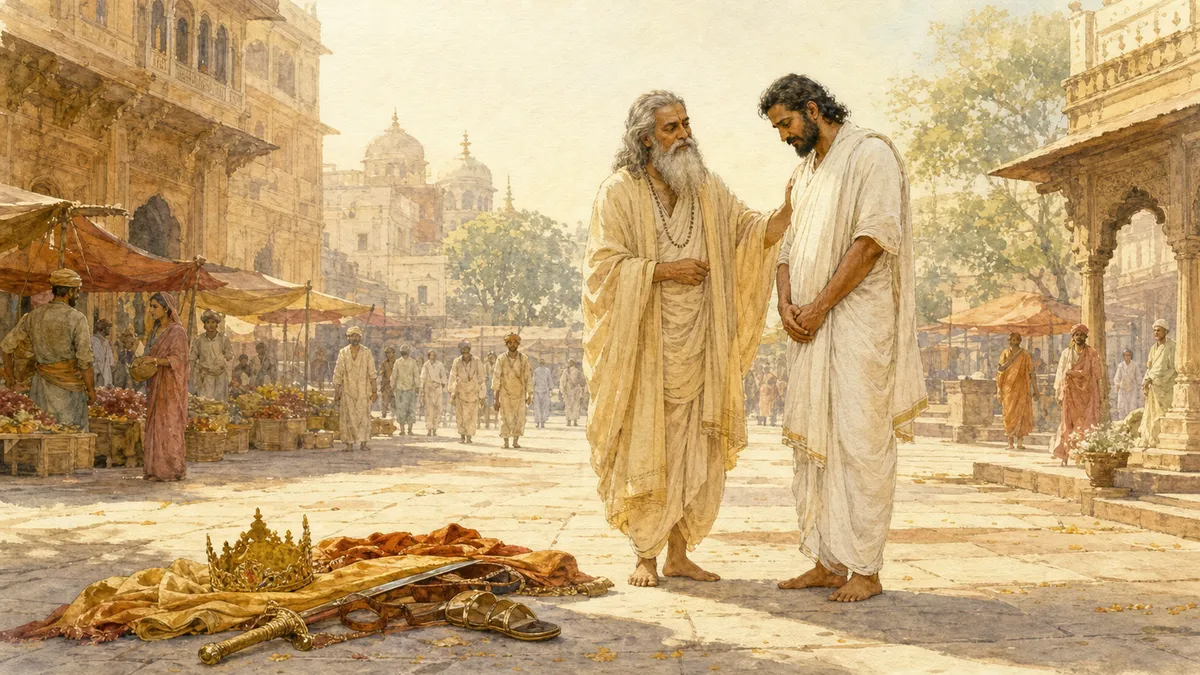
A king came to a master and asked to become his disciple.
The master said: – But you are not ready to study with me.
The king asked: – How is that?
The master said: – If you are ready, take off all your clothes, go naked through the marketplace, beat yourself on the head with a shoe while doing so, and shout: “I am a fool, I am a fool!” If you can do this, I will accept you as a disciple. If not, you are not ready.
The king was faced with a great dilemma. On the one hand, his kshatriya pride did not allow him to simply back down and say, “Yes, I am not ready for that.” A kshatriya is, of course, neither a shudra nor a vaishya; a shudra can easily be embarrassed, a vaishya always seeks compromise and tries to bargain, but for a kshatriya this is a matter of his honor. For a vaishya, the most important thing is money; for a shudra, the most important thing is primitive pleasures, while no one bothers him; but for a kshatriya, his own opinion, his own dignity, the honor of his clan, the honor of his family, and his own personal honor are very important. And a kshatriya is ready even to die for honor.
The king was a kshatriya, so he could not simply refuse. On the other hand, accepting such conditions would mean experiencing disgrace in the eyes of the entire state. That is, he truly was faced with a great dilemma.
The yogin immediately showed him where he had clinging, what samsara was holding him by. In this way, he as if told the king that until he freed himself from these clingings, it was not even worth beginning a conversation about discipleship. Not because this yogin was not compassionate or was very proud of himself, but because he knew that the teaching must be poured into proper vessels; if it is poured into improper vessels, it will not work.
When we enter the Dharma, we must have an approach at least on the level of a kshatriya. A kshatriya is someone who is ready to go all the way for his idea. If we have an approach on the level of a shudra or a vaishya, we will not be able to fight for the great idea of enlightenment, because levels of this kind are the approach of compromise.
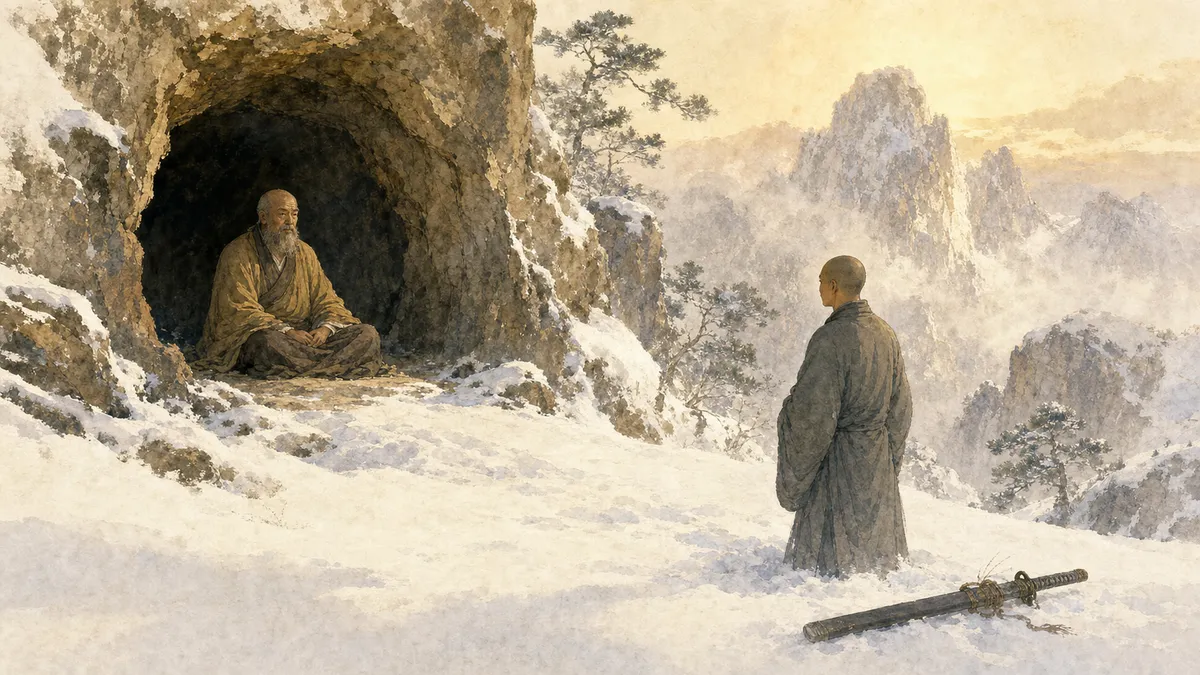
When Bodhidharma was meditating, standing waist-deep in snow, a monk named Eno approached him and asked him to transmit the teaching to him. But Bodhidharma did not even look at him. Then Eno stood in the snow for half a day.
Bodhidharma asked: – What do you want?
Eno said: – Please transmit your teaching to me.
Bodhidharma said: – The great Dharma is not for mediocre minds like yours.
But Eno continued to stand. He was even being covered with snow.
Bodhidharma asked him: – Why are you not leaving?
Then Huike took a sword, cut off his own arm, and said: “If you do not transmit the teaching to me, my head will be next.”
Devotion to the Dharma is born from an understanding of suffering and disillusionment with the samsaric way of thinking. We are very unconscious people, even when we enter the path of practice. We think in very familiar worldly categories.
Impermanence and the Bardo
Communicating with laypeople at retreats, I tried to convey to them the idea that a moment will inevitably come when you will no longer need to go to work, you will not be able to go to stores, make purchases, drink coffee, or watch television. Such a moment will inevitably come, when all these things will cease, and then you will have to think very seriously about the meaning of life, if you do not think about it seriously now. This moment is called “impermanence.”
Robert Monroe, describing his out-of-body experiences of astral travel, said that in the bardo he had encounters with spirits. One day he met a person in a subtle body (like a ghost in the bardo) who was looking around in confusion and swearing.
Monroe asked him: “What’s the matter?”
The man answered: “What’s the matter? And you ask what’s the matter? I died—that’s what’s the matter! And I don’t even know what I’m supposed to do now.”
Monroe asked: “And how did it happen?”
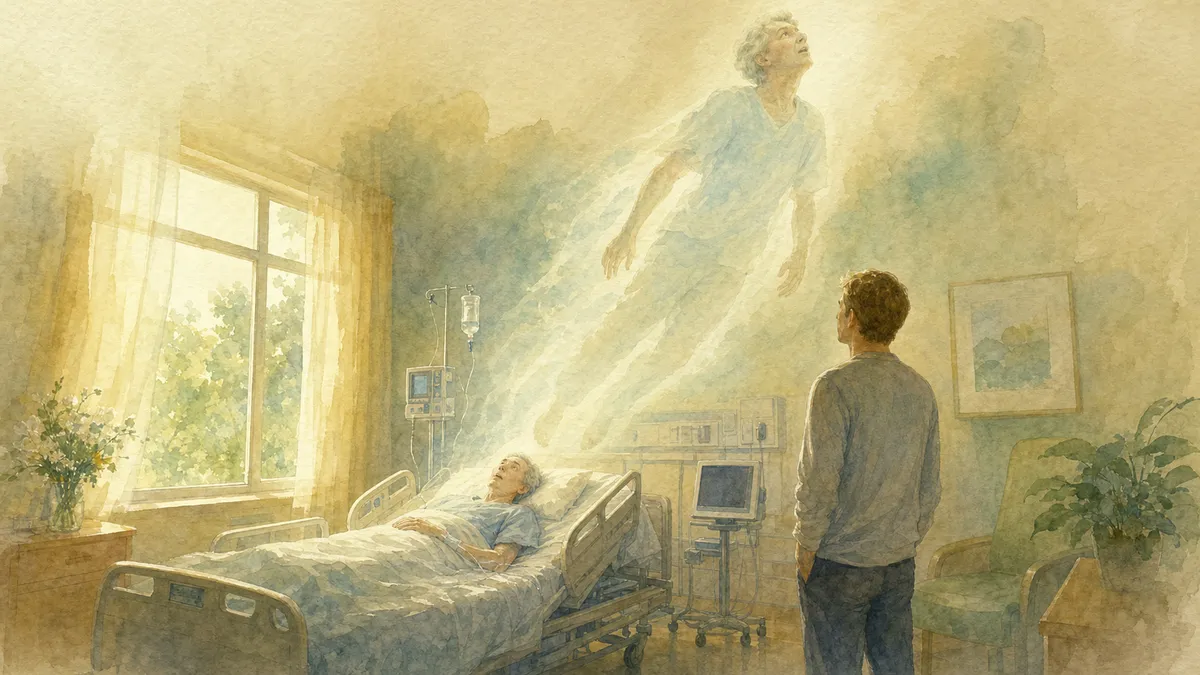
The man said that he had been lying in intensive care, hooked up to various wires. And he had been lying like that for several months, so he became so fed up with it that he pulled out the wires and wanted to run home. But when he tried to get up, he began to sway violently and suddenly felt himself flying up toward the ceiling. And when he passed through the ceiling, he realized that what is called death had happened to him.
Then he said, swearing: “Those preachers told me about God, about heaven, about hell, but I don’t see anything like that. I don’t even know where to go. There is only empty dark space here.”
That is the kind of bardo he got into and became stuck in. Monroe, of course, tried to give him some instructions.
In another case he describes, he saw many people in a hospital who had died and did not know what to do next. Some were still wandering through the hospital corridors, wondering why no one noticed them; others were sitting in the hope that Saint Peter would come for them and give them the “keys to heaven”; still others were trying to pray. In short, they were all confused, bewildered, and lost. Their whole life had been turned upside down. They no longer had a gross physical body, but had a subtle body; however, they could not figure out what to do in this subtle body, where to go.
Monroe describes another such case. When he came to the neighbors’ apartment, he saw there a woman who had previously lived in that house, and now, having left the physical body, was wandering around the room in a subtle body. He asked her: “Why don’t you leave here?”
This woman said: “This is my home, and no one will evict me from here. Even if my relatives completely ignore me, have stopped paying attention to me, and don’t even want to talk to me, I still won’t leave here. My husband’s paintings are here, and I will guard them.”
Monroe asked her: “Don’t you know that you have died?”
She asked: “What do you mean, I died? I remember that I was ill, I felt bad, but then I felt better, so I got up. I didn’t die, I’m alive!”
When Monroe tried to convince her otherwise, she could not accept this idea; her mind resisted very strongly.
Then Monroe said: “Try to lift the chair. I’m sure you won’t be able to.”
She tried to lift the chair but could not. Monroe showed her how she could even pass through the chair—it was all a great shock to her.
She asked: “So what am I supposed to do now? And what will happen now?”
Then she began to say: “Don’t come near me, don’t come near me! You’re probably the devil? If you don’t look like an angel, then you’re the devil! You want to seize my soul and carry it off to hell.”
Monroe had to explain to her that he was not the devil. Then he showed her how one could pass through walls, through the ceiling, and tried to explain that now she was free to fly wherever she wished; that now she did not need to remain in that place. Then he lost the subtle body of this being in the bardo.
When he met another man, he saw him enter some bedroom where a man and a woman were having sex. He, too, tried to have sex, but he simply could not manage it, and this infuriated him greatly. Monroe tried to tell him: “You have no body; you cannot have sex.”
But this man was like someone possessed; he strove again and again to realize what he desired, not abandoning his attempts.
He said: “Yes, I desired her so much during my lifetime, and now there is such a wonderful opportunity for it.”
All these beings entered the bardo state while being completely unprepared for it. During their lives they had absorbed certain ideas about hell, paradise, God, but they had never practiced seriously, and therefore did not know what to do. And Monroe tried to help them at his own level. He described all of this in his book “Journeys Out of the Body.”
Awareness in the Bardo
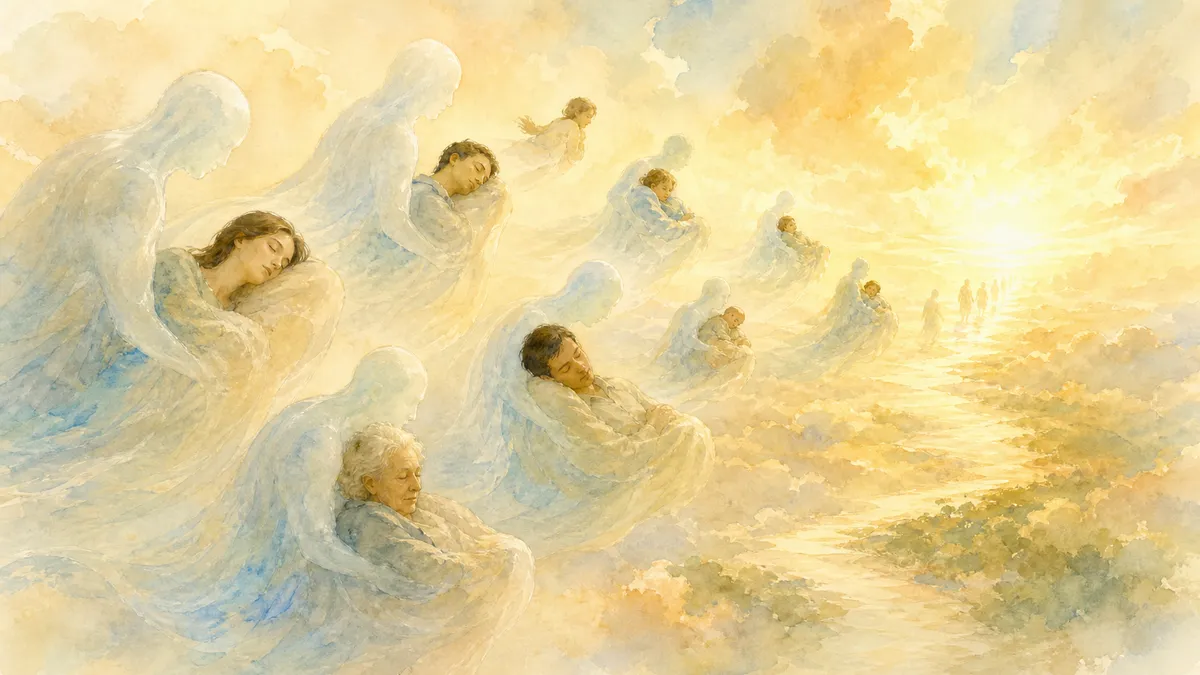
In the same way, when a practitioner finds himself in the bardo, he possesses awareness and can direct his consciousness to the necessary point. But if he does not possess awareness, he cannot direct his consciousness to the necessary point. Spirits come for him and lead him to one of the places where he is to spend the next long stretch of time.
Spirits are energy. You cannot simply say to it, “This is an illusion.” It is real energy that can seize and move your subtle body.
For example, I once had an experience in which I saw myself entering a certain place, something like a bardo point, where bodiless spirits were bringing various beings in subtle bodies there by their arms and legs (adults, children) and simply throwing them down. These souls were asleep; they could not understand anything at all. And the spirits were very strong, with great speed of consciousness, and communicated mentally, on a telepathic level. They were incorporeal, invisible, appearing like a little cloud, and they handled human souls very easily, as if this were their constant service.
When a practitioner cannot control his consciousness, cannot change karmic vision at the moment of the bardo, he becomes subject to the elemental influence of various forces. Therefore one Sufi saint said this: “When the angels of hell approach you and want to speak with you, do not talk to them. When they tell you to go to hell, refuse to do so.” In other words, self-liberate all energies except presence.
But the point is that one can refuse to do anything in the bardo, when one is in contact with such stronger energies, only if one is awakened, if one is in presence, if one has enough awareness to say: “There is no power here other than my power. There is no authority here other than my authority. There is no will here other than my will.” But only a genuine master can say this, one who has already created his self-liberated tunnel of reality and lives in the state of the mandala. And one who cannot say this is subject to the law of karma, the law of rebirth. Whether he wants it or not, he will receive a new birth in one of the worlds or will be moved to a certain karmic realm.
People who do not reflect on impermanence, on the law of reincarnation, cannot understand these things. Their thinking is very narrow; it thinks in terms of the present day, of some momentary things. Therefore, in various teachings of yoga, tantra, and Buddhism, there is a practice of reflecting on suffering. A person who has not become disillusioned with samsara may be very attached to his ego, to how his selfish “I” is perceived by others (not the spiritual “Self,” but precisely the egoistic “I”). But in fact such attachment is a limitation. And such attachments disappear precisely through reflection on impermanence.
Sufferings
“In this world people are born from the womb, therefore your consciousness (one of the five skandhas) enters the united seed and blood of your parents. The embryo, passing through various stages of maturation (a gelatinous egg, an elongated curd-like formation, a dense lump, a hardening egg, a solid ball, and so on), experiences suffering. When your limbs, other parts of the body, and sense organs are fully formed, the mother’s womb will seem to you like a cramped, stinking prison.
When your mother eats something hot, you suffer as if you were being burned by fire. When the mother eats something cold, you suffer as if you had been thrown into icy water. When she sleeps, you suffer as if you were being crushed by a mountain. When her stomach is full, you suffer as if you were squeezed between two rocks. When she is hungry, you suffer as if you were falling into an abyss. When she walks, sits down, or does something, you suffer as if you were being carried by the wind.
Such are the sufferings experienced in the womb.
When the term of pregnancy comes to an end and the time of birth arrives, the karmic winds of samsara bend your head down to your heels and push you through the birth canal. You suffer as though a mighty giant had seized you by the legs and hurled you against a wall. Passing through the pelvic ring, you suffer as though you were being dragged through a hole in an iron plate. If the birth canal is too narrow, you may even die, and the mother may die along with you. But if you remain alive, you will experience suffering equal to the torments of death.
The great Orgyen Rinpoche said:
“Mother and child stand with one foot in the land of the dead. All the mother’s joints are dislocated, except for her jaws.”
Even after birth, having fallen onto the mattress, you suffer as though you had been thrown into a pit of thorns. When the membranes are removed from your back, you suffer as though your skin were being flayed from you alive. When you are wiped clean of impurities, you suffer as though you were being lashed with a thorny whip. When your mother takes you in her arms, you suffer like a little bird carried off by a hawk. When your head is smeared with butter, you suffer as though you had been bound and thrown into a pit.
Such are the sufferings you endure.
When you are placed in the cradle, you lie there as if in a dirty swamp. Whether you are hungry, thirsty, or ill, you can express all your suffering only by crying. After birth, entering the period of youth, you think that you are growing, but in reality your life is becoming shorter day by day, and death is drawing ever closer. Then you become caught up in worldly affairs, which, like the waves of the sea, have neither end nor limit. Since all these affairs are connected with performing actions that create the cause for birth in the lower worlds, they bring nothing but endless suffering.”
Actions that create causes are mainly connected with selfish accumulation. All these causes are not positive; through them the soul reincarnates in the human world and below. Actions connected with service attract Anugraha Shakti and lead to rebirth in pure lands, in groups of practitioners.
“While you are occupied with meaningless and endless worldly affairs, the suffering of old age creeps up on you unnoticed. All your bodily strength gradually becomes exhausted, and you can no longer digest tasty food. Your eyesight weakens, and you can no longer see small or distant objects. Your hearing becomes dull, and you can no longer hear sounds clearly. The tongue loses sensitivity, and you can no longer distinguish subtle flavors, while speech becomes indistinct. Mental abilities weaken, your memory fails you, and your thoughts become confused.”
In her youth, one woman wanted to practice the Dharma, but she never dared to begin, because she was always thinking: “What will they say, what will others say?” When she grew old and everyone had left her, she thought: “If only someone would say something now.”
A Scientific Explanation of Aging
There is an explanation for the aging of the physical body. There is what is called the “Hayflick limit.” In the 1960s, the American scientist Hayflick put forward the theory that in the human body cells can divide no more than fifty, plus or minus ten, times. In the process of cell division, old cells are replaced by new ones, and DNA replication occurs. During such restoration, errors inevitably accumulate, so DNA is copied not precisely, but with small inaccuracies. As cells in the human organism renew themselves, these inaccuracies accumulate over the years, and when their number reaches a critical threshold, the body begins to lose immunity and becomes vulnerable to free radicals, microbes, aggressive enzymes, environmental influences—that is, to everything to which it previously had immunity. If a young body could possess a tremendous charge of prana, then when DNA replication has occurred many times, leading to the accumulation of a significant margin of error, the body ceases to perform its functions properly.
From the point of view of Ayurveda, it is said that the three doshas (vata, pitta, and kapha, that is, wind, fire, and phlegm) lose their balance, and the five elements fall into disharmony. This happens because the reserve of life force (prana) diminishes, and the capacities a person had at eighteen are impossible at fifty if that person does not practice. If, however, a person practices, then a great deal depends on his practice: he can even restore his reserve of prana to the level of an eighteen-year-old youth; he may even grow black hair and new teeth again. But this is basically how the principle of impermanence is explained.
Milarepa’s Song on Old Age
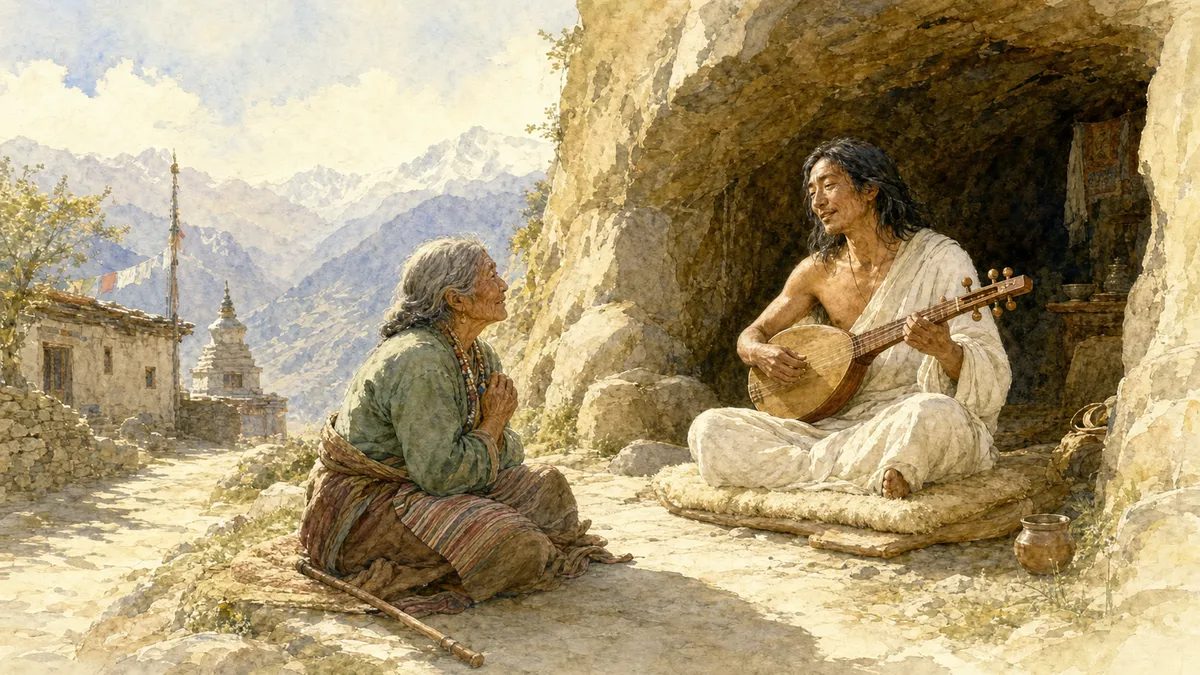
“Teeth fall out, and you cannot chew, and speech becomes slurred. Bodily warmth diminishes, and thin clothes no longer keep you warm. Strength wanes, and you can no longer carry heavy loads. Although you still love pleasures, you no longer have the strength to enjoy them. Because the nadis and pranas weaken, you become irritable and impatient; because those around you treat you with disdain, you become sad and gloomy; because the inner balance of the five elements is lost, you suffer from various illnesses and infirmities. Walking, sitting, doing anything—all is difficult.
Jetsun Milarepa said:
“First: you get up as if pulling a stake out of the ground.
Second: you walk as if creeping up on a bird.
Third: you sit down as if a heavy sack were falling.
If these three features become apparent, grandmother, you have become a sad old woman whose perishable body has already worn out.
First: on the outside, the skin is furrowed with wrinkles.
Second: from within, lumps protrude due to the drying up of flesh and blood.
Third: at the same time there is dullness, deafness, blindness, and confusion of mind.
If these three features become apparent, grandmother, your body looks ugly because of dreadful wrinkles.
First: the clothing is coarse and worn.
Second: the food and drink are cold and tasteless.
Third: when sitting, you need to lean on cushions on all four sides.
And if these three features become apparent, grandmother, you resemble a perfect yogin, because you uncomplainingly allow people and dogs to trample you underfoot.”
“If you cannot rise naturally and have to support yourself with your hands on the floor, it is like pulling a peg out of hard earth. Since the years have bent your back, when walking you cannot raise your head. You cannot walk quickly; it seems as though you are creeping along, as children do when trying to catch a bird. Since all the joints in your legs and arms ache, you cannot sit down smoothly, but flop down like a sack of stones or earth. Your flesh has grown decrepit, and therefore on the outside the skin gathers into folds, and your whole face and body are covered with wrinkles. Inside, flesh and blood dry up, and therefore the joints become visible. The cheekbones and the protrusions of the joints stick out; mental faculties deteriorate, and you become dull, deaf, and blind. With a clouded mind, you sit in a semi-conscious state. Since bodily strength has left you and the desire for beauty has gone, you are dressed in coarse and torn clothing. You eat cold, dirty scraps, without sensing any taste.”
This is one of Milarepa’s songs, which he sang to an old woman when she tried to scold him, calling him a “beggar.” But this song so shook that greedy old woman that she repented, reflected very deeply on the Dharma, and asked Milarepa to accept her as a disciple, although before that she had not even thought of practicing the Dharma.
The True Purpose of Reflections on Suffering
Reflection on suffering is not undertaken in order to fall into depression and constantly walk around dejected. On the contrary, when we practice, we must establish the mind in joy, in divine pride and positive qualities, and form positive sankalpas. However, until there is a foundation consisting of detachment, of reflections on impermanence, our practice will never have depth. Because a yogin who has not understood impermanence, the law of karma, and suffering is not practicing, but playing at spiritual practice; he does not yet take it seriously. For him it is a kind of interesting adventure, but nothing more. In reality, however, things are not like that at all.
The saints of antiquity did not perform radical spiritual feats in order to practice in a superficial way. They were always very deep, consistent, and persistent in their practice.
True presence, contemplation, divine pride, and other things arise only from deep disillusionment with the samsaric way of thinking, when we truly become disillusioned with all the games of our false ego, with clingings and attachments. Until we become disillusioned with such a state of mind, it cannot be said that our practice can be crowned with success. It is simply unbelievable. Such a thing has not happened since Brahma created the universe.
When such a state of consciousness manifests in us, we try to analyze it and look at it as a manifestation of materialistic conditioning, as dreams and reveries of the mind. Then we develop tactics for working with them: either we try simply to shut ourselves off from them, or we try to transform them into something positive, or we try to be in presence and leave them as they are, in the hope that they will dissolve through the power of right contemplation.
An Example of Devotion to the Dharma
Seongcheol Sunim wrote: “Do not let even your little finger rest! Be diligent in your practice.”
He also wrote: “Always think of the pillar on which a plaque is written: ‘Give everything for the practice of Truth.’”
When you practice, it is very important to reflect on the saints of ancient times and of the present, and to try to apply their consciousness to yourself. This does not mean that you need to imitate them. Rather, in your own place you should try to understand how they thought and to absorb the spirit of practice that they followed.
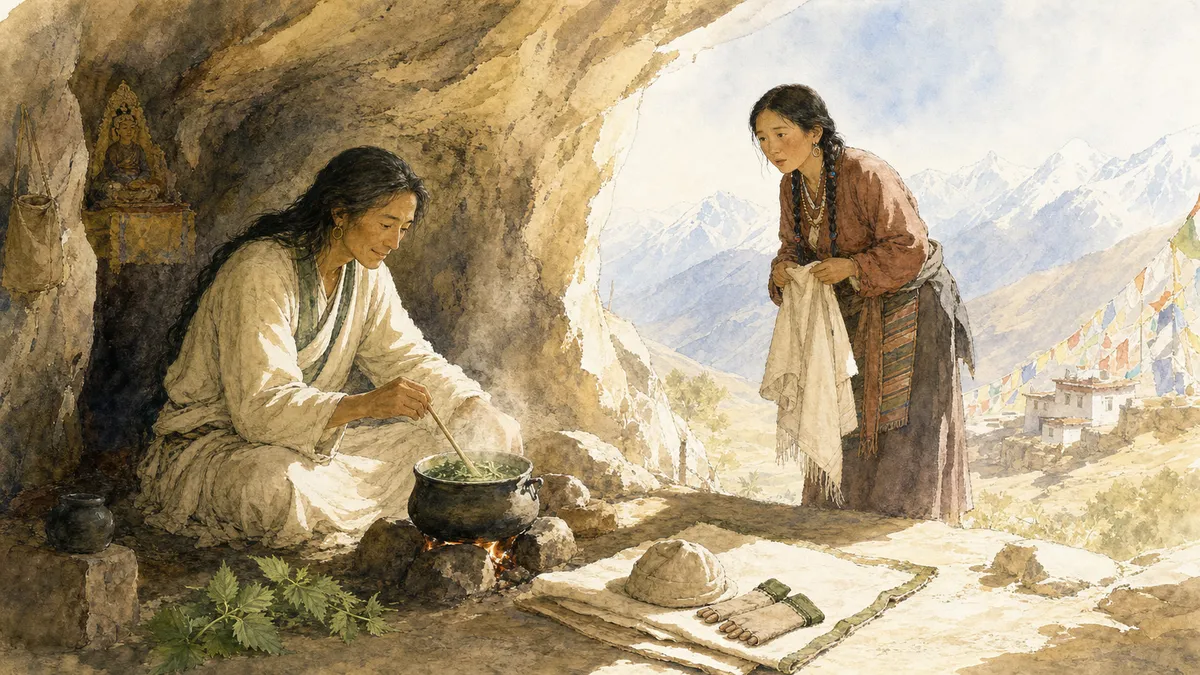
For example, Milarepa was so renounced that he vowed not to leave the cave and to meditate even when he had nothing to eat. When he meditated in this way, he cooked soup from green nettles, so over time his body also turned green and his hair fell out. When his sister Peta came, she saw him naked and asked, “How can you live like this?” She decided to offer him a piece of cloth so that he could sew himself at least some kind of clothing. But Milarepa, following his vow of renunciation, did not want to sew himself clothes. He sewed a cap for his head, fingerless gloves, and put them on. When Peta came, she saw that he had simply ruined the cloth, and so she began to reproach him. Then Milarepa said: “You, woman, have nothing to reproach me for. I am devoted to my Dharma.”
In the same way, when you walk the path of monasticism, you should be devoted to your Dharma and practice in such a way that there is nothing for which you can be reproached.
Read 14 times
Articles
Vidya AI
Search
Lectures
November 13, 2026
Mantra of the day
ОМ СВАЧЧХАЙА НАМАХ ОМ Своевольному – поклонение!
Auspicious Times(Rome)
Brahma Muhurta:
05:03 - 05:59
Abhijit Muhurta:
11:34 - 12:14
Sayam Sandhya:
16:32 - 17:12
Saphala Ekadashi (21 November)
Ekadashi of success. Favorable for achieving goals and spiritual growth.