

Commentary on the text “Ribhu Gita”
November 4, 2025
Ribhu Gita, Chapter Eight, instruction on Advaita Vedanta.
“There is nothing for me to push away or to grasp. There is nothing for me to laugh at and nothing in which to drown. I have no destiny. Only such a one is called a soul liberated while living.”
The qualities of a jivanmukta: freedom from acceptance and rejection
Rishi Ribhu continues to describe the qualities of a jivanmukta, one who is liberated while living. One of them is that there is nothing to grasp, nothing to cling to, and nothing to reject. Usually, in duality, we always love something, hate something, cling to something and want to obtain it, while rejecting something else. This is normal. For example, everyone loves health, and no one loves illness. Everyone loves wealth, while everyone rejects poverty and destitution. Everyone rejects suffering, while joy and happiness are accepted with pleasure. Everything that is favorable for survival and for the enjoyment of the senses is accepted, and after acceptance come clinging, attachment, and being captivated. Everything that is unfavorable is rejected. Rejection is also accompanied by negativity and hatred. This is the usual way of existing in the dual world of samsara.
Ribhu says: find within yourself a layer of consciousness in which there is neither acceptance nor rejection. There is no hatred or clinging either. Advaita is not some abstract philosophy in the clouds. Advaita speaks to us about our state right here and now, about the direction in which we need to move, the direction in which we need to change, what layer of awareness to seek within ourselves, to open, and in what to become established. Advaita, on the one hand, speaks of the nature of reality, and on the other, it says that this nature is within us. And we will not understand Advaita until we discover this layer of consciousness that is free from acceptance and rejection.
There are various cultural and ethical systems of training for how to behave so as not to become attached, not to cling, not to hate. This includes monastic training as well. They cultivate the right traits of character. However, in reality this is only preparation. It is truly possible to rid oneself of liking and aversion, of clinging and hatred, only when we find a certain alternative, a counterbalance to this. At best, we will be well trained in ethics, in how to behave and how to control the mind. But the truth of which Rishi Ribhu speaks is much deeper. He says that if you try to discover within yourself the nature of the mind that is deeply realized in dreamless sleep, then in this nature of the mind there is neither liking nor aversion. It exists in the mind, but not in the nature of the mind. If you try to discover the empty essence of the ego, you will discover that layer of consciousness in which there is neither liking nor rejection.
The search for a layer of consciousness beyond duality
Usually, we all act within very rigid dual parameters. We have already been brought up this way, and our brain is so wired by the collective memory of humanity that duality permeates everything. We hold on to these beliefs very strongly. These beliefs greatly limit us. On the other hand, it seems impossible to reject them. We have to take them into account. They accompany our lives all the time. Simply bring your hand to a fire, and you will understand what to accept and what to reject. We are taught this from earliest childhood — what to accept and what to reject. Nevertheless, Rishi Ribhu says that if you want to become a jivanmukta, you must learn to think differently, to reason differently, to feel differently. And perhaps it is not even a matter of thinking, but of awareness beyond the mind. It is necessary to discover that layer beyond the mind which neither accepts nor rejects.
When we search for this layer, we find feelings. Of course, this is not it. Feelings always either accept or reject. Could it be our thoughts? No, thoughts are also built on dual logic. Could it be our ego, ahamkara? No, the ego has the tasks of survival, ensuring comfort and safety, and setting goals. It thinks in rigid dual constructs and notions; such is its architecture. Could it be buddhi, the spiritual intellect? Buddhi has heard something about this. But it too has its own system of beliefs, and it is more dual than nondual. It only catches a glimmer. Therefore, it is something higher than buddhi. That which is higher than buddhi is the Atman.
Awareness of the Atman begins with dreamless sleep, but it does not end with dreamless sleep. This does not mean that we should look for it in sleep, or somehow try to become aware there. Jagrat-sushupti is a specific state that you can experience while awake, in the waking state. When you open your mind wide while engaged in self-inquiry, when you contemplate without making evaluations or judgments, and you do not become attached, do not cling, and reject nothing, when you abide in avadhana, vigilant awareness, you can discover this layer of the mind. The entire practice of contemplation, atma-vichara, working with sankalpas, the practice of contemplative mudras—this is a movement toward this layer of consciousness. Having discovered it once, one must remain in it.
The Three Golden Rules: Shravana, Manana, and Nididhyasana
First you hear about it from the Guru and receive a direct introduction. This is called shravana, the first principle, the first golden rule. You must listen a great deal to the teaching of Advaita Vedanta on the nature of the mind so that, at last, it catches hold of you and you begin to seek the nature of the mind. Then you need to become convinced of this nature of the mind, that you have entered it correctly. This is called manana.
A disciple comes to the Guru and says: “Guru, I think I have entered this nature of the mind. I think I have found it. It is a state of awareness that is like space, like the sky. I am as if a quantum wave of consciousness smeared throughout space, simultaneously everywhere and nowhere, having neither boundaries nor a center. I seem to abide beyond thought and beyond the mind.” The Guru says: “Very good. And what about the child of a barren woman?” The disciple: "What child?" The Guru asks: “And how can one climb a staircase seen in a mirror?” The disciple again: "What staircase? It is impossible to climb it. Why?" The Guru says: “Keep working. Continue.”
That is, it is not enough to have the experience of space-like consciousness beyond center and boundaries. It is important to become so established in it and so confident that dualistic questions and notions do not cause admixtures and do not collapse you into a gross material, conceptual, mental reality. Here is the moment when you are a wave spread out in space, and here is the moment when you collapse into a particle, into logic, into the mind, upon contact with something. This means it is a state of unstable reception: admixtures arise, and these admixtures become your dualistic limiting beliefs.
Manana means that the disciple has become so established in the nature of the mind that he no longer has doubts. Then he is asked questions again. These questions are not entirely logical; more precisely, they are not logical at all, but they can throw your unstable contemplative state out of balance by means of logic or by what goes beyond logic. Then admixtures of dualistic states may begin. Manana means: with the help of the guru, the disciple has completely freed himself from admixtures. He has become established, when his mind no longer collapses into dualistic conceptuality. It is like a quantum wave smeared throughout space, a quantum-probabilistic wave-consciousness, no longer becoming a particle. Or if it does become one, it does not lose itself as a wave smeared throughout space. Our freely floating awareness no longer becomes gross and conceptual and does not lead to identifications. This is called manana.
When the Guru has tested the disciple, he says: “Now this is what is needed. You are stable in this. Now hold to it all your life. Now, from this, learn to walk, speak, eat, live, work, perform rituals, practice, recite mantras, and deepen this state. This is your fundamental basis of life, from which you will already move confidently toward liberation.”
The Vow of the Single Samaya

Many, having had an experience, begin to think that it is something great and that the path is finished. To think this way means to close off the true path to liberation for oneself. The point is that such experiences do not mark the end of the path, but its beginning. But under no circumstances the end. The beginning in the proper sense. When we have resolved all the problems of inner ignorance and opened that layer of consciousness in which one must abide and in which moksha is possible. When we experience this beginning, we must make a great decision: “Now, having discovered this great layer of consciousness, freely floating awareness in nonduality, may I abide in it all my life, may I not be distracted, may I not fall out of it, and if I do fall out, then not for long, and may I quickly return.”
All of this is called the vow of the One Samaya. And the disciple gives the vow of the One Samaya to himself. Usually vows are given at dikshas, ceremonies, initiations, but the vow of the One Samaya has no ceremony. It is an inner decision that we make for ourselves. Our practice of moksha-dharma in the style of anuttara-tantra begins with this vow of the One Samaya. Other teachings, such as ordinary tantric practice, yoga, and so on, begin much earlier, and they do not require the vow of the One Samaya. They do not require recognition of the nature of the mind, because their mechanics are different. There one must attain dharana, dhyana, and samadhi. But when it comes to anuttara-tantra, entering into the nature of the mind is the foundation. And already from the nature of the mind we can do mantra, kriya, yoga, meditation, and everything else. Rituals, homas, pujas. All of this is done in a different state.
Absence of Toil and Fatigue
“For me there is no toil, and there is no fatigue. For me there are no sorrows, and there are no joys. For me there is no lack of anything. Such a one is called a soul liberated while living.”
For me there is no toil. From this state, there is no longer the understanding: “I am the doer, I act, the fruits and results belong to me.” Action takes place, but there is no ego that believes it is doing and that the fruits and results should belong to it, and worries because of this. Accordingly, there is no fatigue either. If we are the doer, then we have the right to say: “That’s it, I’m tired, I’ve had enough.” The doer can say this, and the doer most often gets tired. If you become tired from actions, it means you are the doer. If you are the doer, you will certainly get tired, because your energy limit is restricted only by your ego. But if you are not the doer—and not being the doer is possible only when you abide in natural awareness, in choiceless natural awareness—then instead of action, the divine play, lila, the universal spanda, the primordial energy of Shiva is accomplished through you. It never tires. There is such a saying: spirits never sleep, gods never tire. And when the play happens through you, it does not exhaust you, but only charges you. No matter how much you do, you do not get tired. Because it is play. And in play you only receive energy. Divine play, lila, unlike karma, saturates us with energy rather than depriving us of it.
Transformation of Emotional States
For me there are no sorrows, and there are no joys. Sorrow and joy are also usually built upon dualistic ideas about life. All of this is a consequence of duality. In itself, sorrow is a coarse, dense, tamasic energy. But when we identify with it, it becomes sorrow. It brings problems into the life of a person who does not know its nature. Joy, on the contrary, is a sattvic, pure, radiant energy. When a person identifies with it, he experiences joy.
On the scale of emotional states, if we begin with the very lowest, it would be paralyzing terror. Then simply terror. Then fear; a little higher still—alertness, a sense of danger, hostility, distrust. If we rise still higher, it will be simply dissatisfaction. Higher still—calmness, serenity. Still higher, joy begins, a feeling of pure happiness. Still higher—delight overflowing the soul, ecstasy. Then, when delight and ecstasy already begin to go beyond the limits of the mind and body, this is the glorification of the Divine, the experience of Divine revelations, a continuous feeling of admiration, what in Shaivism is called chamatkara. Still higher: joy, happiness, bliss, delight, ecstasy, glorification, admiration, revelation. Still higher, it is the experience of oneself as a conduit of divine will. Higher still—the experience of oneself as a vessel of divine wisdom. Higher still—the experience of oneself as a bearer of divine intention or an embodiment of divine actions. Then the experience of the divine paradox, up to the disappearance of the experiencer.
On the scale of emotional states, a yogin who has established himself in presence never descends below calmness and serenity. And overall his state is somewhere between joy, happiness, delight, and ecstasy, with occasional breakthroughs into divine revelations, divine glorifications, and experiences of higher bhavas. Our task is to rid ourselves of negative emotions and negative experiences not by methods of psychotherapy and not even by methods of analysis, in the highest sense from the point of view of anuttara-tantra, and not even by the tantric methods of pratipaksha-bhavana, the opposite attitude, but by methods of establishing ourselves in natural awareness. Because very elevated, very pure, high vibrations are inherent in natural awareness. If you abide in correct awareness, then feelings of sorrow, suffering, or anger, despondency visit you very rarely. Perhaps once in 30 years. But overall, they never visit at all. Awareness does such a magical thing: it eliminates all negative emotions. The lowest emotional state you can experience is a feeling of serenity.
Working with Fatigue in Natural Awareness

Question: Om, Guruji, how should one work with fatigue correctly? Earlier at satsangs, Guruji said that if you experience fatigue, it means you have fallen out of jagrat-sushupti. On the one hand, when fatigue sets in, indeed, returning to this state of presence, of natural awareness, seems to resolve everything, and energy appears. But on lower levels, for example, psychological and emotional fatigue, the mind is still accustomed to maintaining balance so as not to lose it. How should one work and balance with the lower levels, or should one not pay attention to this at all, but simply remain in natural awareness and not descend to these levels? Or is there, after all, some balance between all the bodies and levels in working with fatigue?
There should be balance. But when you abide in good, deep awareness, fatigue is not a problem. Why would you need to work with it? You enjoy it. One should not work with fatigue from natural awareness. One should be in natural awareness during fatigue. That is, natural awareness enjoys any states. Fatigue is one of the states that natural awareness enjoys.
I see that you have a rejection of fatigue, don’t you? You always want to be full of pep. You see fatigue as a problem and think about how to eliminate it. You have decided to go on a crusade against fatigue. You have declared war on it. The approach of Anuttara Tantra is different. It says: whatever feeling, emotion, or state there may be, everything is suitable for practice. Natural awareness penetrates it, gently envelops it, and changes it for the better. The moment natural awareness penetrates your fatigue, you will feel that the fatigue goes somewhere, that it can no longer remain, because natural awareness is a charge of energy, a huge charge of energy. The question arises: do we have enough natural awareness to be in it so deeply?
Question: When truly borderline fatigue sets in, natural awareness seems to open up, but you still can no longer do anything physically, you have not a single thought left, not a single emotion. This state is fantastic; it is precisely on the edge, and it recharges you. On the relative level, is it worth taking some external actions for balance?
Of course. Do everything that is needed. Asanas, pranayama, concentration on the chakras. This does not relieve you of responsibility for body, speech, and mind on the relative level. It is like salting soup properly. It is the same thing. How to work with soup. These are ordinary methods of yoga. If you practice, you will always have enough energy. If the channels are pure and you observe dinacharya, then you will not have such a state of fatigue at all. In principle, it will not be inherent to you.
The Transcendence of the Knower, the Process of Knowing, and the Object of Knowing
“There is no knowledge for me, nor objects of knowledge. There is no knower, no one who knows. There is only the whole. This knower is called a soul liberated while living.”
The next aspect is connected with knowledge. Prameya is that which is to be known. Pramana is the instruments and process of knowing. Pramata is the one who knows. All this duality and triplicity is always present in the Universe, and usually we obtain knowledge in this way. There is always a lack of knowledge; there is always the problem of obtaining knowledge. And in a relative sense, there exists an entire system for obtaining and processing knowledge. But from the point of view of a jivanmukta, when you enter the layer of nondual awareness, your lack of knowledge disappears, because you are in the source of knowledge. Another question is how to learn to use these sources and truly draw knowledge from them.
The process of knowing in the Shaivite tradition consists in going from the objects of knowledge to the process of knowing, from prameya to pramana, and from the process of knowing to the knower, from pramana to pramata. To discover the knower within oneself means to comprehend all knowledge, to comprehend all teachings, to comprehend all wisdom, to comprehend the essence of any learning.
The Energy of Saraswati and the Mechanics of Knowing
The energy of Saraswati is not simply the energy of learning, as in school. It is a teaching about how to move from external objects of cognition to the process of cognition, when you understand the very mechanics of knowing. It is one thing when you mindlessly accumulate knowledge, read, study, and construct philosophical schemes. In this way the gross mind is engaged, and you simply accumulate books, knowledge, and teachings. Another matter is when you understand the mechanics of learning. You understand the process, the instruments of cognition. A third matter is when you understand the one who cognizes all this, the ultimate subject, the ultimate beneficiary. For whom was all this cognition? For me. Who am I, the one who cognizes? You discover that, ultimately, all knowledge in its folded, primordial form is within the cognizing subject. And this cognizing subject is limited in cognition when it separates itself from Brahman. When it does not separate itself from Brahman, it ceases to be limited in cognition.
On this path, limiting beliefs and dualistic notions hinder us. And the process of cognition in Advaita Vedanta is not so much a process of grasping philosophy and accumulating concepts in Sanskrit as it is the removal of superfluous, limiting beliefs. When we remove unnecessary limiting beliefs, we discover that we find ourselves in the very essence, at the very center of cognition, because Brahman is the source of all knowledge. And to come into contact with the source of all knowledge is precisely the path of the jivanmukta.
Three Positions of Cognition: Seeking, Finding, and Having
There are those who seek, and there are those who find. From the position of a seeker, one must move to the position of one who has found or is finding. Do you feel this difference? And from the position of one who has found or is finding, one must move to the position of one who already always has. Is there a difference? Someone seeks, and someone finds. And someone neither seeks nor finds, but has. Seeking, finding, and having—this is the difference between prameya, pramana, and pramata. The deeper we move inward on the path of discovering the consciousness of jagrat-sushupti, and then jagrat-turya, the less we need to seek, and the more we find.
If you are in the position of a seeker, you think like this: “I’ve read this, I haven’t read that, I need to read this, and here is another list of things to read.” You are constantly charged for searching; you seek, seek, seek, but no matter how much you seek, nothing is clear. And there is no satisfaction, no happiness, and no wisdom. That is, there is knowledge, but no wisdom. It is like a son who came to his father in the village and said: “Father, I have two higher degrees—what can you tell me?” And the father says: “You are so foolish that one university was not enough for you; you needed two.”
So what is wisdom? It is that at some stage, from being a seeker, one must become one who finds. The one who finds does not need so much. He opened one text and received a revelation; he found the answer to a question, he understood the entire structure of the teaching, clarity and wisdom arose in him. The one who finds is in a much better position than the one who seeks. They say of him: he intuitively grasps everything, he intuitively understands everything, he understands the essence of what is being said in the text, because he looks at the text, at the logic, at the teaching, at the concept from the nature of the mind. For him, the process of reading sutras and Puranas, of listening to satsangs, is accompanied by insights. It is precisely for the sake of these insights that texts, books, philosophy, and satsangs exist. To be one who finds means to receive insight and to receive grace from contact with sources of knowledge. This is already a process of cognition suitable for a sadhu.
Finally, there is the one who neither seeks nor finds, but the one who knows. This is a great secret. The one who knows usually sits somewhere on an altar, while everyone bows to him, offers flowers, and sings bhajans. So what is his secret? He does not seek and does not even find. He is in the state of one who has always found, who always has. His secret is that he has freed his knower from any limited notions and discovered the knower as Brahman itself. And Brahman is the source of all knowledge. That is, he has entered the source of all knowledge. It is as if the entire database of the Universe is now in your brain. There is nothing to seek; it is at your disposal, you have it.
Question: In essence, this is not a question, but simply an association that arose. It is as if there is movement in a circle. We move away from our source to the periphery and seem to be looking for something, but in reality we then simply return to what we have always had. Is that true?
Yes, that is so. But enriched by new experience. Why was embodiment needed? You did not know something; you began to seek something in the material world of samsara. You thought: “What if I find something?” You wanted something in a material body and took on a body. You thought: “What if I understand something?” The result is experience. The meaning of embodiment, the meaning of cognition, is experience, which at another level leads back again to this source of awareness.
Question: Gurudev, can it be said that one who possesses non-conceptual knowledge is a jnani who abides in omniscience? And a siddha is one who can operate with this knowledge in the manifested realm, as with generation? There is generation, but without electricity the light bulbs do not shine. A jnani possesses generation within himself, but in order to operate with this knowledge, possibilities, and abilities, one must already possess siddhis, and that is already the next level.
Yes, this is a question of the manifestation of iccha-shakti, jnana-shakti, and kriya-shakti. When you have attained the fullness of knowledge, this knowledge now begins to be transmuted into your powers. Knowledge means Shiva-tattva — “I,” or Shakti-tattva — “I am.” And power means that you can now manifest iccha-shakti at the level of Sadashiva-tattva, jnana-shakti at the level of Ishvara-tattva, and kriya-shakti at the level of Sadvidya-tattva. This means that your emptiness returns outward, but now as your own manifestation.
Overcoming Duality in Relations with the Guru
“For me there is no ‘to you,’ and there is no ‘to me’ for me. There is no ‘from you,’ and there is no ‘from me.’ And Gurudev is not mine. Such a one is called a soul liberated while living.”
We dwell very strongly in dualistic human notions. These dualistic human notions are connected with the concepts of “I” and “you.” For us, “I” is always “I,” and a “deity” is a “deity.” Everything is clear! “I” am here, Dattatreya is on the altar. “I” am here, the Guru is on the vyasasana. “I” am here, while a monk is on the right, and a novice is behind. We are always very rigidly oriented toward a coordinate system. This coordinate system permeates our every step, our every thought, every emotion. We always define ourselves within this coordinate system: I, you, subject, object. We also approach the Guru in dualistic concepts: this is the Guru, and this is me. That is clear.
But here we are saying that if one opens the consciousness characteristic of the nature of mind, of a jivanmukta, there are no such distinctions there. It is not that such an attitude should be projected into the relative dimension — in the relative, let everything remain in its place. Here these laws work, and they are convenient for life. But when it comes to the nature of mind, we say that there is a single consciousness there. Not in the sense that none of this exists there. The nihilistic concept of emptiness is an incorrect thing. “Nothing” is simply nothing. We say that it is there, but it sees everything differently, sees everything in another way. This is an alternative to the dualistic notion of “I and you,” “Guru and disciple” — there is a single consciousness there.
To enter this single consciousness, where Guru and disciple are one, where I and the neighbor to the right or left are one, where monks and laypeople are one — this means to feel total unity, total wholeness. To abide in this total unity, total wholeness, instead of division into “mine,” “yours,” “I,” and “you,” to be in this total unity. The disciple unites with the Guru; the disciple performs guru-yoga when he understands this total unity. The process of guru-yoga is a movement toward this total unity. Ishtadevata-yoga is the same. We understand Dattatreya when we move toward union with him in this total unity. Ishvara-yoga is when we unite with Shiva and understand Shiva, when the divisions “Shiva” and “I” disappear, and we realize ourselves as “I-Shiva.” Brahma-sayujya is when we move toward total unity with the Absolute and realize this single field with Brahman.
Uniting View with Conduct
Then, in the relative, dualistic notions may remain. Dualistic notions function in the relative world for convenience and for navigation. But within us, a non-dual notion is preserved. Then it is said that we unite view and contemplation with conduct. To unite view-contemplation with conduct means that our conduct is subordinated to non-dual view and contemplation, that conduct flows from our non-dual vision. This means that we maintain a dualistic attitude in the relative: we say “namaste” to others, “I” is “I,” “he” is “he,” the Guru is the Guru, the disciple is the disciple, each in his own place. But this dualistic conduct of the relative is subordinated to the non-dual awareness within us. Therefore the saints say: “Even if your mind is like that of a Buddha, behave like an ordinary person,” or “Let your view be as boundless as the sky, and let your conduct be as meticulous as sifted flour.”
When we understand how to combine dualistic vision in the relative with nondual awareness, it is said that we are harmonious both in view and in conduct. And what happens? Then our conduct is subordinated to our nondual view. It is like a game. We act as if there is duality, but in reality everything is nondual. Awareness of nonduality allows us to be very light, happy, and joyful in dualistic situations. We say “I,” “you,” but we mean “we are one.” That is, we write three, but keep two in mind. We say “Guru,” “disciple,” but we mean “we are one,” there are not two. We say “I,” “Dattatreya,” meaning “we are one.” We say “I,” “Shiva” — we are one.
This understanding of “we are one” against the background of diversity gradually turns into lila, into divine play, when all dualistic concepts become manifestations of the state of “we are one.” Notice, this is not nihilism, this is not denial; it is the total experience of unity: “we are one.” If you did not understand that we are one, you would think: “I am me, and he is him. And if he opened the window vent and I am cold, then he is a bad person, I can get angry with him, I can quarrel with him.” But as it is, he opened the window vent, you want to get angry, and in your mind there is: “We are one. It is as if I opened the window vent, only in his body.” You do not have to get angry. You can love, even if you do not like something.
The experience of “we are one” in the relative begins to remove any contradictions that arise for you with people, with gods, with spirits, with nagas, with any beings, and with the Universe in general. To remove and dissolve all contradictions, to understand “we are all one,” that everything is invisibly interconnected, means that you are moving toward the state of jivanmukti. Why is it said that all siddhas, all saints, all sages love all living beings? It is not simply because they trained in the four immeasurables and entered such a loving state. That is a superficial view. Deep down, they understand that “we are one.” That is, I cannot help but love myself. I cannot help but love this divine consciousness, which is all-encompassing. The love of a jnani, of a jivanmukta, is natural. You cannot help but love yourselves. You cannot help but love that which is your essence.
The Total Unity of Brahman
“For me there is neither dullness nor ecstasy, neither fatigue nor flourishing.”
“Ecstasy” here is a translation, probably, of “samadhi” or “illumination,” close to the text.
“Only one established beyond is called by me a soul liberated while living. There are no ancestors for me, no precepts for me, no blessings and graces for me, and there are no regrets of any kind. Such a one is called a soul liberated while living.”
Usually we say: there are pitris, there are gods, there are spirits, there are relationships with them. These relationships may be good, and then we receive a blessing, grace. If they are bad, one can receive a curse. We are inscribed into this magical universe. But here Ribhu says that in that layer of the mind there is total unity. Not that there is nothing, but that there is no separation. From total unity, the one consciousness manifests as gods, spirits, ancestors, as blessing, curse, as grace. But in this total unity there are no divisions of any kind. And the one who realizes this total unity moves along the path of a jivanmukta. That is, when you hear “there is no,” you must understand: what is there? What is the alternative? The alternative is the total unity of Brahman. To realize the total unity of Brahman, in which there are no divisions of any kind, is the philosophy of Advaita Vedanta. If you misunderstand and interpret this as simply “there is nothing,” as nihilistic emptiness, this is not the state of a jivanmukta. A jivanmukta is not pralaya-kala, one who has collapsed into nothingness. A jivanmukta is one who realizes the total unity in which there are no divisions. There are no divisions, but the fullness of the play of energy is always present.
The Dissolution of the Limited “I” and the Observer
“There is no ‘I’ for me, and there is no ‘not-I’ either. There is no heavenly kingdom, no merit and sin; for me there is no bad. Only such a one is called a soul liberated while living.”
In this consciousness, which is like a quantum-probabilistic wave spread out in space, there is no “I” with which we are accustomed to identify ourselves at the level of the ego or the mind. But awareness is always present. We cannot call it “I,” because usually by “I” we mean a person born in this world, having a body and a biography. Awareness is present, but it no longer has any relation precisely to our limited, small “I,” bound by limited beliefs.
One can enter this layer of awareness if we begin to remove ourselves as the observer, as the experiencer who appropriates, clings, makes assessments and judgments, constantly reflects and relates himself to some dualistic experiences. The less of this “I” there is inside you, the more of this infinite, boundless consciousness there is inside you. One must abide in it always, try to do so. Whether you are performing a ritual, singing bhajans, preparing food, bathing, working, or carrying out some tasks — you must abide in it.
One must become accustomed to being a probability wave of consciousness, spread out in space, having neither center nor boundaries, which only occasionally collapses into relative materiality in order to solve certain tasks, yet without losing its expanded state. The one who can do this — how does he do it? He learns to remove the reflective mind, evaluative judgments, and to lessen attachment to the observer as the “I.”
At first, of course, one must find the observer, and then gradually one must remove the observer himself, because at a certain stage he too begins to become a problem. A person observes and observes, yet samsara does not end. Yes, he was seeking the observer. At first, the absence of the observer was a problem altogether, because without him nothing at all is possible. Without the observer, we are thrown now into thoughts, now into emotions. Without the observer, we are completely lost in this world; we live by primitive mental constructs or emotions. And so, with great difficulty, we found the inner observer, we separated ourselves from emotions and from thoughts. This is truly a serious achievement that distinguishes us from an ordinary person. To cultivate the observer is a very good thing.
But if we stop only at the observer, this too begins to become a limiting belief. We create a new identification: “I am the observer.” We observe and observe, observe and observe. Samsara keeps turning, everything moves, and nothing changes. And we think: “How much longer will I keep observing? How many thousands of years more will I observe? How many kalpas, yugas will I observe? What is the matter?”
Again the disciple comes to the Guru and says: “Of course, I can observe everything, but how should I act further?” And the Guru says: “Now you must get rid of the observer.” “How can I get rid of him? I have invested so much, I have trained so much, cultivated the observer, and now I have to get rid of him?” And the Guru says: “Yes. If you want to move from the second bhumi to the third, you must get rid of the observer. Self-surrender is needed.” Without self-surrender you can reach the observer, the second bhumi. But in order to get rid of the observer and dissolve him, self-surrender is needed.
Question: Om, Guruji. Can it be said that the observer is a subtle ego, a subtle ahamkara?
Yes. The last veil of maya. It manifests through evaluative, reflective conviction, evaluative actions, through subtle clinging, very subtle limiting notions, because our observer is not free from them. Accordingly, limiting beliefs can be removed only by removing the observer. And self-surrender is when we betray this observer.
Question: Om, Guruji, and when does the observer of the observer who is observing appear? What should be done with him?
Refinement of the Observer
One must gradually refine the observer. Has the observer of the observer who observes all this appeared? And if you noticed the one who observes all this, then there was also the one who noticed all this. That means there is yet another one. One must identify increasingly subtle kinds of observers, moving from the gross observer to the subtle one. You will discover observer number one, observer number two, number three. Discard the gross observers and leave the subtlest one until there is no distinction, and learn to abide in it. And offer this subtlest observer in devotion and self-surrender to the Divine Source.
Question: Om, Guruji! And when the observer, as the Guru said, begins to expand to the state of space, is this the very process of dissolution, and in the end does he dissolve into this space?
Logically, everything is correct. But practically, how? You can take your inner observer and artificially expand it. You can be such an enormous inner observer. But this does not mean that you will be freed from limiting beliefs. As training, this is a good thing. But then this inner observer must be refined, and one must effortlessly move into the experience of space. Because the space generated by the mind will be an imagined infinite space. You may be in such attitudes: “I am infinite space.” But when you have removed all dualistic notions, effortlessly removed this subtle observer, then you will feel infinite space naturally. You will simply recognize it as your own nature. The whole question is whether we manage to remove the observer as completely as possible.
Question: Om, Guruji! But then, in the end, we still manifest in some kind of individuality and uniqueness of our own, don’t we? After all, Lakshmi differs from Saraswati. That is, when we transcend both the observer and space, we will manifest in some special fullness of our own, a special manifestation of energy, but already in a conscious state.
Yes, but this will no longer be a problem. It will be the play of natural awareness, not limiting beliefs. Lakshmi is Brahman, Ganesha is Brahman, Dattatreya is Brahman, but the form of their manifestation is as it is. In the same way with us. We will all be Brahman, but the form of our manifestation will correspond to individual characteristics. There is no contradiction here.
Functions of the Mind in the Enlightened State
Question: Om, Guruji! Regarding the dissolution of the observer. If you contemplate thoughts and feelings, and there is someone who registers this, but it does not affect you in the slightest—that is, forgetfulness occurs—is the observer dissolved? Or should someone like a minister remain, while the king is not particularly concerned by it and it does not interfere with him?
All the functions that are inherent in us must remain. Manas, buddhi, chitta, ahamkara—all of them must perform their customary functions in their proper places, just like sight, taste, smell, touch, and so on. But they are completely subordinate to the Supreme Source, and they are its playful manifestations. They are not its limiting beliefs. And when they are completely subordinated to the Supreme Source, then the deities that limit consciousness become what in Shaivism is called the “samvit-devata-chakra.” And our consciousness becomes the chakreshvara, the lord of these deities. Instead of limiting, conquering, and subjugating, these shaktis serve it. Sight serves, smell, touch, and so on.
The State Beyond Practices
“For me there are neither practices nor learning. For me there are no prohibitions and no self-control. For me there is no abode. The one who knows this is called a soul liberated while living.”
So, “there is no practice” means that practice has acquired an effortless character at the level of shambhava-upaya, and then anupaya. How do we usually think? One must practice. If you practice, you will attain liberation. If you do not practice, you will be left at the broken trough of samsara. Do not waste your life—practice! This is how it is usually understood, and this is correct. But here practice has reached the level where natural awareness no longer needs effort and continues naturally. This is sahaja. And to abide in practice as non-practice is the highest way of sahaja-samadhi. But now we cannot say: “For me there is no practice.” Practice must be there. Foolish people, hearing these statements, think: “For me there is neither practice nor non-practice, for so it is said in the sutras; why should I engage in lower teachings?”
This is not said about the relative body that eats and sleeps. It is not said about the relative mind, which is limited by karma. It is not said about the soul, which is limited by its karma and will reap the fruits of actions. It is said about the layer of consciousness that transcends the soul, which is experienced in jagrat-sushupti and jagrat-turya. There truly is no practice there. Neither mantra, nor asana, nor pranayama, nor visualization, nor sankalpa will reach there. We must try to discover this layer and abide in it, but we must also do our work. One’s own work should not be forgotten. One’s own work must be connected with this layer of consciousness. One’s own methods must be practiced.
Prohibitions and Self-Control in the Nondual State
“For me there are neither practices nor learning. For me there are no prohibitions and no self-control.”
Prohibitions and self-control are yama and niyama in yoga. Yama, niyama, vows, and samaya are the natural way of life for a sadhu. But you cannot transfer them to the layer of boundless awareness of jagrat-sushupti and jagrat-turiya. There you cannot think in terms of “right-wrong,” “I did something,” “this is a sin,” “this is an accumulation of merit.” The very attempt to think there in these categories is unsuccessful, because there are no distinctions there, no separation. It is as if you are abiding in the meditation of mahashanti without thoughts, and no thought of sins, no thought of merits, no thought of practice, and no thought of “I” can arise in you. If you abide in empty awareness, then where can you be? You can only be in empty awareness. You cannot be in anything else. There, any conversation of this kind in dual logic is inappropriate.
But it cannot be transferred to the material level. On the material level, yama, niyama, vows, and samaya operate. Achara operates in it. Therefore acharyas, teachers, say: the spiritual path of liberation without achara is ineffective; it is impossible. Achara for the relative level, for the relative world, must always be present. But it does not work for this layer of consciousness. We must discover this layer of consciousness as free from any dualistic ideas, because it does not seek to distinguish, it does not divide, it is not bound by limited beliefs. To become established in this layer of consciousness, while with the body and prana remaining in that achara, in that role in which we act — in yama, niyama, in vows and samayas.
Beyond Birth and Death
“Iron does not wound me, and doubts are unknown to me. Like sleep, like the mind, I am beyond fluctuations. One who is such is called a soul liberated while living. For me there is no old age, for me there is no childhood, and there is no youth for me at all. There is no death, no darkness. Only such a one is called a soul liberated while living.”
We usually live within a rigid paradigm: birth, childhood, growing up, maturity, decline, old age, death, a new rebirth, receiving a new body. This paradigm expresses our fundamental dualistic ideas. To break this paradigm is precisely to be liberated from the wheel of samsara. But it is possible to break it only if we discover the layer in which there is originally neither birth nor death, neither becoming nor old age nor childhood. This is the layer of awareness that was not born and, accordingly, cannot die either.
One who becomes established in this layer of consciousness looks at life differently. He sees that life and death are two sides of one reality. Birth and death are two sides of the vibrations of one and the same consciousness. He himself, with consciousness, is separate, beyond birth and death. The body is born — primordial awareness is not born. The soul transmigrates — primordial awareness observes all of this while remaining free. The more the yogin’s focus of attention is transferred to that consciousness which remains free, the closer he is to the state of jivanmukta.
What happens then? From this awareness he can generate the body of wisdom, which is never born and never dies — jnana-kaya or jnana-deha. And from the body of wisdom he can generate the radiant-illusory body — pranava-deha, which also is never born and never dies, but has a form, can possess magical attributes and powers, and can have a copy even resembling earthly life, while at the same time being absolutely radiant, empty, and non-substantial. That is, in the illusory body you can have a mandala, the body itself, palaces, retinues, and attributes. It in a way slightly copies our earthly life, only in a purer state. But all of this is absolutely immaterial, consists of radiant light, and is based on nondual awareness. The radiant body itself, the mandala, the palaces, and the attributes are manifestations of this consciousness. This is the principle of tantra.
Identity with Brahman
“For me there is neither the world nor life experiences. For me nothing has ever happened. And there is no silence for me. Only such a one is called a soul liberated while living. I am Brahman. I am only Brahman. I am truly only Brahman. I am pure consciousness. Only such a one is called a soul liberated while living.”
The Story of the City of Vaishali
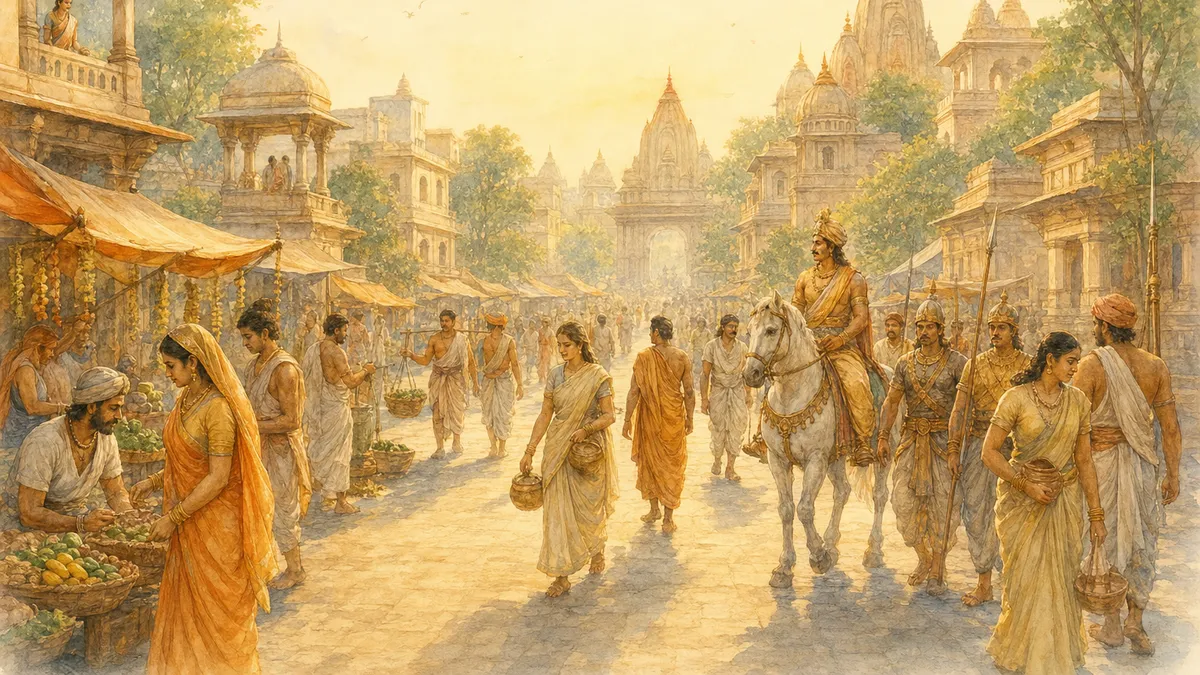
There is a story of Bhagavan Dattatreya in the “Tripura Rahasya” that tells of the city of Vaishali. This city still exists in India today, but it is no longer as it is described in the “Tripura Rahasya.” It tells of how one ruler attained enlightenment. When he attained enlightenment under the guidance of his guru, he told his wife, relatives, and courtiers about it. He told them about the nature of the mind and how to contemplate, and they too all attained enlightenment. They, in turn, told their relatives and other courtiers. And those people told the servants, and the servants told their relatives, and thus, like a wave, it swept over the entire city. Everyone gave one another direct introduction. The husband gave direct introduction to his wife, the wife to the children, the masters to the servants, the courtiers and ladies-in-waiting to the maidservants, the generals to the soldiers, the rulers to their subordinates, the subordinates to the workers, and the workers to the laborers. And this wave completely swept over the entire city.
And within a short time, the entire city attained enlightenment. And then it is said that all its inhabitants were enlightened, abiding in natural awareness. The soldiers served, the king ruled, the householders went about their affairs. Some of them were even courtesans, but, being enlightened, they continued to practice their craft. And they all argued, rejoiced, worried, shouted, cried, worked, served, and traded. Everything was teeming with life. Yet they were all in an enlightened state. They were all in sahaja samadhi, from the very lowest social strata to the king himself. The sages, seeing this city, were astonished. This city was called Vaishali. Such a city exists today. This is Dattatreya’s story to the brahmin Parashurama—his disciple.
This is an example of how we should act after discovering the nondual nature of the mind.
