


The Vedic Family as the Foundation of Spiritual Culture
A Vedic family is a mini-sangha, and the home of a Vedic family is an ashram. The more people practice, the purer the world will become, the more peaceful life in it will be, and the easier it will be to free oneself from the illusion of samsara. The more ashrams and temples there are, the more spiritual energy and sattva there will be, the more teachers, masters, sannyasis, karma sannyasis, and sadhus there will be, and the stronger the culture will become.
The power of culture is a great thing, because a person is shaped by their environment, society, and the magic of social conditioning. When we spread the Dharma, we create a different culture, and we create the magic of spiritual culture, which also has a powerful influence. Whichever magic is stronger, that is the reality tunnel that becomes embodied. For example, my magic is to spread the Dharma of Advaita, Shaivism, and Anuttara Tantra.
There are many other kinds of magic—the spread of consumer culture, the magic of other religions, the magic of materialism, atheism, communism; there are many different ideas in the world. But we can examine the essence of any idea: whether it leads to awareness, an increase in sattva, and liberation from ignorance; whether it eliminates ignorance. Sanatana Dharma is the supreme path of divine magic. When we speak of Shakti and the spreading of the Dharma, we speak of the essence of the entire universe, which encompasses all gods and all living beings on the planet and throughout the universe.
Many living beings could free themselves from suffering, destroy their ignorance, and awaken their awareness if only they knew the Dharma, but they simply do not know it. They pass it by; they lack the connection and the merit. Just as you once passed it by—the Dharma had always existed, but you simply did not know about it; it had not reached you, for example, thirty years ago.
Twenty years ago, I was preaching—it was the year 2000—we were moving from Crimea to Divya Loka, searching for Divya Loka, and I had an ashram in Simferopol. In other words, the Dharma existed, Sanatana Dharma existed in India, but you did not know about it; then later you encountered it and discovered its preciousness and depth. The same is true of many other souls. Our task is to provide the opportunity to come into contact with the Dharma, to raise our own level so that we can help others eliminate their ignorance, delusions, and all the confusion of samsara—but first and foremost, it must be eliminated within ourselves.
Sahaja Vidya—the Knowledge of the Natural State
Sahaja Vidya contains within itself the power of mantras, imbued with the power of omniscience. All mantras are activated under its guidance.
Sahaja Vidya is the knowledge of the natural state, the secret teaching of the natural state that is present in Shaivism, Tantrism, and Advaita Vedanta. In all teachings, Sahaja Vidya is present as the supreme apogee, the culminating practice, the pinnacle of all pinnacles, the innermost core of all teachings, all methods, all religions, and all lineages.
Why is it the apogee? Because it relies on nothing that has a name, form, or method; it is anupaya, that which requires no reliance on methods; it is natural. “Natural” means that it contains no artificial constructs; it is effortless. “Effortless” means that it comes through divine grace. It also unites view, contemplation, and conduct into one—ground, path, and fruit into one. That is, the ground is Sahaja Brahman, the path is also Sahaja Brahman (abiding in it), and the fruit is also Sahaja Brahman.
The view is Sahaja Brahman (Shiva), contemplation is abiding in Sahaja Brahman, and conduct is spontaneous abiding in Sahaja Brahman. This is the path reached by every living being who journeys deeply along the spiritual path, regardless of the tradition or religion to which they belong.
Once, Neem Karoli Baba was asked what sadhana he had practiced in his youth and what he practiced now. He said, “Earlier, in my youth, I stood on my head, practiced yogic pranayamas, and engaged in Kundalini Yoga, but now I abide only in natural love for God.” Every soul follows the path of method (the path of upaya) at its own stage in order to arrive at the yoga of nondual awareness, the yoga of self-surrender and self-recognition, the yoga of naturalness—this is Sahaja Vidya.
Sahaja Vidya is the principal sadhana practiced by all gods, rishis, and siddhas. This does not mean that they do not perform sadhanas, mantras, or rituals. Tantric sadhanas and rituals are also performed in the heavenly worlds—so profound and sophisticated that humans could not even dream of them—but this is work with shakti. From the standpoint of realizing the truth, however, the principal and highest method is abiding in natural awareness, self-surrender, and self-recognition. At the same time, all rituals, sadhanas, practices involving pranas and energies, mantras, and invocations of deities are also performed, but they are performed in the aspect of shakti. This aspect of shakti may vary, whereas the aspect of truth is one and the same for all—it is Sahaja Vidya.
Mantras and Divine Spanda
By drawing upon the powers of spanda, mantras endowed with the power of omniscience act in such a way as to fulfill their inherent functions with regard to embodied beings. According to the commentaries, this refers not only to mantras as such, but also to certain classes of deities—mantras, mantreshvaras, and mantramaheshvaras. And in it they dissolve together with the worshipper’s mind, since they are forms of stainless peace and have the nature of Shiva.
Mantras, devoid of specific attributes and any limitations, together with the minds of those devoted to them, dissolve completely into this principle of spanda. Thus, by their very nature, they are all Shiva.
Here, the word “mantras” refers primarily to the deities from whom arises the jiva that contains the universe within itself, and to all the states through the realization of which supreme identification takes place. Therefore, there is no state in word, object, or consciousness in which Shiva is absent. The experiencer, by virtue of that which is experienced, abides everywhere and in all things.
Shiva’s All-Pervading Presence
There is no state in which Shiva is not present. In the jagrat state there is turiya. Turiya is the perception of Shiva. In the states of svapna and sushupti—that is, dream and dreamless sleep—Shiva is also present, and he is known through the dimension of turiya. In eating, speaking, and perception through the eyes, ears, skin, nose, and tongue, and in the process of thought, Shiva’s presence is always there. In every activity of the five karma indriyas and the five jnana indriyas, Shiva’s presence is always there. In meditation with images and in meditation on emptiness, Shiva’s presence is always there.
This is the dimension of turiya, the dimension of sahaja, which permeates everything. It is the all-pervading spanda; the entire universe is the omniscient, total presence of Shiva. In ritual, mantra, invocation, the recitation of shlokas and stotras, in bhajans, upasana, and puja, there is always the spanda inherent in Shiva, permeating everything.
Through natural awareness, we discover this spanda, and the more skilled we become at discovering it, the better we learn to draw it forth in any situation, the more accomplished we become in the practice of natural awareness. As long as we are not sufficiently aware and skilled, our discovery and perception of spanda are often interrupted.
There is a condition in which we can perceive spanda, and then spanda bestows grace. Grace eliminates the kleshas, halts and dissolves karma, and awakens the mind. But there are times when we cannot discover spanda. This means that we cannot discover grace, we cannot be filled with grace, and all that remains is the perception of the mind and ego. The art of contemplative awareness and self-surrender lies in discovering the presence of divine spanda, divine grace, always and everywhere.

Freedom from Mental Patterns
External objects and the sense organs make a strong impression on our mind. We are deeply affected by external objects, and internal objects also make a strong impression. For example, certain concepts can completely throw us not only out of contemplation, but even out of emotional balance.
There are a number of concepts and certain notions, certain images—for example, memory and recollections. If you have not practiced samskara-shuddhi well enough, there may be a chain of memories that always knocks you out of a balanced emotional state. This means that you must purify these memories, purify them again and again, practicing samskara-shuddhi until nothing stirs in your soul, until you feel that no associations remain in it and only light arises, and that your attention no longer wishes to sustain these chains of memories and images.
There are chains of concepts that can throw a yogin and his contemplative practice off balance. When he begins to think about something that does not accord with his notions about a particular matter, his mind becomes disturbed. For example:
- There are people who have strong fixed ideas and patterns concerning justice
- There are other people who have strong fixed ideas about the right way to do things; they believe that only they know what is right
- There are people who have fixed ideas about what is true and what is false
There are a great many different fixed ideas that, when activated, can cause one to leave the spanda of the dimension of divine grace. They are all nothing more than the horns of a hare; they are like flowers in the sky, a horse’s horn, an egg laid by a horse, a horned hare, a rainbow in the sky, or a city of the gandharvas—that is, something completely unreal. They are invented by the mind and are fixed patterns that arose from consciousness, in which we simply became entrenched; and because we began paying attention to them, they acquired a certain power.
A sadhu must be very careful not to be captivated by any ideas, allowing all ideas to be liberated through the power of his own natural awareness. Self-liberation is one of the greatest arts of a yogin on the path of Sahaja Vidya: the ability to liberate one’s own ideas without falling into deviations.
When we master the art of liberation from conceptual images, habitual ideas, and subtle mental images, we become awakened spiritual beings, because latent karma, active karma, and potential karma—that is, sanchita, prarabdha, and agami—no longer have power over us. Our true nature is naturally released—this is the greatest jewel of the Sahaja Vidya teaching.

Unity with Shiva and the Perception of the Divine Play
Since the individual soul (jiva) is identical with everything, all beings arise from it, and it experiences its identity with all things. Knowing all this, there is no state that is not Shiva. Whether a word refers to an object or to a thought, it is always and everywhere the subject alone that manifests as something perceived objectively. One whose consciousness is one with Him, who constantly sees the entire universe as His play, is liberated while living, without a doubt.
Thus, consciousness is always one with Shiva, and consciousness always sees the universe as His play. These are the two aspects that reflect the principle of the energy and consciousness of Shiva and Shakti.
The View and contemplation mean always being one with Him, always uniting with Shiva, always being in unity with Shiva. The View is the remembrance “Shivoham” (“I am Shiva”), “Aham Brahmasmi” (“I am Brahman”). It is the remembrance that the mind, at its foundation and in its nature, is vast and wide open, without fixation on even the slightest object the size of a tiny speck of dust. The View means: no center, no boundaries, no name, no form, no concepts, no effort, no fruits, no results. It is a deep rootedness in awareness of this truth.
And contemplation is non-distraction from the View, a special vigilance that reminds us of the View and brings us back to it every second, prompting us at every moment to abide in the View.
The View is first experienced as the capacity for self-liberation, then as the capacity to experience the empty aspect of reality, and then as the capacity to experience the self-luminous aspect of reality, various levels of light, and various levels of bhava. This is the View and contemplation.
And conduct is our ability to perceive Shakti, to live in the universe of Shakti, in the universe of the Divine Mother, and to see the play of Shiva through Shakti, to perceive the playful nature of all phenomena, and to perceive all phenomena in pure vision. If we do not understand that everything is play, then we are deluded.
Shiva’s Great Prank
Here I am, the Guru, and you are the disciples; I reveal a secret to you—everything in this world is divine play. So what will you do? How will you perceive it? It is truly the greatest fact.
There are people on YouTube called pranksters who play practical jokes. To prank means to play a trick on someone; they are fond of practical jokes. They set something up, and a person freezes in shock and becomes frightened; then, when they have reached the peak of nervous tension, they are told, “Look, it’s a prank, it’s a practical joke, you’re being filmed by a hidden camera,” and suddenly reality is turned upside down. Everything seems to be the same, but the person sighs with relief and laughs.
The effect of realizing that the whole world is a single divine game should be just like this: it is as if your world turns upside down and a weight is lifted from your soul. You realize that all of it was unreal—it was all staged. And for what purpose? To grant you darshan, so that you could experience the thrill of a prank.
You see, life—all of life—is Shiva’s great practical joke, designed to grant you this darshan, to draw this emotion, this bhava, out of you. And the Guru is the one who reminds you: “Look, Shiva’s all-seeing eye is filming you—it is his practical joke. It is the play of his thirty-six tattvas. It is the greatest game in the universe.” Shiva and Dattatreya are the greatest masters of the divine practical joke; they are amusing themselves, but their amusement has a very profound meaning. The purpose of this amusement is to teach you, to grant you darshan, to give you the experience of divya-bhava, and to give you an understanding of the illusory nature of all phenomena.
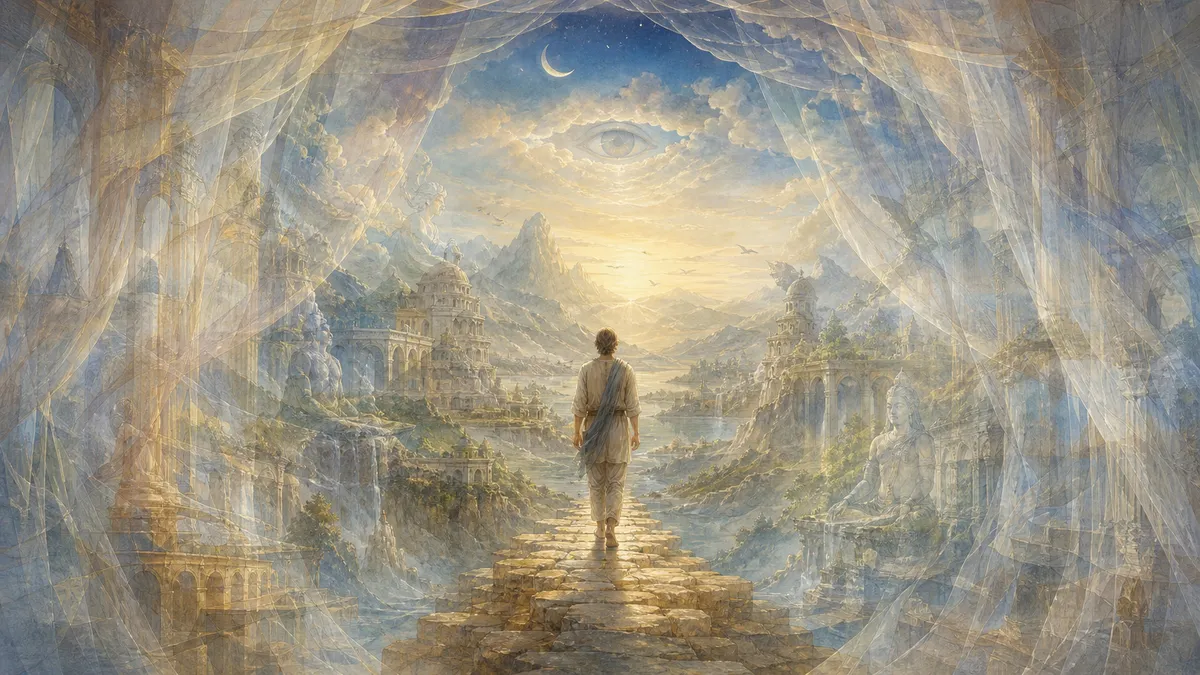
Sometimes people become angry and take offense until they realize that it is a prank. Sometimes the pranksters even get hit on the head because people fail to understand what is happening, especially if you try to prank someone in an African American neighborhood in the United States, where reactions can be very harsh; then the pranksters themselves run away, because people were genuinely frightened and genuinely outraged.
In the same way, all living beings in samsara, not understanding the principle of the game, the practical joke, become genuinely frightened and genuinely agitated by it all. For example, Arjuna on the battlefield of Kurukshetra could not believe that it was a practical joke—it was all a real battle, a war, and on the other side stood his relatives, cousins, uncles, and others. But Krishna says, “Fight, Arjuna—it is all a game. God’s game. It is all an illusion. Simply perform your duty and play your role like an actor.” It is very difficult when such energies are involved, but we must learn to perceive the world as Shiva’s game and ourselves as players.
The Cosmic Game and Our Roles in It
Perceiving the divine game also places us in the position of participants in this game, and within it we also occupy a particular role, such as carrying out the divine will. The gods, rishis, siddhas, and asuras play it; demons play it too, as do pretas and pishachas, each according to their level of understanding. In other words, this is not some small local game—it is a game on a cosmic scale, and its magnitude is astounding.
Nevertheless, it is a game. A game means that it is empty, illusory, and spontaneous; it is inseparable from knowledge, and there is not a trace of inherent existence behind it. It pursues no goals other than the attainment of spiritual bhava. For example, what goals does a game pursue, especially if it is not a professional sport? Clearly, the purpose of a game is the game itself; a game has no other goals. The pleasure of playing, bhava—that is all.
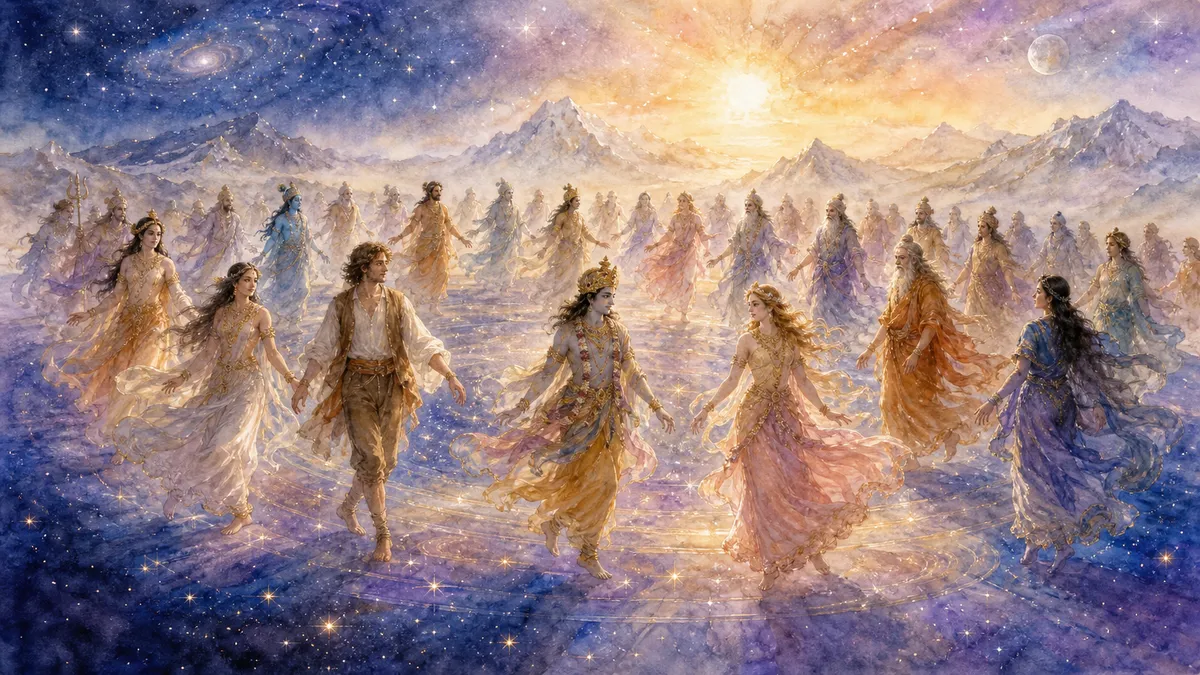
Saints are never mistaken in their perception of the playful nature of all phenomena, but ordinary souls are always confused by this playful nature, because perceiving the playful nature of all phenomena requires vairagya and abiding in the view, in the profound view.
An actor who plays a soldier, then a king, then a physician, then a drunkard, then a robber on stage never forgets for a moment that it is a stage and that he is an actor. After the performance ends, he changes his clothes as if nothing had happened and goes home to his wife and children; in other words, he does not change. The play leaves no impression on his consciousness.
In the same way, by recognizing the divine game (lila), we attain a consciousness that is neither confused nor obscured; no events of samsaric reality leave an impression on our consciousness, whether in the human world, the world of the gods, or any other world.
Levels of Participation in the Divine Game
There are games with a script, and there are games without one. For example, there is an actor who plays the role of Othello in a major theater; he acts according to a script, which is written by a scriptwriter and set by the director. In other words, they already have a certain finished canvas, a certain picture of reality.
Then there is the scriptwriter, who no longer acts according to a script but writes the script himself—this is his creative work, the script is his dream, his vision. His role is different.
Besides this, there is the theater director. He hires stage directors, scriptwriters, and actors; he has even more freedom of will. He manages the scripts and determines the theater’s policy—which scripts will be staged and which will not.

Likewise, in the universe there are those who set the script for living beings, deities who write scripts for other living beings, and there are deities who create those deities who set the scripts. Everything depends on the level, and the higher your level, the freer you are from all scripts. For example, for this material universe there are indeed scripts written by Brahma and his assistants for certain kalpas, for certain vast periods of time, for maha-kalpas. Vishnu himself gives rise to Brahma, while Shiva gives rise to many Vishnus from the pores of his body.
Question: So it turns out that the soul’s freedom of will lies in choosing its own game. There are different roles, and I choose whichever one I want, but I cannot choose, for example, not to play this game, because I need to reach a certain point where my karma is exhausted?
You cannot refuse to play. The fact is that the game began without your being asked, even before your birth, and you have only just begun to realize that you are actually in a game. This often happens in secular films where people find themselves tied up in a room and do not understand: “How did we get here?”—and they begin to reconstruct the chain of events. It turns out they came from different places—these are some kind of horror films—and then it turns out that someone seized them and tied them up, and they begin acting out this thriller in order to save themselves. They do not understand what they did to deserve it or why they ended up there, but someone else’s will has already captured them. In the same way, we were born here, and someone else’s will has trapped us in this script. Most people do not even understand this—they simply live, work, die, and are born again, while sadhus are those who have become aware of this game.
Liberation from the Script Through Unity with God
Freedom of will lies in becoming free from the script. However, it is possible to become free from the script of this game by becoming one with God, because the soul cannot conduct its own game without becoming one with God, since there is always only one principal player. By becoming one with God, it can truly unite its will with the will of God. Therefore, the “Svachchhanda Tantra” contains the expression: “One’s own will is the Lord.” Indeed, through its will, lila (play) also begins to unfold.
Therefore, when an avatar comes, people do not say, “The avatar did this,” “The avatar acts,” or “The avatar plays a role”; instead, they speak of “lila,” as they say in India: “Krishna lila.” Krishna lila means that Krishna plays—he does not act, but plays in accordance with his own svatantrya. Svatantrya means that he is absolutely sovereign in his own will. For example, sixteen thousand palaces, one wife in each, sixteen thousand wives, and each one thinks that he is with her alone—in other words, this is the siddhi of the illusory body.
He fights on the battlefield of Kurukshetra and arranges various diplomatic and political games, while remaining absolutely unattached. Why does he need any of this? Krishna lila—that is, something absolutely spontaneous, absolutely unpredictable. Yet through him the greatest global karmic processes on earth are brought about and set in motion—in other words, the divine will of Vishnu acts through him.
The same is true of Shiva, the same is true of Dattatreya and Dattatreya’s sixteen avatars—all avatars come and play. Dattatreya plays: he appears in the sky in padmasana and provokes the siddhas; the siddhas begin competing with one another through their siddhis, while Dattatreya destroys their pride and says, “Practice better; free yourselves from pride and anger”—and the siddhas do not understand that this is Dattatreya lila.
The same is true of Shiva when he staged various games: some hermits did not understand who he was and decided to curse him. Using the power of a spell, they sent a tiger against him—and the tiger was torn to pieces. These are the various lilas of the gods. Vishnu in the form of Mohini, who stole the nectar from the asuras—all this is lila, that is, divine play. People cannot comprehend the grandeur of God’s games, the grandeur of the games of God’s avatars, but they are taking place constantly.
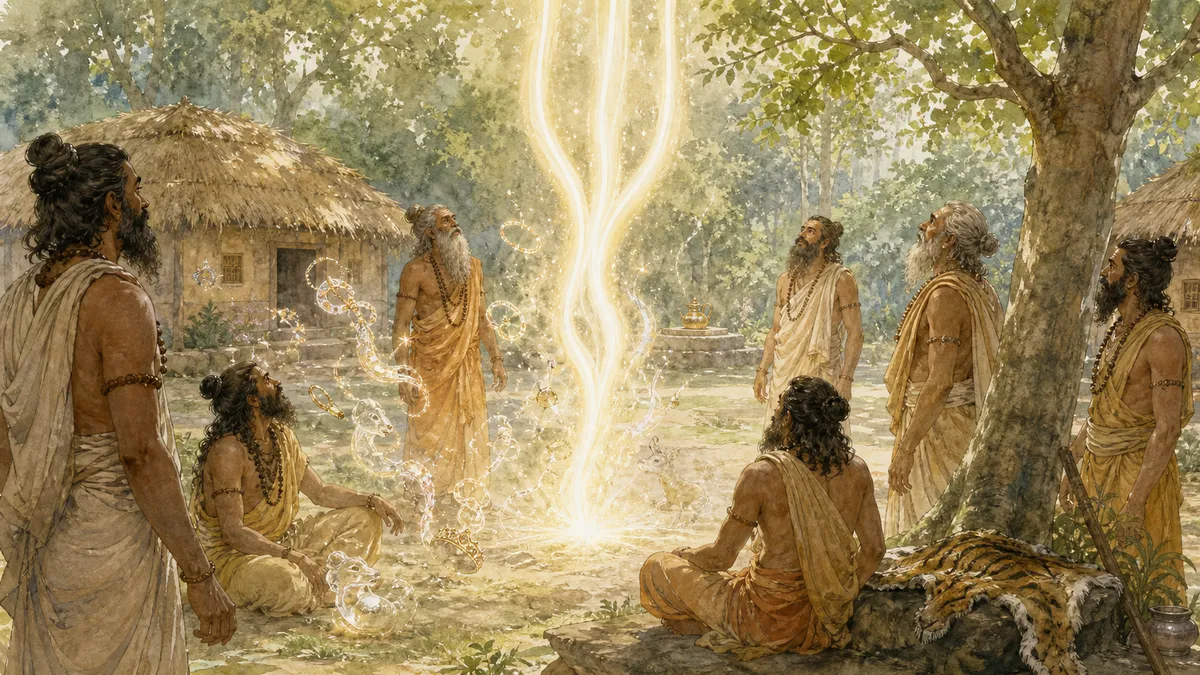
On the other hand, one who abides in unity with their higher Self perceives the entire world as divine play. Such a person is a jivanmukta; there is no doubt about it.
The Nature of Divine Play
Divine play means that there is no longer any eternalism, materialistic entanglement, extremism, or entanglement in the material, external objective world. Nor is there any nihilism, extremism, or absorption in non-being. It contains the dynamics of the play of energy and empty awareness.
Awakening in it is the attainment in samadhi of the unity of the contemplated and the contemplator, occurring by the will of the sadhaka. Only That arises in the mind of such a meditator as the object of meditation. A sadhaka with a firm will realizes identity with That.
Through the power of intention, faith, devotion, and contemplation, the sadhaka realizes identity with Shiva.
Perceiving the Play in Quantum Reality
The perception of divine play cannot occur in the objective world, in the dualistic subject-object world—you simply will not be able to recognize the principle of lila (play). The perception of play always occurs in divine magical reality, in quantum, probabilistic, stochastic reality, when the subject begins to become one with the object, when the observer begins to become an active agent of perception.
Let us take ordinary perception—in ordinary perception, the observer is not particularly prominent. At the market, you might ask a person selling onions: “How is the observer doing? Are you aware of the inner observer, the antaryamin, the sakshi? Is there self-liberation?” They will say: “What are you talking about? I’m selling onions”—and that is most people. This is the dualistic subject-object picture of the world.
The yogin begins consciously cultivating the observer and expanding the field of observation; the observer begins to come to the fore alongside upasana, faith in God. On the one hand, there is faith in God as separate from oneself; on the other, there is the observer, who also begins to deepen and become an active agent, a participant in the perception of the world.
Through the observer, the yogin enters a quantum, probabilistic, stochastic picture of the world, a magical fabric of reality in which the observer begins to influence processes and the external world. The external world, too, manifests not as external objects but as a manifestation of a single awareness—that is, as a magical world. This is when the will begins to change reality, when the very act of observation can change reality. This is the quantum picture of the world—all this is already known in science; it is no secret.
Scientists proved long ago that the observer influences the process of observation and that observation has an active aspect. Quantum processes are characteristic of the micro level, at least in current quantum physics. Science has not yet made much progress at the macro level; it is only approaching that level, but yoga and dharma teach that these processes are characteristic of the micro level, the macro level, and every level.

Shaping Reality Through Divine Play
Divine play is the observer’s involvement in the picture of the world, when the world is a single consciousness. In other words, it is at the very least a magical picture of the world in which will, conception, imagination, awareness, and bhavas play a role, and in which reality can be shaped. We can change the picture of the world; to some extent, we can change the local divine play taking place within it if we develop authoritative, volitional, operative functions—to some extent, we become the mandaleshvara of reality.
We can do this precisely to the extent that we control our senses, emotions, our own mind, and our will. If there is strong sankalpa, strong will, and profound clarity, then we can shape reality to some extent; most importantly, we must also know why we want to shape it.
Some people have read books by Vadim Zeland and certain others and have rushed headlong into shaping reality, reciting various incantations. And yes, it works—some minor things work out, certain small intentions are realized, but then they reach a kind of dead end and say: “But beyond that, it doesn’t work; it doesn’t work with larger objects.” Most importantly, they begin to wonder: “What do I want? In what direction do I want to change reality? How do I want to do it, and why?”—that is, major worldview questions arise.
Because when you understand that the world around you is a manifestation of you, and that the world around you exists independently of your consciousness, but only as long as you agree to it—and if you do not agree and understand that you can change the world around you, becoming to some extent an authoritative, volitional operator—then you begin to wonder what needs to be changed and in which direction.
Sadhus and yogis have long been engaged in this—all the sacred scriptures speak of nothing else. They do not say that the world should be changed in minor ways; they say that the world must be changed completely: transformed into a mandala of the pure dimension, oneself transformed into a deity, time, space, and causality dissolved, and all the kanchukas dissolved. It must be changed at a very fundamental level, and these fundamental changes to the world are precisely liberation from samsara, from the most subtle, deeply embedded laws.

There is even a writer named Pelevin—he wrote about an old woman who intuitively realized that the world depends on the observer and that reality can be controlled. She worked as a restroom attendant, and while she was cleaning the toilets, such thoughts came to her—she was interested in Zen, I believe—and she began trying to change reality.
Shiva-Spanda as the Foundation for Controlling Reality
The magical, divine worldview, in which we see the principle of lila (play), enables us to understand that reality can be changed, that reality depends on the power of our mind, and that reality becomes what we conceive it to be in our thoughts. It will be explained further that it is our attention that changes the world. That is, our attention is capable of manifesting anything at any time, in any place, under any circumstances.
Our attention brings shakti to life—by what means? By awakening Shiva’s spanda. Since Shiva is everywhere and spanda is everywhere, our consciousness can awaken spanda in any object and can manifest anything at any time, in any place.
For example, when Indra was fleeing from the asuras, he concentrated on a molecule or an atom and, through the power of his attention, awakened Shiva-Spanda and created an entire universe. He hid in that universe from the asuras and, after some time, created an entire world, established himself as its ruler, and continues to rule it to this day—it is one of the universes of our world. But originally it did not exist; there was only a molecule or an atom, and within that atom Indra created such a universe. This is the power of attention governed by spanda—this is the secret of controlling reality spoken of by the siddhas. This is Shiva-Spanda.
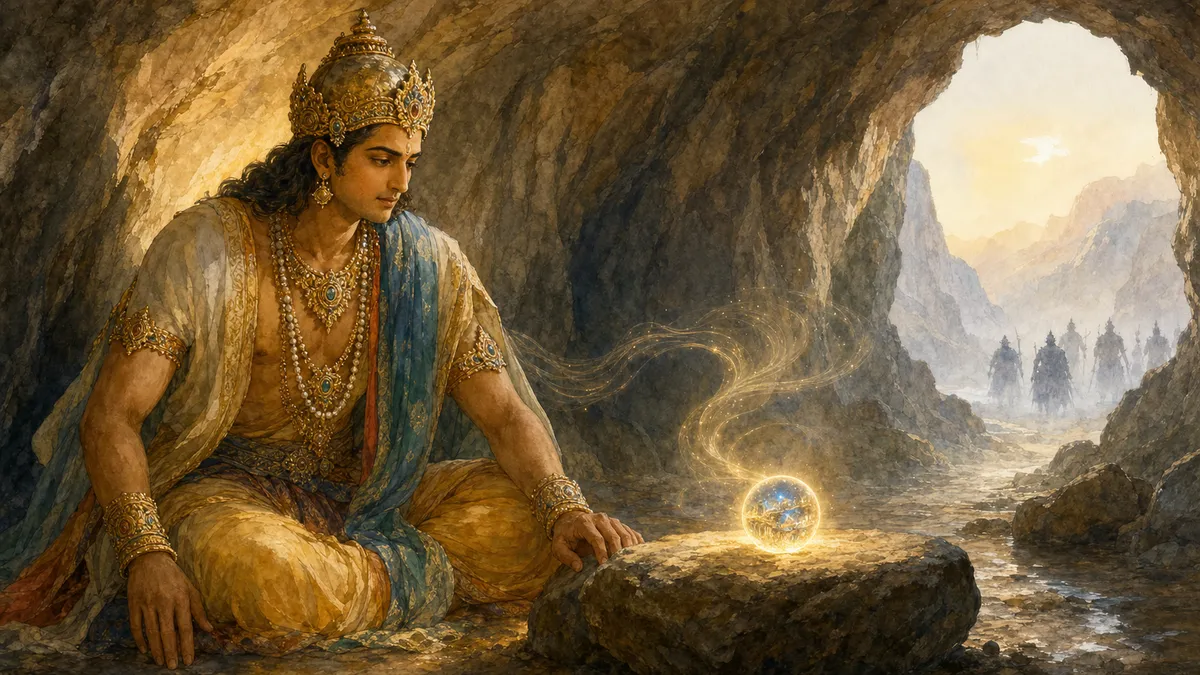
Question: All siddhis are based on this principle, as far as I understand?
Yes.
Question: They seem to change reality, but only until it comes up against a scenario; that is, you can change it, but once you reach the scenario, you cannot change it.
Yes, until the reality generated by your attention encounters someone else’s scenario, that of a higher being. For example, when you change the scenario and change reality, you may find that your reality is already embedded in some other, greater reality, whose boundaries are set not by you but by certain greater beings. For example, by local mantreshvaras who oversee this group of galaxies; and you keep changing things here, but then you look and find some kind of current there.
It is like mice in a house being able to change reality, gnawing away at it to some extent, until the owner arrives. But if they come to an agreement, an equilibrium will be established between them; however, if the mouse were to become large and intelligent, then it would no longer be clear who was in charge—you see, it is not certain that the owner’s will would still be able to change reality.
Identity as the Path to Immortality
Identity is precisely the attainment of immortality. It is the perception of the Atman; it is nirvana-diksha, which bestows the nature of Shiva. This alone makes it possible to attain the nectar of immortality; this alone is the realization of the Atman. This diksha leads to nirvana; it bestows the authentic state of Shiva.
