

Cultivating the right motivation. We remember that we are walking a path, and on this path, four enemies may await us: Mara Klesha (desires), Mara Skandha (attachment to the "I," thoughts, images), Mara of Pride (the son of a celestial being), and the Mara of obstacles, called the Mara of Death, who takes away life force. One must walk the path in such a way that these Maras do not catch you. Just as wolves in the jungle catch weak animals—the slow, the clumsy, the cowardly—but cannot catch the agile and the brave, so too do the Maras catch unfortunate sadhus. Therefore, my blessings to you are that you may be fortunate sadhus.
A fortunate sadhu lives not by the head, but by the spirit. Sometimes people say "by the heart," but this is often misleading—which heart? Sometimes emotions are what "thinks." Therefore, I prefer to say "by the spirit." One who lives by the head is not a very fortunate sadhu. To live by the spirit means to live in integrity, in samyoga, in balance.
Samyoga – The Foundation of Spiritual Practice
You must live in harmony with nature, in balance, in samyoga. Samyoga is balance with the external elements, with each other, with one’s own body, with one’s pranas, with one’s mind, with the mandala where you practice, with the monastic mandala, with monks, laypeople, novices, and with subtle beings (beings of the subtle world). Punishing spirits are on the left side, in front, and behind; guiding spirits are on the right. As soon as you begin to think wrongly, you immediately encounter obstacles. Punishing spirits sometimes perform their duties very zealously. Guiding spirits act more subtly. These are also parts of the mind, parts of the collective consciousness, assigned to you according to karma.
All traps can be bypassed when there is samyoga, balance. It is very important to give significance to samyoga because if you lack samyoga, you walk the path, apply effort, and meditate, but then your mind may go out of balance, your pranas may go out of balance, and your ego may go out of balance. Then you become vulnerable to the Maras, to the kleshas. You can lose your integrity on the spiritual path. One must never lose integrity. On the contrary, sadhana should increase your integrity, increase your inner harmony. An inexperienced practitioner often loses it. He is like an inexperienced driver who presses the gas and brake pedals simultaneously, and his engine stalls. He wants to go, but he stalls, moving in jerks. That is such a practitioner.
You can lose the balance between the red and white bindus, the five pranas, between the internal and external, between view and behavior, relative and absolute truth, mind and non-mind, between service and sadhana, in relationships between male and female, between elders and juniors, with the physical world and the subtle world, with desires and their suppression. Many such opportunities are provided to test you. Through renunciation (vairagya), dispassion, and all-acceptance. An inexperienced practitioner, like a child or a blind kitten, can get lost in all this in five hundred ways. Therefore, you must not be an inexperienced blind kitten; you must become sages, masters of life and sadhana.
To practice Dharma means to practice samyoga, balance in everything. From balance, contemplation is born. No balance – no contemplation; there are only beautiful words and nothing more. You may not speak very beautifully, but you can be defined by your life—whether you are in balance, in samyoga, or not. One who is in samyoga is a contemplator. Therefore, you must bring your life into balance, bring your pranas and mind into balance, the external and internal, the view and behavior—then you will smile happily.
The True Center and False Attachments
You are part of the universe, part of nature; you cannot exist by yourself. Imbalance occurs when we become too fixated on our problems, giving importance to ourselves. Sometimes we think too much about ourselves instead of thinking about God. "I have this, I have that, I am so special." In reality, a good practitioner thinks about God seventy percent of the time, about service twenty percent, and about themselves ten percent. Then there will be balance.
Bhagavan, God, is the center, the magnet that attracts everything. If you pay attention to Him—that is, if you are established in the view—this balance appears in you. But if you direct the mind to a false center—to ahamkara (ego)—you shift and become eccentric. Your center of gravity shifts, and balance is lost. Either you think too much about others, or about yourself, or about external circumstances. If you hold to this center, service is natural, relationships are in harmony, everything is harmonious; this is samyoga, integrity, self-sufficiency.
Often attachment prevents one from attaining such integrity and self-sufficiency (no matter what it is attached to) when the mind has a tendency to cling to something. This disturbs samyoga, disturbs balance; one must not give their spirit to anything except God: not to a person, nor an idea, nor a vikalpa (imagination), nor to any external affairs under the noble pretexts of serving others. You must not lose your integrity. All this is ahamkara, all this is ego. You will lose your integrity if you allow your soul to be given to this.
True and False Types of Freedom
The "Three Freedoms" come from samyoga, and never from any other state.
There are three other types of freedom, the so-called "freedom of a madman," called verisvatantryam—the freedom to fall into a demonic state, the freedom of the ego, for ahamkara (ahamkara-svatantrya), the freedom to be self-sufficient for oneself, for the ego, and the freedom to fall into dependency and attachment (abhimanya-svatantrya), the freedom to make mistakes, to become attached, and to fall into delusions. These three types of freedom are false. The true "three freedoms" are born from samyoga, balance. Through maintaining samyoga, our inner essence (sahaja-tattva) grows.
The Example of Krishna and Arjuna
When Krishna stood with Arjuna on the battlefield of Kurukshetra, he said, laughing: "Is this a battlefield or a field of offerings?"
For him, offerings, battle, or ritual were all the same, although Arjuna did not think so. Arjuna then wondered:
"Why do you perceive everything with such equanimity? Look, a grand battle lies ahead."
Krishna said: "Because I perceive my Higher Self. It is the same as yours, but you cannot perceive it because you have never concentrated on it, never noticed it."
Arjuna became confused and said: "You are trying to confuse me."
Krishna then said: "I am jnana-svarupa, satya-svarupa (the nature of knowledge and truth); how can I confuse you? I want to clarify things for you."
Then he gave this example: "Do you remember how, at sixteen, you captured a certain king and brought him here?"
He said: "Yes, I remember."
"And do you remember how you married Draupadi?"
He said: "I remember that too."
Arjuna was already eighty years old then. Krishna patted him on the shoulder and asked: "And do you remember what you were doing on this specific day three years ago?"
He said: "No."
"And why? Look, you don't remember three years ago, but you remember fifty years ago."
He was surprised then. Krishna said: "Because you only remember what is significant and vivid to you, what directs your consciousness."
We do not notice what our mind is not directed toward. What the mind is directed toward, we can notice. We cannot notice sahaja-tattva until our mind is directed toward it. Samyoga allows the mind to be directed toward it. Everything begins with balance.
Liberation from the Trash of Consciousness
Therefore, it is important for us to always strive to dwell in harmony and balance. If you live in a mandala and have balance, you have no problems; everything is fine, everything is harmonious, you live flexibly—neither with vinaya, nor with relationships, nor with sadhana, nor with service—there are no contradictions anywhere. The more empty we are, the fewer contradictions there are. But if we are full of memories of the past, if we are full of preferences, if we have egoism, then we can often enter into contradictions. This will always be projected, always superimposed. If we want to live in samyoga, we must free ourselves, empty ourselves.
That which we hold onto, that which we cling to, has no value; it is like trash. In people's minds, there is often a lot of trash, so much trash. They talk about the ecology of the planet, but the ecology of consciousness is much more important, because the pollution of the planet is a consequence of the pollution of consciousness. We must free ourselves from this trash. With so much trash in the head, how can one live happily, what Liberation can one even talk about? You cannot even exist normally in life; your head gives you no peace. Self-liberation begins with removing all this trash from the head; we look at life more simply. We become more relaxed, harmonious, and empty. A yogi is one who fears no one and whom no one fears. So says Dattatreya.
Interdependence and Harmony with the World
Samyoga, balance, means that we can live harmoniously with any energies in the world. We do not disturb this harmony; we understand that we are part of the Universe, part of the whole. Brahma gave us this body; we are not independent; we live by the air, and air is part of the body of the goddess Bhumi Devi. Without the sun, we could not exist, and the sun is Surya Devata. We are all interdependent, interconnected. Anyone who thinks they can be an independent, individual, great, proud person is greatly mistaken; they are within the mandala, and they cannot escape it. They simply need to accept this fact and establish harmony in their heart.
When we understand this—that we are not separate from the world, that we are dependent and interdependent in everything—we can look at the world differently; from this, balance, samyoga, is born. If you have samyoga, you walk carefully, speak consciously, eat as much as needed, meditate correctly, your tattvas (elements) are harmonious, your mind is serene and does not wander, your soul is always in its place, and you are always happy. You are empty, like a hollow bamboo, and then the wind of awareness begins to blow through you.
The Story of Yajnavalkya
Once, the brahmin Yajnavalkya was studying with his Guru. In ancient times, teachers placed great demands on students. If a student violated ethics, behaved rudely, or neglected the knowledge being given, or was lazy, the brahmin could expel them. Yajnavalkya was a good student, but gradually he began to be very proud of himself; complacency and conceit arose in him. His Guru noticed this and said: "Yajnavalkya, you are full of conceit and pride; it is better for you to leave the school. And the knowledge you have received, you must give back." Then Yajnavalkya induced vomiting; this vomit left him, and the knowledge left him, as it is told in the Upanishads. Then it was pecked up by birds named Taittiri. Thus the Taittiriya Upanishad appeared. Subsequently, Yajnavalkya transmitted the Shukla Yajurveda (the White Yajurveda). And he himself was very strict with his students while teaching them, remembering the lesson he had received from his Guru.
If our samyoga is destroyed, if balance is destroyed, then we cannot apply the knowledge; the knowledge is within us. But it leaves us, it is expelled; we cannot carry it, we cannot be its vessel, as it contradicts our incorrect internal values and attitudes. Knowledge is a great thing. When we let it in, we must be able to maintain balance, we must be able to carry it, to nurture it so that it grows within us; then it will take root and manifest as the immortal child of awareness.
Four Types of Liberation
According to the Teaching, we attain four types of Liberation. Salokya-mukti means reaching the loka of a god, the dimension of a god. Sarupya means attaining the same form as the god, for example, the illusory body of Dattatreya. Samipya-mukti is proximity to god, being near the deity in dualistic tantras, and in non-dualistic ones, dwelling very close to non-dual awareness. Sayujya is dissolution (laya). All these four types of Liberation: salokya, samipya, sarupya, sayujya, indicate a very high level of samyoga.
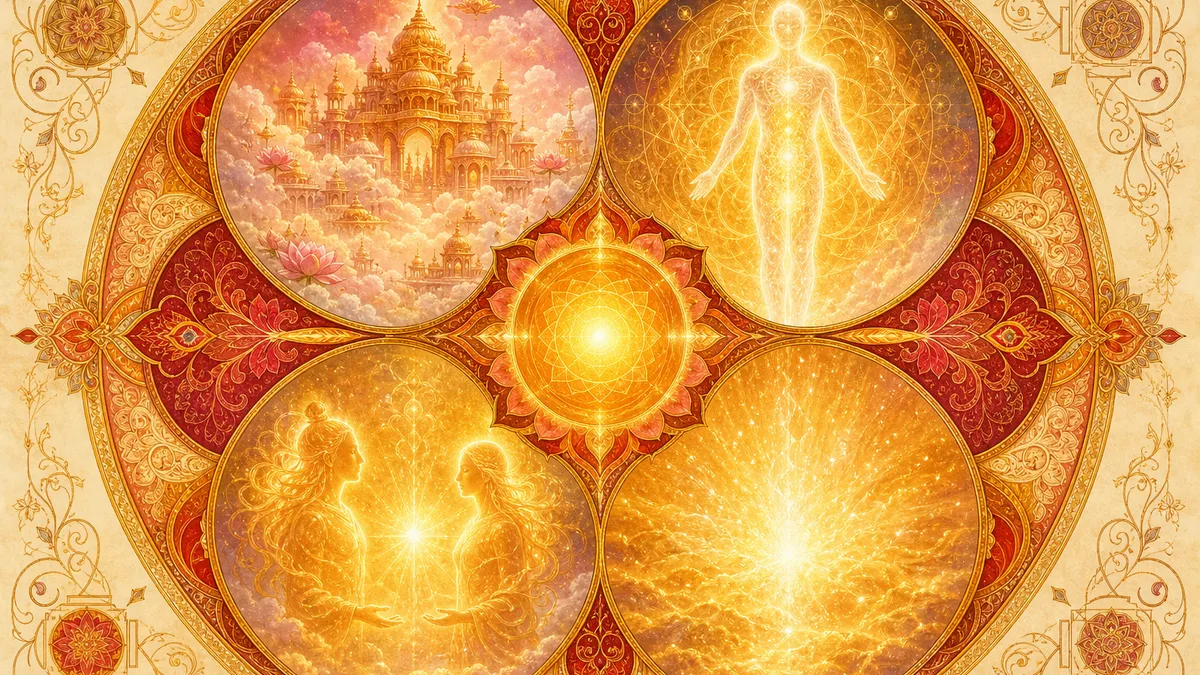
The higher the dimension of celestial beings, the higher the level of harmony. Harmony increases in the angelic worlds. In the worlds of the gods, it is very great; they have completely merged with the laws of the universe. In the world of the asuras, harmony is disturbed; in the world of the devas, it is disturbed toward bliss, enjoyment, toward the ego. In the world of the asuras, it is disturbed toward pride, envy, and rivalry. In the world of humans, samyoga is disturbed toward attachment. The lower the worlds, the less samyoga there is, and there is no balance. In the lower worlds, in the hells, balance is severely disturbed. In the hellish worlds, might makes right; large spirits kill small ones.
Balance in the World and Collective Karma
In our world, balance exists, but it is maintained with difficulty. For example, when volcanoes erupt or earthquakes occur, it is the tattvas going out of balance. When cataclysms and wars happen, it is minds going out of balance. Clashes, crimes—all these are violations of balance, of samyoga. A violation of natural forces and laws. And the devas who exist in this world, the guardian spirits of the area, cannot cope with maintaining this balance. There are subtle, divine, spiritual forces that care for the maintenance of such balance. But when many souls with low karma arrive, this balance is disturbed; they may not be able to cope, and sometimes the higher devas consciously do not allow them to manifest their power, might, and abilities. They have their own plan. They think: "Let the balance be disturbed, let the karma be washed away by these beings. Let them receive a lesson and exhaust this."
Earth is a large metaphysical metasystem. And often the various problems occurring within it are also consequences of the violation of samyoga. Therefore, it is very important to think correctly, to choose the right reality tunnels, and not to allow impure thinking to arise. All students who have a samaya connection are like computers in a local network. We have, as it were, a common local network. If one gets a virus, others can catch it too. And samaya specifically protects students from such viruses. We speak of samaya, pure vision, because one must not infect consciousness with impure thoughts, must not infect consciousness with trash. It must be protected; it is an information system, very dear to you, precious—it is your life. This is why we so often speak of the importance of pure thinking.
But all people are connected to each other. If there is incorrect thinking in a certain country, then after a while, scenarios of punishment begin to unfold there; balancing forces are attracted to restore this equilibrium.
For example, an earthquake recently occurred in Haiti. A huge number of people died, and the economy was completely destroyed. Some religious hierarchs expressed the opinion that the residents of this country practiced a lot of Voodoo. Moreover, there are different kinds of Voodoo. Voodoo is a religion. There is a dark side to Voodoo, and they abused this dark side of magic.
The Mind as an Instrument of Knowledge
Truth will reveal itself when the mind continues the search, vichara, in a state of samyoga, balance. The mind will do its job if it is not distracted by extraneous thoughts; a purposeful mind is a good tool for knowing the Atman. But it must be purified and trained. If your mind is subdued, purified by discipline, and trained, it is suitable. If it is not subdued, not trained by discipline, and not purified, it is an unsuitable tool.
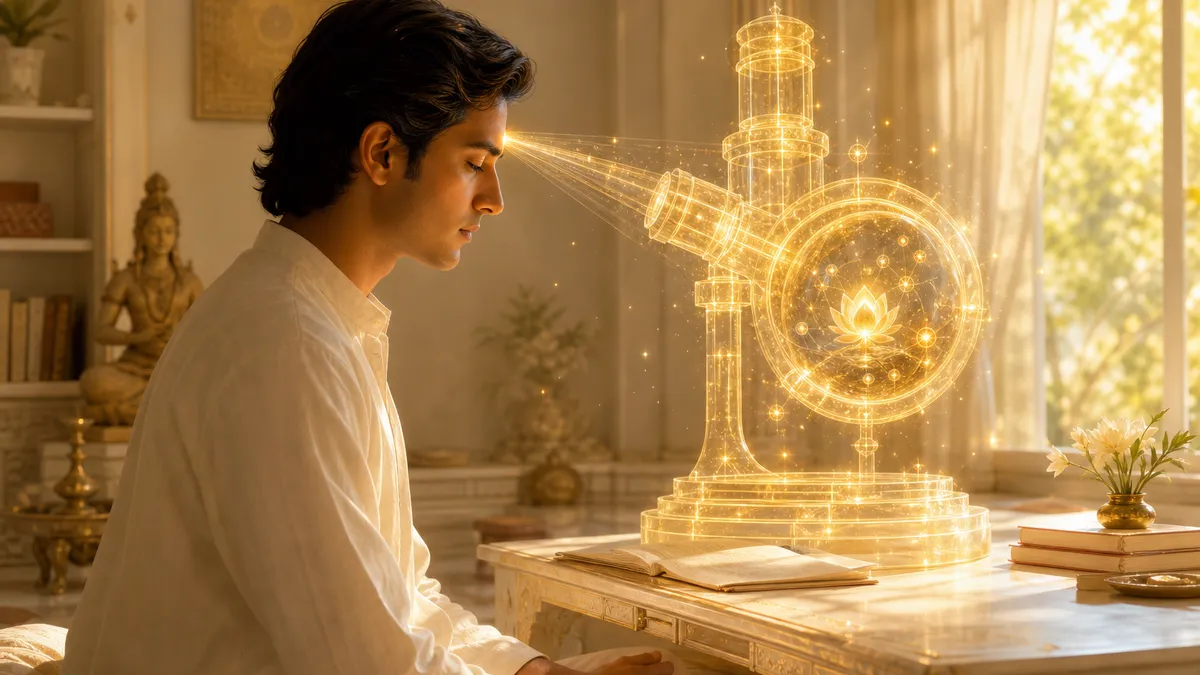
A student asked the Guru: "Why can't I see the Higher Self?"
He said: "Can you see atoms, molecules, electrons?"
He said: "No, a microscope is needed."
The teacher said: "Likewise, for spiritual life, an inner, spiritual microscope is needed. You must create it within yourself."
He asked: "And how do I create it?"
It is a purified, disciplined, and subdued mind. If the mind is not infected by desires and attachments that can stir up a whole stream of thoughts, the search is possible.
