

Commentary on the text “Yoga Vasistha. Chapter 6. The Story of Ikshvaku”
Year after year we make prostrations, sing bhajans, meditate, and do seva. They say it helps one attain happiness. If you are diligent and attentive, it helps to purify your karma.
Even if there is an excellent Teaching, excellent methods, there is no way without purification; one must purify one’s heart, one’s karma. The whole point is that there is karma. The methods work when most of the karma has already been planed off, as if with a plane. Methods, especially subtle contemplative methods, are already cutting with a jigsaw; they are already sanding. That is, contemplation is when you are already polishing the surface. But imagine that there are knots, notches, bark—then you will not be able to sand the wood. You need a saw, a chisel, a plane. A lot of shavings must come off. This is precisely the process of purification.
Many people often have not entirely correct ideas about spiritual life as a technology, especially Western people: “I will study the technology, receive a mantra, study a method, pranayamas, techniques, meditations, some kriya, I will keep turning it, and everything will work out.” And here a great catch, a big surprise awaits, because there is karma. Karma is a specific force sleeping within us, a specific energy, a specific mood of our mind, which sometimes surfaces at the most inappropriate moment, when we think: “Any moment now I will become almost enlightened. Any moment now I will enter samadhi.” But suddenly karma surfaces, like some inner voice, and says: “Come on, let’s be proud. Come on, let’s become attached. Well, come on! Just a little. After all, you are already almost enlightened, and when you attain enlightenment, nothing will be interesting anymore. Don’t miss the moment!” This is karma.
Therefore, the matter is not only in upaya (method) and not only in wisdom. That is, upaya (method) and jnana (wisdom) are the two wings on which the bird of Liberation flies, but the matter is also in the purification of karma. Purification of karma and accumulation of merit are one and the same, only from different angles. Karma sleeps in us in the form of memories, in the form of images. Dig a little deeper into each of us, and there karma sleeps: for someone, a royal golden helmet with wings, a sword, a shield; for someone, the garments of an apsara who danced before Indra himself; for someone, the special overalls of a first-class pilot; for someone, the magical armor of an asura warrior; for someone, karmic debts to people (future unborn children in subtle bodies cry out, “give birth to us”). And what is to be done with all this? All of this must be purified. Because if you follow along with it, there will never be an end. You cannot rebirth all the children, you cannot repay all the debts, you cannot win all the wars, you cannot occupy all the thrones (and even to occupy one throne, how many problems and sufferings there will be along the way). This is samsara, which misleads and gives hopes for happiness. And since we have seized the chance to enter the path of Dharma, to enter the path of Liberation, we must cherish it very much. That is why we say: “Precious human birth.”
The Path of Renunciation and True Responsibility
Sometimes there are very responsible people. They say: “I must repay my debts to society.” But responsibility is a relative concept. One must be responsible in the right way. The main thing is to understand what you truly must be responsible to. But what about the living beings whom you must save in the future, for whom you are the only hope? If you do not attain Enlightenment in this life, you will not come to them and help them. And what about responsibility for carrying out the divine will? Ultimately, responsibility to the sangha. And worldly duty is, no matter how you look at it, a fixed idea, a social pattern. And in general, it is maya, but you dreamed that you are responsible. For what? In illusion, for example, you have a shop and sell something in a dream. It is the same thing. If you want to wake up, then raising the question that you are responsible for a shop in a dream is mistaken.
Therefore, a sadhu who strives for Liberation follows the path of renunciation. He tries to renounce unnecessary kinds of responsibility, unnecessary obligations. He does not renounce all obligations. For example, there are spiritual obligations; one should not renounce them, otherwise it would be nihilism. At least at this stage, the time has not yet come. Perhaps the time will come when you enter the status of a hermit or enter a twelve-year retreat. In a twelve-year retreat, even if you approach the manager and ask: “May I do some kind of seva?” he will say: “What seva? You are in retreat!” That’s it, you will not even be allowed to do seva. But this must come in its own time, when the karmas have already been purified. Therefore, a sadhu chooses the path of renunciation, when he renounces all unnecessary kinds of responsibility. At the same time, he learns to accept responsibility for the Dharma, for the sangha, for himself as a sadhu, for carrying out the divine will, for samaya, for the principles and rules of monastic culture and ethics. He enters a new, higher, and subtler dimension of responsibility.
Divine beings, even when liberated, still manifest something and sustain energies, but they do not have the kind of responsibility that exists among human beings. For human beings, responsibility is always connected with malas, that is, with impurity (with karma, with the ego). One must act and then also reap the fruits of these actions. That is, any responsibility in the world of human beings is fraught with consequences. In a certain sense, it is even dangerous to take responsibility for it. A king who has taken responsibility for his subjects may take on all the karma of his subjects and in the next life end up in hell because of them. After all, he will have to punish someone, wage war, kill.
But the responsibility of divine enlightened beings is different. It is like a game without causes and effects, without karma, without fruits, without attachment to results. It is like the sole responsibility to be devoted in heart, to be aware in non-dual self-surrender to the Presence. Therefore, the highest responsibility of a sadhu is not some kind of obligation; it is rather the duty always to abide in a state of devotion to God, of self-surrender. He may take on certain obligations in accordance with place, time, and circumstances (for example, helping others), but this is already an expression of his highest obligation of the single samaya, the devoted heart, and self-surrender.
Vasishtha continued:
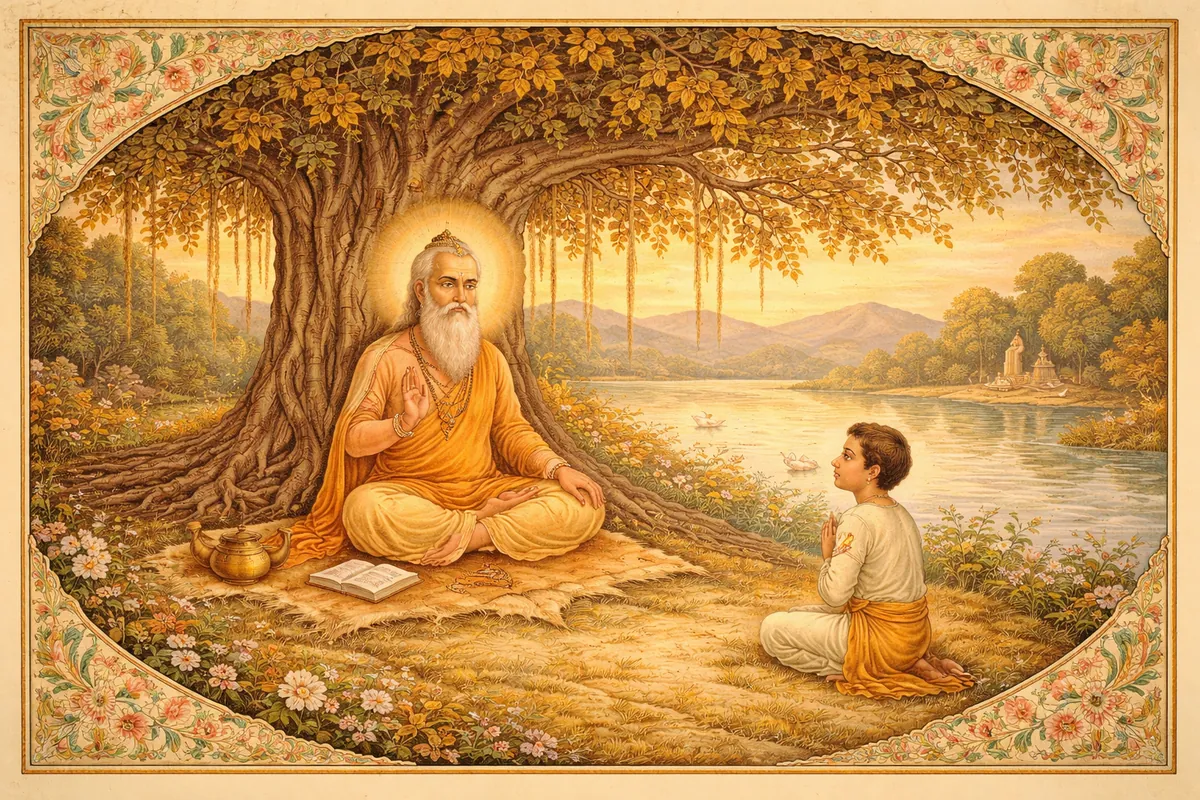
–Your ancestor, Ikshvaku, while ruling the kingdom, once reflected: “What could be the source of this world, full of various sufferings—old age, death, pain, as well as pleasures and ignorance?” He could not find an answer. After the proper salutations, he approached his father Manu, the son of Brahma himself, and asked him: “Your will compels me to ask you a question. What is the origin of this world? How can I free myself from the succession of deaths and births?”
One saint used to say: “The two most important events in our life cannot be disputed: birth and death. Then what is the point of thinking so much about other trivial things in the interval between them? It is utterly useless.”
When we enter the spiritual path, enlightenment, liberation, and establishing a connection with God are the main goals and meanings of our relationship with the Tree of Refuge, with the Teaching, and of the Guru-disciple relationship. And this is what we must not lose as the main line. For example, the reason one comes to a Guru is the search for Enlightenment, and not anything else: not attention to one’s person, not the realization of hidden creative talents. Although there is nothing bad in this, it is simply not the main reason why one should come to a Guru. And still less is it the realization of any personal projects and ambitions in life. All sorts of things happen on the spiritual path. It happens that many side branches arise on the spiritual path, and a person may forget why he came in the first place. We must constantly remind ourselves of this. Not self-gratification of the senses, not siddhis, not bookish wisdom, and not many other secondary things. Another matter is that karma sometimes forces one to engage in these secondary things. That is, sometimes practitioners engage in them not because life is easy. Their karma is simply such that they still need to do this, because they cannot become enlightened immediately.
Turya-jagrat and the Purification of Karma
But when we follow the path of Enlightenment, we work through our karmic tendencies through service, reuniting them with the enlightened state. In this way, a gentle purification takes place, a gentle working through of karma. How can and should this be done in accordance with the tradition of the Teaching? We must receive some taste, some personal experience of non-duality through direct transmission and the study of texts. At least a small experience, at least some hint of turya. When you answer the Guru’s questions and he confirms it, the Guru confirms not on the basis of your answers to the questions, but on the basis of the consciousness that stands behind the answers. The answers may be anything; that is not fundamental. What matters is the consciousness that stands behind these answers. And when such confirmation has occurred correctly, it means that the mind has established the proper connection with turya or, at the very least, the proper connection with the higher tattvas.
Turya—what is it? It is the first and second tattvas (Shiva and Shakti tattvas). And the higher tattvas are the next three (Sadashiva, Ishvara, and Sadvidya). These next three are the karana-sharira (causal body). That is, to receive confirmation from the Guru after direct transmission is to penetrate in spirit into the highest spheres of being, into the transcendent realms of God, where there is neither name nor form, where there is the purest consciousness beyond thoughts and beyond sheaths. And when the disciple gives an answer to the question, he receives confirmation: “Yes, through my highest aspect of consciousness I can reach these tattvas. At the very least, I can touch them, I can feel inspiration from them. Even if I have not yet realized them constantly in my life, neither in sleep nor in waking, in the highest understanding I can remember them, I can penetrate there. I have a certain taste of my own.” And when we are able to bring this experience—the experience of nondual presence, the experience of the inspiration of faith, the experience of the inspiration of self-surrender—these are all different facets, but all of this is one—into our current life, to maintain this experience, to act in this spirit, then this is the sought-after, necessary state in which our karma must be purified. All other states may exist, but they are not effective, they are not capable of purifying karma, and there may be many traps and obstacles in them.
The state I am speaking about is called turya-jagrat. Turya-jagrat means that you abide in an enlightened or semi-enlightened dimension while awake and learn to act from it. You are not yet liberated; liberation is still far away, because you have the burden of karma, you still have hidden tendencies of the mind, body, and prana. But in your higher aspects, your highest chakras have caught the taste of nonduality, and now your task is to accustom yourself to acting from this taste of nonduality: to act for the benefit of other living beings, to act as a conduit of the divine will, to act for the good of the Dharma, to manifest compassionate activity (bodhichitta), to act as play without attachment, to act with an open heart.
When we act in this way, our karma is purified. At this stage we should not avoid action; we should act so that our karma may manifest and be purified. But since we act in the spirit of self-renunciation, in turya-jagrat, in the spirit of divine presence, then even as our karma manifests, it will not harm us. As it manifests, it will be playfully released in the natural state, if we have correctly understood how to act. The siddhis call such behavior nishkama karma yoga—action without personal desire. It is characterized by such qualities as resourcefulness without attachment. Such a person, when he acts from nondual presence, is absolutely fearless, because the experience of turya removes the gross clinging of his mind, and he feels the body of wisdom (jnana-deha).
Three Enlightened Bodies
Turya itself is the body of wisdom (jnana-deha), but when turya unites with jagrat and manifests in action, that is already another matter—it is siddha-deha or siddha-kaya. Pranava is when, in an illusory body, you sit in an illusory body on a lotus throne in pure lands and heavens, comprehending the diversity of your mind in the form of the radiance of gods, mandalas, in the form of very pure emanations. This is the subtle world. But siddha-kaya is your ability to act in the spirit of self-renunciation, in the spirit of nishkama karma, flexibly, purposefully, from non-doing, and in general, as if not acting, but rather playing. To act without ego, from the natural state—from the state of an ocean of love, an ocean of happiness, an ocean of patience, to act as a conduit of the divine will, setting neither goals nor tasks, yet achieving them very effectively.
Oceanic Qualities of a Sadhu
I often say, when administrators communicate with me: “An administrator must become an ocean of patience.” He must forget that he is a limited personality. Otherwise, if he does not become an ocean of patience, he will not last long as an administrator, because the multitude of living beings with whom he comes into contact can easily throw his mind off balance, since each of them has their own ideas and characteristics. The administrator also has his own ideas and characteristics; he too would like to express them, but he has no right to do so; he must be a conduit of the Dharma and be very patient. Only then will he be able to be an administrator. He must understand every soul, and also inspire it to service.
A mahant must possess two oceans of qualities: besides being an ocean of patience, he must also be an ocean of love, because he deals with subtle things. It is simpler for a manager: as an ocean of patience, he simply listens to everyday problems, aligns them with current tasks, and skillfully regulates the flows of seva. But a mahant is also, in a certain sense, a spiritual authority, and he must come into contact with the subtle parts of people’s souls. And he himself has subtle parts of the soul, but he has no right to pay attention to them; he must remove them and manifest within himself the highest quality of love—then he will be able to help others and inspire beginners.
And a Guru must be an ocean of patience, an ocean of love, and also an ocean of wisdom. He must contain all these qualities within himself, as well as several additional secret oceans.
In the same way, a disciple must be an ocean of faith and an ocean of devotion, because if he is not such an ocean, it will be difficult for him in his soul. He must absorb all his own karmas. And the more such oceanic qualities we acquire, the stronger, wiser, and more experienced we become as sadhus.
Siddha-kaya and the Danger of Pralayakala
Siddha-kaya means that our state of turiya has united with waking, and we act in the spirit of nishkama karma yoga (without attachment), we act in presence, directly from God, like a perfect warrior of Emptiness; we act by seeing in every thing a challenge, a test of our faith, darshan, a divine play. We choose without choosing, see without seeing, act as conductors of the divine will without clinging to fruits and results, act impersonally, without clinging to our ego, compassionately, for the benefit of the Dharma, in a complete state of awareness; we accept responsibility for our choice and practice the path of combining illusion and absolute reality. That is, when we act from the state of non-action, as a warrior of nondual Emptiness, we no longer have the right to fall into ambition; this is a disgrace for a warrior, a defeat. We have no right to cling, take offense, become attached, or get distracted; we remain in the spirit all the time. But we also have no right to fall into the tendencies of pralayakala.
What does pralayakala do? Having received a taste of nondual Emptiness, he falls into the unmanifest; he desires to fall into it because he believes that turiya is in the unmanifest and that there is no possibility of manifesting it. And what happens then? He does not purify his karmas; he refuses to act and purify his karmas; he hopes that by holding to the unmanifest, entering inactivity, freezing the mind and feelings, and rejecting actions in the manifest, he will purify his karma. But this is impossible! What happens to karma? Yes, prarabdha karma is somehow frozen and does not operate, but sanchita karma is simply blocked, not worked out; that is, the deep karma remains. And this is the tragedy of pralayakala—to practice so much and not attain realization!
A true sadhu does not encourage the tendencies of pralayakala within himself. These are tendencies of rejecting perception, rejecting activity, rejecting seva. He learns to act, but to act correctly, in the spirit of non-action, in the spirit of self-renunciation and complete self-giving. Such a yogin learns, while still alive, to become siddha-kaya, such a perfect body of awakening.
Avoiding the Trap of Nihilism
A sadhu, however, avoids another trap—nastika (nihilism). This trap is the trap of the nihilist who denies the relative, who does not respect the manifested shakti and therefore periodically finds himself in various strange situations because he underestimates the relative dimension. He has this light, superficial view: “All of this is an illusion.” As a view, this may not be bad, but not as behavior, because we must have enough wisdom to distinguish what is what in this world.
Developing Siddha-kaya through Turiya-jagrat
All of these are ways of purifying karma when we act in the spirit of turiya-jagrat. When we act in this way for a long time, the seeds of our body of perfection (siddha-kaya) are sown. What is siddha-kaya in general? Siddha-kaya is the ability of our mind to arise instantly from emptiness, to manifest instantly and act in the relative dimension. We acquire a special resourcefulness in how to arise unobstructedly from the space of Shivatva (absolute shunyata).
All those who can act in Presence easily achieve their goals; all their desires are fulfilled, but they have no desires of their own—they only wish to be conduits of the Divine Will. What are their signs? They are unpretentious, they have few desires, they are the embodiment of wholeness and fullness, they abide in purnatva, they are wholly governed by the Divine Will (not one step to the right, not one step to the left), they abide beyond the concepts of the dualistic mind, they have no ego or their ego is completely subordinated to God. Whatever they undertake, they are always skillful and purposeful, but they have no attachment to the fruits and results. They care for others more than for themselves, and are capable of setting themselves aside for the sake of others. In fact, this is precisely what they realize as their mission. Their mission is to serve God. Serving God, they themselves already abide in such an enlightened or semi-enlightened state, and maintaining such a state is the path for them. They have neither fears, nor doubts, nor hopes, nor clinging, nor fundamental questions that would torment them. There may be questions to clarify details of the Teaching or details of the method. But, generally speaking, if they already abide in jagrat-turya, they abide in a state of the answer; they are seeking nothing, because jagrat-turya is already abiding in the state of a treasure found, of gold. But they take care not to scatter this treasure, not to lose it. This is the object of their concern.
Those who have not attained turya are the ones who seek; but for one who has attained turya, the problem is different—how not to lose turya, how to develop and increase it. For example, if a person is poor, then his only task is to get money, to earn it. But suppose he has moved from the stage of poverty to the stage of wealth; then for the rich person the task is different—he does not need to get money, he already has it, he does not need to earn it, he has already earned it, and it works for him. But what is his task? To preserve it, so that thieves do not steal it, and also to develop certain aspects of his work, to invest it properly, to apply it somehow correctly, to spend it. For a poor man the task is to earn money, while for a rich man it is to preserve it and spend it correctly. In history there have been people from poor strata of society who happened to win a lottery jackpot—some insane sums (five hundred million or more). When they received this money, a dark streak suddenly began in their lives: conflicts with relatives, various problems. And they thought: “It would have been better if I had never received this!” That is, they turned out not to be ready for the wealth that had fallen upon them; they did not know how to manage it, some took to drinking. Five hundred million for a person who lived on five hundred dollars is something that radically overturned his fate.
In the same way, in spiritual life we must be ready for contact with turya; we must act in such a way that Divine Grace blesses us, and not act very radically, especially at first. Therefore, when a disciple attains Enlightenment within the first twelve years, what does the Guru tell him? “Good, good, keep practicing.” That is, it should not be expressed. There is such a tradition—one should not speak of Enlightenment, even if it has been experienced correctly; it must be allowed to mature, it must be allowed to settle, it must be placed into various karmas, confronted with different situations, so that it may become tempered.
Gradually, the disciple must take responsibility for his Enlightenment. That is, there is no high position without responsibility. Responsibility is immediately given along with a high position. “Ah, you are enlightened? Then here is responsibility for you. Accept it! Here are living beings—help them.” Every time we attain some new level, a certain measure of responsibility is attached to this new level. It is always so. There are no levels without responsibility. Of course, we can choose the path of irresponsibility, but then it will not be a completely full enlightenment; somewhere it will still be mixed with ego, somewhere we will evade conducting the Divine Will, somewhere our ego will want to enjoy, and we will indulge it in this.
The Danger of Misunderstanding Advaita
“Manu replied: ‘Nothing of what you see here exists, my son, nothing! Nor is there anything invisible or anything that lies beyond the perception of the mind and the sense organs. There is only Self-awareness, infinite and eternal.’”
You can read similar words in the “Tripura Rahasya” by Sri Shankaracharya, in Gaudapada’s “Mandukya Karika,” but we must perceive them very carefully so as not to fall into the state of a nastika (a denier, a nihilist).
The view of Advaita is a very elite view, and it presupposes a high level of consciousness, awareness, a high level of devotion, self-surrender, a multitude of virtues and positive qualities. If a person with unwholesome karma and little merit perceives this, he may seriously stray from the spiritual path.
What does falling into nihilism mean? “The world is an illusion, so I eat meat, drink wine, smoke weed, do not clean my room, and do not practice. But I am a sadhu of Advaita!” This is a kind of everyday nihilism. Falling into nihilism means: “I deny the law of karma. I am my own Guru; there are no saints or Gods above me, no hells below, no Heavens, because nothing exists.” But in reality, at this stage, all of this exists for the soul! That is, if such a person without realization were to appear before Yamaraja for judgment and say, “Nothing exists!”, Yamaraja would reply: “Well, for people like you, we have prepared a hell for nihilists. There they all say that nothing exists, yet their illusions are constantly shattered, and they suffer terribly from having to take this into account.”
If we merely say with words from the mind, “nothing exists,” this changes nothing, because the law of karma operates not through words, but through prana. And prana is power, shakti. In spiritual life, in the relative dimension, words are worth nothing, and weak awareness is also worth nothing; what has value is the power that flows from awareness. In other words, to say that the Heavens do not exist means to have the power of consciousness to renounce the Heavens when you get there, to dissolve them. To say that the hells do not exist means to have the power to dissolve the hells when your mind forms a body in the hells. This is the correct state; whereas nihilism means not possessing such power, yet at the same time ignoring the law of karma, behaving however you want, even accumulating bad karma under the pretext of the Advaita view.
Avoiding the Extremes of Nihilism and Eternalism
Whenever we study Advaita, we must be careful; therefore, in the list of the fourteen samaya vows, there is one samaya commitment: not to profess false views concerning nihilism and eternalism. That is, this is our promise on the spiritual path—to be attentive with these topics, not to fall into extremes (neither nihilism nor eternalism).
Nihilism is the denial of the higher and lower worlds, of the law of karma that governs movement through these worlds, before you have become someone who has truly transcended these worlds—for example, realized Ishvara-tattva. That is, only Ishvara can fully express this in behavior. We too may say this, but only in view, not in behavior. Therefore, the principle is this: in view, we regard it as an illusion; in behavior, we respect it and manifest ourselves in accordance with place, time, and circumstances, not confusing view with behavior.
An eternalist, on the contrary, is someone who believes that everything is real, that everything exists. This is someone who is unable to correctly understand the empty and illusory manifesting nature of reality. And a sadhu must slip between these two cliffs of eternalism and nihilism, not falling into blind attachment to things, matter, and manifested nature, and not becoming a denier (a nihilist).
Developing Pure Vision
“Because of the energy inherent in cosmic Consciousness, this reflection is seen here as the cosmos, and everywhere as living beings. This is what you call the world. There is neither bondage nor liberation. There is only one infinite Consciousness, which is neither one nor many! Abandon all thoughts of bondage and freedom, and be at peace.”
When a sadhu brings the enlightened dimension into action and acts in the spirit of karma yoga, in the spirit of self-renunciation, and turns his life into an offering to God (mahayajna), his vision is gradually purified. Very many people on the planet often live according to the principle expressed in Latin as “Homo homini lupus est”—“Man is a wolf to man.” This is the philosophy of impure vision. But when a sadhu brings the purity of nonduality (turiya) into the waking state and acts in the spirit of self-renunciation (nishkama karma), he gradually purifies such vision, transforming the world into a mandala of pure vision.
And here we have certain commitments. When we take samaya and practice Guru Yoga, we begin by making a commitment to remain in pure vision with regard to the objects of Refuge. These are the primary objects with which we train, with which we practice being in pure vision. For example, we commit ourselves to taking the position of pure vision with regard to the Guru-shishya parampara, with regard to the Ishta-devata, with regard to the root Guru, with regard to the Teaching and everything connected with it (for example, sacred objects, books), with regard to samaya brothers and sisters, and likewise with regard to the sangha. We practice pure vision. Even if it does not arise in us, we make a commitment that we will practice, that we will work with it, no matter how difficult it may be. And this is sometimes not easy, because our mind says one thing, while our commitments say another. Our mind says: “Your neighbor is just a fool! He does things he should not do.” And your commitments say: “But he is a deity! I must see him purely.” And then we wonder what position to take. Is he a fool, or is he a deity? If you turn to the Guru, the Guru will tell you: “In pure vision, he is a deity playing the fool.” That is, we must have sufficient discriminating wisdom to see what is right and what is not right. We should not be naive and think: “Ah, everything is pure!” Of course, we must have discernment. But nevertheless, even while having discernment, we must still hold to pure vision. One does not interfere with the other.
I read about how two monks of one Guru, who held an important place in the parampara, were discussing him. And one monk, wishing to express reverence for this Guru, who was also a reincarnate being (an Avatar, a tulku), wrote that his Guru had the habit of chewing tobacco. When he gave the Teaching, he would simply chew tobacco and spit into some kind of box or pouch. Wanting to express reverence, the disciple wrote: “Even when he chews tobacco and spits, he does it so gracefully, as if it were some kind of darshan, something divine.” Another disciple read this and said: “For God’s sake, don’t write this in the book (the first disciple was publishing a book about his Guru). What will people think of him if he chews tobacco and spits?” And the first disciple said: “On the contrary, I saw this purely and wanted to write it as an example of pure perception.” And they began to argue with each other. The second disciple began presenting his arguments, saying that if many people saw the Guru chewing tobacco and spitting, what kind of pure vision would they develop? And the first disciple asked: “Can such a trifle really hinder your pure vision?” Then they went to an even more experienced Teacher and asked what he would do. He said that he would make protective and blessing pills from that tobacco and the saliva spat out by the saint, and would use them for retreat. This is an example of different views on how pure vision can be manifested.
We must observe the samayas of pure vision with regard to the objects of Refuge. Even if this is not easy, we must strive to observe them. What does this give? It gives a genuine purification of our perception, when what was seen as impure begins to be seen as pure. When we are able to possess pure vision with regard to the objects of Refuge and act in the spirit of nonduality, then sooner or later such pure vision accumulates within us, and we are able to extend it to an environment greater than Refuge. We are able to include within Refuge a larger group of living beings, the entire surrounding world, and everything that happens. This takes place very gradually, and we can see how deeply we have been purified, how our judgments, perceptions, and various situations have changed. Moreover, our discernment will not disappear anywhere. We are also able to extend pure vision to ourselves, because within us too there are elements of tamas, rajas, and kleshas, and they are not asleep either. But when we extend pure vision to ourselves, they begin to be purified and pacified.
Pure vision does not mean that we imagine something to be very pure, as in heavenly dimensions. Pure vision means that we are able to see even certain impure things as pure in their essence.
There was a story about how a father, a mother, and their two daughters came to a Teacher in Tibet. They had heard a great deal about some Teacher: that he was a saint, that he manifested certain powers. The daughters had the perception that he was some kind of radiant, otherworldly being, like a fairy. They went with this expectation. The parents, however, had known this Teacher for a long time and had simply decided to introduce their daughters to him. And the daughters, having heard all sorts of stories, expected to meet some kind of superhero and rainbow fairy in one, who fluttered about and fed on violets. But when they saw that their Teacher ate ordinary food and went to the toilet, they said, “We don’t want to go to him at all! Why did you bring us here? We expected to see some holy being.” But then their parents explained to them that, in fact, one can be holy while successfully combining all this, that the one does not contradict the other, because the body (prakriti) is material energy that lives according to its own laws, while spirit and pure consciousness are pure spiritual energy. Even being realized, it can act in this body in such a way, and there is no problem with that. The parents had faith and pure vision, while the daughters had a naive and incorrect vision based on the words of others.
The Deepening of Turiya into the State of Sleep
“Manu continued: When concepts and definitions arise from pure Awareness within that very Awareness, then it begins to consider itself an individuality. Such individualities wander in this illusory world. At the moment of insight, what is usually unseen becomes visible; likewise, in individual experience it is possible to see the pure experience of infinite Awareness. But this knowledge cannot be read in books, and the Guru’s help will not help; it can be attained only by oneself, for oneself.”
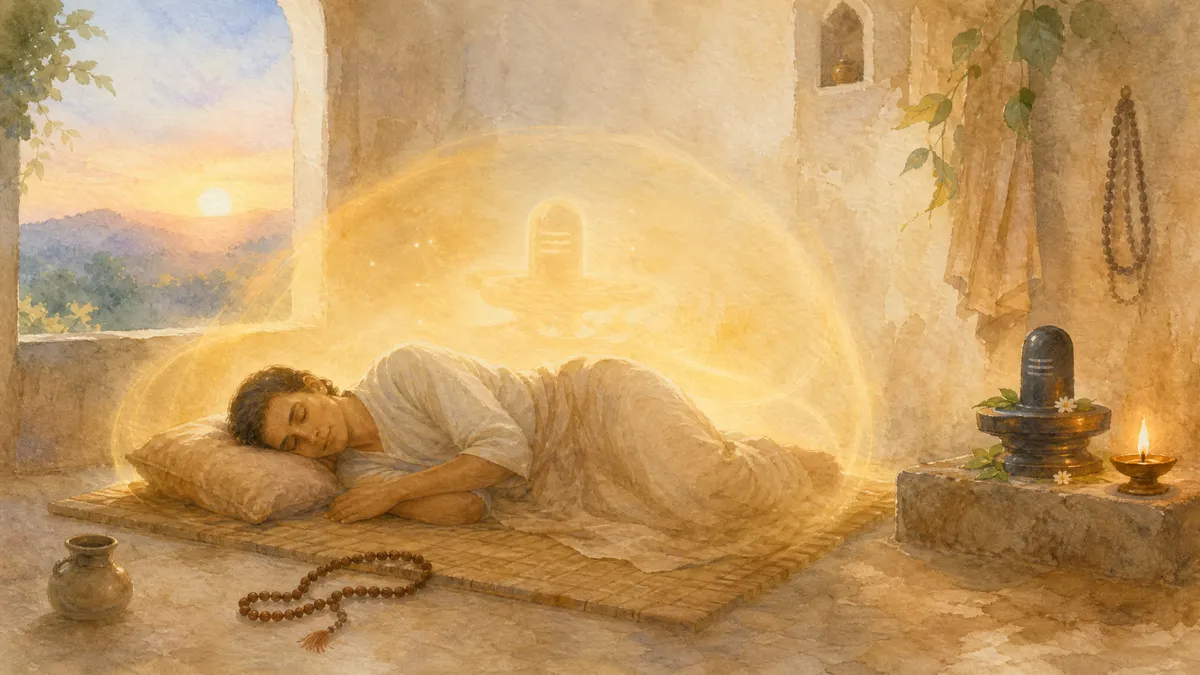
What is meant is that the Guru’s blessing will help, but one will have to practice here oneself. So, when we cultivate the state of turiya-jagrat and learn to act in the spirit of self-renunciation, mahayajna, as conductors of the divine will, in the spirit of non-doing, contemplation, pure vision, compassion, love, devotion, completely removing our ego, in the spirit of humility—just as an empty hollow bamboo conducts the wind of awareness, like straw lying on the road or a dry leaf carried by the wind—our state of turiya deepens and becomes truly realized. It gradually begins to penetrate dream sleep. In dream sleep this is called turiya-svapna, that is, we can remember God in a dream. In fact, this is the greatest achievement! Many realized masters have turiya-jagrat but do not have turiya-svapna, and therefore their realization is not final. They are enlightened while they are not asleep, but when they sleep, they are ordinary people; their subtle body is not yet capable of remembering God in this state. But in truth, genuine realization comes when they remember God and abide in turiya while they are asleep.
An Example of True Realization
There was an incident with Seongcheol Sunim, a famous Zen master in Korea, when a seventy-year-old man came to him, one who had meditated all his life. He himself did not even want to go, since he considered himself realized, but his friends insisted that he speak with Seongcheol Sunim. And when Seongcheol Sunim listened to him, he said, “Yes, perhaps you have attained some precious state through your meditation. But tell me, is it preserved in sleep?” The man said, “No, during sleep I lose it.” Then Seongcheol Sunim took a kettle and began hitting him on the head with it: “What? And you say that you have meditated? Go and meditate properly!” And this old man humbly accepted these instructions, because he understood that his realization was not yet complete. He meditated for another ten years, and only after ten years did he realize this state. He needed another ten years of diligent meditation and diligent contemplation in motion for turiya to penetrate dream sleep.
When turiya penetrates dream sleep, it means that we are able to nourish ourselves with divine grace while we sleep. It means that there is no more piglet sleep. As they say, “Piglets gorge themselves beyond all measure and then snore away.” This is what is called piglet sleep. But now it is already yogic sleep. “When all people sleep, the yogi is awake,” says Krishna in the Bhagavad Gita. This means that we are able to perceive divine grace and divine light in the state of svapna. This is not merely being aware as if awake in ordinary consciousness; it is truly being aware and abiding in nididhyasana. The simple awareness of a worldly person and abiding in nididhyasana are different things. That is, in sleep we are able to be in nididhyasana, to meditate on Brahman.
The Awakening of the Maya-Kaya
And when we cultivate such an ability for a long time, our second body awakens—the maya-kaya, our divine illusory body—because the cultivation of turiya consciousness in dream sleep transforms the image of our soul, the form of our subtle body; it brings into it luminosity, purity, the rainbow radiance of the five elements, Brahma aham bhava, and various divine qualities. The maya-kaya is the body of perfect enjoyment; it is the subtle radiant body; it is the enlightened expression of the clarity of our mind, of its play, of supreme joy, when the mind recognizes the bliss of its own possibilities, when the mind freely manifests its emanations in the form of pure visualizations, syllables, deities, and various enlightened forms of deities and their mandalas.
Perhaps in waking life we do not encounter very beautiful images of deities, very beautiful forms; such a dimension is unfamiliar to us. But as soon as turiya penetrates our subtle body, it becomes natural for us to see ourselves in the form of a deity, to see other deities, and to receive darshans of divine beings. This layer becomes accessible to us, and we see that siddhas and deities always abide in their mandalas, that they are always manifesting some kind of activity; we simply did not see them before, and now we have noticed them.
“Regard your body and sense organs as instruments for gaining experience, not as yourself. The view ‘I am the body’ is a delusion, and the seeker must avoid delusions. ‘I am nothing but pure Awareness’—such an understanding, if one succeeds in maintaining it, contributes to Liberation and Enlightenment.”
Realization of the Higher Tattvas and the Jnana-kaya
“I am nothing but pure Awareness.” When we realize the void, empty nature of the mind beyond all names and forms, we realize the higher tattvas, for example, the purusha-tattva. All this begins with the purusha-tattva, when through our body we realize something greater than our body. We can realize higher tattvas up to the maya-tattva (the mental body), and then penetrate into still higher tattvas (the causal body—karana-sharira). And when we realize the higher tattvas (the fifth, fourth, third, second), all of this is the jnana-kaya.
Jnana-kaya means the realization of the empty nondual nature of the Absolute as pure luminous consciousness. In the process of such realization, we discover our inner light and the inner light of God; we discover the five primordial spaces (vyoma-panchaka). Even to discover one of these spaces is a great attainment.
Who among us thinks of ourselves as an infinite flash of pure Light? Very few think that way. In the Scriptures, for example, in the Shiva Samhita, we may have read: “There will arise a shining space like ten million moons or ten million suns.” What is being written there? We have never had such an experience. But when we receive such an experience, we discover that our consciousness is capable of shining—shining very brightly, simply radiating. And for this, nothing special needs to be done except to purify one’s heart and perception. Our consciousness is capable of being a vast radiant space. And it turns out that this is our true essence, and then this radiant space is somehow packaged into mind, ego, memory, and body, and begins to act.
Therefore, when we penetrate into the higher tattvas and discover that this is our natural nature, we stop seeking, we stop being curious; it is no longer interesting to us, because we understand that whatever we may learn will be lower than this space of Light. Any knowledge framed in words, signs, and images will no longer be valued in comparison with this experience. This is where purnatva (wholeness, fullness) arises. We no longer seek anything; we are in a state of acquired knowledge, even though it is not yet deep and needs to be maintained. Therefore, saints do not read books for themselves; they do not need to study from books what can be realized directly from this state of Light. It is precisely this Light that is the Source of all knowledge; from it have issued the Vedas, the Upanishads, the Tantras, the images of the Gods, the sounds of mantras, bhajans, all revelations, all great Teachings and philosophies, and sampradayas. They have issued precisely from it. All of this is called the jnana-kaya—the divine body of wisdom.
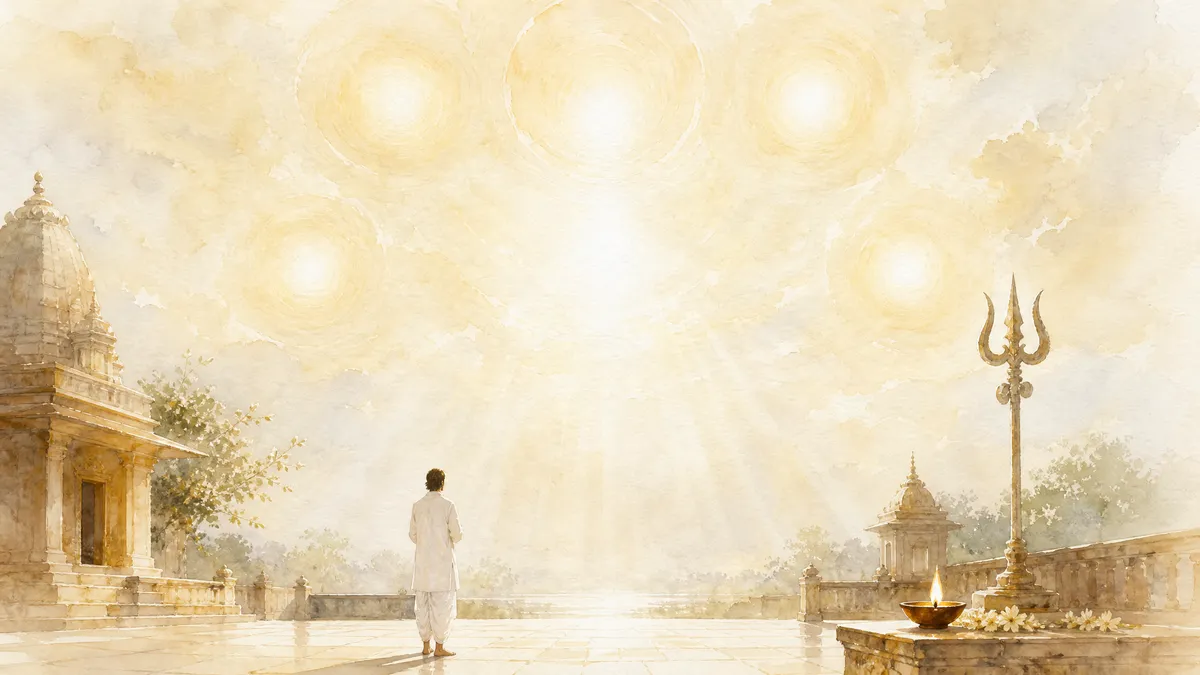
Penetration into the jnana-kaya means that turya has penetrated deep sleep, that we are capable, even in dreamless sleep, of perceiving reality as it is. This is a very blissful state, and therefore it is also called anandamaya-kosha. Anandamaya-kosha is jnana-kaya of a low level. The true jnana-kaya (body of wisdom) is that which is beyond anandamaya-kosha; it is the Atman and the experience of Brahman, the experience of the first and second tattvas (the higher tattvas), as well as Parama-tattva — that which is beyond all tattvas, indescribable and incomprehensible.
“Until you understand that you are Consciousness, free from birth, old age, and death, you will groan, ‘alas, I am dying’ or ‘oh, woe is me, my situation is hopeless!’ Such thoughts only strengthen ignorance. Free your mind from impure thoughts and concepts. Remain yourself without such concepts.”
To remain oneself is sahaj, our own innate dimension. This is also called svabhava — self-nature, that which constitutes our inner nature. Its property is svatantrya (primordial freedom).
“Engaged in various affairs, abide in a state of equilibrium and rule your kingdom in peace and happiness.”
One Taste and Svabhavika-kaya
When various states of turya (various dimensions) have been experienced, what should the yogi do? He must return to the waking state. Abiding in a state of equilibrium, he must hold to Brahman. This is called nididhyasana while abiding in the waking state. And when he falls asleep, his experience of turya must manifest flawlessly first in the dream state, and then in dreamless sleep. And then, if he lives in this way for a long time, he discovers the next body. This is, of course, a conditional body; one could say, a form of existence, but this form is also called “kaya” or “deha.” It is svabhavika-kaya. This body is also called vajra-deha (diamond body). It is the state of essence; it is the experience of the inseparable unity of all three previous bodies.
The siddha-kaya body is the experience of the radiance of enlightened activity in everyday life. The maya-kaya body (illusory body) is the experience of the radiance of joy and enjoyment in the subtle world. The jnana-kaya body is the experience of wisdom obtained beyond names and forms. And svabhavika-kaya is the state of essence, the experience of the pure light of non-duality that unites these three bodies together, when waking, dreaming sleep, and dreamless sleep are permeated with turya, when they all merge with one turya. Then it is said that the yogin attains one taste. One taste means that waking, dreaming sleep, and dreamless sleep are united in the fourth — in turya. They are all one; there is no longer any difference: to be awake, to be in dreaming sleep, to be in dreamless sleep, or to be in the transcendental state. Everything and always is transcendental consciousness.
When the yogin experiences this, he is called a jivanmukta — liberated while alive. It is difficult to describe such a thing. One can say that such a person always abides in God, and he himself is one with God, having realized the highest sayujya-mukti. He has attained Shivatva (the nature of Shiva), he has attained Shiva-sayujya, he himself is the source of all blessings.
The Consciousness of Ishvara and the Creation of Worlds
“Consciousness amuses itself by creating the appearance of worlds, and then again absorbing them into itself. The power or energy that binds to this world is the same power and energy that dissolves what has been created and liberates.”
What consciousness, then, amuses itself by creating the diversity of worlds? It is not the consciousness of the ego, not the consciousness of the personality. It is the consciousness of Ishvara. And when the yogin realizes svabhavika-kaya within himself, he becomes aware of his identity with Ishvara; he is ready to be born as a new little Ishvara. Not Param-Ishvara (the great Ishvara, who is always one), but as a little Brahma, ready to create his own new little Universe. It may be the size of ours, but by the standards of the Cosmos it will still be small. He may be very powerful, like our Brahma the Creator, but by the standards of Parameshvara he is still small, because such Brahmas, Vishnus, and Shivas issue forth from the body of Parameshvara every moment like bubbles from water, like specks of dust in the air.
Bhagavan Shiva Prabhakara Siddha Yogi Shri Guru Brahmananda Avadhuta ki — jai!
Shri Guru Swami Vishnudevananda Giri ji ki — jai!
