

Commentary on Garab Dorje’s text “The Golden Letters”
“In the state of contemplation, these appearances or phenomena do not become anything else; they encounter themselves, like the reflection of a face in a mirror or two people from the same country who happen to meet in a foreign land. Having met, they instantly recognize each other; it is at such a moment of self-awareness that self-liberation occurs.”
Many people say: “I do not understand what self-liberation is.” To clarify this, one can give the following example. For instance, anger arises by itself, and then it goes away by itself; we do not do anything special for this to happen. Self-liberation is very similar to this situation.
You became monks in order to attain enlightenment; you came to the monastery in order to practice and study. That is, some part of your mind decided to practice enlightenment. However, when you made that decision, you did not realize that enlightenment is already inherent in you, that when you come to the monastery you will not be given something you did not possess, but will be helped to reveal what has been inherent in you from the very beginning. Of course, enlightenment is inherent in every living being from the very beginning, yet not every living being manages to reveal it. That is, you came to the monastery already carrying enlightenment in your heart.
Without this enlightened state, you would not exist, could not live, would not exist at all, because this enlightened state is the very root of the life of every living being. In essence, apart from it there is nothing. And as we practice, we become increasingly convinced of this; our mind disentangles itself more and more from the many complexities to which it has clung. When the mind has completely disentangled itself, it is said that a person has attained enlightenment, but in reality he has discovered what has always been inherent in him. That is, there is no progress here; one might say, on the contrary, there is a return. However, on the relative level this is seen as progress, since our mind has become completely refined and clear; it has discovered an infinite sky within itself, attaining purity.
Indra’s Net and the Interdependence of All Phenomena
“The natural state is the mirror of awareness, in which all phenomena and appearances are reflected, and therefore self-awareness always exists, everywhere and in all circumstances. It is like the great net of Indra, consisting of countless chains of mirrors, where each mirror reflects all the other mirrors. In Indian mythology it is said that the divine builder of the king of the Gods, Indra, named Vishvakarman, made such a mirror net for the heavenly palace located on the summit of the cosmic Mount Sumeru. In this net, called Indrajala, all things and phenomena of the world reflect all other things and phenomena, according to Dzogchen.”
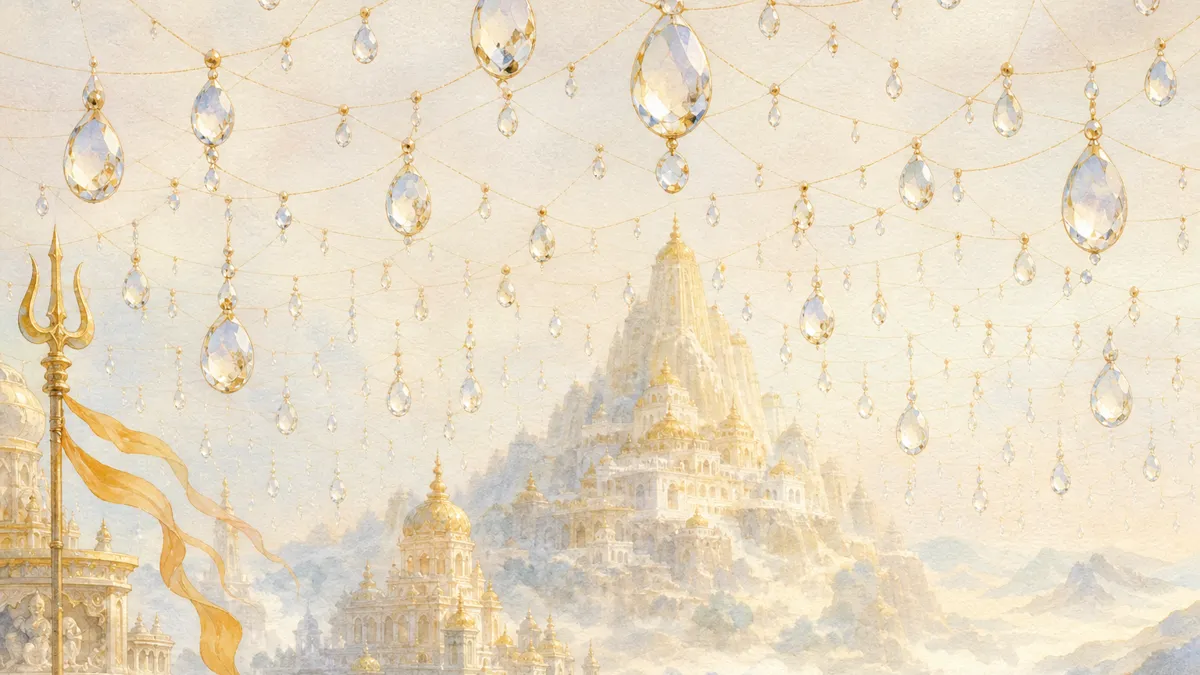
Here it is said that all things resemble the mystical net of Indra. There are no things that exist separately, on their own. For example, we may think that external objects existed before us or will exist when we are no longer here. In a relative sense this is so, but of course, from a deeper point of view, it is not entirely so, because every external object exists only in interconnection with the subject perceiving it. Only the process of mutual perception allows the subject to perceive the visible universe, and the visible universe exists only thanks to its perception by a specific subject. This process of perception is called “karmic vision.”
For example, stars and planetary systems exist. This seems to be something very vast and long-lasting. Nevertheless, it exists only because we perceive it. Even when we look at the most distant star, it exists because we have consciousness. It is part of ourselves; that is, we are observing part of our distant mind.
Every external object exists only thanks to the subject. All things exist dependently. For example, we can perceive deities because we have a state of the divine within us, or we can perceive hell and demonic states because such states also exist within us. There is no hell as such and no deities as such, since all of this is a manifestation of the single basis.
Suppose you are told how beings suffer in hell; you will feel fear or rejection, something inside you will respond to it. But if you are in a state of deep contemplation, nothing of the kind will arise. There was joy — even more joy will appear; perhaps a little coarser wrathful energy will be added. You will not be impressed by stories about terrible suffering in hell, because you will be able to unite everything and bring it into contemplation; it will not seem like suffering, but will simply be perceived as the play of the fierce energies of the absolute spirit.
The Single Taste of All Phenomena in the State of Contemplation
When a person is in such contemplation, it is said that he has attained an understanding of the fundamental basis. For a saint, all phenomena have one taste, one state, not two; that is, heavens and hells, samsara and nirvana, subject and object, inner and outer are balanced. Such balancing occurs when we constantly remain aware of ourselves at a very deep level, beyond thoughts, when we discover inner emptiness and empty ourselves. When we become completely empty within, then outside there is only one emptiness as well; when we are filled within, then outside there are trees, men, women. When we discover emptiness within, we see that it is immortal, indestructible, grasped by nothing, and then we see this indestructible emptiness outside as well.
When our mind slips into the coarser layers of consciousness, this emptiness becomes so obscured and lost that it seems as if it does not exist at all. For example, ordinary people think that it does not exist at all. There is even a saying: “If you tell an ordinary person about the Tao, he laughs.” Animals also cannot guess at this emptiness, because the influx of coarse energies is too strong in them.
And how do things stand with a monk? Perhaps yes, perhaps no; sometimes he feels emptiness, but as soon as he loses mindfulness, emptiness departs, and therefore the influx of his thoughts and emotions comes again. If the monk is inexperienced, he quickly identifies with them; if he is experienced, such things will not disturb him, because thoughts, emotions, and any coarse layers of consciousness, before they have time to arise, immediately dissolve in this emptiness; they are as if inseparable from it. And for an even deeper practitioner, they do not even dissolve in it, but are the play of emptiness itself, its adornment, its manifestation. He does not even need to dissolve or self-liberate them, because everything is already self-liberated from the very beginning. Whatever manifests, it is emptiness playing in this way, and therefore there is neither attachment nor harm.
Kleshas, thoughts, emotions—that is, all the coarse layers of consciousness—burn ordinary people; they experience a leakage of energy and a capture of consciousness. A saint, on the contrary, is not burned at all by such manifestations of the coarse layers of consciousness; they do not harm him in the least, because his empty consciousness is very strong, like a vast flame the size of the cosmos. And the coarse layers of consciousness connected with the body and mind are like tiny sparks; they arise and are immediately absorbed.
When we have not yet discovered our emptiness, on the contrary, it is like sparks, because it shines only a little, and we often slip into the coarse layers of consciousness. What does an experienced practitioner do? He instantly notices such a moment of slipping and immediately returns, trying to establish himself in this state of emptiness. For an experienced practitioner, it is unthinkable to slip from this state of emptiness; that is, for him it is, as it were, impossible.
Sometimes thoughts and coarse layers of consciousness can manifest quite strongly, so the state of emptiness of a beginning practitioner is subjected to great tests. Sometimes, for this purpose, Teachers themselves deliberately created special situations in order to subject the student’s state of emptiness to great tests. If the student withstands such a test, then his own mind and certain inner karmas that have manifested will no longer bewitch him. For example, once I gave the students the task of jumping into the snow and crawling in it. Some did it without thinking, in the manner of: told to do it—did it, like a soldier. Some entered awareness and perceived it as practice; in some, something manifested inside, and inner karmas told them to do it in some other way. This was a good illustration of how karmas and emptiness manifest in a student.

The Dissolution of the Inner World into Emptiness
“According to Anuttara Tantra, however, the natural state is a single state, while specific cognitive acts multiply infinitely. This applies equally to external phenomena, to thoughts that a person regards as his inner world, and also to sensations and feelings.”
Until we have discovered this fundamental emptiness, we have an inner world. For example, we may keep a diary and write there: “Today is October twenty-second. The teacher said this. Such-and-such a monk told me that. My mood was such-and-such.” A practitioner may set down there something most cherished, for example their dreams and plans. That is, we have this inner world; we cherish and nurture it, and it seems to us to be something dear. There was one student who kept such diaries until I noticed. I told her: “It is time to tear up these diaries. In this way you are simply playing with your mind, telling yourself fairy tales.”
When you enter primordial emptiness, such things cease to have significance for you; reflection works in you in a completely different way; you no longer have anything to write down and put aside. You may write things down, of course, but they will not be personal impressions, rather some quotations from teachings or descriptions of techniques and exercises, if you do not keep them in memory. And there is no longer anything dear or valuable for you in the mind that you could nurture and cherish. Such activities as looking through photographs of relatives left behind in the world, keeping a diary, and anything else of this kind cease to have any meaning for you at all when you discover emptiness.
This does not mean that you cease to feel love for living beings or lose compassion; you simply see the primordial Source, the original emptiness from which both relatives and thoughts arise. You understand that there is no need to pay attention to particular manifestations if you can immediately touch the Source. You no longer ever describe your emotions, analyze your thoughts, or keep any diaries. Your reflection becomes very simple: either it is absent altogether, or it becomes utilitarian, pragmatic; that is, if you do think, the thoughts are roughly like these: “I need to prepare prasad, and then perform such-and-such service. It needs to be done in such-and-such a way.” You can also think in a very complex way, but this thinking will not concern your inner states; it will be caused by some specific reason. Inside you there will no longer be any mental analysis, process, or self-reflection, but only emptiness.
Emptiness is incomprehensible to the mind; it is beyond thoughts and so simple that the mind is unable to comprehend it. In the state of emptiness, you live all the time as if in one state: for you there is no yesterday or tomorrow; for you it is always today. One could say that each time you awaken anew, but it is always today.
There is a fantasy film called “Groundhog Day.” According to the plot, a person kept waking up on the same day because something had happened to time. He did not understand what had happened, tried many times to change something, and in the end fell into a deep depression. He even committed suicide several times, but woke up again, and the same day began for him. Suddenly he understood that he simply needed to accept this reality and rejoice in what is. Then he began to engage in creativity, to change himself, and completely changed as a person. He, as it were, became a practitioner.
The Flexibility of the Yogin and the Illusory Body
When we discover original emptiness, any clinging to the inner world disappears. We no longer have a personal inner world; that is, the body, thoughts, and memories remain, but our attitude toward all of this changes. We cease to consider these things an inner world. We know that our inner world is so vast and deep that some emotional fragments and mental blocks cannot be considered an inner world; all of this ceases to have significance for us. Our inner world expands unimaginably, and therefore we stop holding on to what we held on to before. The desire to assert our own “I” in some way, the sense of pride, attachments, fixed ideas, some unequivocal point of view about anything, for example “this is so, and that is so,” or certain mental convictions—all of this completely disappears from us.
This does not mean that we have no mental supports or convictions at all. Some things remain with us; nevertheless, we do not attach to them the significance we attached before. We know that all of them are, as it were, conditional, and that original emptiness stands behind them. And when our convictions and our inner world are subjected to some kind of influence, we experience no problems, but freely accept this influence and allow it to be absorbed into primordial emptiness. We know that emptiness does not depend on anything at all: not on any convictions whatsoever, nor on any inner world. We know that it will cope with everything and survive in any situation.
We become truly open to the world. This is not about worldly life, not about a monk, having attained enlightenment, starting a family, going to watch football on television and drink beer. We become open to the world in the sense that we open ourselves to any experience, thereby deepening our spiritual progress. We are no longer afraid of anything, because we know that all of this is primordial emptiness, that it is always self-sufficient, and that we will never lose it again.
Alongside this, a complete transformation of karmic vision takes place, and the monk, opening himself to the world, moves so far away from the consciousness of ordinary people that it is even difficult to imagine; he no longer has anything in common with everyday life at all. Therefore, siddhis, as a rule, chose secluded, remote places. It is known that the immortals do not live among people. Mahasiddhas have very little contact, and great saints admit only a very limited circle of people to themselves, because they have moved very far away from karmic vision.
For example, in India there was a saint who was one hundred and seventy years old. He said that once, in the Himalayas, he wandered very far and met an old man who had come out to drink water from the Ganges. When he spoke to this old man, he began answering in pure Sanskrit, that is, in the ancient form of Sanskrit, and he did not even know any other language. As it turned out, this old man had been living for five thousand years; he leads a very secluded, withdrawn way of life and very rarely comes down from the mountains.
One who discovers his emptiness, after some time, completely changes his karmic vision; his inner world is no longer filled with anything except this inner emptiness. And how does he live? His inner emptiness opens various channels and creatively manifests through his mind and body, but his inner world, as it were, completely merges with this emptiness. He has no personal fixed inner world; he can create an inner world from emptiness according to his wish, he can create it in one way or another, but he has no inner little world of his own. He has an immense, bottomless emptiness that can create any model of an inner world depending on the situation.
Such a yogin becomes very flexible. He has nothing to cling to; he can respond appropriately to any situation and shape his inner world in accordance with it. Suppose we sometimes see that someone does not fit into a group at all, or fits in only with difficulty. This happens because his inner world may differ from the inner world of others. And then he has to reread the rules again and again, while the guardian of dharma wags a finger at him. He simply has an inner world to which he pays a great deal of attention, but this inner world may not resonate with the world in which he lives. And when he goes out for donations, there may be a mismatch between him and those with whom he communicates.
But when a yogin attains primordial emptiness, he becomes very flexible. What is flexibility? It is the ability to instantly, in fractions of a second, restructure one’s inner world in accordance with the surrounding environment. Emptiness responds to the situation, instantly assesses it, gives a command to the lower layers of the mentality, mind, and astral body, and in accordance with this builds the inner world. That is, a person essentially becomes an illusory body while still alive. If a certain body is needed, he projects it; and if it is not needed, this body seems to be drawn into emptiness and disappears. If another body needs to be depicted, then emptiness responds, gives a command to the mind and emotions, and then another body appears.
Self-Liberation Through Close Attention
Thus, the yogin no longer lives relying on any fixed data, but plays; that is, he responds to the diversity of things in this world, while his own state is completely transparent, grasped by nothing, empty. Therefore it is said that such a yogin is like hollow bamboo in which the wind of awareness plays. When he is fully adequate, his life becomes a dance, a song, something divine; he always hits the mark, never misses, and in any situation he lives in a perfect and harmonious state.
“Thus, for example, the feeling of anger disappears or self-liberates at the very moment when we manage to recognize it as anger; all its energy immediately evaporates. This method is called ‘Self-Liberation through Detection by Intense Attention.’”
The first stage of self-liberation is detection through intense attention. Until we have discovered this emptiness, we cannot do without effort, even though the overcoming of effort is spoken of. But efforts can be discarded only when you are trained in intense attentiveness, and a small effort cannot be avoided. Intense attentiveness is generated through the practice of the method. Often attentiveness is lost because we do not give the method proper attention. It is considered that ideally the method should be practiced in close formation. “Close formation” is a style of practice in which the method is applied second by second, that is, without any gap.
The following example is given: when knitting a sweater, one stitch follows another; if even one is skipped, there will be a hole. In the same way, density is applied in the method, when we apply the practice of the method at every step, for example, attentiveness to the body or atma-vichara. It does not matter what you practice, but only on the condition of dense application of the method will you obtain naked intense attentiveness.
When such attentiveness has been obtained, there is not even any need to ask about self-liberation; it arises by itself thanks to such naked intense attentiveness. All confusions of the mind occur because such attentiveness is absent, that is, it is lost, forgotten through distraction. For example, a person may come and, sighing dejectedly, ask: “Guru, I have listened to so many lectures! So why have I still not revealed this state?” To this I answer as follows: “You are simply doing all this in vain. Return right now to attentiveness, be attentive to these states, to the thoughts that arise, and to your dejection. Simply continue to apply the method densely and do not sigh. And then you will see that these thoughts will disperse in two seconds. You simply need to shift to continuous practice of the method.” Over time we understand this, and then we learn the secret of self-liberation.
The Meeting of the Son with the Mother Light
“In search of the mother, the Source, knowledge meets the mother, that is, vision self-liberates by vision itself, just as melted butter dissolves in butter. In search of the source of the light that gave rise to this primordial awareness or vision of phenomena, knowledge directly meets its mother, which is the primordial state of clear light, the ground.”
By mother is meant primordial emptiness — prajnana, sahajya — these are synonyms. By son is meant secondary emptiness, which arises in our consciousness. This is our consciousness when it reflects primordial emptiness; a state of enlightenment arises in it. Ultimately, both primordial emptiness and the emptiness that has arisen in our consciousness unite. Then it is said that the light of the son meets the light of the mother. Son and mother are also conventional dualistic concepts used only for explanation. In reality, emptiness is one.
However, there is primordial emptiness and the emptiness that arises in our mind at the moment of enlightenment or at the moment of practice. It is considered that secondary emptiness is like a son born of the mother. It is reflected in our state of mind, therefore it is conventionally said that knowledge meets the mother.
In order for us to constantly meet this emptiness and become established in it, continuous intense attention is necessary, which exhausts our being captivated by the inner world. When, instead of the inner world, emptiness is laid bare in us, then all clinging and attachments fall away, and then we truly become empty.
