

Commentary on the text “The Story of Shankaracharya”
Since today’s bhajan is dedicated to Shankara, we will begin with a story about Shankara.
From Georg Feuerstein’s “The Yoga Tradition”:
“The Shankara-Dig-Vijaya (‘The Essence of Shankara’s Conquest of the World’) by Madhava, a fourteenth-century biography of Shankara, the great teacher of nondual Vedanta, recounts another remarkable story.
One day, according to tradition, a hard-hearted Kapalika approached the venerable Shankara, praising him as a true ascetic who had realized the Self and asking him for a favor.”
Here, the Kapalika is a black Tantric magician from the Kapalika sect.
“Shankara listened to him wholeheartedly, yet with perfect dispassion. The Kapalika explained that for hundreds of years he had subjected himself to extreme austerities in order to earn Shiva’s grace. He wished to ascend to Shiva’s heavenly abode in his physical body, and Shiva had promised to fulfill his wish if he offered him the head of a king or that of an omniscient sage. Having failed to obtain a king’s head, the Kapalika now asked for Shankara’s. He had judged the great ascetic correctly, for Shankara agreed without hesitation. They arranged a time and place where the transaction was to take place, without the knowledge of Shankara’s disciples, who would naturally have tried to prevent his beheading. At the appointed hour, Shankara entered a state of formless ecstasy (nirvikalpa samadhi), calmly awaiting the sword’s passage across his neck.
The Kapalika approached him, his eyes rolling wildly under the influence of alcohol. He raised his trident, preparing to sever Shankara’s head. At that moment, Padmapada, one of Shankara’s chief disciples, saw with his third (mental) eye what was about to happen. He called upon his chosen deity, Narasimha—an incarnation of the god Vishnu in the form of a man-lion. At that very instant, the faithful disciple assumed the god’s leonine form, soared upward, and appeared at the scene. Just as the Kapalika began to lower his trident, Padmapada leaped upon him and tore open his chest.”
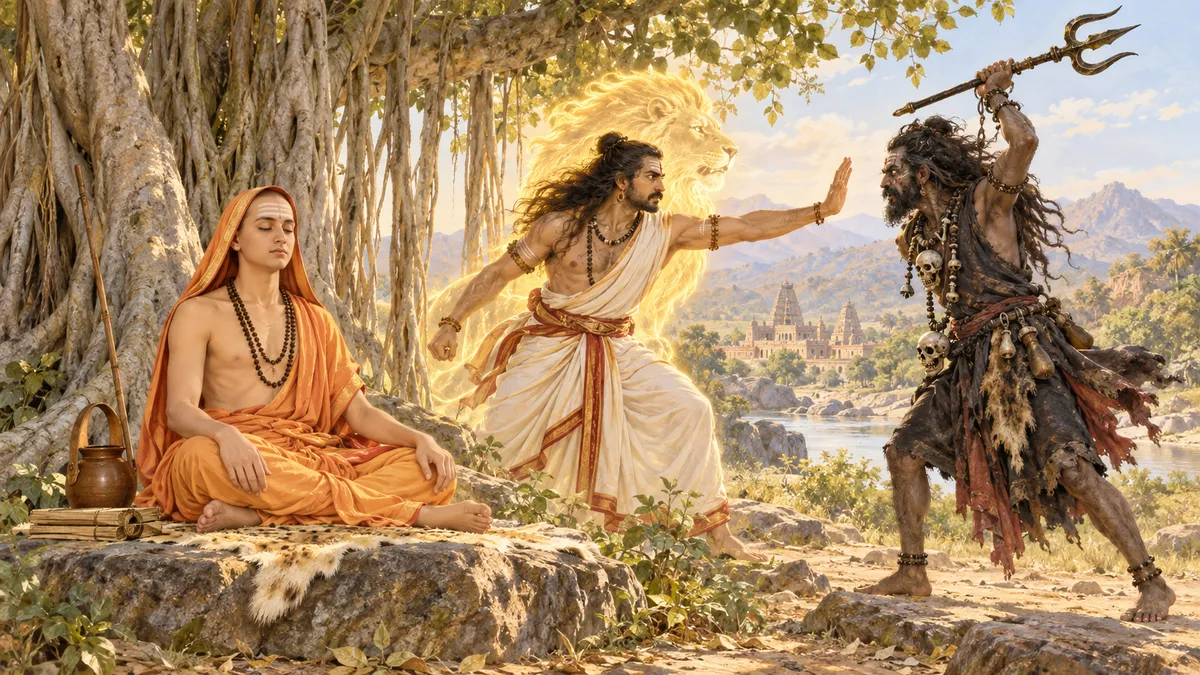
In other words, Shankara’s disciple Padmapada manifested the siddhis of the illusory body. Transforming himself into a wrathful deity, he sent his illusory body to Shankara’s aid.
“Shankara returned to his ordinary state of consciousness and, seeing the mangled body of the Kapalika and the bloodstained form of Narasimha before him, asked the god to relinquish his terrifying appearance and reveal his gracious countenance. Thereupon Padmapada regained his ordinary consciousness and form and immediately prostrated himself at his teacher’s feet.”
Shankara as a Fully Enlightened Being
Thus, Shankara appears here as a fully enlightened being, free from all limitations. He was so free from limitations that he even agreed to sacrifice his head to some mad black magician in order to help him attain liberation.
When we appeal to such fully enlightened mahasiddhas, for example during a bhajan mandala, we pay homage to them, then invoke them, attune ourselves to their descending power, and ultimately unite with them in a state of nonduality. This means that we reason roughly as follows: “Shankara, you are now beyond samsara, on the other side of life and death, time and space. You are completely free, while I am still here and have many limitations. Please turn your attention to me and grant me some of your spiritual power.” This is approximately the meaning of our appeal during a contemplation bhajan.
If we meditate in a deep state of consciousness, then, of course, such a responsive descending power activates the wisdom of the saints. Why can we not say that Shankara could help us even without our appeal? The saints are always radiating their spiritual power, but we must open ourselves to it in order to activate it. It is like the sun, which is always shining, but we have no way to receive its light while we remain indoors. We must go outside and expose ourselves to the sun’s rays. That is, we must take action so that the sun’s rays fall upon us; if we do not take such action, the rays will pass us by.
In the same way, during an invocation bhajan, we engage in similar activity: we activate the wisdom of the saints by addressing them with such a request and invocation. Someone may say, “We invoke them. But we cannot say that Shankara actually appears here.” In reality, however, the spiritual assistance of shaktipat is not connected with the material plane. It is connected with the subtle spiritual plane. And if you possess profound Guru Yoga, then you are certainly within the lineage of transmission of the siddhas and receive such a blessing. For this, your Guru Yoga must be genuine. You must always abide in this presence, in the transmission, because Guru Yoga is the immediate presence that is no different from the guru.

Recognizing Limitations as the Foundation of the Spiritual Path
We all have limitations, such as kleshas and dualistic notions. It would be unserious to deny the fact that we have limitations; otherwise, there would be no need for us to be here—we could, for example, be dancing in the heavens or manifesting our illusory forms in the world of the gods. But we practice because we have things to work on: purifying the mind, the subtle bodies, the pranas, the subtle dualistic notions in the causal body, and so on. We embark on the spiritual path based on the fact that we have limitations and need to work on them seriously. Moreover, we understand that not everyone may be destined to eliminate all limitations in a single lifetime.
One teacher said, “If you think you have no limitations, pinch yourself. You will feel that your body is still made of flesh and blood, which means that you certainly have plenty to work on and purify.”
The monastic path is a continuous process of self-purification that lasts for years, from morning to evening, until genuine transformation takes place. And when we understand this principle, we realize that it is we, not the guru, who must be interested in changing ourselves, transforming ourselves, and removing limitations from our consciousness and subtle bodies. These limitations are various forms of karma accumulated in the subtle bodies. And it would be naive to assume that, after having some minor experience, we are already beings without limitations, completely free from samsara. That, of course, is not the case.
How can we rid ourselves of limitations? Only if we are able to acknowledge our mistakes, purify the mind, repent, change an incorrect point of view, change an incorrect attitude, and so on. If you lack this ability, you do not even have a chance of transformation, because you are closing off this path for yourself. A true practitioner always understands this and tries to purify their consciousness if it still clings to certain limitations. A true practitioner is personally committed to freeing themselves from such limitations.
It often happens that a lay practitioner, novice, or beginning monk is very diligent and meticulous in certain matters. But after some time, he becomes careless and even complacent, thinking, “Been there, done that; everything is fine.” This is a dangerous tendency in monastic life. The worst thing is to start seeing oneself as such an “expert.” It is precisely this superficial bravado and complacency that are clear signs of the subtle mara, the “son of a celestial being,” beginning to penetrate the yogi’s consciousness.

Undesirable Qualities (Anarthas) on the Spiritual Path
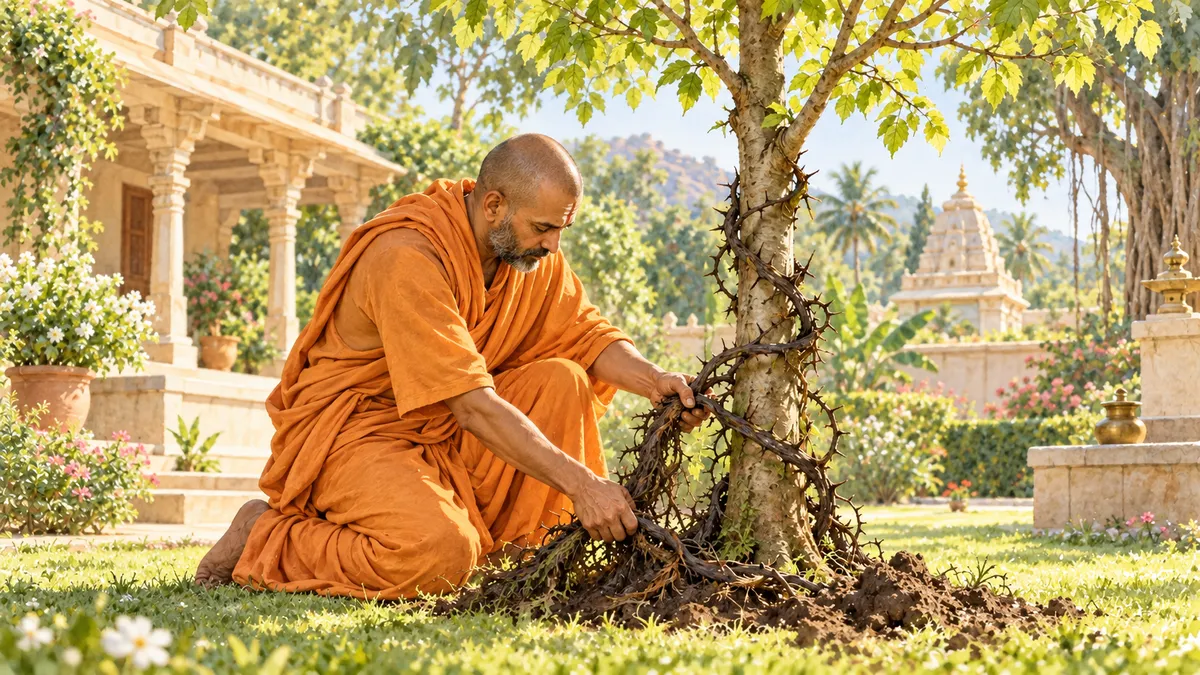
This condition is called anartha (an undesirable quality). In other words, over the years of practice, not only fruits and spiritual roses grow in the yogi’s soul, but also weeds—that is, undesirable qualities (anarthas). An experienced practitioner always peers closely into their soul to uproot such anarthas, since they have absolutely no need for them.
What undesirable qualities are there?
The first undesirable quality is kleshas, that is, obscurations, strong affects, and emotions. If you have any strong emotions, if something irritates or enrages you, these are all kleshas, manifestations of your obscurations. If you want to assess the level of your realization, check whether you experience such strong, disruptive emotions or whether you have realized the single “taste,” when, for example, someone spits in your face and nothing even stirs within you, and you respond with great joy: “Om Namah Shivaya.” If you have such a single “taste,” it means that you have no obscurations. If your reactions are different, however, then it is entirely reasonable to say that you remain in duality, in samsaric vision. You have failed to see Bhagavan’s lila, which He performed with you. Remaining in impure karmic vision, you simply reacted to the situation in a conditioned way and generated an emotion that will serve as the cause of new karma and, consequently, a new incarnation. Whether we want to admit it or not, this is a fact. Thus, a klesha is an obscuration or clouding of consciousness in which we lose the natural state, our awareness diminishes, and we act impulsively and emotionally. This can often be seen in beginning practitioners.

The second undesirable quality is anartha. Anartha is an undesirable quality for spiritual practice that grows over the years. For example, a person practices, but along with awareness, some subtle complacency grows, nurtured for years until it eventually turns into a monster. The tendency to criticize and judge others, spiritual pride, conceit, contempt, and absorption in certain states are all varieties of spiritual anarthas, undesirable qualities. At first, the practitioner does not notice the anartha and allows it to grow, until eventually it manifests itself clearly. And when anartha manifests, it requires a radical reassessment of one’s practice and profound purification.
In addition to kleshas and anarthas, another problem may arise: aparadha (offense), for example, when samayas are violated or a disrespectful attitude toward the teacher or the teaching is allowed. Offense does not mean verbally insulting someone. Rather, it is an impure perception of someone or something connected with the Dharma. If such impure perception manifests, this is, of course, not good, because it too is an obstacle on the path to spiritual realization.

Finally, another problem practitioners encounter is avidya, that is, deviations or traps into which an inexperienced practitioner falls. For example, a person does not know what absorption in clarity is and falls into clarity, considering it a very important experience, but from the perspective of sacred texts and saints, it is not important; on the contrary, it is an experience not worth clinging to at all. Or a practitioner falls into the experience of emptiness but ignores the capacity for integration, thereby creating the preconditions for rebirth as a formless samsaric god (all three worlds, including the formless realm, are still considered samsaric rather than enlightenment in nirvana). In other words, if a practitioner does not know the subtleties of the teaching, or lacks the clarity to perceive certain truths correctly, deviations (avidya) arise.

Thus, when we try to free ourselves from limitations, kleshas, anarthas, aparadhas, and avidyas continually arise. And a yogi must be very vigilant, especially a beginner—and beginners here actually make up ninety percent. He must be like an experienced driver who notices all of this within himself and tries to eliminate it in a timely manner. Until you have become established in the single samaya and the principle of self-liberation has become completely clear, these things will continually surface, and you must not allow yourself to remain in such a complacent state of calm, because your enemies are not asleep and are doing their work. If you are not vigilant, they will inevitably lead you astray from the spiritual path. I say this with confidence because I have seen many such examples. A true monk is by no means a shapeless jellyfish, but a spiritual warrior who lives vigilantly from morning until evening, always keeping his sword and shield at the ready.
How Hidden Limitations Manifest
How can we understand what limitations exist in our consciousness? It is very simple. It seems to us that we have no limitations, but when we find ourselves in certain situations or unusual circumstances, previously hidden tendencies immediately begin to manifest. In this case, the situation or circumstances serve as a secondary cause. Kleshas or anarthas—the primary cause—even if we have them, are not visible under ordinary circumstances. But if we find ourselves in difficult relationships, experience physical pain, or face the collapse of our fixed ideas, the kleshas that are in a latent (hidden) state are immediately activated and begin to produce negative karmic reactions. The fact that we do not see that we have limitations does not mean that we truly have none. It simply means that there has not yet been a secondary cause—a corresponding situation—that would allow these limitations to manifest. As soon as secondary causes appear, the limitations immediately begin to manifest.
For example, if I were to tell brahmacharini Galina, “For your training, it is very important that you now come to the center of the hall and sing and dance in front of everyone,” she would, of course, refuse and would not be able to do it. Then I might ask a monk to do the same thing, and he would be able to do it. What does this indicate? It indicates that the monk does not have these limitations. He may have other hidden limitations, and a different secondary cause would be needed to reveal them. But Galina has these limitations, although she had not seen them before and did not even suspect that they existed. The secondary cause in the form of the guru’s instruction revealed them.
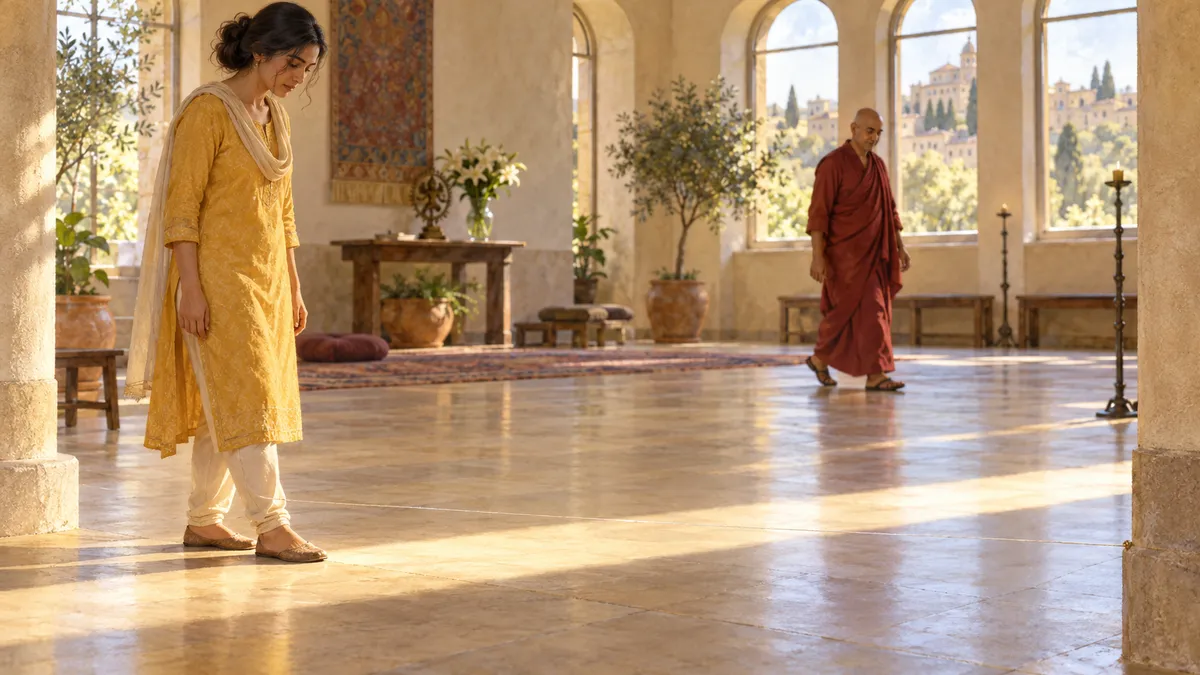
Why was she unable to follow the guru’s instruction? Because she was unable to unite with the situation while remaining in presence without losing awareness. If she began to do it—to sing and dance in front of everyone—she would lose control and awareness, and her sense of self and her self-identification with the ego (ahamkara) would be shaken. This block is precisely the kind of buffer mechanism that supports the structure of ahamkara, the false ego. And as soon as you touch it, resistance arises, because ahamkara protects itself very desperately—unless, of course, the subtler consciousness (the buddhi channel) is activated and counteracts this self-defense of ahamkara. This is roughly how our limitations operate. It is an example of how certain limitations of ours can be demonstrated by introducing secondary causes as a catalyst.
The Guru’s Role in Revealing Limitations
The guru’s task is precisely to create such secondary causes and show the disciples the limitations they possess, since the disciple himself may often be unaware that they exist. And the further we advance, the more radical the methods become. For example, the siddhas created very radical secondary causes in order to bring disciples face-to-face with their limitations during the training process. At advanced stages of training, the demands are far higher than those placed on beginning students. In other words, the practice of the single “taste” entails an immense confrontation with one’s own illusions.
For example, a dark retreat, when there is no escape from a dark room where there is only you and your visions, or places of power, where you cannot say anything to the spirits who rule the mountains as you would to an administrator: either you subdue the spirit, or it subdues you. These are very powerful practices in the style of the siddhas. There is no way to evade anything here. This is shakti entering you. There are other ways to reveal certain limitations. Naturally, such practices presuppose a very mature level on the part of the disciple and the ability to take responsibility. If a disciple is unable to take responsibility for their sadhana, then, of course, such methods of revealing limitations are not offered to them.
The Principle of Self-Liberation as the Foundation of Practice
We do not need any extraordinary practices of the avadhutas. It is much easier to practice under the conditions we have now and observe the emotions that arise as a result. It is perfectly clear that if you are overwhelmed by emotions, then, from the standpoint of the teaching, you are not abiding in the natural state. To be in the natural state means to be in continuous presence, in Guru Yoga, because the guru is not seized by emotion. If your consciousness is not synchronized with the guru, with the siddhas, and with all the saints, you immediately fall into ordinary consciousness. And it is precisely because we become distracted and fall into ordinary consciousness that the kleshas and obscurations begin to operate.
If we are overwhelmed by emotions, we accumulate karma every day unless we self-liberate them. And if a person is overwhelmed by certain emotions, I usually tell them: “Please do not try to determine the causes or solve any problems; all of that is futile. Simply try to become more aware and generate clarity. Try to understand the principle of self-liberation and continuous presence right now, and you will see that everything will begin to resolve itself.”

But if a disciple has not understood the principle of self-liberation and continuous presence and remains caught up in an ordinary situation, completely immersed in duality, then they are predisposed from the outset to make mistakes, follow the kleshas, and create new karma. And do you think such a disciple will be able to attain liberation in the bardo? Of course not, because in the bardo some situation will inevitably arise that triggers emotions. It does not matter what kind of situation it is. For example, a person may see hungry ghosts, hells, or wrathful deities, and will inevitably react to them if they are in a dualistic state of consciousness. Emotions will arise, creating strong obscuration, and their consciousness and all their subtle energy will follow this obscuration into one of the worlds. Why does this happen? Because there is no understanding of the principle of self-liberation.
In Laya Yoga, the principle of self-liberation is far more important than any techniques or practices. One who has understood the principle of self-liberation is a king of the teaching. Conversely, one who has not understood the principle of self-liberation, whatever experiences they may have, is merely an amateur. Therefore, I always tell disciples: “Please understand the principle of self-liberation. Please master this principle intellectually and in practice. What is required of you is not an understanding of any supernatural powers or nirvikalpa samadhi, but specifically of the principle of self-liberation, because it is the cornerstone of the teaching, without which it is impossible to proceed any further.”
Differences Between Sutra, Tantra, and Anuttara Tantra
In sutra, the vow is very important, because sutra is connected with the body, and the vow is taken at the level of the body. In tantra, initiation is important. It is believed that one should not perform tantric practices without having received initiation, because, at the very least, they will bring no benefit. But in Laya Yoga and Anuttara Tantra, the main things are neither vows nor initiations, but direct introduction to understanding and knowledge (jnana), synchronization with the mind of the teacher and all the saints, and the ability to maintain continuous presence.
We practice sutra, tantra, and Anuttara Tantra, the latter being predominant for us. Therefore, our key concept is the understanding of self-liberation and direct introduction to knowledge. This means that your realization should manifest in the ability to integrate with situations in everyday life. It should manifest as clarity, attentiveness, flexibility, wisdom, the ability to take circumstances into account, to be in harmony with others, and to display a single “taste” at least at the initial level—that is, when, at least at the level of consciousness, you are able to self-liberate many things.
Clarity and Overcoming Ordinary Consciousness
What is clarity? It is the ability to remain present and, from that presence, take into account the Vinaya, samaya, the circumstances, the teachings, the hierarchy, and much more. In other words, it is the ability to remain appropriate at all times and interact harmoniously with others. If we lack this ability, it means that we lack such clarity; therefore, we must pay serious attention to self-liberation and eradicate mundane consciousness.
What is mundane consciousness? Any consciousness that is caught up in dualistic reality can be considered mundane. For example, I was told that during a retreat, one practitioner asked another practitioner to move a tuket, but he did not want to do so, and therefore they began to quarrel. This is a clear demonstration of mundane consciousness. Mundane consciousness is a state of consciousness in which we are unable to distance ourselves from a situation and view the world from a cosmic perspective, through the eyes of the Absolute, but instead rely on the bodily concept: “I am this body. A cat is a cat, a dog is a dog, a human being is a human being.” In other words, we cannot assume a transcendent standpoint and experience emotions about what is happening. In fact, virtually all manifestations of emotion are mainly connected with mundane consciousness. A monk should strive to notice manifestations of mundane consciousness within himself, and if such manifestations arise, he must work on them.

For a yogi who has mastered the principle of self-liberation and abides in moment-to-moment presence, it is inconceivable to be caught up in mundane consciousness. He is integrated, unites with all circumstances, and is quite capable of dealing with everyday matters; nevertheless, his spirit abides not in mundane but in absolute consciousness. Therefore, he never has any problems; he is very light.
Potentiality and Secondary Causes
Thus, as we have established, we have many different limitations, and by using the method of self-liberation, we must work with these limitations. When we study self-liberation, the teaching of primordial perfection, or our potentiality, this does not mean that we immediately become perfect or that we have no limitations. Rather, it means that we work with limitations using methods that differ from those of sutra and tantra, namely the methods of self-liberation.
There are the concepts of “potentiality” (or potential) and “secondary cause.” A mirror is often used to represent potential. For example, a mirror can reflect various things, and it has enormous potential. That is, the mirror’s potential to reflect is virtually limitless. A small mirror can contain a mountain, a forest, the enormous sun, and even stars located millions of light-years away, without the mirror increasing in size. This is an example of how we can possess limitless potentiality while inhabiting a limited body. However, would we be able to understand that a mirror has limitless potential if there were no reflections? Obviously not. In other words, reflections of some enormous objects would have to appear in the mirror for us to understand its unlimited capacity to reflect. In this case, the stars or the sun are a secondary cause that reveals the mirror’s infinite potential. One could say that when we appear before a mirror, our image immediately appears in it. Our appearance was the secondary cause that demonstrated the mirror’s potential to reflect.
In the same way, we too possess limitless potential. Deities, siddhis, the monastery, the guru, and spiritual practice are secondary causes that make it possible to actualize our infinite potential. In other words, we already possess it, but under certain secondary causes, our limitless potential can manifest as complete liberation, the attainment of a subtle divine body, and so forth. For example, secondary causes are necessary for mystical visions, mandalas, deities, samadhi, and siddhis to manifest. Suppose you have the potential to manifest various pure visions, but the secondary causes would be a dark retreat and a posture for contemplation. If the secondary cause does not arise—that is, if you have not received the transmission of Jyoti Yoga or do not practice in a dark retreat—then pure visions will never arise at all, which means that it is impossible to work with them.

When we invoke saints and siddhas, this is the same secondary cause that brings forth our awakened state. Without such a secondary cause, our limitless potential cannot manifest. However, the secondary cause does not necessarily have to be the invocation of siddhas or deities with form. For example, sankalpas (“Atma-vichara,” “Light,” “Space,” and others), abiding in naked awareness, and self-liberation are also secondary causes that reveal our limitless potential. When we skillfully use secondary causes, the limitations in our consciousness disappear. If we do not use them, these limitations naturally remain.
