

Commentary on the text by Sri Ramana Maharshi “Collected Works,” chapter six: “Knowledge of the Supreme Atman.”
This chapter describes the way to realize the Atman.
When the mind in the form of the ego, which takes the body to be the Atman and wanders outward, is held within the Heart, the feeling “I am in the body,” “I,” departs, and the inquiry “who abides in the body?”, conducted with a calm mind, will be experienced as “I am the Supreme Self.” This “I – Self” is nothing other than the Absolute, the Atman, situated in the lotus of the Heart, the city of the body, the abode of God.
After this, one should remain calm, with the conviction that the Atman shines as everything and yet as nothing, within, without, and everywhere, being also transcendental Being. Such a state is known as meditation on the Truth, expressed by the saying “Shivo Ham,” or “I am Shiva,” and it is also called the fourth state.
That which is even higher than this subtle experience is God, variously called the state beyond the fourth, the all-pervading, Supreme Being, shining within as the core of the divine flame and described as manifesting in concentration and meditation as the space of the Heart, pure Consciousness, the Absolute, shining in the sky of the mind, bliss, the Atman, and wisdom.
One should think only of the Absolute, one should consider oneself only the Absolute, one should dedicate all one’s actions only to the Absolute, one should see the world as the Absolute, one should regard everything as absolute until one truly sees it so. One should submit one’s ego to the Absolute, one should make it the servant of the Absolute if we want to realize the Absolute. One should eliminate the unpurified mind that inclines toward another vision. One should cut off the perverted will connected with egoism, which compels us again and again to take on new bodies. One should cut off clinging to this perverted will and to one’s own egoism. One should cast away any attachments to anything except the Absolute. Such is the testament of all saints.
One should understand that you have always been the Absolute, that you have not been separated from It for even an instant, even if in the relative dimension you think in terms of space and time, imagining the Absolute as an attainment in the future and yourself as having departed from the Absolute. In the relative dimension this is so; however, in the absolute dimension there has not been a single second when you departed from the Absolute. One should, acknowledging this fact, constantly be aware of oneself as abiding in the Absolute. One should unite any thoughts and actions that we perform with the Absolute, blending them with everyday life: eating, work, personal life, and so on. One should not think that the Absolute is experienced in retreat and in meditation, but that it is absent in the kitchen, that it disappears when you chop wood. It is experienced twenty-four hours a day. One should blend abiding in the Absolute with relative actions when you study relative things in the Dharma, such as yoga techniques, mantra, kriyas, and auspicious actions (prostrations, bhajans, and so forth). Only if you are permeated by this transcendent breath of the Absolute can it be said that you are in proper contemplation, because contemplation is nothing other than abiding in the absolute state.
At first we think that contemplation belongs to some category of rational activity; then we understand that it is beyond concepts. However, to think that this is still our own state is a mistake. It should be understood not as rational activity, not as one’s own state of some awareness with effort, but as the absolute state, which our comprehending mind grasps by the power of its clarity, and then surrenders to it and is absorbed.

Through long, uninterrupted, and steady practice of meditation on the Atman as “I am the Supreme,” the veil of ignorance in the Heart and all ensuing obstacles will be removed, resulting in perfect wisdom.
Removing the Veil of Ignorance
One should constantly dispel these veils of ignorance. We enter the path of liberation by acknowledging the presence of these veils. The veil exists, and this is a fact. Otherwise, we would not experience suffering, the fear of births and death. Therefore, leaving everything else aside, one must focus on removing this veil. Until the veil is removed, reincarnation, the receiving of new bodies, suffering, births, and deaths are inevitable. Everything is useless.
In one sutra it is written: “The burial mound will cover all alike: the king and the coward, the fool and the hero.” Even if someone occupies a very high position, is intelligent, possesses great wealth, family connections, a beautiful or an ugly body—all this has no significance whatsoever. The question is whether we have removed the veil that binds us to the notion “I am this body.”
In “Forty Verses to Arunachala,” Sri Ramana says: “Those who think, ‘I am this body, which excretes feces and consists of impurities,’ are like pigs that eat those very excrements.” Until we have known the Absolute, the fixation “I am this body” is strong within us. With the knowledge of the Absolute, our identification changes to another: “I am infinite Being, Awareness, Bliss. I am the great luminous clarity of the Mind, spread out in all directions. I am boundless Being: to the right, to the left, above, below.”
Yogananda, while communicating with his disciples, would sometimes enter deeply into sahaja-samadhi and say: “When you are in thousands of bodies, you forget which particular body you are in.”
Sahaja-samadhi as the Highest State
The state of a yogin abiding in sahaja-samadhi is indescribable. It is sahaja-samadhi that is the supreme level of consciousness available to a saint practicing laya yoga. Savikalpa and nirvikalpa are merely stages for attaining sahaja-samadhi. In sahaja-samadhi we are in a state of stable unity with the Absolute, which does not depend on concentration, meditation, or kundalini energy. It is not as vivid as nirvikalpa, and it does not deny the world, since the senses function and therefore perception of the world is present. There are no visions or anything of that kind in it; nevertheless, it possesses astonishing depth. It allows you to attain liberation in one lifetime, even if during your life you did not have deep experiences of concentration. Only by realizing genuine sahaja-samadhi can one say that there is self-liberation.
The sutras say that a person who has not realized even the first dhyana, but who has realized the natural state in sahaja-samadhi, will attain liberation faster than a yogi who can concentrate the mind in the dhyanas for a long time, because such concentration is similar to the consciousness of worldly gods and can easily bind one to one of the levels of relative reality. One who cannot even concentrate or meditate, but has attained sahaja-samadhi, will certainly attain liberation. When the cell of his body is broken, the Clear Light of his own consciousness will unite with the great Light just as oil flows into oil, as water enters water, as a spark unites with flame. Therefore one should desire only sahaja-samadhi, while other kinds of samadhi are temporary, unstable, and are not that which gives true realization. When sahaja-samadhi gains strength and unites with the pranas and elements, it becomes saruba-samadhi—the final principle that grants the highest realization in the body.
Such knowledge of Reality, which constantly abides in the cave of the Heart, in the temple of the body, is truly the realization of the Absolute, which is inherent in everything, since the Heart contains within itself all that exists.
The Fivefold Formula
There is a formula according to which we practice in laya yoga. It is called the fivefold formula (pancha-manana).
It says that the entire world must be reduced to the mind. This is the first step toward self-liberation. When we naively suppose that the world is separate from our consciousness, we do not understand this; we are seized by the demon of subject-object relations. The first thing that must be done in order to kill this demon is to learn to reduce everything to the mind.
The second step is to reduce the mind itself to emptiness.
The third step is to reduce emptiness to the Clear Light.
The fourth step is to reduce the Clear Light to non-duality.
The fifth step is to directly present non-duality to great bliss.
When you practice sutra, tantra, or laya yoga in this way, you do not go astray. This is a unique quintessence of the teaching that shows the correct path of attainment; however, only one who has attained can decipher it.
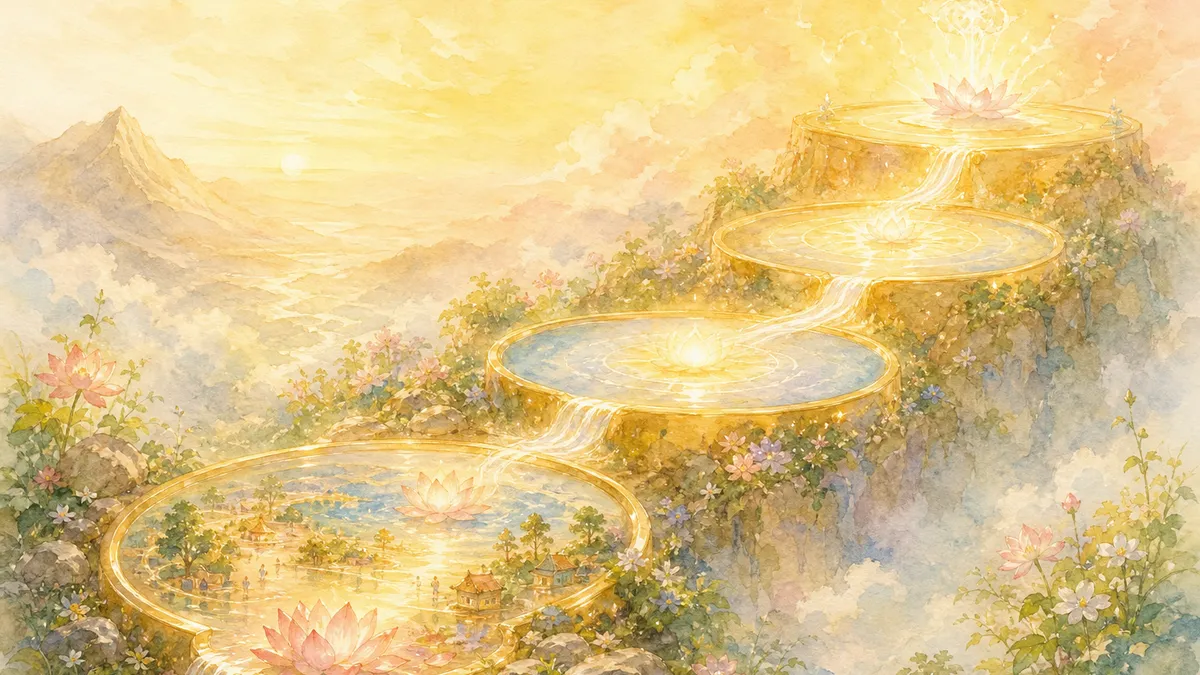
First Step: Reducing the World to the Mind
What does it mean to “reduce everything to the mind”? It means to seek the subject, to seek the perceiver. There are two ways to perceive the world. The first way is that I can see a candle and think: “This is a candle, and this is I, who sees it.” In this case, the vector of my consciousness is directed one-way toward the candle. The second way is that I can see the candle and at the same time ask myself: “Who sees it, who is the seer?” That is, I can try to become aware of the source from which seeing itself arises. Then I will discover that the eye transmits the image to the retina, the retina transmits the signal to the optic nerve, and the latter to the brain. The brain transmits the image to the astral body, the astral body to manas, and manas to buddhi (awareness). Then I understand that sight is a factor of my own consciousness. We can do the same with smell, hearing, and so on. Thus, everything we perceive, we reduce to the “I” or to the mind.
If we set philosophy aside, this means constantly concentrating on the feeling of “I” and on self-awareness. Concentration on the feeling of “I” and self-awareness, attentiveness to this feeling of “I,” is one of the basic practices that opens presence. Even if you have not received direct introduction, but diligently perform atma-vichara, it will happen to you on its own. From the point of view of this practice, it means thinking as follows: “The world around me is a manifestation of my consciousness. There are no problems outside; there are problems only in my mind, within me. If anything needs to be changed, it is only my perception, my awareness.”
Second step: reducing the mind to emptiness
The next stage is to reduce the mind to emptiness. When we have become accustomed to reflecting in this way and abide in a certain awareness of “I,” maintaining attentiveness, a subtle layer of awareness, we continue to analyze what “I” is. By performing mahashanti, we discover that the “I” is empty in itself; it has neither root, nor basis, nor foundation. It has no point of fixation; it is spread out like the sky; it is the greatest emptiness itself. It cannot be said that there are any qualities or objects there. This is called “reducing the mind to emptiness.” We need to become convinced that the mind, in its essence, is emptiness; we need to lose faith in concepts, in sounds, smells, colors, and everything else, understanding that they all arise from emptiness.
If you see a deity, thinking that it exists in itself, that is, separately from emptiness, then you are simply mistaken. If you see the Teacher as a body or touch his mind without understanding that he speaks from emptiness, expressing only it, then you are also mistaken. Therefore, we recognize everything as emptiness. Many interpret emptiness in a nihilistic sense; however, this emptiness is positive in the sense that it surpasses any material categories. Nevertheless, it is an absolute something that is the Source of all tattvas and manifestations.
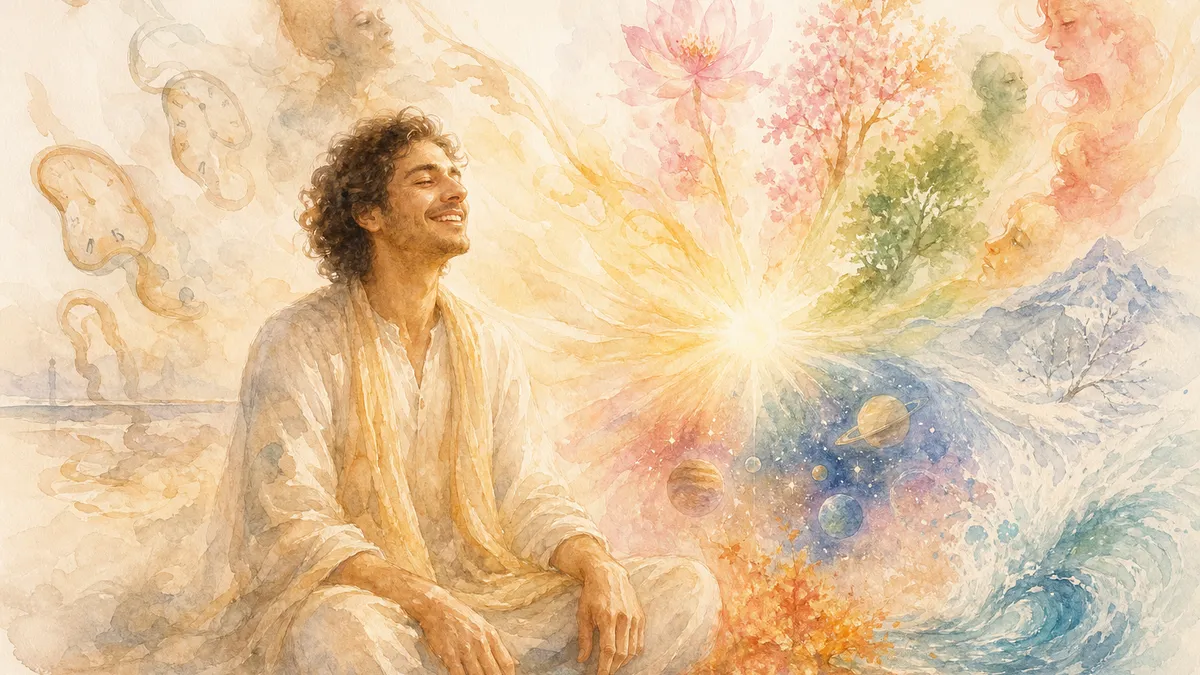
Finally, when we have experienced our mind as emptiness, our illusions disperse, and we simply laugh. It turns out that everything we previously considered real does not exist. Time, space, subject, object, anger, greed, attachment, love, and everything else do not exist. Everything has one source—emptiness. The five elements, the seasons, the stars and planets—all arise from emptiness.
Third step: reducing emptiness to the Clear Light
When we further analyze this emptiness, we discover that it is light. One should not think that this is some material light, like the light of a lamp or the bright light of a luminaire. Rather, this light expresses a special clarity associated with consciousness. When we bring a candle into a room, everything becomes vividly and clearly visible. Therefore, the essence of emptiness is luminosity because it possesses the quality of clarity, when everything is revealed and becomes known. This is called “reducing emptiness to the Clear Light.” What does it mean to show emptiness to the Clear Light? It means to reveal the Clear Light in deep meditation.
These formulas are concrete experiences in the body; they are not philosophy, but rather physiology, because liberation is experienced in the body and mind. It does not depend on the abstractions of philosophers, but has concrete experiences on the relative level.
We can reveal different levels of the Clear Light. The saints say that there are the subtlest levels of light, which show whether we have revealed them to the utmost or not. It is believed that the light is fully revealed only at the moment of death, at the moment of saruba-mukti, the great transition, when the small light within our little “I” unites with the great one, and complete integration takes place. The light is also revealed when the winds enter the sushumna nadi through the practice of awareness or kundalini yoga. Or the light is revealed through dream yoga and sleep yoga. Finally, through the highest practice of jyoti and taraka yoga, very deep levels of light are revealed.
The Teaching on Light is the cream, the esoteric essence of laya yoga. It is something that is not spoken about before the general public; it is the secret of realization in one lifetime. To practice this secret of realization, we must be spiritually prepared. When we reveal the essence of our consciousness as light, we experience various phenomena. This is called “brow vision” or the vision of light emanating from the chest. Together with the light, various kinds of space are experienced. This is described in the “Advaita Taraka Upanishad.” In our tradition, this sadhana is called jyoti yoga.
There are different ways to activate manifestations of light: a dark retreat or methods of daytime practice, when we allow light visions to develop by meditating in a special way. These light visions have four stages: arambha, ghata, parichaya, nishpatti. When we experience light, we unite presence with different visions of light. Then different visions arise, connected with deities, mandalas, and yantras. In this way, we obtain the result without practicing tantric methods of transfiguration or transformation. Without reciting mantras, without visualization, we obtain the highest experiences, characteristic only of the yoga of light in laya yoga. Finally, by working with the subtlest levels of light, with their unity of emptiness and this light, we come to the exhaustion of all visionary phenomena. When this occurs, the dissolution of the elements takes place in the yogin’s body. And when a certain level of visions has been attained, at the moment of death the body dissolves, leaving no physical traces behind. Thus the complete attainment of realization takes place, which is called the body of glory or pranava-deha.
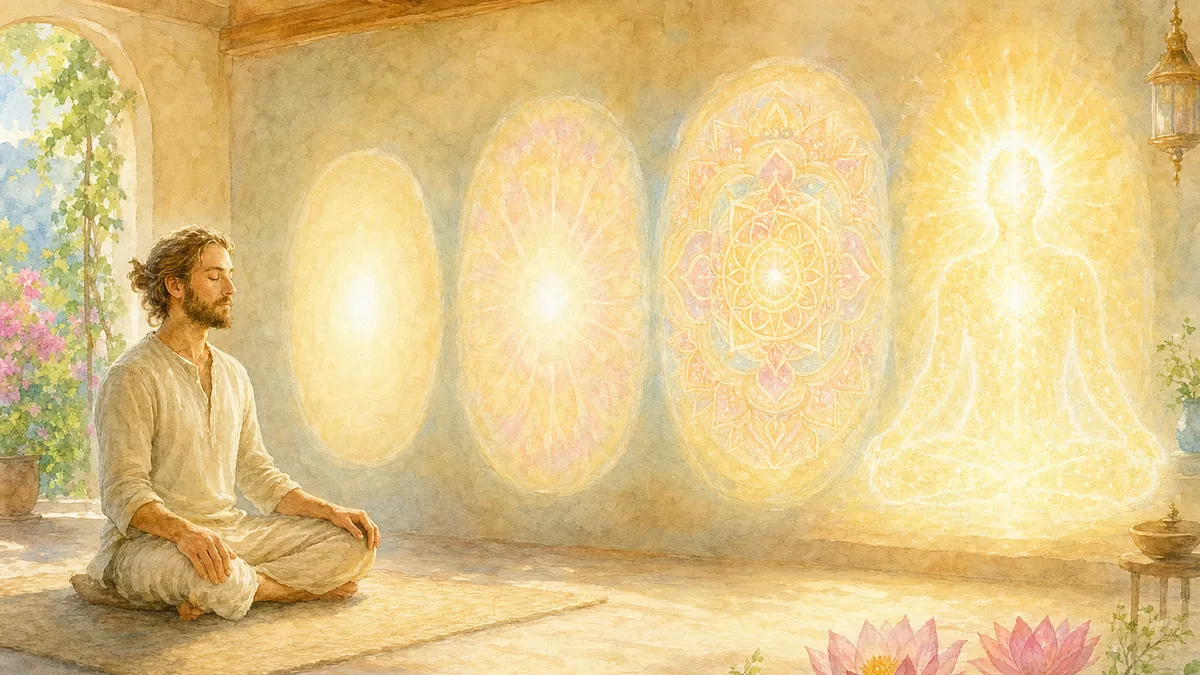
You have also heard about the types of light in dream yoga. When we reveal certain levels of light (usually four types of light are spoken of), we present emptiness to the Clear Light. This is confirmed by the scriptural texts:
The sage abides blissfully in the city of nine gates, which is the body.
The Fourth and Fifth Steps: Nonduality and Bliss
When we open the Clear Light, we discover true nonduality within it. We speak of attaining nonduality; however, true, ultimate nonduality is attained with the revelation of these types of light. Until these types of light have been attained, there is always a subtle duality. Even if, on the surface level, we think that we abide in nondual awareness, subtle duality always remains. Complete nonduality, according to the instructions of the saints, is attained with the revelation of the final types of light. Therefore, the formula “to reduce light to nonduality” is attainable for highly advanced spiritual practitioners.
Paramahansa Yogananda once explained to his disciples how he sees. He said: “You see nothing; you do not even understand how beautiful you are! Everything consists of Light!”
Finally, when nonduality has been revealed and realized, the next principle is to directly show nonduality to bliss. This means uniting the principle of light and the principle of nonduality with the deepest energy, recognizing this energy as bliss. When this is recognized, true supreme realization occurs. Such is the fivefold formula in the practice of laya yoga.
Whether you engage in kriyas, practice mahashanti or the maintenance of presence, whether you perform kundalini yoga or dream yoga, these formulas permeate every type of yoga.
The body is a temple; the personal “I” is the Absolute. If He is worshiped as “I am the Supreme,” then liberation will follow.
Usually, in the sutra, the body is considered a “bag” of bones and flesh, a receptacle of blood, mucus, and other impurities. In tantra, the body is considered a manifestation of divine energy, and impurities are regarded as its energies, as something pure, when everything is pure. In the sutra, the body is denied, while consciousness is exalted. In tantra, both consciousness and the body are divine.
The approach of one who practices the sutra is this: “I am Brahman, but this body is dirty; it is full of impurities, therefore it must be forgotten, cast aside, while fully abiding in true meditation.” To forget the body means not to become attached to it and not to consider the energies within it at all.
In tantra, the principle is this: “My consciousness is divine, but within me, in the body, there are also divine energies. This body is the very manifestation of the deity.” If the pure energies in the body are revealed, they are devatas. There are gods, deities (devatas), in the body. In the upper parts of the body (from the navel to the head) are peaceful devatas, and below (from the navel to the feet) are wrathful ones. All these energies are revealed as nadis, chakras, channels, and bindu.
Anuttara Tantra: The Nondual Approach
The approach of anuttara tantra is this: “The body is consciousness, and consciousness is the body; there is no difference whatsoever. Devatas, pure and impure energies—all are one; there are no identifications and no bonds. Simply abide in presence without reasoning or evaluation, entrust everything to the Absolute, and then everything will be absolute; not even a millimeter of anything bound will remain. Do not be especially concerned with the energies; do not reflect that this body is divine, but simply abide in presence. Day and night, trust only presence.”
These are the three fundamental approaches that should be distinguished and not confused, applying each of them at its proper time.
“The Spirit that wears the body in the form of the five sheaths is the cave; this cave is none other than the Heart; the transcendental Being abiding there is the Lord of the Cave.” This method of realizing the Absolute is known as dhara-vidya, or intuitive knowledge of the Heart. What else can be said? This must be realized through direct immediate experience.
Self-Surrender: The Dissolution of Egoism
When we have become accustomed to being aware and practice self-liberation, the next stage is self-surrender, the dissolution of egoism and the cutting off of clinging to the “I.” We are already immersed in this state. Only such clinging prevents us from attaining this self-surrender. When we renounce the idea of individual existence and clinging to the ego, such self-surrender takes place.
What does it mean to perform self-surrender? It is when the false ego becomes the servant of the absolute “I,” becomes its puppet. Such a yogin has neither hope, nor fear, nor clinging. He does not practice; practice happens by itself with him, because when the “I” is cast aside, there is nothing but practice. He does not strive for realization; he simply bathes in the sea of realization. He does not attain; rather, attainment falls upon him, comes crashing down upon him. He cannot even miss attainment; it is impossible. It is like the fact that wherever we point, raising our hand upward, there will be sky everywhere. When we eliminate the ego, realization pours into us in megatons. The question is how deeply we can eliminate this ego.
Often many teachers of the direct path deliberately taught their disciples nothing. They did not give lectures or transmit techniques, but said: “Just stay here.” And if the disciple was sufficiently receptive, he was confronted with a situation in which neither his mind nor his ego could enjoy itself. He simply did some work, tended the fire, and so on. At first he asked about various teachings, techniques, practices, and the teacher answered him: “Just stay here.” The disciple still worried and pleaded, but the teacher said: “I will give you the most direct teaching—just stay here.” Then the disciple lost all hope, and together with it fear and clinging to himself. And suddenly the campfire, the trees, the cows, and other things began to teach him, if he lived in the forest with the teacher. Then, twelve years later, he comes to the teacher and begins to explain to him what the campfire, the cows, and the trees have taught him. The teacher said: “Well then, now I will repeat to you what they taught you.” And what they taught him was brahma-vidya (knowledge of Brahman). This happens because the ego is cut off, and when the ego is cut off, we are continuously in the state of transcendental Reality.
The Basis of Self-Surrender: Awareness and Grace
Self-surrender does not tolerate bargaining: it is without gain, without plans, without hope, without the desire to receive anything in return. Naturally, self-surrender stands on the foundation of the presence of awareness. Self-surrender is higher than self-liberation, because self-liberation leads to self-surrender. However, self-surrender must stand on the foundation of awareness. Many religions practice self-surrender, but as long as there is no awareness, this self-surrender cannot be complete; it may even be incorrect. For example, if there is no awareness, no clarity, then it is difficult to understand to what self-surrender should be performed. Perhaps it should be performed to an image of a deity made of stone, or to concepts, or to a Teacher who is in a body. When awareness is developed, we understand to what self-surrender should be performed. When the mind is discovered as infinite space, as the highest Absolute, self-surrender is effortlessly performed to this boundless space.
At this level, practice ceases to be formal; that is, it no longer needs form or effort. It is as if every second you open wide and leap into this space; wherever it may be, you recognize it every second. You feel as though you are standing at the center of the Universe, with absolutely no support beneath your feet. All you can do is continuously leap into this boundless space. You can continuously surrender to it, capitulate, give yourself over; you can transfer power and authority to this space. You yourself surrender to it as a captive, allow it to guide you, and do not interfere.
When a yogin reaches this level, it is said that his contemplation takes place without effort. His body may perform asanas, do this or that, but now it is more like a game; there is no effort at all, and the practice is centered only around self-surrender. This stage is beyond logic; it is also called “grace.” Grace means something received freely, something that was not attained through effort, was not earned. This means that the opening, the merging with this space, does not depend on formal effort, does not depend on anything at all. It is grace; it is that which is given freely.
There was once a holy avadhuta who practiced yoga for a long time. He attained a high degree of realization and then began to preach that God exists without anything whatsoever: without rituals, without Dharma, without ashrams, and that one need only surrender to Him. The local king, who professed a different teaching, became angry with this yogi and wanted to execute him. He ordered him to be trampled by an elephant, had boiling copper poured down his throat, and threw him from a cliff into the water in a chained chest, but the yogi always remained alive. In the end, the king lost hope of killing him and took Refuge in him, becoming his disciple. This yogi recited only the mantra “Om Namah Shivaya,” although in reality he did not even need the mantra, because he was performing self-surrender.
When you perform self-surrender, this light of the unborn Wisdom of awareness guides you. It is no longer you who does your work, but He within you who does your work. You simply transfer authority to Him. The question is to transfer all authority. If you transfer only part of the authority, then He can do only part of the work. When you practice in this way, the notion of meditation, of the meditator, and of effort disappears. Then the final breakthrough occurs, and self-recognition comes.
Self-Recognition: Discovering the True Nature
After self-surrender comes self-recognition, when you discover: “I am not a human being. In the body, of course, I resemble a human being, but in reality I am Brahman, the Absolute. Nothing existed except me. It is even funny that I considered myself a human being. I simply forgot myself; I thought I had been born and took myself to be someone. I thought I was conditioned by the body or by time. But I am the Source of all Being, God Himself.” Self-recognition comes when the yogin discovers that there is nothing except him, that everything that exists is he himself. But even when one experiences this, Sri Ramana advises in his text:
On the level of behavior, this should be concealed. If the yogin does not conceal it, he may encounter obstacles.
