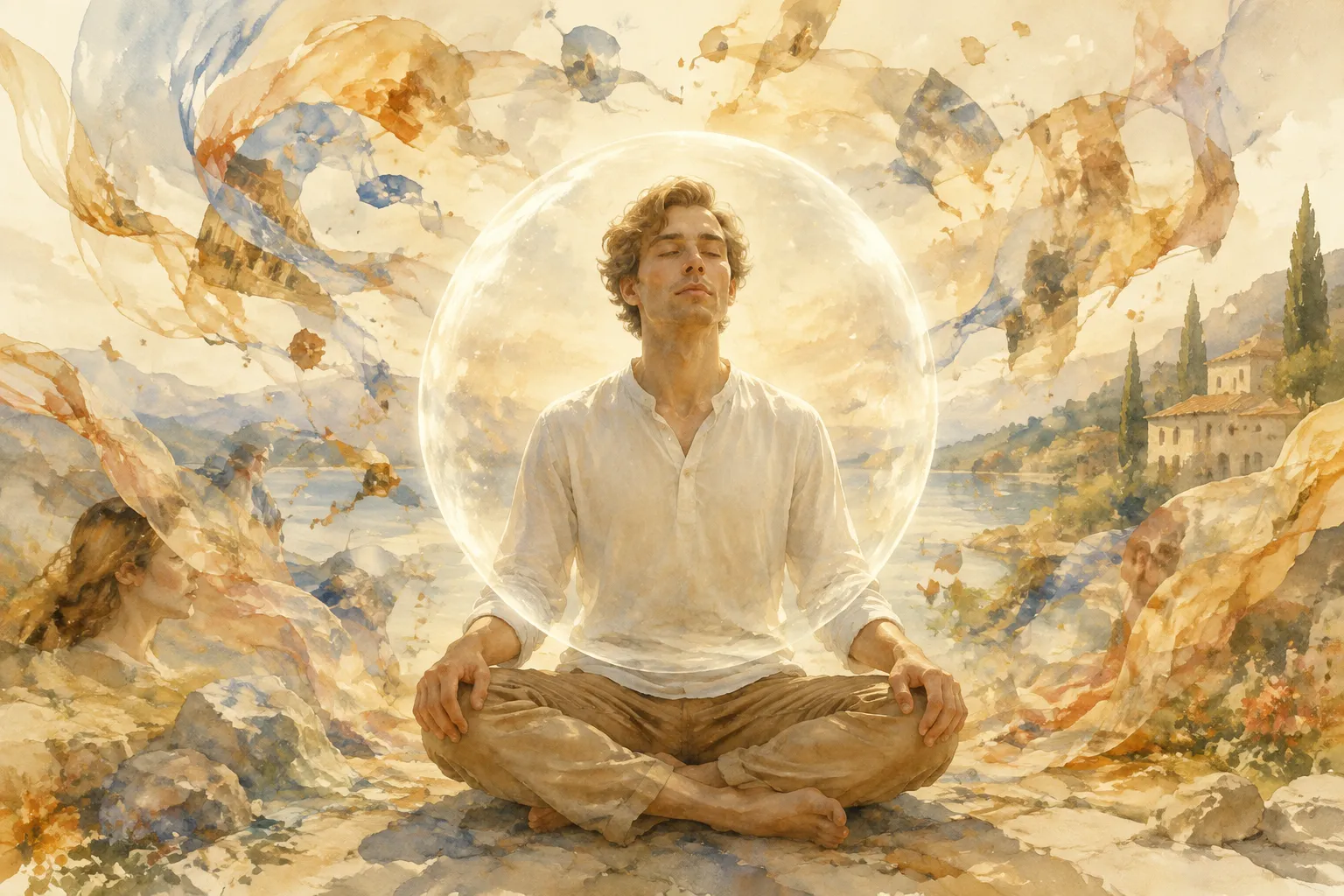
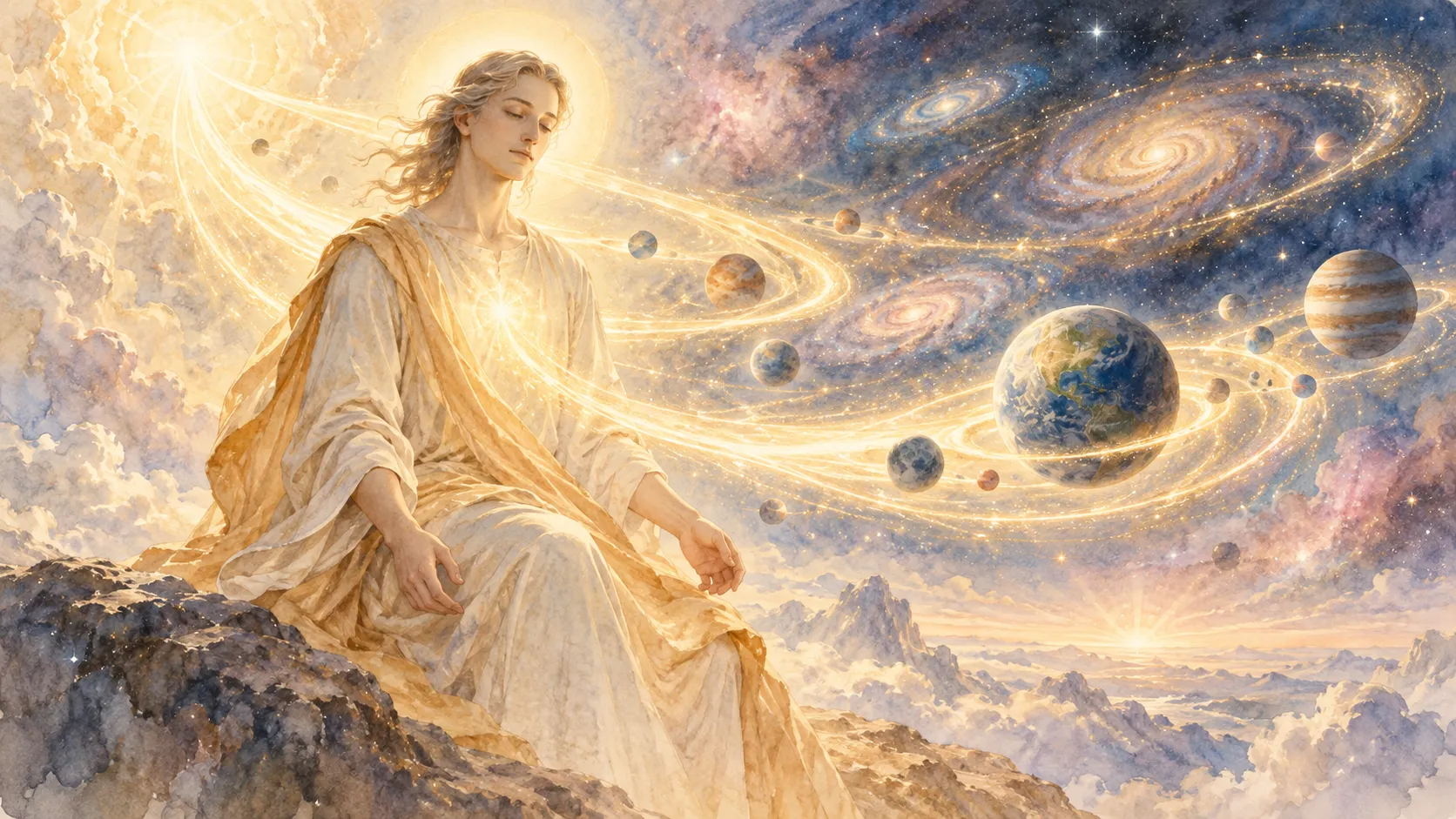
Self-dedication as submission to divine forces and overcoming the ego
23.09.2026
0 мин. чтения
0
Share
copy
search
add
share
First, I pay homage to the Tree of Refuge, the lineage of transmission, the Adiguru Shri Shankaracharya, the Paramguru Shri Brahmananda, and the avadhuta Dattatreya as the guru of all gurus. By expressing reverence, we establish a connection; by invoking, we establish a connection; by making offerings, we establish a connection; by visualizing and reciting a mantra, we establish connections through sound and form. The entire life of a sadhu is the establishment of a connection with the Absolute and its pure manifestations.
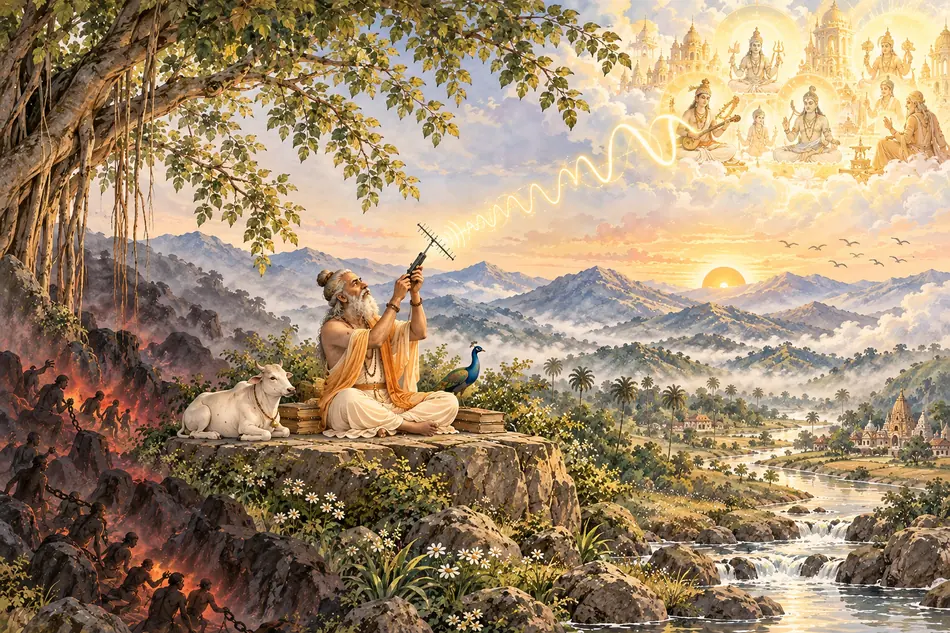
Since we live in samsara, divine inspirations descending into the world of samsara encounter various difficulties. The world of samsara is a zone of unstable spiritual connection. That is why people have so many delusions, so much ignorance, and so much suffering. It is a zone of unstable connection, unlike the divine dimensions.
The worlds of the gods can be compared to a stable zone with good reception of the signal from the divine. Everyone has a very strong divine connection. The human world is a zone of unstable reception, while the lower dimensions, such as Patala Loka, are a zone with no connection whatsoever, where spiritual signals cannot be received.
Since we live in a world where our spiritual connection with God, with wisdom, and with divine beings is unstable, we must constantly restore this connection. It is like a person who is in an area with poor cellular service and constantly turns their mobile phone this way and that: it catches a signal, it does not, it catches one here. In the same way, a sadhu constantly tunes themselves to connect with the divine Source until this tuning is established and is never lost again, until this connection, through tapas, changes something in us, until it purifies us. Then, even while living in the world of samsara, we will cease to live in samsara with our soul. With our soul, we will begin to live in the world of saints, in the divine dimension—the Deva Loka, the dimension where this connection is stable.
Self-surrender is the art of making such a connection continuous and stable. And in order to make this connection stable, we need to attain total absorption in the Divine and discard whatever interferes with this absorption, discard the ego with its attachments and illusions, and establish a connection with the Divine. Then, even while living in samsara, we will live like the gods in the divine dimension, because we will open this divine dimension within ourselves.
The instructions of Shri Ramana Maharshi on self-surrender constitute that part of the teaching of Laya Yoga that we call Prapatti Yoga, which follows the art of self-liberation. In principle, there is no difference between self-liberation and self-surrender; self-surrender is simply a deeper self-liberation. First, we learned to free ourselves from thoughts, penetrated into the non-mind, into non-conceptual consciousness, and then we discovered that within us there is something profound that, despite the fact that we have entered the realm beyond thoughts, does not leave or abandon us. And this profound element is our inner mechanism, the antahkarana, our ego—ahamkara—and our attachment to it.
And then we make the decision that our liberation of the self through contemplation must become deeper. It must rely not on our personality, not on our art of awareness, not on our practice of mindfulness—or rather, not only on ours; it must rely on something that transcends us. Of course, not on something, but on God, on the absolute Source.
We Are Subject to the Laws of the Universe
Seeker: Is surrender by itself sufficient for realizing the Atman?
Maharshi: It is entirely sufficient for a person to surrender themselves. Surrender is a return to the cause of one’s being. Do not deceive yourself by imagining some God outside you as the first cause. Your origin is within; surrender yourself to it. This means that you should find the source and immerse yourself in it.
Thus, self-surrender is a re-subordination. This is a very important point. It is a re-subordination in which we begin to submit to forces other than those to which we submitted before. We cease to submit to the forces of karma within ourselves. There are forces within us, and these forces wield great power over us—we must understand this. They are not simply forces; they are forces of authority, and they control us. For example, the force of karma, the force of the ego, the force of the gods and inner deities, the force of the planets, the force of the mind, the force of the sense organs—the indriyas—and the force of worldly desires. We are subject to these forces, and no one even asks us.
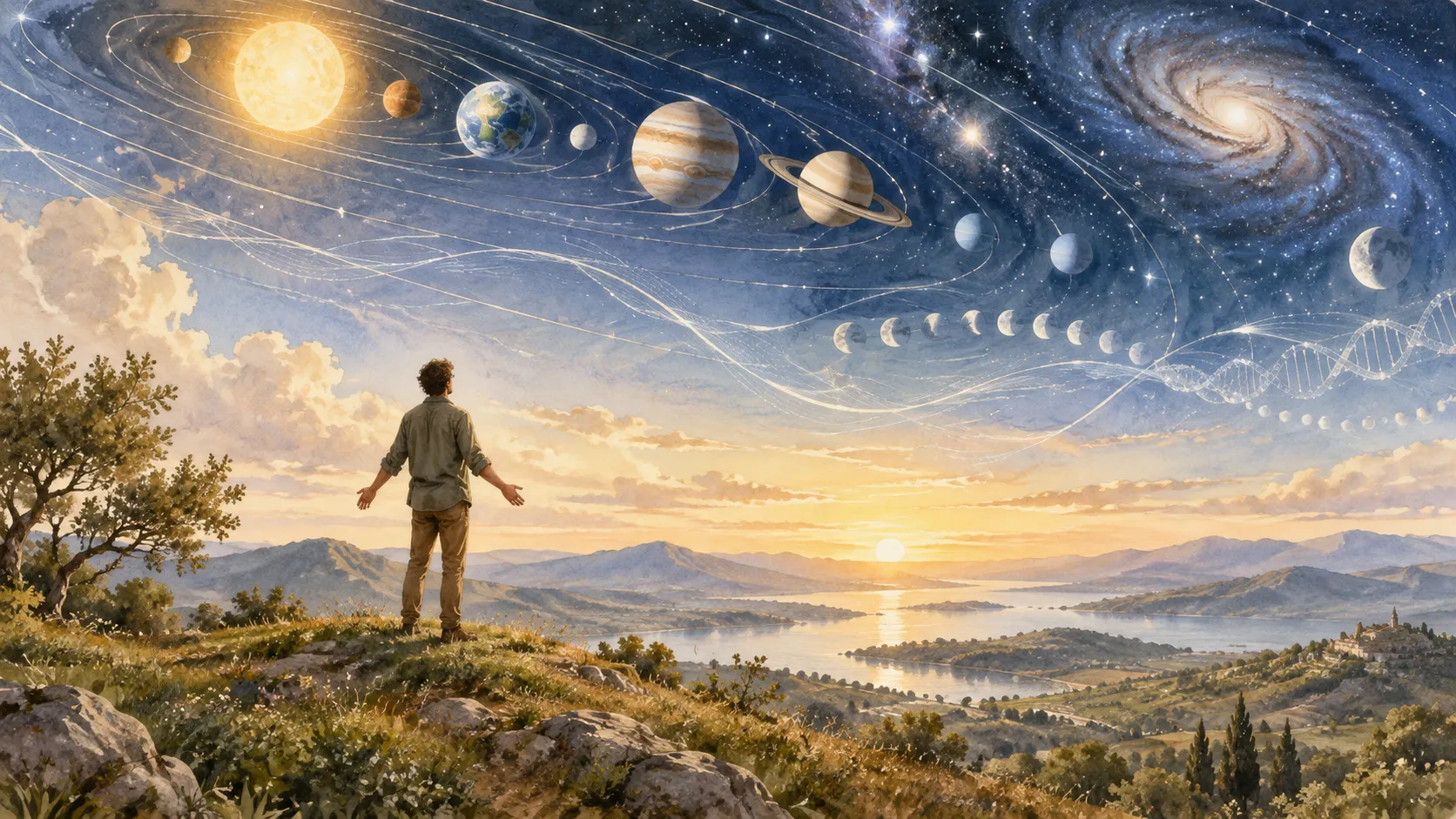
We were born, and that is a given. If you were born in Russia, then by default you are all subject to the authorities of Russia, the Constitution of Russia, and the laws of Russia. Or you were born in this universe; by default, you are all subject to the laws of this universe—specifically these laws, specifically this universe. The passage of time, rhythms, the cycles of stars and planets, the dimensionality of space, the metric of space, the topology of space, the laws of physics, elementary particles, quantum and nuclear physics, the laws of the body’s biochemistry—no one asks us, and by default we are already subject to all of this.
The laws of nature, the five tattvas, the three gunas—we are subject to them by default. Perhaps there are other universes created by other Brahmas; there, for example, there are not three gunas but five, and not five elements but only three. Vasistha writes about them. There, Brahma emerges from the element of fire or descends from the ocean; there, universes are structured differently and the laws are different.
But we live precisely in this universe, embedded precisely in its laws and completely subject to them. We are subject to all these laws, and all this conditioning is power—enormous power, aishvarya-shakti—over us as souls. And since we are under the power of all these forces, energies, and laws, the five koshas of the body and the elements of the body, the three doshas are built into us: vata, pitta, kapha—where can you escape them? However you look at it, your body consists of three doshas and five elements: earth, water, fire, air, and space. You cannot pull them out of yourself and throw them somewhere, saying: “I don’t need the kapha or vata dosha,” or “I don’t need the element of fire; it gets in my way.” You are subject to them; you are made up of them.
We are completely subject to all these forces and laws. Even if a person considers themselves great, wealthy, influential, or important, none of this matters. First and foremost, they are under the power of forces that are invisible and unrecognizable to ordinary people. But to saints, sages, and sadhus, this power is fully visible and recognizable thanks to viveka.
We are subject to the laws of the five koshas—the sheaths. We cannot say: “I don’t like the manomaya kosha; I’ll do without it.” It is impossible; you cannot pull it out of yourself. We are made of this. But the saints say that there is still a way to free ourselves from this power, from this maya, from all this samsara. And this way is to begin submitting to another, higher power. Because this power is, so to speak, not from God; it is from maya, from illusion. This power is maya’s hypnosis, the hypnosis of illusion over us. We simply need to free ourselves from this hypnosis.
In other words, living beings are hypnotized by the koshas, hypnotized by the material world, by the sense organs and the objects of the senses, by worldly desires, by their mind and ego. They are under the influence of such enchantment by maya, such sorcery, and are deeply immersed in it.
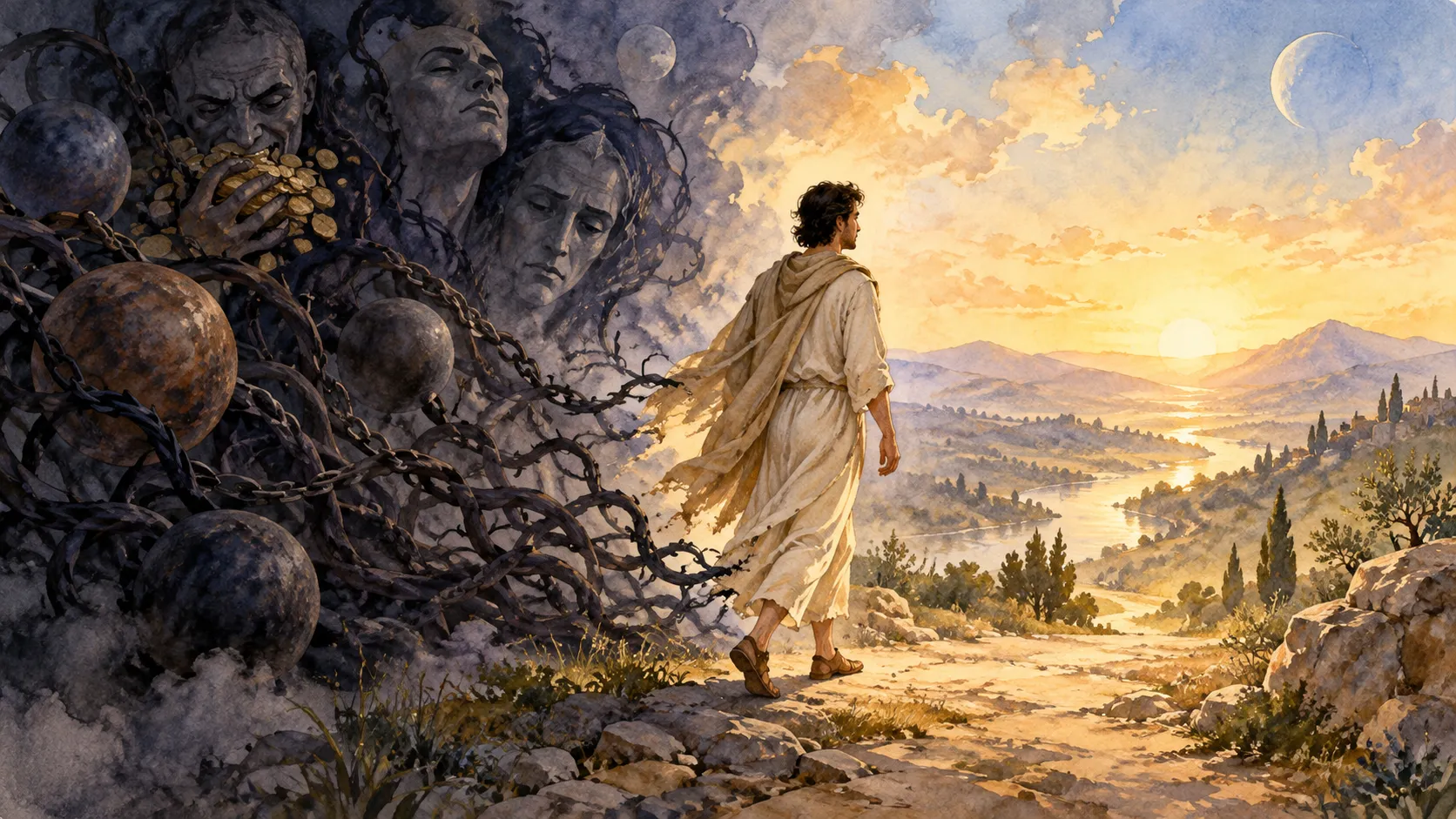
Self-surrender means that at some point our mind becomes clear, and we begin to understand all this. We think: “How was I previously subject to my mind and my ego? How did my desires rule over me? I was a slave to my thoughts; they all robbed me like bandits.” It is like unjust authorities robbing their citizens, not caring for them, while collecting taxes from them and taking everything away. So too, within us or outside us, this maya is like unjust authorities that give us no happiness, only suffering, taking everything from us—our vital energy, our sense organs, and our wisdom.
Wisdom arises in us, and we think: “Oh, now I will serve great authorities, higher authorities. I will not serve the power of my tongue, the power of my genitals; I will not serve the power of my attachments; I will not serve the power of my mental concepts; I will not serve the power of my egoism. All this leads only to disappointment and suffering. I choose higher authorities, those that will give me a genuine sattvic state and true wisdom. I choose God, Refuge, the holy sages, Dharma—the sacred wisdom—and the Atman within.”
And when we understand this, we develop the desire to free ourselves from the power of karma over us and to leave the karmic dimension for the dimension of divine grace and play. But when we make such a decision—when we decide to submit ourselves to a different authority—it turns out not to be simple, because these authorities of samsara hold us tightly; they have sunk their claws into us with a death grip.
And we want to carry out this re-subordination, but we see that everything resists it; it is just as when a people wants to live independently, but the authorities hinder them in every possible way because they stand to lose a great deal. Greed, egoism, pride—how can they manage without us? Who are they, anyway? How will they live on their own? In the same way, within us all these karmic forces and planets say: “How can he manage without us? How will he live without our authority?” The gunas and tattvas also, along with all their impure manifestations, protest: “How can he become enlightened, free, and divine here—and what are we needed for? How can he escape from our karma without paying his debts?” And there are forces that oppose the spiritual path.
We discover that although we want to re-subordinate ourselves, it turns out to be very difficult, and our strength is insufficient. The forces that hold us are much stronger than we are. The planets, gunas, koshas, natural elements, the elements, time. What can we do? We human beings are nothing in comparison with time—who are we to compete with time? Who are we to compete with the five elements, the three gunas, and the various cosmic tattvas? A human being is a very small creature, a speck of dust; he is nobody and nothing before these great energies. He is completely under the power of these energies.
Then we become disillusioned with the ego as a means of liberation and understand that it is impossible to become liberated through the ego. No matter how much we practise, we may purify ourselves a little, improve ourselves a little, and even prepare ourselves a little, but if anything can liberate us, it is something that transcends the gunas, transcends the elements, and transcends time. And this is only God, only the Absolute, only Brahman. It is only that which is itself free, which possesses an immense potential for freedom, which possesses immense power and authority. That which itself has power over the gunas, tattvas, and time.
And then we understand: “I must surrender to this lord, I must invoke him and remain beside him, I must draw closer to him, I must rely on him completely, I must trust him completely. It is like a weak country that cannot withstand the aggression of a large state. There are countries with a population of 100,000 people whose army has 10 people and whose police force has 30 people. And if a large state attacks them and 10 divisions arrive at once, they know that defending themselves is pointless, so they seek protection from more powerful states. They ask the larger states to help and protect them. They say: ‘We rely on you; we surrender to you.’”
In the same way, within us, when we understand that these energies have power over us and that we cannot pacify them, we rely on God, on the Absolute. We invoke him so that he may intervene and take this mission upon himself. But for this to happen, we too must do something. In international politics, there is such a practice: if a country does not resist foreign aggression itself, even its patron states do not hurry to intervene and send troops. But if it fights actively and says, “We will not surrender our land; we will stand until the end,” then international policymakers look, listen, and say: “Yes, perhaps we should help them.” But if a country does nothing, they also say: “No, we will not intervene. We do not need these problems.”
In the same way, if our soul makes immense efforts, divine grace also descends and intervenes. Self-surrender is when we make efforts in devotion, in becoming completely empty.
The Relationship Between Personal Will and Divine Will
Seeker: It is said that a person gains everything completely if he finds refuge wholly and exclusively in God, casting aside everything else. Does this mean that one should sit quietly in some place and contemplate God all the time, casting away every thought, including thoughts of the food necessary to sustain the body? Does this mean that when a person is ill, he should not think about meditation and treatment, but believe exclusively in providence? The Bhagavad Gita says: “A person who, without sorrow, renounces all desires and actions, free from the sense of ‘I’ and ‘mine,’ attains peace.” This refers to renouncing all desires. Therefore, should we devote ourselves solely to contemplating God and accept food and water without asking for them, solely as a manifestation of divine grace? Or should we make a small effort? Bhagavan, please explain the mystery of this self-surrender, sharanagati.
Maharshi: Complete surrender undoubtedly implies living without any attachment to thoughts. But does this mean that one must discard even thoughts of water and food, which are necessary to sustain the physical body? He asks: “Should I eat only food that I receive as divine providence, rather than as alms, or should I make a small effort?” All right. Let us suppose that we should eat only what comes of its own accord, but even then, who will eat? Let us suppose that someone puts food into our mouths, but it still needs, at the very least, to be swallowed. Is that not an effort? He asks: “In the event of illness, should I take medicine, or should I remain calm, leaving all concerns in God’s hands?”
In Shankara’s book “Sadhana Panchaka,” it is stated that in order to cure illness through so-called fasting, one should eat food received as grace. But for this, a person must at least go and ask for it. If everyone were to sit calmly with their eyes closed, saying that they would eat when food appeared by itself, how could this world continue? Therefore, one should accept everything that comes as it is, in accordance with one’s traditions, but remain free from the feeling that one is doing anything oneself. The feeling “I am the doer” is bondage, so it is necessary to take this into account and find a method by which it can be overcome, rather than becoming lost in doubts about whether to take medicine when ill or eat food when hungry.
Thus, the question is how personal will and surrender, your will and the divine will, relate to each other. Holy sages say that, as an individual, you have the right to exercise your will in accordance with place, time, and circumstances — desha, kala, patra (place, time, circumstances). You may do various things appropriate to that time, place, and circumstances, but you have no right to the fruits of your labor. You should exercise your will as subordinate, as service to the Absolute, as service to the Divine.
For us, this means that when making an effort and doing something, we should not be in a state of duality but in a state of non-duality. We must abide in the right view — drishti; only while abiding in the right view can we remain in surrender, and then we can exercise our will without karmic consequences.
Consequences of Will Without the Right View
Will exercised without the right view and contemplation, without surrender and devotion to God, inevitably leads to identification. Identification creates attachments, absorption in maya, and leads to new karmic results. There is a saying: “We choose our parents in the next life right now, already in this life, through our actions.” That is, by making certain efforts and thinking in a certain direction, if we do not contemplate and remain in duality, we are already choosing our parents for the next life. We are choosing our body for the next life.
But how can we avoid choosing our parents and body for the next life? Some think that one must renounce something and simply remain in a meditative state of consciousness. But according to the teaching, this is called losing action in view, in awareness. Ramana Maharshi also criticizes this view. He says: you cannot renounce absolutely everything. At the very least, you will still have to bring a spoon to your mouth, exercise your will, and make an effort. Or you will have to orient yourself somewhere. You cannot cast aside your personality, make it completely devoid of will, abandon the functions of the personality, remain in a trance state, fail to integrate with the phenomena of this world, fail to fulfill a certain mission, and not use this personality.
But it should be used only as an instrument, only as service. And as soon as you decide to use it as an instrument, for the sake of service, you gain the right to exercise your will. This will not bring you karma-phala — karmic results. Through this will, you do not create a body for yourself in the next life, nor do you create parents for yourself in the next life. But as soon as this will becomes selfish, materialistic, and directed toward the gratification of sensual desires, karma, karma-phala, are generated. Everything depends on understanding this subtle point.
Sakshi, Shraddha, Prajna, and Avadhana — Conditions for Surrender
Maharshi: Such doubts will arise all the time and will never end. There are even doubts like these: “May I groan when I am in pain? May I inhale after exhaling?” Call it Ishvara—God—or karma—destiny. But some map, some higher power, will guide everything in this world according to the development of each individual’s mind. If responsibility for any events is transferred to this higher power, then everything will proceed automatically. For example, when we walk, do we think about which leg to move and when? Does walking not happen automatically? The same thing happens with breathing, as we make no special effort to inhale or exhale. Can we always refuse to do something if we want to do what we like? Much happens automatically without our being aware of it. Complete surrender to God implies casting away all thoughts and concentrating the mind only on Him. With such concentration, extraneous thoughts disappear. If our thoughts, words, and deeds are immersed in God, then all the burdens of our lives will rest upon Him.”
Having immersed their minds in Brahman, holy sages neither act nor retain awareness of action; therefore, the laws of karma are either greatly weakened for them or do not operate at all. They are freed from the law of cause and effect and enter a dimension where the law of divine grace and the law of divine play operate. They do not act, but divine play—the lila—manifests through them. They surrender their minds and bodies to the service of the Divine.
What are the conditions for self-surrender? First, we must kindle faith—shraddha. Sooner or later, such faith must arise through the Guru’s instructions, the study of sacred scriptures, and our own reflections. In addition, we must acquire sakshi—the witnessing consciousness. Sakshi means that we have separated ourselves from the body and mind and learned to detach ourselves from them to some extent, to contemplate and observe all of this. We have discovered the inner observer.
Through this, prajna arises. Prajna is a deepened state of sakshi. If we cultivate the witnessing consciousness, observe our thoughts, and create a kind of center within, then prajna is a deeper state. It is when our witnessing center begins to unfold and transform into what we call bare awareness, when our mind gradually becomes very subtle, we try to remain without concepts, and it begins to expand and open up. This is prajna.
And when, in this state, we have avadhana—vigilance, the constant intention to remain in this prajna and not fall out of it—we are ready for self-surrender. In other words, sakshi, shraddha, prajna, and avadhana are the conditions indicating that we are ready, that we have prepared ourselves for self-surrender. From this state, we can re-submit ourselves to the Divine Source, because the Divine Source becomes more comprehensible to us. We gain access; a door opens. But if our faith is weak or prajna is absent, then even if we want to surrender ourselves to God immediately, we will not be able to do so.
Re-submission to Higher Powers
Self-surrender is re-submitting ourselves to forces greater than those that govern us at the present moment—our ego, karma, gunas, koshas, thoughts, attachments, and memory. And all of them claim the right to govern us; all of them claim the right to appropriate our will, our path—we want to go in one direction, while memory says: “But you have had such experiences; act in accordance with them.” We aspire to remain in awareness, while our thoughts say: “But we are like this and like that. Think in this direction, and think about this.” Or take our desires. We want to remain in the Divine, but desire says: “You have not experienced this yet, you have not seen this in life, but it is so delightful, and this is truly wonderful—try it.” If a person is inexperienced, if the soul is immature, they think: “Indeed, there is something to it; I must experience it, I must try it.” This is a certain power over the soul.
Constant planetary influence also takes place. Saturn comes and says: “That’s it—for 12 years you are my slave, and I am your master. Come on, obey me.” And we think: “What is happening? Neither meditation is working, nor are there any moods or elation.” This is Saturn’s power.
But self-surrender means that we stop listening to all these forces that subordinate us and say: “I am under Dattatreya’s jurisdiction, I am under the jurisdiction of the Absolute, I submit to God, so you have no rights over me.” And if we truly believe this and sincerely abide in it, that is how it will be. Because divine reality will assume its authority over us and grant us its protection. It happens that when someone is being oppressed but is protected by a stronger patron, everyone fears or respects that person, and no one can do anything bad to them. In the same way, we gain such a protector if we completely trust in him, if we completely surrender to him, if we enter into contact, remain in constant connection, and rely on him.
Discovering the Atman and surrendering to it as the highest essence
Seeker: But is God not the doer of all the actions I perform?
Maharshi: The present difficulty is that a person considers himself the doer, but this is a delusion, since the higher power does everything, while the person is only its instrument. By adopting this point of view, he frees himself from anxiety; otherwise, he brings it upon himself. Let us consider, for example, the sculpture at the base of a temple tower, appearing to carry the entire weight of the tower on its shoulders. Its posture and gaze express tremendous effort, creating the impression that it is bearing the entire load. But let us think: is that really so? The tower is built on the ground and rests on a foundation. The sculpture, meanwhile, is part of it, made to look as though it is carrying the entire weight. Ridiculous? Yet this is how a person who considers himself the doer also appears.
Seeker: Swami, it is useful to love God, is it not? Why, then, should one not follow the path of love?
Maharshi: Who said that you cannot follow it? Follow it, but when you speak of love, there is duality—the lover and the entity called God who is loved, is there not? The individual is not separate from God; therefore, love implies a person’s love for himself, for his own Atman.
In loving God, we are essentially loving ourselves, because we are human beings only in an illusory conception. In the absolute state, in the true state described in the Vedas, we ourselves are God. But we must understand what in us is God and what is not God. The body is not God; the energetic body—the pranamaya kosha, the astral body—the manomaya kosha, the mental body—the jnanamaya kosha, and the causal body—the anandamaya kosha—none of these is God in his pure manifestation. We must understand what it is that we should love.
Beyond the five sheaths, the Atman shines; the Atman is God. But when we look into the Atman, we will see that speaking of it as ourselves in the human sense is not entirely correct. That is, on the one hand, it is us, while on the other hand, it has nothing in common with us. For it contains neither mind nor body, neither taste nor smell, neither the sense of smell, thoughts, nor personality. In essence, we contain infinity within ourselves. Within each of us there is an infinite, immense part; in its unfolded form, each of us contains vastness. We must come to love this infinity and vastness within us.
This vastness does not depend on us. It is not connected with our body, our personality, or our ideas. It is, as it were, one and the same for everyone. And this is who we truly are; we are one being—and this is inconceivable. This being is beyond personality; it stands far above personality. We can only surrender to it. When we speak of devotion and love, we speak of devotion and love for our essence. But the word “our” should not deceive us, because when we say “our,” we imply something personal, that is, something related to the body, related to the mind, related to a particular jiva—but that is not so. For in spiritual life, it is dangerous to claim ownership of what cannot be claimed as one’s own.
The path of devotion and the purification of karmas
Seeker: That is why I am asking you whether it is possible to worship God on the path of love.
Maharshi: This is exactly what I said. Love itself is the true form of God. If you reject everything, saying, “I don’t love this, I don’t love that,” then what remains will be svarupa, the true form of the Atman, pure bliss. Call what remains pure bliss, God, the Atman, or whatever you like. This is devotion, this is realization, this is everything.
For example, you experienced non-duality, ananda—bliss—arose within you, and you experienced a state of wisdom. And then you develop a desire not to lose it, to hold on to it constantly. You keep holding on to it, and you become steady, you become sthita-prajna, established in wisdom. You are devoted to this state, absorbed in it. Great feelings arise from it—elevated, very pure feelings that surpass human feelings and human emotions. This is where love for God is born; this is the state of devotion—a total absorption in divine reality.
But before we attain such total absorption, karmas churn within us, and various forces that wish to retain their power rebel within us. Every sadhu goes through a struggle. All those old karmas accumulated in the subtle and causal bodies must be purified. They come and manifest before the sadhu. All the old samskaras emerge, moreover, within a single lifetime. It is like having old recordings on a hard drive and deciding to erase all those recordings. But they cannot simply be erased. They strive to manifest and emerge.
If a sadhu has good, sattvic, meritorious karma, then all these recordings, all these karmas, will be erased peacefully. If the karma is mediocre, with tamas and rajas, then they will emerge through struggle, through vira-bhava; the sadhu will heroically fight them and be a spiritual warrior. If a divya-sadhu playfully frees himself from these karmas through singing, dancing, play, and joy, then a vira-sadhu fights them. This is his karma: he wages war against them, he battles them every day. He loves fighting the mind and the ego in general. Previously, he fought outwardly, but now he fights inwardly; these are his samskaras. But a pashu-sadhu is simply absorbed or overwhelmed by these karmas. Therefore, a pashu-sadhu cannot attain liberation in this life; he can only count on the next life and gradually purify himself. A vira-sadhu conquers his karmas like a good warrior, a divya-sadhu dissolves them playfully, but in any case, all these karmas must emerge.
Dissolution will be successful if we do not connect these karmas to ourselves, but show them to the divine Source. This is self-surrender. Something manifests, and we say: “I am not your rival; go and compete with God, go and look at God. I will not fight you, I will not fall into dependence again; I will simply offer you to God, I will simply offer you to absolute Consciousness, and it will deal with you itself.” This is self-surrender.
In other words, karma can be compared to a bundle of firewood, and consciousness can be compared to a furnace. If this firewood is brought to you and thrown at you, thrown and thrown, you must take it and throw it into the furnace. The furnace is the consciousness of God, and there it will burn up. But if you do not throw this firewood into the furnace, and it keeps being thrown at you, your boiler room will become completely filled with firewood, and you will not even be able to get out of it. But if you throw it into the furnace in time, it burns, and everything is fine; the main thing is that as soon as the firewood is thrown at you, you must immediately throw it into the furnace—do not wait.
But sometimes they throw you a log that is frozen solid and large, and it will not even burn. This is where difficulties arise. Then you must quickly figure out what to do with it: either increase the fire, or saw the log into pieces, or dry it out. But you must manage to throw it into the furnace.
All self-liberation, all self-surrender means that we skillfully throw these logs of karma into the furnace. And what do some people do? A log comes to them, and they look at how beautiful it is. They start thinking about it; they do not do what they are supposed to do and forget to throw it into the furnace. And then the next bundle arrives, and another one after that. There is no need to think about it too much, no need to examine it, no need to discuss it at length. All that is required of you is to grab it and quickly throw it into the furnace.
The World Is Full of Divine Love. The Essence of Divine Grace
Maharshi: If everything is rejected in this way, then only the Atman remains. It is the essence of true love. One who knows the secret of such love discovers that the world itself is filled with universal love. The experience of the indestructibility of consciousness is one of the states of devotion, bhakti, akin to imperishable love.
When such self-surrender deepens, you suddenly find yourself in another dimension, a sacred dimension, and discover astonishing things. You discover that the world itself is filled with divine love. You discover the dimension of unceasing, imperishable love—prema. Go and tell someone somewhere on the street: “The world is filled with divine love.” People will laugh in your face, unless it happens to be a truly devout Christian. They will tell you: “Nothing of the sort—the world is filled with greed, avarice, envy, jealousy, and everything else. But at the very least, it is certainly filled with various concepts and attachments. Who has ever seen this divine love?”
But if you practice this sadhana, you will truly and inevitably see that the world is in fact filled with divine love, and you yourself will enter a state of imperishable love. You will leave the dimension of karma and enter the dimension of divine grace and divine play. You will free yourself from the jurisdiction of the karmic laws.
The gods in the higher lokas all live in the dimension of divine grace, in the dimension of divine love and lila. They do not act; Bhagavan’s lila manifests through them, and karma does not operate. Karma means divine justice, and it operates in the worlds of human beings: you do something—you receive the result; everything is fair. If you do something bad, you will be punished; if you do something good, you will receive something good.
Divine grace, however, is when you do something good—you are blessed; you do something bad—you are blessed, because there is no such thing as bad. There is no bad; there is only good. You do nothing—you are also blessed. Whatever you do, you are blessed anyway; you make a complete mess of things—you are still blessed. Because all your actions are lila, because there is no karma, because everything is pure, absolute, and perfect from the very beginning. Do whatever you want—you are blessed and receive merit; do nothing, do the most unimaginable thing—you are still blessed, because everything you did was lila, it was pure, it was sacred, it was divine, it was perfect.
The Transition from the Human to the Divine State
The gods live according to such laws. But human beings cannot live according to such laws, because gods are gods, and people are people. And we need to become gods in our souls. We cannot become gods in the body right now, in this life at least. This body has been given by prarabdha karma, and it must remain human. That is how Brahma has ordained it, but in our souls we can become like gods and enter the state of divine grace, enter the jurisdiction of the divine dimension, the state of play—lila.
Maharshi: True knowledge of the Atman, truly shining as indivisible supreme bliss, rises like the nature of love. The extremely intricate knot of life will be untied only when the truth of love, which is the true nature of the Atman, is known.
The knot of life is our karma, and it is extremely intricate. In other words, to incarnate is already to become caught in this knot of life—to receive a body and be born in the material world. Only an avatar is not entangled, or a vidyadhara, a siddha—one who has come with a mission and knows why he came here. But speaking of an ordinary person, receiving a body and being born into this world means creating tremendous entanglement. This is the consequence of past karmas. But thanks to such divine love, this knot can be untied; all the knots of our karma are undone, and all of this ceases to be important.
“Maharshi: Liberation is attained only after reaching the heights of love. This is the heart of all religions. The experience of the Atman is only love, which means seeing only love, hearing, touching, tasting, and smelling nothing but love, which is bliss.”
Love and bliss are different aspects of the Absolute, depending on which parts of our mind respond to this connection. But in any case, when we experience and become absorbed in them, a certain peak is reached at which the karma of our ego is burned away.
The Path of Bhakti and the Dissolution of the Mind
Seeker: I aspire to bhakti and want to intensify this passion; realization is not even important to me. Let me be strong in my aspiration.
Maharshi: If aspiration is present, realization will come by itself, even if you did not want it. You passionately aspire to bhakti, so that the mind melts in devotion. Camphor burns away without a trace. The mind is camphor, and when the mind dissolves into the Atman, leaving not even the slightest trace, that is self-realization».
What does it mean to aspire to bhakti? Bhakti yoga is the yoga of devotion, the yoga of service, the yoga of worship. Yoga means connection; it means directing our mind toward the divine Source. Laya yoga means jnana and bhakti together. With the help of jnana, we gain viveka and open the subtle layer of consciousness—this is our instrument, while with the help of bhakti we direct our spirit toward the Absolute Source so that it may fully reunite with it and dissolve.
To think of God, dedicate our actions to God, investigate divine reality, feel ourselves to be conduits of the Divine, serve God, glorify the qualities of God and the saints in our minds, and live in the bhava of glorification. To merge with Brahman so completely that this body is the body of the Absolute, this mind is the mind of the Absolute, and these senses serve the Absolute. Then the cosmic order of the world will be restored, and we will be freed from the laws of samsara, because samsara is the dimension where the cosmic order has been disrupted by maya. Restoring our original divine nature is possible through such self-surrender.
Restoring the Cosmic Order through Self-Surrender
For example, we have eyes; the eyes look, but the eyes themselves do not enjoy anything—they deliver visual images within us to the mind, to consciousness. We have ears, but the ears themselves do not use sound; they transmit it to the center, to consciousness, to the mind. We have hands, but the hands themselves do not act according to their own will; the hands do everything consciousness tells them to do so that consciousness in the body may be well. The same applies to taste and touch—in other words, all the sense organs are subordinate to a single center. And when they perform their functions well, they say: “We are healthy.”
But if the eyes begin to become attached to something, a person loses energy. If the sense organs do not surrender what they perceive, they are considered diseased, as some of their functions have been disrupted. In the same way, we are, in a sense, the jnana-indriyas and karma-indriyas of the Absolute. And if we do not submit everything to it, if we do not surrender everything, we are like corrupt officials, exceeding our authority. For example, there is an official who tries to indulge himself at the expense of the state. He does everything not for the state but for his own pocket—he builds a country house in Cyprus, siphons off several million, and signs certificates in exchange for bribes. In other words, he uses state power and state money for himself, thereby violating the cosmic order. Then they come for him and say: “You have violated the order; you are corrupt.” And a punishment scenario follows.
In the same way, if we try to appropriate the perceptions of this world, experiences, or certain parts of the divine, we also enter into dissonance with divine reality. Then it is said that such a soul—corrupt, so to speak—wants to appropriate everything for itself, does not want to surrender anything to God, and abuses its will and its position. It must be banished to samsara; let it remain there—that is precisely where such souls belong. Therefore, all souls living in samsara have abused their free will and behaved badly.
But as soon as we embark on the path of self-surrender, we correct ourselves, we restore the cosmic order of the world, we do everything right. And a blessing follows. Essentially, samsara is the soul’s discord with its divine nature; it is when the soul has quarrelled with God. The soul has fallen into disharmony; out of its lack of understanding, it has failed to understand God and has not wanted to listen to Him. When it is in conflict with God. That is why all people in this world suffer, because they are in conflict with God. The only ones who do not suffer are those souls that have restored this connection and in whom the conflict has disappeared. They are no longer in samsara; their souls are in heaven. The gods in heaven and the saints—all are in harmony with God, they are in direct connection, with no conflict whatsoever. There is not a single saint who says, “There is such heaviness in my heart.” There are no saints like that. If you see saints, they either remain silent, abiding in stillness, or they smile, dance, sing, or give teachings. But they are always happy. They abide in ananda. They have no conflict whatsoever, because they have established this connection; they have no disharmony.
Self-surrender is a way to eliminate this disharmony, which is initially inherent in all living beings in samsara, except for saints. At the moment when we surrender ourselves to God, if we are not saints, then we are close to sainthood; we are moving toward sainthood, eliminating this disharmony. And the more we surrender ourselves to God, the closer we are to sainthood. Then there is only one God in our heart; He becomes number one, while everything else becomes number two. Everything we do, everything we think, everything we say ceases to be all that important; it becomes a play, a response in accordance with the place, time, and circumstances. There is never any disharmony, even if we seem to be doing difficult things for people.
For example, the gods create universes without being distracted; that is, it is a complex form of service. They do not lose their natural state because they are in complete self-surrender. Nevertheless, the gods have will and various powers—aisvarya, iccha, kriya—but they do not appropriate them to themselves. They are immense. The siddhas have a concept called svechchha-chara—to follow one’s will. This does not mean following the will of the ego. Svechchha-chara means that your will and God’s will have become one. And whatever you manifest will be completely subordinate to God’s will, will be one with God’s will; everything will be for the good, because there is no ego and because the siddha has become the purest channel of the divine Source.
Self-Surrender through Contemplative Presence
“Seeker: I believe in venerating an image. Will this not help me attain jnana?
Maharshi: It certainly will. Meditation on images helps concentrate the mind, for it becomes free from extraneous thoughts and is filled with the form being meditated upon. After this, the mind becomes one with the object of meditation, which makes it completely pure. Then ask yourself: ‘Who is the worshipper?’ The answer will be: ‘I,’ that is, the Atman. In this way, the Atman is finally attained. Venerating formless reality with thought-free thought is the best way of worshipping.”
A very important point is venerating formless reality with thought-free thought. Ramana Maharshi conveys the teaching of the siddhas’ contemplation to its very depths. This is the practice of naked awareness, contemplative presence, Brahma-vichara based on spanda. Here, however, he presents it in very simple words, without any terminology. We venerate formless reality with thought-free awareness. That is, thought-free awareness means abiding in naked awareness. To venerate means to establish a connection, meditate, and surrender oneself to formless reality. In these words, Ramana Maharshi gave a direct transmission of the practice of contemplative presence.
Maharshi: But when a person is not ready for such veneration of the formless God, worship in a form is the only suitable option. Formless worship is accessible only to people who are free from the ego-form. Know that all worship performed by people possessing an ego-form is merely worship of form. The pure state of immersion in grace, the Atman, which is devoid of any attachment—this alone is truly the state of silence, freed from everything else. Know that uninterruptedly abiding as this silence, experiencing it as it is—this alone is true mental worship (manasika-puja).
Immersion in Divine Grace and Its Deepening
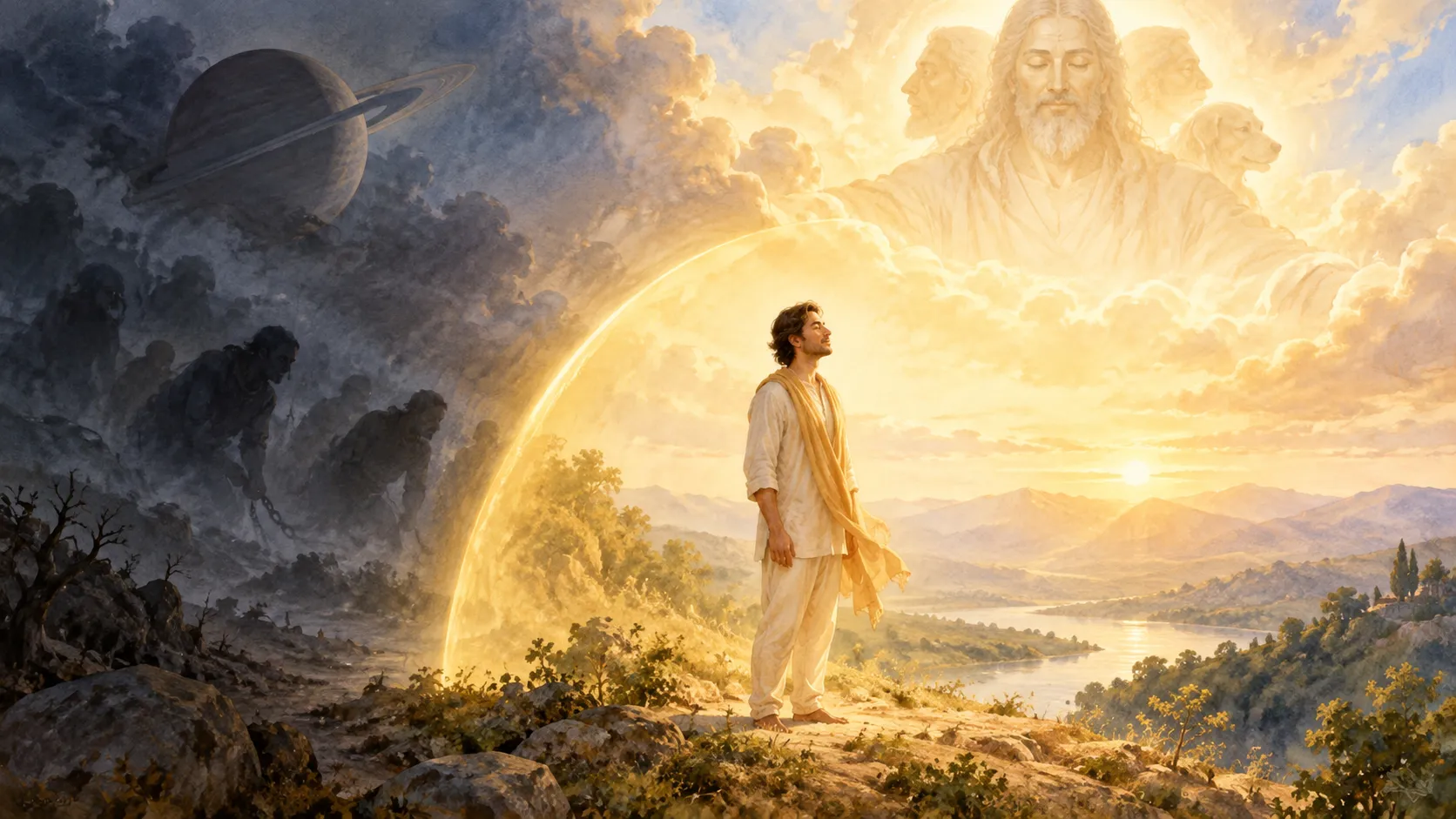
Thus, the pure state of immersion in divine grace is precisely what we strive for on the path of self-surrender; it can be called sahaja-samadhi or bhava-samadhi. It is pure and immersed in divine grace—not in the mind, not in the ego, and not outwardly. Then we can act playfully in this world, and our actions will no longer be our own actions, but the play, the lila, of the Absolute, the play of this divine grace, and they will be actions that bestow blessings. But as soon as the ego and attachment awaken in us, we lose our pure immersion in divine grace and fall out of it. Then actions begin again, and karma starts to exert its influence once more.
At first, we experience brief periods of immersion and long periods of falling out of it. But through vigilance, avadhana, and wisdom, a sadhu learns how not to fall out and how to remain immersed in divine grace for extended periods, as well as how to make these lapses minimal. Then such a sadhu is immersed in divine grace for most of his life, but he falls out of it at night when he sleeps, because there is nothing he can do about it. Or he falls out only when the grahas intensify, when some powerful influences arise; certain very strong impressions may throw him off balance. But for the most part, he does not fall out—this is a sadhu of the initial category, a good sadhu, already an experienced sadhu.
Finally, at the next stage, he is immersed in divine grace so deeply that he does not fall out of it during dream sleep, and even in moments of severe trials he remains within it. Like the strong overcoming the weak, he overcomes the grahas, overcomes emotions and thoughts, and remains in divine grace. The connection is not lost.
Finally, a sadhu of the highest category does not fall out of divine grace either during dream sleep or during dreamless sleep. Even in moments of the strongest influences of the gunas, tattvas, and maya, he does not fall out of divine grace. There is nothing left that could shake his spirit and cause him to lose his connection with God and divine reality. He becomes like the gods, divine beings, and siddhas.
If you have managed to experience immersion in divine grace even for a second, then from that point onward it is only a matter of increasing the number of such seconds throughout the day. You simply need to remain in it and continue remaining in it, deepening this immersion in divine grace. And even if your mind rebels, or your sense organs contradict you, or the planets or external reality interfere, you must, on the one hand, make heroic efforts and, on the other hand, cultivate devotion and self-surrender so as not to fall out of divine grace. Because within it lie salvation, freedom, wisdom, and protection. And within it, the entire divine world with its boundless mysteries unfolds. This is the inexhaustible love of which Sri Ramana Maharshi speaks. This is the sacred, holy, wondrous, mystical dimension.
Self-surrender
Contemplation
Karma
Ramana Maharshi
Atman
Ego
Maya
Bhakti
Divine Grace
Sharanagati
Author Гуру
Read 19 times
Articles
Vidya AI
Search
Lectures
November 1, 2026
Mantra of the day
ОМ НИТИМАТАМВАРАЙА НАМАХ ОМ Лучшему из нравственных – поклонение!
Auspicious Times(Rome)
Brahma Muhurta:
04:52 - 05:47
Abhijit Muhurta:
11:33 - 12:14
Sayam Sandhya:
16:45 - 17:27
Mokshada Ekadashi (6 November)
Ekadashi of liberation. Helps to achieve spiritual enlightenment.