Commentary on the text “Laya-Amrita-Upadesha-Chintamani”
The yogin said:
“O avadhuta, spontaneously innate awareness
is not sought; it itself awakens the yogin—
it is the very ‘I,’ not something external.
In it everything has already been accomplished spontaneously,
and is primordially perfect.”
Absolute Being is perfect from the very beginning; it pours forth its rays continuously. We are not perfect for the reason that we deviate from these rays because of our own egoistic will, seized by samskaras, because of the tendency to deviate. The point is to eliminate such a tendency and egoistic will—this is the meaning of repentance.
Coming into the sangha, you come into contact with the highest—with the divine cosmic law. Perhaps at first it seems to us that we come into a family of monks, to the Teacher, to practice. But as practice proceeds, the vision of the Dharma, the sangha, and the Guru gradually deepens; then we truly see that we are coming into contact with the divine cosmic law and that, perhaps in past lives, we made great efforts to enter into such contact: we performed ascetic practice or accumulated merit.
Now on Earth the time of dualistic religions is coming to an end—religions which, following dualistic notions of sin, encouraged the mind’s tendency toward splitting, generating such a divided state and then overcoming that very same state.
The Nature of Repentance in Laya Yoga
From the point of view of laya yoga, sin as such does not exist, because everything is absolute and perfect. Nevertheless, in the relative sense, we repent. Repentance means that we expose and eliminate our unconsciousness. Although the primordial “I” is absolutely perfect, because of our unconsciousness we are not able to allow it to unfold fully; our own egoistic will and grasping are still too strong. We cling too much to our karmic traces, and all these karmic traces are, of course, unconscious.
Rita is the universal law of cosmic harmony. One may say that it is the natural state in its dynamics, which manifests in the growth of a flower, in music, in creativity, in meditative dhyanas. When we enter into this harmony, we open ourselves to this Light of the natural state. Then this Light begins to illuminate us. But when we act unconsciously, we miss this harmony; then karmic vision arises, based on a certain imbalance.

In essence, egoistic perception based on kleshas, thoughts, emotions, and attachments is disharmonious worlds. Therefore, in the tradition, samsara is usually called such disharmonious worlds, where in principle there is no openness to the higher laws of cosmic harmony, to absorbing the light, but rather a fixation on one’s own internal data and blind following of them until the strict laws of cosmic harmony put an end to this in the form of death, old age, illness, and so on.
Liberation and the State of a Single “Taste”
To leave the worlds where there is disharmony in relation to cosmic existence—that is liberation. Of course, liberation is not some kind of non-being, emptiness, and so on. These are merely terms that indicate that no perceptions or concepts can be reached by the subtlest awareness. However, when it is attained, it also has the property of manifestation, but this manifestation is completely different; it is transcendental.
The properties of this manifestation are also called samarasiya, which literally means a single “taste.” Therefore it is said of the siddhas that they practiced and at the end of their practice attained the state of a single “taste.” The term “samarasiya” can also be translated as nectar-like “taste” or the universal taste of nectar. When we completely eliminate our impurity, unconsciousness, and being seized by egoism, and fully open ourselves to this divine Light of cosmic harmony, in such a state we attain Being in which everything possesses a single “taste.” This means that everything is perceived and seen as perfect.
This Teaching is not for those
who are bound by desires and believe in words.
Only to yogis with a fortunate destiny and to disciples
who have earned the Teacher’s special trust
can it be revealed
as a magical jewel
that fulfills all wishes.
If we are bound by desires, then most likely self-liberation and self-surrender will not come easily to us for a long time. If we believe in words, that is, are conditioned by concepts, we will not understand the very foundations of the teaching. In the teaching, faith is based not on words, but on awareness and presence. Anugraha (the power of divine self-revelation) always exists and sends out its vibrations. The question is how to become completely empty, to empty one’s heart and enter into this resonance — this is the principle of great obedience.

The Practice of Self-Surrender and Emptying
At first, we think that to practice means to do this or that. Later, we discover that practice means getting rid of oneself as the doer. Until we get rid of ourselves as the doer, until we learn to empty ourselves, practice based only on effort will always be like flying with one wing. It is difficult. To empty oneself means to surpass all those ideas and perceptions with which we previously identified ourselves.
Therefore, at first the Teacher says: “Discipline yourself, learn to perform service and to do not what you want, to renounce what you like. This is necessary so that you understand the taste of such self-renunciation and emptying, because in the process of practice you will have to give up not only external things, such as the world and so on (it is easy to give this up, it is simple, it will not cause problems), but you will have to give up the most subtle states of yourself in order to go further, to enter the supersubtle state of complete emptiness.”
Renunciation does not mean something negative, as if we were losing something, for we renounce the gross, the unconscious, and illusions, and acquire the absolute, the perfect. Renunciation seems frightening and negative only to those who are conditioned. They are so conditioned, so immersed in illusion, that they think they will lose something as a result of such renunciation. It is like offering an ant, which is dragging along its speck, to leave it behind in order to possess not even a palace, but an entire planet. But it has never seen either palaces or planets. All it has seen are grains, specks, and the like. And it clings to them so tightly that when it is told: “Leave it!”, it thinks: “And what will I receive in return if I leave my speck?” It is told: “You simply do not understand anything at all yet! You will be one with all of Being; galaxies and planets will be at your disposal, and you are holding on to your specks!”
Purification of the Will and Cosmic Harmony
Our will is precisely what makes us hold on to such specks. Self-surrender does not mean losing the will, becoming weak-willed, dull beings; rather, it means that we purify our will to its primordial state. We see that the will should not be connected with egoism, but that it is Being as such. Therefore, it is said that high-level teachings are revealed to yogis with fortunate destiny and to disciples who have earned special trust. One can come into contact with this primordial vibration when we have truly emptied ourselves of everything illusory and worldly, when we have become perfect, like hollow bamboo, and this cosmic wind of awareness begins to blow within us.

When something does not work out for us at all, or works out but with difficulty, this does not mean that the practice itself is imperfect. Reality does not sing false melodies; that is impossible. Only we ourselves can deviate from perfection because we are overflowing with our false perceptions. In absolute Being, everything is perfect and absolutely pure.
Self-surrender also does not mean that we must become passive and fall into lazy relaxation under the pretext of non-doing. The dance of the primordial Reality is described in the sacred books, yet we must still make the movements ourselves. Although this primordial vibration, this breath of Eternity, is transmitted by the Teacher as its conduit, we still have to breathe ourselves. Self-surrender rather means action and the manifestation of will with right vision. It means that now action comes not from the mind, but from the emptiness of primordial awareness, and the will manifests already in unison with the world’s cosmic harmony, that is, not as a deviation, but in unison with the law of Rita.
Bad Will and Falling Away from the Cosmic Law
At present, our birth is the result of the manifestation of evil will. It can be said that the entire life of living beings is the result of their evil will. Of course, someone may think that these worlds are something wondrous and valuable, but the six worlds of samsara are all the result of living beings’ falling away from the universal cosmic law, their evil volition; therefore such living beings are called duratma — the Atman that has fallen into delusion, in other words, the evil self. And no matter how hard people here try to promote the ideas of evolution, progress, love, improvement, philanthropy, and others, all of them must ultimately lead to entering into harmony with the universal cosmic law. But this is possible only when liberation is realized.
Then we fully enter into resonance with Rita (the universal cosmic law). Until then, all living beings in samsaric universes are the result of such a falling away from the universal cosmic will. That is, we were born because consciousness was seized by vasanas, samskaras, and the illusion of its own self-existence; therefore in some religions they say: “the world lies in evil” or “this world is a manifestation of the devil.”

In Laya Yoga, the world is a manifestation of the Absolute, not a manifestation of the devil. However, when there is samsaric conditioning, this manifestation is distorted as a result of falling away from unity with the cosmic law. When we attain complete awakening, we are in harmony with the cosmic law; then we are no longer separate from it. This is called samarasya — the state of a single “taste.”
As long as we are separated from the cosmic law, we do not have a single “taste.” If there is joy, then it is joy; and if there is suffering, then for us it is suffering. If there is love, then it is love; and if there is hatred, then it is hatred. In the state of samarasya, suffering is one of the forms of joy, and hatred is one of the forms of love, since there is no duality. In the state of conditionedness, sin is a form of ignorance and leads to the lower worlds, while fear is a complete darkening of consciousness. In the state of samarasya, fear is one of the forms of rapture, and sin is one of the forms of divine harmony. That is, in the state of a single “taste” there is nothing that exists in human concepts, because this is the absolute dimension of divine Being.
The Nearness of the Incomprehensible State
O wonder! How happy are the yogins who have united their “I” with this Incomprehensible State. It is so close that it is hard to believe in it.
This incomprehensible state permeates all things; it is right at hand, yet we are separated from it by billions of universes. This is a paradox. Although it is right at hand and in the palm of our hand, nevertheless we are so far from it. And if we do not turn toward this primordial state, we will continue to be just as far from it as before. But when we turn toward it, suddenly we can become close to it even faster than we think — in a single instant.
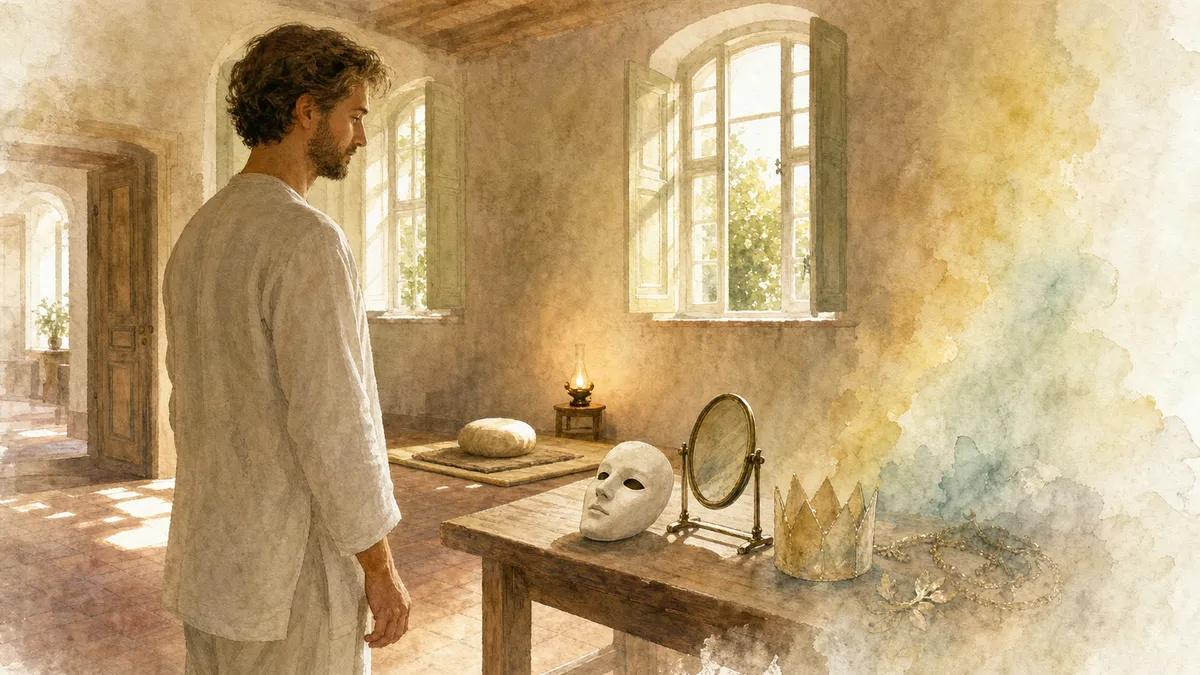
When can we turn toward it? When we have eliminated within ourselves the deviation from this universal cosmic law, when we have removed all inner falseness and left only the Absolute. Inner falseness means not only bad thoughts, wrong behavior, and so on. From the absolute point of view, everything except the Absolute is considered such inner falseness, that is, illusion as such. Why? Because all experiences based on individualistic, egoistic perception are false, artificial, mere stage props.
It is like in a theater, where all roles have already been assigned in advance. In a play, someone plays the role of mother, father, friend, beloved, but from the very beginning all of this is theater, a stage setting. When we awaken, we eliminate false perception; then we see that true knowledge has shone forth within us, and we are no longer enchanted by such props and play.
Overcoming the False Ego
The greatest stage prop is the self, the false ego, our individualistic “I.” At first, our practice is carried out on the basis of such a false ego and individualistic “I” — there is no escaping this. Something in the Dharma attracts us, something appeals to our ego, and we think: “Wow! This is real! This is definitely the practice, it is authentic.” We heard about dark retreats and think: “Wow, there is nothing like this anywhere: not among the Krishna devotees, nor among those, nor among others. But here it exists. I will definitely have some kind of experience; it must be something amazing. I will be like Milarepa or like the siddhas.” Or we saw sophisticated kriya yoga techniques and thought: “This is something truly complex, incredible! This inspires me greatly.” Or we heard about kundalini yoga, about someone entering samadhi, their breathing stopping, and their subtle body exiting through the crown of the head.
All of these are, of course, wonderful and important experiences; however, the experience of awakening is much deeper, because the experience of self-surrender and renunciation of the individual “I” (self-transcendence) encompasses all practices and all the power of different methods.
Repentance
A true yogin, a monk, always remembers his vows, especially the vow of ahimsa (nonviolence), non-possessiveness (not owning material things), service, obedience, chastity (brahmacharya), and the rules of discipline. He has strength of spirit, faith, and devotion, observes all the commandments, is firm in observing all vows and commandments, constantly abides in contemplation, mindfulness, and meditation, is diligent in practice and service, and loves his cell and monastery, places favorable for sadhana. He avoids worldly bustle and idle speech. In this way, he spends his days and nights one-on-one with the highest Truth.
A true yogin, a monk, is moderate in everything, all-forgiving, shows love to all, is patient, steadfast, strict with himself, always attentive, austere and restrained, dispassionate, modest, has humility, is detached from the desires of this world, does not judge others, sees gold and pebbles equally, remains the same in joy and sorrow, fame and disgrace, pleasures and sufferings, controls his mind and emotions while immersed in his Higher Self, avoids sensual pleasures and unnecessary communication with the opposite sex, avoids expressing himself without need, and avoids worldly bustle and attachment for the sake of the Dharma.
A true yogin, a monk, is always immersed in contemplation, abides in mindfulness, studies the Dharma, maintains diligence in meditation, remembers impermanence, the preciousness of human birth, the law of karma, and suffering, and directs every thought toward awakening.
All monks repeat:
I repent! O all rishis and mahasiddhas, saints and buddhas of all ten directions, all enlightened goddesses and deities, Avadhuta Dattatreya and Adinatha, guru-parampara and Guru, remember me! Please help me purify my consciousness of defilements and kleshas, dispel the darkness of ignorance, accept my sincere repentance, and direct my consciousness only toward the Dharma and liberation from illusions. May the forces of sincere repentance and the kleshas be transformed into the pure energy of Wisdom and Clear Light!