

Our goal as sadhus is the realization of Divine wisdom and following the saints. It is very important to understand that it is important not only to realize Divine wisdom, but also to follow the saints, because the saints embody the principle of the Divine will, and when we follow the saints and the sacred scriptures, we also unite with the Divine will and begin to conduct the Divine will.
To follow the saints means to unite with one’s chosen deity, Ishta-devata, with the Tree of Refuge, with the Guru lineage, with the root Guru, with the sacred scriptures, and with the Sat-Guru within oneself. We are wise, proper sadhus when we realize Divine wisdom and follow the saints.
When we follow the saints, we perform Guru Yoga, invoke the Ishta-devata Dattatreya, unite with the Tree of Refuge, and then, having purified ourselves, we become conductors of the Divine will. Ultimately, by following the saints as the embodiment and manifestation of the Divine will, we can perceive in a pure way what God is and what the Divine will is, and we ourselves can become conductors, pure conductors of the Divine will.
When we become a pure conductor of the Divine will, we ourselves enter the Tree of Refuge, we become a full-fledged part of the parampara of the Tree of Refuge of the saints, and our name is inscribed in the transmission lineage of the Tree of Refuge, and we become vessels of knowledge, divine beings, vidyadharas, those through whom, as through a conductor, the energy of divine blessings descends.
The Path of Inner Asceticism
For this, we practice antar-tapasya (the path of inner asceticism). One who walks the path of inner asceticism renounces himself every second in order to be continuously in God. As long as he is renounced and abides in God, in that moment he is holy. If he forgets God and the path of renunciation, then his holiness vanishes as if it had never been. Therefore, whatever happens, a sadhu always seeks the hand of God and trusts it. Whatever his body may be occupied with, he seeks his Lord as a child seeks his mother.
We need to learn always and everywhere to rely on God, to leave behind attachments and the will of our ego — this is the essence of prapatti yoga, self-surrender and casting off oneself. The essence is to come under the jurisdiction of God.
Two Wills: Egoistic and Divine
We have our own will, our self-control, self-reliance, and certain boundaries of our personality — ahamkara. This will of ours embodies our ignorance, our karma; it is the conductor of our karma. And there is the Divine will; it flows from the subtlest luminous consciousness, it embodies our freedom, the divine lila, the play; it is completely free from karma, from causes and effects.
These two wills within us seem to compete, to struggle. The Divine will is not heard at all at first; it is as if suppressed and asleep, while the will of our ego is very strong, because we have relied on it for a very long time, for many hundreds of lives; it has guarded us, protected us, ensured our survival, set goals for us, and we have grown accustomed to the idea that this will is our lord, our king and master, that it is us ourselves, and that it is precisely this will that must be listened to, precisely this will that must be obeyed, and that it must be conducted through our body and mind.
We enter the spiritual path, and suddenly a conflict arises: it turns out that there is also the Divine will, and the Divine will must be placed above the will of one’s ego. And such a rift arises within us; for a time we become, as it were, servants of two masters. One will is great and mighty; we think and believe, and the sacred scriptures and sages say: yes, it must be listened to. But as they say: “God is far away,” while one’s own will is here and now, and it seems that it should be cast off, yet it helps in life and sometimes provides comfort, frank joy and pleasure.
When we understand that there is such a rift and do not fully understand whose will we should listen to, it is here that we must clearly say to ourselves: “If I have set out on the path, then I must follow the sacred scriptures and the holy sages; I must sort all this out; I must acquire pancha-kosha-viveka — the discernment between myself and my sheaths — I must understand what I should listen to: whether the impulses of the body, or the sensations of energy, or the mind of the subtle body, the astral body, to feel it, conduct it, serve it, or to listen to my mental body, my subtle thinking, or to feel and listen to my causal body, or to cast all this aside and listen only to the purest Divine will as the transcendent. Or whether I should listen clearly to what the scriptures, the holy sages, and the Guru say.”
And this understanding—when we begin to distinguish between the Divine will and the will of our ego, and begin to understand whose will the sacred scriptures and holy sages are conduits of—is very important for us, and we call it viveka, pancha-kosha-viveka. Then our soul begins to choose what to serve, whose conduit to be, whom to listen to.
The Information War for Consciousness
Today the modern world is overflowing with information, and many people are confused; their consciousness is continuously attacked by various mass media. Today the mass media are means of mass manipulation of consciousness. Today no news item comes just like that; any news item expresses the interests of certain media holdings, media companies. And the news feed is selected in such a way as to promote the interests of certain political groups, one point of view or another, one form of karmic vision or another.
Today the world, in the global sense, has become a large informational structure, and each structure strives to defend its worldview, its point of view, even its geopolitical project, its system of values. You will not find a common system of values for all humanity; there are very many groups of influence, and each has its own system of values. Liberal democrats, orthodox capitalists, representatives of sexual minorities, representatives of various parties, representatives of various governments, transnational corporations—and these points of view are constantly in rivalry: each defends its own tunnel of reality, its own vision, its own right to influence history, to create the future, to move forward. Conflicts and struggles often arise between them, and all of this is a struggle for consciousness, for the soul, so that a large number of people will support me. This process continues within us as well.
The Parliament of the Soul
Within us there is not a homogeneous consciousness; the soul cannot be imagined as something singular. Rather, our soul is not one thing, but an entire parliament, and in this parliament there are its own radicals and liberals, its own socialists, Marxists, and capitalists; there are its own saints, and there are sinners. Our soul is a field of consciousness in which its own subtle, heterogeneous forces operate: various subpersonalities, alter egos, thought-projections; but there is, of course, directly our “I,” which expresses our individuality at the present moment.
A sadhu is one who learns to separate himself from the multitude of inner wills; they are also called chaitasikas (little minds, small minds). Sometimes you became angry at someone, and some angry person arose in the subtle mind, and he already lives independently in your consciousness. And you experienced an exalted feeling during the Bhajan Mandala, a deity was born, and this deity too already lives independently in your consciousness and inspires you. This evil person and this deity are parts of one consciousness, but they have different points of view. Sometimes you listen to the angry person within you (perhaps he was generated at the age of five by a strong impression, a samskara), and sometimes you listen to the inner deity within you; sometimes you follow one, sometimes the other. And all this is called the will of our ego, the will of our soul, which flows from our karma.
A sadhu is one who learns to distinguish this will, and he understands that saints, holy sages, sacred scriptures are conduits of the Divine will, and they must be listened to, while one cannot trust oneself as long as one is at this level. As long as you are at this level, you cannot trust the will that comes from the ego, from the subtle body, until you reach the deep, purest, primordial, original will within yourself, the will that comes from the Sat-Guru.
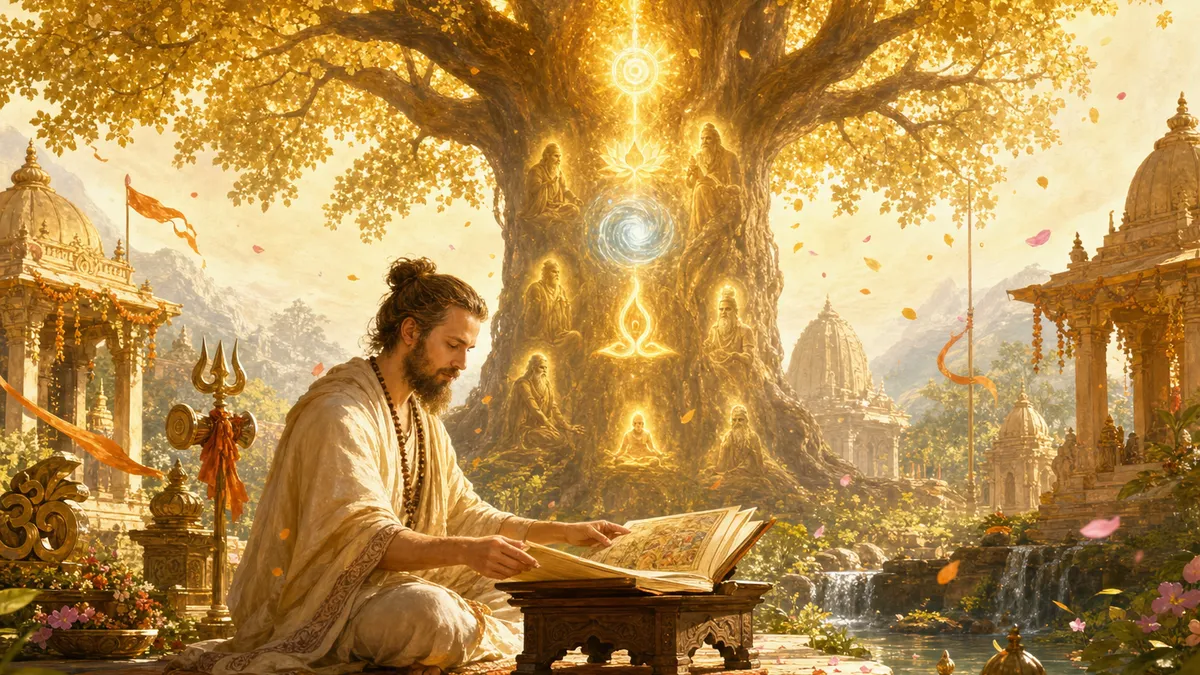
Therefore, a sadhu strives to abandon attachment to his false ego; he seeks not his own will, but the Divine will; he relies not on his own wisdom, but on Divine wisdom. And when he has no understanding at all of what Divine wisdom is, he looks into the sacred scriptures. He opens the “Yoga Vasistha,” the “Tripura Rahasya,” and looks: “Here is what Divine wisdom is, here is what Divine will is.” He turns to the saints; in this lies the greatness of the Tree of Refuge: Dattatreya, the rishis, the siddhas, the gods Brahma, Vishnu, Shiva—these are suprapersonal, boundless, infinite, eternal holy objects that do not change with time; they are great forces of the Divine, divine energies. Kalpas and yugas will pass on Earth; morality, ethics, virtue, and culture will change on Earth, but the Tree of Refuge is unchanging; a sadhu can rely on it, he must follow it, conduct the will of the Tree of Refuge.
Principles of Self-Surrender
Thus, a sadhu seeks not his own greatness and glory, but the greatness and glory of God; he does not try to be the one who tastes and enjoys everything he consumes, but strives to allow God, through him, to taste and enjoy. A sadhu may have any sensations and feelings, but he must not appropriate them for himself; this is the meaning of prapatti yoga, nishkama karma yoga: the sadhu offers all experiences, feelings, and sensations to God, and then the feelings do not harm him, because these feelings cease to bind him, to place him in a position of dependence; the feelings cease to be robbers. They simply play the role of soldiers, and the king over these soldiers is awareness.
The sadhu offers all thoughts to God, and then thoughts do not harm him: they do not become complex chains of constructions that push him toward certain actions in karma. Sometimes a person says, “fate is pushing me.” But what is fate? It is only thoughts, and thoughts arise from consciousness; the person himself pushes himself toward something. But when a sadhu offers all his thoughts to God, no fate pushes him anymore, no thoughts force him to embody his vasanas. A person begins to liberate himself, and we call this pratimoksha — the art of self-liberation. The sadhu offers his speech to God, and then his words become the nectar of blessing. And the principle here is this: offer all actions to God, and they will not bind you, but will become His play, lila.
The Path to Unity with the Divine
We strive, by knowing Divine wisdom, to carry out the Divine will, to be pure conductors of the Divine will, and then we do not need to be overly concerned about actions: our actions will be directed from within by the Divine themselves, they will themselves gradually become lila.
A sadhu lives by the principle: offer yourself to God and you yourself will become as one with Him, and in this lies the principle of Advaita. However, Advaita cannot be realized before prapatti yoga has taken place. Without offering oneself, it is impossible to declare: “Aham Brahmasmi.” Aham Brahmasmi arises by itself after self-offering, because the ego, the jiva, cannot declare: “Aham Brahmasmi.” The jiva is not Shiva if it is not in a state of self-offering.
But when the soul offers itself to God, only then does the jiva become one with Shiva; it eliminates its own individuality, merges with God in this self-offering, and pratyabhijna (self-recognition) occurs. And it is no longer the soul that recognizes itself as God, but God who recognizes Himself as God, while the soul is simply His instrument. It cannot be that the soul recognizes itself as God, that the jiva realizes: “oh, I am Shiva”! This cannot be; it is impossible in principle. Because the jiva is always the jiva; the jiva is always limitation.
The jiva can offer itself to God, but at the moment of offering it will completely eliminate the notion “I am the soul,” and will completely erase anava-mala. And then the jiva will say: “yes, I am Shiva, I have always been Him. I am Dattatreya, I have always been Him, I always am, and the soul is energy, my instrument.” And here self-recognition occurs, when the sadhu can say: “Aham Brahmasmi.”
Principles of Divine Life
A sadhu lives by the principle: allow God to possess you, and He will become you. He lives by the principle: offer Him yourself and all your possessions, and the entire universe will become yours. Whatever happens, accept it as the grace of God: His blessings or curses, and this art must be learned from the saints. God Himself knows whom and what to send you, how to teach you in the best way. He leads you to Himself by the shortest path. Do not resist what He gives you, but recognize it as grace; this is the law of inner asceticism. Inner asceticism consists in abiding in a state of contemplation of the Divine and in a constant state of self-offering.
Then the sadhu learns to fulfill not his own will, which comes from the jiva, from the subtle body — this is a continuation of karma — but the Divine will. The Divine will is not contained in images, thoughts, symbols, words, sounds, or letters, but it is expressed by holy souls, gods. Dattatreya as the Ishta-devata for a yogin is precisely the expression of such Divine will. When we want to know what the Divine will wants, we can read the “Tripura Rahasya,” turn to Dattatreya, to his sacred texts, turn to the Tree of Refuge, which originates from Dattatreya, and we can understand what the Divine will wants through its bearers.
The sadhu betrays God with no one and nothing, and therefore God does not abandon him. He never leaves a person, but if a person betrays God with someone or something else, then it seems to him that God has abandoned him. A sadhu never experiences this, because he remembers that he does not belong to himself, but to God. In enlightenment, the sadhu is the Absolute itself, having taken on a body and playing as a sadhu.
The Impossibility of Attaining God Through the Efforts of the Ego
And then the sadhu must ask himself: what is my goal—am I striving to make myself free, pure, wise, holy, enlightened, or do I wish to give myself to God, whatever I may be, without any conditions? Until surrender to God takes place, no matter how much we strive, it is an attempt to squeeze oil from a stone.
It is impossible to become free by trying to make oneself free, just as it is impossible to pull oneself up by the hair, just as it is impossible to save oneself from a thief by turning to a thief for help, just as mango fruits do not grow on an apple tree, a cow cannot give birth to a child, and rye cannot sprout from pea seeds; if we purify copper by polishing it, gold can never be obtained in this way. In the same way, by purifying ourselves as human beings, while remaining in egoistic samskaras, in an egoistic, human vision, we should not hope that God will be born from our efforts, that the Divine will be born, because God is born only from God. God abides in Himself; no one can create Him through their efforts. It is always a delusion: that by improving ourselves, by making certain corrections, we can attain enlightenment. We cannot attain enlightenment in this way; it is through the soul’s self-surrender to God that we can attain enlightenment.
This does not mean that one should not make efforts and practice; in all other respects, efforts are important and necessary. Efforts are necessary in sadhana and for the realization of sankalpas, for the purification of the soul and the preparation of oneself for self-surrender—this is what efforts are necessary for. But beyond that, effort is impossible. And we must understand the meaning of anupaya yoga, the path of non-effort, the path of self-surrender.
The Cosmology of Creation and the Three Aspects of the Divine
Scientists assert that the universe was born from primordial cosmic chaos, which was in a very inert state. This corresponds to the Vedic tradition: this primordial cosmic chaos in an inert state is the god Shiva. Then certain areas of heterogeneity began to appear in the universe, like certain initial vibrations in consciousness, like fluctuations in the mind, and they existed for a very long time. These vibrations (in Sanskrit, “spanda”) express the intention of consciousness to manifest, but they are very heterogeneous; the difference may be somewhere around 0.5% compared to this inert consciousness. This corresponds to the god Vishnu, when it is said that Vishnu reclines upon the waters of the causal ocean and slumbers for billions of years. These heterogeneous vibrations are very stable and exist for a long period of time.
Then it is said that a lotus appears from Vishnu’s navel, and from it Brahma the Creator is born. The most powerful activity begins; by the power of reason, Brahma begins to generate a multitude of beings and various universes. And this corresponds to the theory of the creation of the universe: in the first moments, when it is said that an instant before creation a very great heating of space occurred, the temperature was several hundred billion degrees. Because of this super-hot temperature, the universe began to explode. It happened instantly, like lightning (in one second light travels three hundred thousand kilometers). And when the universe was heated to such an incredible state, a state of enormous explosion began; within a second the balance had already been disturbed, and within the horizon of light propagation (approximately three hundred thousand kilometers per second), an enormous space was created in the universe, where all beings, stars, and planets already existed in seed form, in potentiality. This is the principle of Brahma, who creates vast worlds by the power of intention, by the power of sankalpa.
Then time began to unfold; this energy flowed, it could not remain in equilibrium, and tamas, rajas, and sattva began to unfold, as did the five elements; space began to appear. Within this space, the most powerful movement arose, and the element of air appeared. In certain places in space where there was intense heating, the element of fire appeared, the element of fire in the form of plasma. As it solidified, it began to cool and become water; water molecules, condensing, began in certain areas to settle and sink into a denser dimension, into grossness, into materialization, and thus the element of earth appeared. And this gross material universe is the result of the cooling of these elements and the scattering of these five elements; all of this is the creativity of Brahma. All the intentions, thoughts, and sankalpas of Brahma began to be embodied.
Brahma, Vishnu, and Shiva are three states of the universe:
Brahma — at the moment of creation;
Vishnu — such a stable state of vibration before creation, which exists for a very long time, a state of the heterogeneity of space;
Shiva — the unmanifest, very inert, with no movement, no heterogeneities; this is quantum chaos, like a black hole, the guna tamas, and beyond it.
These three states express three forms of the Divine, three energies of the Divine: jnana-shakti, iccha-shakti, and kriya-shakti. Beyond all these three energies there is turiya, the transcendental state, that which is connected neither with manifestations, nor with the materialization of the universe, nor with its maintenance, nor with its destruction.
The Soul and Its Unity with the Divine
The soul is a particle of Brahma’s sankalpa; one could say it is Brahma Himself, who created souls, created this energy in order to play better, to understand Himself better through His parts. And until the soul understands its unity with these three great forces: with Brahma, Vishnu, Shiva, and reaches that level of creation, of the universe, that level of cosmology and theurgy on which they dwell, it will not attain liberation.
There is a man in Chelyabinsk who says: “I am God. I have realized everything, I bless you.” He sometimes comes to church, sometimes to Protestants, to Vaishnavas, and says: “I am God and I bless you.” The last time, I was told, the Vaishnavas almost beat him up. They said to him: “If you are God, then you must lift Govardhan Hill, as Krishna did.”
This is the soul’s delusion: the soul cannot say “I am God” while it remains a soul, and when the soul dissolves in Him, it does not need to declare this to anyone; it is Him in fact. I would say to such a person: “Then you need to heat up the universe, as Brahma does, to a billion degrees, and then create a new Big Bang, if you are God.” Sometimes neo-Advaita gives rise to such tricks of the mind and tricks of the ego. Since we follow classical Advaita, we consider it a delusion to speak this way.
The Difference Between Method and Realization
This can be recognized as a view, but not as behavior; it can be recognized as kriya-jnana, a working method, but not as a fact, not as shuddha-jnana. The working method is kriya-jnana. If you practice kriya-jnana, you may repeat “I am God” as much as you like: Aham Brahmasmi, Aham Brahmasmi, and that is fine; it is your meditation, but it is not a fact, this must be distinguished. It would never occur to anyone that you are God, that you are a new Brahma. This is a method in the process of which your ego must dissolve, but the real experience of “Aham Brahmasmi” comes by itself, naturally—after the self-surrender of the jiva, after we have completely dissolved our ego at the feet of the Divine Light. And then the experience of this Divine Light is precisely what constitutes the principle of “Aham Brahmasmi.” Everything happens through self-surrender: self-recognition (pratyabhijna) occurs naturally.
My blessings that everyone may strive to be conductors of the Divine will, that you may see your goal not in yourself, but in God, in the Divine Light, in Divine grace.
