Commentary on the text “Song of Divine Grace”
“O Lord! You have initiated me into the mystery of how to remain ever wakeful, without sleep. And I have become Your devoted servant, and You will never leave me again. You have become my life. You have drawn closer to protect me from the bonds of impermanence. And now it is already too late for You to withdraw from me, because You are now with me everywhere and will never leave me, just as I will never leave You. And I cannot bear my judgments and opinions—You, Father, decide everything for me, because I am incapable of making decisions.
May all hasten to abide in this Eternal Source of Grace.”
This is a continuation of Ramalinga’s song.
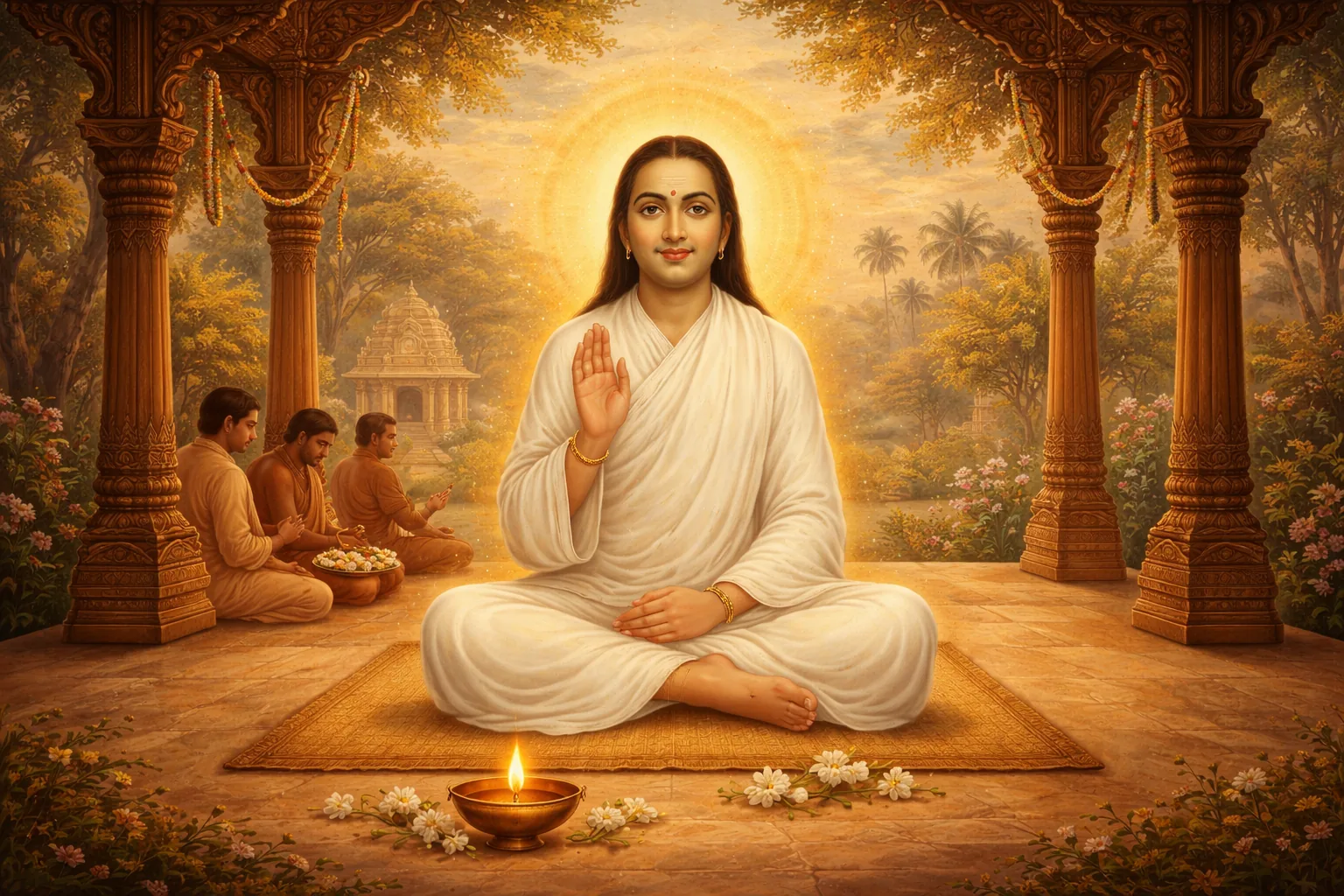
These are instructions on how to open the view and be impeccably devoted to the view. Ramalinga uses the traditional term “God,” inherent in the religion of bhakti. However, we use a term more closely related to non-duality. Although this is merely a matter of vocabulary, of terminology.
Ramalinga abides in non-duality, but he expresses his state in dualistic words. Of course, he remains fully in the non-dual state while doing so. And when, with the eyes of his ego (ahamkara), of intuitive reason (buddhi), he looks at this non-dual state, the word “Lord” arises in his consciousness. This means that when he describes this reality, he adopts a dualistic concept. But when he is in sahaja samadhi and his mind stops, he abides in the non-dual state.
He does this not for himself, not because his mind is in duality, but because he expresses it for others. And in order to convey it to others, he uses words that divide into consciousness and the Absolute.
Wakefulness Without Sleep and the Nature of Dreams
To master vision, or the view, means for us to abide in non-duality. When we receive initiation into non-duality, we are always wakeful, without sleep. Why do dreams occur? Why are we subjected to them? Why do they influence our consciousness? Because there is dualistic consciousness in dreams. For example, you may dream that someone gave you initiation, and therefore you wake up in a wonderful mood. Such a dream is a sign of the purification of obscurations.
As a rule, one who has attained the state of an arhat never has impure dreams. Unless, perhaps, it is someone else’s karma. Sometimes you may have dreams in which someone obstructs your practice, and therefore you may wake up tired. These dreams occur because there is you, the dreamer, that is, the one who experiences the dreams. From the very beginning they are unreal. However, since the dreamer exists, the dreams have a real effect on him. But when consciousness is in non-duality, there is no dreamer; there is only boundless light, which no petty dreams can touch. They all dissolve.
When you have brahma-bhavana, then even if you create an illusory body in a dream, you do not engage in conversations with anyone. Does Brahman have conversations with anyone? These can only be skillful lilas for the sake of compassion and the salvation of bardo spirits. But when you have brahma-bhavana, you abide as the central deity in your mandala, into which all visions and images are included.
This means that the dreamer who possesses brahma-bhavana in the state of non-duality is in such immense power and shakti that all living beings are part of his consciousness. They are the play of his mind.
To put it more simply, when you meet a bardo spirit in a dream, you instantly perform phowa for him, liberating him. At the very least, you enlighten his mind and tell him how to contemplate. You are not at all interested in what he is doing. And the power of your clarity is such that you instantly perform the transference of consciousness for him, without discussing anything with him and without even listening to him.
Whether you meet a peaceful spirit or a wrathful one, whether you meet a samsaric deity, you act in the same way. Then all living souls receive a blessing from you. This is precisely what it means to abide as the central deity in the mandala. In a dream or while awake, you explain the true state to living beings.
Self-Transcendence and Service to the Absolute
Ramalinga says: “I have become Your devoted servant, and You will never leave me again. You have become my life.”
At the stage of self-transcendence, when the ego is cut off, our ego has only one chance: to become a servant of the Absolute, the absolute Supreme Source. And then He never leaves us. He becomes our life.
What does it mean to become a servant of the Supreme Source? It means listening to Him every second and acting only from the Supreme Source.
And how can the ego listen to the Supreme Source? When there is subtle discriminating wisdom, viveka, when there is subtle clarity, like the light of a laser flashlight, which can distinguish lower dualistic egoic states from the nondual higher “I,” then the absolute “I” is instantly recognized and all lower states are resubordinated to it.
For example, thoughts and emotions arise in you. But your discriminating wisdom instantly identifies them as lower, and therefore resubordination to the Absolute immediately takes place. Then they are all liberated. Whether movements of the soul or fluctuations arise, they are instantly recognized as lower and immediately resubordinated. And this happens every second.
That is why it is said of a saint that he lives and dies every second. His ego appears, flares up, but instantly dissolves in its Source. Three seconds later it appears and flares up again instantly, and returns there as well. Therefore, after three seconds the saint is already different from what he was three seconds ago. His consciousness is always fresh and young; he never ceases to be amazed by the world.
This does not mean that he comes to a bhakti gathering and then, upon reaching the “Serene Ocean,” forgets what the manager told him, or reads a sutra and does not remember it. Relative memory remains; nevertheless, he does not identify with this relative consciousness. This is self-transcendence, self-surrender, when the false “I” is constantly surrendered to this great ocean of consciousness.
One who has not realized the mystery of self-transcendence is, one might say, a lost sheep. At best, he can be attentive and contemplate. This is not bad either. For example, he may try, in basic practices, to diligently train attentiveness, and this is absolutely necessary. However, his attentiveness has not yet deepened enough to lead him to the vast ocean of the Supreme Source, even if it is developed, and therefore he still does not always know what to do with this attentiveness. He can easily be tempted by maras, since his practice is still governed by duality. But one who has mastered self-surrender and self-transcendence can never be tempted by maras. He will not be misled by clarity, bliss, or emptiness, because he is accustomed to sacrificing everything to the Supreme Source.
Before self-transcendence has occurred, a person can be misled by his thoughts, his will, his own clarity, his supernatural powers, because he believes that there is a “he” who possesses something: fame, power, and some other worldly things. But when self-transcendence occurs, such delusion is impossible in principle. He knows that he possesses nothing. He does nothing. Universal energies pass through his body; he is simply their conduit, and his relative “I” constantly belongs to something greater.
Liberation from Judgments and Opinions
Ramalinga says: “I cannot bear my judgments and opinions. You, Father, decide everything for me, because I am incapable of making decisions.”
We say that to contemplate means to abide in an aware state without judgments, opinions, or evaluations. The ego by itself cannot make any true judgments or opinions, because it is based on the past. Its judgments are based on fixed notions, while reality is always new. Therefore, the ego never coincides with reality when it tries to judge reality on the basis of past experience.
But when we open ourselves to the Great Source, we see that all our judgments and opinions have no significance whatsoever. They are completely empty and mean nothing. Therefore, sometimes a state may even arise in which it would be better not to make any judgments at all, because whatever judgments you make are absolute illusion, complete absurdity.
The perception of reality takes place from the depths of the “I.” Only when such a perception of reality occurs does the conceptual mind, keenly aware of the inadequacy of what it is doing, nevertheless give it verbal form and utter certain words. But this is already something like a game. There is no identification with it. A saint is not identified with his words for even a single second. By and large, deep in his soul he has no judgments or evaluations about anything whatsoever. He does not attach to his words the kind of significance that ordinary people attach to them. In fact, he attaches no significance to them at all. Deep in his soul he sees complete equality. He knows that whether he babbles like an infant or recites sacred sutras, whether he sings mantras or spews curses—none of this actually has any meaning, since everything is the Absolute. All words have no meaning whatsoever. All words are simply vibration, behind which there is no meaning of their own.
Therefore one saint said: “The speech of a naljorpa is like rumors of distant events or the babbling of a madman.” Whether he utters inarticulate sounds or, like a mahapandit, operates with the logical categories of philosophy—all these are absolutely equal things for him. Whether he sings songs of Dharma, worldly songs, or blasphemes the Dharma—everything will be praise of the Dharma, everything will be the Absolute, everything will be sacred simply because he attaches no significance to words. For him, words are simply a game released from the natural state. Nevertheless, out of compassion, he gives his words the necessary form: sometimes logical, sometimes poetic, and sometimes philosophical. Words are a way to transmit the energy of the Absolute.
A yogi-naljorpa attaches no significance to words because he attaches no significance to thoughts. All thoughts that arise in the stream of his consciousness are seen as completely illusory, completely empty, as a game. Thoughts of Dharma, thoughts of the worldly, foul or angry thoughts, so-called impure thoughts—there is no power behind them. They no longer color him or carry him away, because against the background of all these thoughts there is a boundless ocean. Compared with these thoughts, reality is so deep that paying attention to thoughts is simply ridiculous.
This is precisely how the gods live. They are not immersed in concepts. Of course, their consciousness abides in meditative states of various levels: if they are unenlightened gods, they abide in dhyanas, and if they are enlightened gods, they abide in states of contemplative presence of nonduality. But neither the former nor the latter are in any way carried away by concepts. Concepts are displaced by meditative states. People, on the contrary, are carried away by concepts, but are only weakly drawn to meditative states.
When a person discovers true contemplation, all his concepts self-liberate. This does not mean that he cannot think, make judgments, generate concepts, and operate with them. He can do this even better than a person who has no contemplation. Nevertheless, he invests them with an entirely different meaning. He does not attach significance to them. They never bind him.
Only when we discover the natural state, the intuitive mind, can we understand the source of concepts and know their worth. We see that all concepts are essenceless and completely illusory. However, we see that there are skillful concepts, like a finger pointing at the moon, which can point to the Source. We seem to see two things at once: we see that concepts have no significance whatsoever, and we see that concepts are a sacred play of the energies of the Absolute, that they point to the Supreme Source. That is why Ramalinga says: “I cannot bear my judgments and opinions.”
The Nature of Evil and Divine Grace
“O Lord of the radiant universe! My nature is to do what is evil. Your nature is to restrain Yourself and, having looked more closely at me, to bestow Your Grace and Love in response to my evil. Glory to You, Father, for having endured my unkind deeds for so many years, and when I came to You asking for help, You did not forget me, but received me with tender love and bestowed Your Grace.
Glory to You, Eternal Ocean of Compassion! Hurry, all of you, to attain His Grace and peace, for everyone is worthy of His Light of Grace. The time has come to forget all the past and not to build the future, but in the total present to remember God and ask in sincere prayer for His Grace, which is infinite. The time has come.
O Lord! You entered my body, mind, and thoughts. You made me happy by giving me Your Blessing and joy. You granted me the Light of Supreme Wisdom, illuminating me with radiance. This was one of the ways You used to free me from impermanence. When I was able to remove all my thoughts, feelings, judgments, and concepts, You suddenly entered me, and tears flowed from my eyes. Your Light of Supreme Wisdom enveloped me, and Your will became mine. I disappeared, as mirages disappear in the desert. And if You decide that this path is easy for me, then I am ready to accept any of Your paths, even the most difficult one. If You wish, take my body and life—why do I need them without You? I need only You, and I agree to any path, if only to be with You. Your Holy Feet bear witness to what I have said, because my heart is open to You, and You Yourself know everything about me.
You entered my body, and it became a temple for You. Glory to You, Father! Glory to You, my Teacher! Glory!”
If you attune yourself to the consciousness from which these lines arise, you will discover continuous rapture. This is an extraordinary exaltation of spirit. Having attuned yourself, you will discover such purity that it is even difficult to imagine. There is not even a shadow of the worldly in it; there is no impure vision, obscuration, or clinging to the “I.” This is such an exalted state that your consciousness, even simply reading these lines, begins to be transported and as if awakened.
Ramalinga says: “The nature of my ego is to do what is evil.” What is meant here is the following: whatever the ego does, all of it is cloudedness, obscuration, that which leads to harmful karmic imprints, if it is not connected with the Supreme Source. When the ego is not in contact with intuitive reason, everything it does is a continuation of obscurations. Ramalinga says that the nature of the Absolute is to dispel our ignorance. There are these words here: “For so many years You endured my evil deeds.” Our higher “Self” has always seen our obscurations and pure states. It simply waited for the obscurations to disperse, after which we would be able to perceive our pure state.
One might say that somewhere deep in the soul it silently waits for this every second, simply observing us, chuckling a little at our lack of understanding.
Then Ramalinga says: “The time has come.” This means that right now we can enter and open ourselves to this consciousness. In the total present, remember God and ask for His Grace. The time has come.
There is no moment when this time has not yet come. We ourselves postpone the time when we begin to think constantly of God and ask for His Grace. Some postpone it because of shallow attentiveness, some because of projections, plans, and hopes. Some because they give unnecessary importance to verbal concepts. But in reality there is no time when it has not come. This time has come right now.
The Merging of Wills and the Disappearance of the Ego
Ramalinga says: “The Light of Supreme Wisdom enveloped me, and Your Will became mine.”
At first there is the will of our “I,” our ego. It is conditioned by the body, habits, and upbringing. This is false will, durbuddhi (perverted intellect). Until the Supreme Source is opened, all living beings have durbuddhi—false and perverted consciousness. They are like a finger that does not know it is part of the hand, and therefore tries to do something that contradicts the overall movement of the hand.
But when the ocean of wisdom envelops consciousness, the will of the Absolute becomes the will of the person. They are one and the same. Because there is no longer the will of the person, but the will of the Absolute. This does not mean that a person becomes weak-willed, apathetic, and unable to do anything at all. It is incorrect to think that one who has accomplished self-transcendence is some kind of spineless amoeba that does nothing but cry. Everything human is preserved. Moreover, it blossoms. But now it is not on its own; it is subordinated to something greater—the absolute Supreme Source.
The human will flows into the Source of the Supreme Will (iccha-shakti), and the person draws upon the immense will that comes from the Absolute. But now he no longer considers this will to be his own little personal “will,” but regards it as inseparable from the will of the Absolute. Therefore Ramalinga says: “Your will became mine.” Now the person no longer has durbuddhi—a perverted intellect—but has atma-buddhi: consciousness continuously connected with the absolute Source. And this consciousness always acts only strictly from this Source, because the slightest loss of connection with it, the slightest distraction, is again a transition into an obscured samsaric state.
Therefore the saints say: “Guard contemplation just as a mother guards her only child.” That is, nurture and strengthen this sacred connection as carefully and tirelessly as a mother nurses her only child. Always be attentive in your thoughts and actions; do not be distracted for even a second. Do not allow consciousness to become coarse and slip into lower states.
The Great Disappearance of the Ego
“I disappeared as mirages disappear in the desert.”
The ego disappears when consciousness comes into contact with the Supreme Source. In fact, the body, the mind, and memory remain. What, then, disappears? Identification disappears; the feeling that the ego is real disappears. The sense of “I am a separate person” disappears completely. This is a very radical disappearance. It is even deeper than death, because at the moment of death identification does not disappear—only the body disappears. But at the moment of such a great disappearance, everything that drove our karma through billions of incarnations disappears.
When Buddha Shakyamuni discovered the nature of Mind, he said the following: “Now I understand what it is all about. The builder of this house has been found. This builder is the mind. I will no longer succumb to its tricks.”
The ego is a mirage. Individual existence is a mirage. However, for beings in samsara, it is the only mirage they contemplate from birth to death. When the ego flawlessly melts into the ocean of serene space, it disappears like a mirage in the desert, like something that in truth never existed at all.
A saint may still use the word “I,” may make it appear to others that he has his own will, makes decisions, and acts. A saint may possess a developed ego, a developed intellect. He may operate with and play with all qualities as he wishes. But his ego is already absent. His ego has been transformed into shuddha-sattva-svarupa. It is no longer the ego that thinks it exists on its own, but something like a puppet subordinated to the Absolute. The saint never again identifies himself with it. For him it is simply a functional part, like an ordinary working tool.
Instructions on Love for God
“O you who long for God! I bow at your feet. I am a poor servant of God, and I want to speak to you, if you would be so kind as to listen. Accept me as a servant of God who can share with you the secret of how to open your heart to our Father. Love God day and night, when you are joyful or sad, when you have nothing to eat or drink. Love the One Who spontaneously creates universes and worlds. When reading the Vedas, do not become philosophers who know only how to argue about God—what form He has, where He is or where He lives. Do not waste your time! All these conversations about God will give you no reward, and you will not come to know God even by a millimeter. But when you open your heart to Him, removing all your knowledge and concepts, thoughts, will, and desires, then you will know God in His fullness and in all His qualities. Become like a child—now crying, now laughing. God is perfectly pure happiness. Be glad to come closer and see it with your own eyes and feel it with your own body. I have proclaimed to you the highest truth, in which there is no doubt.”
“O men and women of the world! You are in constant discord. Do you truly think of God, eternally dancing in the Heart of all Creation, and ask for His Grace? Even if you have committed evil words and deeds, all this will melt like snow in spring if you ask God for Grace in sincere prayer. Only He can help you atone for all that you have done in the past. I truly speak the truth, because I have walked this path to God. Since you are all my friends and kin, I tell you this in order to share true benefit with you.”
“O men and women of the world! Listen to the truth that comes from my lips. The experiences of sleep, sorrow, fear, and obstacles have passed forever. Evil, despair, ignorance, darkness, and dread have left me forever. But prosperity, love, the Immortal body, happiness, and joy have arrived to dwell in me in full measure. Keep in mind this truth of my experience.”
“O men and women of the world! This is the good Supreme Grace of God, which has neither beginning nor end, that has filled my mind and will. And I have become an eternal being. And I will also help you attain this Supreme Light of Grace. This divine grace will remove from you all notions, such as caste, differences between races, notions of dogmas and sects. May all of you without exception abide in the joy that has poured down upon me! May all of you without exception traverse this path as quickly as I did!”
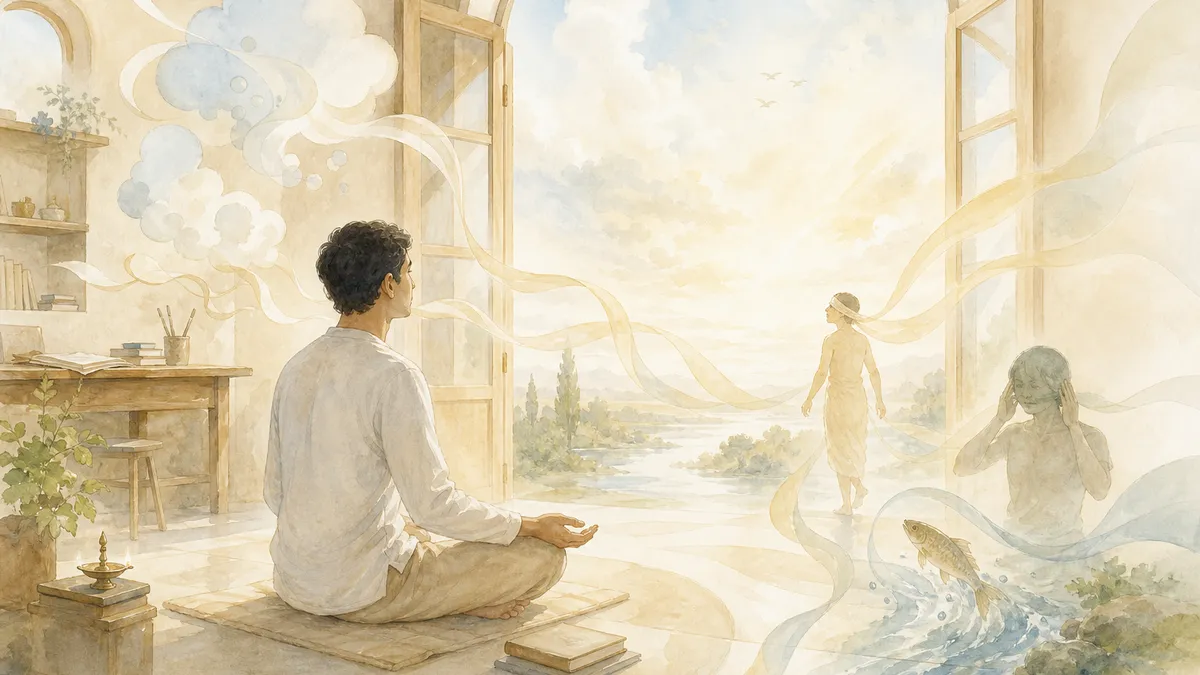
What does it mean to “love God day and night, when joyful or sad, when there is nothing to eat or drink”? It means constantly directing one’s consciousness toward the primordial transcendent space, like pure light, where there are no thoughts, no sensations, no notions, removing all one’s knowledge and concepts, thoughts, will, and desires. Any experiences are nothing compared to such contemplation.
The Path of Detachment
Over several years of monastic life, a monk becomes accustomed to being detached from his desires, thoughts, and feelings. One who yields to his desires, who is not detached from his thoughts and feelings, is, of course, not a monk. Over several years of monastic life, a monk becomes accustomed to detaching himself from his “I,” from everything that comes from it. Why does he do this? To whom is such a sacrifice offered? In order to reveal absolute consciousness.
To detach oneself from concepts means to contemplate beyond concepts. One who believes in words and is bound by them is like a blind kitten. One who is enchanted and seized by his own thoughts or the thoughts of others is like a deaf-mute. One who is enchanted by his own will or his own desires is like a fish cast onto the sand that does not know how to return.
The practice of a monk consists in the ability to detach oneself from everything. Until discriminating wisdom and the ability to detach ourselves from everything arise in us, we cannot reveal this primordial consciousness. The primordial foundation of all thoughts, will, desires, and knowledge is the pure space of the Absolute.
What does it mean to detach oneself? It does not mean beginning to have a negative attitude toward something or generating a judgmental attitude. It means not generating any state at all, but flawlessly shifting the focus of one’s consciousness into the higher “Self.”
An Appeal to the Lord for the Unity of All Living Beings
“O my Lord! You are the eternal dancer in the Radiance that dispels ignorance, illusions, and evil. I have strengthened my heart like steel. And I want to give food to these hungry and poor beings. But, alas, here I am powerless—only the unity of all living beings can ensure an eternal, satiated feast. Therefore, let brothers and sisters, all without exception, pray to lessen their hunger and be filled with the eternal nectar of immortality.”
“O my Teacher! I learned from You that Supreme Knowledge is knowledge of the Immortality of the soul and the body. Therefore I strove to be devoted to Your Radiant Wisdom.”
“O my Teacher! If it were not for Your compassion toward me, I would never have been able to experience the stream of joy of Your Grace.”
“O my Teacher! I learned from You that refuge is Your Lotus Feet. And therefore I no longer need any other help.”
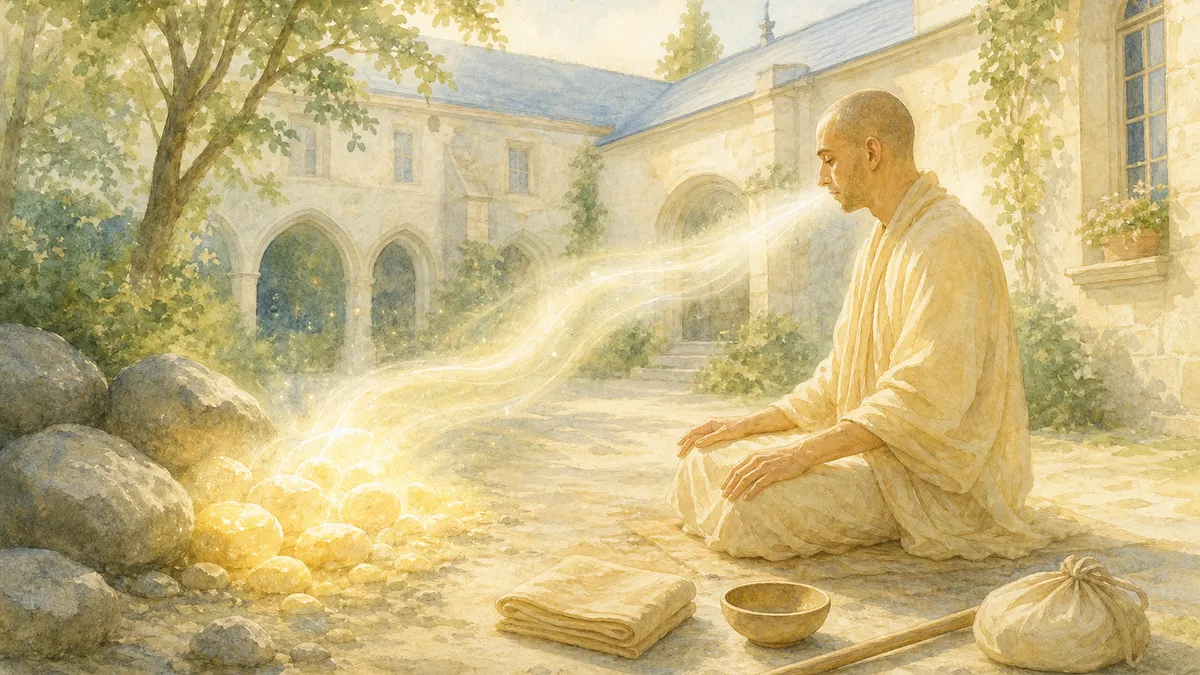
“O my Lord! I have not put on shoes. I have not put on a white shirt. I have no good cloth for clothing. I have no work. I have no money at hand. I have no plump body formed from tasty food. I have no place of residence. I have no superiority of any kind. I have only cleared a place for God in my heart, in my body, in my mind. And what do I have? Only the Grace of God—and is anything else needed?”
Such words can melt stones. If you repeat these words, I give you my oath: you will become a saint in this life. Without doubt, you will. A monk is one who has nothing: no place of residence, no money at hand, no beloved work, no superiority over others, no clothing that he would wish to wear. Everything he has, from his clothing to his plans, belongs to God.
Ramalinga says: “I cleared a place for God in my heart, in my body, in my mind. And what do I have? Only the Grace of God. And is anything else needed?”
When we have nothing, then there is only the Grace of the primordial Source, the Creator of all worlds. But when you have this Grace, then you have everything. And the one who does not have this grace in fact has nothing at all.
One who has attained this grace abides in the greatest happiness, wherever he may be, whatever he may be occupied with.
Transformation in the Sacred Sound OM
“I opened my heart to God! In the primordial sacred sound OM. On a dark night He transformed me into a being with form and without. He delivered me from death forever. Therefore pray and ardently desire that He pour the Nectar of Grace upon you as well.”
“O Lord! You are the Boundless Space suffused with Perfection! You are Infinite Being, filling all space with Yourself! You are the One who encompasses all This! You are the Knowledge that dispels ignorance! You are the Light of inspiration! O Lord! You are the beautiful culmination of all sacred scriptures!”
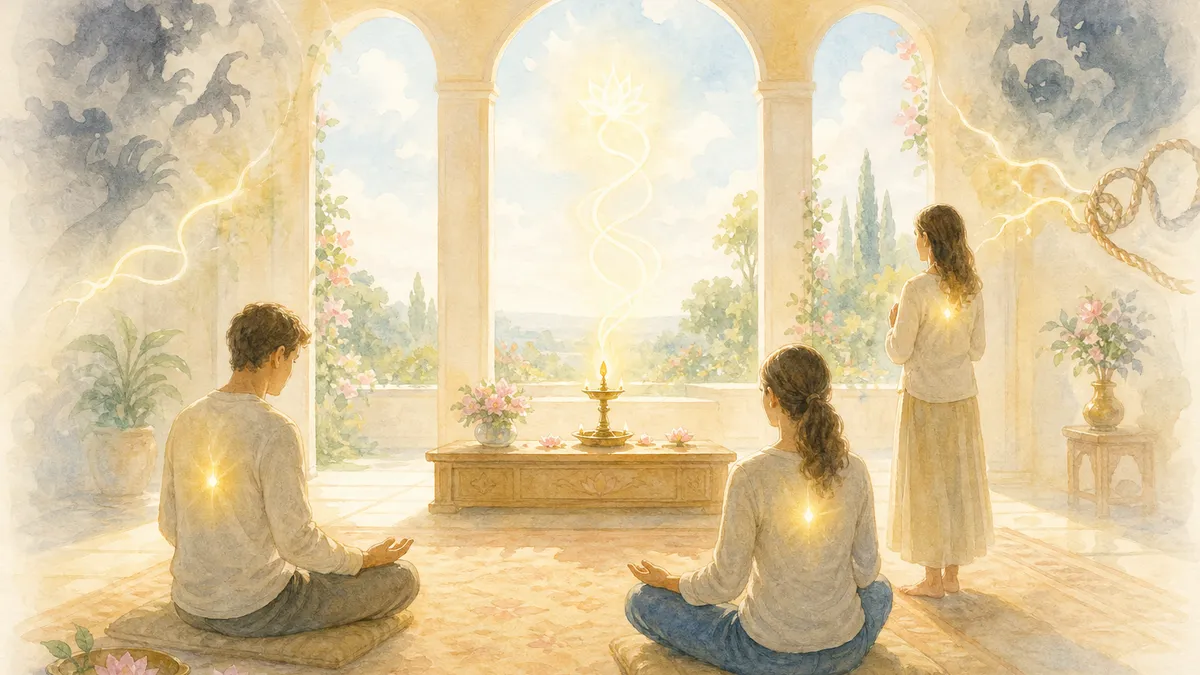
“O Lord! You have removed all dangers from me! You have lit the lamp of Your Beauty within me! You have destroyed my will! Therefore pray, brothers, allow the Lord to abide in you as well.”
“O my Lord! You have bestowed upon me the power of purity! You have removed laziness and sleep from me. You have made my body Your own. Therefore, brothers, pray and seek refuge in God, Who, through His Grace, can make you eternal.”