

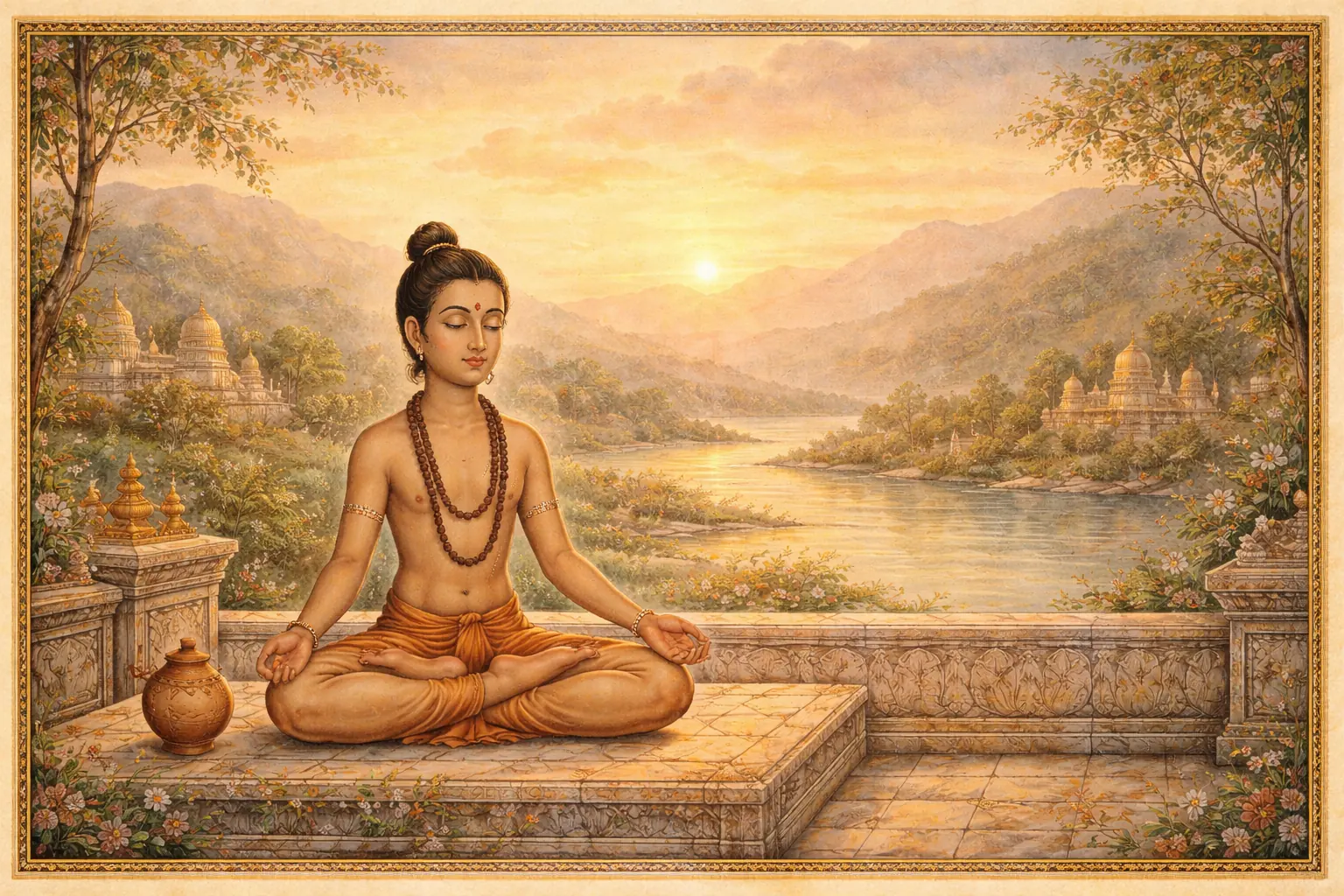
Commentary on the text “The Master’s Code.” Chapter 87
1. Having entered non-action, the Master finally comes to know himself.
2. The Master comes to know himself when the Boundless Spirit reveals to him the final, astonishing secret for a human being. This secret is as follows: he himself has always been and is the Boundless Spirit, and no one else. Thus, all dreams disappear, and the mind’s dreams finally dissolve.
According to the teachings of laya yoga, true self-recognition comes after the phase of self-transcendence has been passed through. What is this phase of self-transcendence? It is also called atma-nivedana, prapatti, self-surrender, the dissolution of the “I” in the Absolute. This is the stage when the practitioner’s limited personality begins to transcend itself. But self-transcendence cannot occur until we have discovered the principle of non-action, until we have made the “great decision” and entered into it.
Making the “great decision” and entering into “great non-action” is the cornerstone of the entire practice, the turning point, the culminating phase of the transition from the second rule to the third. The second rule is to clarify the principle of non-action and the space of non-action, to cut through all doubts and eliminate all misunderstandings. The third rule is to directly enter the true state and simply maintain it and work with it thereafter.
Sometimes the interval between the transition from the second principle to the third can last even decades, because manana (the second principle, that is, clarification) is the very essence and foundation. Until you have clarified it, there is nothing to maintain; you are still in delusion, and therefore can maintain only an illusory vision, kleshas, maya, and duality. Such clarification comes as a result of studying philosophical texts on the teachings, reading instructions (upadeshas), and, of course, through one’s own contemplative practice.
Contemplative Practice and Working with Sankalpa

One’s own contemplative practice consists in continuously working with sankalpa. And working skillfully, understanding the relationship between sankalpa and the natural state, as well as various principles such as effortlessness, letting go, relaxation, vigilance, and attentiveness. For this, it is necessary to have a “secret friend” on the path (vigilance and attentiveness). It is also important not to somehow fall into the thirty-five deviations or create an imbalance of the pranas.
In other words, you must understand that your contemplation is a highly refined technique: you are constantly balancing on the edge, walking along a razor’s edge—one step to the side, and you have fallen off. And be assured that far from everyone can walk along this razor’s edge, since it is like climbing to a mountain summit along a narrow path during a raging hurricane or windstorm. Nevertheless, if you are fully equipped with the instructions, method, teachings, and practice, then one day you will reach this summit.
When the clarification of the mind’s empty nature arises, you truly cut through all obscurities and doubts and can say precisely where this very child (“the son of a barren woman”) lives, because you encounter him. But this does not mean that you can rest on your laurels. It is like receiving a key and opening a door, but from that moment, of course, nothing ends—it only begins.
It is precisely after this that you make the “great decision”: “Yes, now I will go in this direction. Now I know exactly which direction to take.” Until you have made the “great decision,” you still do not know where to go or what direction to take. One who has not made the “great decision” is like a person with blindfolded eyes. In other words, they have doubts and hesitations; they are uncertain of themselves, their abilities, and their practice, and they place their hopes in some miraculous means on the external plane.
As they say, if your mouth still waters when you hear teachings other than those concerning the natural state, then you still do not possess sufficient wisdom to follow the path of contemplative practice—in other words, you are still hoping for something. But when you have cut through doubts and obscurities—truly cut through them—and have nothing left to doubt and nothing external to rely on, you rely only on God revealed within yourself. This God has truly revealed itself as your own living experience, and there is nothing left to doubt.
Making the “Great Decision” and Entering Non-Action

And then you simply make this “great decision.” And when you make the “great decision,” you decide to eliminate the entire pursuit of external achievements, to eliminate all hopes for any future achievements and plans, to eliminate all attachments to the past, to eliminate all the mind’s wandering. Not exactly eliminate them, but simply not place your hopes in any of this. Perhaps it will not be possible to eliminate everything at once; instead, simply do not hope for or rely on any of it, do not place your hopes in actions, activity, or your ego as the doer.
And by making such a decision, you find yourself in a state of total trust and openness to bhava. You are in a state where nothing more needs to be done, where everything has already been done, and all that remains is to stay. At the same time, of course, this does not mean that on the relative level you lapse into laziness or stupor—that would be a mistake.
Of course, in ancient times there were saints who were described in texts as sleeping from morning until evening and doing nothing else, but in their sleep they meditated and were in samadhi—that was their path. Perhaps it was a special sadhana or practice, but I do not think it would suit you here. Even if you did nothing but sleep, you might grow tired of it, because you have a body and pranas.
In other words, on the relative level, this does not mean doing nothing. Relationships and relative plans—all of this, of course, remains; none of it simply dissolves away. And if you say, “We do not need to pay for electricity because we are practicing non-doership,” the people who provide you with that electricity will not share your view; they will still ask you to pay.
The principle is that our consciousness functions in an entirely different way: it functions simply without a doer, merely responding to the situation based on clarity, without creating a center, without creating attachments or concern about anything at all.
Self-Transcendence and Opening the Channel of Connection
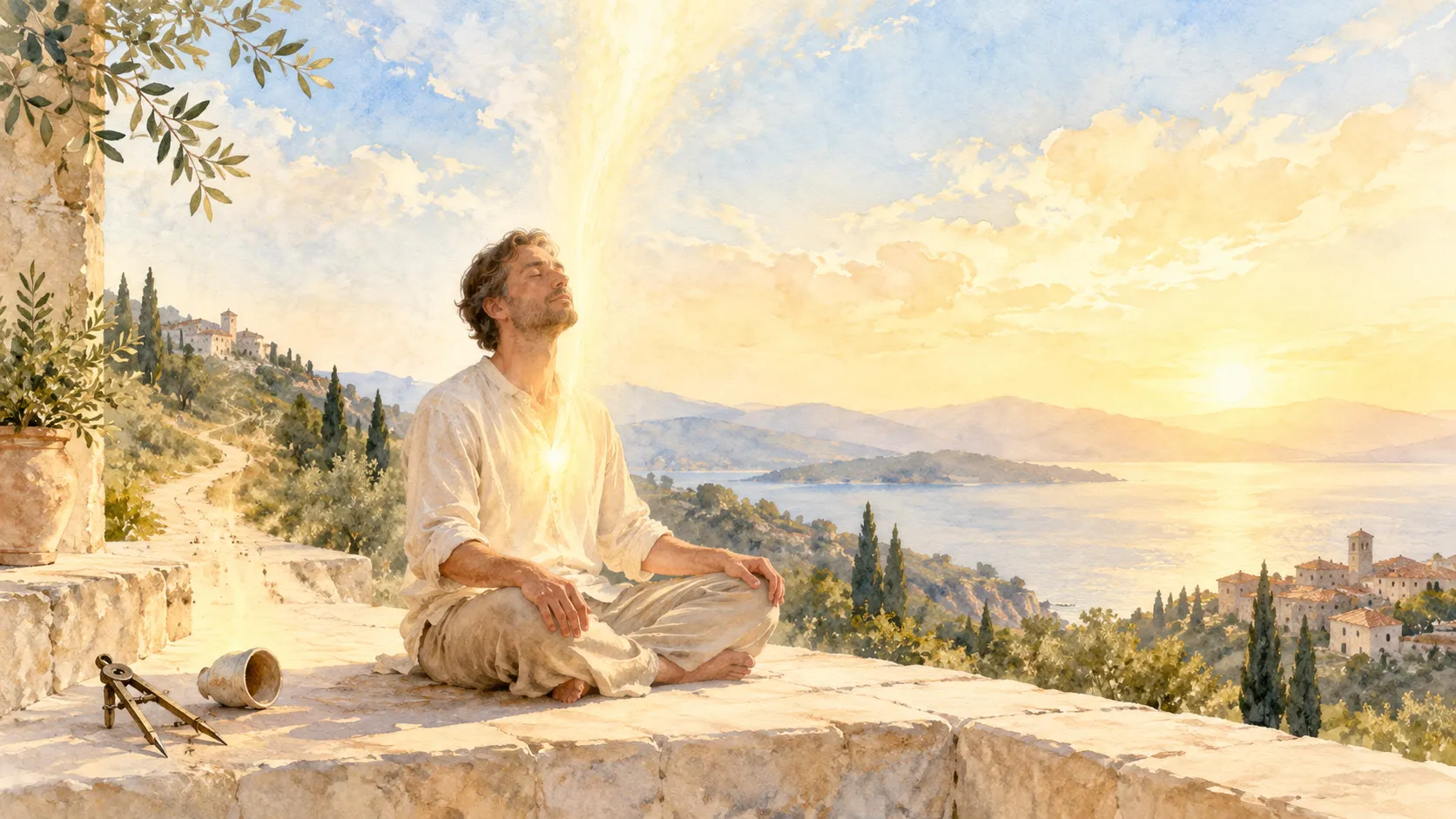
It is precisely with this entry into non-doership that the true recognition of oneself begins. Self-transcendence takes place at the moment of entering non-doership. Our old doing ego, striving for liberation, setting goals, and holding ideas about itself, encounters this silent and infinite space of non-doership; it feels that there is nothing left for it to do here, that it has lost its power. And at this stage, the ego begins to surrender to this space of non-doership.
To surrender means that the focus of your attention begins to shift from the ego into the space of non-doership. And the more this surrender takes place, the more benefit the ego receives, because this space of non-doership begins to imbue it with tremendous shakti, with energy. Previously, the ego felt dependent on external sources of energy; it wanted to receive energy from worldly desires, from other people, and from sensual pleasures. It was always trying to draw energy through the chakras, through something external, because its own source and channel of connection with fundamental consciousness were blocked.
But “entering non-doership” and making the “great decision” are as if they tear the lid off the sahasrara chakra and open this channel of continuous connection. And when, as a result of such a decision, this channel of continuous connection is open, the ego begins to receive tremendous energy, a great source of inspiration, powerful shakti, immense confidence in itself and its abilities, creative capacities, and more.
Before the ego begins to receive this, it is very important to give it the right motivation, the right intention and conduct—that is, compassion, pure vision, the four immeasurables, and the motivation to serve the dharma and others. For sometimes, without the right motivation, having received a colossal impulse of light from the natural state, the ego may literally go berserk, overestimate its abilities, fall into a state of arrogance, and begin using them for the wrong purposes. And as soon as this begins, after some time such a channel closes, and then everything returns to the way it was, because the higher “Self” saw this and said, “No, it is still too early for him. He is not ready for this yet. He is not capable of handling this shakti.”
This is precisely why a yogi trains his relative ego to be impeccable; he polishes and hones it. When such self-transcendence begins to take place, when the impeccably honed ego itself is constantly trained to subordinate itself to the supreme Source, self-recognition takes place—the self-recognition described in Chapter 87 of the book The Master Code.
The Act of Self-Recognition

Self-recognition means the act in which discerning clarity, manas, ahamkara, and buddhi begin to unite with the Atman, when a spark passes between them, a mahamelana (great meeting) takes place, when the final illusions, personal karmas, dualistic judgments, and concepts completely disappear, and when a person begins to recognize that they have never been a person.
At first, they thought they were a person; then they thought they were a practitioner, an enlightened person, or a God-man. But when self-recognition occurs, even all these illusions disappear. They begin to understand that they are not actually a person; rather, only their physical body, ego, and manifestations are called a person. They themselves are not localized in any particular body, but are one all-pervading consciousness. This feeling is like a radical hyperjump; it is an entirely different level of being. And such a person, experiencing themselves as only one being, simply continues the games in this body.
Disappearing as a Personality and the Plasticity of Consciousness
3. Having recognized himself, the Master completely disappears as a personality, yet continues to live. His life becomes filled with inexpressible grandeur.
“Completely disappears as a personality” means that he is now no longer attached to his own personality and can shape this personality in any way he wishes. He can activate the hidden samskaras of ancestral memory from past incarnations. His personality is not permanent; that is, he can make his personality whatever he wishes and activate any experience depending on the situation.
If he needs to build, he activates all the memory of how he built the pyramids of Cheops and becomes a marvelous builder. If he needs to be a scientist, he activates all of humanity’s ancestral, collective, and absolute memory, and then becomes a scientific genius. Depending on the situation, he draws upon any samskaras, unfolding them and instantly restructuring his personality. That is, his personality becomes a self-organizing structure that instantly restructures itself to suit a specific situation. It is not crystallized or frozen, but dynamic and plastic.
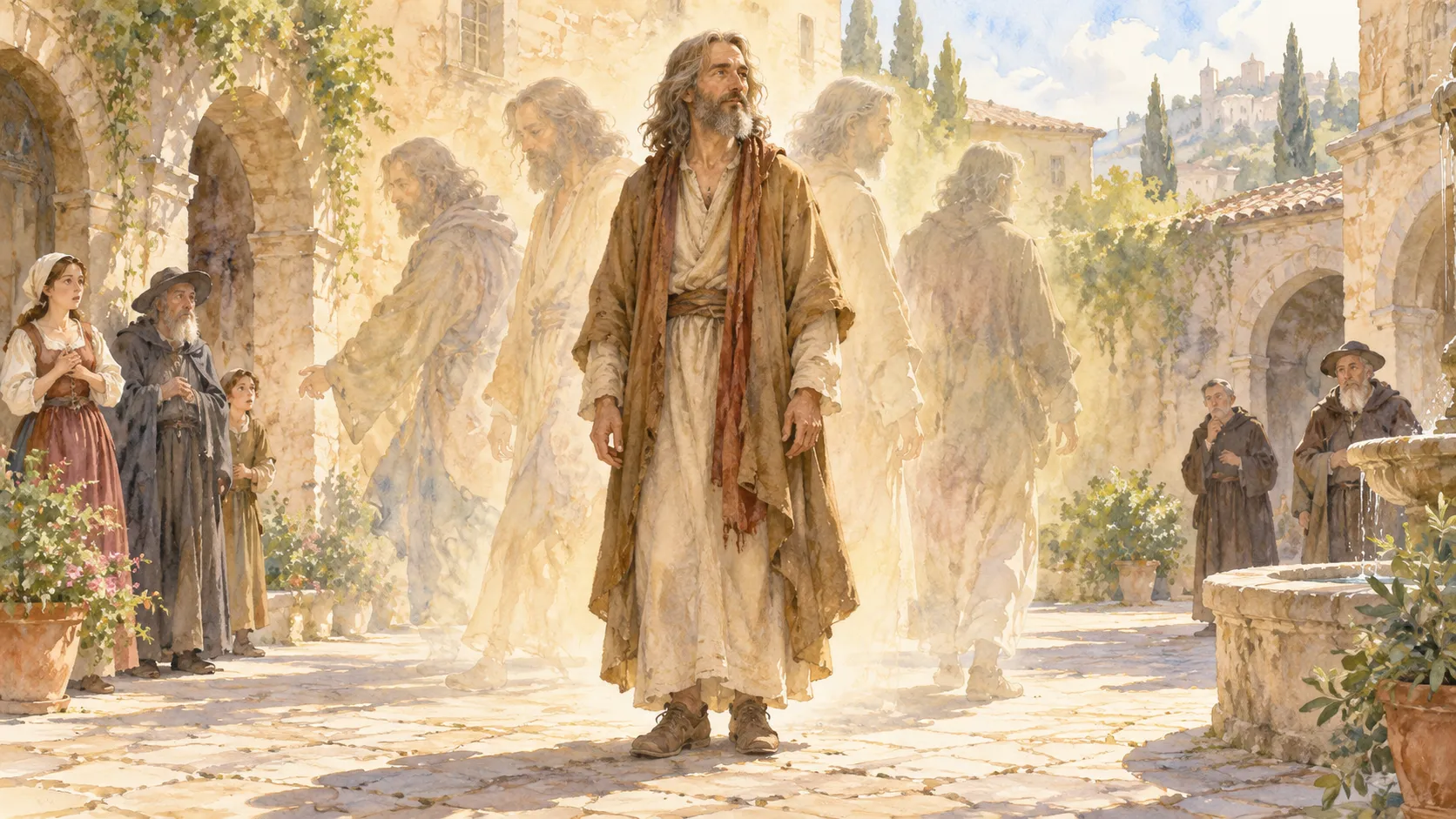
Many siddha-avadhutas often shocked other people by demonstrating such plasticity. To people, it seemed like madness. But for the avadhutas, it was transcendent madness, sacred holy folly. No one among ordinary people could understand it, since such changes and abilities are not characteristic of ordinary people. But this is because the Master disappears as a personality; his personality, so to speak, is constructed for a specific situation.
Universal Integration
4. Having recognized himself as the Boundless, the Master resounds in every sound, from the rustling of grass to thunder; he beats in every heart, flows through the veins of all living beings in the universe and through the beds of all rivers, gapes with the bottomless depth of the sky, shimmers with the light of all stars, and wafts the fragrances of all flowers. He drinks moisture through every leaf and blade of grass, blows together with the wind, and laps with every wave.
To experience this, a yogin usually performs integration—the uniting of presence with external elements and experiences. But at this stage, integration occurs by itself. That is, it is no longer integration, but complete merging, when there is nothing left with which to integrate and no one left to integrate. It is a single process of total universal integration.
Shivananda Swami once said to his disciples: “With one blink of my eyelids, I can extinguish the sun.” And when you abide in such universal integration, this truly ceases to be mere words.
Of course, even when self-recognition occurs, the body remains, as do its inherent karmas, samskaras, and everything else. As self-recognition unfolds, they are purified and revealed. And if self-recognition is authentic, then contemplative presence, reuniting with these karmas and samskaras, creates pure manifestations, mandalas, auspicious worlds, and dimensions. Then everything that emanates from the sacred is fragrant, aromatic, and auspicious. And depending on the strength of self-recognition and karmic tendencies, it emanates with greater or lesser intensity.

This happens much like the sun shining on ice: when the sun’s rays fall on the ice, the ice evaporates; if the sun’s rays are strong, the ice melts fairly quickly and turns into vapor. In the same way, as a result of self-recognition, the ultimate integration of the higher “Self” with the inner samskaras, vasanas, and even external elements takes place, resulting in this continuous melting. Melting is sublimation, crossing over, and transmutation. And what is the vapor? The vapor is the dimension of pure vision that emerges as a result—in other words, energy reaches its ultimate divinity, completeness, and purity. As a result of this vapor and melting, a pure dimension, or the world of the mandala, emerges, at the center of which stands the yogi’s consciousness.
Nurturing Potential and the Inner Struggle
When you practice contemplation, it means that you are constantly opening up your potential, working with it, and growing. If you practice correctly, your abilities, creativity, and wisdom increase. Your potential becomes subtler and manifests with ever greater power. You truly become someone who unfolds this potential within. But for it to unfold, you need to be attentive to nurturing it and nurture it with confidence. If we do not nurture it, nurture it incorrectly, or nurture dualistic thoughts instead of our potential, nothing will come of it; sooner or later, we will run into some kind of wall with a large question mark standing there. This means that we must be sure that we are nurturing it well and regularly adjusting the process of nurturing this potential.
During this nurturing, the yogi constantly experiences various disturbances:
- from his own mind and concepts, until he learns to self-liberate them;
- from kleshas, obscurations, and worldly desires;
- from tamas;
- from obstacles;
- from the disorienting prana of external factors;
- from someone else’s karma or his own ancestral karma;
- from certain spirits connected with him;
- from the gods of passion, who sometimes like to test practitioners; but this is rather a blessing, because such trials are always a leap toward a new level.

All these factors try in some way to disrupt and interfere with this nurturing. Nurturing is not a smooth and idyllic process; it is a fearless struggle in which either you prevail or you are prevailed over. Yet this struggle takes place within, between different parts of consciousness. This does not mean that a person is schizophrenic or internally divided. On the contrary, a person is whole, because the question has already been resolved for him: he has already made the “great decision” and entered this space of non-doing. Wholeness has been attained; it is just that within him there is still, so to speak, an “inner mafia,” inner bandits or inner enemies who have not yet been fully subdued and are trying to besiege his state. And in order to nurture it, he needs to resolve his problems with them, tame them like wild animals, pacify them, or somehow transform their vision so that they become pure.
And this nurturing is a constant battle between two parts of the mind: the clear and the unclear. When the unclear part of the mind prevails, it means that there was distraction, and therefore the clear part of the mind was missed. Conversely, when there was awareness and vigilance, the clear part of the mind was faster than the unpurified part of the mind, and therefore it prevailed.
The Lion’s Roar and True Siddhis
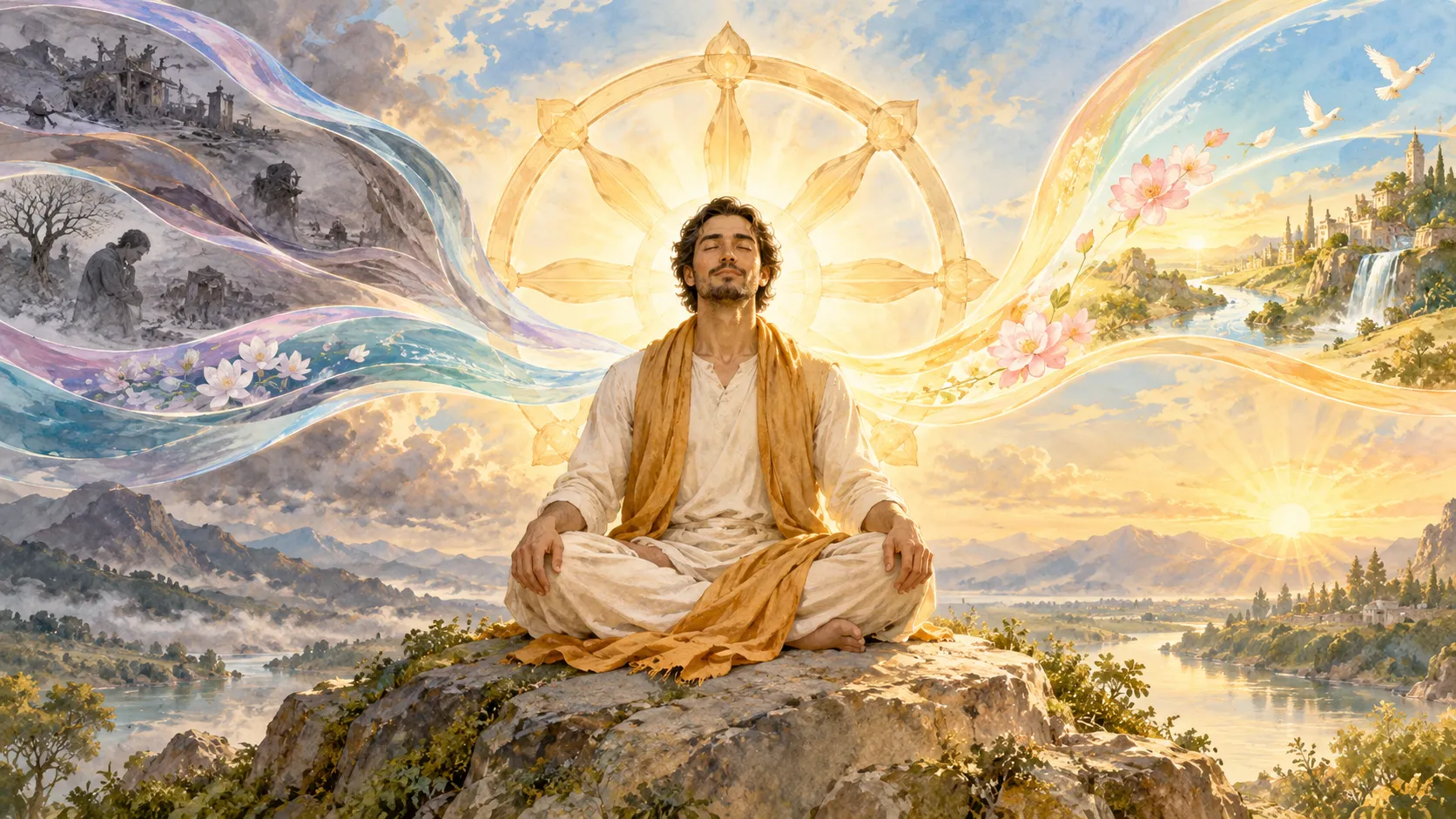
Eventually, a sphere of awareness arises in the yogi that, after some time, begins to function and bring him benefit. This period is called the “lion’s roar” or the “turning of the wheel of dharma.” In other words, you not only abide in presence; by combining it with different energies and elements, you can miraculously transform and transmute them.
By combining it with the universal power of Anugraha-shakti, you can invoke it; by combining it with some other universal energy, you can manifest it; by combining it with visual consciousness, you can manifest beautiful forms, and so on. And if there is a great deal of it, you can bring about a change in karmic vision; by combining it with sankalpa (intention), you can shape the future and purify the past. This is the stage of siddhis described by Tirumular in the “Tirumantiram.”
Depending on how well you come to understand these principles of connection and how skillfully you are able to connect, how well you nurture them and how vividly you experience this state, they manifest more weakly or more strongly. These are no longer magical or shamanic siddhis, but the true siddhis of the natural state. This is precisely what happens naturally in the process of discovering the nature of mind. Which siddhis should a practitioner aspire to? First and foremost, the siddhis of pure vision, the manifestations of Anugraha-shakti.
