

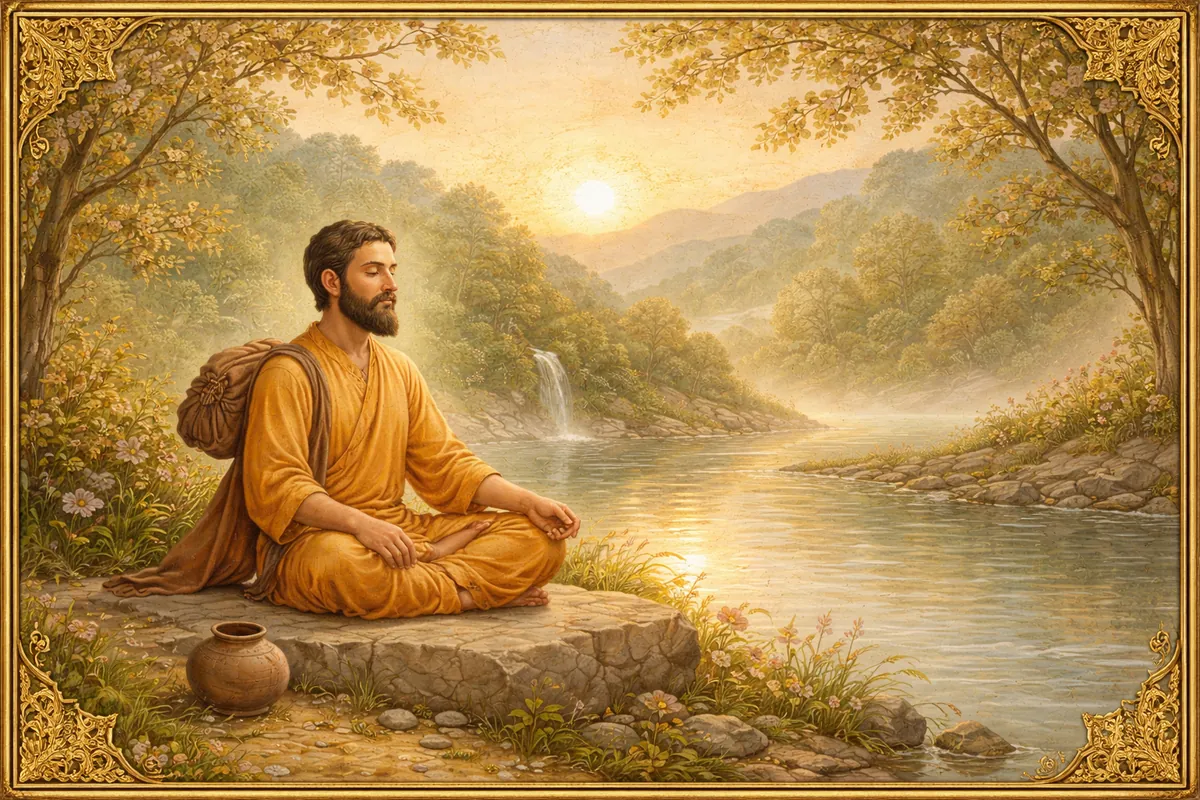
Commentary on the text “Ashtavakra Gita. Chapter 1. The Witness”
“You are free from attachments and actions, devoid of flaws, self-luminous. Truly, you are bound only by the striving for enlightenment. By your nature, you are pure Awareness. This Universe is filled with you. All that exists is contained within you. Transcend the limitations of the mind. Abide only in Awareness—independent, unchanging, formless, incomprehensible to the intellect, serene and imperturbable.”
Within us lies hidden the divine Consciousness, the inner God. It is a particle of the Absolute, a particle of Shiva, who is sarva-karana-karanam (the cause of all causes), who is svayambhu (self-born), that is, not begotten by anyone, not made, not created, but existing by Himself, resting upon Himself and producing this Universe from Himself. A particle of this Consciousness is hidden within us, and this particle is just as infinite in its qualities as Paramashiva, Brahman, the Absolute.
That which is hidden within us surpasses what we know about ourselves. For example, we know about ourselves (we are sure of this) that we are a man or a woman, what nationality we are, where we live, our age, character, intellect, habits, biography. This is all that is known to us about ourselves. There is another area: that which is unknown to us about ourselves. This is the realm of terra incognita; it is unknown to us, we know absolutely nothing about it, and we can only learn about it from the Holy Scriptures and merely guess.
It is like having a mobile phone, an iPhone, and knowing a few of its functions. But what functions and capabilities the developers have built into it, you can only guess. And far more has been built into it than you know. You use a very small set of functions: making a call, sending a message, recording a video, the internet, and that is all. But the developers put a great deal into it. In the same way, its developers (the gods, Shakti, Shiva) have put a great deal into this body, but we can only guess at its functions and inner capabilities. To understand what the capabilities of this phone are, one must read the instructions and study them seriously. In the same way, to understand one’s own capabilities, one must study the instructions, study them and practice.
Sacred texts are instructions for beginning users on how to understand oneself. We are users of our body, mind, and prana, but still unskilled ones. We know very few functions and are mostly identified with this body and the lower tattvas. The instruction is pramana, what is called “authoritative testimony,” received from saints through the descending chain of succession. The descending chain of succession is what is called apaurusheya (non-human knowledge), that is, knowledge descending from God to man. Not proceeding from man to God, but descending.
Awareness That Has No Form
So, Ashtavakra says: “Abide in awareness that is independent, unchanging, and formless.” Within us there is awareness that does not depend on perception, on name and form. Ashtavakra says: “That which has form is not true. Only the formless is eternal.” Name and form belong to the modifications of material nature (prakriti). At the moment of Pralaya (the dissolution of the Universe), all this disappears.
But in fact, there is no need even to wait for Pralaya until all this disappears and dissolves. For example, in three hundred years, in the year 2318, this place will be hard to recognize, and all of us will be hard to recognize as well. If you meet someone three hundred years from now, you will say: “Oh, how you have changed!” I hope that everyone will change for the better, will be seated on lotuses in the form of deities, emitting the radiance of light, magically projecting intentions and illusory bodies into different worlds, while abiding in Brahman with the mind. These are good changes. Matter that has names and forms is always undergoing change; therefore, a sadhu considers that what has form is empty, illusory, it has no value, and it cannot be relied upon.
“Only the formless is eternal.” The formless means the infinite space of awareness, the Maha-tattva, which is beyond space. Buddhi is another name for the Maha-tattva, the element of consciousness. The element of consciousness exists just as the other elements do (earth, water, fire, wind, space), but this element is subtle, and it is internal. The external five elements are much grosser. This element of consciousness is connected not only with us, but with all living beings.
To discover the element of consciousness through contemplation is the first step toward what the Sacred texts speak of. And Ashtavakra guarantees: “Having comprehended this truth, you will not fall into illusion again.” And what is this element of consciousness? It is the Atman as a particle of Shiva within us.
“As a mirror is within and outside the image reflected in it, so too is the supreme ‘I’ within and outside this body. As all-pervading space is within and outside a vessel, so too is the Eternal and All-Pervading Absolute within and outside all that exists.”
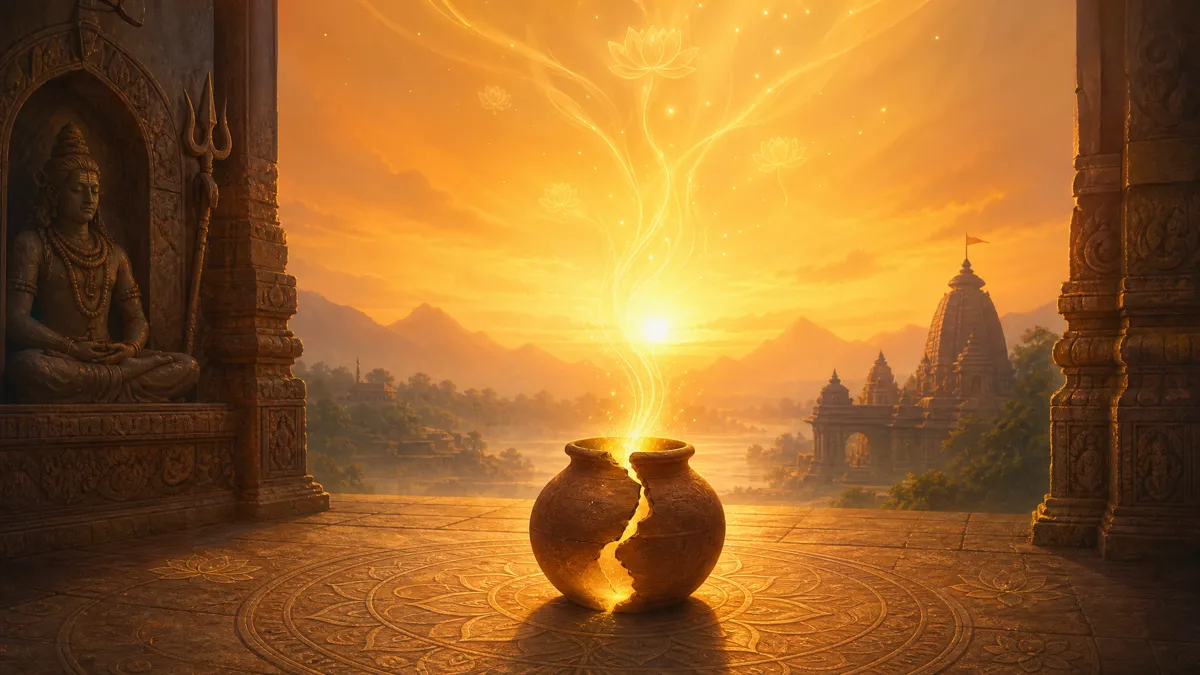
The all-pervading space of pure consciousness is likened to the space hidden inside a pitcher. It seems as though the pitcher conceals the space. But in reality it cannot be concealed by anyone, and the process of concealment is an illusion for space. When the pitcher breaks, the space in the pitcher merges with the outer space, and it is discovered that there was only one space. That is, in reality the space inside the pitcher and the space outside have always been one space, but there was a certain illusion of separateness. It is actually impossible to enclose space in a pitcher. When we comprehend the truth of formless consciousness, this all-pervading space inside and outside is revealed.
Dissolution of the Subtle Body
How can one comprehend the truth of all-pervading consciousness? One must get rid of one’s physical notions connected with name and form. The physical body is only an expression of our character, of the personality contained in the subtle body. The physical body is simply a spacesuit. There was a film, “The Matrix,” in which they showed large combat robots with people sitting inside them and controlling them. The robot walked, and the person inside controlled it. In the same way, the body is a biological robot, but the one who controls it sits inside, and that is the soul.
If you look at one another not as a body, but as a soul, then you will see the body simply as a spacesuit inside which the manager, the soul, is sitting. And this soul also has a human form, human notions. That is precisely why the physical body is the same. The physical body takes on the form that the soul has. If the soul changes its form or changes its level of energy, then the body also changes (it either changes its structure or changes completely).
In order to comprehend this formless consciousness, the soul, the astral body that abides within the physical body and controls it, must be dissolved. And this subtle body that controls the physical body contains our character, attachments, intellect, personality, habits, and tendencies. In general, it is everything that we call the personality, the antahkarana — our inner instrument. The process of such dissolution is called antahkarana laya chintana in Laya Yoga.
To dissolve means to bring closer to the divine particle of Shiva, which has nothing in common with all these personal characteristics. Dissolution occurs at the moment of approaching. This particle of Shiva (Atman) gives grace, gives darshan, and then everything of which the soul consists begins gradually to dissolve and transform.
In other words, we must lose the human ego-form to which we are attached, with which we identify ourselves. For example, if there are certain habits, then these habits must be lost, dissolved. Or, at the very least, they may be left, but one’s attitude toward them must be changed, which is equivalent to change. When the attitude is changed, they play no role. If we considered ourselves to be someone and identified ourselves with that, we must dissolve it or cease to identify with it.
The Teaching on the Possibility of Change
A sadhu does not say, “Yes, that’s how I am!” That is a foolish sadhu. A true sadhu never says that. Why? Because as soon as he says it, what will the Guru answer him? “Well then, change! What is the use of your being that way!? You were that way — so what? Did it help you? Did it save you from suffering, give you happiness, give you God, immortality, eternity, divine fullness, divine wisdom? Do not cling to it, do not make such a fuss over being that way! In reality, you are not that way at all. You only think that you are that way at the moment and in the current situation. But in reality you are not that way. You imagined that you are that way and believed it; you established yourself in this and are now insisting that you are that way!” And no one else but the Guru will say this. This is the value of Guru-tattva. Someone else will say, “Well, yes. You are that way, and I am this way. Okay, I respect that!” But when you come to the Guru, it is a signal to him that you do not want to remain that way, that you are not clinging to it. The Guru says, “You think that you are that way, but you are not that way!” Because the Guru knows the same thing; he, too, once thought that way. And then he understood that everything is different, that he is completely, utterly different. Therefore he sees that the disciple also has such a possibility. When some disciple says, “Yes, that’s how I am!” the Guru answers, “No problem: you were that way, you will become different. Change, that is all.” The disciple lacks the wisdom to understand that he can change; he thinks he will always be that way. But the Guru knows this perfectly well.
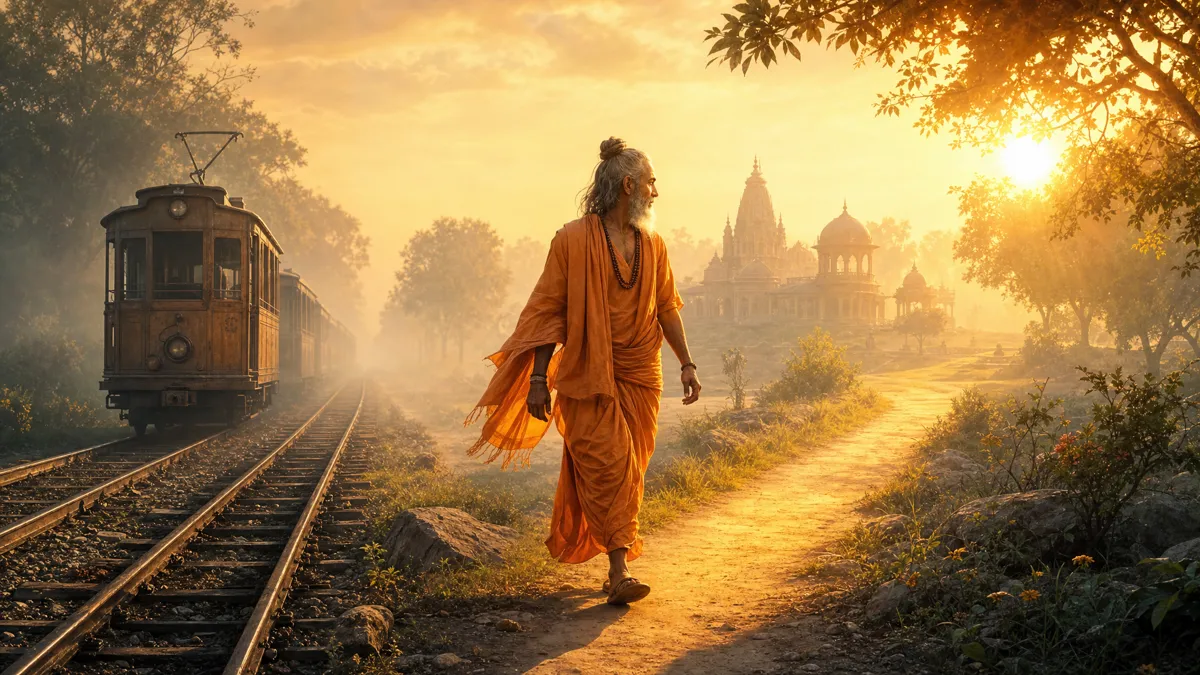
A sadhu must understand that he has the opportunity to change. If such an opportunity exists, it means there is a precious human birth. And if there is no opportunity to change, then it means there is no precious human birth either. That is it—you are on the rails of karma, you are so attached to them that, like a tram, you can move only forward or backward. A tram cannot turn right or left at will; it is conditioned only by the rails, by prarabdha. And a precious human birth means the opportunity to change.
The Practice of Antahkarana Laya Chintana
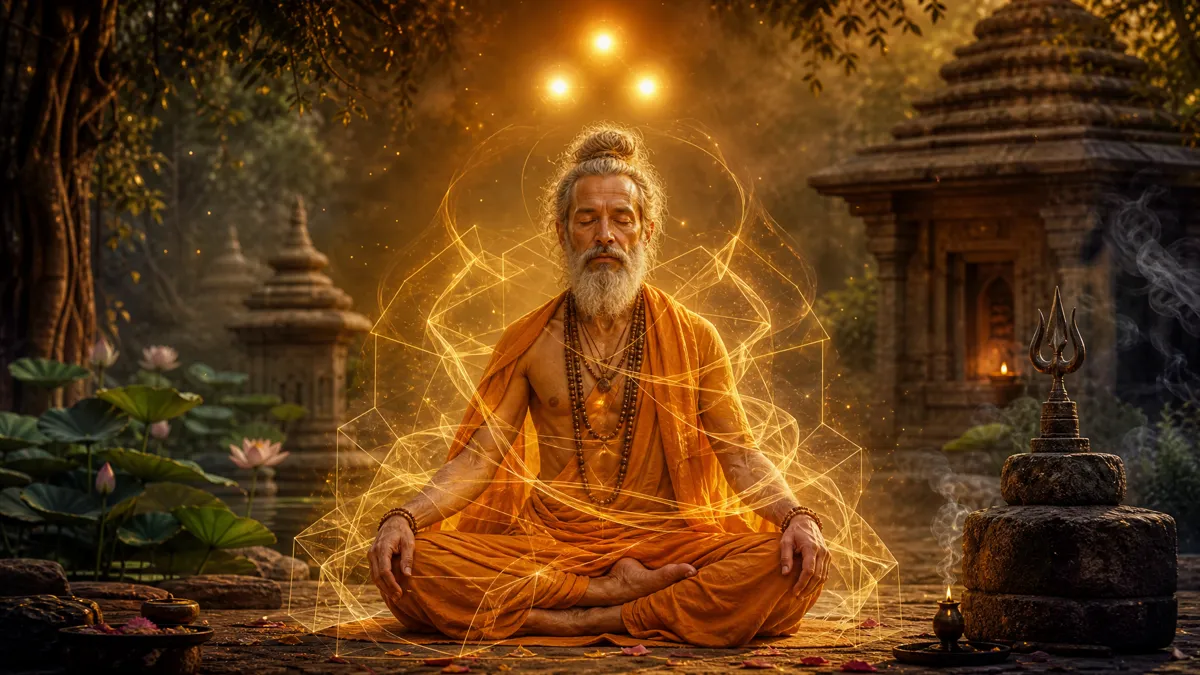
To perform the dissolution of antahkarana laya chintana means to dissolve all one’s attachments, habits, ambitions, and character traits. At the very least, it means disidentifying from them, not insisting on anything, not becoming attached to anything, not clinging to anything, not projecting oneself into anything. It means not setting any frameworks or boundaries for oneself at all, becoming alive, spontaneous, fluid, unlimited by anything, and devoted to God alone, while wisely taking into account place, time, and circumstances.
When we act in this way, the subtle body gradually begins to lose its habitual form. Each of us has a habitual form of the subtle body. For example, when we think about ourselves and imagine our future, we intuitively imagine that we are precisely in this form. But sadhus understand that this can be changed, and they challenge it. They imagine themselves in the form of Dattatreya. They know that one can have three heads and six arms, not walk but sit upon a lotus, possess magical powers and space as consciousness, have light as one’s foundation, and move through all worlds. Therefore they visualize themselves as Dattatreya; they meditate on themselves as Brahman within.
The yoga of the illusory body is based on this: when we free ourselves from habitual notions, when sadhus meditate on themselves as the mahavakya “Aham Brahmasmi.” All of this can be changed, and all of this must be changed. If, for example, you have patterns or fixed ideas regarding something, this must be changed, released, purified, made empty. How can it be changed and purified? One must learn to offer all of it to God. It will not simply go away and will not simply be purified by itself, but if it is offered to God, then it will go away and be purified.
Once, probably twenty-five years ago, a person came to me for darshan. He began to set out his thoughts, his ideas regarding spiritual life, judgments about others, and so on. I listened to him for a long time, and then asked: “Do you really believe in what you are saying?” He replied: “Well, yes, of course. How could it be otherwise?” To which I said to him: “Well then, repent of it. Everything will be fine, and you will feel relieved.” Because everything we believe in at the level of the mind, at the level of feelings, has the nature of illusion; it is illusory.
That is why it is said: “There is no need to saw off a rabbit’s horns.” It does not have any; it never had them from the very beginning. “There is no need to look for the city of the Gandharvas on a map,” because it does not exist in the first place. “One should not try to learn the name of the child of a barren woman,” because she never gave birth to him; he never existed. Everything with which we identify ourselves is illusory from the very beginning; it is not real and is a form of emptiness.
What, then, is true? The Atman within us, the infinite consciousness within us, is true. But does this mean that we must renounce the energy that has been poured into our character, personal qualities, traits, forms, and habits? No, there is no need to renounce energy! The energy of the subtle body is also energy. Manas-shakti is a certain mental force, the energy of the astral body. But all this energy must be fully surrendered to God and dissolved in non-duality; it must take on a different character: empty, illusory, playful. This means that this energy no longer binds us; it can manifest in accordance with time, place, and circumstances; it fully serves God, is a conductor of divine wisdom, a conductor of divine will and play.
Abiding in the Causal Body and Complete Surrender
When we dissolve our human astral form, our karma disappears along with it, because karma was contained in this human form and in the memory of this form. Then only the causal body remains, and we can directly abide in the anandamaya kosha (the causal body). We can be aware of the causal body and perceive the world through the eyes of the causal body. It is as if you were awake while sleeping a dreamless sleep, yet not asleep, but aware of yourself in dreamless sleep.
When we become aware of the dimension of the causal body, we become aware of Ishvara, we become aware of God; we understand that everything emanates from Ishvara, everything is created by Ishvara, everything is sustained by Ishvara, everything consists of Him, and we ourselves possess the nature of Ishvara, are a part of Him. Outside Ishvara, we do not exist. It is like the tip of a finger becoming aware of itself as the whole hand, and then becoming aware of itself as the entire body, and it understood that outside the whole body it does not exist.
Therefore, a sadhu is one who always lives in God, with God, and in the awareness of God. And for this, complete humility is needed, complete surrender to God within. We are not speaking of surrender and humility before something or someone outside: people, dogmas, concepts, some idols. We are speaking of the inner God. There must be complete capitulation before this inner God, complete humility before Him, complete reliance on Him, complete trust in Him. Often people do not listen to Him, even if they practice; they simply do not want to listen to Him, they do not hear Him, His voice is still very weak. Sometimes, even when practitioners hear His voice, they still do not submit to Him, because they are afraid, because there are still many selfish desires, and they do not know whether their desires will survive in the state of surrender, or whether they will disappear somewhere. There is still attachment to desires. They cannot capitulate before this God, because there are still scattered particles of the mind and ego that want to conduct their own internal policy.
But in fact, the moment of capitulation means that we give up everything: hopes, ambitions, and clinging. Everything is spiritualized, everything is illuminated. And then those desires that the mind had, ambitions and ego, may not disappear. If you truly want it, God will leave them to you. He gives the soul every possibility; He is not stingy. If you really want it, then He will leave them to you, but already in a pure form, in non-attachment, in a sacred version. He will allow them to be experienced, but from a completely different angle: as a game, without attachment, without clinging, without egoism, without karma, without accumulating problems, without identification with samsara.
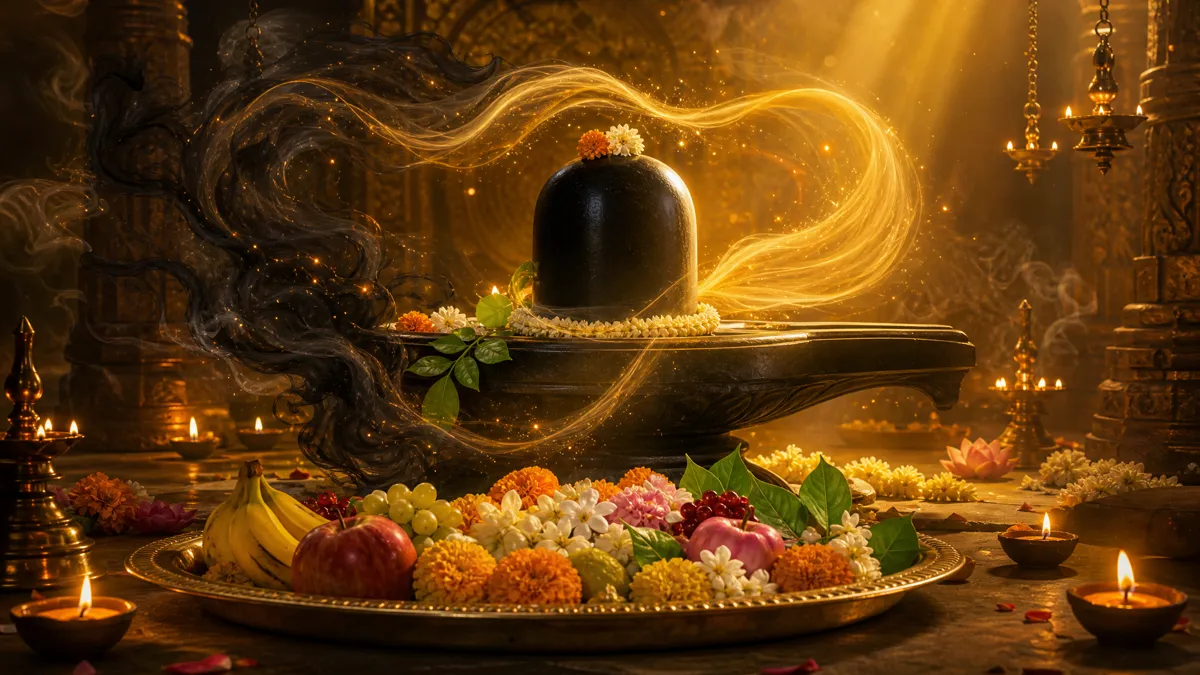
It is like offering prasad to Shiva. Does Shiva come down from the altar and eat all the prasad? Everyone then enjoys eating the prasad after Shiva and Dattatreya. In other words, God does not take the prasad itself; He accepts only devotion, while all the prasad remains.
In the same way, when you offer your ahamkara, ego, desires, clinging, and habits as your prasad, if you so wish, He will leave them to you, and you can continue to use them. If you wish, He will even leave your kleshas for your use. But He will transform and sanctify them so that they become something that does not cause problems, like a snake whose poisonous fang has been pulled out. He will show you their empty, illusory nature; He will show you the nature of the kleshas as the nature of the five wisdoms; He will sanctify them and turn them into divine powers and energies, so that they cease to be kleshas. The same applies to the traits of your character, habits, personality qualities, ego, and manas. All of this will be completely transformed and will cease to cause you problems.
There is an example given. There was a rope that bound. The rope was burned, but it retained its form. In form it is the same rope, but this rope can no longer bind anyone.
In the same way, all parts of our inner instrument, having been roasted in the fire of the Absolute, will, as it were, be preserved, and you will even be able to use them, but they will no longer be able to bind you, because they will be empty, illusory, playful, and inseparable from God, and in essence — divine shaktis.
And this principle, when the kleshas become something like ornaments, is expressed by the snake around Shiva’s neck. The snake symbolizes poisonous energies that have been completely subdued and that Shiva has victoriously hung as an ornament.
Chapter Two “The Joy of Self-Awareness”
Janaka said: “I am Immaculate, Serene; I am Awareness, I am beyond nature. How long I allowed illusion to deceive me. I alone give light to this body and to the Universe. Everything in the Universe is mine, and nothing is mine.”
To say: “I am Impeccable, Serene; I am the Supreme Awareness,” we must first surrender to Him as the inner God. Our mind, body, and ahamkara must completely submit and surrender to Him. Without prapatti-yoga, atma-nivedana, and self-surrender, we have no right to say this. In a sense, we can say it, since there are no laws forbidding us to say it, and anyone can say it as much as they like, but there will simply be no benefit from it. These words can be spoken from the experience of Shiva-tattva, from the experience of God, from the experience of Ishvara. And in order to enter into this experience, one must offer all the lower tattvas to God and reunite with Him.
What Ashtavakra speaks of is pratyabhijna—the highest stage in Laya Yoga. In Laya Yoga there are three stages: pratimoksha (self-liberation), prapatti (self-surrender), and pratyabhijna—this is the highest, third stage. Prati means a turning toward oneself; abhi means face; jna means knowledge. That is, it is knowledge or recognition of oneself as a result of turning toward oneself.
Self-recognition is possible after self-surrender. Through self-surrender the ego is transcended, goes beyond itself, and discovers the Absolute. Without self-surrender, it is impossible to discover the Absolute! That is, while remaining with the ego, you cannot look at the Absolute and perceive Him in any way, but you can worship Him as an ego in a state of devotion.
“I alone give light to this body and the Universe. Everything in the Universe is mine, and nothing is mine. Now I have renounced the body and the world and, through secret wisdom, have been able to behold the Supreme Self.”
The secret wisdom lies in the complete surrender of one’s “I” to God, in the ability to conduct divine wisdom, to become a conduit of the divine will one hundred percent. To become one hundred percent governed by the divine will from within and to become capable of manifesting divine deeds and the divine play one hundred percent.
If we ask: “What guides me in my life? What governs me from within? Whose will do I conduct? What wisdom do I conduct? What deeds do I manifest?” then, most likely, upon investigation the answer will be that it is some mixture of energy, will, mind, ego, buddhi, culture, society, upbringing, karma, the instructions of the Guru, and the Sacred Scriptures. All of this together creates a conglomerate, and depending on which of these is proportionally greater or lesser, the line of our behavior is formed accordingly. In this way our prarabdha karma manifests.
Self-surrender consists in, having realized the divine energies one hundred percent, becoming governed by God, not taking a single step without the divine will, without the inner divine blessing. And what does “inner divine blessing” mean? It is when you feel God within in the form of clarity, in the form of bhava, and from within you intuitively understand how to act correctly and how incorrectly, how to think correctly and how incorrectly, how to speak correctly and how incorrectly. To act correctly is when this bhava does not fade; to act incorrectly is when it fades. And being governed one hundred percent by the divine will and divine wisdom means that you do not lose connection with God for even a moment, and besides this, you also manifest Him.
The Maturation of the Enlightened State
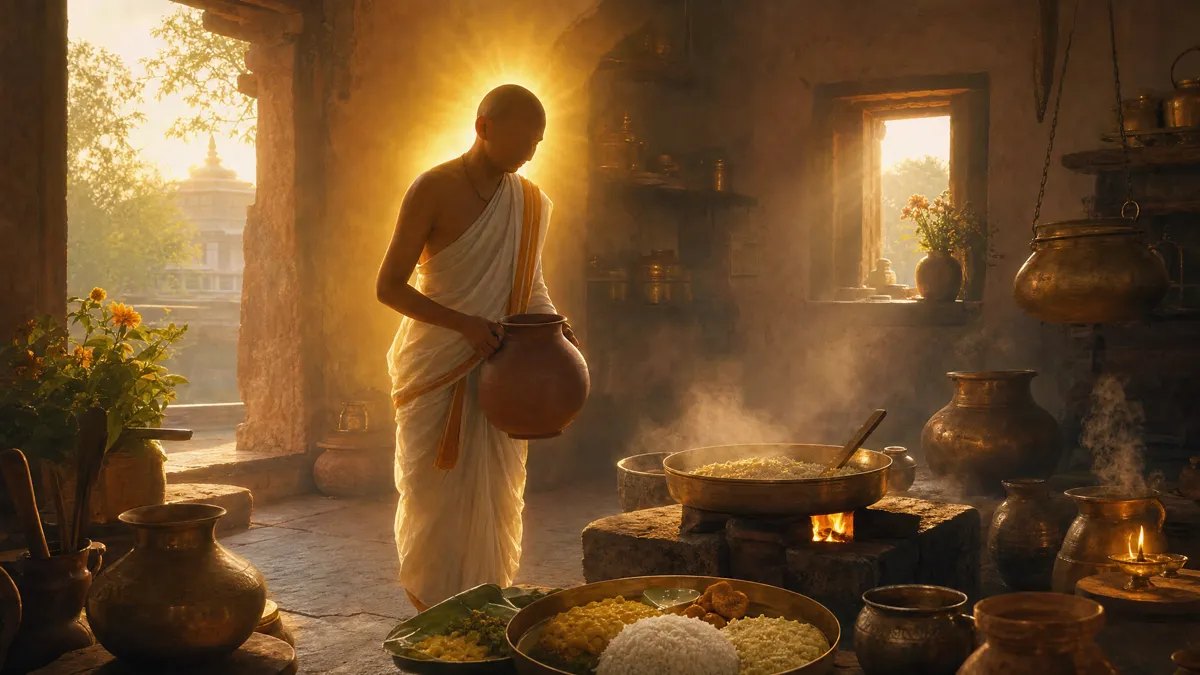
At first you cannot manifest it; even if you have realized the connection with divine wisdom and divine will, it is very difficult for you to manifest it. Therefore, in the beginning you should not manifest it too strongly, because you will suffer from the fact that, in attempting to manifest it, everything becomes obscured and is lost. Therefore, according to tradition, when a disciple, for example, in Zen monasteries, attains Enlightenment and receives confirmation from the Master, the Master says: “And now, for twelve years, simply do not manifest it; live modestly, keep it secret, otherwise it will not mature. If you immediately try to manifest it outwardly, you will encounter many obstacles.” This state of complete unity with the Absolute must ripen, settle, and become firm. Therefore, for the next twelve years he simply lives as a monk, carries water, chops wood, cooks prasad as the head cook, performs ordinary seva, does something else of this kind, and does not manifest it in any way. He allows the awakened state to mature.
And then the Master summons him and says: “So, the time has come to appoint a new Mahant. Answer me, my dear ones, this question,” and he asks a question. Among the others there were the head cook (though in fact he was already an enlightened one playing the role of the head cook), the senior monk, or the administrator. And the administrator thinks: “Well, it would be logical to put me in the role of Mahant; this is the next, one might say, stage of career advancement. What is there to think about?” And the head cook... Well, where is the head cook, and where is the administrator in terms of status? The Master asks the question, the administrator begins to think about how to answer better and more eloquently, while the head cook simply takes and kicks a bucket, and the question shatters to pieces. The Master says: “Well, off you go! We now have a new Mahant. You will organize a new monastery there!” The administrator does not understand why he was not appreciated. Because the one who had been the head cook had long since attained Enlightenment; he was simply playing that role without identifying with it. But the Master was simply waiting until his wisdom became firmly established and his subtle body fully matured.
Non-Dual Vision of the World
“Just as a wave, foam, and bubbles are not different from water, so the entire creation that arises from the Self is not different from the Self. Examine the fabric carefully: there are only threads there. Examine the Universe carefully: there is only the Self there.”
What does it mean to examine the Universe carefully? It means learning to look at the world through the eyes of non-dual awareness. If we examine the Universe within ourselves, we discover five sheaths. To examine carefully means to go beyond the five sheaths and discover turiya — the fourth state. And this fourth state is the all-encompassing Consciousness that permeates the entire Universe.
It is precisely the lack of investigation that makes us identify with lower layers rather than with this infinitely pure Consciousness. When we carry out enough investigative work, we discover this impeccably pure and radiant Consciousness and understand the secret of how this Universe is structured.
“Just as sweetness permeates the juice of sugarcane, so the Universe created in Me is permeated by Me everywhere.”
It is said that sugarcane, if you taste it anywhere in the world, will be sweet everywhere. In the same way, wherever you may be, in whatever corner of the Universe, there will be Consciousness.
The Buddha gave this example: “If you go up to the ocean or the sea, dip your finger in one place and taste the water, then go to another place and also dip your finger, the water will be equally salty.”
Our Consciousness permeates the entire Universe equally. However, this Consciousness does not belong to the personality. When Ashtavakra says, “I permeate the entire Universe,” he is not speaking of himself as a body or as a mind. He has simply discovered Shiva and reunited with Shiva’s body of wisdom. His identity in Shiva has become so deeply rooted that he can already say “I.” But this has nothing to do with the mind, the personality, the ego, or other such things. Now he can use the mind, he can use the personality, but his essential identity is one with Shiva. He has the right to declare this because he feels how he permeates the entire Universe. And there is a certain personalness in this, because the personality (ahamkara) and the ego have also remained, but impersonality dominates.
Personalness and impersonality, the preservation of distinctions and their absence — this is the incomprehensible paradox of the unity of form and emptiness, which is called achintya bheda-abheda tattva.
When you look at Dattatreya or read the Dattatreya Stotra, it says there: “He is with a body and without a body”; he is the one who possesses a body and the one who does not possess a body, that is, sakala and nishkala (with attributes and without attributes). Dattatreya expresses this principle of achintya bheda-abheda tattva. That is, “I can play as I wish. I can play at duality, I can play at non-duality. I can be anything.” Because for the Absolute there are no limitations whatsoever.
The Illusory Nature of the World
“There is no awareness of the Self — the world appears real. There is awareness of the Self — the world disappears. Because of ignorance, a rope may appear to be a snake. Through knowledge, the illusion disappears.”
If in the evening a person is walking along a path, he sees a bush from afar, and this bush seems to him to be a robber, and he becomes afraid. But when he comes closer, his faculty of discrimination increases, and he understands that there is nothing to fear — it is not a robber, but a bush. And where did the robber go? The question is rhetorical. He did not go anywhere; he simply was not there, but the fear was real. Real fear arose because of an illusory robber. The person smiles, remembering that he was afraid of an illusory robber. But at that time his fear was real.
Once, about eighteen years ago, I was traveling to Berdyansk for a seminar. From afar, through the car window, I saw something on the road by the roadside. It seemed to me that a little red dog was standing by the roadside. I became interested and decided to take a better look at it when we drove up. But when we came closer, I saw that it was not a little red dog; it was a small wooden chair, and on it was a jar of honey (they were simply selling honey there). I thought: “This is how vision can mislead.” That is, my mind imagined a little red dog where there was a chair with a jar of honey. But a deficiency of vision, a flaw in the discriminating faculty of sight, gave rise to the mind’s imagination, which filled all this in. I fully expected to encounter a little red dog, but there was a jar of honey — a pleasant discovery.
In the same way, the entire Universe of the material world is such a little red dog; we simply have not looked deeply enough into its nature. And when we look more closely at its nature, something purer, divine, and beautiful turns out to be there. That is, the illusion of the material world to which we are so attached disappears, and the divine nature manifests when our discernment deepens.
The Luminous Nature of Consciousness

“My nature is Light. Truly, I am Light, and there is nothing else. When the world manifests, I alone shine.”
Each of us possesses a luminous nature. Even when we walk, talk, laugh, or eat, this luminous nature does not walk, does not talk, does not laugh, and does not speak; it simply always is. It is very difficult for us to unite with this luminous nature, to believe in it, to be in oneness with it and act. But when our heart is purified, this luminous nature begins to shine brightly. To discover it, jnana and devotion are needed, the readiness to surrender, to capitulate before this luminous nature, to submit to its grace.
“The whole world, which has arisen from Me, dissolves into Me. Thus the pot again becomes clay, the ornament melts into gold, the wave merges with the ocean.”
The Absolute is something unchanging. Material nature, including our body, is something that undergoes modification: character traits, the subtle body, destiny, karma. Discovering the unchanging is precisely what it means to abide in the View. Constant investigation of this unchanging is precisely what it means to abide in contemplation.
A man in Odessa met an old Jew on the street and asked: “If I go straight and then turn right, will the railway station be there?” He replied: “The railway station will be there even if you don’t go there! It will be there in any case. Wherever you go, it will still be there.”
In the same way, the Absolute is in its place in any case. However deluded you may be, whatever you may do, whatever hells or heavens you may end up in, He is still in His place. This all-encompassing Light still remains. Whatever ignorance we may enter into, it makes no difference to Him. To us — yes, it does; but to Him — no. This is how the Universe is arranged.
And there are souls who recognize this fact, integrate with it, and walk the path, and there are those who do not integrate, do not recognize, do not walk the path, do not surrender, and pursue their own policy, wish to be deluded, experience karmas, and insist on their delusions. These latter are called “duratma” — the deluded Atman. They are also called “mudha” — a fool, a donkey. Those who are wise are called “Mahatma” — great souls, that is, those who have realized their unity with the Absolute. And such a state between duratma and mahatma is present in every sadhu a hundred times a day, because in the course of a day a sadhu manages to forget himself a hundred times and return a hundred times, to fall into ignorance a hundred times and return a hundred times and realize his nature. This is the process of contemplation; it is normal.
When we try to contemplate, we discover that distraction is our natural state. We talk a lot about the natural state, but our natural state is to become distracted, while at the same time returning. If you return, then that is not bad. You simply need to understand that it is normal to become distracted and come back again, to become distracted and return again, because those who do not return are already saints. If you were never distracted, you would already be sitting on lotus thrones, and disciples would be making offerings to you. For your stage at this point, being distracted is normal. But you must make efforts not to be distracted, so that the state of duratma is as little as possible, and the state of Mahatma is as much as possible, at least during the day. This is nididhyasana.
Discovering the primordial nature is difficult, but possible. But what is truly difficult is maintaining the primordial nature. For this, antar-tapasya (inner asceticism) is needed. Ashtavakra and Janaka are those who discovered the primordial nature and, without becoming distracted, maintained it in such a way that all their illusions, all their ego, all the instruments of karma dissolved.
The Transcendent Action of Realized Beings
“The arising of the Universe in Me is merely an illusion of perception. Thus silver is perceived in mother-of-pearl, water in a mirage, a snake in a rope.”
It seems that pure devotees of Shiva, fully realized yogis-jnanis, also have character traits, certain desires, and can express displeasure or joy. But all this is nothing more than an illusion. Such beings act from a transcendent state, but they are not bound by karma. Their body has prarabdha, but they themselves are not prarabdha; therefore, even while acting, they do not act. They are always in the transcendent dimension. But from the outside it may seem that they act like ordinary people.
For example, from the outside it seemed as if Rama was attached to Sita, as if he suffered when Ravana abducted her. It seemed that Krishna was partial to the Pandavas and, in a different way, partial to Duryodhana and the Kauravas. It seemed that many holy jnanis or Avatars had certain preferences, feelings, and desires.
One king attacked the Shakya clan of the kingdom of Kapilavastu, to which the Buddha belonged. And before that, the Buddha had stopped this king twice: he sat down on the road, blocking the troops’ path, and the king left, leading his troops back. But the third time the Buddha was unable to block the troops’ path, and they attacked the kingdom of the Shakya clan. The Buddha was meditating, and it seemed that he was somewhat sad. He said: “For some reason my head hurts today.” He said nothing more, although his kingdom, the kingdom of his father and relatives, had been completely devastated.
The Miraculous Nature of the Absolute
“Oh, how wondrous I am. I am indestructible and continue to exist even if the whole world, from the Creator to a blade of grass, is destroyed. Oh, how wondrous I am. I take on a body, yet remain the One; I come from nowhere, go nowhere, yet permeate the entire Universe.”
And what is this I? It is Dattatreya, it is Ishvara, it is we ourselves, one with Dattatreya, one with Ishvara. It is the absolute divine Consciousness, God within us, to whom we have fully surrendered ourselves and in whom we have dissolved, with whom we have become completely one.
Only when complete self-surrender and self-recognition have occurred can we say these words: “Oh, how wondrous I am.” If we say them earlier, we will be mistaken. We will say: “How wondrous I am, as the mind. I come nowhere and go nowhere,” and the mind will immediately lead us into illusion. If we say: “How wondrous I am as the ego,” then the ego will immediately remind us of its limitations. But when we surrender the mind and the ego, we can speak these words.
“Oh, how wondrous I am. None are equal to Me in power. Without a body, I eternally sustain the Universe. Oh, how wondrous I am. I have everything that can be conceived and expressed in words, and I have nothing.”
When Ashtavakra speaks these words, it is Ishvara speaking through him. It is not the personality of Ashtavakra or Janaka speaking. The personality of Ashtavakra and Janaka is just as limited as before; in principle, it cannot say this. But Ishvara looks and speaks through this personality.
The Dissolution of Subject-Object Relations
“In reality there is no knower, no knowledge, and no object of knowledge. This triad appears to exist because of ignorance. I am flawless transparency.”
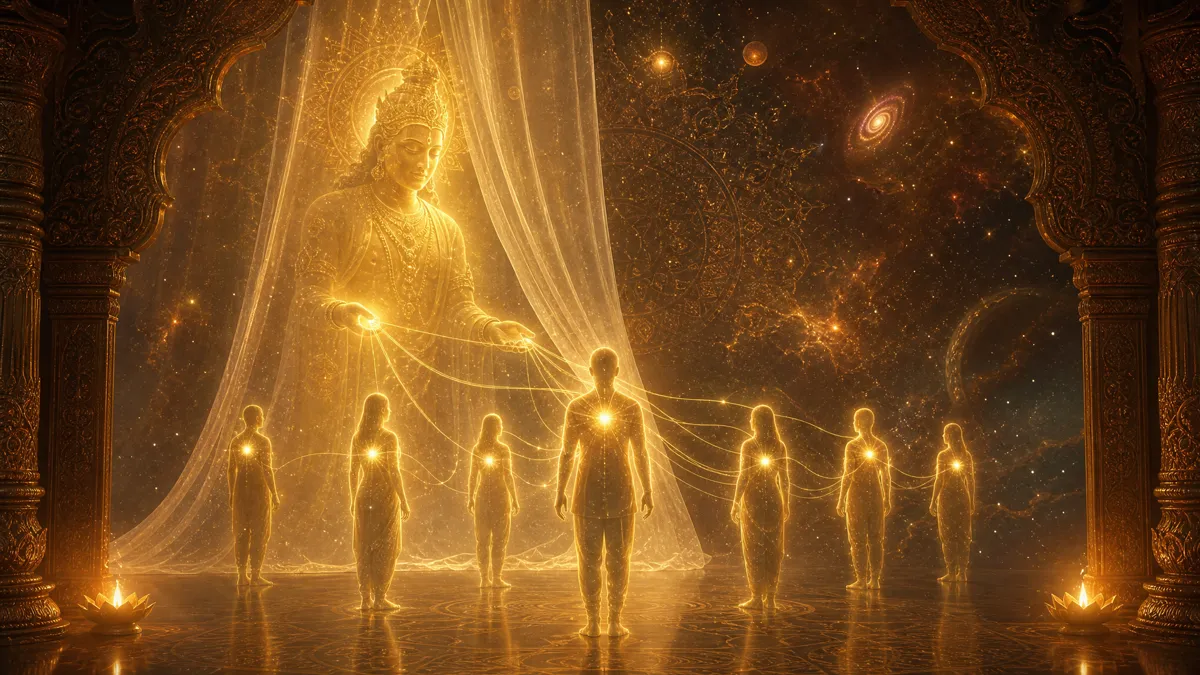
The dissolution of subject-object relations resembles a situation in a puppet theater. During a puppet performance, the audience does not understand that one person controls all the puppets, and that he also voices them in different voices. But when someone goes behind the partition, he sees that the same person is controlling all of it. There is even such a song: “They are all puppets in skilled and toil-worn hands.”
All living beings are puppets in the skillful hands of Ishvara. Ishvara, amusing Himself, talks to Himself, preaches to Himself, leads Himself into delusion, sorts out relations with Himself, and then liberates Himself. This is the process of His divine play. In the process of this divine play, His various parts gain the experience of interacting with maya and return to Him.
Nonduality in Action
“Duality is the root of suffering. The one remedy is to understand that everything visible is unreal. I am the One, filled with purity, awareness, and bliss. I am boundless Awareness, but I imagine that I am limited by ignorance. Constantly contemplating this, abide beyond all divisions.”
Duality means acting from duality. It does not mean not acting at all. Many believe that non-duality means giving up activity, but this is not so. Non-duality means giving up selfish actions and identification with them. Dynamics are possible in non-duality. Non-duality is not a frozen, static state, only Nirvana without the manifestation of energy, without the play of Shakti.
In non-duality one can also act. But this action is different; it is action in the spirit of self-renunciation, not seeking enjoyment, without attachments, without the desire to obtain fruits and results. It is action for the sake of action itself.
For example, today we went on a hike. The question is: “Why did we go?” The mind must immediately find a logical justification. “We went to see the sights, to look at the surroundings.” One who is concerned about health will think: “We went because one needs to walk ten thousand steps a day according to the pedometer. A healthy lifestyle! One must walk, train the body!” There is a goal. Various other goals can be found as well. Someone wiser, like a sadhu, will say: “We went to contemplate! I am contemplating; I am practicing in sankalpa. Chankramanam.” In fact, we went simply because we went. True abiding in non-duality is that we went without a goal.
Yes, it is right to contemplate, but even in contemplation there is no goal of contemplation. There is contemplation, but there is no goal. There is contemplation, but there is no contemplator. This is non-duality. When you can contemplate in this way, without an actor and without a goal, then you eat, sleep, walk, stroll, and at the same time you are flawlessly immersed in God; at every moment you abide in divine grace (Brahma-ananda). There is no duality, you have no false motives and there is no one who generates these motives. Then you are one hundred percent guided by God; you perceive everything as divine play.
For example, something happens to you: an offering is made to you, respect is shown to you. Good, such is the divine play. Someone else comes up and shows you disrespect, for example, perhaps even flicks you on the forehead. You have no objections about this either; such is another divine play. You do not suffer because of it, because you do not fall out of the dimension of divine play. Divine play manifests continuously, and you are able to extract the nectar of blessings from everything. That is, you see nectar everywhere, and only nectar. In the temple—blessings; in the kitchen—the same blessings. But if you are in duality, then in the temple there are blessings, while in the kitchen there are hindrances, obstacles, fuss. When you perform service, you also extract the nectar of blessing if you act in this way. If you act for the sake of results, then when it works out you are glad, but when it does not succeed you are sad, the result has not been obtained. But whether the result is obtained or not, you must always extract blessings, you must always be glad, because the point is not in the fruits or in the results. This is the approach in the spirit of non-duality.
Bhagavan Sri Avadhuta Dattatreya ki—jai!
Sri Guru Swami Vishnudevananda Giriji ki—jai!
Questions and Answers
Question: “There was such a program, ‘Immortality.’ You even said that Lord Shiva Himself would come and bless humanity. Was there such collective merit at that moment?”
Yes.
Question: “What happened to this program? Or did something happen to humanity?”
Humanity has no merit for its embodiment. The blessing is there, but there is no merit.
Question: “What should be done now to earn it?”
After 2012, the elements in the Universe and the karmas of people came into motion, and various purifying processes began. Therefore, many noted that it became more difficult for them to contemplate. Many worldly people began to notice this; shifts began to occur in people’s minds. I think this will end soon, and the elements will come into equilibrium again. As a result of such shifts, the karma of people and of the Earth is being purified.
And the development of technology, unfortunately, also went somewhat in the wrong direction. No matter how hard I tried to direct it along the Vedic path, according to the principle “If you cannot prevent it, you must lead it.” But the development of technology is moving toward the selfish use of resources by ruling clans for themselves, and not for the people, toward control and manipulation.
Christians understand this too, and they are beginning to worry about it; they have an entire movement rejecting biometric identification, end-to-end identification, chipping, electronic cards, biometrics, and much else. They are opposing this quite seriously. They have prophecies about it. We have no prophecies, and somehow we are not worried about it. But their prophecies and their elders say that when such things begin, do not accept any of these documents; prepare to go to villages farther away from federal highways and big cities—only there will the Antichrist not reach you. There are radical Christian priests (I saw a video) who take out an iPhone and a sledgehammer and say: “This is how one should deal with the devil that has come to us!” That is, they are very seriously determined to give up certain attachments and comforts so that biometrics and chipping are not performed on them, so as not to accept the mark of the beast; that is their concept.
But in general, the development of technology, unfortunately, did not take a humane path; there was not enough merit for that. It went in the direction of serving certain clans that want to govern, make a profit, and control everything.
Question: “Guruji, as for the specific country on whose territory we are now located, what awaits it in the near future?”
Its fate is better than Russia’s at the moment. It cannot be said that there will be a dawn in the near future, but there will be stable stabilization, I would put it that way, because the vector of values is more humane. Later, everything may change very significantly. Right now, only the preparation for these changes is underway.
Question: “In what direction?”
In a more spiritual one.
