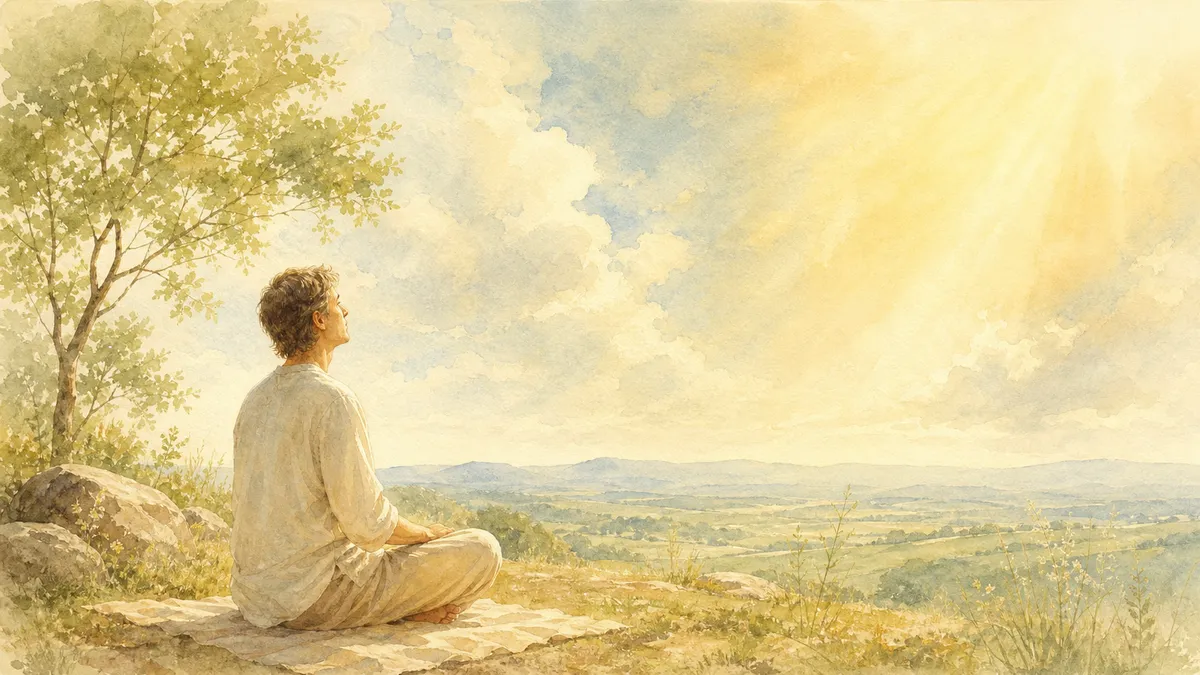
Self-recognition: choosing your reality through the power of intention and presence
20.06.2026
0 мин. чтения
0
Share
copy
search
add
share
Commentary on the text “Tirumantiram”
The instructions of the siddha Tirumular, “Tirumantiram,” Tantra One
284. Faith Leads to Liberation
The Supreme Light in dazzling radiance Even the siddhas, gathered in a group, do not know. But this vision and the bliss of salvation He grants to those whose hearts are inflamed with faith.
Faith is one of the qualities of a disciple when he follows the teaching. Earlier we said that the capacity for understanding (or discernment), the readiness to cooperate with the teacher, and faith are the qualities of a disciple necessary for him to enter the state of transmission. At the same time, in the teaching of anuttara tantra, we speak not simply of faith in something external or faith in concepts, in ideologies. Faith in anuttara tantra is much deeper — it is based on your awareness, on understanding. If there is no such awareness and understanding through the recognition of “I am” awareness, then such faith will not be deep and serious; it will not last long. That is, if our faith is merely like certain ideals, when we look at the Guru and think, “Ah, what a darling. How well he speaks,” or when we go to the monastery on someone’s shakti, then such faith does not last long; it will be enough for only a week of life in Chukhlomka. And this often happens if a person comes to the monastery on sentiments, on such superficial faith.
True faith does not lie in the external, because following the external, as it is said in the tantras, is stupidity and illusion. Simply following the external is duality. But true faith is based on the unity of the inner and the outer. If we say that faith is based only on the inner, then this is not entirely correct, because we begin to trust the inner too much, and this is yet another extreme. True faith is based on awareness, which unites the outer and the inner. And above all, faith is connected with recognizing one’s own space of awareness, when, abiding in awareness, you make an independent choice, because the Teaching always presupposes your freedom of will and your independence. If there is no such independence, then you have not yet formed as a disciple. And if there is such faith, then it is unshakable, very deep, and positive. It inevitably leads you to realization. It is precisely such faith that allows you to enter into connection, enter the transmission, and benefit from the teaching.
Practice in the Monastery and Karma Yoga
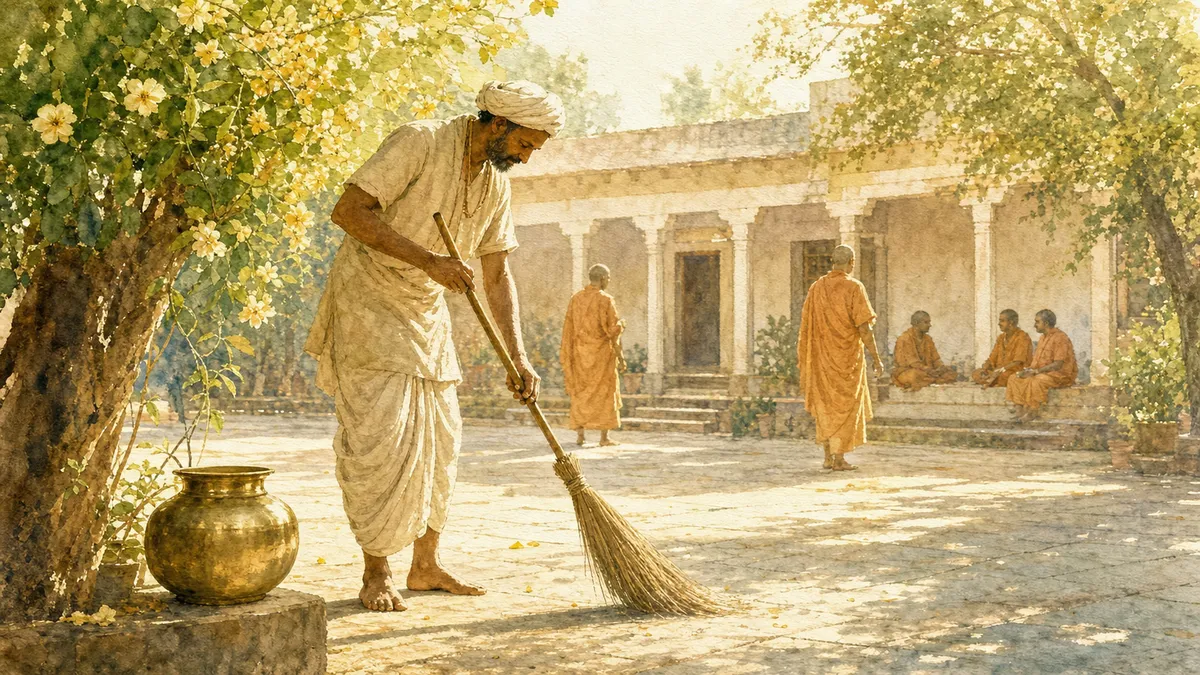
When you are in the monastery, it is very important to realize and understand this principle. Everything here is directed toward entering the transmission. If such a state is absent, everything you do as service will be merely work. But if there is faith and the state of entering the transmission, then I, as a teacher, say to you as disciples: “Do karma yoga.” This is my personal assignment for you, through which you advance, tame the ego, discard hopes and clinging, and acquire emptiness and non-attachment to actions. This is your specific sadhana, your specific method. And when you perform karma yoga, you have a clear understanding that you are doing all this in order to enter a new vision, to develop commitment. It is just as complete a method of practice as sitting meditation, but it works only on the condition that you have the consciousness of contemplation, samaya, transmission. And then you can practice it in the same way as breath retention (wind training, for example).
Practice is multifaceted, and different texts give various instructions, but transmission always occurs through the specific instructions of the guru. For example, in tantric practices much is said about attention to retreats and solitude. But I will say that such instructions are not everything, because in tantra very great importance is attached to visualization, the stages of development and completion, and the transition into pure vision through this practice. There, no importance is attached to contemplation in motion. For the stages of development and completion to allow one to fully attain realization, one must spend a great deal of time in retreat sitting, reciting mantras, visualizing oneself in the form of a deity. However, if you follow anuttara tantra, this requirement is not the same, because in anuttara tantra the emphasis is placed on contemplation in motion, and the principle of contemplation in motion and the unification of contemplation with all actions is very important. Therefore, monks practice in retreat for five months out of twelve (by number of days), and the remaining seven in motion (at least in the beginning).
When you perform karma yoga correctly, you separate yourself from your false identification with the “I” and identify only with the true “I.” If you do this correctly, that is, with awareness, then all the qualities of awakening begin to come to you.
The Example of Milarepa and the Skillful Means of the Mahasiddhas
Swami Sivananda told Satyananda Saraswati: “Forget yourself and perform service in the ashram — through this, all realization will come to you.” And Satyananda Saraswati, practicing in this way, truly attained realization. This is precisely the approach that should be taken when you engage in karma yoga — action in service. If your mind is muddled, if you have a great deal of inner data and are strongly attached to it, then this is the best way to attain emptiness of mind. Here is shakti, here is the situation — integrate with it, remove yourself. If you are empty, if you have the intention to integrate with it, you will do it. But if you have a barrier, some inner attachment, it will not work. Perhaps these inner barriers are difficult to bring out in meditation or in technical practices, because they are not visible, because the ego can build itself a pedestal out of anything. But thanks to external shakti, one can overcome these inner barriers in a short time. And this is one of the skillful means of the mahasiddhas.
Do you think that Milarepa, when he was studying under Marpa, received transmissions and sat in retreat for seven days every month? Nothing of the sort. For nine years in a row, he built various houses, carrying out Marpa’s assignments, and during all that time he did not receive a single word of Dharma. But thanks to this practice, he became so empty, his potential grew so greatly, that he became the greatest mahasiddha. That is, Marpa as a guru was highly competent; he knew what he was doing. He understood that if he had immediately transmitted the teaching to Milarepa, nothing good would have come of it. He knew that he had no right to transmit the teaching to Milarepa, who, after practicing black magic, had killed thirty-eight people and therefore had heavy karma. If he had transmitted the teaching to him after six months or a year, and Milarepa had begun kundalini yoga, the practices of jyoti yoga, or meditated on mahashanti in a cave, his inner demons would simply have torn Milarepa apart. Thanks to his clarity, Marpa was able to confront him with situations in which his inner demons were brought outward, so they could be seen and liberated.
Why was Milarepa able to carry out such tasks for so long? Because he had faith. Faith is a fundamental factor in your practice. Among us, the term “faith” is not used so actively; usually the term “principle of samaya” is used. Therefore we say that if you have a good samaya connection, you will certainly come to liberation.
288. Seek Him, and He will find you
God knows those who, day and night, in the heart’s depth, Immersed in samadhi, contemplate Him in non-action. To them, the wise, illumined by inner radiance, He comes and abides with them.
289. Be firm in Devotion
If you are unsteady in the search for the Divine Light, there is little use. I always seek the One in whom there is no limitation. My Supreme One, life’s precious treasure and the heart’s delight... To merge with Him is the highest purpose of all life.
309. Direct your heart and thoughts to the Supreme
The tongue and heart sing in unison, coming to know His greatness. Though He is in different forms, find Him in unity. Even if life shakes you and the axle slips out of the hub, Seek the Lord, bind Him to yourself with love.
For us, directing the heart and thoughts to God means continuously trying to see through and contemplate the supreme Source as one’s own nature.
310. The ignorant are those who do not follow the Truth
Even an ignorant person, if blessed with the vision of the Supreme Truth, Will be approved by God’s merciful Gaze, and He will give him hope. But he who is blind to the divine rays of True Love, May seem learned, yet cannot contain the Truth — he is ignorant.
311. The unlearned do not understand that God is in everything
The one who truly knows follows the only path. Others think: “Many paths lead to Knowledge.” The Supreme God is present in everything, in all places; Ignorant is the one who does not realize His Omnipresence.
314. The ignorant enjoy carnal pleasures
The truly wise seeks the path of Dharma, of strict asceticism, Truly knowing that life is transient, like mist. The unwise, however—the wretched rogues of this world— Play at fleshly joy, which is mixed with karmic suffering.
334. Divine Nectar Leads to Siddhis
Having passed through all Tattvas and egoism, having known the Truth of the Atman, And having immersed yourself in true joy, having freed yourself from false austerities, And having rid yourself of worldly temptations, intoxicated with true bliss, You will attain true siddhis, the full Bliss of Shiva, pure and unmixed.
335. Yogis Seek Ambrosia in the Moon of the Skull
Yogis who keep the breath under control Strive for the nectarean bliss of the Moon of Contemplation; They seek the eight siddhis, while fools Allow maya to make their heads spin.
336. Drink the Divine Nectar in Samadhi
Open and drink the nectar that flows from the Source; Unfold all the petals of the Lotus Feet of the Holy Master. Guide the yogic breath upward through the spiral channel. Thus, entering Samadhi, you will encounter the Divine Good.
Tantra Three. Ashtanga Yogam
551. It Is Difficult to Expound the Science of Yoga
Without deviating to one extreme or the other, Follow the path of eight-limbed Yoga And attain the state of Samadhi. Those who walk the blessed path Will reach the summit of Jnana. They will no longer be born in this lowly flesh.
552. The Eight Limbs of Yoga
Yama, Niyama, countless Asanas, Beneficial Pranayama, as well as Pratyahara, Dharana, Dhyana, and the attainment of the triumph of Samadhi— these eight are the steel limbs of Yoga
553. Always Practice Yama
The heavens may burst forth with downpours in the eight directions, Yet still practice the holy Yama,”— Thus spoke the Lord with matted locks the color of coral, which are pleasing, To the Four Sages immersed in worship.
554. The Ways of Yama
He does not kill, does not lie, does not steal; He is marked by virtues, humble and just; He does not follow pleasures, knows no shame, is not subject to lust— Such is the one who stands on the path of Yama.
556. The Ten Virtues of Niyama
Purity, compassion, moderation in food, and patience, Honesty, truthfulness, and steadfastness— These he zealously preserves. Killing, theft, and lust he rejects— Thus does the one who observes Niyama Adhere to the ten virtues.
557. The Next Ten Characteristic Signs of Niyama
Tapas, meditation, serenity, and holiness, The giving of alms, vows, and the study of Siddhanta, Offerings and pure thoughts;— With these ten, one abiding in Niyama perfects his Path.
The Space of Variants and Micro-Choices
In your future there exists a space of variants, that is, various versions of your future. You do not create this future; rather, you attract it through the power of intention (iccha-shakti), through your consciousness. All these variants exist simultaneously. Somewhere there is a scenario in which you are a saint, fully awakened; in another variant you are a siddha; in a third, a householder immersed in samsaric concerns; in a fourth, simply a good monk. Perhaps there are also bad variants.
The process of attaining liberation is not the creation of something, but the recognition of one of the variants and the correct choice of it. That is, you move within the space or field of variants, directing your consciousness through intention. How you move in this field of variants depends on the disposition of your consciousness, on your minute-by-minute micro-choice. In other words, every day you make such micro-choices, and if they are correct, then you approach the necessary variant and actualize it, fully manifesting it.
To be in contemplation is not something abstract; it is the constant making of correct micro-choices. To practice pure vision is to constantly make such a micro-choice toward the Absolute, until it fully manifests.
When you sit down in mahashanti meditation, all of you have the opportunity to practice with vagueness and agitation or to choose awareness. When you listen to a lecture, you have the choice to be aware or to become vague. When you perform service, you have the choice to engage in it deeply, seriously, purposefully, and with self-dedication, regarding it as a path of practice, or to do it according to some other principle. When you have a retreat schedule or a basic practice, you have the choice to recite the mantra consciously, with bhava, without being distracted, or simply to work for quantity. Such choices are very subtle, but we make them every second.
If we make the right choices, then in the space of variants we actualize our holy or liberated state. If we make the wrong choices, then we attract those lines of destiny that are connected with karmic states.
The Principle of Self-Recognition and Prakamya Siddhi
At first we do not understand this. As we practice, we begin to understand that by the power of consciousness one can attract any shakti from the external space. And then we start to think about what kind of shakti we want to attract so that it changes us. We can do this precisely by the power of consciousness. In order to attract such shakti and to change ourselves by the power of consciousness, we must understand how it is done. If we simply desire it, it will not work. We can attract such shakti only if we desire without desiring, when we act from a state of relaxation, from the inner emptiness of the heart, and not from an egoistic state.
The principle of self-recognition means not attaining something, but recognizing it as already existing—this is the root principle of Anuttara Tantra. If you try simply to attain something, striving for it in an egoistic way, you will spend a great deal of time on it. The principle of self-recognition and realization through such a manifestation of shakti proceeds from natural contemplation. Here it is assumed that you already understand this principle at least a little, and then the natural state becomes for you a means of manifesting prakamya siddhi, when, using the natural state, you consciously try to manipulate energies, to manifest the desired result through the power of intention (iccha shakti).
Once, at a seminar, when lay disciples gathered and were practicing, I said to them: “Let’s imagine your future a little. Roll the film forward and imagine the future thirty to eighty years ahead.” When they began to roll it forward, they did not like it, and they became confused. I then said to them: “You have a choice, and through practice you can choose another version of the future. If you have the intention to choose another version, then there are means for this, for example, the practice of yoga.” When I said this, everyone practiced very diligently.
In 1996, we had lay practitioners who at two o’clock in the morning were doing vaiyavya kumbhaka, and the whole hall was filled with the sound of breathing. They practiced on their own in retreat, and in addition to the program they stayed on to practice at night.
You must understand that through practice you choose your future from the space of variants. You always have such a choice. When you understand this principle, your practice becomes very conscious; you already bear personal responsibility for it.
The path of Anuttara Tantra is always the path of self-recognition. At first we always make efforts, but at a higher level we recognize what already is and has always been. What must we recognize? We must recognize ourselves as awakened, ourselves as a deity, the world as the play of the Absolute or as pure vision. This can be recognized not by the conceptual mind, through ahamkara, but only when we have truly immersed ourselves in presence. Immersion in presence gives you the ability to manifest your intention very flexibly. And then you see the situation not as something that must be attained, but you see it as already realized, though not yet actualized. Prakamya siddhi is based precisely on this way of seeing.
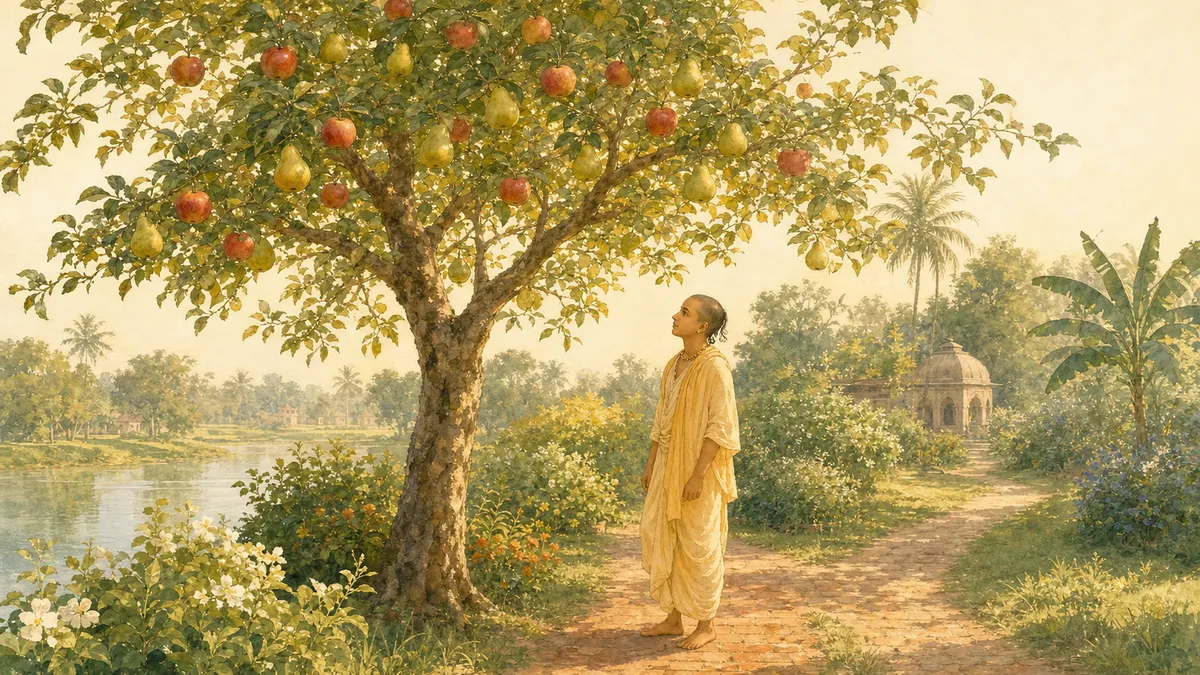
Sometimes, thanks to prakamya-siddhi, one can produce phenomena in the external material world. But we are primarily interested in the phenomenon of spiritual purification and spiritual realization. For example, if many people abide in the natural state and recognize “Divya Loka” as a pure land, then the pure land will manifest. But this requires deep immersion in presence. If, while abiding in presence, you try to recognize yourself as a saint and your sankalpa is one-pointed, then after some time this state will manifest — this is the principle of instant presence. Instant presence means continuous self-recognition. Sometimes it can even help in worldly affairs. This is also called worldly siddhis. In general, when you manifest something using presence, it is prakamya-siddhi. For example, Sri Chaitanya materialized a tree on which apples and pears grew at the same time. Such trees do not exist in the human world, but he materialized it. How did he do this? Through the power of presence, he chose another version of the universe, where such apples and trees grow, where this is the norm. That is, he did not force something on this tree to change, for example by altering its genotype, but chose another version of events, another variant universe, where such trees exist right now, and this tree manifested.
The Principle of Choosing Versions of Reality
One could say that the power of our intention glides through various variants in the field of events in the universe, actualizing first one variant, then another, while in the relative dimension it seems as though something is changing. Various siddhis, such as materialization and so on, manifest in the same way.
I explained this principle to one disciple while he was driving a car. I told him: “It seems to you that you press the gas pedal and reach some goal, that is, you are driving. But in reality, it is not quite so. Samskaras are moving. And when you press the gas, you simply make an offering, you engage gross shakti. The samskaras begin to move toward you faster, while you are like a navigator in the field of samskaras. That is, it is not the material world that is moving, but your consciousness is moving in the field of samskaras. When you add more energy, your consciousness moves faster through the field of samskaras.”
When you understand this, the external vision of the world also changes, and then prakamya-siddhi manifests in you — the power of fulfilling intention.
The Instant Path of Self-Recognition
For us, prakamya-siddhis are not important in some external sense; they are important for realization. To manifest prakamya-siddhis in spiritual practice means to think approximately like this: “At present I am a person limited by samsara, practicing spiritually, but I would like to become a yogi, a saint, and I am trying to realize this.” From the point of view of the gradual path, we know that one must do a great deal of practice, perhaps even for many lives, because there is a great deal of karma, and there may not be enough time to purify it. But from the point of view of the instant path, the approach is different: you do not try to achieve this, but try to acknowledge your realized nature as an accomplished fact, and then simply recognize it. Therefore, abiding in presence is the continuous recognition of what is and has always been.
When there is one-pointedness in such continuous recognition, you suddenly find yourself in precisely the state you desired. Yet at the same time, you should, as it were, not desire it, because any desire only obscures your realization. Presence is not connected with hope, or desire, or realization; on the contrary, it is connected with letting go. That is, you attune yourself to the necessary variant, and then let everything go. It is precisely when you want nothing that this variant is realized through your intention.
The position of self-recognition and the instant path in tantra is the most transcendent, lofty, complex, and paradoxical path, but it is precisely this path that is praised by the mahasiddhas. It is precisely this path that leads to true awakening not over seven lives, not sixteen, and not hundreds, but in this very life. This means, having entered presence, to assume the status of a creator god in the field of variants of events in the universe. Divine pride is nothing other than operating with such variants and constantly choosing the correct variant, for example: the variant of one’s liberation, the variant of one’s samadhi, the variant of pure vision.
The position of instant awakening means that you do not strive to do anything, but are in the moment-to-moment state of perfection right now. The question is how sensitively and deeply you penetrate into it.
For example, at one time I was thinking about how the position of self-recognition could be applied from the point of view of everyday matters, such as service, because at that time I was concerned with service (in a relative sense, of course). I was thinking that it would be good to build a new hall, but then I thought that from the point of view of self-recognition everything already exists, so it only needs to be recognized. Then I went to the building where our library is now located and quickly found this hall, recognized that it already exists, that it does not need to be built. Then I thought about something else, and in this way various things appeared for us. That is, you can apply this even in a relative sense. In other words, when we acknowledge that everything is already perfect, everything is already absolute, and that it is enough only to recognize this, then this energy begins to manifest in you — this is the principle of prakamya-siddhi. But prakamya-siddhi is a much deeper thing; that is, you may regard the example of the hall, in comparison with the true possibilities of prakamya-siddhi, as a joke. Nevertheless, this is exactly how self-recognition occurs, when you recognize your absolute nature right now. You know that it does not need to be created, attained, or sought, but simply recognized. One must gather depth and spirit in order to recognize this nature, and then become rooted in it.
Tests on the Path of Recognition
The principle of anuttara tantra is precisely the continuous recognition of one’s true nature. Of course, this is not so simple. When I was explaining this principle to students in Crimea, one of the students said: “Well, that’s it, I have already recognized my nature! The retreat is still nine days long, and I recognized it on the very first day, because you explained everything so well. I think there is no need to continue further.” I said: “It is not that simple. The master of suffering will come with his female disciples (confusion and despondency) and test whether you can maintain it or not. And only when you pass the exam with this master will you be able to say that you have recognized your nature. And at night a guru named unconsciousness will come to you with his two shaktis (distraction and illusion). If you can recognize your nature at that time, then be sure that you have done it correctly. Then another master will come, who will also test you. And if you successfully pass all these tests, be sure that you have recognized.”
In other words, if we simply declare our recognition, this is only the very beginning. Of course, we must declare such recognition on the inner level; nevertheless, this is not a reason to relax incorrectly or rest on our laurels. Further practice consists in passing through these tests and bringing one’s recognition into all aspects of life, so that this recognition fully matures.
What is the difference between an ordinary person who practices the path of self-recognition and a siddha? A siddha has recognized this on a very deep level, and his inner emptiness allows him to manipulate even universal energies. An ordinary student, however, recognizes this simply on the mental level, and this recognition does not penetrate to the level of the subconscious or to even deeper levels. Nevertheless, we recognize it on the level at which we are, at least on the level of intellect and awareness, and then allow this recognition to penetrate ever more deeply. Divine pride, the principle of the natural state, contemplation, sahaja-sthiti — all of these are actually one and the same in different terminologies. It consists in recognizing our absolute nature and in moment-by-moment presence in this absolute nature.
Manifestation of the Inner Universe
When you recognize your absolute nature and abide in this moment-by-moment presence, it reveals the inner universe within you. Then, from this inner universe, you can manifest creative powers, abilities, siddhis, and so on. You manifest these siddhis not because you want to amaze someone with them, but simply because this is the nature of things; it is natural for you, because you are in deep presence.
At the level of the lower tantras, magical rituals, mantra recitation, and offerings are performed in order to manifest something from the space of the universe. But when you have mastered this principle, you no longer need magical rituals, mantras, visualizations, or offerings. You can do this simply by the power of intention, by the power of your iccha-shakti. In essence, what is a ritual? Through ritual, a yogin changes certain energies within himself, and these energies call forth other universal energies from the space of the universe; when they descend, something manifests on the relative level, that is, in the world of phenomena, and then it is said that the ritual has achieved its goal.
For example, it is believed that if a person is ill, food should be distributed to as many people as the sick person has years of age, or fish or animals destined for slaughter should be released, and then the person will recover. When this happens, an energy is invoked from the outer space (maha-akasha) that enters this person's field of karma, and he recovers. And then they say that the magical ritual has worked. That is, the person has changed his intention and invoked a more global shakti into his life.
When we make offerings to the mahasiddhas, something pure and holy opens within our consciousness. By changing ourselves a little from within, we invoke universal energies from the outer space, and then these energies take root here every day or once a week during the bhajan mandala. These energies deepen more and more.
But at the stage of complete mastery of prakamya-siddhi and the natural state, the yogin does not even need rituals. It is enough for him simply to change his own state and invoke universal energies from the outer space so that they change karmic vision.
Stories of the Manifestation of Siddhi
For example, in Tibet a blacksmith invited a teacher to perform a special ritual as a result of which the blacksmith was to have success in something important to him. With great reverence, the blacksmith prepared what was necessary for the offering (cakes, statuettes, incense, and so on) and arranged it all very beautifully on the altar. When the teacher arrived—and he was a fairly well-known saint named Sandan Tsidenov—he swept all the prepared ritual items into one heap and said, “None of this is needed. That is all, the ritual has been performed.” The blacksmith was very frightened; such strange behavior by this teacher seemed to him not very respectful. But the teacher assured him: “Everything has been done properly, everything is according to the rules.” Why did this teacher say that? He possessed colossal realization, so it was enough for him simply to appear in that space and change something in it, to express a sankalpa from the state of presence, and after some time everything would materialize. The ritual itself played no role at all. And indeed, after some time had passed, the blacksmith saw that everything he had asked for had materialized, had manifested. The ritual was in fact a secondary cause, while the primary cause was the natural state of presence of Sandan Tsidenov as a mahasiddha; he simply expressed a sankalpa.
Other texts tell how a yogin was traveling in the mountains, and there was no water there. Then he struck a stone with his staff, and water began to gush from that stone. A similar incident was described in the life stories of many saints. What happened? Through the power of his presence, the yogin manifested that version of the course of events in which water flows from the stone or there is a stream in that place. That is, while abiding in presence, he recognized the world in such a way that water flows from the stone, and after some time this manifested. One should not think that he somehow pierced the stone with his staff and made a well; it can be said that the staff simply served only as an attribute of the ritual offering.
The World as a Projection of Consciousness
When you understand this principle, the world becomes different. Then you clearly understand that the world is a projection of consciousness. And since it is a projection of consciousness, projections can be changed by changing consciousness. Projections can be changed only if you are in moment-to-moment presence, if you continuously recognize yourself. And then you simply, effortlessly, without strain, without struggle with the world, in harmony, in relaxation and naturalness, recognize yourself or recognize the version of the course of events that you need. You gently shift reality, simply choosing within the field of events the version that is necessary, and this version is actualized. You know that in the universe there is an infinite field of events, a countless number of their variants; by changing yourself from within, you can simply choose the variant you need, and this variant is actualized.
When you understand this principle of consciousness, contemplation also becomes clear to you. You know that you do not create pure vision, but choose it and acknowledge it as an already established, accomplished fact. You also know that you do not attain enlightenment, but choose it and gradually become established in it. You do not attain the siddhi of robust health and longevity, but simply choose within the field of events a version in which you are healthy. At the same time, your choice must be genuine; it must come from inner awareness and be truly deep.
But if a person has impure thoughts, there are some obscured states, and on the level of surface consciousness he says, “Yes, I choose this,” while inside he has spiritual darkness, negative states, then in reality, of course, he is choosing something else, even if he says that he chooses this. He chooses, for example, the world of hungry spirits or the world of asuras. That is, this choice must necessarily take place on the level of bhava, on the level of inner awareness.
Often people, not understanding this, choose wrong life paths. They choose suffering or illness for themselves. This happens because an unconscious choice was made at the subconscious level. Such unconscious states are called obscurations, kleshas. In order to purify obscurations and kleshas, we must, through the power of clarity and discriminating wisdom, penetrate deeper and correct our choice.
In essence, pure vision, divine pride, and presence are nothing other than the moment-by-moment correction of choice. That is, you constantly choose the holy and the sublime, constantly choose eternity and infinity.
I transmitted to the monks the practice of likhita-japa, in which you write down sankalpas. This is nothing other than the continuous directing of consciousness toward such a choice. When you work correctly with sankalpas in likhita-japa while remaining in presence, they simply materialize.
Action from the Transpersonal Principle
Why is it necessary to remain in presence, and not simply express an intention in order to attain prakamya-siddhi? Because if you express an intention at the level of the ego (ahamkara), the small personal “I,” then nothing will come of it, or it will come about only with great difficulty. Dattatreya said: “Your willpower is blocked by universal energies.” If we act from the small personal “I” and a contracted mind, self-recognition does not reach its goal, and therefore the intention cannot materialize. In order for an intention to materialize, we must act not from the inner personal principle, but from the transpersonal principle. We must invoke these shaktis not from within, but from the outer space of the universe.
As you know, we have several kinds of space. Chit-akasha is inner space, maha-akasha is outer space, hrid-akasha is the transcendental space that unites the inner and the outer. They are also called the light of the son, the light of the mother, and the light of the fruit. Inner and outer space are situated within one transcendental space. Therefore, first we express intention at the level of inner space, and then, while remaining in presence, we try to manifest it through outer space, and then it fully materializes.
It is possible to unite with outer space only when you are in presence. This is precisely why we perform the practice of “gazing at the sky,” integration with external objects, attunement to the impulse of the descending force (Anugraha), and many other sadhanas that mix the two spaces. Ultimately, when we understand that the inner and the outer are one transcendental space, the principle of self-recognition gains strength.
Guru Yoga and the Principle of “Aham Brahmasmi”
What is the meaning of Guru Yoga, for example, with the mahasiddhas? By uniting consciousness in Guru Yoga during the bhajan mandala, we also try to recognize ourselves as a mahasiddha. When you practice “Aham Brahmasmi,” you try to recognize yourself as Brahman. That is, you do not doubt or think, “Will I attain this or not?” but you acknowledge it as a given, as the norm, and unite with it. It is precisely when you allow yourself to acknowledge this as the norm, and this norm becomes rooted in your consciousness, that you will attain the same state.
In essence, to be in presence is to acknowledge the bhava of Aham Brahmasmi as the norm. When you can acknowledge this bhava as the norm, prakamya-siddhis manifest by themselves. You can truly bend space and change time. At first, of course, this happens within small parameters. But our goal is not the manipulation of space, time, and cause-and-effect relationships for the sake of entertainment; our goal is the accomplishment of the “great transition” into a completely pure state of nonduality and one “taste,” complete liberation. Such a transition is also called kaya-vyuha.
The Level of Siddhas
The teaching of prakamya-siddhi is an advanced section on the natural state, where we are not merely trying to reveal the natural state, but are already using it. When you speak about the natural state for years, everyone thinks: “Oh, this natural state again. When will I finally enter it?” But one day a moment comes when you actually enter it, and not only enter it, but also begin to benefit from it. It truly becomes powerful; you can manifest energies through it, manipulate shakti in the visible relative world. This is the level of siddhis, that is, the next section of the teaching, about which we speak very rarely because the issue is not relevant. Nevertheless, at the higher stages of training this is quite accessible, when, while abiding in presence, you can manipulate universal energies, change the characteristics of objects, space, time, your own destiny, the destinies of others, and so on.
In order to attain such a level, one must think in a very uncommon way, paradoxically, because entirely different laws operate here.
For example, a famous physicist, when he was a student, was taking an exam at a university (I think it was Niels Bohr or Nobel). The professor gave him the following task: “Here is a hotel building, about one hundred stories high, and a barometer. You need to use the barometer to measure the height of the building in meters.”
The question seemed trivial to the student. But he gave the professor this answer: “You need to throw the barometer down and measure the speed of free fall. Knowing the coefficient, you can determine the height of the building.” The professor gave him a failing grade, but he knew that this was a brilliant student, so he said: “You have one more chance.”
The student knew the correct answer, but he did not want to answer in a trivial way. He thought for a moment and said: “There is another option: you can hang the barometer like a pendulum on a rope and calculate the length of the building using angular deviations in different directions and the gravitational constant.” The professor gave him a failing grade again and said: “You have a third attempt.”
The student said: “There is yet another way. I will go up to the doorman and say: ‘Monsieur, if you tell me the height of this building, I will give you the barometer.’” The professor who was examining him was simply furious. But the student said: “In fact, all my answers are correct, so you cannot give me a failing grade. I guarantee you that with all these methods I will find out the height of the building.”
The professor had to admit that these answers were indeed correct. They were unconventional, non-logical, brilliant. Later, this student became an outstanding physicist.
In the same way, in order for you to operate from the level of the natural state and attain prakamya-siddhi, you need to think unconventionally, nonlinearly, not within the duality of time and space, causes and effects, but beyond them. That is, you need to operate with the concepts of eternity, infinity, the moment-by-moment presence of all options in the field of events, the ability to choose them, and the status of a creator god.
Read 16 times
Articles
Vidya AI
Search
Lectures
November 5, 2026
Mantra of the day
ОМ ЭКАЙА НАМАХ ОМ Единому – поклонение!
Auspicious Times(Rome)
Brahma Muhurta:
04:56 - 05:51
Abhijit Muhurta:
11:33 - 12:14
Sayam Sandhya:
16:40 - 17:21
Mokshada Ekadashi (6 November)
Ekadashi of liberation. Helps to achieve spiritual enlightenment.