

Commentary on the “Chandogya Upanishad”
First should come the conduct characteristic of a bee: study, reflection, and meditation. Since this is the conduct of a beginner, it would be wrong to adhere to it while engaging in yogic practices. Then there is the conduct characteristic of a deer, which is intended exclusively for the period of practicing the path. Adhering to it during yogic practices is wrong, because your samadhi then loses its freedom. Conduct characteristic of a mute person is used exclusively to reach the pivotal point of experience. Adhering to it when one should behave like a bee is wrong, because it implies a failure to distinguish between word and meaning.
There are seven stages of conduct that describe how a yogi should behave at various points in their spiritual life. First, there is the conduct of a bee. This is the stage of learning, which should last at least two or three years. At the bee stage, one should study texts, accumulate merit, train in preparatory exercises, carry out assignments, and follow instructions until the first signs of maturity appear.
Then comes the deer stage, when one should go into retreat, observe silence, renounce everything, and nurture the meditation received through knowledge. For example, those monks who are now in retreat—or those who have already completed six-month or year-long retreats—have followed the path of the deer. On the path of the deer, there is no longer any need to study various books and teachings, indulge one’s curiosity about things, or engage in different activities. On the path of the deer, one should focus solely on practice, meditation, and controlling the winds, setting everything else aside.

Next comes the stage of conduct resembling that of a mute person. It is necessary for a radical transformation of consciousness, when speech and mental activity should be completely excluded and one should focus solely on the nature of Mind. Until the nature of Mind has been recognized, this is very important, because mental activity, speech, and dualistic consciousness constantly obscure it.
Then there is conduct characteristic of a swallow flying into its nest. This is a period of particular meticulousness, when one should strictly adhere to the instructions and meditate as though threading a thick thread through a small needle’s eye—for example, in order to maintain dhyana and control over the pranas.

Finally, there is the conduct of a madman, undertaken once experience in samadhi has been acquired. It is intended to consolidate the experience of samadhi. If only a partial experience has been attained, however, this conduct is inappropriate. The conduct of a madman means casting aside duality and conventions.
The next type of conduct is the conduct of a lion. It is intended exclusively for the period when one’s vision has become completely perfect. Adhering to such conduct before true understanding has been attained is wrong, because, lacking confidence, one may fall under the influence of other things. What is the conduct of a lion? It is when a person, like a lion, directly and fearlessly expresses their nature and their view, instructing others, preaching, and inspiring them in the Dharma. In other words, they are permitted to express their consciousness.
Finally, the next type of conduct is characteristic of dogs and pigs. It is said to be intended exclusively for the period when mastery has already been attained. One should not resort to it at any other time, because one may incur the wrath of the dakinis. Conduct characteristic of dogs and pigs is a metaphor that points to the single “taste” of all phenomena. Just as a dog or pig is indifferent to what it eats because everything seems tasty to it, so to a yogi everything appears sacred in the state of the single “taste,” because the yogi does not divide things into pure and impure, right and wrong. However, the practice of the single “taste” is intended for true masters; if a beginner or someone who has only gained a certain degree of experience attempts to adhere to it, this will be a mistake.

If one trains in conduct in this way, the nature of Mind will merge with true nature, the yogi will learn to control not only the mind but also the elements, and will attain true knowledge of the universal forces. If one deviates from the aforementioned modes of conduct, this will be a departure from proper conduct, and therefore no fruit will be attained in the practice.
Padmasambhava gave the following instruction: “If you want to attain results in your practice, adhere to the right modes of conduct.”
These modes of conduct were described in ancient times by the avadhuta Dattatreya.
The Teaching on the Infinite and the Finite
“Truly, the infinite is happiness. There is no happiness in the finite; only the infinite is happiness. But one should strive to comprehend the infinite itself.”
There are two aspects to our inner reality: the finite and the infinite. The Upanishad says that happiness lies in the infinite. When we speak of practicing the natural state, we say that the natural state has no boundaries. However, we must reflect deeply on what “has no boundaries” means. Reflection on infinity itself can give you a powerful rasa, a taste of nonduality. When you contemplate the infinity of time and space, the infinity of mathematical number sequences, you realize that it is something irrational that cannot be described by logic. Bhava arises—the experience of infinity. In essence, attaining enlightenment means introducing the principle of infinity into your experience and constantly operating with it.
In ordinary life, we constantly operate with finite quantities: subject, object, dualistic concepts, linear connections, past and future. But this picture of the world is entirely false and illusory. It functions, but only within a certain range, in ordinary life. Yet in an essential sense, this picture of the world is illusory, and psychological perception is likewise illusory. To attain enlightenment, enter the natural state, merge with God, and know the truth of the supreme Source means to abandon the false picture of the world, false knowledge of oneself, and false identification; to enter a new picture of the world and a new state; and to begin operating with new categories—eternity, infinity, the single “taste” of all things, play, primordial purity, and perfection. We must operate with them just as we operate with thoughts in everyday life, that is, apply them everywhere and at all times. This means that we displace the old operating system within ourselves and install a new one; we replace the old vision of ourselves as a human being conditioned by the body with multidimensional consciousness that is currently simply focused within the confines of the physical body.
“Venerable one, I strive to comprehend the infinite.
Where one sees nothing else, hears nothing else, and knows nothing else—that is the infinite.”
The mind of an ordinary samsaric person is focused on the trivial, on finite things, because it believes that life comes down to this. But the mind of a saint is directed toward the infinite. This infinite is not tied to any specific medium, such as merely the infinity of time and space or some abstract infinite numerical quantity. It is the infinite as such, the infinite in principle, which is indefinable and cannot be reduced to intellect, concepts, or sensory perception. It can be defined as experience (bhava), as awareness (chit), as bliss (ananda), as the ineffable essence of being (sat). Therefore, the infinite is the experience of the ineffable essence of being, of bhava (sat-chit-ananda).

“Where one sees something else, hears something else, and knows something else—that is the finite. Truly, the infinite is immortal, while the finite is mortal.”
Our finite part is always associated with duality. Wherever there is you and another, the law of finite quantities begins. All finite quantities that have boundaries are mortal. Our finite part is the ego, ahamkara, the body, thinking, and memory—all of this belongs to the finite part of our “self.” It is mortal, so one should not cling to it. Not clinging to it does not mean that it should be disparaged. It should be developed in every possible way, yet one should not cling to it. The immortal part is that which is infinite.
Discerning vision means that, within the flow of events and things and within our own perception, we isolate this immortal, infinite part. We learn to find the immortal, infinite part in prasad, in the sounds we hear, in conversation, in the sight of a landscape, in dreams, in meditation, and in any experiences. One who can isolate this immortal, infinite part is called a skilled master of contemplation. One who is unaware of it is called a bandhika—a being bound by the fetters of samsara. One who has heard of it but has not yet learned to isolate it is called a novice, a beginner, a seeker of the infinite.
Just as a hunter tracks an animal by its trail, or a dog searches for its owner by scent, in the same way a true master of yoga seeks the infinite day and night, and nothing outside the infinite interests him. Even if he does thousands of things, all of this is like a child suckling at its mother’s breast at night: although he drinks milk and is nourished, he pays no attention to it, being immersed in infant sleep. In the same way, a saint speaks and performs various actions, but his mind is passionately directed toward the infinite day and night. Nothing else interests him.

The Foundation of the Infinite and Divine Pride
“—On what, venerable one, is the infinite founded?
—On its own greatness, or not even on greatness.”
When we speak of sahaja, of the infinite, we always emphasize the aspect of divine pride, of greatness. This infinite is founded on its own inherent greatness. This greatness is not created; it has been inherent in it from the very beginning. When we practice the principle of divine pride, it means that we reveal the greatness inherent in us. Global greatness is inherent in us, incomprehensible greatness is inherent in us, but we seem not to notice it. Because we do not notice it, we regard ourselves as insignificant and have low self-esteem. Low self-esteem gives rise to a sense of self-abasement and, conversely, a desire to assert ourselves. But all this is based on the absence of inner greatness.
When inner greatness is revealed, there is neither low self-esteem nor a desire to assert oneself, but rather abiding in inner greatness, which surpasses everything. This inner greatness eclipses all social ties and personal relationships; although they may continue, they are now like bubbles on water. This inner greatness dispels all concepts like smoke; this inner greatness decisively cuts off all fears, attachments, and hopes. It bestows upon the yogi incredible spiritual strength, joy, and delight in the Absolute. It gives him inspiration and enthusiasm in practice.
“Cows and horses are called ‘greatness’ here, as are elephants and gold, slaves and wives, fields and houses. But I do not say this, I do not say this,” he said.
“For in that case, one thing is founded on another.”
When we associate the greatness of eternity with something external, we fall into a web of conventions. For example, Bhagavan Sri Rajneesh was once asked: “You are probably one of the richest people on the planet. But you are a yogi! So why do you need such wealth?” Rajneesh replied in his characteristic style: “I measure by different standards, so I consider myself one of the poorest. If you could see the wealth of the gods, their palaces and luxury, you would understand that I actually possess no wealth.”
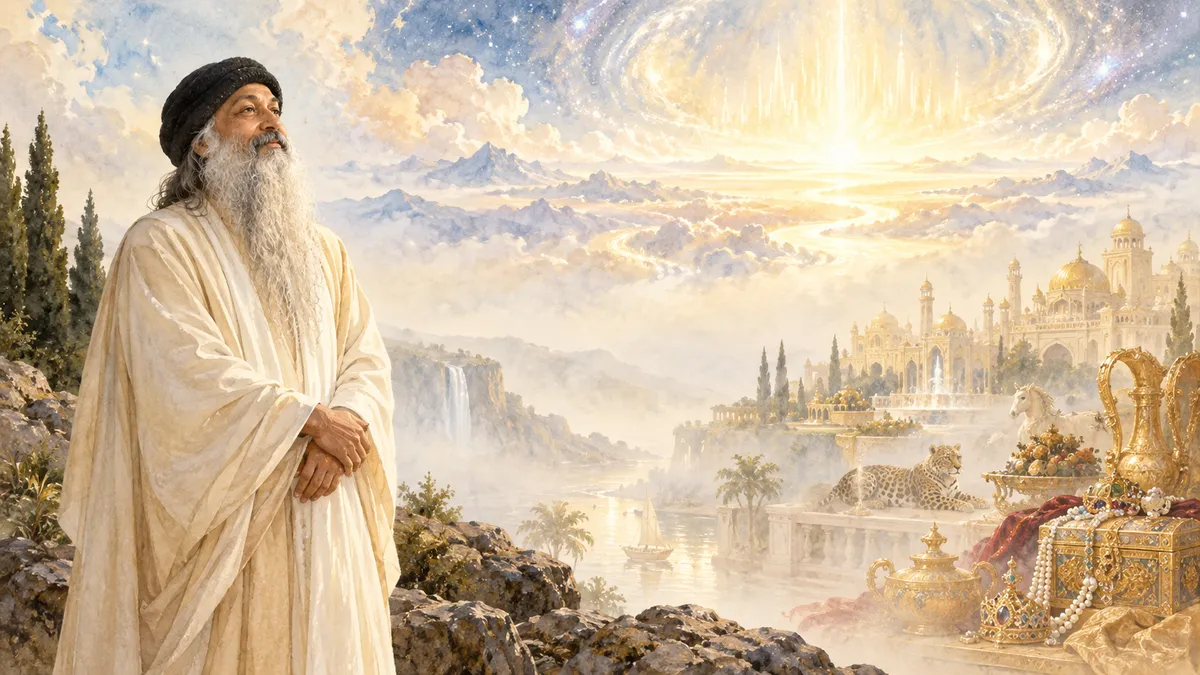
If we associate greatness with something external, we immediately fall into the web of duality, because the laws of the relative world operate here. For example, we may consider ourselves experienced practitioners. But experienced relative to whom? A monk is experienced relative to a novice, but compared with a spiritual master, he is like an infant. A spiritual master is experienced relative to a monk, but compared with Gorakshanath, he is like an infant. Gorakshanath is the greatest among the mahasiddhas, but Brahma the Creator, who gives birth to universes, in each of which there are a million Gorakshanaths, is incomparably greater than he is. Brahma the Creator is the greatest, but he emerges from only one pore of the Absolute, and there are infinitely many such Brahmas. In other words, all relative relationships are conditional. Compared with hungry ghosts, even a worldly person living an ordinary life would be very pure. But the thoughts and breath of a worldly person would seem like a stench compared with the holy gods. All these are relative concepts. Thus, we do not associate bhava, true greatness, with any categories, and then we become free from all conditional categories.
Infinity as All-Encompassing Reality
“This infinite is below, it is above, it is behind, it is in front, it is on the right, it is on the left—it is this entire world.”
When you often hear about the natural state and contemplation, you may think that this is something metaphysical and complex. But a very simple definition is given here. What does it mean to be in realization, to be united with the supreme Source? It means feeling the infinite in front and behind, above and below, to the left and right, within and without. If you understand this principle, there will no longer be any need for many philosophies, because all philosophies and metaphysical explanations will come down to this.
“And now, instruction concerning oneself: I am below, I am above, I am behind, I am in front, I am on the right, I am on the left—I am this entire world.”
When you meditate on such infinity, after some time you become so absorbed in this meditation, so focused on it, that nothing exists for your mind except infinity. Then you and infinity begin to merge; the jiva begins to merge with the Atman, and the soul begins to merge with God. When such a merging occurs, it is said that a person has attained holiness, that they continuously direct their mind toward the Supreme.
When such merging occurs continuously, old impressions, the false “I,” the habit of thinking in limited categories, attachments, hope, fear, the intellect’s evaluative activity, and goal-setting—all of this is displaced. One’s past life story and old impressions of oneself—all of this is displaced. It is displaced deeply, down to the very roots, at the level of the subconscious, at the level of the subtlest vasanas and samskaras in the causal body, in dreamless sleep, and even at the level of the pranas. And then you feel that you have ceased to be that small human being and have yourself become infinity. Then you can feel: I am in front, I am behind, I am on the right and on the left, I am above and below—I am this entire world. To abide in the state of sahaja means to feel this and nothing else.

Atman as the Source of All That Exists
“And now, instruction concerning the Atman: the Atman is below, the Atman is above, the Atman is behind, the Atman is in front, the Atman is on the right, the Atman is on the left—the Atman is this entire world. Truly, one who sees thus, thinks thus, and knows thus finds delight in the Atman, pleasure in the Atman, union with the Atman, and bliss in the Atman. Such a person becomes their own sovereign and is able to act as they wish in all worlds.”
One who continuously directs their mind toward infinity attains bliss. Their mind is always elevated and joyful, their prana is always pure, their heart is always serene, and there is immense joy in their soul, because they have found a great pearl, a great jewel, the greatest treasure. An inner universe has opened within them, so vast that it encompasses all that exists. They are no longer misled by the visible objects of this world. They draw pleasure from their inner universe. In reality, this inner universe is neither inner nor outer. It is called inner because this emphasizes that it emanates from consciousness.
“Those who think otherwise have other rulers over them and attain perishable worlds; in all worlds they are unable to act as they wish.
Truly, for one who sees thus, thinks thus, and knows thus, from the Atman comes the vital breath; from the Atman, hope; from the Atman, memory; from the Atman, space; from the Atman, heat; from the Atman, water; from the Atman, appearance and disappearance; from the Atman, food; from the Atman, strength; from the Atman, knowledge; from the Atman, contemplation; from the Atman, thought; from the Atman, will; from the Atman, reason; from the Atman, speech; from the Atman, name; from the Atman, the sacred texts; from the Atman, deeds; from the Atman, all of this.”
When such a connection with the supreme Source has been established and the yogin continuously abides in this purest space, then thought, action, understanding of the sacred texts, eating, and everything else arise from this great space. Previously, thought arose from the intellect or memory, eating depended on external food, and action arose from causes, effects, and social relationships. But now all of this arises from a single center, from the Source.

The Fruits of Abiding in the Atman
“One who sees this sees neither death,
Nor illness, nor suffering.
One who sees this sees everything;
Everywhere, they attain everything.They become one, they become three, five,
Seven and nine, and they are also called eleven,
And one hundred and eleven, and twenty thousand.When food is pure, one’s nature is pure; when one’s nature is pure, memory is strong; when memory remains strong, liberation from all bonds comes.”
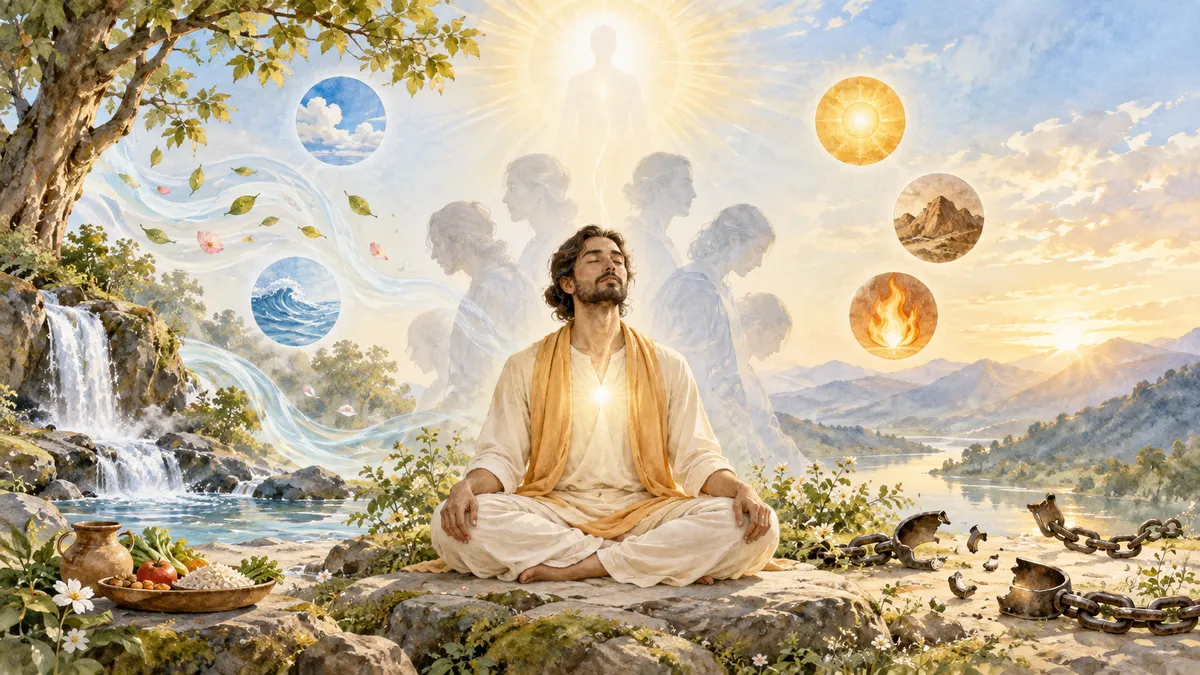
What does this verse mean? “One who abides in the Atman attains everything.” One who abides in the Atman can manifest as countless illusory bodies. These illusory bodies may be associated with the five elements, the three gunas, and various types of consciousness. When food is pure, one’s nature is pure. When your perception of external objects is purified, your prana is purified as well. The nature of your consciousness also becomes pure. When the nature of consciousness becomes pure, awareness gains strength. Here, the term “memory” refers to the principle of self-remembrance. This is not worldly memory, but remembrance of oneself as the Atman. When memory and self-remembrance are preserved, liberation from all bonds comes.
The verse ends as follows:
“Thus, to the one who has been purified of impurities, the venerable Sanatkumara points out the shore beyond darkness. And he is called ‘Skanda,’ he is called ‘Skanda.’
